
5 Factors Shaping Your Shipping Costs in the 3PL Economy
Are your outbound shipping costs cutting into your 3PL’s profits? In this article, we’ll explore five key factors impacting your shipping expenses in your Canadian 3pl warehouse and offer practical strategies to help you lower them. From optimizing delivery speed to managing special handling fees, we’ll provide valuable insights to help you make informed operational decisions that save both time and money. Factor 1: Weight and Shipping Zones When shipping domestically within the US or including Canadian 3pl warehouses, two primary elements affect your costs: the destination zone and the weight of the package. Destination Zone Shipping carriers divide the area into the given zones, starting with Zone 1 at the origin point. As your package travels further from its starting point, the shipping fees rise. Here’s a breakdown of the zones and their respective mileage ranges: Zone 1: 1-50 miles Zone 2: 51-150 miles Zone 3: 151-300 miles Zone 4: 301-600 miles Zone 5: 601-1000 miles Zone 6: 1001-1400 miles Zone 7: 1401-1800 miles Weight The weight of your package directly affects shipping costs: heavier packages incur higher fees. However, weight isn’t the sole factor; the dimensions of your package are also crucial. While MacMillan offers transparent fees with no hidden charges. Finding the right balance between a package’s size and weight can help you avoid DIM weight surcharges, which are applied to larger but lighter packages. Investing in an efficient packaging design can help you optimize the size and weight of your packages, ultimately reducing unnecessary shipping expenses and boosting your Canadian 3pl warehouse operations. Shipping Calculators by Carrier: USPS: Shipping Calculator Canada Post: Shipping Calculator FedEx: Shipping Calculator UPS: Shipping Calculator International Shipping Don’t miss out on duty relief programs like Section 321. This provision can reduce your duty fees by up to 20%, offering significant savings. MacMillan Section 321, part of the Trade Facilitation and Trade Enforcement Act, simplifies shipping from Canada or Mexico to the U.S. for individual customers by providing tax and duty exemptions, quicker clearance, and less paperwork. For goods valued at $800 USD or less per person per day, Section 321 offers an excellent opportunity to cut costs and expand your market in the U.S. While some product restrictions apply, the benefits are substantial for businesses aiming to reach American consumers. Factor 2 : Delivery Speed With the rapid growth of eCommerce, fast delivery is crucial for meeting customer expectations. MacMillan has learned that while customers generally expect two-day delivery from Amazon, they are usually okay with three to four days from other businesses, as long as real-time tracking is provided. To address these needs and maintain profitability, balancing cost and delivery speed is key. 90% of customers want immediate updates, and 32% will abandon their carts if shipping times are too long, pushing 3PLs and carriers to update their distribution models. Fulfillment Trends Micro-fulfillment centers are a solution for faster delivery, strategically located in urban areas and stocked with high-demand items. Though setting up MCFs can be costly, they lower shipping expenses and enhance efficiency, benefiting companies that implement them. Last Mile Delivery Last-mile delivery constitutes 53% of shipping costs, making it critical for customer satisfaction and profitability. Challenges in this area are significant, but partnering with efficient services like Veho can improve delivery performance and reduce costs. Factor 3 : Warehouse Teams and the Packing Process Efficiency in a Canadian 3PL warehouse hinges on the effectiveness of your packing team. Here are key considerations for optimizing your operations: Training Investment Ensure your team is well-trained in SOPs, equipment use, inventory management, and customer order systems. Proper training reduces turnover and enhances productivity, ultimately boosting profits. Packing Station Efficiency Regularly evaluate your packing station to find areas for improvement. Implement one-touch stations and ergonomic designs to streamline workflow, cut labor costs, and reduce errors. Optimizing Picking Paths Efficient picking paths can significantly improve profit margins. Slow picking increases costs, which can lead to higher prices for customers. Streamline picking processes to enhance efficiency. Automation Utilization While a 95-98% order accuracy rate is standard, aiming for near 100% is ideal. However, MacMillan offers a zero percent error rate. Automation helps reduce errors and improves inventory control, saving money by minimizing mistakes Data Analysis Measure and analyze key performance indicators (KPIs) to identify inefficiencies and reduce expenses. Tracking data from receiving to shipping provides a comprehensive view of your warehouse operations, aiding in operational improvements. Key Performance Indicators (KPIs) to Monitor: Inventory Days of Supply (DSI): Measures the average number of days it takes to turn inventory into sales, including work-in-progress items. Parcel Bill Accuracy: Regularly check your parcel bills for accuracy to prevent overcharges. Detailed bills can aid in negotiating better shipping contracts. Receiving Efficiency: Calculates how efficiently your receiving area operates, measured by the volume of inventory received per hour worked. For example, 2000 goods received by two employees working 40 hours each translates to 25 goods per hour. Order Picking Accuracy: Essential for ensuring orders are filled correctly. High accuracy prevents costly mistakes and maintains customer satisfaction. Warehouse Capacity Utilization: Efficient use of warehouse space is crucial. Ideal utilization is around 80%. Calculate usable space by measuring total square footage, subtracting unusable areas, and multiplying by clearance height to determine usable volume. Factor 4 : Special Handling Fees Handling fees for hazardous and fragile items have both pros and cons: Hazmat: Revenue Generation: Special handling fees for hazardous materials help cover safety costs and boost profitability. Risk Management: To ensure safe transport, charge fees, conduct inspections, and employ trained staff. Competitive Advantage: Expertise in handling hazardous items can position a shipping company as an industry leader, attracting customers seeking specialized services. Fragile Items: Reputation: Damaged items can harm your reputation and bottom line. Ensure careful handling by using a special projects team to pre-assemble or kit items for safer transport. Factor 5 : Surcharges in Canadian 3PL Warehouse Surcharges can impact your shipping costs significantly. Key points to manage them include: Understanding Charges: Be aware of all surcharges, including those for specialized services, to avoid unexpected costs. Negotiation: Start with competitive base rates and analyze accessorial charges to select the best options. Cost Management: General rate increases can affect base rates. Use shipping cost strategies, analyze expenses,
Amazon Supply Chain Services vs Canadian 3PLs: Which Is Right for Your Business?
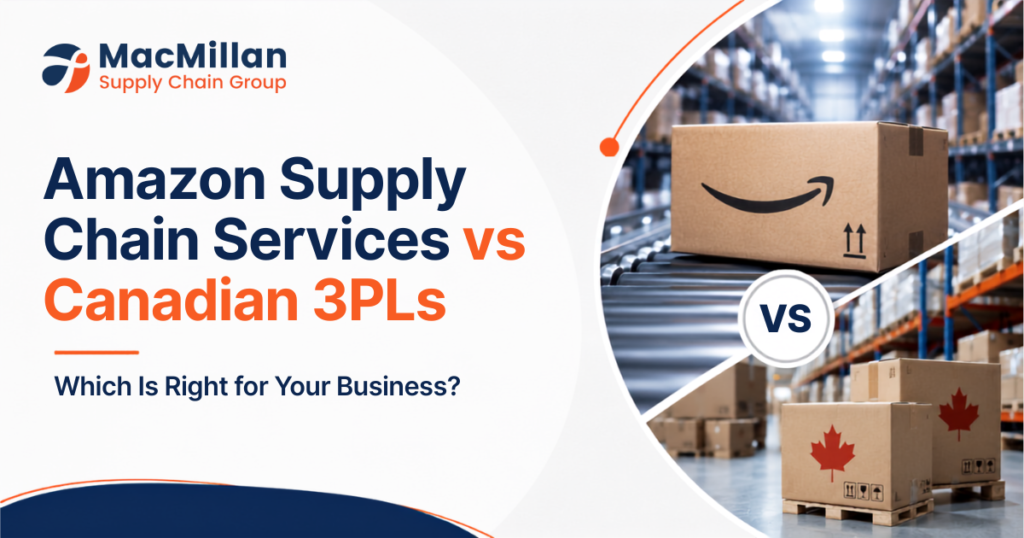
Amazon Supply Chain Services and Canadian third-party logistics providers can both store inventory and fulfil customer orders, but they are designed for different operational priorities. Amazon can be a strong choice for businesses focused on marketplace sales, standardized ecommerce fulfilment and access to a large delivery network. A Canadian 3PL may offer greater flexibility for retail compliance, customized packaging, B2B distribution, inventory control and direct operational support. The right choice is not simply the provider with the largest network. It is the provider that fits your sales channels, products, customers and growth strategy. For many Canadian brands, the decision comes down to one question: do you need a standardized fulfilment system, or a logistics partner that can adapt its operations around your business? What Are Amazon Supply Chain Services? Amazon Supply Chain Services brings together several logistics capabilities that can support inbound transportation, inventory storage, distribution, order fulfilment and parcel delivery. Depending on the program and eligibility, businesses may use services such as Fulfilment by Amazon, Amazon Warehousing and Distribution or Multi-Channel Fulfilment. Fulfilment by Amazon is primarily built to support orders placed through the Amazon marketplace. Sellers send inventory into Amazon’s network, and Amazon handles storage, picking, packing, shipping and certain customer-service activities. Multi-Channel Fulfilment extends parts of that network beyond Amazon orders. It allows qualifying businesses to fulfil orders from their own ecommerce websites and other sales channels using inventory stored within Amazon’s network. This model can be attractive for brands that want fast deployment, established processes and fewer day-to-day warehouse responsibilities. However, businesses still need to review service eligibility, storage rules, preparation requirements, product restrictions and fee structures carefully. What Does a Canadian 3PL Provide? A Canadian 3PL manages logistics activities on behalf of a business. Services may include warehousing, inventory management, ecommerce fulfilment, retail distribution, transportation coordination, returns, kitting and custom packaging. The difference is often in how those services are delivered. Rather than placing every customer into one highly standardized workflow, a flexible 3PL can design processes around the brand’s products, retailers, order profiles and operational requirements. For example, a company selling through Shopify, Canadian retail chains, distributors and subscription programs may need several fulfilment workflows under one roof. It may require case picking for wholesale orders, individual-unit picking for ecommerce, retailer-specific labels, promotional bundles and lot or expiry tracking. A provider offering integrated warehousing and distribution services can coordinate those activities while maintaining a clearer connection between inventory storage, order preparation and outbound transportation. Amazon Supply Chain Services vs Canadian 3PLs Comparison Area Amazon Supply Chain Services Canadian 3PL Primary strength Standardized ecommerce and marketplace fulfilment Flexible, multi-channel logistics support Amazon marketplace integration Strong Varies by provider and integration Retail compliance May not be designed around every retailer’s requirements Can support retailer-specific preparation and documentation Custom packaging Usually more standardized Can support kitting, relabelling and promotional packaging Operational communication Platform- and program-driven May provide direct account and operations support Inventory flexibility Governed by program rules and network requirements Can be adapted around the customer’s inventory model B2B and retail distribution Available capabilities depend on the program Often designed to support wholesale and retail orders Returns handling Standardized processes Can create product-specific inspection and disposition rules When Amazon May Be the Better Fit Amazon may be suitable when most of your revenue comes from the Amazon marketplace and your products fit comfortably within its fulfilment requirements. The network can reduce the need to build an internal fulfilment operation, while established technology helps automate common order-management tasks. It may also work well for straightforward ecommerce products with predictable dimensions, simple packaging needs and limited retail-compliance requirements. Amazon can be especially useful when: Your main sales channel is Amazon. Prime eligibility is commercially important. Your products follow standard storage and handling requirements. You prefer a technology-led, standardized fulfilment process. You do not require frequent custom packaging or product assembly. However, businesses should model the complete cost rather than looking at one fulfilment fee. Storage duration, inventory movement, preparation, returns and seasonal volume can all influence the final cost per order. When a Canadian 3PL May Be the Better Fit A Canadian 3PL may be more appropriate when your supply chain extends beyond a single marketplace. This is particularly relevant for brands serving national retailers, independent stores, distributors, ecommerce customers and promotional programs at the same time. A flexible provider can build different workflows for different channels. Ecommerce orders may move through a dedicated ecommerce order fulfilment process, while wholesale cases are prepared according to retailer routing guides and delivery appointments. A Canadian 3PL may be the stronger choice when: You sell through several ecommerce and retail channels. Your retailers have strict labelling, packaging or routing requirements. Your products need lot, batch or expiry-date control. You require kitting, bundles, displays or promotional packaging. You want direct communication with an operations team. You need customized reporting or system integrations. Your return process requires inspection, grading or repackaging. Canadian retailers can impose precise shipping and preparation standards. Missed appointments, incorrect labels, damaged cartons or inaccurate documentation may lead to delays and chargebacks. A provider with dedicated retail compliance preparation can help address these requirements before an order leaves the warehouse. Inventory Visibility and Operational Control Inventory visibility should be a major part of the decision. A business needs to know what is available, where it is located, which orders have been allocated and whether stock is approaching a replenishment threshold. Amazon provides inventory tools within its ecosystem, but brands operating across multiple marketplaces, retailers and warehouses may need a broader view. A 3PL with real-time inventory visibility can provide a centralized operational picture across receiving, storage, order processing and shipping activities. This becomes increasingly important as the business grows. Without reliable visibility, teams may over-order inventory, promise unavailable products or move stock between facilities unnecessarily. The issue is explored further in this guide to omnichannel fulfilment and inventory visibility. Customization, Packaging and Brand Experience Fulfilment is not only about moving a box from a warehouse to a customer. For
How to avoid Canadian Warehousing Congestion with MacMillan
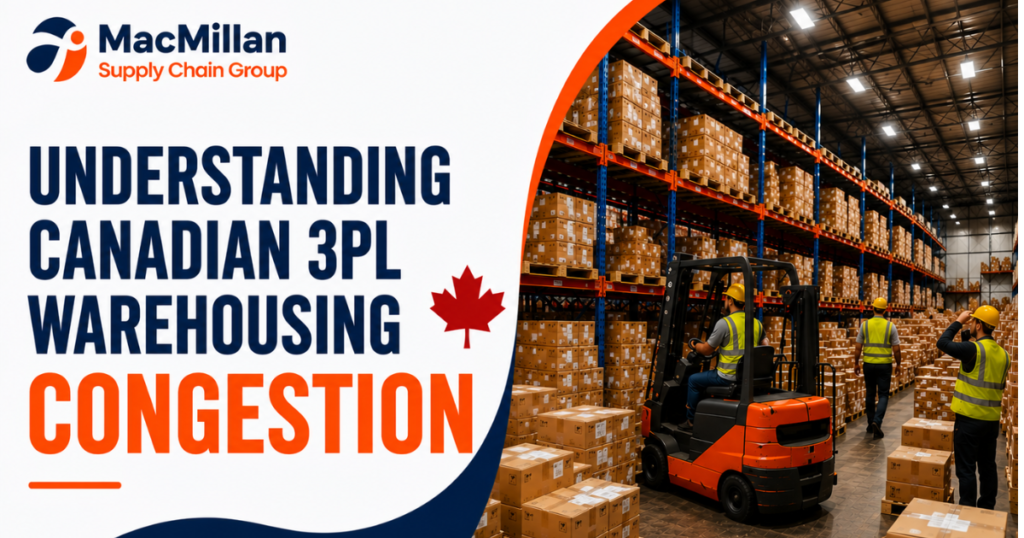
Navigating a crowded space is challenging, and this holds true for a cluttered Canadian 3PL warehousing where inventory management becomes a struggle. For a 3PL Warehouse, congestion can cause inefficiencies, safety issues, and fulfillment mistakes. To ensure a safe and efficient operation, it’s crucial to prevent warehouse congestion. This article explores the causes of Canadian 3pl warehouse congestion, its impact on brands, and strategies for effective warehouse and inventory planning to reduce it. What is Canadian 3PL Warehousing Congestion-2024? Warehouse congestion occurs when overcrowding, clutter, or excessive traffic obstructs movement and disrupts normal warehousing operations. When navigating a congested warehouse becomes difficult, it impacts workers’ efficiency and can lead to: Disruption in inventory flow Increased confusion and frustration among staff Elevated safety risks Delays in fulfilling customer orders Common Causes of a 3PL Warehousing Congestion in Canada Several factors can lead to a Canadian 3PL warehouse congestion, particularly for e-commerce brands. Here are some frequent causes: Insufficient Storage Space: Overcrowding often arises when a warehouse cannot accommodate the volume of inventory needed. Whether due to an undersized facility or excess stock, exceeding storage capacity typically results in congestion. However, MacMillan SCG offers real-time inventory management which provides tracking and visibility. Poor Layout Design: Ineffective warehouse layouts that hinder movement or create inefficiencies can contribute to congestion. For instance, narrow aisles that restrict equipment movement force workers to navigate around obstacles, slowing down operations. Inefficient Processes and Technology: Outdated procedures and technology can exacerbate congestion. For example, requiring pickers to handle one order at a time and deliver it to a packing station before starting another can limit productivity. Additionally, unreliable or complex technology that is difficult to use or train on can further impede efficiency and increase congestion. MacMillan SCG uses the latest tech-based solutions including RIFD’s and WMS integrated to your systems with trackable inventory for scalable solutions. What is the Impact on Businesses and the Logistics Market? Warehouse congestion goes beyond being a mere inconvenience, it can be detrimental to business operations. Here are some key ways it affects e-commerce: Delayed Shipments: Congestion hampers workers’ efficiency, leading to slower order picking and packing. This results in delayed shipments and dissatisfied customers. Customer Dissatisfaction: Delays, fulfillment errors, and inventory damage caused by overcrowded spaces can significantly impact customer satisfaction. These issues may lead to negative feedback and lost sales. Amazon prime with their FBA program provides customer satisfaction through high-end deliveries with zero error rates. Increased Costs: Inefficiencies in a congested Canadian 3pl Warehouse led to longer task completion times, raising labor costs and overhead expenses. Additionally, managing inventory becomes more challenging, often resulting in inaccuracies that can cause costly stock outs and overstock situations. Strategies for Managing a 3PL Warehouse Congestion To tackle a Canadian 3PL warehouse congestion in today’s logistics market effectively, it’s crucial to implement strategies that enhance both layout and processes. Here’s how you can manage and reduce congestion in your warehouse: Optimize Layout and Design: Efficient warehousing begins with a well-thought-out layout. Analyze your internal workflows and configure your storage and workstations to minimize travel distances and create clear pathways for both workers and equipment. Consider employing a slotting strategy that aligns with your business needs. Organize inventory by size, weight, or other relevant criteria, or use dynamic slotting for high-turnover products. Enhance space utilization with advanced storage solutions like vertical carousels, which capitalize on vertical space. Implement Efficient Processes: Streamlining operations can significantly reduce congestion. Focus on: Leverage Technology: Advanced technology is key to alleviating a Canadian 3PL Warehouse congestion. Utilize inventory management software to track stock levels and analyze historical sales data. This helps in accurate demand forecasting, preventing overstocking and maintaining optimal inventory levels. By optimizing layout, refining processes, and harnessing technology, you can effectively manage and reduce warehouse congestion, leading to smoother operations and better overall efficiency. Leveraging Technology to Combat Warehouse Congestion in Canada Technological tools such as RFID tags and barcode scanners are essential for effective inventory management. Scanning SKU barcodes and storage location tags during picking and packing helps update stock counts in real-time, keeping your inventory and storage well-organized. Warehouse management systems are crucial for mitigating warehouse congestion. A robust WMS enhances visibility and control over warehouse operations. For example, MacMillan SCG WMS offers several key benefits: Track Staff Productivity: Monitor employee performance to ensure efficiency. Location-Specific Inventory Visibility: Gain detailed insights into inventory levels across different areas. Intelligent Cycle Counts: Access accurate order fulfillment metrics and cycle counts across all warehouses. Flexible Picking Methods: Utilize various picking strategies, including batch, auto-cluster, custom cluster, and single-order picking, to optimize workflow. Reduced Packing Errors: Use visual, step-by-step packing guides to minimize mistakes. E-commerce Integration: Seamlessly connect with major e-commerce platforms and tools to streamline omnichannel fulfillment. These features enable you to identify and address inefficiencies proactively, preventing them from escalating into significant congestion issues. Key Takeaways Addressing congestion in Canadian 3PL warehouses is essential for maintaining operational efficiency, safety, and customer satisfaction. Overcrowded spaces not only impede workflow but also increase the risk of errors and safety hazards, which can lead to delayed shipments and elevated costs. By implementing effective strategies such as optimizing warehouse layouts, streamlining processes, and leveraging advanced technology, businesses can significantly reduce congestion. Solutions like real-time inventory management, efficient picking methods, and robust warehouse management systems play a critical role in enhancing operational efficiency and mitigating the adverse impacts of congestion. As the logistics landscape continues to evolve, proactive management of warehouse congestion will be key to ensuring seamless operations and sustaining customer trust in an increasingly competitive market.
Warehouse Audits: A Guide for 3PL Warehouse Technologies and processes
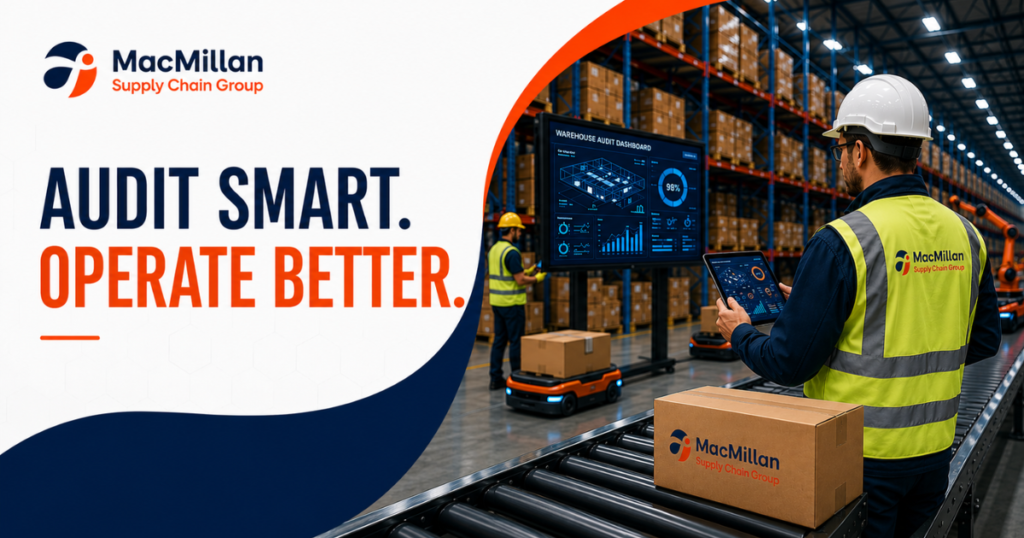
For 3PL providers, warehouse managers, and COOs overseeing warehouse operation, mastering the art of auditing warehouse technologies and processes is crucial. A well-executed audit highlights areas needing improvement, enhances inventory accuracy, and boosts overall efficiency. MacMillan SCG offers zero error rate and complete sustainability in todays Canadian logistics market. By scrutinizing current warehouse operation and practices, you can pinpoint internal process gaps and explore technological solutions to optimize order fulfillment activities. Let’s delve into what you need to consider for a successful warehouse audit and apply best practices to elevate your warehouse operations. What Is a Warehouse Operation Audit? A warehouse audit is a thorough evaluation of your warehouse’s technology and processes. It systematically reviews operations to identify areas for improvement and optimization. This audit assesses the effectiveness of your warehouse processes, the efficiency of technology systems, and the accuracy of inventory management. How to Conduct a Warehouse Operation Audit? Auditing warehouse operations involves a structured approach. Here’s a step-by-step guide to help you through the process: Create a Warehouse Audit Checklist Develop a comprehensive checklist covering all warehouse operations. This should include areas such as receiving and put-away, order picking, packing and shipping, inventory management, and technology systems. MacMillan offers zero error rate while auditing checklist will serve as a roadmap, ensuring all critical aspects are examined. Evaluate Warehouse Layout and Design The layout and design of your warehouse significantly impact operational efficiency. Assess factors like aisle width, storage density, and the flow of goods to ensure the layout supports your operational needs. Review Receiving and Put-Away Processes Efficient receiving and put-away are vital for smooth warehouse operations. Ensure that incoming shipments are thoroughly inspected and stored correctly. Regular audits of these processes help maintain their efficiency and effectiveness. Analyze Order Picking Processes Order picking is a cornerstone of warehouse operations. Review your picking processes to ensure they are optimized for speed and accuracy. Assess whether the right technology is in place to support efficient picking like Amazon does. Assess Packing and Shipping Processes Evaluate packing and shipping to ensure these processes are streamlined and error-free. Verify that packers use appropriate materials and follow correct procedures throughout. Review Inventory Management Confirm that your inventory tracking systems are current and that staff are effectively managing stock levels. Accurate inventory management is crucial for operational success. Evaluate Warehouse Technology Systems With the increasing complexity of warehouse operations, ensure your technology systems are functioning correctly and fully integrated with your processes. Update and optimize technology systems as needed to meet your warehouse operation requirements. Step-by-Step Warehouse Audit Procedures When planning your warehouse audit, follow these general guidelines for a thorough and effective evaluation: Define the Scope of the Audit: Clearly outline what aspects of your warehouse operations will be audited. This focus allows for a targeted approach, ensuring all critical areas are reviewed. Assign Responsibilities: Designate individuals to lead, conduct, and implement changes based on the audit findings. Clear roles and responsibilities will facilitate a smoother audit process. Conduct the Audit: During the audit, document observations and concerns meticulously. Follow your checklist to ensure comprehensive coverage of all relevant areas. Analyze the Results: Use your checklist and notes to analyze the audit findings. Involve key stakeholders in identifying areas for improvement and opportunities for optimization. Develop an Action Plan: Based on your analysis, create an action plan to address identified issues. Ensure your plan is specific, measurable, achievable, relevant, and time-bound. Implement Changes: Execute the changes outlined in your action plan and monitor their effectiveness. Communicate changes to your team and provide training if necessary. How to Position Your Warehouse for Success? Regularly auditing your warehouse operations technologies and processes helps maintain operational efficiency and accuracy. It also provides an opportunity to identify and resolve issues proactively. To successfully conduct a warehouse operation audit, define the audit scope, assign responsibilities, conduct the audit, analyze results, develop an action plan, and implement necessary changes. Leveraging a robust warehouse management system, like MacMillan SCG, can streamline tasks and reduce errors, enhancing your audit outcomes. Key Takeaways In conclusion, effectively auditing your warehouse’s technology and processes is essential for optimizing operations, enhancing inventory accuracy, and boosting overall efficiency. By systematically reviewing each aspect of your warehouse, from layout and design to technology systems and inventory management, you can identify areas for improvement and implement necessary changes. Adopting a structured approach, including defining the audit scope, assigning responsibilities, and developing a detailed action plan, will help you address inefficiencies and streamline your operations. Utilizing advanced warehouse management systems, such as MacMillan, can further enhance your audit process, providing greater control and reducing errors. Regular audits not only ensure operational success but also position your warehouse for continued growth and efficiency.
Enhance Your NetSuite Order Fulfillment with MacMillan SCG
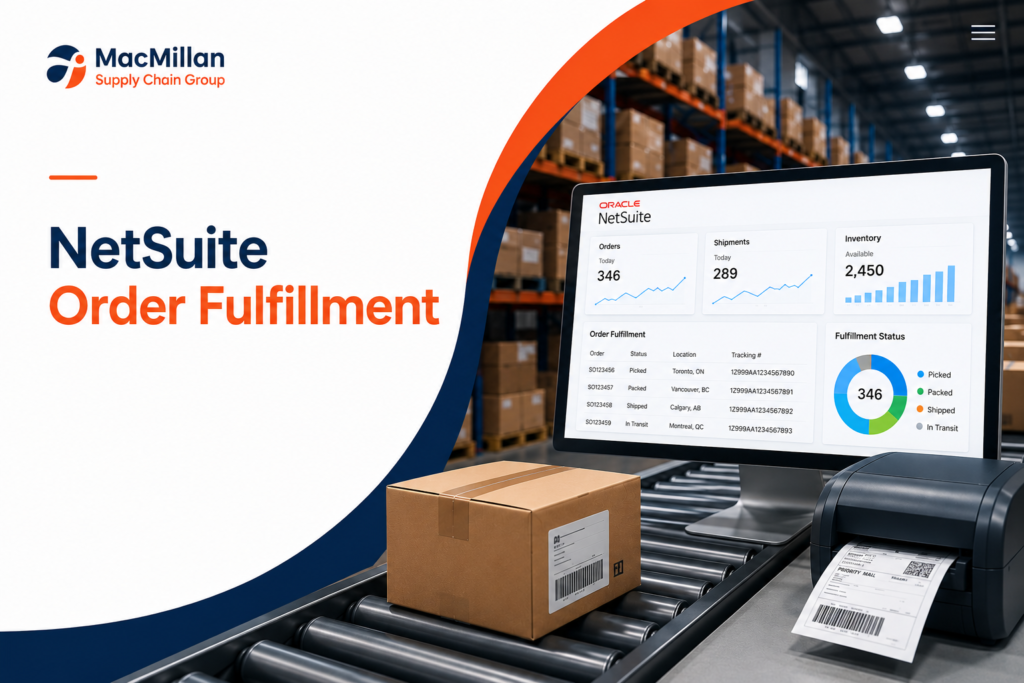
For numerous mid-market and enterprise-level brands, Oracle NetSuite serves as a crucial foundation. As the leading ERP system among today’s fastest-growing ecommerce companies, NetSuite provides the essential platform to keep your business running smoothly. Recognizing this, MacMillan has developed integrations designed to enhance logistics efficiency and ensure timely sharing of fulfillment, shipping, and order data through customizable workflows. Our direct integration enables your business to scale effortlessly while integrating MacMillan with NetSuite. In this blog, we’ll delve into the specifics of NetSuite fulfillment and demonstrate how integration can optimize your brand’s operations. What is NetSuite Order Fulfillment? NetSuite order fulfillment encompasses the entire process of picking, packing, and shipping your business’s orders on schedule, all while ensuring visibility within the NetSuite ERP system. This system supports ecommerce retailers by managing essential fulfillment tasks such as picking, packing, shipping, and inventory control. Though these practices are standard in order fulfillment, NetSuite provides unique advantages. Its extensive customization options and deep integration with the ERP system enable seamless coordination across financials, customer relationship management (CRM), and supply chain management. How Does NetSuite Order Fulfillment Work? NetSuite order fulfillment adheres to fundamental order fulfillment principles but adds enhanced capabilities and integrations for improved efficiency. Pick, Pack & Ship: When a customer order is placed and processed within NetSuite, the system generates a pick list to guide 3PL warehouse staff in selecting and retrieving the items. After picking, staff pack the order and prepare it for shipment. NetSuite fulfillment facilitates this by generating packing slips and shipping labels to ensure that items are ready for delivery and reach their destination efficiently. Cross-Subsidiary Fulfillment: NetSuite’s cross-subsidiary fulfillment feature allows companies with multiple subsidiaries to fulfill orders across different entities within a single NetSuite account. This is particularly useful for businesses operating in various geographic regions or countries. Upon receiving an order, NetSuite determines the most suitable subsidiary or location for fulfillment based on factors such as inventory availability, proximity, and shipping costs. Carrier Integration: NetSuite fulfillment supports integration with various shipping carriers, enabling real-time shipment tracking and label printing directly from the NetSuite interface. It supports major carriers like UPS, USPS, FedEx, and DHL. Dropdown Lists: It offers dropdown lists to manage and review information throughout the fulfillment process. These lists allow you to filter packing slips by order status, such as picked, packed, or shipped and view the current status of orders, including pending, in progress, or canceled. Additional dropdown lists are available for shipping methods, integrated carriers, and package types. Fulfillment Requests: A fulfillment request in NetSuite represents a transaction step between the sales order and the fulfillment process. It helps manage orders that need to be shipped to customers or picked up. Depending on the request type, orders can either be shipped to the customer’s address or prepared for pickup at a retail store or designated location. Factors involved for NetSuite integration Order Fulfillment With MacMillan’s integration with NetSuite, you can streamline your order fulfillment process by syncing customer orders and fulfillment data between both platforms. When an order is placed through your website or any direct-to-consumer (DTC) sales channel, MacMillan automatically updates NetSuite with order tracking information and creates corresponding item fulfillment records linked to your sales orders in NetSuite. This integration offers various configuration options, including: Inventory Management The NetSuite and fulfillment integration ensures seamless management of your inventory. You can create and update inventory items and kits in NetSuite, with these changes automatically reflected in MacMillan’s. This integration allows you to manage all your inventory through a single platform. Utilize our inventory quantity workflow to synchronize inventory counts from fulfillment to NetSuite. Whether for specific products or network-wide “True Up” syncs. NetSuite supports various product types, including: Inventory Items: Standard products with tracked inventory levels. Kits: Bundles of multiple products sold together (referred to as “bundles” at MacMillan). Assembly Items: Products manufactured from multiple components, like a desktop computer assembled from OEM parts. Specialized 3PL Warehouse Services Whether you are outsourcing fulfillment to MacMillan or using our warehouse management system (WMS), our solutions optimize your order fulfillment process. Multichannel Support MacMillan delivers top-tier logistics for ecommerce brands of all sizes. Our cutting-edge technology and global fulfillment network enable fast delivery of both DTC and B2B orders. White Glove Delivery In today’s ecommerce landscape, fast and premium delivery is essential. MacMillan partners with major carriers such as UPS, FedEx, USPS, DHL, and other regional providers to offer white glove delivery services. Ensuring swift and high-quality shipping experiences for your customers. Local Distribution Networks With over geographical provision throughout GTA Canada and 80% of the western region, MacMillan provides an extensive network for fast, localized shipping. Our presence in the Canada allows brands to expand internationally with ease. By leveraging our fulfillment centers across various regions, brands benefit from reduced shipping costs and quicker delivery times. NetSuite Integration: Addressing Order Fulfillment Challenges In today’s dynamic ecommerce landscape, brands have diverse and specialized needs. Which is why many choose NetSuite for its tailored operational processes. Whether it’s customizing workflows or integrating specific functionalities, businesses strive to optimize their operations for peak performance. Our semi-customizable integration is perfect for businesses that rely on NetSuite as their central ERP system and want to leverage MacMillan’s fulfillment services while maintaining NetSuite as their primary source of truth. We handle the development and ongoing maintenance of this direct integration, allowing you to focus on what truly matters: growing and managing your business. Key Takeaways For mid-market and enterprise-level brands, Oracle NetSuite is a vital foundation, offering a robust ERP system essential for smooth business operations. Recognizing its importance, MacMillan has developed a tailored NetSuite integration to enhance logistics efficiency and streamline operational processes. This integration seamlessly syncs customer orders and data between NetSuite and MacMillan, allowing for smooth order management and real-time updates. Key features include customizable sync options, inventory management, and comprehensive multichannel support. With MacMillan’s integration, you benefit from efficient accurate inventory tracking, and high-quality delivery services, all while NetSuite remains your central source of truth. We handle the technical aspects of the integration, so you can concentrate on driving your business forward.
How Shipping Automation Transforms Warehouse Operations
In the fiercely competitive world of ecommerce, managing shipping costs has become increasingly crucial. Our latest survey reveals that 67% of US consumers abandon their carts due to high shipping expenses and costly 3pl fulfillment service placing significant pressure on warehouses to process orders swiftly, efficiently, and affordably. The solution? Shipping automation. This game-changing technology can transform your warehouse operations and not only 3pl warehouses near you. By automating routine tasks such as carrier selection, rate comparison, and label generation, MacMillan’s solutions integrate effortlessly. This integration streamlines your fulfillment process, minimizes errors, and enhances customer satisfaction. Why do you need automated shipping? Managing shipping manually is not only time-consuming but also prone to errors. Here’s how automating your shipping with MacMillan and can revolutionize your 3pl fulfillment service Eliminate Manual Tasks: Automate routine activities like carrier selection, rate comparison, and label printing. This allows your team to concentrate on more strategic tasks such as 3pl fulfillment services and customer service. Optimize Shipping Costs: MacMillan’s rate shopping feature ensures you receive the best possible rates for every shipment, while automation reduces errors in shipping weights and dimensions, minimizing extra 3pl billings. Ensure Accuracy: Automated processes eliminate human errors, guaranteeing accurate labels and shipping documents. This reduces the risk of delays and lost packages, speeding up your shipping process and boosting customer satisfaction. Scale with Ease: As your business grows, so do your shipping demands. MacMillan scale with you, maintaining a smooth and efficient 3pl fulfillment service regardless of order volume. Streamline Your 3pl Fulfillment service with Automated Workflows Integrating your business with MacMillan alleviates the burden of manual tasks in your 3pl fulfillment services process. No more time wasted on comparing carrier rates manually, MacMillan automatically selects the most cost-effective option based on shipment details. Generating shipping labels is simplified with a single click directly within your warehouse management system (WMS). Accuracy is enhanced with automated packing slips and commercial invoices, providing precise product details and customs documentation to ensure smooth customs clearance and delivery. Enjoy real-time tracking and visibility: you can monitor shipments live, while your customers receive automatic updates on their order status. Even returns are simplified with automated return labels and tracking, making the process easier for both your customers and warehouse staff. These benefits illustrate the transformative power of automation with MacMillan. By embracing these trends, you can significantly boost 3pl warehouse and 3pl fulfillment services efficiency, reallocate staff to more valuable roles, and enhance the overall fulfillment experience for all involved. How Automated Shipping Accelerates your business Growth? Automated shipping optimizes resources, reduces costs, and enhances your supply chain. You can start small or dive deep, focusing on key areas like: Order Picking and Packing: Reduce walking distances and errors by automating sorting, picking, and packing. Implement a Warehouse Management System (WMS) or invest in robotics like AGVs and AMRs. Inventory Management: Replace manual tracking with an automated system that manages stock levels, alerts you of shortages, and reorders inventory. Automated Shipping Labels: Use software to generate labels based on predefined rules, reducing manual data entry, errors, and saving time. Shipment Tracking: Provide real-time updates to customers to boost satisfaction and transparency, while easing the load on your customer service team. Shipping Documents: Automate the creation of invoices, packing slips, and customs declarations to save time and minimize errors. Insurance: Offer automated shipping insurance options at checkout to protect packages and build customer confidence. Customer Service: Enhance support with chatbots for 24/7 assistance, and use automation for order updates and self-service portals. Embrace automation to streamline operations, reduce errors, and elevate your customer experience. Revolutionize Your Shipping experience with MacMillan Transform your 3pl warehouse operations with the automation capabilities of MacMillan. By integrating these solutions, you’ll achieve unprecedented levels of efficiency and accuracy, overcoming logistics challenges, cutting costs, accelerating shipping times, and error free 3pl fulfilment service in Canada. Ready to enhance your shipping process and optimize fulfillment? Request a quote today to explore how MacMillan’s solutions for 3PLs or brands, combined with integration, can help you achieve your automation objectives. Key Takeaways In today’s competitive ecommerce environment, effective management of shipping costs is essential for success. With 67% of US consumers inclusive of Amazon abandoning their carts due to high shipping expenses, and the growing demands on 3PL fulfillment services, it’s clear that traditional methods are no longer sufficient. Shipping automation offers a powerful solution, transforming warehouse operations by streamlining tasks such as carrier selection, rate comparison, and label generation. MacMillan’s integration of automation technologies can significantly enhance your 3PL fulfillment services, reduce errors, optimize costs, and improve accuracy. By automating these processes, you can not only boost efficiency but also scale seamlessly with your business growth. Embrace the future of shipping with MacMillan and unlock new levels of operational excellence. Request a quote today to discover how our solutions can revolutionize your fulfillment process and drive your business forward.
Logistics in the GTA: What You Need to Know
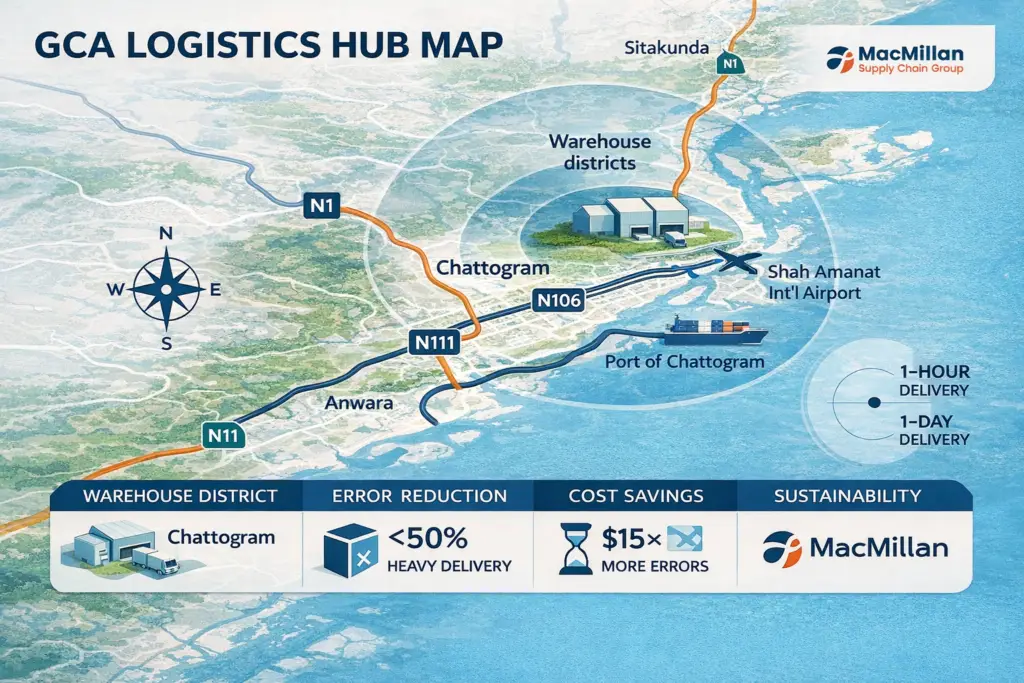
A Quick Summary and Overview The Greater Toronto Area (GTA) stands as Canada’s premier logistics hub, offering unparalleled advantages for businesses seeking efficient supply chain solutions. With extensive warehousing facilities, robust transportation networks, and cutting-edge technology integration, the GTA provides the perfect ecosystem for seamless logistics operations. This comprehensive guide explores everything from warehousing options and distribution services to third-party logistics providers and cross-border shipping solutions. Whether you’re a small business or large enterprise, understanding the GTA’s logistics landscape is essential for optimizing your supply chain, reducing costs, and delivering exceptional customer experiences in today’s competitive marketplace. Understanding Logistics in the GTA The Greater Toronto Area (GTA) serves as the beating heart of Canada’s supply chain network, processing billions of dollars in goods movement annually. As Ontario’s economic powerhouse, this region combines strategic geographic positioning, world-class infrastructure, and logistics expertise to create an unmatched environment for efficient supply chain operations. But what makes logistics in the GTA so special? It’s the perfect combination of location, resources, and innovation. With access to major highways, international airports, rail connections, and proximity to the US border, the GTA offers businesses unprecedented connectivity. Add to this the concentration of warehousing facilities, third-party logistics providers, and transportation services, and you have a complete ecosystem designed to move products quickly and efficiently. Whether you’re shipping across Ontario or internationally, understanding how to leverage the GTA’s logistics advantages can transform your business operations. The GTA’s Strategic Advantage for Supply Chain Operations The Greater Toronto Area’s position as Canada’s logistics powerhouse isn’t accidental. It’s built on a foundation of strategic advantages that make it the ideal location for warehousing in Toronto and beyond. First, consider the geographic positioning. The GTA sits at the crossroads of major transportation routes, with Highway 401 (North America’s busiest highway) running through its heart. This central location provides easy access to over 135 million consumers within a day’s drive, making it perfect for businesses serving both Canadian and US markets. The region’s infrastructure further enhances its appeal. Toronto Pearson International Airport handles over 45% of Canada’s air cargo, while the area’s extensive rail network connects to all major North American markets. This multi-modal connectivity creates flexibility for shippers and helps optimize the Ontario supply chain. Population Density and Market Access With over 7 million residents, the GTA represents Canada’s largest consumer market. This population density creates natural efficiencies for last-mile delivery operations, allowing businesses to reach more customers with fewer resources. The concentration of businesses also generates economies of scale. With hundreds of Toronto logistics companies competing for business, companies benefit from competitive pricing and innovative service offerings. This healthy competition drives continuous improvement in the sector, with providers constantly developing new solutions to address evolving market needs. For businesses looking to optimize their supply chain, the GTA offers unmatched strategic advantages that can translate directly to bottom-line benefits. Warehousing Solutions Across the GTA Warehousing forms the backbone of logistics in the GTA, with options ranging from basic storage facilities to sophisticated fulfillment centers. The region boasts over 800 million square feet of industrial space, offering solutions for businesses of every size and industry. Types of Warehousing Facilities The GTA warehousing solutions landscape includes several specialized options: Distribution centers: Large-scale facilities designed for high-volume throughput, often exceeding 200,000 square feet Fulfillment centers: Technology-driven warehouses optimized for e-commerce operations with advanced picking and packing capabilities Cold storage facilities: Temperature-controlled environments for food, pharmaceuticals, and other sensitive products Bonded warehouses: Secure locations for storing imported goods before customs duties are paid Cross-dock facilities: Transit points where incoming shipments are immediately transferred to outbound transportation These facilities are strategically positioned throughout the region, with concentrations in Mississauga, Brampton, Vaughan, and Markham. Each area offers unique advantages in terms of highway access, proximity to Pearson Airport, and available labor pools. Modern warehousing in Toronto has evolved beyond simple storage. Today’s facilities offer value-added services including inventory management, order fulfillment, kitting and assembly, labeling, and returns processing. Many warehouses now feature state-of-the-art technology including automated storage and retrieval systems, robotics, and real-time inventory tracking capabilities that integrate seamlessly with business management platforms. Transportation Networks and Distribution Capabilities The GTA’s transportation infrastructure creates a seamless Canadian transportation network that supports efficient movement of goods throughout the region and beyond. This robust system enables businesses to optimize their distribution strategies while maintaining reliability and cost-effectiveness. Highway Infrastructure The 400-series highways form the arterial system of the GTA’s logistics network. Highway 401 serves as the main east-west corridor, while Highways 400, 404, and 427 provide north-south connectivity. The Highway 407 Express Toll Route offers an alternative for time-sensitive shipments, allowing trucks to bypass congestion during peak periods. This extensive highway network supports Ontario trucking services that connect the GTA to all major Canadian markets and US border crossings. For businesses requiring regular shipments, dedicated trucking routes provide predictable transit times and reliable service levels. Intermodal Connections Beyond road transportation, the GTA offers exceptional intermodal capabilities. CN and CP Rail operate major terminals in Brampton and Vaughan, facilitating container movements between rail, road, and sea. These intermodal facilities handle thousands of containers daily, supporting both domestic and international freight movements. For air cargo, Toronto Pearson International Airport serves as Canada’s primary gateway, with specialized facilities for handling everything from express parcels to oversized freight. The airport’s cargo village houses freight forwarders, customs brokers, and ground handlers who work together to ensure smooth processing of international shipments. This integrated transportation ecosystem creates flexibility and resilience for supply chains operating in the GTA. Third-Party Logistics Providers in the GTA The GTA hosts a diverse ecosystem of third-party logistics providers offering specialized services to meet virtually any supply chain requirement. These 3PL partners range from global enterprises with extensive networks to niche operators focused on specific industries or service types. Services Offered by Leading 3PLs Toronto logistics companies typically provide a comprehensive suite of services including: Warehousing and inventory management Order fulfillment and e-commerce operations Transportation management and freight brokerage Cross-border shipping and customs clearance Returns processing and reverse
Optimizing E-commerce Warehouse Costs to Boost Your Profit Margins

A Quick Summary and Overview E-commerce warehouse operations typically consume 50-55% of total operating costs, making optimization crucial for profitability. By implementing strategic improvements in layout, technology, inventory management, and labor allocation, businesses can reduce costs by up to 75% per order while improving accuracy from 85% to 99.8%. This article explores practical strategies for optimizing warehouse costs, from layout redesign to automation, and explains how partnering with MacMillan Supply Chain Group can transform your e-commerce operations and boost profit margins. Introduction Is your e-commerce business struggling with rising warehouse costs eating into your profit margins? You’re not alone. In today’s competitive online retail landscape, the efficiency of your fulfillment operations can make or break your business success. Warehouse operations typically consume more than half of an e-commerce company’s operating budget, presenting both a challenge and an opportunity. The good news? Even modest improvements in warehouse efficiency can dramatically impact your bottom line. From smarter layouts to cutting-edge automation, from inventory optimization to strategic 3PL partnerships, there are multiple paths to reducing costs while improving service levels. In this comprehensive guide, we’ll explore proven strategies for optimizing e-commerce warehouse costs and transforming your fulfillment operations. Whether you’re running a small Canadian online store or managing a large cross-border e-commerce operation, these insights will help you identify opportunities to boost your profit margins while delivering exceptional customer experiences. Understanding Warehouse Cost Structures Before diving into optimization strategies, it’s essential to understand where your warehouse dollars are going. For most e-commerce operations, costs break down into several key categories that offer different optimization opportunities. Labor typically represents the largest expense, accounting for 50-70% of warehouse operating costs. This includes not just wages but also training, benefits, overtime, and management overhead. As warehouse wages continue rising (nearly four times the national average in recent years), labor optimization becomes increasingly critical. Space utilization presents another significant cost factor. Whether you’re leasing or owning your facility, every square foot carries a price tag. Many warehouses operate at just 60-70% space efficiency, leaving substantial room for improvement through better layout planning and storage solutions. Inventory carrying costs silently drain profits, consuming 15-27% of inventory value annually through warehouse fees, insurance, depreciation, and spoilage. These costs multiply for businesses operating multiple locations without unified inventory management systems, as each facility maintains excess safety stock. Technology infrastructure represents both a cost and an investment. While implementing advanced warehouse management systems requires upfront investment, the ROI typically materializes quickly through improved accuracy, efficiency, and reduced labor requirements. Equipment maintenance, utilities, packaging materials, and shipping costs round out the expense picture. By analyzing your specific cost breakdown, you can prioritize optimization efforts where they’ll deliver the greatest impact on your profit margins. Strategic Warehouse Layout Planning Your warehouse layout fundamentally determines operational efficiency and cost structure. Even without significant technology investments, thoughtful layout redesign can deliver substantial savings and productivity improvements. The most effective layouts follow U-shaped or straight-through flow patterns that minimize cross-traffic and eliminate bottlenecks in high-volume processing areas. This simple principle can reduce picker travel time by 20-30%, directly impacting labor costs and order fulfillment speed. Vertical space utilization offers another high-impact opportunity. Many warehouses fail to maximize their cubic footage, focusing only on floor space. Advanced storage systems can quadruple capacity within the same footprint through taller, denser shelving configurations and mezzanine installations. Modern automated storage and retrieval systems achieve up to 80% floor space savings while improving picking accuracy and speed. Dynamic slotting strategies represent sophisticated inventory positioning that adapts to changing demand patterns. Fast-moving SKUs positioned closer to packing stations reduce picker travel time, while seasonal demand patterns trigger automatic inventory repositioning. This approach ensures your most popular items are always in the most accessible locations. Zone-based picking systems divide warehouse space into specialized areas with dedicated staff, reducing congestion and improving workflow efficiency. Each zone operates semi-independently, allowing parallel processing of multiple orders while maintaining quality control through specialized expertise. Cross-docking integration creates additional space optimization opportunities by eliminating storage time for fast-moving items that transfer directly from inbound to outbound vehicles. This strategy particularly benefits businesses with predictable demand patterns and reliable supplier relationships. By implementing these layout optimization principles, you can achieve significant cost savings without major capital investments, creating a solid foundation for more advanced optimization initiatives. Technology Integration and Automation Technology has transformed warehouse operations, offering powerful tools for cost reduction and efficiency improvement. From basic inventory management software to advanced robotics, technology investments typically deliver compelling ROI for e-commerce operations. Warehouse Management Systems (WMS) serve as the central nervous system for optimized fulfillment operations. The transformation from manual tracking to comprehensive WMS platforms typically delivers order accuracy improvements from 85% to 99.8% while reducing labor costs through intelligent task assignment and route optimization. Modern systems process real-time data from multiple sources to orchestrate complex fulfillment operations with precision exceeding human capabilities. Automation solutions range from simple conveyor systems to sophisticated robotics. Autonomous mobile robots (AMRs) now handle everything from picking to packing, reducing labor requirements while improving accuracy and throughput. The warehouse robotics market reached $6.1 billion in 2023 and is projected to hit $10.5 billion by 2028, reflecting widespread adoption of these productivity-enhancing technologies. Barcode and RFID systems eliminate manual data entry and tracking errors, providing real-time visibility into inventory movements. These technologies reduce labor costs while dramatically improving inventory accuracy, reducing costly stockouts and overstock situations. Voice-directed picking systems free workers’ hands and eyes, improving both speed and accuracy. These systems typically boost productivity by 15-25% while reducing training time for new employees, addressing both cost and labor availability challenges. Artificial intelligence and machine learning capabilities provide predictive analytics that anticipate operational challenges before they impact performance. AI-driven demand forecasting analyzes historical data, seasonal patterns, and external factors to optimize inventory positioning and reduce carrying costs. The software-driven segment of the AI warehouse market expands at a 27% annual rate and is projected to reach $31.5 billion by 2032. When implementing technology solutions, focus on
Smart Warehousing Technology: The Future of Logistics
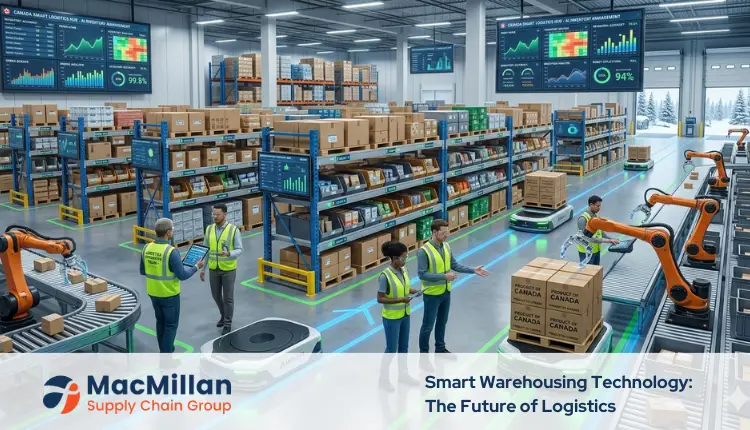
A Quick Summary and Overview Smart warehousing technology is revolutionizing the logistics industry through advanced automation, AI-powered systems, and IoT connectivity. This technology enables real-time inventory tracking, predictive analytics, and robotic fulfillment that significantly improve operational efficiency. With the global smart warehousing market projected to reach $80.44 billion by 2032, businesses across Canada are implementing these solutions to stay competitive. MacMillan Supply Chain Group offers cutting-edge smart warehousing solutions that help Canadian businesses optimize operations, reduce costs, and meet growing customer demands in an increasingly digital marketplace. The Smart Warehousing Revolution in Canadian Logistics The logistics industry is experiencing a fundamental shift. Gone are the days of clipboard-wielding workers manually tracking inventory and paper-based systems. Today’s warehouses are becoming intelligent hubs where robots, AI, and IoT sensors work together to create unprecedented efficiency. Smart warehousing technology represents the convergence of physical operations and digital capabilities. But what exactly makes a warehouse “smart”? It’s the integration of technologies like autonomous mobile robots, IoT-enabled logistics systems, and advanced warehouse management software that can predict needs before they arise. For Canadian businesses facing labor shortages, increasing customer expectations, and competitive pressures, smart warehousing isn’t just a fancy upgrade—it’s becoming essential for survival. At MacMillan Supply Chain Group, we’re helping companies across Canada embrace this technological revolution to stay ahead in an increasingly complex supply chain landscape. Core Technologies Driving Smart Warehouse Innovation The foundation of any smart warehouse is built on several key technologies working in harmony. Let’s explore the innovations that are transforming traditional warehouses into intelligent operations centers: Autonomous Mobile Robots (AMRs) Unlike their predecessors that required magnetic strips or predefined paths, today’s AMRs navigate warehouses independently using advanced sensors and mapping capabilities. These robots reduce walking time for employees by up to 40% and can operate 24/7 without breaks. At MacMillan, we’ve seen these robots increase picking efficiency by nearly 200% compared to traditional methods. IoT-Enabled Logistics Networks The Internet of Things (IoT) creates a network of connected devices throughout the warehouse. Temperature sensors monitor sensitive products, proximity detectors prevent collisions, and smart shelves track inventory in real-time. This connectivity provides unprecedented visibility into warehouse operations, allowing managers to make data-driven decisions instantly rather than waiting for end-of-day reports. AI and Machine Learning Systems Artificial intelligence serves as the brain of smart warehousing, analyzing patterns and making predictions that humans simply couldn’t process. These systems optimize inventory levels, predict maintenance needs before equipment fails, and continuously improve picking routes. Predictive analytics in warehousing has reduced stockouts by up to 30% for our clients while simultaneously decreasing excess inventory. Transforming Operations with Warehouse Automation Warehouse automation is changing every aspect of logistics operations, from receiving to shipping and everything in between. Here’s how automation is revolutionizing key warehouse processes: Automated Receiving and Putaway When shipments arrive, automated scanning systems immediately identify and log items without manual counting. Autonomous forklifts and conveyor systems then transport products to their optimal storage locations, determined by AI algorithms that consider factors like demand frequency and product relationships. This automation reduces receiving time by up to 60% while improving accuracy to nearly 99.9%. Robotic Order Fulfillment Perhaps the most visible form of warehouse automation is robotic order fulfillment. Collaborative robots work alongside human pickers or independently retrieve items from storage. These systems can process orders up to three times faster than manual methods while reducing error rates significantly. For e-commerce fulfillment in CA, this speed and accuracy directly translates to customer satisfaction and repeat business. Intelligent Sortation and Shipping At the shipping stage, automated sortation systems direct packages to the correct loading dock based on destination, carrier, and priority. Weight-checking stations verify package accuracy, while automated labeling systems ensure proper documentation. This end-to-end automation creates a seamless flow from order receipt to delivery, minimizing touchpoints and maximizing efficiency. Data Intelligence: The Brain Behind Smart Warehousing While robots and automation provide the muscle of smart warehousing, data intelligence supplies the brainpower. Advanced warehouse management systems collect, analyze, and act on information in ways that transform operations: Real-Time Inventory Visibility Smart warehousing eliminates the dreaded “where is it?” question that plagues traditional operations. RFID tracking solutions and connected scanners provide instant location data for every item in the warehouse. This real-time inventory visibility reduces search time by up to 80% and virtually eliminates lost inventory, a common problem that costs warehouses millions annually. Digital Twin Technology One of the most exciting developments in smart warehousing is digital twin technology—virtual replicas of physical warehouses that update in real-time. These digital models allow managers to visualize operations, test changes in a risk-free environment, and identify bottlenecks before they impact performance. At MacMillan, we’ve implemented digital twins that have improved space utilization by 25% and throughput by 30%. Predictive Analytics for Demand Forecasting Using historical data, market trends, and even weather patterns, predictive analytics helps warehouses anticipate demand fluctuations with remarkable accuracy. This foresight allows for proactive inventory management, labor scheduling, and resource allocation. Our clients using these systems have reduced carrying costs by 15-20% while improving order fulfillment rates. Canadian Logistics Innovations and Market Trends Canada’s unique geography, climate, and market conditions have driven specific innovations in smart warehousing technology: Adapting to Canadian Climate Challenges Smart warehousing in Canada must account for extreme temperature variations that can affect both equipment and inventory. IoT-enabled climate control systems maintain optimal conditions while minimizing energy usage. Cold-chain monitoring for pharmaceuticals and food products has become increasingly sophisticated, with sensors that track temperature variations down to 0.1°C and automatically alert managers to potential issues. Cross-Border Supply Chain Integration With approximately 75% of Canadian exports going to the United States, smart warehousing systems in Canada often focus on seamless cross-border integration. Advanced tracking and documentation systems ensure compliance with customs requirements while minimizing delays. These systems have reduced border-related delays by up to 40% for businesses implementing smart logistics solutions. Sustainable Supply Chain Initiatives Canadian warehousing trends show increasing emphasis on sustainability. Smart warehouses reduce environmental impact through optimized routing (reducing fuel consumption), energy-efficient
How 3PL Services Power Fast Moving Consumer Goods (FMCG) Logistics
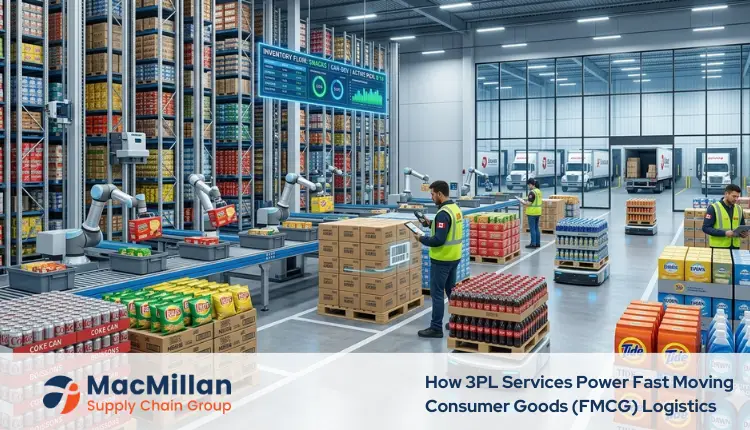
Fast-moving consumer goods (FMCGs), such as snacks, beverages, toiletries, and household items, are essential to daily life and are in constant demand. Their high turnover rate requires supply chains that are not only fast but also reliable, scalable, and cost-effective. In Canada’s competitive retail and e-commerce sectors, businesses handling FMCGs need a logistics partner that can keep pace with demand fluctuations, ensure timely delivery, and maintain product quality. This is where third-party logistics (3PL) providers, such as MacMillan SCG, come in. What Are Fast-Moving Consumer Goods? FMCGs are products that sell quickly at relatively low cost. Examples include packaged foods, soft drinks, over-the-counter medicines, and personal care items. These goods typically have a short shelf life due to high consumer demand or perishability. Therefore, speed and efficiency in warehousing, distribution, and delivery are vital to avoiding stockouts and spoilage. These items often require multiple shipments, specific handling requirements (such as ambient or temperature-controlled storage), and high-frequency order fulfillment. Even minor disruptions in the supply chain can have a significant impact on customer satisfaction and revenue. Logistics Challenges in FMCG Managing the logistics of FMCGs presents several challenges: Products need rapid turnover and replenishment. Inventory must be precisely managed to avoid overstocking or stockouts. Cold or ambient storage may be required. High-volume orders must be fulfilled accurately and quickly. Seasonal or promotional demand spikes require flexible scaling. Efficient last-mile delivery is essential to meeting delivery SLAs and maintaining customer satisfaction. 3PL Solutions from MacMillan SCG MacMillan SCG addresses these challenges with integrated, tech-driven 3PL services tailored for the FMCG sector. With over 20 years of experience, MacMillan is one of Canada’s most trusted logistics partners, offering end-to-end visibility and efficiency throughout the supply chain: Warehousing: GMP-certified, temperature-controlled storage options, with over 250,000 sq. ft. of racked and bulk space strategically positioned across Canada. Learn more about our warehousing and distribution services. Speed & Accuracy: 8-hour dock-to-stock times and 99.56% inventory accuracy ensure products are always ready for sale. Our WMS is Mantis-powered, allowing real-time tracking and reporting. Order Fulfillment: 99.5% perfect order rate backed by seamless integration with major e-commerce platforms. Discover more on our e-commerce fulfillment solutions. Transportation: Our national fleet of 3000+ drivers uses AI-powered route optimization for timely, efficient delivery, covering 90% of FSAs with next-day service. Visit our transportation services page to explore the network. Final Mile Delivery: Our last-mile delivery solutions ensure your FMCGs arrive exactly when and where needed, with options for white-glove service and real-time tracking. Real Results for FMCG Businesses MacMillan’s ability to handle high-volume, fast-turnaround operations makes it a preferred logistics partner for FMCG brands. With 45 cross-dock locations nationally and over 3.1 million shipments handled annually, our clients benefit from scalable logistics, reduced delivery times, and end-to-end support. Whether you’re shipping personal care products across Ontario or distributing beverages nationwide, MacMillan’s precision-driven approach ensures your inventory moves seamlessly through every stage of the supply chain. Why Choose a 3PL for FMCG? Partnering with a specialized 3PL provider like MacMillan gives FMCG businesses: Reduced operational costs through shared infrastructure Flexibility during demand spikes and seasonal surges Enhanced tracking and inventory control via advanced WMS Compliance with Canadian health and safety regulations Scalable logistics infrastructure to support growth Seamless integration with leading e-commerce platforms like Shopify, Amazon, and Walmart About MacMillan SCG MacMillan Supply Chain Group is a Canadian leader in 3PL and logistics services, trusted by over 40 top-tier brands. We specialize in tailored supply chain solutions, including warehousing, container destuffing, final mile delivery, and more. Our systems are designed to scale with your business, using data and automation to reduce errors, improve visibility, and increase profitability. Our same-day and next-day capabilities, combined with 99.00% OTIF performance, make us a reliable choice for FMCG businesses across Canada. Ready to streamline your FMCG supply chain? Partner with MacMillan SCG to simplify your logistics and meet your consumers’ expectations with precision and speed. Request a quote today and experience Canada’s trusted 3PL advantage.