Black Friday Fulfillment Canada: 2026 Peak Season Guide
Black Friday Fulfillment Canada: How E-commerce Brands Can Prepare for…
Black Friday Fulfillment Canada: How E-commerce Brands Can Prepare for…
When discussing e-commerce, what typically springs to mind? Most likely,…
As the busiest time of the year draws near, the…
As the busiest time of the year draws near, the…
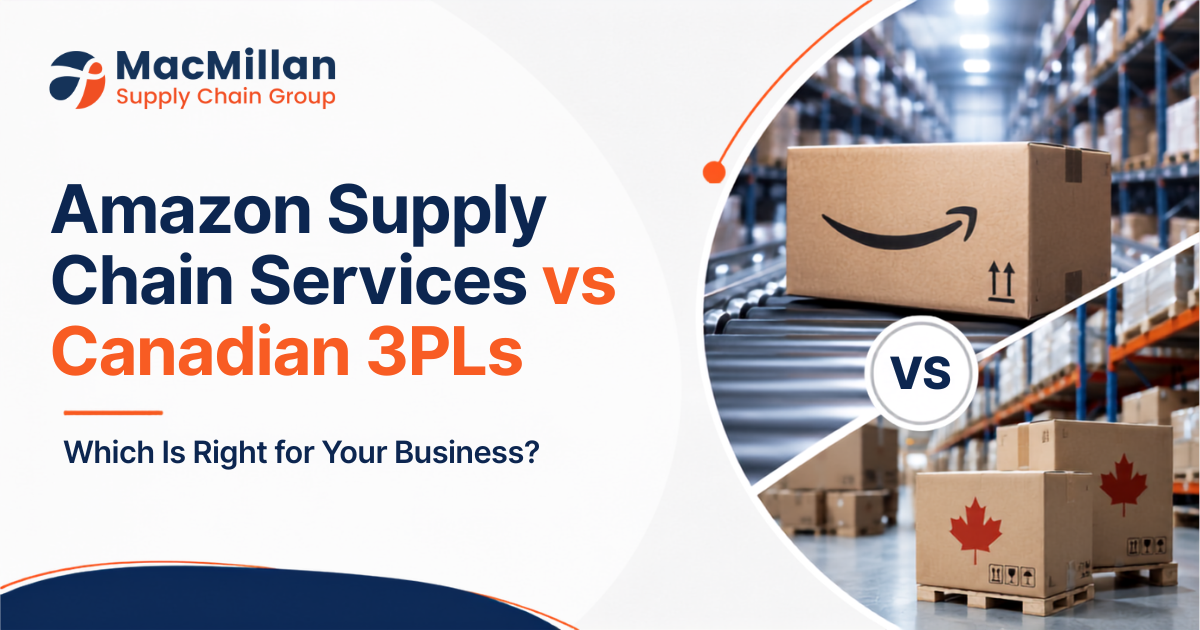
Amazon Supply Chain Services and Canadian third-party logistics providers can both store inventory and fulfil customer orders, but they are designed for different operational priorities. Amazon can be a strong choice for businesses focused on marketplace sales, standardized ecommerce fulfilment and access to a large delivery network. A Canadian 3PL may offer greater flexibility for retail compliance, customized packaging, B2B distribution, inventory control and direct operational support.
The right choice is not simply the provider with the largest network. It is the provider that fits your sales channels, products, customers and growth strategy. For many Canadian brands, the decision comes down to one question: do you need a standardized fulfilment system, or a logistics partner that can adapt its operations around your business?
Amazon Supply Chain Services brings together several logistics capabilities that can support inbound transportation, inventory storage, distribution, order fulfilment and parcel delivery. Depending on the program and eligibility, businesses may use services such as Fulfilment by Amazon, Amazon Warehousing and Distribution or Multi-Channel Fulfilment.
Fulfilment by Amazon is primarily built to support orders placed through the Amazon marketplace. Sellers send inventory into Amazon’s network, and Amazon handles storage, picking, packing, shipping and certain customer-service activities.
Multi-Channel Fulfilment extends parts of that network beyond Amazon orders. It allows qualifying businesses to fulfil orders from their own ecommerce websites and other sales channels using inventory stored within Amazon’s network.
This model can be attractive for brands that want fast deployment, established processes and fewer day-to-day warehouse responsibilities. However, businesses still need to review service eligibility, storage rules, preparation requirements, product restrictions and fee structures carefully.
A Canadian 3PL manages logistics activities on behalf of a business. Services may include warehousing, inventory management, ecommerce fulfilment, retail distribution, transportation coordination, returns, kitting and custom packaging.
The difference is often in how those services are delivered. Rather than placing every customer into one highly standardized workflow, a flexible 3PL can design processes around the brand’s products, retailers, order profiles and operational requirements.
For example, a company selling through Shopify, Canadian retail chains, distributors and subscription programs may need several fulfilment workflows under one roof. It may require case picking for wholesale orders, individual-unit picking for ecommerce, retailer-specific labels, promotional bundles and lot or expiry tracking.
A provider offering integrated warehousing and distribution services can coordinate those activities while maintaining a clearer connection between inventory storage, order preparation and outbound transportation.
| Comparison Area | Amazon Supply Chain Services | Canadian 3PL |
|---|---|---|
| Primary strength | Standardized ecommerce and marketplace fulfilment | Flexible, multi-channel logistics support |
| Amazon marketplace integration | Strong | Varies by provider and integration |
| Retail compliance | May not be designed around every retailer’s requirements | Can support retailer-specific preparation and documentation |
| Custom packaging | Usually more standardized | Can support kitting, relabelling and promotional packaging |
| Operational communication | Platform- and program-driven | May provide direct account and operations support |
| Inventory flexibility | Governed by program rules and network requirements | Can be adapted around the customer’s inventory model |
| B2B and retail distribution | Available capabilities depend on the program | Often designed to support wholesale and retail orders |
| Returns handling | Standardized processes | Can create product-specific inspection and disposition rules |
Amazon may be suitable when most of your revenue comes from the Amazon marketplace and your products fit comfortably within its fulfilment requirements. The network can reduce the need to build an internal fulfilment operation, while established technology helps automate common order-management tasks.
It may also work well for straightforward ecommerce products with predictable dimensions, simple packaging needs and limited retail-compliance requirements.
Amazon can be especially useful when:
However, businesses should model the complete cost rather than looking at one fulfilment fee. Storage duration, inventory movement, preparation, returns and seasonal volume can all influence the final cost per order.
A Canadian 3PL may be more appropriate when your supply chain extends beyond a single marketplace. This is particularly relevant for brands serving national retailers, independent stores, distributors, ecommerce customers and promotional programs at the same time.
A flexible provider can build different workflows for different channels. Ecommerce orders may move through a dedicated ecommerce order fulfilment process, while wholesale cases are prepared according to retailer routing guides and delivery appointments.
A Canadian 3PL may be the stronger choice when:
Canadian retailers can impose precise shipping and preparation standards. Missed appointments, incorrect labels, damaged cartons or inaccurate documentation may lead to delays and chargebacks. A provider with dedicated retail compliance preparation can help address these requirements before an order leaves the warehouse.
Inventory visibility should be a major part of the decision. A business needs to know what is available, where it is located, which orders have been allocated and whether stock is approaching a replenishment threshold.
Amazon provides inventory tools within its ecosystem, but brands operating across multiple marketplaces, retailers and warehouses may need a broader view. A 3PL with real-time inventory visibility can provide a centralized operational picture across receiving, storage, order processing and shipping activities.
This becomes increasingly important as the business grows. Without reliable visibility, teams may over-order inventory, promise unavailable products or move stock between facilities unnecessarily. The issue is explored further in this guide to omnichannel fulfilment and inventory visibility.
Fulfilment is not only about moving a box from a warehouse to a customer. For many brands, the packaging is part of the product experience.
A subscription business may need rotating inserts, samples and bundles. A retailer may require shelf-ready cartons. A seasonal campaign may involve promotional displays or special labels. These activities require labour planning, quality checks and clear work instructions.
A Canadian 3PL offering value-added services can integrate these tasks into the fulfilment process. This can reduce the need to send inventory between separate packaging and warehouse partners.
Amazon’s standardized model can be efficient, but it may not provide the same degree of packaging flexibility for every product or campaign. Businesses should therefore decide how much control they need over presentation, assembly and the customer’s unboxing experience.
Technology is essential in either model. Orders, inventory and shipping data must move accurately between the sales channel and the fulfilment provider.
Amazon offers strong integration within its own ecosystem and supports multichannel use cases through eligible services. A Canadian 3PL may connect with ecommerce platforms, marketplaces and enterprise resource planning systems through direct integrations, APIs or electronic data interchange.
Before choosing a provider, ask how it will connect with your current technology. Confirm how quickly orders are imported, how inventory updates are synchronized and how exceptions are reported. MacMillan’s platform and ERP integration services are designed to support connected fulfilment workflows across business systems.
Comparing storage and pick fees alone can produce the wrong answer. The better metric is the total cost required to serve each sales channel successfully.
Calculate receiving, storage, order handling, packaging, transportation, returns and account-management costs. Then consider indirect costs such as retailer chargebacks, stockouts, inventory transfers, internal labour and customer-service issues.
Amazon may offer an efficient model for standardized products and high marketplace volume. A Canadian 3PL may create more value when customization, retail compliance and operational support prevent costly exceptions.
The cost structure of outsourced logistics is examined in more detail in this article about the economics of 3PL warehousing.
Yes. The choice does not always need to be exclusive. A hybrid fulfilment strategy can use Amazon for marketplace orders while a Canadian 3PL handles retail distribution, DTC orders, reserve inventory, custom packaging and returns.
This approach can reduce dependence on one network and place each order type into the most appropriate workflow. However, it requires accurate inventory planning and reliable system connections. Stock must be allocated carefully so one channel does not consume inventory reserved for another.
A hybrid strategy works best when roles are clearly defined. The business should decide which provider owns each inventory pool, sales channel, return stream and replenishment process.
Start with your customers rather than the warehouse. Identify where they buy, how quickly they expect delivery and what packaging or compliance requirements apply to each channel.
Then review your products. Consider dimensions, shelf life, handling requirements, order frequency, seasonality and return rates. Finally, evaluate your growth plan. A solution that works for marketplace orders today may become restrictive when retail and wholesale sales expand.
Amazon can be an effective fulfilment option for brands seeking scale within a standardized network. A Canadian 3PL can be more suitable for businesses that need flexibility, local operational support and coordinated fulfilment across ecommerce, retail and distribution channels.
MacMillan Supply Chain Group helps Canadian businesses manage warehousing, fulfilment, transportation and value-added operations through customized logistics programs. To discuss the requirements of your supply chain, contact the MacMillan SCG team.
Yes. A Canadian 3PL can prepare and ship orders for Amazon-related workflows, depending on the seller’s fulfilment model, integration and marketplace requirements. The provider may also support other channels from the same inventory network.
Not in every situation. The total cost depends on product size, storage duration, order volume, sales channels, packaging requirements and returns. Businesses should compare the complete cost per order rather than a single published rate.
A Canadian 3PL may be better suited to complex retail distribution because it can support retailer-specific labels, routing guides, appointments, case picking and compliance documentation. The right answer still depends on the provider’s capabilities.