
E-commerce Inventory Management: 7 Best Practices
As the busiest time of the year draws near, the…
As the busiest time of the year draws near, the…
As the busiest time of the year draws near, the…
Did you know that only 21% of businesses feel really…
As the world becomes more interconnected, cross-border e-commerce has become…
A Quick Summary and Overview
Demand forecasting is a crucial process for estimating future product or service demand, enabling businesses to plan production, manage inventory effectively, and optimize supply chains. Understanding different forecasting types and methods can significantly enhance business operations and customer satisfaction. This article explores the fundamentals of demand forecasting, its benefits, challenges, and solutions. We’ll discuss how leveraging technology and 3PL partnerships can improve forecast accuracy and overall supply chain performance. By the end, you’ll have a comprehensive understanding of demand forecasting and how it can positively impact your business operations.
Introduction
In today’s fast-paced business environment, accurately predicting future demand is more critical than ever. Demand forecasting serves as the foundation for effective supply chain management, inventory control, and strategic decision-making. By anticipating customer needs and market trends, businesses can optimize their operations, reduce costs, and improve customer satisfaction.
At MacMillan Supply Chain Group, we understand the importance of precise demand forecasting in driving business success. This article will guide you through the intricacies of demand forecasting, from its basic principles to advanced techniques and technologies. We’ll explore how businesses can overcome common challenges and leverage the power of data analytics and 3PL partnerships to enhance their forecasting capabilities.
Whether you’re new to demand forecasting or looking to refine your existing processes, this comprehensive guide will provide valuable insights to help you make informed decisions and stay ahead in today’s competitive marketplace.
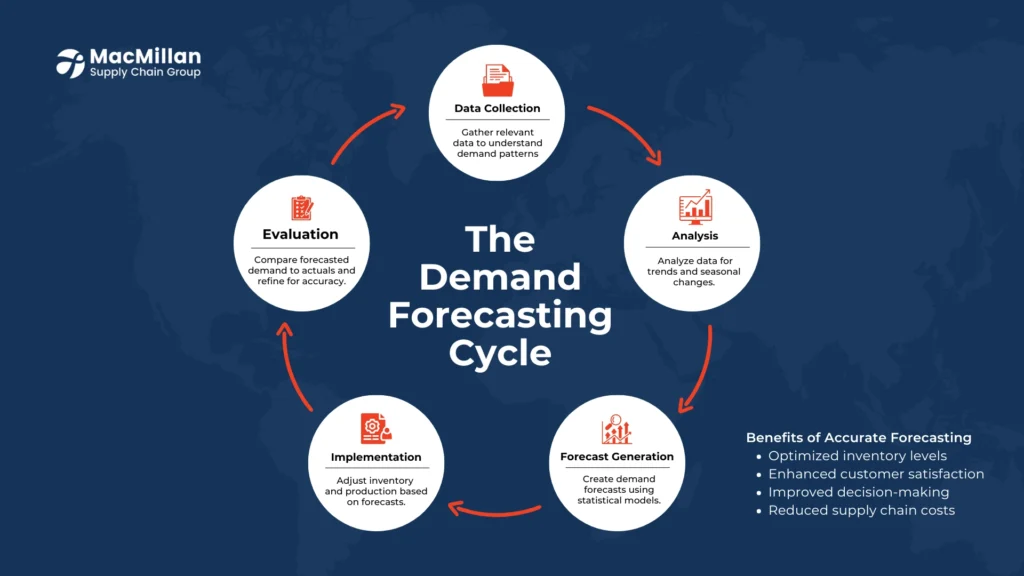
Demand forecasting is the process of predicting future customer demand for products or services. It involves analyzing historical data, market trends, and various internal and external factors to estimate future sales volumes. This crucial business activity helps companies make informed decisions about production, inventory management, and resource allocation.
There are several types of demand forecasting:
Common methods used in demand forecasting include:
Choosing the right forecasting method depends on factors such as data availability, industry type, and specific business needs. Effective demand forecasting requires a combination of analytical skills, industry knowledge, and advanced tools to generate accurate predictions that drive business success.
Implementing accurate demand forecasting brings numerous advantages to businesses across various industries. Here are some key benefits:
By leveraging the power of demand forecasting, businesses can enhance their overall performance, resilience, and long-term success in today’s dynamic marketplace.
While demand forecasting offers numerous benefits, it also presents several challenges that businesses must navigate:
Overcoming these challenges requires a combination of advanced technology, expert knowledge, and a commitment to continuous improvement in forecasting processes.
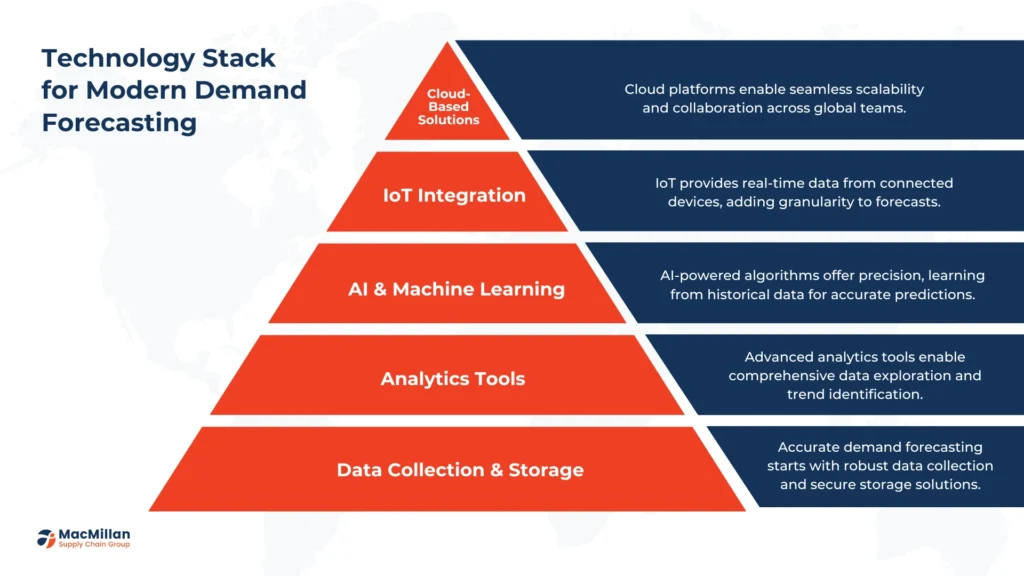
To address the challenges of demand forecasting and maximize its benefits, businesses are increasingly turning to advanced technologies and 3PL partnerships:
By leveraging these technologies and partnerships, businesses can significantly enhance their demand forecasting capabilities, leading to improved supply chain performance and overall business success.
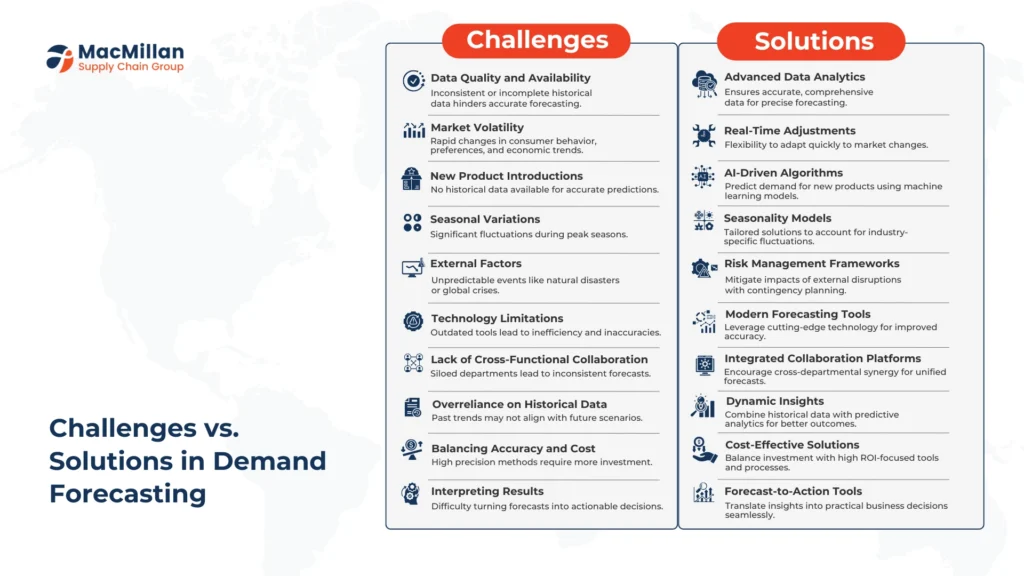
At MacMillan Supply Chain Group, we’ve identified several common problems in demand forecasting and developed effective solutions to address them:
Inaccurate or incomplete data:
Problem: Many businesses struggle with poor data quality, leading to unreliable forecasts.
Solution: We implement robust data collection and cleansing processes, integrating multiple data sources to ensure comprehensive and accurate information. Our advanced analytics tools can also identify and correct data anomalies.
Inability to account for external factors:
Problem: Traditional forecasting methods often fail to consider external influences like economic changes or competitor actions.
Solution: Our forecasting models incorporate a wide range of external data sources and use AI-driven algorithms to detect and factor in relevant external trends and events.
Lack of real-time adjustments:
Problem: Many forecasting systems are unable to quickly adapt to sudden market changes.
Solution: We provide real-time forecasting capabilities that continuously update predictions based on the latest data, allowing for rapid adjustments to changing conditions.
Difficulty in forecasting for new products:
Problem: Without historical data, new product forecasting can be challenging and inaccurate.
Solution: Our approach combines market research, analogous product data, and expert input to create reliable forecasts for new products. We also use machine learning algorithms to rapidly incorporate early sales data and refine predictions.
Inconsistent forecasts across departments:
Problem: Different departments often produce conflicting forecasts, leading to misaligned business strategies.
Solution: We implement collaborative forecasting platforms that bring together insights from various departments, ensuring a single, consistent forecast across the organization.
Overreliance on spreadsheets:
Problem: Many businesses still rely on manual, spreadsheet-based forecasting, which is time-consuming and prone to errors.
Solution: Our advanced forecasting software automates much of the process, reducing errors and freeing up time for analysis and strategic planning.
Inability to handle complex supply chains:
Problem: Global, multi-tier supply chains can be extremely difficult to forecast accurately.
Solution: Our sophisticated supply chain modeling tools can handle complex, multi-echelon supply chains, providing accurate forecasts at every level.
Lack of scenario planning:
Problem: Many businesses struggle to prepare for different potential futures.
Solution: We provide robust scenario planning capabilities, allowing businesses to model various “what-if” scenarios and develop contingency plans.
Poor integration with other business systems:
Problem: Standalone forecasting systems often don’t communicate well with other business applications.
Solution: Our forecasting solutions integrate seamlessly with ERP, CRM, and other business systems, ensuring data consistency and enabling automated actions based on forecast results.
By addressing these common problems, MacMillan Supply Chain Group helps businesses transform their demand forecasting capabilities, leading to improved accuracy, efficiency, and overall supply chain performance.
To avoid common demand forecasting pitfalls and implement effective solutions, consider the following steps:
While these steps can significantly improve your demand forecasting capabilities, partnering with an experienced 3PL provider like MacMillan Supply Chain Group can take your forecasting to the next level. Our expert team and advanced technologies can help you overcome challenges, implement best practices, and achieve superior forecast accuracy. Contact MacMillan Supply Chain Group today to learn how we can transform your demand forecasting and optimize your supply chain operations.
2 Responses
Great article on demand forecasting. The practical strategies and insights shared here can help businesses improve planning, reduce risks, and make more informed decisions. Very informative read!
Thanks for your thoughtful feedback! We appreciate you reading.