
How the Right White Glove Service Benefits Your Brand
You’ve sent your product out for delivery, they’ve received it, but will they remember it? With 73% of consumers saying the experience is as important as the product, you should forget about traditional drop-offs and focus on how you deliver your products. If you want to cement your brand in your customers’ minds, then delivery cannot be an afterthought; it needs to be an excellent experience, especially with items considered big and bulky. This is where white glove services step in. From the moment when the appliance or piece of furniture leaves the warehouse to when it’s in your customer’s hands, every step is an opportunity to impress, dazzle, and earn that coveted wow. As a 3PL, we understand the importance of going the extra mile. In this blog, we’ll take you through how to make your delivery experience your brand’s biggest asset by integrating white glove services. What is White Glove Service? White glove service means taking extra care of your customers’ needs with attention to detail. It ensures that your customers are happy by handling their products and services (where applicable) as carefully as possible. It means any service that goes the extra mile to meet customers’ needs. How Does White Glove Service Benefit Your Brand? Delighting the Customer with on-time delivery: Shortened delivery windows that are tracked and actually met, means no more clients waiting for deliveries, getting frustrated and annoyed. Positive Brand Image: When you handle shipments carefully, customers connect your brand with quality experiences. Word-of-Mouth Promotion: Exceptional service leads to natural word-of-mouth marketing, establishing your brand as a leader. Stand Out from Competitors: Providing white glove delivery differentiates your brand from competitors who offer only standard shipping. Increased Profitability: Specialized services often mean higher profits, making white glove delivery a valuable investment for your company. What Does White Glove Service Include? White glove service includes extra care from start to finish, ensuring everything goes smoothly. Here’s a breakdown: Specialized Packaging: Custom packaging solutions based on the item’s size, type, and fragility. Secure and Swift Shipping: Use dedicated vehicles with padding, climate control, and security surveillance features. Expert Handling and Placement: Skilled professionals ensure the safe unloading and placing of items in the desired room of choice. Installation and Assembly: Comprehensive setup services ensure the product is ready. Cleanup Services: Optional removal and disposal of packaging materials to leave spaces clean and tidy How Can You Boost Your Brand with White Glove Service? White glove service isn’t just a fancy add-on; it makes a real difference for customers and your brand. Here’s how you can make it work wonders for you: Build Trust to Keep Customers Coming Back Tailor your services to fit exactly what each customer needs, making every step of their journey with you smooth and personal. Solve problems quickly and reach out before issues grow. This cuts down on complaints and shows you care. Adding services like assembly shows you’re thoughtful and ready to help. Using skilled delivery teams makes customers trust you more, encouraging them to return when they need to make another big purchase. Make Your Services Smoother and Smarter White glove service today leans on tech and smart data, making it better and more affordable. The right tech and training mean you can handle products better and deliver faster, impressing customers. Tech helps you offer personalized services to more customers without a big cost jump. Happy customers talk. They’ll share their great experiences, bringing in more business and building your brand’s reputation. III. Improve with Feedback Ask for and really listen to what your customers say to improve your white glove service. This shows your customers that you care about what they think and want to keep getting better. Use their suggestions to develop new ideas and stay ahead of what they expect, ensuring your brand stays fresh in their minds. Choose Your White Glove Delivery Partner Wisely Here’s how to find a partner that fits your business goals and needs: Look for Speed and Flexibility You need a partner who can deliver quickly and handle big or tricky orders. They should offer flexible delivery times, including evenings and weekends, and have a solid plan for returns. Look for a range of services, from simple drop-offs to in-room setups. Demand Reliable Delivery Times Pick a partner that promises precise delivery slots so customers aren’t left waiting. They should provide real-time delivery updates to keep customers informed. Find a Partner Who Values Your Brand Your delivery team should reflect your brand positively. Ensure they are well-trained and can offer drivers who understand your products and brand values. Go for Eco-friendly Options If sustainability matters to your brand, choose a partner with green delivery practices. Check for carbon-neutral shipping and responsible return handling, like recycling or donations. Why Pick a 3PL for White Glove Service? Using a 3PL provider for white glove services is smart. We handle your special deliveries with extra care and skill. A 3PL saves you time and money, easily adjusts to your needs, reaches more places, and uses the latest tech to keep deliveries smooth. We ensure your valuable items are safe, follow all the rules, and let you focus on your main business. Choosing a 3PL means every delivery gets VIP treatment. With a provider like MacMillan, you’re sure your products and customers are in good hands, keeping them happy and returning. Boost Your Online Business with MacMillan’s Fulfillment Services Running an online shop means getting orders to customers fast and without hassle. MacMillan helps you with the logistics to do just that. We excel in taking your products from the warehouse to the last mile, ensuring a seamless customer experience, including hassle-free returns. Our approach is tailored, recognizing that each online store has its own needs and challenges. We’ve created a dependable network that makes us a go-to partner in the e-commerce space. Upgrade your e-commerce fulfillment process with MacMillan, where efficiency, reliability, and customer happiness are
Tech-Infused 3PL’s: Navigating How AI is Transforming Supply Chains.
In the fast-evolving landscape of global trade and e-commerce, supply chain isn’t just about moving goods from point A to point B. The supply chain is the web linking together multiple functions, including logistics, production, procurement, marketing and sales. Modern businesses demand speed, efficiency, and above all, smart solutions that can seamlessly integrate into their operations. A.I and supporting technology can help automate tasks across the supply chain, from data analysis, forecasting customer demands, generating marketing campaigns, inbound and outbound calling and more. In a rapidly developing logistics landscape, tech-infused third-party logistics (3PL) providers, revolutionize the industry by blending traditional logistics services with cutting-edge technologies to deliver a sustainable impact to their partners. What is a 3PL? A 3PL, or third-party logistics provider, is a partner that helps companies optimize their supply chain and logistics operations. They specialize in services such as last mile delivery, warehouse storage, order fulfillment, container de-stuffing and transportation. You may also hear 3PL companies called by other names: · Fulfillment company · Order fulfillment companies · Fulfillment warehouse · Fulfillment center Not all 3pl providers provide the same services but their primary goal remains to effectively take the supply chain management burden off their clients’ shoulders. The primary advantage of using a 3PL is that it allows businesses to focus on other core aspects of their operations without the complexities of logistics management. Several 3pl providers also provide specialized services catering to the various niches/industries. For more information on what the right 3PL provider looks for you, visit our 3PL Guide. What is Tech-Infused 3PL? Tech-infused 3PL is the next step in the evolution of logistics services. This approach integrates advanced technologies like Artificial Intelligence (A.I), machine learning, robotics, and data analytics into traditional logistics processes. The infusion of these technologies enhances the efficiency, accuracy, and reliability of logistics services. For instance, A.I can predict shipping delays, robotics can automate warehouse operations, and big data can enhance supply chain transparency. This tech-driven approach not only streamlines operations but also provides more adaptability in the dynamic market landscape. Why Does it Matter and Why Should You Care? In today’s fast-paced market, a delay in delivery or a supply chain disruption can be detrimental to a business. Tech-infused 3PLs leverage technology to mitigate these risks, ensuring a smoother, more predictable logistics process. For businesses, this means improved customer satisfaction, reduced overhead costs, and enhanced capability to scale operations globally. Additionally, the data-driven insights provided by these advanced technologies empower businesses to make proactive decisions, thus enhancing strategic planning and execution. However, like all other technologies during their inception, implementing A.I and ML (Machine Learning) solutions isn’t cheap, hence making A.I driven 3PL’s an ideal partner for business’s seeking to harness the power of A.I without the hassle and investment needed. Want to learn more about what an A.I driven partner can do for you? Get in touch with us today. How does A.I and technology work in Supply Chain? A.I provides businesses with unparalleled efficiency and accuracy to manage and optimize supply chain activities such as: monitoring product quality, balancing inventory levels, reducing and identifying fuel-efficient delivery routes. Thanks to A.I’s ability to simulate human intelligence and perform complex tasks, it provides more efficiency than traditional software’s. Its subfields include machine learning (ML), in which systems learn from consuming and analyzing, vast amounts of data rather than being programmed with step-by-step instructions. Thanks to this learning process, A.I systems can outperform traditional software in functions such as deciphering information from video feeds, interpreting spoken and written text, predicting future market behavior, making decisions in complex scenarios, and surfacing insights buried in large data sets. However, A.I is not just limited to processing data but impacts the entire chain from product design to sales and marketing. Several fine-tuned LLM’s (Large Language Models), notably Chat-GPT have changed the way we work. The ability to search the web, write content, generate images, act as cold calling sales agents (with the help of other software’s) and with recent developments even powering robots. These kinds of capabilities are proving extremely useful in managing and optimizing workflows. For example, supply chain systems powered by ML algorithms can discover patterns and relationships within data sets that are often missed by humans or non-A.I systems, so they can more accurately forecast customer demand, which leads to more economically efficient inventory management. A.I can also analyze factors such as traffic and weather conditions to recommend alternative shipping routes, reducing the risk of unplanned delays and improving delivery times. It can monitor workspaces to spot poor quality control procedures and health and safety violations. And new use cases are constantly emerging as supply chain professionals continue to experiment with the technology. Finding the Right Tech-Driven 3PL Partner for Your Business Choosing the right tech-driven 3PL partner involves several considerations. Here are a few tips: Technology Integration: Assess the technological capabilities of the 3PL provider. Ensure they have a proven track record of integrating advanced technologies like A.I and robotics. Scalability: Your 3PL partner should be able to scale their services as your business grows. Look for flexibility in operations and the ability to handle increased order volumes without compromising service quality. Security: Given the data-intensive nature of tech-infused 3PL services, ensure that your provider has robust security measures in place to protect your data. Experience and Reliability: Evaluate their experience in your specific industry. A reliable 3PL provider will have not only the experience but also positive testimonials and a strong reputation. Sustainability: Consider whether the 3PL provider follows sustainable practices. With increasing awareness of environmental issues, partnering with a green 3PL can enhance your brand’s image and compliance with global standards. The integration of technology into logistics, especially through A.I, is not just an enhancement but a necessity in the modern business environment. Tech-infused 3PL’s such as MacMillan SCG provides their partners s a competitive edge by enabling more efficient, reliable, and transparent supply chain management solutions. By understanding the capabilities and
Amazon’s Seller Fulfilled Prime: A Guide to 10x your Sales.
Following its success with Prime delivery and becoming the business standard for next day delivery, Amazon is once again changing market dynamics by providing businesses an opportunity to stand out and step into the vast amazon e-commerce marketplace. Amazon Seller Fulfilled Prime has emerged as a game changer, revolutionizing customer satisfaction and boosting online sales. The “Amazon Prime” distinction alone can significantly boost visibility, trust and ultimately sales. In addition to all these benefits, Amazon’s SFP (or Seller Fulfilled Prime) can grant your business greater control over inventory tracking, order fulfillment processes, and brand visibility while meeting the prime delivery requirements and standards. Contrasting with Fulfillment by Amazon (FBA), where Amazon handles storage, picking, packing, and shipping, SFP gives sellers more control over their fulfillment process while still meeting Amazon’s stringent standards. This guide will explore the differences between SFP and FBA, and help sellers determine if SFP is the right choice for their business. What is Amazon prime? Amazon Prime, offers free same day shipping and delivery to its customers, in response to this age-old dilemma since the inception of e-commerce. Now you may be wondering: How does same-day shipping differ from same-day delivery? Same-day shipping is when a customer’s order leaves the warehouse on the same day of purchase; Whereas, Same-day delivery takes it a step further and guarantees your order will be delivered on the same day it’s purchased. Unsure how important same-day delivery is? Take a look at these stats: What is Amazon’s Seller Fulfilled Prime and how does it differ? Amazons’ seller fulfilled prime program offered by amazon allows qualified third-party sellers to display the prime badge on their listed products and offering prime shipping benefits to customers either directly from their warehouses Canada or through a 3PL warehousing service. The Seller fulfilled program by amazon providers with more control over the fulfillment process while still meeting Amazon Prime’s strict standards. However, unlike Amazon’s “Fulfillment by Amazon program “, also known as Amazon FBA, where the handling, storing, picking and packing of the products are directly engaged by amazon itself, sellers in the SFP program can now manage these aspects themselves while still fulfilling Amazons’ strict delivery standards and procedures or by choosing a Third-party Logistics Provider (3PL) such as MacMillan Supply Chain Group. What does Amazon’s Seller Fulfilled Prime Offer? Amazon’s Seller fulfilled prime (SFP) offers a unique blend of advantages for Amazon’s sellers who want to offer Prime shipping with added flexibility and transparency of managing their own fulfillment process. The online retail landscape is now more competitive and diversified than ever. Amazon’s SFP program offers a golden chance providing greater exposure to your products and could be the decisive factor for creating long term customers. Your business can benefit with this program in several ways including: Reach your target audience VIA Amazons search engine preference: The SFP program not only allows you to list your products with a premium badge but will help you reach the most loyal customer base, Thanks to Amazon’s optimized search preferences that it gives to its prime products. Increased visibility converting into sales: The prime badge by Amazon to the products listed on SFP just like for FBA gives a prompt visibility for fast and reliable shipping which all customers love! Moreover, SPF gives you a competitive edge in winning the buy box,making it easier for the customers find and purchase. Control over inventory and branding: Having your own warehouse means having your own rules or via a 3PL provider which can give you full access and control over inventory management and intact pricing models, avoiding amazons space and charges for limited storage. Since you ship directly to your customers you can work for higher efficiency levels via packaging, inserting promotional material and making it sustainable for your brand. Potential cost cutting: SFP can save your business additional fees on long term storage that FBA cannot. You could find more competitive delivery rates through your own transporter connections or a 3PL, possibly reducing costs in comparison with FBA. Multi-channel flexibility: SFP can help you manage inventory for sales on your own social networks, websites and other offline channels. In the peak season where your business may encounter spike in demand SFP allows flexibility without Amazon’s potential restrictions. Is Amazon SFP the right choice? Determining if SFP is the right choice for your business could depend upon various factors including operational capabilities, long term goals and consumer base. While SFP offers huge advantages like expanded reach, greater satisfaction, and access to Prime members, it additionally requires meticulous attention to detail and a guarantee to meet Amazon’s stringent performance guidelines. To sum up, seller fulfillment program could be an excellent option for sellers who have an established fulfillment infrastructure or experienced 3PL relationships, the businesses wanting more control over their inventory and branding after taking into consideration the products they are offering.Listing some Pros for joining the SFP program for your business: Cost reductions: You can avoid FBA storage and fulfillment fees for large and bulky items, which can be a fair amount of money. Increased sales: Prime members are more likely to buy products with a prime badge which can lead to a boost in sales More control over your brand: You can promote your own brand by customized packing and shipping inserts rather than Amazons. While the Amazons SFP program sounds good on paper, there are some considerations to be followed before being accepted into the program. Joining the program can entail stringent requirements and increased responsibility. The sellers must meet SFP requirements that can be more complex to set up that FBA, as you are responsible for the entire fulfillment operation including inventory management, shipping logistics which can be time consuming and resource sensitive. How to sign up for Amazon’s Seller Fulfilled Prime? Here’s a step-by-step guide on how you can get started with Amazon’s Seller Fulfilled Prime program. Some pre-requisites include having a Professional sellers account, meeting Amazon’s standards for shipping performance and being
3PL Warehousing: How to Save Business Costs
Partnering with a third-party logistics (3PL) provider like MacMillan Supply Chain Group can be a strategic move to help your business save money and boost efficiency. 3PLs achieve this through economies of scale, which grant them access to better shipping rates and optimized warehousing costs. They eliminate the need for businesses to invest heavily in their own warehousing infrastructure and technology. 3PLs leverage cutting-edge technology, such as warehouse management systems and business intelligence tools, to streamline operations, reduce errors, and gain valuable insights which can be your warehousing solution to cost efficiency. Choosing the right 3PL involves assessing your specific needs. Look for a provider with a proven track record, transparent pricing, and a commitment to technological innovation. MacMillan Supply Chain Group is ready to tailor a solution that aligns with your unique business requirements, providing reliability, transparency, and expertise to optimize your logistics operations and drive cost savings for you. A variable cost model from a 3PL allows you to easily manage and optimize your business operations. Let’s explore how 3PLs accomplish this. What are the main ways a 3pl can help you savemoney? There are many massive benefits inherent in outsourcing to a third-party logistics provider. Many of these benefits are centered around a 3PL’s ability to provide shippers with cost savings and greater levels of efficiency throughout the logistics process. 3pls have large resource networks which help them cut costs and boosts efficiency and have flexible capacity which can easily adapt to high and low order volume without losing efficiency. A good 3pl can save you money in a multitude, take a look at the following: Economies of Scale One of the biggest advantages of partnering with a 3PL is their ability to leverage economies of scale. By handling large volumes of shipments for numerous businesses, they become high-volume customers for major carriers like UPS and FedEx. This buying power translates into significantly discounted shipping rates that individual businesses would be hard-pressed to achieve on their own. When you work with a 3PL, you essentially tap into their bulk discounts, allowing you to ship your products at a fraction of the cost. Using a good 3pl partner can help you optimize your asset utilization by spreading the fixed warehouse costs, transportation fleet and technology across a larger client base, resulting in a lower per unit cost for each client. Moreover, by combining shipments from multiple clients, 3PLs can fill trucks and containers more efficiently, reducing transportation costs per unit. Warehousing: Your 3PL’s Facilities = Your Savings Managing a warehouse can be financially draining, you need space, equipment (like forklifts and conveyor belts), and technology to have a track on your inventory management systems. A good 3PL partner eliminates this requirement for its customers allowing you to redirect your resources to core business growth. Reduced Capital Investment: You don’t have to buy or lease warehouse space or invest in expensive equipment. A 3PL such as MacMillan supply chain group incurs expenses but spreads the cost across all clients, thus each client is responsible for only a small fraction of capital investment as opposed to absorbing it all by operating their own facility. The latest technology is always available If you choose to manage shipping internally, you’ll need to purchase and implement your own IT platform. This means another system to learn, manage, update, troubleshoot, and integrate with customers which can be cost bearing. However, by outsourcing these functions to a 3PL, you transfer the responsibility of system operations to a company that specializes in these platforms. The sophisticated technology that top 3PLs use within the warehousing space can prove to be a toolkit for your business. 3PLs continually invest in the latest logistics technology, providing you with access to advanced systems and capabilities without having to bear the full cost yourself. Warehouse Management Systems (WMS): These systems optimize everything from inventory tracking to order fulfillment, making processes faster and more efficient. A Warehouse Management System (WMS) serves as the central command center for a 3PL’s technology, managing all daily warehouse activities ranging from managing incoming shipments and tracking inventory locations to fulfilling orders and integrating with other systems. Business Intelligence Tools: Gain insights into your inventory levels, shipping costs, and customer behavior so you can make informed decisions. Freight Rate Shopping: 3PLs use specialized software to find the most cost effective and customized shipping options for each order. How can a 3PL help you reduce labor overhead Managing a warehouse team involves costs beyond just wages – there’s recruiting, training, benefits, and more. A 3PL handles all of that for you. As labor costs are a significant expense for a company, selecting a good 3PL can optimize the overhead costs by cost sharing which involves spreading the cost across multiple clients, making it more affordable for you. Choosing a 3pl partner can give you access to seasonal flexibility where your 3PL can adjust staffing levels to accommodate your warehousing operations. Freight: More Than Just Moving Boxes Freight refers to goods or cargo being transported from one place to another. This can include a wide range of products, from raw materials and components to finished goods ready for distribution. Shipping goods isn’t cheap. Between fluctuating fuel costs, the pressure to deliver quickly, and the complexities of pricing structures, freight expenses can quickly add up. Buying Power: 3PLs handle large volumes of shipments for multiple businesses. This gives them leverage to negotiate better rates with carriers like UPS and FedEx than you could get on your own. Dimensional Weight Savings: Carriers often charge based on the size of a package, not just its weight. A good 3PL can help you optimize packaging to avoid these “dimensional weight” penalties. Carton-ization strategy: Closely connected to dimensional weights is cartonization strategy and technology. Top tier 3PLs will capture the weights and dimensions of all your products. Using specialized software, 3PLs can determine the most efficient way to pack your products, further reducing your shipping costs. Negotiated Fees: 3PLs
Top 7 3PL Alternatives to Red Stag Fulfillment in Canada
Customers prioritize receiving their orders securely, accurately, and on time, which makes choosing the right 3PL warehousing and fulfillment services crucial for businesses. This article highlights top 3PL service providers in Canada, offering an overview of their strengths and weaknesses to help businesses make informed decisions. Key players today include MacMillan Supply Chain Group, Ship Bob, Ship fusion, Fulfillment by Amazon (FBA), Ship Hero, and Ship Network, each catering to different businesses. This article emphasizes the importance of understanding specific business requirements and evaluating potential 3PL partners based on metrics like accuracy, strategic locations, and transparent pricing models. By conducting market research and assessing these factors we have elaborated the potential logistic partners for your business, to enhance your logistics operations and meet customer expectations effectively. To achieve this, it’s vital to assess and compare top 3PL warehousing companies operating in Canada. However, finding the ideal partner can be a challenging task. This article aims to outline some of the leading warehousing and fulfillment services that are available today. Here is a list of top 3PL’s in Canada 2024 MacMillan Supply Chain Group is providing scalable 3pl solutions to business, offering warehousing, last mile fulfillment and innovative ecommerce solutions customized to your needs. Ship Bob is well-suited for small to medium-sized ecommerce enterprises that ship parcels of small to medium sizes. Operations including a 50-pound parcel weight limit, minimum order volume is none which can be a source for companies with larger volumes and error rate of 0.05%. Ship Fusion is most suitable for sensitive cargo and FDA-compliant, food-grade inventory storage, such as cold chain transportation systems. Operating with a 50-pound product/parcel weight limit, minimum order volume of 500+ and an error rate of 0.2%. Fulfillment by Amazon FBA is a dedicated shipping and order fulfillment company for Amazon sellers with its optimized programs. FBA orders are eligible for prime order fulfilment, to get more insight read out article on Amazon’s Seller Fulfilled Prime. Moreover, FBA has a parcel weight limit of 50- pounds, minimum order volume is none while the error rates remain undisclosed. Ship Hero: is a top ecommerce solution provider for enterprise level with a monthly shipment to SKU ratio of 10:1, cost-effective, and efficient deliveries. Operating with a parcel weight limit of 20- pounds and a minimum order volume of 10,000, while Ship hero offers a 1% error rate. Ship Network is ideal for large volume orders for enterprise level shippers working for optimized solutions. Operational with a parcel weight limit of 30- pound, minimum order volume rates to be 250 and above and an error rate of 0.1%. How to Analyze the best 3PL services for your company? Finding the right 3PL warehousing company isn’t a one-size-fits-all situation. Your ideal partner depends on your unique business needs. Here’s how to navigate the options. A good place to start is by investigating your current business operations and goals, Ask yourself the following questions: This isn’t an exhaustive list, but it gives you a good starting point to understand your specific requirements which can be important while selecting your right 3PL partner. What factors to consider while selecting a 3PL partner? Once you know your business needs, explore the different services offered by the top 3pl companies and consider factors when determining the quality of service provided by a third-party logistic provider. Compare various metrices such as: Product Weight Limits: Can the company handle the size, weight, and any special storage requirements of your products? Order Volume: Do they have minimum order requirements that fit your current and projected sales volume? Accuracy Rates: How does their accuracy rate measure up? Strategic Geographic Locations: Does their network of fulfillment centers align with your target markets for faster delivery times? Presence in GTA and Western Region access to networks? SKU Management: Do they have limitations on the number of products (SKUs) you can store with the 3PL company? Customer satisfaction: Is direct feedback taken from the customers associated with the 3PL provider? Transparency in pricing models: Is the 3PL provider clear about costs with no hidden charges and is the model competitive in terms of other logistics providers such as Red Stag fulfillment? PRODUCT WEIGHT LIMITS: HOW LARGE ARE YOUR PRODUCTS? Businesses selling bulkier items, finding 3pl services with the right expertise is crucial. This ensures your products are safely stored, picked, packed, and shipped to arrive in pristine condition. Beyond size, some products may require specialized handling. The best 3pl providers such as MacMillan supply chain group operating as a cost leader in Canada can accommodate these needs with appropriate warehouse space and properly sized boxes while proving to be a cultural fit for your company’s operations. ORDER VOLUME: WHAT IS THE RATE OF PACKAGES SHIPPED EACH MONTH? If you consistently ship a large number of products monthly, prioritize warehousing services equipped to handle that volume efficiently. Conversely, if your order volume is currently lower, look for fulfillment services specifically designed for businesses like yours. If you’re aiming for rapid expansion, choose a 3pl service that can handle your current volume while offering the flexibility to scale alongside you and your seasonal space requirements. ACCURACY RATE: WHAT IS THE PERCENTAGE OF ACCURATE SHIPMENTS? Knowing that every mishap costs your business money and potentially harms customer satisfaction, be sure to ask potential 3pl partners their errors. Some fulfillment service providers allow up to a 4% error rate. But, the best order 3pl companies such as MacMillan boast an accuracy rate of 99% or higher with their responsiveness and their track record of meeting when problems arise with the lowest percentage rate of damage turn over. STRATEGIC GRAPHIC LOCATIONS: TOP WAREHOUSES ARE STRATEGICLY LOCATED FOR FAST SHIPPING Macmillan’s Presence in GTA allows full geographic coverage and also offers 80% access to Western Regions. Physical warehouse locations are important because they show how quickly your customers will receive their orders. Based on your unique needs, find a third-party logistics company with warehouses in strategic locations that
How Do 3PLs Help Automotive Sellers?
Automotive retailers have historically relied on brick-and-mortar stores due to the operational challenges of warehouse fulfillment for bulky, oversized, or heavy products. However, the automotive market is well-suited for online shopping, offering buyers access to rare parts for various makes and models. 3PL service providers can significantly aid automotive sellers by offering specialized 3PL warehousing and expert fulfillment services for consumers. The role of 3PL in the automotive supply chain involves inventory management, transportation and distribution leading to cost reduction, and compliance. Moreover, this blog outlines five ways a 3PL assists automotive sellers. What is an automotive 3pl? An automotive 3PL is equipped to handle a wide range of auto parts, offering comprehensive logistics services for full-service automotive sellers. This includes 3PL warehousing capabilities to store and ship oversized merchandise such as fenders, tires, seats, and complete engines. Some of the globally recognized 3PL leaders in the automotive industry include DHL supply chain and XPO logistics, which have served as the top innovative logistics solutions in the automotive market with a strong market presence. At MacMillan SCG we excel in shipping heavy and bulky products. Our 3PL warehousing services include extra-wide aisles to accommodate large boxes and robust conveyor belts designed to handle heavy items efficiently. What is the role of 3pl in automotive supply chain? The automotive supply chain is a complex network requiring precision, efficiency, and adaptability. Third-party logistics (3PL) providers play a crucial role in this area, from optimized 3PL warehousing to efficient order fulfillment and delivery to designated area. The demand for automotive fulfillment is only getting bigger in today’s market dynamics, with the growth of online and onsite sales. This blog delves into how 3PLs enhance the automotive supply chain, from inventory management, warehousing, order fulfillment to cost reduction and technology integration for improved customer satisfaction. Enhancing inventory management: In the automotive industry, managing inventory efficiently is essential due to the vast range of parts and components, each with varying demand cycles. MacMillan as a 3pl service provider utilizes advanced inventory management systems (IMS) to track parts in real time, minimizing the risk of stockouts and overstock situations. This real-time visibility allows companies to maintain optimized inventory levels, ensuring that critical components are always available when needed. Streamlining transportation and distribution: Given the need to move heavy and bulky items like engines and transmissions. 3PLs offer specialized transportation solutions tailored to the automotive sector, including multimodal transport options. MacMillan SCG allows a geographic coverage in the Greater Toronto Area and 80% of western region coverage allowing warehousing Toronto and to help your business align networking. Reducing operational costs: By outsourcing logistics to 3PL service providers, automotive companies can significantly reduce their operational costs. 3PLs leverage economies of scale, enabling them to offer competitive pricing for warehousing, transportation, and other logistics services. Ensuring compliance and risk management: Compliance with industry regulations and standards is paramount in the automotive sector. 3pl services providers implement robust risk management practices to mitigate potential disruptions in the supply chain, including contingency planning and disaster recovery strategies. 5 ways a 3pl help automotive sellers Expert fulfillment is essential for business growth, especially for automotive sellers dealing with bulky and fragile auto parts. Here are five ways a 3pl service provider can help an automotive sellers thrive in today’s dynamic market. Inventory management and safe storage: Selling auto parts can be an inventory management challenge. With numerous parts to store, each requiring the correct version for different models, you might need to organize and secure thousands of SKUs, ready for shipment. This is where professional warehousing comes in. Logistics companies such as MacMillan SCG utilizes warehouse management systems (WMS) to track SKUs from inbound shipment through order fulfillment and shipping with a 24/7 security protocol to keep your inventory safe and tracked. Kitting: Kitting involves pre-packing items to ship together, a strategy automotive sellers use to prepare SKUs that usually sell as a group. For example, a customer ordering a steering column for a 1999 Ford Mustang might also need related parts to accompany such as a steering wheel. By using kitting, you can pre-assemble all the necessary components for rebuilding a power steering system into one convenient package. Kitting also facilitates package consolidation, saving on shipping costs. By packing small items with larger products that ship based on dimensional weight. Kitting streamlines the pick and pack process, as a picker can retrieve a single pre-assembled kit instead of multiple individual SKUs to fill an order. Assembly lines are set up to efficiently create kits ready for shipping, and the kitting process can include standard operating procedures (SOPs) to ensure each set is packed safely. Pick, Pack and Ship: An automotive 3PL service provider specializes in timely and complete order shipments. Their warehouse management system (WMS) generates efficient pick lists for warehouse staff. Technologies like RFID tags and barcoding ensure accuracy in item selection. Additionally, experienced packers use the appropriate materials and operational methodologies to pack each order professionally, ensuring it arrives in perfect condition. Cross docking: is labeling orders on the inbound dock and moving them to shipping instead of placing stock into inventory first. Cross-docking is an excellent method to allow order fulfillment and lower storage costs. When evaluating potential 3PL service providers, inquire if they offer cross-docking to enhance the speed of your order processing. Returns management: Return processing in automotive 3PL refers to the management of product returns within the automotive supply chain by 3PLs. Although high-quality automotive logistics can minimize your return rate. Thus, having reverse logistics solutions in place is still crucial. Handling returns like engine blocks or transmissions can be a challenge, partnering with a 3PL can assist you in overcoming these obstacles. Return processing in the automotive 3PL includes several key steps such as: Receiving Storing Inspection and evaluation Inventory update Disposition Reporting Scalability and shipping discounts: Shipping automotive parts, mainly the heavy or oversized ones, can incur significant expenses. Carriers often impose surcharges for packages exceeding certain weight limits, such
Choosing The Right WMS: Streamlining Warehouse Operations
In today’s fast-paced market place, efficiency is paramount. To enhance productivity and reduce costs in 3PL warehousing operations, many businesses turn to Warehouse Management Systems (WMS). WMS software helps ensure inventory is received, stored, picked, packed, shipped in the most efficient way possible. With all these functions occurring simultaneously across different physical locations within the warehouse, it’s easy for processes to become misaligned or data to be lost. This is where WMS comes in. This article delves into WMS logistics, exploring its key features and processes. Moreover, how MacMillan SCG can manage your inventory and warehousing operations in real-time using WMS integration with your systems in order to streamline business processes. What is warehouse management system logistics? A warehouse management system, or a WMS gives you the tools, processes, automation, and reporting you need to manage your 3PL warehousing operations. A key component of WMS logistics is inventory management as it allows warehouse managers to accurately track and control inventory levels, ensuring the right products are available at the right time, thereby preventing stockouts and overstock situations. This real-time visibility into inventory levels enables better purchasing, storage, and order fulfillment decisions. WMS logistics also involves order management. A WMS system automates order processing, reducing errors and delays, and enables accuracy in order picking and packing. Warehouse space is a valuable asset, and effective space management is essential for maximizing storage capacity and operational efficiency. WMS software uses tools like slotting algorithms to determine the most suited location for each product based on demand, size, and weight. This helps in optimizing space utilization. What are the processes that make up a WMS? At its core, a WMS is a software system that automates and streamlines 3PL warehousing, acting as a central hub connecting various aspects of warehouse management. By leveraging real-time data and analytics, a WMS enables businesses to make informed decisions and optimize their warehouse processes. Inventory management: Provides visibility into inventory systems, tracking stock levels, product location and movement. Order management: Efficiently processes and fulfills customer orders, ensuring timely delivery and reducing errors while allowing order tracking. Picking and packing: Optimizes the picking and packing process, suggesting optimized routes and methods to minimize labor and time. Shipping and tracking: Organizing the shipping process by generating shipping labels, coordinating carrier pickups, and providing real-time tracking information to customers. What are the Key features of a WMS? A Warehouse Management System (WMS) offers a variety of features designed to streamline 3PL warehousing operations. Key features include: Real-time data: a WMS provides an up-to-date information on inventory levels, orders and shipments Barcode scanning: Utilizing barcode scanning technology, a WMS eliminates manual data entry, reduces errors, and enhances customer satisfaction. RFID integration: A WMS enables automatic identification and tracking of inventory through RFID technology, increasing visibility and control over stock. Automated workflows: A WMS automates repetitive tasks such as order processing and inventory replenishment, freeing up time for more strategic activities. These key features can enhance 3PL warehousing operations. For instance, implementing a wave picking strategy, where multiple orders are picked simultaneously, can reduce travel time within the warehouse and boost productivity. Benefit of implementing a WMS in 3PL Warehousing A WMS can help you build an automated and cost-effective warehouse by optimizing inventory counting, cost cutting, order status and more. Let’s have a closer look at the key advantages: More accurate inventory counts: When implemented correctly, a Warehouse Management System (WMS) provides real-time visibility into your inventory levels, improving risks of inventory shrinkage. This is achieved through barcode scanning of both incoming inventory and each unit picked for orders. The accurate visibility offered by a WMS at MacMillan SCG helps avoid stockouts by allowing you to track inventory levels accurately. Some WMS solutions also offer auto generated reminders to reorder inventory when a SKU reaches a specific threshold. Enhanced Order Accuracy: A WMS can integrate with your e-commerce platform to ensure real-time stock updates, reducing the likelihood of customers placing orders for out-of-stock items. This enhanced accuracy in inventory management leads to higher order accuracy rates and faster movement of orders through the supply chain. For businesses with inventory distributed across multiple warehouses or fulfillment centers, advanced WMS solutions can forward orders to the most strategic location, which can reduce shipping cost and delivery times. More productive warehouses: Implementing a WMS software can streamline tasks and standardize processes, ensuring that operations are performed correctly the first time, reducing the need for costly rework. Cost cutting: In the long run, a WMS delivers cost savings by: Minimizing manual errors such as stowing mistakes and mispacks Streamlining complex tasks with templates, reducing need of work Accelerating fulfillment processing, maximizes labor productivity Preventing inventory shrinkage Centralizing 3PL warehousing operations into a single platform, reducing needs for various tools. 2x Shipping: Customers demand faster shipping rates; a study shows that 57% of consumers would hesitate to use a retailer again if their delivery was late. At MacMillan with integrated WMS and proven On-time-Delivery track records we provide higher customer satisfaction. The future of WMS The future of WMS in 3PL warehousing is exciting with new technological advancements and evolving customer expectations which are shaping the industry. Some of the new trends include: Integration with ecommerce platforms: As ecommerce continues to grow, WMS will integrate with platforms like Shopify and Amazon to streamline order fulfilment processes. Automation and robotics: These technologies are set to revolutionize 3PL warehousing operations. Analytics and AI: Advanced analytics and artificial intelligence will enable businesses to extract value from warehouse data. IoT and real-time tracking: Internet of things will enable tracking of inventory and assets, providing unparalleled visibility and control. How can MacMillan’s WMS help your business? MacMillan SCG offers the best-in-class WMS helps you manage inventory in real time, reduce picking, packing, and shipping errors, and scale with ease. Using an integrated WMS, MacMillan has achieved automated tasks such as carrier selection, label printing, and documentation, which saves time, reduces errors, and improves shipment accuracy. Integration with transportation management systems
Your Guide to Launching a 3PL Business: Opportunities and Trends
In the past two years, the logistics industry has experienced many transformative changes. These shifts are driven by technological advancements, changing customer behavior, and increased delivery traffic. The global 3PL industry is composed for substantial growth. Research indicate it will exceed $1.3 trillion by 2026 and touch $1.75 trillion by 2027, with an average annual growth rate (CAGR) of nearly 8%. Embarking on a 3PL warehousing business venture requires a thorough understanding of market trends, opportunities, and the competitive landscape. This blog will offer comprehensive insights into the core functions of a 3PL warehousing and essential steps to follow for starting a 3PL business and exploring its vast opportunities. 3 core functions when starting a 3PL The 3PL business model is revolving around inventory control and managing 3PL warehousing operations for other businesses. While the specific services and capabilities of a 3PL can vary, there are three core functions that most 3PLs offer. Let’s take a closer look at each of these fundamental operations. Inbound inventory operations: A 3PL assists customers in transferring and managing products from manufacturers or wholesalers to the 3PL’s warehouses. This involves scheduling inbound inventory and replenishment orders to ensure customers maintain appropriate stock levels. Some 3PL warehousing services solely receive inventory, while others also help create orders and manage inbound inventory. At MacMillan SCG, we provide data and support to help customers restock at optimal times, reducing the risk of stockouts and revenue loss. Our inbound teams swiftly offload goods and scan them into inventory software, or WMS systems giving you real-time visibility of available items at each location (read more about choosing the right WMS for your business) 3PL warehousing and storage: One of the most important functions 3PL warehousing includes is storing your inventory properly. Top-tier 3PLs use scanning and automation tools to maintain order accurate, real-time inventory counts to be accessible 24/7. MacMillan as a top tier 3PL warehousing provider specializes in space accommodation and handling product specifications (e.g., hazardous materials, temperature-controlled goods). Additionally, 3PLs work diligently to minimize shrinkage, optimizing both their customers and their own operations. Order fulfillment: The final component of standard 3PL warehousing service is order fulfillment. This involves picking products from stored inventory, packing them according to customized orders, and shipping these packages to the end customer. Effective order fulfillment relies on the 3PL’s strong relationships with carriers and local partners to ensure efficient distribution. To minimize costs, it is important to work with multiple carriers and maintain multiple locations. Ensuring order accuracy is a critical responsibility of the 3PL. At MacMillan, we believe in taking accountability for our services, which is why we cover the cost of any damaged orders. A fulfillment network such as Ship Bob with its most noticeable 2-Day Express shipping program which allows you to meet the high expectations set by Amazon, significantly reducing shipping costs for customers and speeds up last-mile delivery. Business Opportunity in starting a 3PL Business Starting a 3PL business offers significant benefits, the ease of online shopping, heightened by the pandemic, led to an 11.16% growth in ecommerce in 2023. This surge is driving global demand for 3PL warehousing services, as customers increasingly expect timely and accurate deliveries. Many smaller merchants, unable to manage their own logistics operations, are outsourcing their distribution and fulfillment operations to 3PL warehousing partners to remain competitive. In response, 3PL companies are making substantial changes in supply chain management, focusing on reducing delivery costs, cutting-edge technologies, and enhancing overall responsiveness. These new adaptations are key metrics for growth in the 3PL industry. Steps for starting a 3PL business Before starting a 3PL business, there are several factors to consider, here are the steps a business must follow: PART 1- EVALUATION AND SETUP Deciding 3PL type and specialization:To start a 3PL business, it’s crucial to understand industry verticals and decide on a specialization. A 3PL can focus on a specific product category, such as retail, food, apparel, or large appliances, or they can operate as an ecommerce fulfillment provider. For instance, a 3PL operating in electronics fulfillment can also handle apparel due to the similar processes involved.The chosen product specialization will form the warehouse layout, as the storage needs for apparel differs from those for appliances. This specialization also determines the appropriate pallet configurations. Additionally, 3PLs must select relevant sales channels that align with their specialized product class to maximize efficiency and market reach. Selecting the Location:The geographic location of the warehouse is a critical consideration for a 3PL owner. When selecting a warehouse location, the 3PL must prioritize proximity to where products are stored and ensure it is centrally located to 3PL warehousing activities. This strategic positioning helps the 3PL achieve fulfillment and reduce shipping costs by minimizing the distance for receiving and dispatching products. Setting up 3PL warehousing space:Each 3PL warehouse has its storage capacity tailored to the specific product category it serves. However, there are fundamental principles that 3PL warehouse managers should consider for effective layout design: For inventory movement, each warehouse should include several key areas: Reserve storage area Carton and product picking area Packing and dispatch area Cross-dock area Empty pallet and packaging area MHE charging area Shipping PART-2: TECHNOLOGICAL OPERATIONS Modern warehouse management software is essential for meeting the unique needs of customers and efficiently managing 3PL warehousing and fulfillment operations, ultimately enhancing the customer experience. Such as, MacMillan offering an integrated WMS and TMS for your systems which will optimize your business processes. Find out more. The right 3PL software:The right software helps to optimize fulfillment operations seamlessly for modern 3PL warehousing. MANAGE 3PL WAREHOUSING OPERATIONS: Implementing 3PL WMS optimizes both inbound and outbound operations by providing flexibility and real-time data visibility. It optimizes inbound processes, reducing dock-to-stock time with almost zero shrinkage, and manages the inbound workflow processes, including receiving, quality control, and put away. The WMS software enables strategies, reduces cost, automates picking, packing, sorting, and shipping processes. MANAGING CLIENT OPERATIONS: Once clients are onboarded, the right
Top 5 best Third Party Logistics Companies
Selecting a reliable third-party logistics (3PL) provider is crucial for businesses looking to streamline their logistics operations. The top five 3PL companies listed in this blog will help you excel in various domains, offering optimized operations by analyzing their core functions and strengths to best fit your needs. To simplify your decision-making process, consider starting with any of these five reputable 3PL companies: The five best 3PL companies Here is a list of the best third party logistics providers to best fit your business requirements: Ship Hero is a robust Warehouse Management System tailored to enhance eCommerce operations by optimizing the picking, packing, and shipping processes. Its operations include inventory management, order tracking, automation rules, and seamless integration with major eCommerce platforms. Ship Bob provides exceptional fulfillment services designed to help direct-to-consumer eCommerce brands to stay competitive. By managing 3PL warehousing and logistics, Ship Bob allows businesses to focus on growth and delivering outstanding customer experiences. MacMillan SCG as a cost leader in the Top Tier 3PL warehousing provider in Canada offers you scalability and Robustness with intergraded WMS and TMS systems for you to track orders. If you are looking for a Top Tier Provider in Canada, MacMillan will not let pricing to be an issue with its transparent pricing structures with no hidden fees. XPO Logistics focuses on the usage of technology to efficiently move goods or products through its network. The company focuses on de-risking supply chains, providing businesses with visible and efficient logistics solutions. United Parcel Service, Inc. (UPS) has evolved from a small messenger service into a Fortune 500 global shipping and supply chain powerhouse. UPS is renowned for its massive reach and reliability over operational networks. If you already understand the value of a 3PL logistics provider, these five companies are top starting points for your research. If you’re still learning about 3PL companies and their benefits, keep reading for more insights. Overview of 3PL companies Third-party logistics (3PL) companies vary widely in networking and service offerings, designed to meet diverse business needs. While some 3PL companies focus on specific industries or geographic locations, others deliver customizable solutions suitable for any business. Our top five 3PL companies stand out for their proven track records, extensive networks, and customer satisfaction. Startups and small businesses often turn to 3PL companies to manage their logistics, allowing them to focus on their core strengths. Larger corporations also benefit from outsourcing logistics operations, enabling them to streamline 3PL warehousing processes and leverage specialized expertise. What are the core functions of 3PL companies? The top five 3PL companies mentioned above distinguish themselves through several key competencies that give them a competitive edge such as: Extensive network and transportation capabilities Advanced technology and Integrated tracking systems Efficient 3PL warehousing and inventory management Outstanding customer service and Feedbacks Customizable solutions to specific business needs Considering 3PL warehousing locations When selecting a 3PL provider, evaluating their fulfillment center locations and 3PL warehousing capabilities is essential. The top five 3PL companies mentioned above boast strategically located warehouses nationwide, ensuring cost-effective shipping. These companies have invested in cutting-edge warehousing facilities that emphasize visibility, security, and scalability. E-commerce platforms and sales channels supported by 3PL Effective supply chain management is crucial for e-commerce businesses to ensure timely order fulfillment. The top five 3PL companies integrate with popular e-commerce platforms like Shopify and Amazon. They also support multiple sales channels, including marketplaces like eBay and social media platforms. By leveraging the expertise of these 3PL companies, e-Commerce businesses can drive sales growth. Customer satisfaction with a 3PL company When choosing a 3PL provider, it’s important to consider their track record of customers value added feedback and communication. For instance, MacMillan SCG offers direct customer feedback for the 3pl services provided and allows on-site visits for tracking and increasing order accuracy rates. The top five 3PL companies have a proven record of delivering exceptional service and consistently exceeding customer expectations. How to get started with a 3PL service provider? Partnering with a 3PL company involves a straightforward onboarding process: Assess your third-party logistics needs Research and shortlist potential 3PL companies Request for Proposal (RFP) to 3PLs to get comprehensive information. Choose the 3PL provider that best fits your business Collaborate with the 3PL company to set up systems and processes By following these steps, you can begin leveraging the benefits of 3PL services and optimizing your supply chain operations. What is Full-service warehousing? A Full-Service warehouse offers many possibilities for your small or growing business. Generally, a full-service 3PL warehouse will cater more services than storing your products and moving them from point A to point B. additionally, a full-service warehouse offers: Key tips for choosing the best 3PL company When choosing a 3pl warehousing company to manage your warehousing and fulfillment operations we highly recommend keeping the following points in mind: Conduct Thorough Due Diligence: Inspect the potential 3PL providers and their facilities, reach out to their customers for feedback, research them online, and review their Business Bureau report. These steps can help you avoid unreliable companies and ensure the provider can handle your orders accurately and perform on-time deliveries with zero damaged rates. Examine Pricing models: Be aware that warehousing companies often omit some potential costs from their quotes to make their pricing appear more appealing. To counter this, request a comprehensive list of all charges and ask for a mock bill based on a month’s worth of data. Such as MacMillan with offers no hidden fees and has a transparent pricing structure. Assess Partnership Value: Consider whether you feel comfortable and confident in the 3PL provider’s ability to handle specialized products. If you have any doubts, don’t let lower pricing convince you to overlook a solid partnership. Evaluate the 3PL’s Connections: High-quality 3PL providers often have partnerships with other reliable service providers and local networks which can benefit you with better rates and access to necessary services and products. Avoid these mistakes while choosing a 3PL partner When selecting a
Buffer Inventory: The Key to seamless Third-Party Logistics
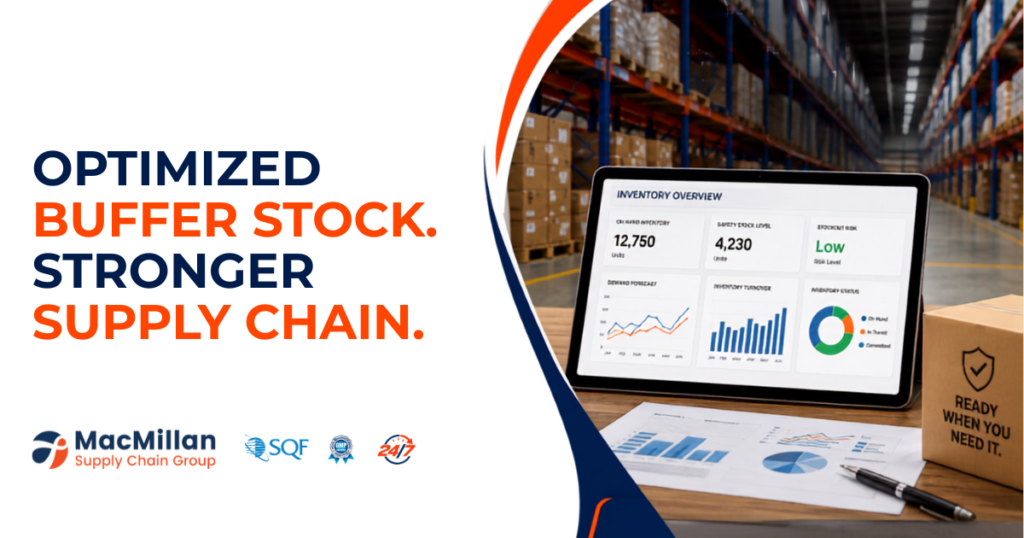
Supply chain demand spikes can often lead to out-of-stock items, risking customer satisfaction. MacMillan helps your business maintain safety stock or buffer stock to meet customer demands even during disruptions or sudden seasonal increases. While having substantial buffer stock offers a safety net in 3pl warehousing, it also incurs significant costs. By employing reliable strategies and leveraging expert insights, you can balance customer demand with optimized operations. Expertise in logistics enables you to provide an exceptional customer experience through order fulfillment, while effectively managing 3PL warehousing challenges and minimizing costs. What is buffer inventory? A buffer serves as a protective layer against potential disruptions within 3PL warehousing operations. Buffer inventory, which is also known as safety stock, or supply chain safety net is a surplus of inventory stored in a warehouse to mitigate risks, logistics failures, transportation delays or unexpected demand spikes. The amount of buffer inventory to be kept depends on several factors such as the type of products sold, average production lead times, historical inventory and order accuracy trends. While some demand changes can be anticipated, such as during flash sales or organized promotions, other increases in sales might be unexpected, as seen with face masks during the COVID-19 pandemic. Safety stock vs buffer inventory The terms “buffer inventory” and “safety stock” are often used interchangeably, both referring to the extra stock an e-Commerce business maintains to protect against potential supply operations and demand uncertainties. In some contexts, “buffer inventory” specifically refers to unexpected spikes in product demand. While “safety stock” means inventory reserved for disruptions in the 3PL warehousing operations, like supplier delays or production halts. Ultimately, both aim to ensure sufficient inventory is available to meet demand and maintain order accuracy rates. MacMillan offers trackable inventory systems for customers for higher accuracy rates and zero errors. What are the benefits of Safety stock? Maintaining buffer stock provides several advantages, minimizing the value of investing in additional inventory. Benefits of having a safety stock in 3PL warehousing are as follows: What are the strategies to optimize buffer Inventory levels? Maintaining the right amount of inventory is crucial as too much inventory can increase capital and costs. While less inventory can lead to stockouts and missed sales opportunities. Here are essential factors to consider when determining your safety stock levels: Lead Time Variability If your lead times are unpredictable, it’s important to maintain higher inventory levels to account for potential delays, ensuring you can meet demand consistently. Inventory Accuracy The accuracy of your demand forecasts directly impacts on your safety stock requirements. When forecasts are reliable, you can keep lower safety stock levels. Acceptable Service Levels Service levels refer to the percentage of time you aim to avoid stockouts. Higher service levels indicate more buffer stock. Cost of Carrying Inventory Evaluate the costs associated with maintaining inventory, including storage and the opportunity cost of tied-up capital. To optimize operations of your safety stock levels, consider the following strategies: Regularly Review and Adjust Inventory Levels: Adapt to changes in lead times, demand patterns, and service level targets. Implement Robust Demand Forecasting Methods: Enhance order accuracy to reduce the need for excessive buffer stock. Collaborate with Suppliers: Work with suppliers to reduce lead time variability and improve reliability. Monitor Inventory Performance Metrics: Continuously analyze metrics such as turnover rates frequency to identify areas for improvement. How to calculate buffer inventory levels? Determining the appropriate amount of buffer inventory is crucial for maintaining 3PL warehousing operations, but it’s not a one-size-fits-all scenario. For accurate buffer inventory, you’ll need robust analytics and reporting tools. These tools provide detailed insights such as historical order data, SKU performance, and demand forecasting. Access to this data allows you to calculate the amount of buffer inventory needed to optimize 3PL warehousing storage and ensure timely order fulfillment. Safety Stock Calculation Methods Basic Safety Stock Formula Formula: Safety Stock = (Maximum Daily Usage × Maximum Lead Time) – (Average Daily Usage × Average Lead Time) Approach: Ideal for scenarios where demand and lead times are relatively stable. Service Level Method Formula: Safety Stock = Z-score × Standard Deviation of Demand × √Lead Time Approach: Suitable for businesses aiming to meet a specific service level target, ensuring a high probability of fulfilling customer demand. Time-Based Calculations Approach: Utilize previous sales information and forecasted demand to set dynamic safety stock levels. Adjustments: Modify safety stock based on demand fluctuations, such as seasonal trends. Regularly review and update buffer levels as new data becomes available. Usage: Best for businesses with predictable demand patterns and reliable forecasting capabilities. Heizer and Render’s Method (for Lead Time Variability) Formula: Safety Stock = Z-score × √((Lead Time × Demand Variance) + (Average Demand² × Lead Time Variance)) Approach: Effective when lead times are inconsistent, incorporating both demand and lead time variability. Buffer Stock calculations: Demand and Lead Time Stability: Evaluate how stable and predictable your demand and lead times are. Data Availability and Accuracy: Ensure you have access to accurate historical sales data and reliable forecasts. Desired Service Level: Determine your service level goals and understand the costs associated with achieving them. Calculation Complexity: Assess the complexity of the chosen method and the resources required to implement and maintain it. How much safety stock 3PL warehousing needs? Managing buffer stock is an ongoing 3PL warehousing process that requires regular attention and adjustment. Here are some strategies to help optimize your safety stock: Conduct 3PL warehousing reviewsContinuously monitor inventory levels, demand patterns, and 3PL warehousing performance. Adjust buffer inventory based on evolving conditions. Prevent OverstockingRegularly assess inventory turnover rates to reduce excess stock that ties up capital and increases carrying costs. Implement strategies like Just-In-Time (JIT) or Economic Order Quantity (EOQ) to optimize stock levels. Strategically Distribute StockIf your business operates in multiple 3PL warehouses, consider strategically distributing buffer inventory across these facilities. Outsource to a 3PL like MacMillan SCG 3PL warehousing and fulfillment can be demanding, consuming time, resources, and effort. However, leveraging the capabilities of a technology-driven 3PL provider such