
What It Means to Have Time Critical Shipments
Time-critical shipments can be defined in many ways. Critical shipping involves urgent and efficient logistics management of goods that must be delivered to the customer within a very specific time frame to reduce or eliminate supply chain issues due to production defaults, accidents, breakdowns, natural circumstances and more. However, providing time-critical services is beyond simply getting a shipment to its destination at a specific time. Many express carriers offer additional services like product visibility through track-and-trace devices, special handling and care, extra security and so on. There are many factors involved in time-critical shipments and it may require many parties to ensure shipping needs are optimized without compromising service levels. The likelihood of financial losses and reduction in service levels is high for businesses worldwide if time-critical logistics solutions are not put in place. Hence, companies rely on logistics experts to avoid costs associated with downtime as much as possible. The conditions for this strategy are critical environments, efficient logistics and well-organized procurement programs. Different Time-Critical Shipments Options There are different time-critical shipment options available for your time-sensitive needs depending on the urgency of your shipment. Time-Critical Shipping Often the term time-critical shipping and expedited shipping are used interchangeably but they are quite different as one is characterised by speed while the other is characterised by strict deadlines. With expedited shipping, products must be delivered fast which can be achieved with same-day delivery. While time-critical shipments must arrive as soon as possible, which means that if the goods are needed in three days, then they only have to be delivered within the window frame of the deadline. Time-critical shipments benefit many businesses across different industries from the timely delivery rates of a vital part of semiconductors to documents of vital importance which could determine the failure or success of securing a new contract. To seamlessly manage time-critical shipments alongside your logistic partners, there must be effective communication which portrays your clear intent as a business. This helps the logistic providers to deliver on their promises of time-critical services which may include knowing the mode of transportation that best suits your shipping needs (for example, air freight instead of a cargo van) providing enough drivers for a straight truck to avoid the need to stop and rest, hence avoiding failed delivery. About 38% of customers say they’ll never shop with a retailer again following a negative delivery experience, making it all the more important to provide fast shipping every time. Expedited Shipping This is a time-critical shipping method that ensures that shipments delivery are prioritized so that they take less time than usual to arrive at their destination examples include next-day delivery, overnight delivery and so on. It is relative to how long the standard shipping method takes which varies according to the logistic partner, the distance the goods are being shipped from and to, and the mode of transportation. For example, a standard shipping time can take days, weeks or even months depending on the distance and mode of transport. And since expedited shipping is relative to standard shipping, it may take hours, days or weeks for delivery times, as long as it’s faster. Though faster delivery time has its advantages and often may put the brand on the customers’ good side because it leads to customer satisfaction which in turn leads to brand loyalty and increased sales. It is however important to weigh the pros and cons of offering expedited shipping for your customers. Pros of Expedited Shipping The need for storage space is reduced; if storage is a concern for your business, Shipping out goods as quickly as possible may be a great way to clear out some space, mainly if you sell bulky or highly-valued items. The biggest advantage of expedited shipping is its speed and guarantee. This timeliness not only ensures customer satisfaction but also boosts loyalty and sales. Lower risks of damages due to less handling because expedited shipments make fewer or no stops along their delivery routes. Again, this makes it an attractive option for businesses that deal in fragile goods. Cons of Expedited Shipping Expedited shipping incurs an extra shipping cost which may quickly eat into your profit margin unless you sell high-ticket items and can easily offset some or all of the cost to your buyers. Not all delivery companies offer expedited shipping which may affect some businesses whose nature of items are time-sensitive such as perishable goods and medical supplies. White-Glove Delivery Services While this method may not entirely require a time-critical delivery date, it is however the delivery approach used for commodities with specific needs. It is also a way to inject additional values into the freight delivery process which includes but is not limited to protective packaging for fragile items using premium packaging materials, product assembly or dismantling and delicate handling by courier services. Many business-to-business and business-to-consumer companies often use white-glove delivery services to ensure the safe and speedy delivery of goods. And white-glove service is critical for certain events when items must arrive at a specific location at a specific time. For example, a bakery business can maintain the fresh, delicious reputation of their baked goods, expensive medical and lab supplies such as MRI equipment and lab specimen refrigerators can be kept secured and sterile using a white-glove delivery service. Other products that benefit from white-glove delivery are electronic devices, home appliances and furniture, automotive and aviation, retail and e-commerce stores. For these businesses, the ability to get their products to customers as quickly and safely as possible makes all the difference. Conclusion The current events surrounding your business will help in making an informed decision on the option of time-critical shipments to adopt. At Macmillan Supply Chain Group we offer a variety of cost-effective customized solutions for critical deliveries beyond all modes for your transportation needs. Whether you need the fastest route for your critical freight or you need an expert opinion to make sure your supply chain is optimized and cost-effective. If you’d like to
Work With an Ecommerce Fulfillment Company in the GTA
As an online store business owner, offering the best customer experience extends beyond having a great social media presence, email marketing or easily navigated website design. If you don’t have an e-commerce fulfillment strategy that best meets your customer’s expectations in place, you’re not going to build a community of loyal customers. What is E-commerce Fulfillment? E-commerce fulfillment refers to the entire process involved in getting an order delivered to a customer. It entails the processing, pickup, packaging and shipping of online orders to the final customer. However, it goes beyond just picking, packing and sending out orders. The best e-commerce fulfillment strategies involve an ordered procedure that results in e-commerce orders getting delivered to the end customer and in return help transform logistics into a revenue driver through improved conversions and increased sales. The following steps elaborate the individual services and workflows that sum up an e-commerce order fulfillment service. Steps in E-commerce Fulfillment Services The order fulfillment process extends through one or more distribution centers and typically includes inventory management, supply chain management, quality control, order processing and customer service in distinct steps. Order Fulfillment Services Order fulfillment services are often used interchangeably with e-commerce fulfillment. A fulfillment service refers to the act of picking, packing and getting orders delivered to customers. All e-commerce businesses are responsible for order fulfillment, whether you’re an online business that self-fulfill orders or partners with a fulfillment service provider. Partnering with MacMillan Supply Chain Group helps set your business apart from market competitors. There’s no order fulfillment process without the customer first making a purchase online, afterwards, the items are picked, packed and inspected for damage in the warehouse or fulfillment centers and then sets on their delivery journey. Order Management This is a broad concept of the overall visibility of your customer orders from when they get placed to when they get delivered. It involves receiving, tracking and fulfilling e-commerce orders across sales channels. This helps you monitor each status of any order (such as processing, pending or received, etc.), as well as being aware of when there’s a stockout or a change in customers’ buying patterns and preferences. Inventory Management Inventory management is overseeing an e-commerce business’ stocked products. It includes receiving inventory, inventory storage and restocking inventory. The most important aspect of inventory management is finding a balance between how much or how little inventory to have on hand to avoid stockouts or backorders and additional costs due to prolonged storage. E-commerce Shipping The shipping costs and delivery method you offer your customer are dependable on the type of items you’re shipping out (E.g., heavyweight, perishable or highly-valued), the delivery-goods location and destination, the delivery speeds and the technology and resources at your disposal. Small e-commerce businesses may handle their shipments themselves by using the nearest post office or a local FedEx store to deliver the goods. Bigger, more established online retailers will adopt fulfillment companies to enjoy faster and discounted shipping rates for their larger monthly order volume. Warehouse Management System Warehousing refers to storing inventory before orders are placed or fulfilled. The goods are safely and securely stored in an orderly manner for easy and quick allocation once orders are placed. Third-party logistics store inventory in their fulfilment center and ship orders to customers directly from there. Returns Management This leg of e-commerce fulfillment involves receiving, accessing and restocking returned items unless damaged or malfunctioning. This is also the stage of e-commerce fulfillment that incorporated customer service and support for handling complaints. Depending on the product condition, some e-fulfillment services let returns be sent to the e-commerce business instead of the fulfillment center. Fulfillment Software E-commerce fulfillment software is the digitized means by which inventory and order management as well as picking, packing and delivery processes are handled. It is the technology that allows a real-time connection and tracking between e-commerce fulfillment providers and business owners. International Order Fulfillment International fulfillment involves the fulfillment of goods and products to customers who live in countries outside of where your e-commerce business is based. The options available for this are either working with a fulfillment company located abroad or shipping orders from your location to other countries. You may wish to start selling in the Greater Toronto Area or offer affordable shipping to customers in Canada. Working with a skilled fulfillment expert can help you easily navigate your international shipping capabilities. Choosing The Best E-commerce Fulfillment Solution Sometimes, the line between being able to outsource e-commerce fulfillment to third-party logistics (3PLs) or continuously adopting a self-fulfillment solution can be blurry. But it helps to know the physical and financial costs associated with adopting either e-commerce fulfillment solution. The Cost of Self-Fulfillment Other certain insignificant costs come with self-fulfilling orders asides from the shipping costs. And they are easily overlooked until you get stressed out by the scarcity of an essential material needed in your order fulfillment. Examples may include tools and packing supplies, transportation costs and car maintenance, dealing with unhappy customers which may sometimes jeopardize the future business, human error due to lack of integrated technology and so on. The Cost of third party logistics (3PLs) Fulfillment The rates of most 3PLs fulfillment differ, but the common costs you’ll come across are for; the acceptance and arrangement of incoming inventory, storage costs per -SKU, shelf or pallet, custom branded packing materials, specially assembled orders (kitting) and delivery. 3PL fulfillment companies offer bulk discounted rates because they work with thousands of e-commerce businesses. E-Commerce Fulfillment in Toronto When an e-commerce business hit a certain milestone, it will either partner with 3PL or invest in the infrastructure, pieces of equipment, resources and workforce to oversee order fulfillments itself. However, partnering with a 3PL allows you to make room for investments in other critical business areas like marketing and enhancing your product. Third-party logistics companies provide high-level expertise that let online business drive fulfillment for efficiency and maximum customer satisfaction. If you’d like to work with an e-commerce
Top Trends for Canadian 3PL Companies in 2026: Fulfillment, Logistics, and Growth in a Thriving Market
The logistics industry in Canada is growing at an impressive rate, with 2023 poised to bring in new macro trends that will impact the third-party logistics (3PL) industry. The need for efficient distribution networks to meet the demands of e-commerce has led to the rise of omnichannel distribution, and 3PL providers are developing technology platforms for real-time visibility and inventory management. In response to the emphasis on sustainability, 3PL providers in Canada are focusing on implementing sustainable practices in their operations. Advancements in technology such as AI, blockchain, and IoT are being adopted to improve supply chain visibility and efficiency, while automation technologies are helping reduce labor costs and increase productivity. The shift towards nearshoring is also likely to continue in 2023, with an increase in demand for services that support domestic supply chains. This blog will explore these trends and what they mean for the future of 3PL in Canada. Table of Contents E-commerce and Omnichannel Distribution Emphasis on Sustainability Advancements in Technology Increased Adoption of Automation Shift to Nearshoring 5 Third Party Logistics Trends in Canada in 2026 1. E-commerce and Omnichannel Distribution The growth of e-commerce in Canada has been one of the biggest drivers of the 3PL market. With more and more consumers turning to online shopping, businesses must optimize their distribution networks to meet demands. This has led to the rise of omnichannel distribution; where companies use multiple channels to fulfill orders, such as online marketplaces, brick-and-mortar stores, and distribution centers. To support these complex networks, 3PL providers are developing sophisticated technology platforms that allow for real-time visibility and inventory management. In addition, the use of value-added services, such as order fulfillment and delivery times, has become increasingly important for e-commerce businesses looking to gain a competitive advantage in the Canadian market. 3PL companies can provide these services to help businesses improve their customer satisfaction and increase their revenue. 2. Emphasis on Sustainability Sustainability is becoming an increasingly important consideration for businesses and consumers alike. In response, many 3PL providers in Canada are focusing on implementing sustainable practices in their operations. The use of electric vehicles is one of the most effective ways to reduce carbon emissions and transportation costs. Additionally, companies are adopting sustainable practices such as green packaging, reducing the amount of touches a package can go through, and implementing reverse logistics. These practices not only reduce a company’s environmental impact but can also lead to cost savings and improved customer satisfaction. 3. Advancements in Technology In 2023, we can expect to see more companies implementing technologies such as artificial intelligence (AI), blockchain, and the Internet of Things (IoT) to improve supply chain visibility and efficiency. These technologies can help reduce costs, improve operational performance, and enhance the overall customer experience. With the use of big data, 3PL providers can analyze customer behavior and demand patterns to better forecast inventory needs and optimize their logistics operations. Furthermore, real-time tracking of inventory and shipments through the use of IoT sensors can improve transparency and efficiency in the supply chain. 4. Increased Adoption of Automation Automation has been a key trend in the logistics industry for several years, and in 2023, we expect to see even more widespread adoption. With the rise of e-commerce, businesses are under increasing pressure to fulfill orders quickly and accurately. Automation technologies such as robotics, drones, and automated storage and retrieval systems (AS/RS) can help companies achieve these goals. Additionally, automation can help reduce labor costs and increase productivity, making it an attractive option for many 3PL providers. Real-time visibility of inventory through automated systems can also improve inventory management and minimize errors. 5. Shift to Nearshoring As a result of the disruptions caused by the COVID-19 pandemic, many companies are re-evaluating their supply chain strategies. This has led to a trend towards nearshoring or bringing production closer to home. This shift is likely to continue in 2023, which means that 3PL providers in Canada may see an increase in demand for services that support domestic supply chains. 3PL companies with a large warehouse and distribution space in the Greater Toronto Area (GTA) can offer businesses a better choice for cost-effective transportation services and distribution costs. Furthermore, a qualified team of industry experts can assist businesses in developing their core competencies in supply chain management and product development, providing additional services and benefits to their customer base. Conclusion: Third Party Logistics Canada The logistics industry in Canada is undergoing a significant transformation with new trends that require 3PL providers to be adaptable and innovative to meet the changing needs of their clients. The growing importance of sustainability, technology, and automation is expected to continue shaping the industry in the coming years. The adoption of new technologies can help 3PL providers increase efficiency, reduce costs, and enhance customer experience. Furthermore, the shift towards nearshoring will have an impact on the logistics industry in Canada, and 3PL providers can position themselves for success by supporting this trend. The future of the logistics industry in Canada is promising and offers significant opportunities for growth and development. Sources “The Future of Canadian Logistics and Third-Party Logistics (3PL) Services.” Global Trade Magazine, 17 Aug. 2021, https://globaltrademag.com/the-future-of-canadian-logistics-and-third-party-logistics-3pl-services/. “5 Trends Shaping the Future of Canadian Logistics.” UPS Compass, 11 Oct. 2021, https://compass.ups.com/5-trends-shaping-future-canadian-logistics/. “3PL Industry Trends to Watch in 2023.” Cerasis, 3 Jan. 2023, https://cerasis.com/3pl-industry-trends-to-watch-in-2023/. “Canadian Logistics Overview,” TIACA. “2023 Logistics Industry Outlook: Key Trends and Predictions,” Armstrong & Associates. “Third-Party Logistics Market in Canada – Growth, Trends, and Forecasts (2020-2025),” Mordor Intelligence. Frequently Asked Questions What are the major third-party logistics (3PL) trends in Canada in 2026? Major 3PL trends in Canada include e-commerce and omnichannel fulfillment, sustainable logistics practices, AI-driven supply chain management, warehouse automation, and nearshoring to strengthen domestic supply chains. How is e-commerce changing the 3PL industry in Canada? E-commerce is increasing demand for faster order fulfillment, real-time inventory tracking, efficient returns management, and flexible distribution networks. 3PL providers help businesses manage orders across online marketplaces, retail stores, and other sales
Outsourcing Order Fulfillment: Why It’s the Right Choice for Your Business
In today’s competitive business landscape, staying ahead of the curve is crucial for sustained growth and customer satisfaction. One area that can significantly impact your success is order fulfillment. You might be wondering whether outsourcing fulfillment is the right move for your business. In this blog post, we will explore the advantages of outsourcing your fulfillment. 11 Benefits of Outsourcing Your Order Fulfillment 1. Optimize for Growth and Scale Easily By outsourcing fulfillment operations, you can tap into the expertise of a third-party logistics provider (3PL) that specializes in streamlining processes, utilizing advanced technologies, and enhancing efficiency. One of the major challenges businesses face as they grow is managing increasing order volumes. Outsourced fulfillment offers a flexible solution that seamlessly accommodates your scaling needs. Fulfillment partners can handle container destuffing, cross-docking, and much more. They have the infrastructure, resources, and personnel to handle fluctuations in demand, allowing you to meet customer expectations without the burden of building and managing your own warehouse and distribution network. 2. Cost Savings and Operational Efficiency Fulfilling orders in-house requires significant investments in infrastructure, equipment, technology, and human resources. Outsourcing to a third party logistics provider in Canada eliminates these capital expenses and replaces them with a scalable pricing model, often based on the volume of orders processed. 3. Expertise and Focus Fulfillment service providers specialize in order processing, inventory management, shipping, and logistics. By leveraging their expertise, you gain access to a team of professionals dedicated to ensuring seamless order fulfillment. With their knowledge and experience, they can implement best practices, reduce errors, improve accuracy, and expedite delivery, resulting in enhanced customer satisfaction. By outsourcing fulfillment, you free up valuable time and resources to concentrate on strategic initiatives that drive business growth. 4. Geographic Reach and Faster Shipping Outsourcing fulfillment can create opportunities to expand your customer base by tapping into new markets. Fulfillment partners often have multiple warehouses strategically located to facilitate faster shipping and reduce transit times for their e-commerce fulfillment clients. Their size may also allow them to leverage a vast network for shipment and deliveries – this enables you to offer competitive shipping options, including same or next-day delivery, strengthening your market position and delighting customers with timely order fulfillment. 5. Scalable Technology Integration Modern fulfillment providers leverage cutting-edge technology and systems to manage inventory, process orders, and track shipments. By outsourcing, you gain access to these sophisticated tools and platforms without the need for upfront investments or ongoing maintenance costs. This seamless integration of technology enhances visibility, enables real-time tracking, and empowers you with valuable data insights to optimize your business operations further. 6. Skyrocket Your Efficiency Efficiency is the lifeblood of any business, and outsourcing order fulfillment can supercharge it. By entrusting your fulfillment needs to experts who specialize in streamlined processes, advanced technologies, and optimized logistics, you unlock a new level of efficiency. This newfound efficiency enables you to allocate more time and resources towards core business functions, such as marketing, product development, and customer engagement, ultimately driving your success to soaring heights. 7.Scale with Confidence Scaling your business can be a daunting task, especially when it comes to managing increased order volumes. But fear not, because outsourced fulfillment is your ultimate ally in conquering this challenge. Fulfillment partners possess the infrastructure, resources, and scalability required to handle fluctuations in demand seamlessly. By leveraging their expertise, you can confidently scale your operations without the burden of constructing and managing your own warehousing and distribution network. Say goodbye to scalability worries and hello to unlimited growth potential! 8.Unleash Cost-Saving Superpowers When it comes to financial success, outsourced fulfillment holds the key to unlock immense cost-saving superpowers. Building and maintaining an in-house fulfillment center demands substantial investments in infrastructure, technology, staffing, and ongoing maintenance. However, by outsourcing, you transform these fixed costs into variable costs that align with your order volume. This cost-effective approach optimizes cash flow, enhances financial predictability, and frees up capital to fuel innovation and strategic initiatives that drive your business forward. 9.Embrace Specialization and Expertise In the rapidly evolving world of order fulfillment, specialization is paramount. Outsourcing fulfillment allows you to tap into the specialized expertise of fulfillment service providers who excel in efficient order processing, inventory management, shipping, and logistics. These experts implement best practices, reduce errors, improve accuracy, and expedite delivery, ensuring unparalleled customer satisfaction. By outsourcing, you can harness their knowledge and experience to exceed customer expectations and establish your business as a true industry leader. 10. Reach New Horizons Expanding your market reach is vital for sustainable growth, and outsourced fulfillment opens up a world of possibilities. With multiple strategically located warehouses, fulfillment partners enable faster shipping and reduced transit times. This means you can effortlessly reach new geographic markets, offering competitive shipping options like same-day or next-day delivery. By providing an exceptional customer experience through timely order fulfillment, you can gain a competitive edge and cement your position as a market leader. 11. Unlock the Power of Advanced Technology Technology is the catalyst that propels businesses into the future, and outsourced fulfillment grants you access to cutting-edge technology without the burdensome investment. Fulfillment partners leverage advanced systems and platforms to efficiently manage inventory, process orders, and track shipments in real-time. This seamless integration of technology provides enhanced visibility, actionable insights, and empowers you to make data-driven decisions for optimizing your business operations. Embrace the power of technology and watch your business soar to new heights. MacMillan Supply Chain Group: Your Order Fulfillment Partner With MacMillan’s extensive expertise in supply chain management and logistics, we are dedicated to helping your business succeed. Whether you’re an established ecommerce brand or a growing online retailer, we understand the importance of efficient order fulfillment. By partnering with us, you can unlock a range of benefits, including streamlined processes, cost savings, and improved customer satisfaction. Our advanced technology and state-of-the-art fulfillment centers ensure accurate and timely order processing, while our dedicated customer service team is always ready to provide exceptional support. With
8 Third-Party Logistics KPIs to Measure for Performance
When embarking on the journey to select an ideal Third-Party Logistics (3PL) provider, the significance of aligning key performance indicators (KPIs) with your overarching business goals and the nuanced demands of your supply chain cannot be overstated. The prospect of delving into this process need not appear as an intimidating endeavor; rather, this blog serves as a comprehensive and guiding checklist to shepherd you through this intricate decision-making process. In a world where logistics management can be the lynchpin of operational excellence, careful consideration of these factors is paramount. Here, we delve deeper into a myriad of KPIs that merit careful contemplation and assessment as you navigate the intricate terrain of selecting the most fitting 3PL partner for your unique enterprise: The Third-Party Logistics KPIs to Monitor 1. On-Time Delivery The significance of the On-Time Delivery metric reaches far beyond the confines of a mere numerical value; it serves as a profound reflection of a company’s reliability, unwavering commitment, and customer-centric approach. By meticulously calculating the proportion of shipments that are consistently delivered in accordance with pre-established schedules, a business showcases its dedication to upholding customer satisfaction as well as the seamless flow of its supply chain operations. This metric stands as a tangible testament to the organization’s ability to honor promises made to customers, solidifying trust and loyalty. 2. Order Accuracy The profound importance embedded within the Order Accuracy KPI reverberates across a myriad of facets within a company’s operations. It serves as a direct and impactful gauge of customer contentment, acting as a pivotal factor in mitigating the occurrence of returns, exchanges, and the need for corrective actions. Each and every precisely fulfilled order contributes as a foundational building block to creating a positive and memorable customer experience. This meticulous attention to order accuracy not only drives customer loyalty but also significantly contributes to the overall reputation and brand image of the company. 3. Inventory Accuracy The meticulousness with which a 3PL maintains its inventory records carries a ripple effect that resonates from the very shelves of its warehouse to the overarching bottom line. By deftly avoiding the pitfalls of stockouts, overstocks, and any discrepancies in inventory levels, a business ensures the consistent availability of the right products precisely when they are needed. This level of precision has a direct and positive impact on sales performance, while simultaneously optimizing the utilization of capital. It’s essentially a harmonious synergy between operational finesse and financial prudence. 4. Lead Time In today’s rapidly evolving business landscape, time is an invaluable asset. The measurement and analysis of the time span between the initiation of an order and its successful dispatch encapsulate a company’s operational agility and efficiency. A shortened lead time functions as a formidable asset in a company’s arsenal, enabling it to adeptly respond to the ever-shifting sands of customer preferences and market trends. This agility, rooted in reduced lead times, not only enhances customer satisfaction but also positions a company as a proactive player in the market. 5. Capacity and Scalability As a business embarks on its journey of growth, so do its operational demands. Ensuring that a chosen 3PL partner can not only effectively handle the current order volumes but also possesses the flexibility to seamlessly scale alongside the company’s projected growth trajectory is the cornerstone of a truly sustainable partnership. The pursuit of alignment between a company’s expansion aspirations and the operational capabilities of its chosen 3PL guarantees a seamless journey toward mutual success. 6. Technology and Integration In an era where digital prowess is not just a competitive edge but a prerequisite, the evaluation of a 3PL’s technological capabilities is no longer a choice—it’s an imperative. Scrutinizing the sophistication of their warehouse management systems, the efficacy of their order tracking mechanisms, and the seamlessness of their integration with a company’s internal systems are pivotal factors in ensuring a landscape of efficient operations and comprehensive visibility. A technologically advanced 3PL translates into streamlined processes and heightened competitiveness. 7. Customer Service and Communication At the heart of any enduring partnership lies the bedrock of effective communication. Beyond the realm of operational metrics, the responsiveness, transparency, and adeptness of a 3PL in swiftly addressing and resolving issues are crucial aspects to consider. Integrating these facets within the framework of a Service Level Agreement (SLA) nurtures an environment of collaboration and mutual understanding, bolstering the partnership’s resilience in the face of challenges. 8. Returns Management Often underestimated, the domain of returns management has substantial influence over a company’s overall customer satisfaction. A meticulously orchestrated returns process extends far beyond a mere cost-saving measure; it’s a pivotal avenue for elevating the entire customer experience and fostering brand loyalty. A seamless and customer-centric returns process is a testament to a company’s commitment to not only delivering products but also nurturing enduring relationships with its customers. Conclusion: Third-Party Logistics KPIs In the ever-evolving tapestry of industries, the relevance of specific KPIs is intrinsically linked to factors such as your industry vertical, business model, and the strategic aspirations of your supply chain. If you’re curious to learn more about MacMillan’s approach to crafting, managing, and transparently reporting KPIs, feel free to reach out to our Director of Sales and Marketing, Monika Lojek. In a landscape characterized by relentless change and heightened customer expectations, the endeavor to optimize logistics is an important step to take. Frequently Asked Questions What are the most important KPIs to monitor when choosing a 3PL provider? The most important 3PL KPIs include on-time delivery, order accuracy, inventory accuracy, lead time, capacity and scalability, technology integration, customer service, and returns management. These metrics help evaluate a provider’s efficiency and reliability. How does on-time delivery impact supply chain performance? On-time delivery measures the percentage of shipments delivered according to the agreed schedule. A high on-time delivery rate improves customer satisfaction, builds trust, and helps maintain a reliable supply chain. Why is inventory accuracy important when evaluating a 3PL partner? Inventory accuracy ensures that recorded stock levels match actual warehouse inventory.
Section 321 & Canadian 3PLs: 2026 Guide
If you’ve ever wondered why some online stores thrive while others struggle, the secret often lies in how they handle order fulfillment. Did you know that 48% of online shoppers will abandon their carts if delivery takes more than a week? These stats highlight the importance of efficient e-commerce fulfillment. Effective e-commerce fulfillment is not merely a logistical requirement but a vital element in fostering customer satisfaction and facilitating business growth. It involves establishing a seamless connection between your products and customers, thereby ensuring that each order not only fulfills a need but also reinforces the strength and reliability of your brand. In this blog, we will explore the fundamental aspects of e-commerce fulfillment, aiming to assist you in optimizing time efficiency, minimizing costs, and enhancing customer satisfaction. What Is E-Commerce Fulfillment and Why Does It Matter? E-commerce fulfillment is a critical section of your supply chain, involving the reception of bulk goods, the storage of stock-keeping units (SKUs), and the execution of order processing, which includes picking and packing, as well as the delivery of products to customers. The key processes in this segment include: Inbound Shipments: E-commerce fulfillment facilitates the arrival and placement of products on shelves in e-commerce fulfillment centers. Warehousing and Storage: It strategically stores SKUs in inventory for future orders. Order Fulfillment: It involves the meticulous process of selecting and packaging orders for dispatch. Order Delivery: The shipping phase is where orders are transported to customers. Reverse Logistics: Managing the returns process and ensuring efficient handling of returned goods. E-commerce fulfillment involves ensuring that products are stored correctly, orders are processed efficiently, and customers receive their purchases promptly and in good condition. Good fulfillment practices can lead to happier customers and more successful business operations. The E-Commerce Fulfillment Process An e-commerce fulfillment process commences upon a customer’s online purchase of a product and concludes with the delivery of that product. Let’s explore the list of various types of e-commerce fulfillment services: Order Fulfillment Services This fundamental service encompasses the selection, packaging, and dispatch of products to customers. Specialist 3PLs, such as MacMillan, enhance this process, ensuring efficiency and effectiveness for e-commerce entities. Order Management This involves the tracking of all customer orders. It includes monitoring the status of each order, analyzing customer purchasing patterns, and managing inventory levels to prevent stock shortages. Inventory Management This crucial step involves the administration of a business’s product inventory. It encompasses the storage, replenishment, and estimation of required stock levels, aiming to perfectly balance supply with customer demand. E-Commerce Shipping Shipping is the method of product delivery to customers. It varies depending on the origin and destination of the shipment, the nature of the products, and the desired speed of delivery. Businesses range from self-handling shipments to collaborating with carriers for optimized rates. Warehousing This refers to the storage of products prior to their purchase. Warehousing solutions can range from modest in-house storage to extensive warehouse facilities, with a focus on maintaining product safety and organization. Returns Management This process involves the handling of returned merchandise, including its receipt, inspection, and reintroduction into available inventory. Given the nature of online shopping, an efficient returns process is vital. Fulfillment Software This technology streamlines the fulfillment process by linking e-commerce platforms with fulfillment centers. It provides real-time updates on orders and inventory, and can strategically allocate orders to the most suitable fulfillment center. International Order Fulfillment This pertains to the fulfillment of orders for international customers, a process complicated by varying international regulations, tariffs, and taxes. Collaboration with experienced fulfillment providers is advisable to navigate these complexities. Pick and Pack Fulfillment This operation involves retrieving items from storage and preparing them for shipment upon receipt of an order. Efficiency in this process is key, whether it involves batch picking or specialized packing stations. Kitting and Assembly Employed for products that require specific assembly or arrangement before shipping, this service involves additional steps such as the combination of various components, which may require more time and resources. Each of these components plays a pivotal role in the smooth operation of an e-commerce business, contributing to overall efficiency, customer satisfaction, and business growth. Choosing the Right E-Commerce Fulfillment Model for Your Business E-commerce fulfillment is a critical aspect of any online business, impacting customer satisfaction and operational efficiency. As your business evolves, so too might your fulfillment strategy. Understanding the different models available can help you make the best choice for your business at each stage of its growth. 1. In-House Fulfillment This approach involves the complete management of the fulfillment process internally, ranging from utilizing a modest space like a spare room for initial storage to potentially expanding into a full-scale warehouse as the business grows. Why choose it? Autonomy in Operations: It provides the freedom to manage every aspect of the fulfillment process, ensuring each order adheres to the highest standards set by the business. Personalized Customer Experience: It offers the opportunity to customize packaging and include unique additions such as thank-you notes or promotional items, thereby enhancing the overall customer experience. Operational Flexibility: Enables the ability to make swift modifications to orders and address customer-specific requests or concerns promptly. Considerations: Scalability Challenges: Increasing order volumes can place substantial demands on both time and space, potentially impeding the business’s ability to grow effectively. Resource-Intensive: Requires significant investment in physical space, equipment, and staff. Managing logistics can become a complex task that diverts attention from other business areas. 2. Outsourced Order Fulfillment (3PL) Outsourced order fulfillment, commonly known as Third-Party logistics (3PL), involves delegating the entirety of supply chain management to external logistics providers. Companies like MacMillan assume responsibilities for storing, selecting, packaging, and dispatching products. Why choose it? Access to Expertise: Engaging with a 3PL provider allows businesses to benefit from their extensive experience and specialized resources, leading to more streamlined and professional fulfillment operations. Scalability: 3PL services are inherently scalable, efficiently accommodating an increase in order volumes without necessitating additional investment in space or personnel by the business. Cost
E-commerce Fulfillment Guide 2026
If you’ve ever wondered why some online stores thrive while others struggle, the secret often lies in how they handle order fulfillment. Did you know that 48% of online shoppers will abandon their carts if delivery takes more than a week? These stats highlight the importance of efficient e-commerce fulfillment. Effective e-commerce fulfillment is not merely a logistical requirement but a vital element in fostering customer satisfaction and facilitating business growth. It involves establishing a seamless connection between your products and customers, thereby ensuring that each order not only fulfills a need but also reinforces the strength and reliability of your brand. In this blog, we will explore the fundamental aspects of e-commerce fulfillment, aiming to assist you in optimizing time efficiency, minimizing costs, and enhancing customer satisfaction. What Is E-Commerce Fulfillment and Why Does It Matter? E-commerce fulfillment is a critical section of your supply chain, involving the reception of bulk goods, the storage of stock-keeping units (SKUs), and the execution of order processing, which includes picking and packing, as well as the delivery of products to customers. The key processes in this segment include: Inbound Shipments: E-commerce fulfillment facilitates the arrival and placement of products on shelves in e-commerce fulfillment centers. Warehousing and Storage: It strategically stores SKUs in inventory for future orders. Order Fulfillment: It involves the meticulous process of selecting and packaging orders for dispatch. Order Delivery: The shipping phase is where orders are transported to customers. Reverse Logistics: Managing the returns process and ensuring efficient handling of returned goods. E-commerce fulfillment involves ensuring that products are stored correctly, orders are processed efficiently, and customers receive their purchases promptly and in good condition. Good fulfillment practices can lead to happier customers and more successful business operations. The E-Commerce Fulfillment Process An e-commerce fulfillment process commences upon a customer’s online purchase of a product and concludes with the delivery of that product. Let’s explore the list of various types of e-commerce fulfillment services: Order Fulfillment Services This fundamental service encompasses the selection, packaging, and dispatch of products to customers. Specialist 3PLs, such as MacMillan, enhance this process, ensuring efficiency and effectiveness for e-commerce entities. Order Management This involves the tracking of all customer orders. It includes monitoring the status of each order, analyzing customer purchasing patterns, and managing inventory levels to prevent stock shortages. Inventory Management This crucial step involves the administration of a business’s product inventory. It encompasses the storage, replenishment, and estimation of required stock levels, aiming to perfectly balance supply with customer demand. E-Commerce Shipping Shipping is the method of product delivery to customers. It varies depending on the origin and destination of the shipment, the nature of the products, and the desired speed of delivery. Businesses range from self-handling shipments to collaborating with carriers for optimized rates. Warehousing This refers to the storage of products prior to their purchase. Warehousing solutions can range from modest in-house storage to extensive warehouse facilities, with a focus on maintaining product safety and organization. Returns Management This process involves the handling of returned merchandise, including its receipt, inspection, and reintroduction into available inventory. Given the nature of online shopping, an efficient returns process is vital. Fulfillment Software This technology streamlines the fulfillment process by linking e-commerce platforms with fulfillment centers. It provides real-time updates on orders and inventory, and can strategically allocate orders to the most suitable fulfillment center. International Order Fulfillment This pertains to the fulfillment of orders for international customers, a process complicated by varying international regulations, tariffs, and taxes. Collaboration with experienced fulfillment providers is advisable to navigate these complexities. Pick and Pack Fulfillment This operation involves retrieving items from storage and preparing them for shipment upon receipt of an order. Efficiency in this process is key, whether it involves batch picking or specialized packing stations. Kitting and Assembly Employed for products that require specific assembly or arrangement before shipping, this service involves additional steps such as the combination of various components, which may require more time and resources. Each of these components plays a pivotal role in the smooth operation of an e-commerce business, contributing to overall efficiency, customer satisfaction, and business growth. Choosing the Right E-Commerce Fulfillment Model for Your Business E-commerce fulfillment is a critical aspect of any online business, impacting customer satisfaction and operational efficiency. As your business evolves, so too might your fulfillment strategy. Understanding the different models available can help you make the best choice for your business at each stage of its growth. 1. In-House Fulfillment This approach involves the complete management of the fulfillment process internally, ranging from utilizing a modest space like a spare room for initial storage to potentially expanding into a full-scale warehouse as the business grows. Why choose it? Autonomy in Operations: It provides the freedom to manage every aspect of the fulfillment process, ensuring each order adheres to the highest standards set by the business. Personalized Customer Experience: It offers the opportunity to customize packaging and include unique additions such as thank-you notes or promotional items, thereby enhancing the overall customer experience. Operational Flexibility: Enables the ability to make swift modifications to orders and address customer-specific requests or concerns promptly. Considerations: Scalability Challenges: Increasing order volumes can place substantial demands on both time and space, potentially impeding the business’s ability to grow effectively. Resource-Intensive: Requires significant investment in physical space, equipment, and staff. Managing logistics can become a complex task that diverts attention from other business areas. 2. Outsourced Order Fulfillment (3PL) Outsourced order fulfillment, commonly known as Third-Party logistics (3PL), involves delegating the entirety of supply chain management to external logistics providers. Companies like MacMillan assume responsibilities for storing, selecting, packaging, and dispatching products. Why choose it? Access to Expertise: Engaging with a 3PL provider allows businesses to benefit from their extensive experience and specialized resources, leading to more streamlined and professional fulfillment operations. Scalability: 3PL services are inherently scalable, efficiently accommodating an increase in order volumes without necessitating additional investment in space or personnel by the
Dropshipping vs 3PL: Which Fulfillment Model Is Right for Your Business?
When discussing e-commerce, what typically springs to mind? Most likely, it’s the vast variety of amazing products available for purchase at your convenience. Yet, an equally crucial aspect of e-commerce is how these products reach the customers, a process just as important as the products themselves. As online shopping redefines the retail landscape, understanding and choosing the right e-commerce fulfillment model becomes a pivotal decision for every venture. In this blog, we’ll get into the heart of e-commerce operations, comparing two of the most influential fulfillment models: dropshipping and third-party logistics. While dropshipping offers a unique model for startups and SMEs to optimize shipping costs without maintaining inventory, 3PL provides a more comprehensive solution for handling logistics, storage, and distribution. Understanding the differences between dropshipping vs 3PL is beneficial and essential for businesses aiming to streamline their operations and enhance customer satisfaction. Both are popular e-commerce fulfillment models, but they cater to different needs and operational structures within e-commerce. With this blog, we aim to simplify the difference between dropshipping and third-party logistics, providing clarity for businesses grappling with the decision of which model best suits their needs. What is Dropshipping? Before getting into dropshipping vs 3PL, let’s touch up on what is dropshipping. Dropshipping is a streamlined order fulfillment method where online retailers sell products without owning or stocking them. This strategy is especially attractive to individuals seeking to establish an e-commerce website with limited financial resources. Unlike traditional retail, dropshipping eliminates the need for the retailer to buy or store inventory. This aspect significantly reduces the upfront costs and risks of starting a business. Retailers partner with manufacturers or wholesalers who own the products. These partnerships are crucial, allowing retailers to list products on their online stores without actually purchasing them. Let’s have a look at the process of dropshipping: How Does Dropshipping Work Key Features of Dropshipping To really understand dropshipping vs 3PL, let’s get a better understanding of what dropshipping entails: Reduced Capital Requirement: Since there’s no need to purchase inventory upfront, the capital requirement is significantly lower than in traditional retail models. Focus on Marketing and Customer Service: Retailers can concentrate on marketing their products and managing customer relations, as they don’t have to deal with inventory management or shipping logistics. Flexibility in Product Offering: Retailers can easily test new products without financial risk, as they don’t need to buy them in bulk. Higher Wholesale Prices: One trade-off in dropshipping is that suppliers generally charge higher wholesale prices as they handle storage and shipping. What is Third-Party Logistics (3PL) Fulfillment? Now that we’ve had a peek into what dropshipping is, let’s move forward with the next segment of understanding dropshipping vs 3PL. Third-party logistics, commonly known as 3PL, is a comprehensive fulfillment method businesses use to manage their inventory and shipping operations efficiently. This approach involves outsourcing various logistics-related activities to a specialized company. 3PL involves delegating key logistics services to an external company, including inventory management, order processing, packaging, and shipping. By outsourcing these tasks, businesses can concentrate on product development, marketing, and customer service, leaving the logistical complexities to the experts. Let’s have a look at how 3PL works: Now that we’ve had a peek into what dropshipping is, let’s move forward with the next segment of understanding dropshipping vs 3PL. Third-party logistics, commonly known as 3PL, is a comprehensive fulfillment method businesses use to manage their inventory and shipping operations efficiently. This approach involves outsourcing various logistics-related activities to a specialized company. 3PL involves delegating key logistics services to an external company, including inventory management, order processing, packaging, and shipping. By outsourcing these tasks, businesses can concentrate on product development, marketing, and customer service, leaving the logistical complexities to the experts. Let’s have a look at how 3PL works: How Does 3PL Fulfillment Work The main Features of 3PL Fulfillment Let’s understand the features of 3PL, to help in understanding the main differences of dropshipping vs 3PL: Inventory Storage: Businesses can store their products in the warehouses provided by the 3PL company, which is especially beneficial for those lacking storage space. Efficient Order Processing: 3PL providers like Macmillan are equipped to handle order processing swiftly and accurately, ensuring timely deliveries. Scalability: 3PL services can be scaled to accommodate increasing order volumes and storage needs as the business grows. Cost-Effectiveness: Outsourcing logistics can be more cost-effective than managing in-house, especially for businesses without the necessary infrastructure. Dropshipping vs 3PL: A Detailed Comparison When it comes to e-commerce fulfillment, the debate of dropshipping vs 3PL often centers on their shared approach to outsourcing key operations. However, the differences between these two models are substantial, each catering to unique business needs and strategies. In the following sections, we’ll delve into a side-by-side comparison of dropshipping vs 3PL, examining each aspect of these models to highlight how they differ and what they offer to e-commerce businesses. 1. Operational Focus and Business Goals In the dropshipping vs 3PL debate, dropshipping is characterized by its no-inventory approach. Rather, they depend on suppliers to dispatch products to customers, as orders are placed directly. This approach allows the seller to focus on other aspects of their business, such as marketing and customer service, while the supplier manages product storage, packaging, and shipping. Dropshipping places significant emphasis on marketing and the acquisition of customers. The vendor enables transactions between customers and manufacturers while also being responsible for marketing and customer relations. A more comprehensive model, the third-party logistics model incorporates inventory ownership and a more extensive emphasis on supply chain management. By utilizing 3PL, organizations can focus on product development and more extensive business strategies. Third-party logistics (3PL) requires businesses to maintain inventory ownership while delegating logistics to a specialized external provider, encompassing storage, handling, and shipping. This arrangement allows businesses to retain control over their stock, ensuring they can directly manage inventory levels and product selection. 2. Inventory Management and Financial Dynamics In the dropshipping vs 3PL comparison, dropshipping operates without vendor inventory, significantly reducing the initial capital required
E-commerce Fulfillment Costs: Complete Guide for 2026
As the busiest time of the year draws near, the effectiveness of your e-commerce fulfillment in peak season strategies comes into sharp focus. This crucial period, characterized by a significant increase in sales, tests the resilience and efficiency of your e-commerce operations. During peak season in e-commerce, your business transforms into more than just a retail outlet; it becomes a dynamic center of operations. The influx of orders is not just a revenue booster but a critical test of your ability to deliver satisfaction with each package. The hurdles in e-commerce fulfillment in peak season, such as inventory management and meeting accelerated shipping requirements, are always challenging. This blog aims to equip you with 15 essential strategies for e-commerce fulfillment in peak season, ensuring your business survives and flourishes during these high-demand times. E-commerce Fulfillment in Peak Season: Factors You Should Consider Achieving peak performance in e-commerce fulfillment in peak season is crucial for sustained growth and customer satisfaction. It’s not merely about surviving the high-demand periods; it’s about leveraging these challenges as opportunities for significant improvement and growth. Think about these important questions as you customize strategies to fit your specific business requirements: How can you harness the power of technology to make your fulfillment process more efficient? Today’s technological advancements offer many tools and systems designed to optimize operations. The right technology can be a game-changer, from inventory management software to automated shipping solutions. How can you build stronger, more collaborative relationships with your suppliers and logistics partners? Solid partnerships are the backbone of successful fulfillment. Open communication, mutual understanding of expectations, and flexibility can help build a resilient supply chain ready to adapt to the dynamic demands of peak seasons. How can you utilize data and insights from previous peak seasons to refine your future strategies? Historical data is a goldmine of insights. Analyzing past performance, customer feedback, and logistical challenges can guide your planning, helping you anticipate and mitigate potential issues before they arise. Engaging with these considerations for e-commerce fulfillment in peak season can transform challenges into stepping stones for success. This approach sets a solid foundation for your business to survive and excel during the busiest times of the year. The Challenges of E-commerce Fulfillment in Peak Season During peak seasons, e-commerce businesses encounter specific challenges in e-commerce fulfillment. Recognizing and tackling these obstacles is crucial for preserving efficiency and ensuring customer satisfaction. Below is an analysis of the main challenges in e-commerce fulfillment in peak season and strategies for their effective management: Managing Increased Demand Peak seasons often bring an overwhelming increase in product demand. This surge tests the limits of inventory management and shipping logistics. To tackle this, businesses need to ensure robust stock levels. Effective demand forecasting becomes crucial here. Though high demand is a positive sign, it requires strategic planning and resource allocation to ensure seamless fulfillment. Controlling Shipping Costs Shipping costs typically rise during peak periods due to increased demand. To mitigate this, businesses can negotiate with carriers for better rates, explore diverse shipping options, optimize packaging for cost-efficiency, and consider using shipping software or fulfillment centers. Additionally, passing some shipping costs to customers while maintaining transparency can be a viable strategy. Meeting Tight Delivery Schedules During peak seasons, the expectation for swift deliveries intensifies, making e-commerce fulfillment in peak season a critical focus. Challenges such as shipping delays caused by weather or logistical issues, particularly in areas with evolving infrastructure, necessitate a robust delivery system and thorough contingency planning. Staffing for Peak Demand A common challenge in e-commerce fulfillment in peak season is the requirement for extra staff to manage the surge in orders. Efficiently recruiting and training temporary staff is vital. Having a streamlined process to rapidly onboard new employees is essential to maintain operational efficiency during these peak periods. Handling Returns and Exchanges Peak seasons can also see an uptick in returns and exchanges. Having a clear, efficient returns policy is imperative. This helps manage the increased volume and maintain customer satisfaction and trust. Anticipating and preparing for these hurdles allows for smoother operations and a more positive customer experience. Top 15 Strategies for E-Commerce Fulfillment in Peak Season Excellence Navigating e-commerce fulfillment in peak season requires more than just hard work; it calls for a meticulously crafted strategy. The challenges during these high-demand periods are numerous, yet with the appropriate approach, they offer substantial opportunities for business growth and improving customer satisfaction. Let’s delve deeper into each strategy to ensure your e-commerce business thrives during these critical times: In-Depth Advance Planning Well ahead of the busy times, it’s crucial to prepare the foundation for e-commerce fulfillment in peak season. This preparation includes securing a strong inventory level and working closely with your shipping partners. Focus on strategies for handling order surges, emphasizing flexibility and scalability in your operations. Stocking of High-Demand Products Utilize historical sales data to pinpoint products that historically see a surge in demand. Proactively stocking these items helps avoid stock shortages, ensuring you’re well-equipped to meet customer needs without interruption. Refining Reorder Procedures Streamline your inventory management for more frequent restocking, particularly for your best-selling items. Prepare your team and suppliers for swift reordering processes. Employing advanced technology can greatly aid in making this process more efficient and less prone to errors. Elevating Reorder Thresholds Proactively adjust the reorder levels for your high-demand products. By doing so, you maintain a healthier stock level, significantly reducing the likelihood of facing stockouts during peak demand. Fortifying Vendor Networks It’s important to solidify your relationships with suppliers as part of your e-commerce fulfillment in peak season strategy. Being proactive in this way guarantees they are prepared for quick and larger orders, a key factor in maintaining a fluid and responsive supply chain. Broadening Shipping Partnerships Diversify your shipping options to meet customer delivery expectations better. This includes forming new partnerships and exploring various shipping methods to manage the increased volume of deliveries effectively. Holistic Preparation of E-commerce Supply Chain and Logistics Undertake a comprehensive
How to Make Big and Bulky Last-Mile Work For You
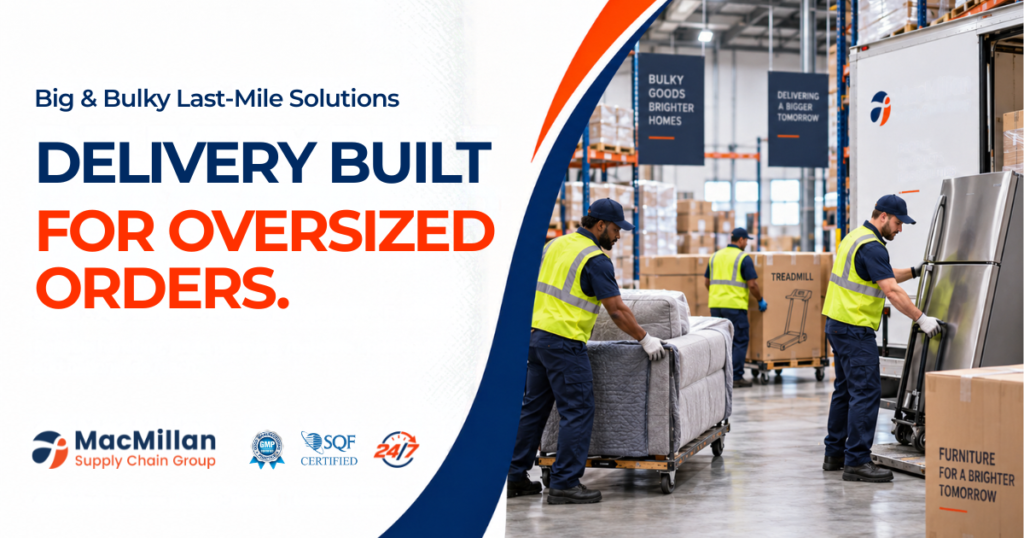
Hats off to you for always wanting to make life easier for your customers. You always try to innovate and meet customer demands. You go the extra mile to ensure that bulky items like fitness equipment, fridges, sofas, or even gigantic artwork seamlessly reach your warehouse to your client’s doorstep. Sorry to burst your bubble, but just imagine the frustration of a customer eagerly awaiting the delivery of a new sofa, only to experience delays, lack of communication, and, ultimately, a damaged product upon arrival. This scenario is a nightmare for the customers and businesses trying to make a mark for themselves while ensuring customer satisfaction. In logistics, last-mile delivery of large and bulky items is one of the toughest tasks companies face. How do we turn this challenge into an opportunity? Read on to discover strategies for making last-mile delivery work for your business. What are the Benefits of Big and Bulky Last-Mile Delivery? Big and bulky last-mile delivery brings large items right to your door. This step is key but often costs a lot and takes time. Yet, it offers great benefits. Here are some of the benefits of last-mile delivery: For Businesses Customer satisfaction: Quick and reliable deliveries make customers happy and loyal. Competitive advantage: Fast delivery sets you apart from competitors. Increased efficiency: Streamlining deliveries cuts costs and boosts profits. Improved brand loyalty: Positive delivery experiences keep customers coming back. Flexibility and scalability: Easily adjust delivery operations to meet demand without losing quality. For Customers Convenience: Products arrive right at your doorstep, saving you a trip. Faster delivery times: You get your purchases quicker. Increased transparency: Track your package and know when it will arrive. Flexible delivery options: Choose when and where your package is delivered. Reduced shipping costs: Efficient deliveries can lead to lower or no shipping fees. What are the Roadblocks in Big and Bulky Last-Mile Delivery? Delivering those big-ticket items—think sofas, fridges, or treadmills—brings its unique challenges, which are: Getting the big stuff from A to B: Bulky items aren’t just a pain to move; they require space, extra hands, and sometimes special gadgets to lift and shift. Maximizing truck space: Have you ever tried fitting a square peg into a round hole? That’s what trying to make everything fit perfectly in the truck looks like. Big items take up a ton of space; sometimes, they need special tools to move around safely. City challenges: Delivering large packages in tight urban spaces or hard-to-reach areas, especially navigating narrow streets and limited parking, is a real challenge. Traveling from far-off warehouses: Big items often come from distant warehouses, making the delivery journey longer. The last mile installation: It’s not just dropping off; Some items must be set up or installed, requiring careful coordination to ensure the installation team arrives on time. Managing free shipping costs: Who doesn’t love free shipping? But “free” comes at a cost for large items. It’s a tough balancing act for retailers, trying to cover those costs without hiking prices too much or eating into profits. How Can You Solve Your Big and Bulky Delivery Challenges? Big and bulky delivery can be tricky, but here are some smart ways to tackle those challenges: Plan your routes smartly Use tech to find the best paths. This will save time and ensure that your drivers avoid traffic jams and tight spots. Use the right vehicles Choose vehicles that match the size and requirements of your items. The right fit minimizes complications during transport. Keep customers in the loop Implement real-time tracking to oversee your delivery fleet. Tell your customers when to expect their delivery. A quick text or email can make a big difference and keep them happy. Train your team Make sure your delivery crew knows how to handle big items. A well-trained team moves things quickly and safely. Offer flexible delivery options Allowing customers to pick delivery slots adds convenience for them and reduces failed delivery attempts. Closer warehouses Positioning your warehouses closer to your customer base cuts down on delivery times and costs. Efficient packaging and handling Invest in quality packaging and equipment like forklifts and dollies to safely move large items. Proper preparation prevents damage and speeds up the delivery process. Partner with a 3PL It’s best to work with pros. A 3PL partner has the tools and know-how to handle big deliveries smoothly which can significantly ease the burden of big and bulky last-mile deliveries. Why You Should Choose a 3PL for Last-Mile Deliveries? Choosing a third-party logistics (3PL) provider for your big and bulky deliveries is smart. Here’s why: Expertise: 3PLs know how to handle large items. We have the skills and know-how to deliver your products safely and on time. Save Money: Working with a 3PL can cut costs. We have the network and tools to do the job efficiently, saving you money in the long run. Better Coverage: 3PLs can reach more places. We have the infrastructure to deliver your items far and wide, expanding your reach. Flexibility: 3PLs can adapt to your needs. Whether it’s a busy season or a sudden increase in orders, we can scale up or down quickly. Less Stress: Let the experts take over. With a 3PL handling your deliveries, you can focus on other parts of your business without worrying about logistics. Streamline Your Last-Mile Delivery with MacMillan We at MacMillan excel at delivering your goods, whether small parcels or big and bulky items, to their final destination safely and on time. We ensure your last-mile delivery is smooth, efficient, and, most importantly, stress-free. Here’s how we stand out: 45 Distribution Centers: Positioned strategically to cover you coast to coast. Over 3,000 Drivers: A large team of professionals ready to roll out. Nationwide Reach: Our infrastructure spans the country, making no place too far. We have a robust logistics network, the tools, and the team to tackle your last-mile challenges head-on. Let’s make your delivery worries a thing of the past. Contact us today! Frequently