
Mastering Black Friday Shipping: Strategies for E-commerce Success
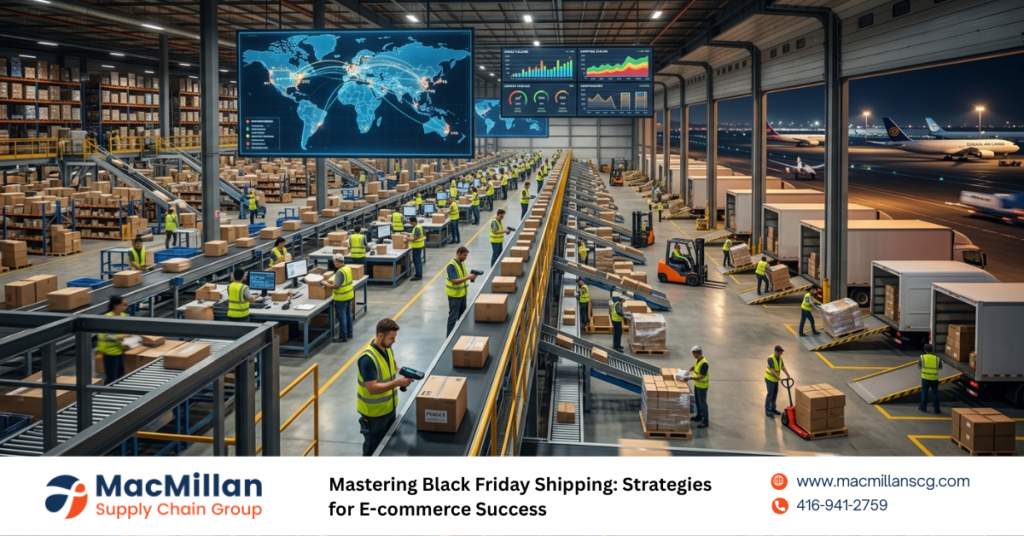
A Quick Summary and Overview Black Friday presents significant challenges for e-commerce businesses, with shipping being a critical factor in customer satisfaction and overall success. This comprehensive guide explores essential strategies for mastering Black Friday shipping, from early planning and effective communication to optimizing free shipping offers and managing international orders. We’ll delve into common challenges faced during this peak period and provide actionable solutions to ensure smooth operations. By implementing these expert tips from MacMillan Supply Chain Group, businesses can enhance their shipping processes, reduce costs, and deliver an exceptional customer experience during the busiest shopping season of the year. An Introduction As the holiday shopping season approaches, e-commerce businesses brace for the surge in orders that Black Friday brings. This annual shopping event has become a global phenomenon, putting immense pressure on supply chains and shipping operations. The ability to efficiently manage increased order volumes while maintaining customer satisfaction is crucial for success during this period. However, the challenges are numerous: from inventory management and warehouse capacity to carrier limitations and customer expectations for fast, free shipping. This guide aims to equip e-commerce businesses with the knowledge and strategies needed to navigate the complexities of Black Friday shipping. By focusing on key areas such as strategic planning, customer communication, and logistics optimization, businesses can turn potential shipping nightmares into opportunities for growth and customer loyalty. Strategic Planning for Black Friday Shipping Effective Black Friday shipping starts with meticulous planning months in advance. Begin by analyzing data from previous years to forecast demand accurately. This information is crucial for inventory management, warehouse staffing, and carrier capacity planning. Consider implementing advanced inventory management systems that can handle sudden spikes in demand and prevent stockouts. Next, assess your current shipping processes and identify potential bottlenecks. This may involve upgrading warehouse technology, optimizing pick-and-pack procedures, or reconfiguring your warehouse layout for maximum efficiency. Consider partnering with multiple carriers 3PL logistics solutions and supply chain expertise to ensure flexibility and redundancy in your shipping options. Develop contingency plans for common issues such as carrier delays, inventory shortages, or website crashes. Having these plans in place will allow you to respond quickly and minimize disruptions to your operations. Finally, consider offering early Black Friday deals to spread out the shipping load over a longer period. This can help manage peak volumes and reduce the strain on your shipping operations. By starting your promotions earlier, you can also capture sales from customers who prefer to shop ahead of the main rush. Remember, thorough planning is the foundation of successful Black Friday shipping. It allows you to anticipate challenges, allocate resources effectively, and maintain control over your operations during this critical period. Effective Customer Communication Strategies Clear and proactive communication with customers is essential for managing expectations and maintaining satisfaction during the Black Friday rush. Start by prominently displaying shipping deadlines on your website and in marketing materials. This helps customers make informed decisions about their purchases and reduces inquiries about delivery times. Implement a robust order tracking system that provides real-time updates to customers. This transparency can significantly reduce customer service inquiries and improve overall satisfaction. Consider using SMS or email notifications to keep customers informed about their order status, from processing to delivery. Be upfront about potential delays or shipping limitations. If certain items have longer processing times or if international shipping is restricted, communicate this clearly before the purchase is made. This honesty builds trust and can prevent disappointment later. Create a comprehensive FAQ section on your website addressing common Black Friday shipping questions. This resource can alleviate pressure on your customer service team and provide instant answers to customer queries. In case of unexpected delays or issues, have a communication plan in place to quickly inform affected customers. Personalized messages explaining the situation and offering solutions or compensation can turn a potentially negative experience into a positive one. Remember, effective communication not only keeps customers informed but also builds trust and loyalty, even in the face of challenges. Optimizing Free Shipping Strategies Free shipping is a powerful incentive for Black Friday shoppers, but it needs to be implemented strategically to maintain profitability. Start by analyzing your profit margins and shipping costs to determine a minimum order value that makes free shipping economically viable. This threshold should encourage customers to increase their cart value while ensuring you’re not losing money on small orders. Consider offering tiered free shipping options. For example, standard free shipping for orders over a certain amount, and expedited free shipping for higher-value purchases. This can incentivize customers to spend more while also managing your shipping costs. Implement limited-time free shipping promotions during specific hours or for certain product categories. This can create urgency and drive sales during slower periods of the Black Friday rush. For items that are too costly to ship for free, consider offering free in-store pickup or local delivery options. This can satisfy customer expectations for free shipping while reducing your overall shipping costs. Use dynamic shipping rules in your e-commerce platform to automatically apply free shipping based on order value, customer location, or product type. This ensures consistency and reduces the need for manual intervention during the busy period. Remember, while free shipping can be a powerful tool for driving sales, it’s important to balance this offer with your overall profitability goals. Carefully designed free shipping strategies can boost conversions without eroding your margins. Managing International Shipping Challenges Expanding your Black Friday sales internationally can open up new revenue streams, but it also presents unique challenges. Start by researching customs regulations and shipping restrictions for your target countries. This knowledge is crucial for avoiding delays and ensuring compliance. Partner with experienced international shipping carriers or freight forwarders who specialize in cross-border e-commerce. These experts can navigate complex customs procedures and offer reliable delivery options. Implement a clear and transparent international shipping policy on your website. Include information about potential customs fees, delivery timeframes, and any restrictions on certain products.
B2C Order Fulfillment: Boost Efficiency & Speed with MacMillan
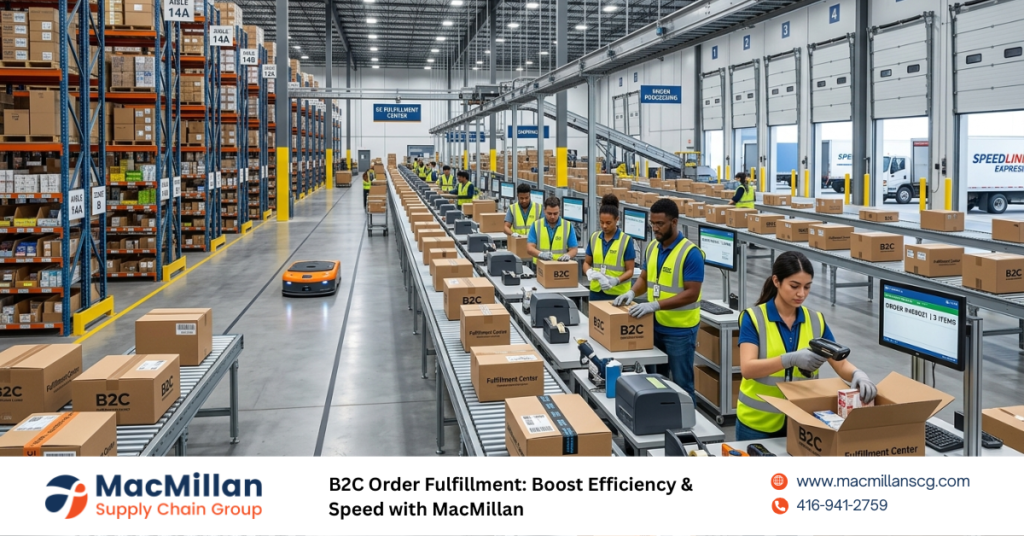
Quick Summary and Overview B2C order fulfillment is a crucial component of the retail and e-commerce sectors, involving inventory management, order processing, and the shipping of products directly to consumers. With rising customer expectations for faster delivery and accuracy, businesses must optimize their fulfillment processes. By leveraging automation, efficient inventory management, and possibly outsourcing to experienced providers like MacMillan Supply Chain, businesses can enhance their order fulfillment capabilities. Introduction In today’s fast-paced e-commerce environment, prompt and precise B2C order fulfillment is key to customer satisfaction. Consumers demand seamless experiences, which hinge on the efficiency of order processing and delivery. As the market competition intensifies, businesses must adopt technologies and practices that ensure swift and accurate fulfillment. MacMillan Supply Chain, a leader in logistics solutions, offers insights and services that can revolutionize your order fulfillment operations, ensuring you meet and exceed customer expectations while optimizing costs. Inventory Management’s Crucial Role in Fulfillment Effective inventory management is the backbone of successful B2C order fulfillment. With accurate inventory tracking using SKUs or bar codes, businesses can ensure that they have the right items available when needed. This minimizes stockouts and overstock situations, maintaining a balance that supports operational efficiency and cost-effectiveness. Advanced inventory systems also facilitate real-time data visibility, enabling better decision-making. MacMillan Supply Chain offers tailored inventory solutions that streamline these processes, ensuring that your products are always optimally positioned to meet demand. The Impact of Automation on Fulfillment Efficiency Automation in B2C order fulfillment enhances speed and reduces human error, providing a significant competitive edge. Automated systems can handle repetitive tasks such as order picking and packing, thus freeing up human resources for more strategic activities. Implementing technologies like automated storage and retrieval systems (AS/RS) within warehouses can drastically cut down processing times. MacMillan Supply Chain assists clients in integrating these cutting-edge automation technologies into their operations, leading to improved efficiency and scalability in handling high order volumes. Outsourcing Fulfillment: A Strategic Advantage For many businesses, particularly as they scale, outsourcing B2C order fulfillment to third-party logistics providers can offer numerous benefits. Outsourcing allows businesses to leverage the expertise and infrastructures of providers like MacMillan Supply Chain, thereby focusing on core business activities like product development and marketing. A strategic partnership with a logistics firm ensures access to state-of-the-art resources and logistics networks, leading to optimized delivery schedules and increased customer satisfaction. MacMillan’s bespoke solutions are crafted to align with your business needs, ensuring seamless and cost-effective fulfillment operations. Common Problems in B2C Order Fulfillment and Our Solutions Delays in Order Processing: Symptoms manifest as prolonged wait times between order placement and shipment, often due to inefficient processes or technology bottlenecks. Our Solution: We implement streamlined workflows and technology integrations that enhance processing speeds, effectively reducing turnaround time. Errors in Picking and Packing: Missteps here include incorrect item selection or packaging, which can lead to customer dissatisfaction and increased returns. Our Solution: MacMillan utilizes advanced picking and packing systems, supported by rigorous training protocols that uphold precision and quality. High Operational Costs: This stems from inefficient logistics strategies and a lack of economies of scale. Our Solution: Our outsourcing solutions optimize logistics operations, leveraging our scale and expertise to drive down costs. Inadequate Inventory Management: Poor inventory practices lead to stockouts or surpluses, both detrimental to cost management and service quality. Our Solution: Implementing robust inventory systems, we ensure accurate demand forecasting and optimal stock levels. By addressing these common pitfalls with MacMillan’s expert methodologies and technology, your business can refine its fulfillment processes, enhancing both efficiency and customer satisfaction. Avoiding Common Fulfillment Pitfalls To avoid these common fulfillment issues, consider partnering with experts like MacMillan Supply Chain. We offer comprehensive assessments of your current operations and develop strategic plans tailored to your needs. By integrating advanced technologies and leaning on our extensive logistics network, you can avoid costly errors and inefficiencies. Take proactive steps towards optimization—get in touch with MacMillan for a consultation and elevate your fulfillment processes to new heights. FAQS What is B2C order fulfillment? B2C order fulfillment is the process of managing inventory, processing orders, and delivering products directly to individual consumers. Why is inventory management crucial in B2C order fulfillment? Inventory management is essential in B2C order fulfillment because it helps businesses maintain accurate stock levels, prevent stockouts, and avoid overstock situations. Efficient inventory tracking ensures products are available when customers place orders, leading to faster fulfillment, improved customer satisfaction, and reduced operational costs. Real-time inventory visibility also supports better forecasting and decision-making. How does automation benefit B2C order fulfillment? Automation improves B2C order fulfillment by increasing processing speed, reducing human errors, and streamlining repetitive tasks such as picking, packing, labeling, and inventory updates. Automated systems help businesses handle higher order volumes more efficiently while improving accuracy and reducing fulfillment delays. This leads to better customer experiences and enhanced operational scalability. What are the advantages of outsourcing fulfillment to MacMillan Supply Chain? Outsourcing fulfillment to MacMillan Supply Chain allows businesses to access professional logistics expertise, advanced fulfillment technologies, and established distribution networks without investing heavily in their own infrastructure. This helps reduce operational costs, improve delivery efficiency, increase order accuracy, and free up internal resources so businesses can focus on growth, marketing, and product development. How can businesses avoid common fulfillment issues? Businesses can avoid common fulfillment issues by implementing accurate inventory management systems, using automation technologies, optimizing warehouse workflows, and establishing strong quality control processes for picking and packing. Partnering with experienced logistics providers like MacMillan Supply Chain can also help businesses reduce errors, improve processing speed, and maintain consistent fulfillment performance. What distinguishes B2C from B2B fulfillment? B2C fulfillment focuses on processing and shipping individual customer orders directly to consumers, often requiring faster delivery speeds, smaller package sizes, and higher order volumes. In contrast, B2B fulfillment typically involves bulk shipments to retailers, wholesalers, or distributors with more complex logistics requirements and scheduled delivery arrangements. B2C fulfillment places a stronger emphasis on customer experience and delivery convenience. Can
Unlocking Supply Chain Transparency with Blockchain Technology

Quick Summary Imagine a world where every product’s journey from raw materials to your doorstep is as transparent as a glass jar. That’s the promise of blockchain technology. By creating an unbreakable digital ledger, it’s rewriting supply chain rules: eliminating fraud, automating contracts, and proving ethical sourcing. And no, this isn’t sci-fi. Companies like Nestlé and Walmart are already using it to track food safety. Ready to join them? Introduction: Trust Isn’t Optional Anymore In an era where counterfeit goods cost the global economy $500 billion annually, and 66% of consumers demand ethical sourcing, supply chains can’t afford guesswork. Blockchain steps in as the ultimate truth-teller. At MacMillan supply chain transparency, we help businesses harness this technology to turn opacity into opportunity solving compliance headaches, speeding up transactions, and earning customer trust. Transparency: The Blockchain Superpower Think of blockchain as a digital notary. Every transaction shipments, quality checks, payments is stamped into a shared, unchangeable ledger. Traceability in Action: A coffee brand traces beans from Ethiopian farms to supermarket shelves in seconds. Fraud Prevention: Luxury brands like LVMH use blockchain to verify authentic handbags, slashing counterfeit risks. “With blockchain, recalls that once took weeks now take minutes.” – MacMillan Supply Chain Case Study Smart Contracts: The Efficiency Game-Changer What’s smarter than a contract? One that enforces itself. Automated Workflows: Orders trigger payments only when goods arrive undamaged. Error Reduction: Maersk cut paperwork by 80% using blockchain for shipping logistics. Why it matters: Fewer delays, happier customers, and teams freed from chasing invoices Security & Compliance: No More “Oops” Moments Blockchain doesn’t just store data—it guards it. Tamper-Proof Records: Alter a shipment detail? The entire network flags it. Audit-Ready 24/7: Pharma companies like Pfizer use blockchain to meet FDA compliance effortlessly. MacMillan Insight: Compliance isn’t a cost it’s your reputation’s insurance policy. Ethical Sourcing: Prove You Walk the Talk Consumers don’t just want “organic” labels they want proof. Blockchain delivers: Conflict-Free Minerals: Tech giants track cobalt from mine to iPhone. Fair Trade Coffee: Farmers get paid fairly; buyers see the journey. Your move: Turn sustainability claims into irrefutable stories. Challenges? We’ve Got Fixes Blockchain isn’t plug-and-play… yet. Common hurdles include: Legacy System Hang-Ups → Our fix: Hybrid integration that bridges old and new. Regulatory Gray Areas → Our fix: Compliance frameworks tailored to your industry. Sticker Shock → Our fix: Scalable pilots that prove ROI fast. MacMillan’s Playbook: Start Small: Pilot blockchain for one product line. Train Teams: Workshops to demystify the tech. Partner Up: We handle integration; you focus on growth. Your Roadmap to Blockchain Adoption Audit Pain Points: Where’s fraud or inefficiency bleeding profits? Prioritize Use Cases: Start with traceability or smart contracts. Collaborate: Choose a partner (like us) who speaks tech and supply chain transparency. Next Step: Book a free blockchain readiness assessment. Let’s map your leap from legacy to leading-edge. Final Takeaway Blockchain isn’t just for crypto enthusiasts. It’s the trust engine modern supply chain transparency need to thrive in a skeptical world. And with MacMillan? You’re not just adopting tech you’re future-proofing your reputation. If you’re ready to enhance your supply chain transparency with blockchain technology, partner with MacMillan Supply Chain for unparalleled expertise and support. Our team will guide you through the implementation process, ensuring a seamless transition and maximizing the benefits of blockchain for your business. Contact us today to unlock the full potential of blockchain in your operations. FAQS What is the main benefit of using blockchain in supply chain management? The primary benefit is enhanced transparency, with all transactions recorded in a decentralized, immutable ledger. This provides real-time visibility and traceability throughout the supply chain. How does blockchain improve supply chain visibility? Blockchain improves supply chain visibility by creating a transparent and shared digital ledger where every transaction, shipment update, and quality check is recorded in real time. This allows businesses to track products from raw materials to final delivery with greater accuracy and accountability. Can blockchain help in preventing counterfeiting? Yes, blockchain helps prevent counterfeiting by providing tamper-proof product records and authentication data. Brands can verify product origins, serial numbers, and ownership history, making it easier to identify fake or unauthorized goods in the supply chain. How does blockchain impact supply chain efficiency? Blockchain increases supply chain efficiency by automating processes, reducing paperwork, and improving data accuracy. Smart contracts can trigger payments, approvals, or shipment updates automatically, helping businesses minimize delays and operational errors. Is blockchain suitable for all types of industries? Blockchain can benefit many industries including retail, healthcare, food, manufacturing, and logistics. However, the level of implementation depends on business size, operational complexity, regulatory requirements, and supply chain needs. How secure is the data stored on a blockchain? Data stored on a blockchain is highly secure because records are encrypted and distributed across multiple network nodes. Once information is added, it cannot be changed without network validation, making unauthorized alterations extremely difficult. Can blockchain help in ensuring sustainable sourcing practices? Yes, blockchain helps companies verify ethical and sustainable sourcing by tracking materials and suppliers throughout the supply chain. Businesses can provide transparent proof of fair trade practices, environmental compliance, and responsible sourcing. What is the role of smart contracts in blockchain-enabled supply chains? Smart contracts automate agreements between parties in the supply chain. They execute actions such as payments, approvals, or order confirmations automatically when predefined conditions are met, improving speed, trust, and operational efficiency. How does blockchain affect the relationship between suppliers and buyers? Blockchain strengthens supplier and buyer relationships by improving transparency, trust, and communication. Both parties gain access to accurate real-time data, reducing disputes, improving collaboration, and increasing accountability across the supply chain. Are there any challenges to implementing blockchain in supply chain transparency? Yes, some common challenges include integration with legacy systems, implementation costs, scalability concerns, and evolving regulations. Businesses may also require employee training and technical expertise to fully adopt blockchain solutions successfully.
The Real Cost of Slow Returns Processing for E-commerce Brands
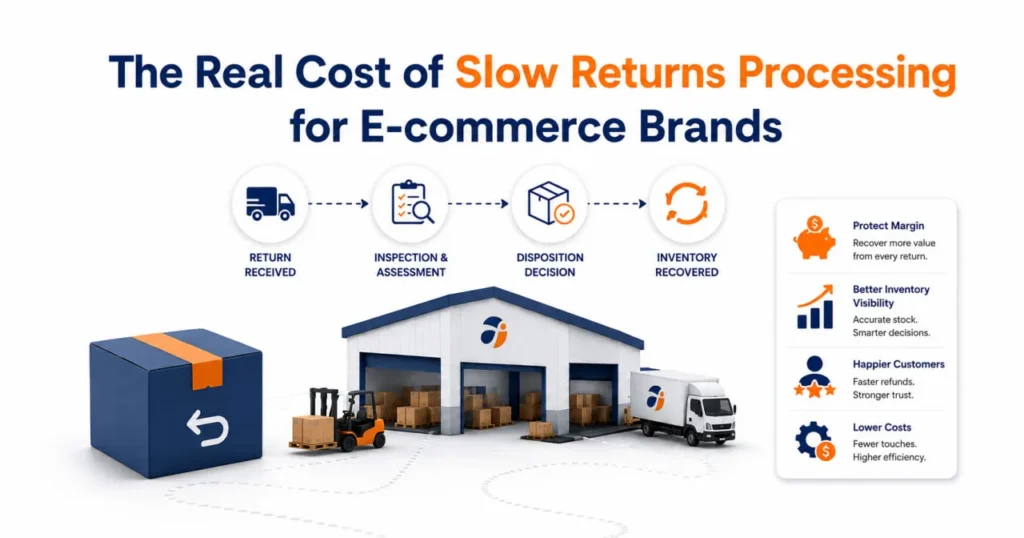
A Quick Summary and Overview For e-commerce brands, returns are not just a customer service issue. They affect inventory recovery, margin, cash flow, warehouse efficiency, and customer trust. When returns move too slowly, sellable stock stays stuck, refunds take longer, operational costs rise, and products can lose value before they ever make it back into inventory. As e-commerce brands grow, reverse logistics becomes harder to manage with manual steps, weak visibility, and disconnected workflows. Brands that process returns well tend to recover value faster, keep inventory more accurate, and create a better post-purchase experience. Introduction A slow return costs more than it looks. At first, it may seem like a minor delay. A product comes back, sits for a while, gets inspected later, and eventually moves through the system. But every extra day adds friction. Inventory stays unavailable. refund timing stretches out. Customer service teams deal with more questions. Warehouse space gets tied up. And in some cases, the product loses its best chance to be resold quickly. That is why returns processing deserves more attention than it often gets. For many e-commerce brands, reverse logistics still sits in the background. Outbound fulfillment gets the focus because it is visible, urgent, and directly tied to sales. Returns are often treated as something to clean up later. But once order volumes grow, that approach starts becoming expensive. Why Returns Processing Matters More Returns matter more now because brands are operating with tighter margins, faster customer expectations, and more pressure to keep inventory moving. A return is no longer just a completed sale reversed. It is part of the full commerce cycle. If the process is slow, the cost shows up in several places at once: slower inventory recovery delayed refunds more warehouse touches less accurate stock visibility higher write-offs weaker customer trust For growing brands, this becomes even more important because there is less room for hidden inefficiency. One slow returns process can create problems across inventory planning, customer support, and cash flow at the same time. What Slow Returns Processing Actually Costs 1. Delayed inventory recovery When returned goods sit too long before being inspected or restocked, sellable inventory stays unavailable. That can make stock levels look tighter than they really are. Teams may reorder too early, expedite inventory unnecessarily, or miss sales opportunities because products that could have been resold are still sitting in a returns area. 2. Lower resale value Time matters in returns. If a product is seasonal, trend-sensitive, promotional, or tied to a fast-moving cycle, a slow return can reduce how much value the brand can recover. What could have gone back into inventory at full price may end up discounted, cleared out, or written off. 3. Higher handling and storage costs Returns that sit too long create extra work. The longer a returned product stays in the system without a clear next step, the more likely it is to be touched multiple times, moved around, manually checked again, or stored in the wrong place. That adds labor cost, warehouse congestion, and operational drag without adding value. 4. Slower refunds and weaker customer experience Customers do not separate returns from the rest of your brand experience. If a return feels slow, unclear, or frustrating, trust drops quickly. Even when the original purchase experience was good, the return process can shape how the customer remembers the brand. Slow refunds, unclear return status, or long inspection times often lead to more support tickets and lower confidence in ordering again. 5. Poorer inventory planning When returns are not processed quickly, inventory data becomes less reliable. Teams may not know what is actually back, what is still being inspected, what can be resold, or what should be removed from usable stock. That weakens forecasting, replenishment, merchandising, and purchasing decisions. 6. Hidden margin erosion One of the biggest problems with slow returns is that the full cost is not always obvious. Brands may see return shipping costs, but miss the deeper margin loss caused by: delayed restocking markdowns on late-returned items extra labor tied-up warehouse space customer support workload lower recovery rates That is why slow returns are not just an operations problem. They are a profitability problem. The Biggest Signs Your Returns Process Is Too Slow A returns workflow is usually too slow when these issues keep showing up: returned items take too long to become sellable again refunds are delayed after the product is physically received teams have weak visibility into return status warehouse teams keep handling the same returned stock more than once inventory numbers become less reliable after returns too many returned products end up discounted or written off customer service spends too much time answering return-related questions If those patterns are common, the issue is usually not returns volume alone. It is the process behind it. 6 Ways E-commerce Brands Can Improve Returns Processing 1. Create a clear returns triage process Every return should move into a defined path quickly. That means deciding early whether the item should be: restocked inspected further held repaired liquidated disposed When returns do not have a clear route, they sit longer than they should. 2. Reintegrate sellable stock faster The faster a sellable product gets back into inventory, the more value the brand can recover. That means reducing the gap between receipt, inspection, decision, and restock. Even a small improvement here can make a meaningful difference in both margin and stock availability. 3. Improve returns visibility Brands need to know what is happening inside the returns process, not just that a return exists. Good visibility includes: what has been returned what has physically arrived what is under review what is approved for restock what is being removed from inventory how long each stage is taking Without that visibility, returns become hard to improve. 4. Use returns data to find repeat problems A good returns process should not only move product. It should also reveal patterns. If certain
Real-Time Supply Chain Visibility: Why Customers Demand It & How Macmillan SCG Delivers
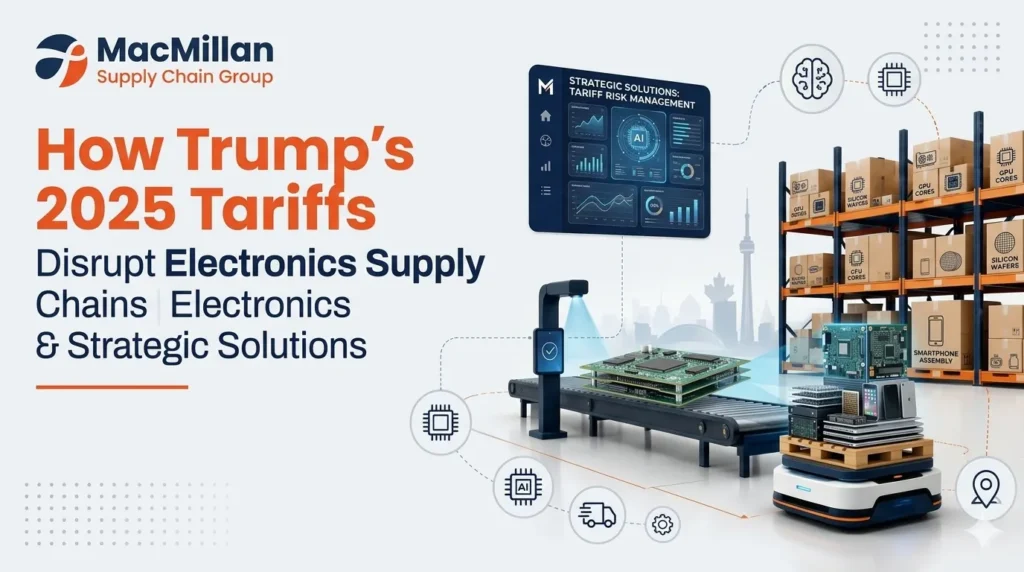
In today’s hyperconnected world, customers no longer settle for vague delivery windows or generic tracking updates. Every link in the supply chain is affected by their demands for accuracy, transparency, and control. Businesses now need to use cutting edge solutions to transform visibility into a competitive advantage rather than merely keeping up. At Macmillan Supply Chain Group (SCG), we’ve built our Canadian logistics solutions around this reality, empowering brands to meet modern demands with agility and confidence. The Rise of Real-Time Expectations in Supply Chains The digital age has rewired consumer behavior. Thanks to giants like Amazon, next-day delivery and minute-by-minute tracking are now baseline expectations. But this urgency doesn’t stop at the consumer level as it cascades through every tier of the supply chain. Retailers, manufacturers, and distributors all require instant insights to optimize operations, reduce costs, and maintain trust. Consider this: 45% of supply chain executives identify real-time inventory visibility as a critical challenge, yet only 31% of companies actively use live data to inform decisions. This gap highlights a pressing need for solutions that bridge the divide between legacy systems and modern expectations. Why Real Time Data Matters Now More Than Ever Customer Trust Hinges on Transparency When a customer orders a product, they’re not just buying an item they’re investing in a promise. Real-time tracking transforms this promise into a tangible experience. For instance, Macmillan SCG’s AI-driven platform provides clients with live updates on shipments, from warehouse dispatch to final delivery. This level of detail minimizes “Where’s my order?” inquiries and builds loyalty by aligning every stakeholder brands, suppliers, and end consumers on a single source of truth. Operational Agility in Disruptive Times Rapid pivots are necessary due to shifting demand, port congestion, and geopolitical issues. Businesses using real-time data relocated shipments in a matter of hours during the 2024 Red Sea shipping crisis, saving rivals weeks of delays. With over 3,000 committed drivers and 45 cross-docking points, Macmillan’s network is built for such agility. Predictive analytics is used to anticipate problems and dynamically recalculate routes. Sustainability Through Smarter Decisions Efficiency is more important than speed when it comes to real-time visibility. Businesses can decrease waste and lower their carbon footprint by keeping an eye on inventory levels, transportation routes, and fuel consumption. These findings are integrated into Macmillan’s Net Zero Journey initiative, which helps clients avoid idle miles and optimize load planning, thus bringing revenue and environmental responsibility into direct alignment. How Macmillan SCG Delivers Real-Time Visibility Precision in Warehousing: Beyond Storage to Strategic Insight Our GMP certified warehouses across Toronto aren’t just storage hubs; they’re data goldmines. With 250,000+ square feet of racked and bulk space, we deploy IoT sensors and Warehouse Management Systems (WMS) to track inventory levels down to the SKU. This granularity enables: Same day fulfillment with 99.4% pick accuracy, reducing costly errors. -Predictive restocking alerts that sync with supplier portals, preventing stockouts. -Climate-controlled monitoring for sensitive goods, ensuring compliance and quality. Last-Mile Mastery: Turning Delivery into a Differentiator Efficiency is crucial because last mile logistics account for 53% of overall shipping expenses. Macmillan’s devoted fleet analyzes traffic patterns, weather information, and delivery windows in real time using AI powered routing software. This implies: – 90% of Canadian FSAs (Forward Sortation Areas) serviced next-day. – Dynamic ETAs shared with customers via SMS or app notifications. – Reduced “failed delivery” attempts through geofencing and recipient communication tools. Seamless Integration: Making Data Work for You Data silos are frequently produced by legacy systems’ inability to connect with modern platforms. By providing plug and play connectivity with popular e-commerce systems like Shopify and WooCommerce, our Mantis WMS removes these obstacles. Clients gain during migration from: – Zero downtime through parallel system testing. – Automated data synchronization across sales channels. – Custom dashboards that unify inventory, shipping, and demand forecasts into a single view. Overcoming Visibility Challenges with Tailored Solutions Challenge 1: Fragmented Data Across Multiple Systems Many companies use different systems for logistics, CRM, and inventory management. These streams are combined by Macmillan’s API-driven technology, which provides a single analytics hub. For instance, after matching production schedules with real-time sales data, a cosmetics firm that used our solution cut overstock by 22%. Challenge 2: Balancing Speed and Cost Hasty shipments can reduce profit margins. Our lane density optimization technology allows shared truckloads without sacrificing speed by grouping deliveries by region. One customer kept their promise of same-day delivery while reducing last-mile expenses by 18%. Challenge 3: Ensuring Data Accuracy Outdated spreadsheets and manual entries invite errors. By automating data capture through barcode scanners and IoT devices, we’ve achieved near-zero inventory shrinkage, a critical advantage for high-value industries like pharmaceuticals. The Future of Visibility: AI, Sustainability, and Beyond The importance of machine learning in predictive analytics is constantly changing. The R&D team at Macmillan is testing AI models that can: Forecast demand spikes by utilizing weather and social media trends. Carriers tariffs are automatically negotiated based on capacity and current fuel prices. To support ESG compliance, create carbon reports for each shipment. Conclusion: Visibility as Your Strategic Partner In a landscape where delays are costly and trust is fragile, real-time data isn’t optional it’s the backbone of resilient supply chains. Macmillan SCG combines Canadian logistics expertise with global-scale technology, ensuring our clients aren’t just reacting to changes but anticipating them. Whether you’re streamlining e-commerce fulfillment or navigating cross-border complexities, we’re here to transform visibility from a challenge into your greatest asset. Explore the Macmillan Advantage today where every byte of data fuels smarter decisions and every delivery strengthens customer loyalty.
Post-Trump Trade Policies: Key Changes for Canadian Businesses | MacMillan Supply Chain
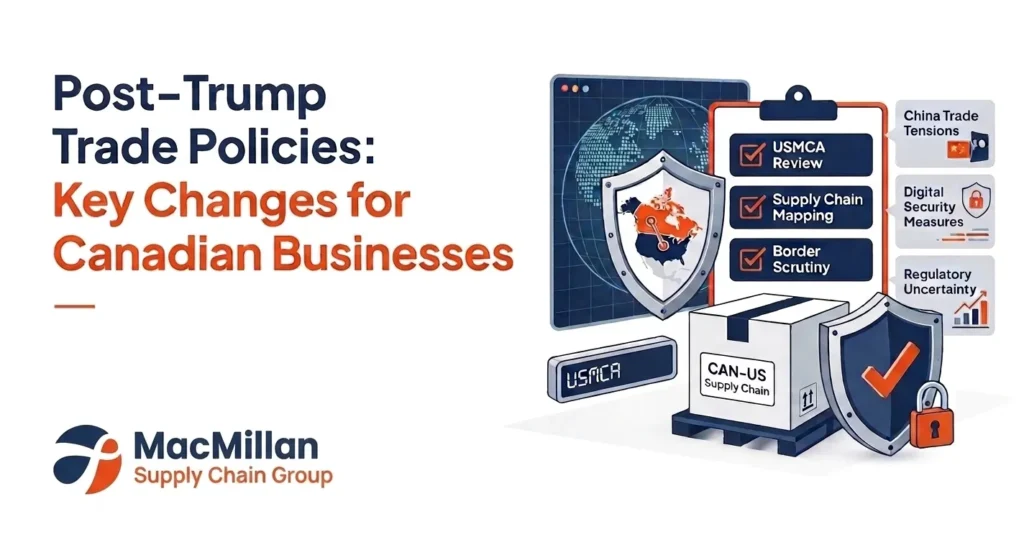
A Quick Summary and Overview The trade policies of the post-Trump era have instigated profound shifts in the relationship between Canada and the United States. There is now a much sharper focus on domestic manufacturing and national security. All of this raises serious questions about the future of cross-border supply chains and eventually even the very concept of free trade. The next major test for all of this is the USMCA (United States-Mexico-Canada Agreement) review in 2026. Even without any potential confounding issues that could arise between now and then, that review is already shaping up in my mind as a major possible inflection point in this relationship. Introduction Every day, nearly $2 billion in goods and services flow between the United States and Canada, making this one of the largest bilateral economic relationships in the world. But in recent years, trade policies have changed—varying by the week or by the day—creating uncertainty for companies on both sides of the border. For Canadian businesses, the switch in trade rules presents opportunities even as it poses challenges. What precisely has transformed in the trade environment, and what should your company be poised for? The evolution from a production-based economy to today’s—well, what exactly is today? And what will tomorrow be? Between heightened national security concerns, the forthcoming review of the new NAFTA (the USMCA), and our ongoing trade dispute with China, the trade landscape is shifting beneath our feet. For companies managing cross-border supply chains, these tectonic changes require not just attention but strategic adaptation. In this article, we’ll break down the key policy changes, explore their real world impact on Canadian businesses, and share practical strategies to navigate this new trade environment successfully. Understanding Post-Trump Trade Policies The current U.S. administration has maintained and expanded many trade approaches from the previous administration while adding new dimensions. At the core of post Trump trade policies is an emphasis on creating a production based economy that prioritizes North American manufacturing over imports from overseas markets. This shift manifests in several key ways that directly affect Canadian businesses: First, there’s a strong focus on reviewing and potentially renegotiating existing trade agreements. The USMCA (which replaced NAFTA) faces a mandated review in 2026, creating uncertainty about future trade terms. U.S. trade officials are already preparing for this review, examining how the agreement impacts American workers and industries. Second, trade decisions are now closely linked to national security considerations. This is especially noticeable in the technology sector, where cybersecurity and data privacy concerns have an impact on legislation. The impacts of the ongoing TikTok ban show how security issues can upend established supply chains and business models. Third, there’s increased enforcement of trade rules, with stricter monitoring of compliance across borders. Canadian exporters face more scrutiny regarding rules of origin, labor standards, and environmental practices. For businesses operating cross border supply chains, these policy shifts require careful monitoring and strategic planning. Companies that previously relied on predictable trade flows must now prepare for potential disruptions and compliance challenges. Working with experienced logistics partners like MacMillan Supply Chain Group can help businesses stay ahead of these changes and adapt their supply chain strategies accordingly. The Evolution of Canada-US Trade Relations The relationship between Canada and the U.S. has always been complex, balancing economic interdependence with national interests. Recent post-Trump trade policies have added new dimensions to this dynamic, requiring a fresh Canadian trade strategy. Historically, Canada has been America’s largest trading partner, with deeply integrated supply chains across numerous industries. However, this relationship has faced significant tests in recent years: The renegotiation of NAFTA into the USMCA brought stricter rules of origin requirements, particularly in the automotive sector. Canadian manufacturers now need to ensure higher North American content percentages to qualify for duty free treatment. This shift aligns with the production-based economy focus that continues to drive U.S. trade policy. Buy American provisions have expanded, creating challenges for Canadian companies selling to U.S. government entities. These policies prioritize U.S.-made products for government procurement, potentially limiting opportunities for Canadian exporters. Tariff threats remain a concern, with aluminum and steel sectors experiencing periodic uncertainty. Though many Section 232 tariffs have been resolved, the precedent creates ongoing risk for cross-border trade. Digital trade has emerged as a new frontier, with data security measures becoming increasingly important. Canadian businesses handling U.S. customer data must navigate evolving privacy regulations and security requirements. Despite these challenges, opportunities exist. The shared focus on reducing dependence on Chinese manufacturing has created openings for Canadian suppliers. Additionally, collaborative approaches to clean energy and critical minerals development present growth potential for Canadian exporters. For businesses navigating these changes, understanding the nuances of Canada-US trade relations is essential. MacMillan Supply Chain Group helps clients leverage these evolving dynamics by optimizing cross-border logistics and ensuring compliance with changing regulations. USMCA Review What It Means for Businesses The USMCA review scheduled for 2026 represents a pivotal moment for businesses operating across North American borders. This mandatory assessment could maintain the status quo or trigger significant changes to the agreement that governs nearly $1.5 trillion in annual trade. Key aspects of the USMCA review that businesses should monitor include: Labor provisions enforcement will likely intensify. The agreement’s labor chapter includes unprecedented protections for workers, and U.S. officials have already used the Rapid Response Labor Mechanism to investigate facilities in Mexico. Canadian businesses with operations or suppliers in Mexico should evaluate labor compliance proactively. Automotive rules of origin requirements could tighten further. The current 75% North American content threshold for duty free treatment might increase, pushing more manufacturing back to the continent. Supply chain mapping becomes essential to understand exposure to potential changes. Digital trade rules may evolve as technology advances. The USMCA was the first U.S. trade agreement with comprehensive digital trade provisions, but rapid technological change could necessitate updates to address emerging issues like AI and data security measures. Environmental standards enforcement will likely increase, with greater scrutiny of compliance across borders. Companies should document their environmental practices
Canada’s Strategic Response to Trump’s Reciprocal Tariffs | Supply Chain Impact
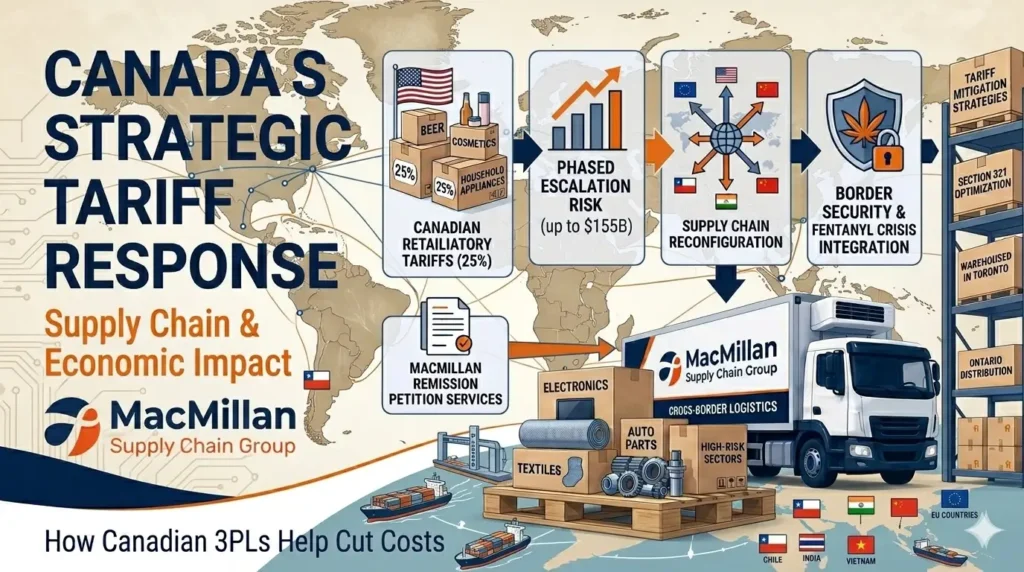
A Quick Summary and Overview In a strong response to President Trump’s massive “reciprocal” tariffs, Canada announced 25% duties on $30 billion worth of American goods, which could rise to $155 billion if U.S. actions continue. Although economic factors like factory reshoring also play a part, border security issues particularly the fentanyl crisis are at the heart of this trade disagreement. The debate poses a threat to the USMCA pact, raises consumer prices, and disrupts supply networks. While maintaining diplomatic efforts to settle the conflict, both countries have put policies in place to safeguard their own sectors. Businesses conducting cross border trade in this unpredictable climate must understand these developments. Introduction The United States-Canada trade relationship is currently dealing with its biggest obstacle in a long time. Citing border security and fentanyl trafficking fears, President Trump has placed new “reciprocal” tariffs on Canadian goods. Canada has responded by announcing a phased strategy of retaliatory tariffs that may eventually affect U.S. exports worth up to $155 billion. Businesses on both sides of the border will be significantly impacted by this intensifying trade war. Decades-old supply networks are suddenly being disrupted, costs are increasing, and businesses need to quickly adjust to the new economic climate. The USMCA pact, which was designed to guarantee stable trade relations between the two countries, is also put to the test by this conflict. For Canadian businesses and those engaged in US-Canada trade, understanding the scope, causes, and potential outcomes of this dispute is essential for strategic planning. Let’s examine the situation and its implications for your business operations. Comprehending the New Tariffs in Canada There are two different stages to Canada’s reaction to Trump’s tariffs. About $30 billion worth of American goods are subject to 25% tariffs under the first phase, which is now in place. These initial retaliatory tariffs strategically target products with political significance in the U.S., including orange juice from Florida, beer from various states, household appliances, cosmetics, and pulp/paper products. The careful choice of these Canada tariffs is what gives them their unique impact. Products that will generate pressure points in politically sensitive areas of the United States have been selected by the Canadian government. Targeting agricultural items, for instance, has an impact on farming communities, which frequently hold considerable political influence. The mechanics of these tariffs are straightforward: when these American products cross the Canadian border, importers must pay an additional 25% tax.This raises the cost of U.S. goods for Canadian companies and consumers, which may lower demand and cause purchases to shift to domestic or other foreign providers. Canada is willing to carry out a second round of retaliatory measures that would extend to cover up to $125 billion in more American goods if the U.S. keeps its tariffs in place. The economic impact of the trade conflict would be greatly increased by this second phase, which would target electronics, cattle, dairy goods, and electric vehicles. Impact on US-Canada Trade Relations The US-Canada trade relationship has historically been one of the world’s largest and most integrated. Bilateral commerce in goods and services was valued at over $800 billion in 2023. Because of this deep economic connectivity, tariffs have an impact on interconnected supply chains as well as individual items. The current trade war poses several risks to this cooperation.. Initially, it upsets long-standing supply chains that span the border several times throughout manufacturing. For instance, before a vehicle is finished, auto parts may cross the border seven times. New levies could now be applied to every crossing, increasing expenses. Second, companies preparing to expand or make investments are left in the dark by these interruptions. Businesses might put off making decisions until the trade environment calms down, which might hinder economic growth on both sides of the border. Third, the disagreement calls into question the basic principles of the USMCA, which was created to offer a secure framework for commerce within the region. Canada argues that the U.S. tariffs violate this agreement by avoiding the established conflict resolution procedures. This undermines confidence in the North American trade deal. These developments necessitate rapid attention to pricing strategies, supply chain resilience, and possible market diversification for companies involved in cross-border trade in order to reduce risks. The Link Between Fentanyl and Border Security The way the United States has connected tariffs to border security issues, specifically fentanyl trafficking, is an unusual aspect of this trade war. The Trump administration asserts that the flow of illegal drugs into the United States is facilitated by Canada’s inadequate border security practices. With thousands of American lives lost, the fentanyl pandemic is a powerful political issue. The U.S. administration has complicated what could otherwise be a simple commercial issue by linking trade policy to this public health disaster. Canada has responded to these concerns by appointing Kevin Brosseau as a dedicated “fentanyl czar” to coordinate anti-trafficking efforts.In order to strengthen law enforcement’s ability to combat drug smuggling, the Canadian government has also labeled seven transnational criminal groups as terrorist entities. However, Canadian officials dispute the American portrayal of the problem, pointing out that less than 1% of fentanyl entering the US goes via Canada. According to Canadian data, the majority of illegal fentanyl in the United States comes from Mexico or enters the country straight from China. Because it shifts the conflict from typical economic negotiations to more extensive diplomatic and security cooperation, this security dimension makes efforts at resolution more difficult. This implies that for companies, the route to tariff removal can rely on advancements in fields unrelated to normal business concerns. Canada’s Support for Affected Industries The Canadian government has put in place a number of support systems for industries impacted by both U.S. tariffs and Canada’s retaliatory actions in recognition of the possible harm to domestic companies. The remission procedure, which enables Canadian businesses to ask for exemptions or relief from retaliatory tariffs if doing so would significantly damage their operations, is at the heart of this support. This procedure recognizes that
Driving Change: What Trump’s Proposed Auto Tariffs Could Mean for Canada’s Automotive Supply Chain
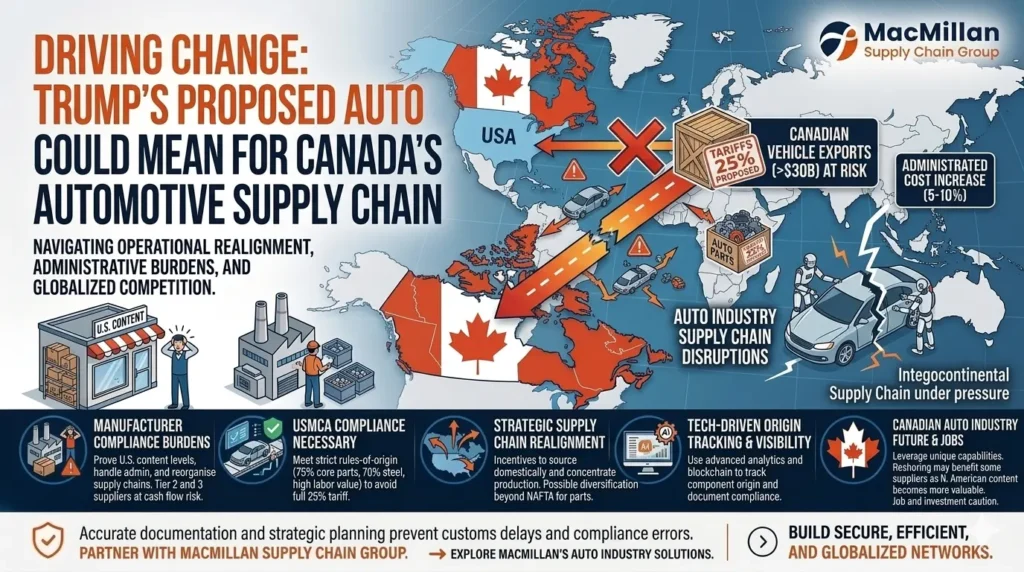
Trump’s Proposed Auto Tariffs and Canada’s Automotive Future Donald Trump, the former president of the United States, has suggested imposing a 25% tariff on imported automobiles and auto parts, which could revolutionize the automotive industry in Canada. The highly intertwined Canadian-American auto industry, where billions of parts and automobiles cross the border each year, would be greatly impacted by this policy. Vehicles that comply with the USMCA may be partially exempt, but Canadian manufacturers must demonstrate U.S. content levels, handle additional administrative requirements, and possibly reorganize supply chains. The MacMillan Supply Chain Group looks at how these tariffs might change the auto industry in North America, what steps need to be taken to comply, and how Canadian suppliers can adjust to stay competitive in this shifting trade landscape. Understanding the Impact of Trump’s Proposed Auto Tariffs The automotive industry is about to undergo significant change, and Canadian manufacturers must be aware of this. The North American auto manufacturing network would be impacted by Trump’s proposed auto tariffs, which would impose a 25% tax on cars and parts entering the country. These tariffs pose a serious threat to the status quo for Canada, which exports more than $30 billion worth of automobile goods to the United States each year. With parts frequently traveling across borders several times before a vehicle is finished, the Canadian auto industry has prospered as a component of an integrated continental supply chain. This smooth movement might become more difficult and expensive under the proposed tariffs. Vehicles that fulfill USMCA requirements might be eligible for partial exemptions, but demonstrating compliance necessitates additional paperwork and verification. We at MacMillan Supply Chain Group are aware of how important these developments are. Let’s examine how these changes may affect cross-border auto manufacturing, what they mean for Canadian auto suppliers, and what tactics can be used to deal with this changing environment. How Trump’s Suggested Auto Tariffs Work A significant change in North American trade relations is reflected in Trump’s proposed auto tariffs.Amid national security concerns, these tariffs would impose a 25% tax on imported cars and parts under Section 232 of the Trade Expansion Act. But, what does this really mean for Canadian Manufacturers? How the Tariffs Would Work Vehicles are treated differently depending on their origin and content thanks to the tariff structure’s tiered system: Vehicles from Europe and Asia that are not covered by the USMCA would be subject to a full 25% tariff on their total value. Only the non-U.S. content of USMCA-compliant vehicles would be subject to tariffs; precise tracking of part origins is necessary for calculation methods. For instance, tariffs would be applied to the remaining 70% ($42,000) of a $60,000 car built in Canada that has 30% U.S. content, resulting in a $10,500 tariff. The economics of cross-border manufacturing are significantly altered by this. According to the implementation timeline, procedures should be in place by June 2025, which leaves businesses with little time to adjust. This calls for a quick review of content sources and supply chains for Canadian auto suppliers. One should not undervalue the administrative burden. Systems for monitoring and certifying the percentage of U.S. content in each component and completed vehicle must be put in place by businesses. This calls for spending money on supply chain visibility tools and documentation systems, which many smaller Canadian parts manufacturers might not have at the moment. USMCA Compliance: The Secret to Effective Tariff Management USMCA compliance is now a business survival strategy for Canadian auto parts manufacturers rather than just a legal necessity. It is now crucial to comprehend the intricate regulations that establish whether a product is eligible for preferential treatment. Critical USMCA Requirements Vehicles must fulfill a number of requirements in order to be eligible for tariff exemptions under the USMCA: 75% of essential components must be made in North America; 70% of steel and aluminum must be obtained locally; and 40–45% of the content must come from businesses that pay employees at least $16 per hour. Many Canadian auto suppliers that source materials from around the world will find it difficult to comply with these thresholds, which are a major increase over earlier NAFTA requirements. Another level of complexity is introduced by the certification procedure. Although USMCA takes a more flexible approach than NAFTA’s formal certificates of origin, it still necessitates thorough documentation.Companies must maintain comprehensive records that specify where each component comes from and what value additions were made in North America. This presents a dual challenge for smaller Canadian parts manufacturers, who must put in place reliable tracking systems in addition to adhering to stricter content requirements. As automakers look for suppliers who can help them avoid tariffs, those who are unable to certify North American content may find themselves at a significant competitive disadvantage. According to industry experts, many auto suppliers have already seen a 5–10% increase in administrative costs as a result of USMCA compliance costs. Businesses must balance these compliance expenses against possible tariff savings in light of the additional pressure from tariffs. Reshaping Cross-Border Supply Chains The way North American automotive supply chains function may be drastically changed by the proposed tariffs. The current system permits parts to cross borders several times during production because it is based on decades of integration. Under new tariff structures, this effective model might no longer be financially viable. Possible Disruptions to the Supply Chain Just-in-time delivery methods, which reduce inventory costs, are crucial to the production of automobiles in Canada. These carefully calibrated systems could be upset by tariffs in a number of ways: Delays at the border due to heightened customs scrutiny; higher inventory costs as businesses prepare for unforeseen events There are incentives to source more components domestically and pressure to concentrate production on one side of the border. Early indications of supply chain diversification are already visible as businesses make backup plans. Some Canadian automakers are looking into opening or growing their operations in the United States, especially for expensive parts that would be
International Logistics 101 | Warehousing & Fulfillment Guide
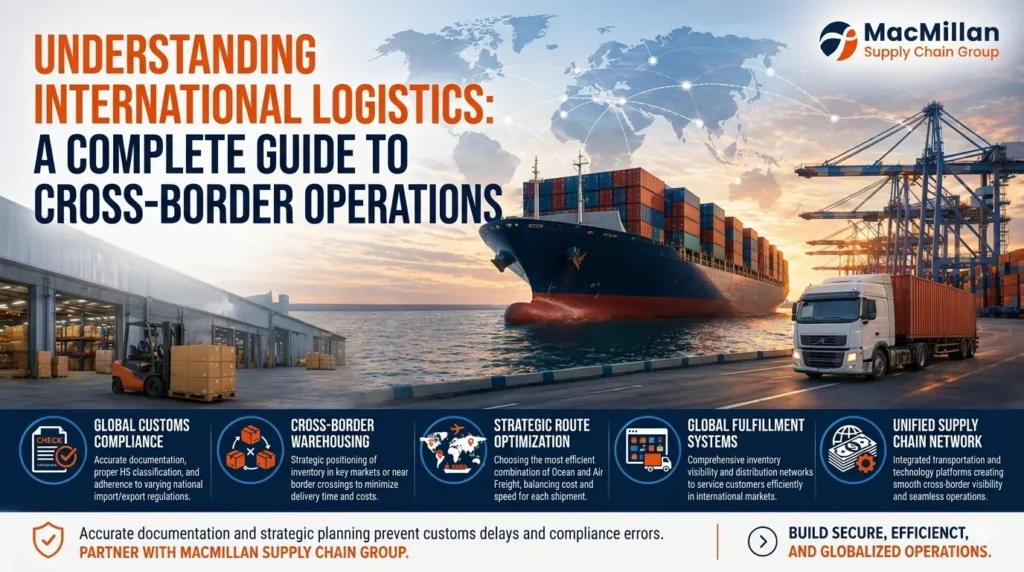
The intricate movement of goods across national borders is known as international logistics, and it calls for knowledge of distribution, warehousing, transportation, and customs clearance. Knowing the basics of cross-border operations is crucial for companies growing internationally to succeed. From choosing modes of transportation to overseeing cross-border warehousing and fulfillment, this guide examines important aspects of international logistics. MacMillan Supply Chain Group provides the infrastructure and experience to effectively handle international logistics challenges, regardless of your level of experience with international trade or your desire to streamline current operations. Introduction: Understanding International Logistics Have you ever pondered how goods from around the globe make their way to your neighborhood shops or homes? International logistics the difficult process of transporting goods across borders while negotiating complex regulations, transportation networks, and fulfillment systems holds the key to the solution. Choosing the best shipping option, overseeing cross-border storage, and guaranteeing efficient customs clearance are all included in international logistics. Gaining proficiency in these areas is essential for companies growing outside of their home markets in order to preserve their competitive edge and client satisfaction. International shipping presents special difficulties for Canadian companies in the linked economy of today. Given Canada’s size and closeness to the US market, businesses require strategic approaches to fulfillment and warehousing that strike a balance between speed, cost, and compliance. Knowing the basics of international logistics can mean the difference between success and expensive errors, whether you’re shipping from Vancouver to Vienna or Toronto to Tokyo. Options for International Shipping Transportation Ocean Freight: The Foundation of International Logistics The most economical way to transport big loads of goods across international borders is still by sea. It’s critical for Canadian companies shipping abroad to comprehend their container options: Full Container Load (FCL): FCL provides superior security and possibly lower prices per unit when your shipment fills an entire container. Least than Container Load (LCL): LCL enables you to share container space with other shippers for smaller shipments, making ocean freight feasible even for small volumes. It usually takes 20 to 30 days for ocean freight from Asia to Canadian ports, which makes it perfect for routine inventory replenishment or non-urgent shipments. Although ocean shipping is slower than air freight, it is usually 4-6 times less expensive, making it the best choice for large orders or bulky items. According to logistics specialists at MacMillan Supply Chain, “timing is everything when planning international logistics.” “Ocean freight offers outstanding value for routine inventory movements, but it requires longer lead times if planned properly.“ Air Freight: Speed When It Matters Most When time is critical, air freight becomes the go-to solution for international logistics. Air freight Canada services connect businesses to global markets in days rather than weeks: Express Air Freight: Can deliver in as little as 1-3 days for urgent shipments; Standard Air Freight: Usually delivers in 5-7 days internationally. Despite being more expensive than ocean shipping, air freight has benefits beyond speed. Products travel less, which lowers the risk of damage and the cost of carrying inventory. The higher cost of air freight is frequently justified by increased cash flow and customer satisfaction for valuable items, perishables, or urgent shipments. International Warehousing Techniques Placement of the Warehouse Strategically The global location of your inventory has a significant impact on shipping costs and delivery times. Cross-border warehousing solutions give companies the freedom to effectively service global markets: Border-Adjacent Warehousing: Facilities near major crossing points between Canada and the U.S. facilitate smooth cross-border commerce Regional Distribution Centers: Strategic warehouses in key markets reduce last-mile delivery times and costs Foreign Trade Zones: Special warehousing areas that allow duty deferment until products enter the domestic market MacMillan Supply Chain Group operates strategically located warehouses throughout Canada, providing businesses with flexible storage solutions that minimize transit times and customs delays. Businesses can lower shipping costs and increase delivery times by putting inventory closer to end users. Managing Inventory in International Logistics International inventory management poses special difficulties. Advanced systems are necessary for efficient international logistics in order to track inventory levels, keep an eye on movement, and guarantee that goods are available when and where they are needed. Contemporary warehouse management systems give companies real-time visibility across international facilities, allowing them to: Ensure that inventory levels are balanced across foreign locations. Expect variations in regional demand. Improved forecasting can lower the need for safety stock. Reduce delays caused by customs by using the right paperwork. According to supply chain experts, “having facilities in multiple countries isn’t the key to successful international warehousing.” “It’s having the systems and knowledge to run those facilities as a unified global logistics network.” Managing Compliance and Customs Comprehending Customs Clearance Navigating customs clearance procedures is one of the most difficult parts of international logistics. Every nation has different regulations, standards for documentation, and things that are not allowed. Working with knowledgeable customs brokers is crucial for companies shipping between Canada and foreign locations. Customs clearance typically requires: Commercial invoices with accurate product descriptions and values Certificates of origin documenting where products were manufactured Bills of lading or air waybills detailing transportation information Proper classification of goods under Harmonized System (HS) codes Shipment delays, extra inspections, or even fines may result from mistakes in customs paperwork. Working with a reputable freight forwarder in Canada, such as MacMillan Supply Chain Group, helps guarantee adherence to all applicable laws. Import/Export Laws and Adherence Navigating intricate import/export laws that differ by nation and product type is part of international logistics, which goes beyond simple customs clearance. These could consist of: Certifications or testing specifications unique to a product Items that are restricted or forbidden Quota restrictions on specific product categories; special licensing for controlled goods Staying compliant with these regulations requires ongoing vigilance and expertise. As regulations change frequently, businesses engaged in international trade need partners who actively monitor regulatory developments and adapt procedures accordingly. Common Problems with International Logistics Numerous obstacles in international logistics have the potential to upset supply chains and lower customer
How Canadian Brands Should Prepare Inventory for Seasonal Product Launches
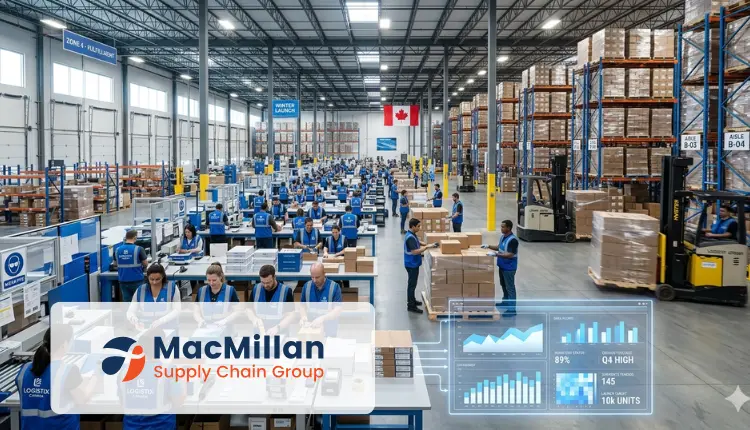
A Quick Summary and Overview Seasonal product launches create a narrow window for success. If inventory arrives late, is staged incorrectly, or is not ready for retail and DTC execution at the same time, the campaign loses momentum before customers ever see the product. Current competitor content that performs well around peak and seasonal fulfillment focuses on forecasting, scalable capacity, real-time visibility, and launch readiness rather than broad logistics education. Shopify’s recent demand-planning and inventory-allocation guidance also emphasizes forecasting, stocking levels, and acting early on seasonal demand signals. MacMillan SCG is positioned around the exact capabilities seasonal launches require: retail-ready warehousing, promotional packaging, kitting, lot and batch tracking, transportation built for retailer precision, and real-time visibility across inventory and orders. Introduction A seasonal launch is not just another replenishment cycle. It is a timed revenue event. Whether you are launching a holiday bundle, spring wellness promotion, limited-edition beauty SKU, or back-to-school retail program, inventory has to be in the right place, in the right format, at the right time. Shopify’s seasonal inventory guidance notes that brands need sales forecasting and early preparation to avoid stockouts or excess stock during seasonal swings. The problem is that many brands prepare marketing before they prepare inventory. By the time demand spikes, they are scrambling to receive product, build kits, allocate stock across channels, and meet retail windows. Competitor content from GoBolt and Metro increasingly frames peak-season and launch support around scalable infrastructure, forecasting tools, flexible labor, and value-added services because those are the operational pressure points buyers actually feel. Why Seasonal Launches Break Down Most seasonal launches fail operationally in one of five places: demand is under-forecasted or over-forecasted inventory is not received early enough stock is not allocated correctly across channels product is not retail-ready when needed teams lack visibility once orders start moving Shopify’s recent inventory-allocation and demand-planning material makes the same basic point: forecasting alone is not enough; brands need a process that turns demand signals into stocking, allocation, and execution decisions. For Canadian brands, this challenge is often more complex because they may need to support national retail, ecommerce, and marketplace demand at the same time, sometimes with bilingual labeling, channel-specific packaging, and retailer compliance requirements layered in. MacMillan’s value-added and warehousing pages specifically highlight bilingual packaging, GS1 barcodes, retailer-specific labeling, and shelf-ready builds for promotional and launch programs. 6 Steps to Prepare Inventory for a Seasonal Product Launch 1. Forecast demand earlier than usual Seasonal launches compress planning timelines. Historical sales, campaign calendars, retailer commitments, regional demand patterns, and product velocity all need to be reviewed early. Shopify’s seasonal forecasting guidance recommends using historical sales data and demand patterns to estimate likely sales swings, while its more recent demand-planning content frames this as a structured process, not a guess. The operational lesson is simple: launch planning should start before procurement deadlines close, not after inventory is already on the water or inbound to the warehouse. 2. Receive and verify inventory before the campaign clock starts Brands often lose launch time because receiving happens too close to go-live. Seasonal inventory should arrive with enough buffer for inbound checks, discrepancy resolution, lot capture, and prep work. MacMillan’s warehousing positioning emphasizes rapid dock-to-stock execution, lot and batch tracking, and visibility for quality control and recalls, which are especially valuable when time-sensitive launch inventory lands close to a promotional window. If the launch involves regulated or sensitive categories such as wellness, beauty, food, or home care, early receiving also reduces the risk of last-minute compliance issues. 3. Allocate inventory by channel before orders begin to surge A seasonal launch rarely lives in one channel. Brands may need to support DTC, retail, wholesale, and marketplaces from one inventory pool. Shopify’s recent inventory-allocation guidance is directly relevant here: allocation strategy determines where stock should sit and how much each channel receives to minimize stockouts and overselling. MacMillan’s service positioning supports this approach through multi-channel fulfillment, real-time inventory visibility, and integrated ecommerce and retail execution. 4. Make inventory retail-ready before the launch window opens For seasonal retail launches, inventory must do more than exist in storage. It must be ready for shelf placement and compliant receiving. That includes pallet specs, labeling, carton orientation, ASN accuracy, displays, and retailer-specific packaging. Metro’s Toronto 3PL page highlights retailer routing-guide compliance and scalable B2B distribution as a core requirement for retail execution, which mirrors how buyers evaluate seasonal launch support. MacMillan states that its warehousing operation is built for retailer requirements including pallet height, label requirements, carton orientation, and ASN accuracy, while its value-added services support display assembly, kitting, relabeling, and promo packaging. 5. Build in promotional packaging, kitting, and inserts early Many seasonal launches include bundles, gift sets, promotional inserts, or limited-edition configurations. Those value-added tasks create bottlenecks if they are treated as last-minute add-ons. Competitor content on DTC and peak execution increasingly promotes custom packaging, kitting, and flexible labor as core launch capabilities rather than optional extras. MacMillan’s value-added services are closely aligned with this need, including product kitting, promo inserts, display builds, bilingual packaging, and retailer-specific labeling. 6. Track launch performance in real time Once the launch begins, speed of insight matters almost as much as inventory position. Brands need to know what is selling, what is delayed, what needs replenishment, and whether retailer or DTC orders are hitting service expectations. MacMillan’s site highlights real-time order and inventory visibility, milestone updates, digital PODs, and KPI-driven reporting, which helps teams react faster during a narrow launch window. This aligns with what is working in competitor messaging too: GoBolt’s peak-season content emphasizes real-time tracking, scalable support, and preventing the problems that otherwise surface during compressed demand spikes. Common Seasonal Launch Inventory Mistakes The most common mistakes are: bringing inventory in too late treating retail and DTC as separate planning exercises underestimating prep time for labeling and kitting not reserving capacity for peaks relying on manual updates during launch week These mistakes usually lead to the same business outcomes: late launches, lost sales, higher expediting costs, retailer frustration,