


Black Friday Fulfillment Canada: 2026 Peak Season Guide
Black Friday Fulfillment Canada: How E-commerce Brands Can Prepare for…


Black Friday Fulfillment Canada: How E-commerce Brands Can Prepare for…

When discussing e-commerce, what typically springs to mind? Most likely,…
As the busiest time of the year draws near, the…
As the busiest time of the year draws near, the…
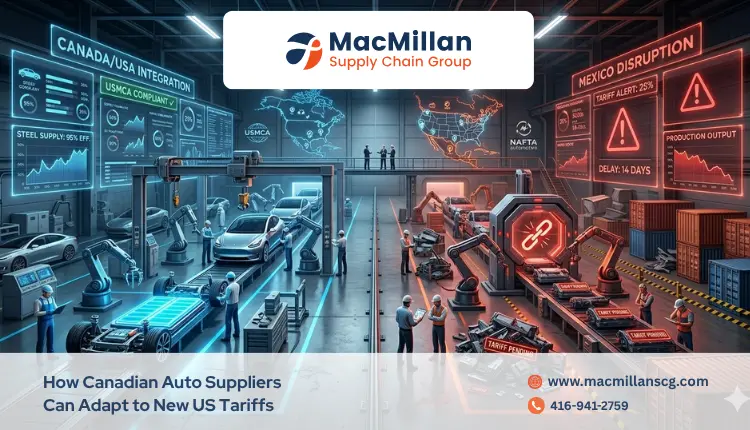
Automakers that use US/USMCA parts in US-assembled vehicles can receive rebates thanks to recent tariff adjustments made by President Donald Trump. Despite being intended to increase American manufacturing, these modifications pose serious difficulties for Canadian auto suppliers. For cars with 85% or more USMCA-compliant parts, the new system offers a 3.75% rebate in year one and a 2.5% rebate in year two. Non-compliant parts are subject to 25% tariffs. North American automotive supply chains are changing as a result of this policy change, and Canadian suppliers may lose contracts, experience cross-border issues, and see a decrease in exports. Through regional partnerships, EV market diversification, and RVC certification, Canadian auto suppliers can overcome these obstacles with strategic adaptation.
The automotive industry across North America is experiencing a major shift following President Donald Trump’s executive order on tariffs. In April 2025, the administration introduced a system of rebates and penalties designed to incentivize US-assembled vehicles using parts from USMCA countries (United States, Mexico, and Canada).
The integrated North American auto industry faces both opportunities and challenges as a result of this new strategy. The policy has repercussions across the supply chain, especially for Canadian auto suppliers who have historically been closely linked to US production, even though its goal is to boost domestic manufacturing in the US.
These developments necessitate prompt attention and careful planning from Canadian auto suppliers. In addition to knowing how these tariff adjustments work, businesses also need to know how to best position themselves to stay competitive in this changing market. Let’s examine the implications of these modifications and how Canadian auto suppliers can adjust to this new situation.
The Trump administration’s new tariff structure gives the automobile industry a carrot-and-stick strategy. For Canadian auto suppliers trying to negotiate this shifting environment, it is essential to comprehend these mechanics.
A sliding scale governs the rebate structure. If at least 85% of the parts in a vehicle meet US/USMCA content requirements, automakers can get a 3.75% rebate of the vehicle’s MSRP between April 2025 and April 2026. This rebate drops to 2.5% the following year (May 2026–April 2027), which puts pressure on manufacturers to make quick adjustments. On the other hand, significant 25% tariffs on parts that don’t meet USMCA thresholds are imposed on non-compliant imports.
Companies that prioritize domestic or USMCA-certified components, such as Ford and GM, are purposefully rewarded by this system. For instance, if a $40,000 car satisfies the regional content requirements, it may be eligible for a $1,500 rebate in the first year. Automakers are therefore financially motivated to carefully examine their supply chains and give preference to vendors who can assist them in reaching these benchmarks.
Through the USMCA framework, the policy seeks to expedite the reshoring of vital automotive manufacturing while preserving a certain amount of flexibility. This implies that it is now more crucial than ever for Canadian auto suppliers to comprehend precisely how their parts fit into an automaker’s regional value content calculations.
As these tariff changes go into effect, Canadian auto suppliers will face a number of immediate challenges. The biggest worry is that contracts may be lost as US automakers reevaluate their supplier relationships in an effort to increase their eligibility for rebates.
Many Ontario-based producers of engines, transmissions, and other vital parts run the risk of being shut out if their goods don’t adhere to USMCA compliance requirements. Automakers might switch to Mexican or American suppliers who can assist them in meeting the 85% rebate threshold. Small and medium-sized businesses (SMEs), which lack the resources to swiftly modify their production processes, should be especially concerned about this.
Another major obstacle is the complexity of cross-border supply chains. For many years, the automotive sector has used integrated production networks, in which components travel across borders several times while being manufactured. Each border crossing for non-compliant parts may result in additional expenses under the new tariff regime. For example, Canadian raw materials that are processed in the United States, put together in Mexico, and then brought back to the United States for the last stage of vehicle assembly may be subject to compounded tariffs at every stage.
Another level of complexity is introduced by Canada’s retaliatory actions. EVs and high-end cars that did not comply with the USMCA were subject to matching 25% duties levied by the Canadian government. Despite being designed to safeguard domestic production, these countermeasures may further upset long-standing supply chains and limit Canadian auto suppliers’ access to the global market.
In reaction to these tariff changes, major automakers are quickly changing their strategies. US-made parts are being given priority by Ford and General Motors, especially for expensive products like batteries, electric motors, and semiconductors. The goal of this reshoring initiative is to reach regional value content (RVC) requirements in order to be eligible for the available rebates.
While they reevaluate their cost structures and supply chains, some manufacturers have even delayed providing investors with financial guidance. To illustrate the substantial influence these changes are having on business planning, GM, for example, postponed its earnings forecast to account for possible tariff-related expenses.
Particular difficulties arise for Asian manufacturers who have production facilities in Canada. Honda’s Civic and Toyota’s RAV4, which are both built in Ontario, may lose market share in the US unless they greatly expand their USMCA-compliant content. Their Canadian auto suppliers are under pressure to either comply with compliance requirements or risk losing business as a result.
In order to assist the automotive industry in adapting, the Canadian government has set up a $2 billion Strategic Response Fund. This fund helps with workforce training, technology advancements, and plant retooling. Industry analysts, however, wonder if this sum will be enough to handle the magnitude of change required, particularly to support the shift to electric vehicle manufacturing.
The Canadian government’s retaliatory tariffs represent another strategic response, designed to protect domestic production while encouraging negotiations. However, this approach risks escalating trade tensions and creating additional uncertainty for Canadian auto suppliers caught in the middle.
We at MacMillan Supply Chain Group are aware of the difficulties facing Canadian auto suppliers in this dynamic trade landscape. Our all-encompassing strategy aids businesses in navigating these challenges while preserving their competitiveness.
In order to find RVC compliance gaps, we assist Canadian auto suppliers in analyzing their present supply chains. Our team collaborates with you to create plans that optimize regional content and cut expenses.
There are a few doable actions you can take to safeguard your company and set yourself up for future success if you’re a Canadian auto supplier who is having trouble because of these tariff changes.
Begin by thoroughly evaluating your present level of RVC compliance. This entails examining your bill of materials to ascertain the precise proportion of components that come from USMCA nations. Knowing your baseline will help you pinpoint areas that need improvement in order to add more regional content.
Investigate strategic alliances with additional USMCA suppliers after that. You can develop integrated supply solutions that assist OEMs in reaching their compliance goals by partnering with complementary companies in the US or Mexico. This strategy frequently turns out to be more economical than trying to move production facilities.
Think about branching out into new automotive markets, especially those for electric cars and driverless technology. These expanding markets frequently have distinct supply chain architectures and could present chances to build new clientele that are less impacted by conventional tariff issues.
Invest in supply chain technology that offers more control and visibility. Blockchain verification, automated documentation, and digital tracking systems can all greatly lessen the administrative load of compliance while enhancing your ability to adapt to evolving regulations.
Don’t overlook government support programs. Funding for workforce development and retooling can be obtained through the Strategic Response Fund and other programs. You can more easily access these resources by collaborating with industry associations.
Think about collaborating with MacMillan Supply Chain Group for all-encompassing assistance in overcoming these obstacles. Our knowledge of supply chain optimization, warehousing, and cross-border logistics can help Canadian auto suppliers stay competitive as they adjust to the new tariff environment. Get in touch with us right now to find out how our customized solutions can meet your unique requirements in this dynamic environment.
You can set up your company to not only withstand these tariff changes but also prosper in the newly reformed North American auto industry by acting proactively now.
The new tariff system offers rebates to automakers who use US/USMCA-compliant parts in US-assembled vehicles. In the first year (April 2025-April 2026), manufacturers can receive a 3.75% rebate if 85% or more of a vehicle's parts meet regional content requirements. This drops to 2.5% in the second year. Non-compliant parts face a 25% tariff. This system rewards domestic production while penalizing imports that don't meet USMCA thresholds.
Small Canadian suppliers can compete with larger companies by improving their USMCA compliance through higher regional value content, forming strategic partnerships with US and Mexican firms, and focusing on specialized or high-demand components. Their flexibility and ability to adapt quickly can be a major advantage in this changing environment.
The EV market offers strong growth opportunities for Canadian suppliers, particularly in areas such as battery materials, electric drivetrains, and advanced electronics. With access to key minerals like lithium and nickel, Canadian companies are well positioned to become important players in the evolving electric vehicle supply chain.
In the long term, these tariffs will push companies to redesign cross-border supply chains, making them more regional and USMCA-focused. Businesses will reduce unnecessary border crossings, invest in nearshoring, and adopt more complex logistics strategies to balance compliance with cost efficie
MacMillan Supply Chain Group helps companies navigate tariff challenges by providing supply chain analysis, RVC compliance support, cross-border logistics optimization, and strategic warehousing solutions. Their expertise enables businesses to reduce costs, improve efficiency, and remain competitive in a rapidly changing North American automotive market.