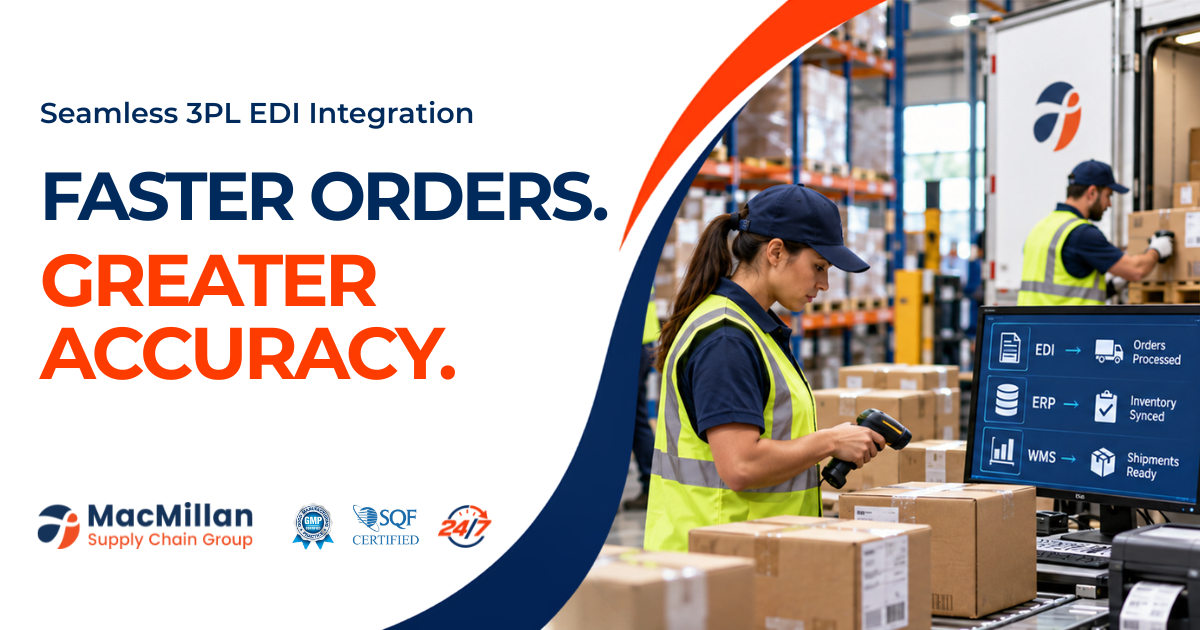

How an Integrated EDI Streamlines Your Business and Reduces Operational Costs
Integrating EDI with third-party logistics (3PL) streamlines the flow of…
Integrating EDI with third-party logistics (3PL) streamlines the flow of…

Hats off to you for always wanting to make…

You’ve sent your product out for delivery, they’ve received it,…
In the fast-evolving landscape of global trade and e-commerce, supply…
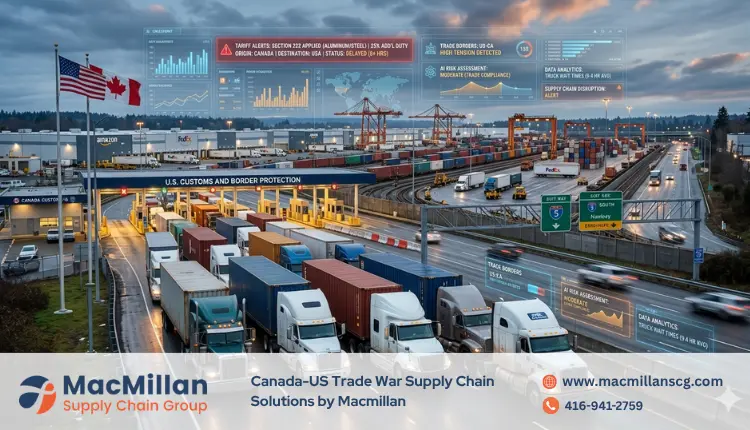
Industries that depend on cross-border trade have been shaken by the recent increase in trade tensions between the US and Canada. Businesses are experiencing supply chain disruptions never seen before as a result of President Trump’s administration’s 25% tariffs on Canadian goods and Prime Minister Mark Carney’s targeted duties on $30 billion worth of US exports in retaliation. At Macmillan Supply Chain Group, we understand that these issues are practical roadblocks that call for quick, technologically advanced solutions. This blog examines how Canadian companies can protect their operations from fluctuations in trade while preserving cost effectiveness and client satisfaction. As a leading provider of Canada-US trade war supply chain solutions, Macmillan SCG offers actionable insights in times of uncertainty.
18% of Canada’s yearly cross-border trade volume is directly impacted by the 2025 tariffs, which target industries ranging from consumer goods to auto parts. This means the following for SMEs:
Our team recently learned from a Toronto-based electronics retailer that their customs clearance times doubled overnight, putting $2 million in backorders at risk. These anecdotes highlight why supply chain diversification has become a top priority for 73% of Canadian companies looking for Canada-US trade war supply chain solutions.
Businesses can do the following thanks to Macmillan’s 45 cross-dock facilities across Canada:
Case Study: By using our Windsor warehouse for staged US-bound shipments, a Montreal fashion brand was able to reduce border wait times by 58% and avoid $470,000 in tariffs. This is a clear example of how Canada-US trade war supply chain solutions can directly impact profitability.
The CARM system from CBSA is integrated with our proprietary Mantis WMS to:
Our AI saved clients $28K per day in detention fees by rerouting 1,200 shipments through Sarnia in 4 hours during the Detroit border slowdown last month. These AI-driven capabilities are a cornerstone of our Canada-US trade war supply chain solutions.
With 90% of Canadian FSAs covered by next-day delivery, we help businesses:
“After the tariffs hit, Macmillan’s same-day Toronto delivery let us absorb costs without raising prices,” notes a Kitchener-based medical supplier.
This agility is key in implementing effective Canada-US trade war supply chain solutions.
Our Net-Zero Logistics Program converts ROI from regulatory compliance:
Sustainability isn’t just a goal—it’s a tool within Canada-US trade war supply chain solutions.
Given that 38% of logistics companies in Canada are experiencing a labor shortage, our facilities leverage:
While Carney’s team negotiates, we’re preparing clients for multiple scenarios:
Our 3-Step Migration Guarantee eliminates transition risks:
By the Numbers:
These figures validate our role as a leader in Canada-US trade war supply chain solutions.
The Canadian–US trade war is about strategically adapting, not just surviving. At Macmillan SCG, we have assisted more than 40 industry leaders in converting their supply chains into networks that are resilient to tariffs and responsive. The first step toward stability is having a discussion, whether that involves using our cross-dock network or our AI customs platform. If you’re searching for proven Canada-US trade war supply chain solutions, we’re ready to support you.
→ Explore our Tariff Mitigation Playbook
→ Schedule a free logistics audit with our trade experts
→ Follow us on LinkedIn for real-time tariff updates
Because in turbulent times, the right partner makes all the difference.
If you import from or export to the U.S., you'll face direct impacts through tariffs, increased customs scrutiny, and potential delays at border crossings. Even if you don't trade directly with the U.S., you may experience indirect effects through your suppliers or customers who do. Many GTA businesses report 15-20% higher input costs due to tariffs being passed through the supply chain. Working with a local 3PL like MacMillan Supply Chain Group can help you navigate these challenges with our expertise in cross-border logistics.
During the recent meeting, Mark Carney discussed rising trade tensions, tariffs, and supply chain disruptions with U.S. trade officials. The focus was on stabilizing cross-border trade, reducing tariff impacts, and exploring potential adjustments to existing agreements to support businesses on both sides. While no major deal was finalized, both sides signaled willingness to continue negotiations.
The United States-Mexico-Canada Agreement (USMCA) is more modern compared to North American Free Trade Agreement (NAFTA). USMCA includes updated rules on digital trade, stronger labor protections, stricter automotive manufacturing requirements, and more enforceable dispute resolution mechanisms. It reflects today’s economic realities, unlike NAFTA which was created in the 1990s.
Several key industries are heavily impacted, including:
These sectors rely heavily on cross-border trade, making them more vulnerable to tariffs and delays.
The Canada economy has responded by increasing supply chain diversification, investing in nearshoring strategies, and expanding trade partnerships beyond the U.S. Businesses are also adopting technology and automation to reduce costs and improve resilience. However, some sectors are still facing higher costs and slower growth due to ongoing uncertainty.
Retaliatory tariffs are taxes imposed by one country in response to tariffs placed by another country. For example, when the United States imposes tariffs on Canadian goods, Canada may respond with its own tariffs on U.S. imports. These tariffs increase costs for businesses, disrupt supply chains, and often lead to reduced trade volumes and higher prices for consumers.