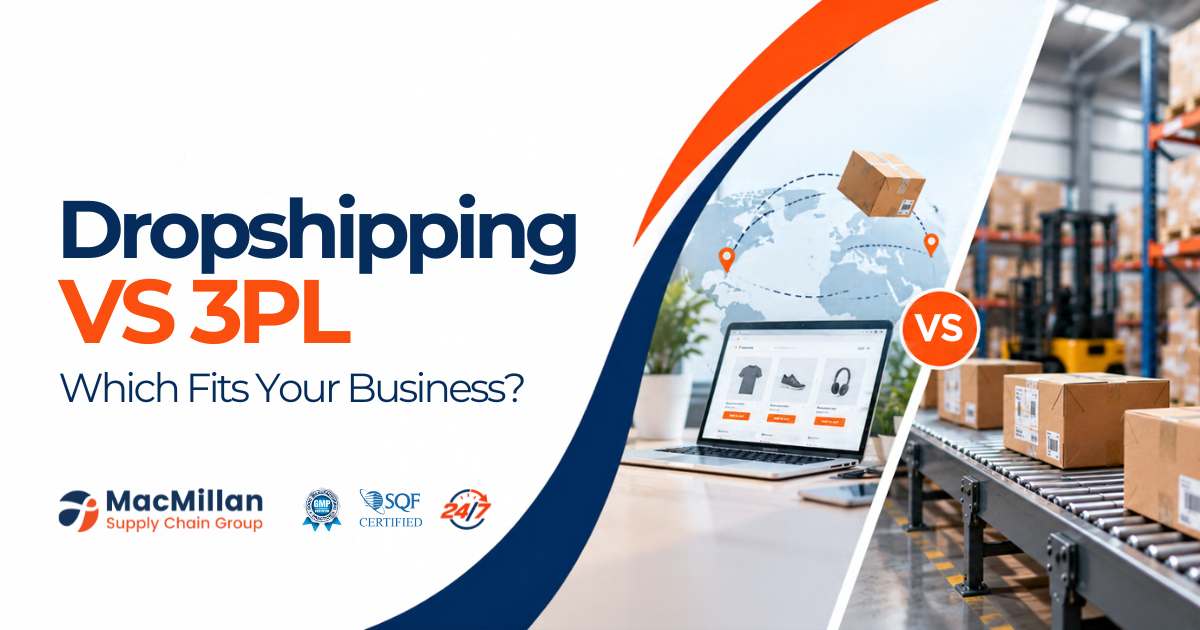
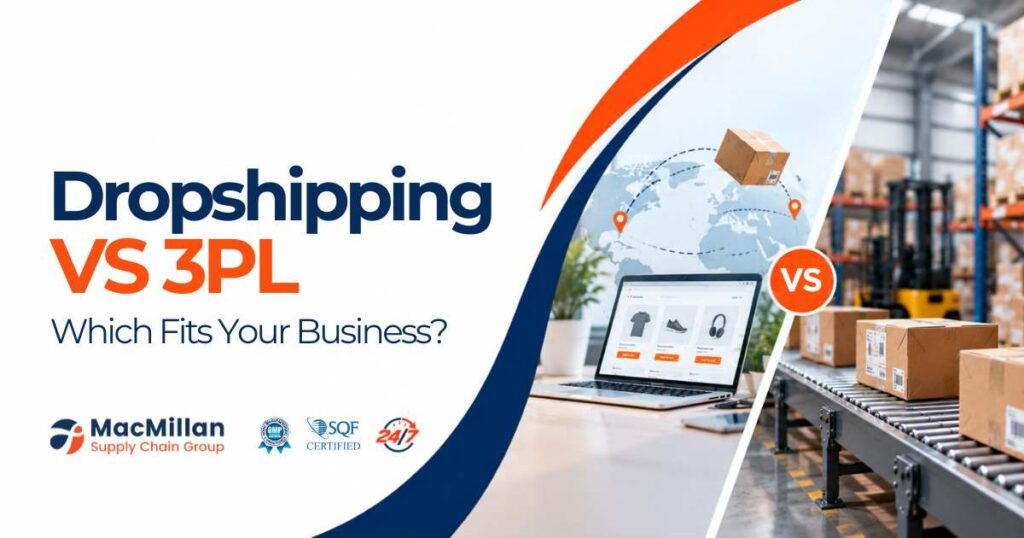
Dropshipping vs 3PL: Which Fulfillment Model Is Right for Your Business?
When discussing e-commerce, what typically springs to mind? Most likely,…
When discussing e-commerce, what typically springs to mind? Most likely,…
As the busiest time of the year draws near, the…
As the busiest time of the year draws near, the…
As the busiest time of the year draws near, the…
When discussing e-commerce, what typically springs to mind?
Most likely, it’s the vast variety of amazing products available for purchase at your convenience. Yet, an equally crucial aspect of e-commerce is how these products reach the customers, a process just as important as the products themselves.
As online shopping redefines the retail landscape, understanding and choosing the right e-commerce fulfillment model becomes a pivotal decision for every venture.
In this blog, we’ll get into the heart of e-commerce operations, comparing two of the most influential fulfillment models: dropshipping and third-party logistics.
While dropshipping offers a unique model for startups and SMEs to optimize shipping costs without maintaining inventory, 3PL provides a more comprehensive solution for handling logistics, storage, and distribution.
Understanding the differences between dropshipping vs 3PL is beneficial and essential for businesses aiming to streamline their operations and enhance customer satisfaction.
Both are popular e-commerce fulfillment models, but they cater to different needs and operational structures within e-commerce.
With this blog, we aim to simplify the difference between dropshipping and third-party logistics, providing clarity for businesses grappling with the decision of which model best suits their needs.
Before getting into dropshipping vs 3PL, let’s touch up on what is dropshipping.
Dropshipping is a streamlined order fulfillment method where online retailers sell products without owning or stocking them. This strategy is especially attractive to individuals seeking to establish an e-commerce website with limited financial resources.
Unlike traditional retail, dropshipping eliminates the need for the retailer to buy or store inventory. This aspect significantly reduces the upfront costs and risks of starting a business.
Retailers partner with manufacturers or wholesalers who own the products.
These partnerships are crucial, allowing retailers to list products on their online stores without actually purchasing them.
Let’s have a look at the process of dropshipping:
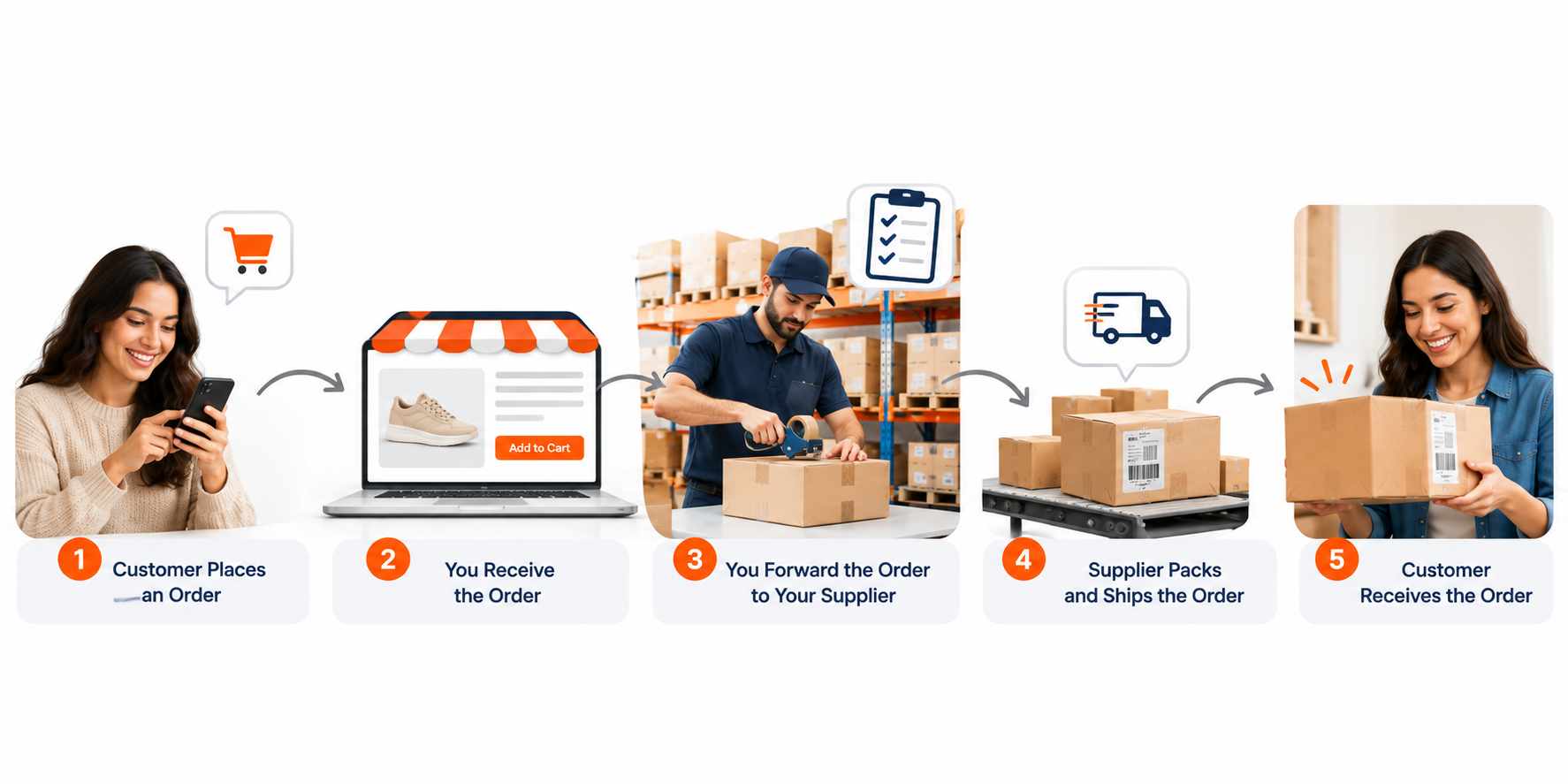
To really understand dropshipping vs 3PL, let’s get a better understanding of what dropshipping entails:
Now that we’ve had a peek into what dropshipping is, let’s move forward with the next segment of understanding dropshipping vs 3PL.
Third-party logistics, commonly known as 3PL, is a comprehensive fulfillment method businesses use to manage their inventory and shipping operations efficiently. This approach involves outsourcing various logistics-related activities to a specialized company.
3PL involves delegating key logistics services to an external company, including inventory management, order processing, packaging, and shipping.
By outsourcing these tasks, businesses can concentrate on product development, marketing, and customer service, leaving the logistical complexities to the experts.
Let’s have a look at how 3PL works:
Now that we’ve had a peek into what dropshipping is, let’s move forward with the next segment of understanding dropshipping vs 3PL.
Third-party logistics, commonly known as 3PL, is a comprehensive fulfillment method businesses use to manage their inventory and shipping operations efficiently. This approach involves outsourcing various logistics-related activities to a specialized company.
3PL involves delegating key logistics services to an external company, including inventory management, order processing, packaging, and shipping.
By outsourcing these tasks, businesses can concentrate on product development, marketing, and customer service, leaving the logistical complexities to the experts.
Let’s have a look at how 3PL works:
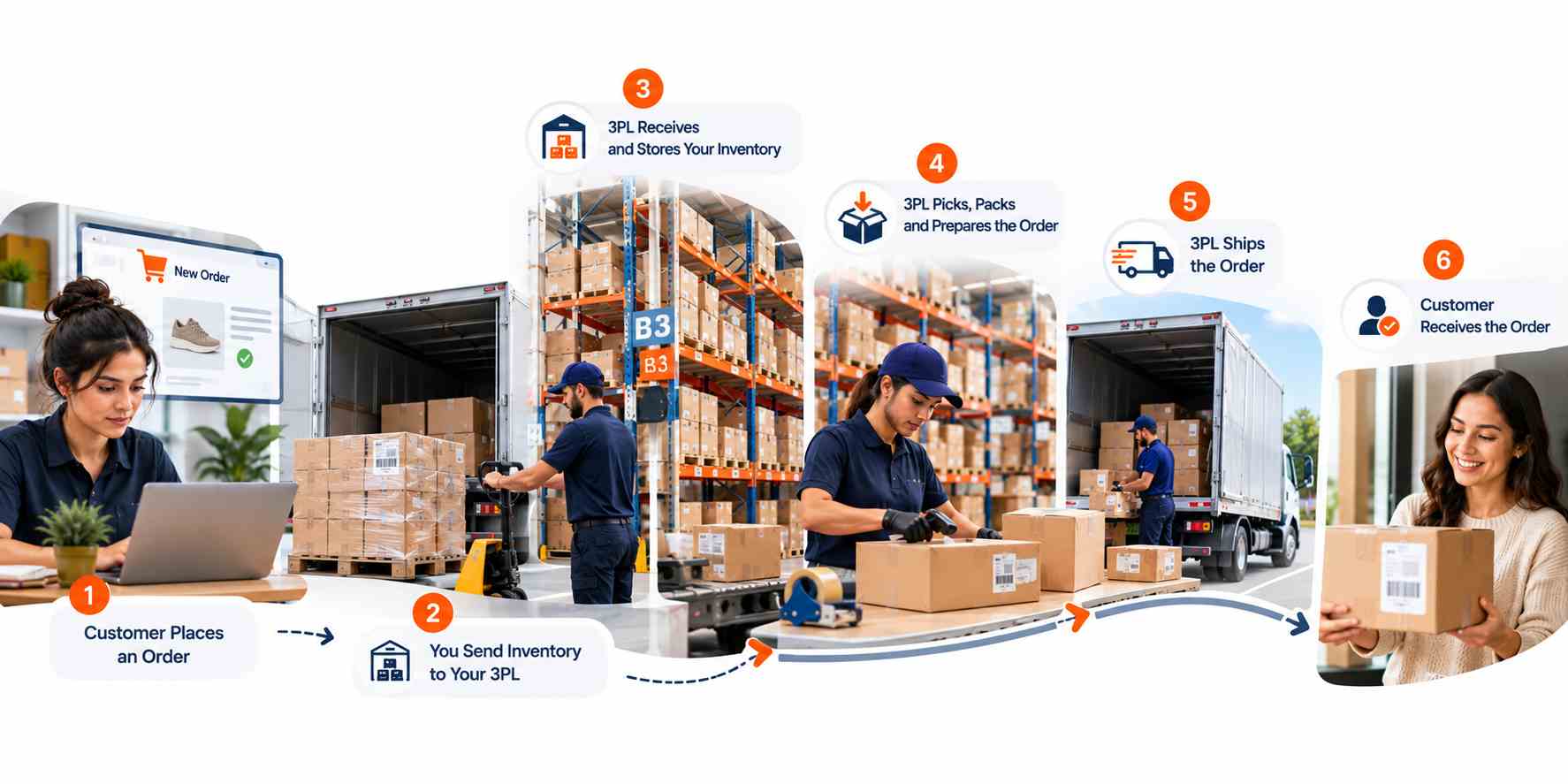
Let’s understand the features of 3PL, to help in understanding the main differences of dropshipping vs 3PL:
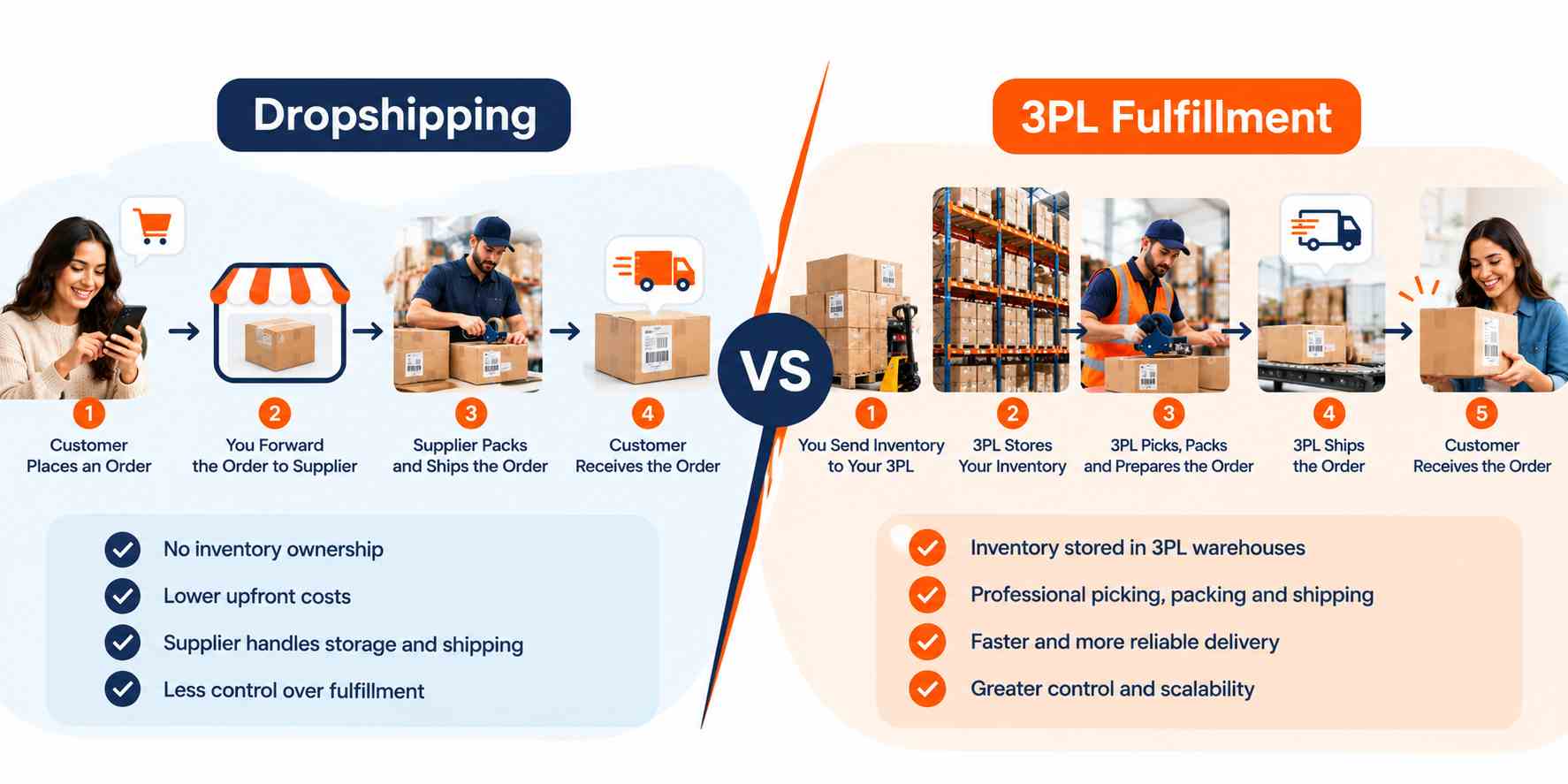
When it comes to e-commerce fulfillment, the debate of dropshipping vs 3PL often centers on their shared approach to outsourcing key operations. However, the differences between these two models are substantial, each catering to unique business needs and strategies.
In the following sections, we’ll delve into a side-by-side comparison of dropshipping vs 3PL, examining each aspect of these models to highlight how they differ and what they offer to e-commerce businesses.
In the dropshipping vs 3PL debate, dropshipping is characterized by its no-inventory approach. Rather, they depend on suppliers to dispatch products to customers, as orders are placed directly.
This approach allows the seller to focus on other aspects of their business, such as marketing and customer service, while the supplier manages product storage, packaging, and shipping.
Dropshipping places significant emphasis on marketing and the acquisition of customers. The vendor enables transactions between customers and manufacturers while also being responsible for marketing and customer relations.
A more comprehensive model, the third-party logistics model incorporates inventory ownership and a more extensive emphasis on supply chain management. By utilizing 3PL, organizations can focus on product development and more extensive business strategies.
Third-party logistics (3PL) requires businesses to maintain inventory ownership while delegating logistics to a specialized external provider, encompassing storage, handling, and shipping.
This arrangement allows businesses to retain control over their stock, ensuring they can directly manage inventory levels and product selection.
In the dropshipping vs 3PL comparison, dropshipping operates without vendor inventory, significantly reducing the initial capital required for e-commerce ventures. Sellers profit from the markup between the wholesale price paid to the supplier and the retail price charged to customers.
This model minimizes inventory management risks but often leads to lower profit margins due to the supplier’s control over wholesale prices.
In contrast, businesses using third-party logistics invest upfront in their inventory, granting them greater control and agility in responding to market changes and consumer preferences.
Financially, this model can lead to higher profit margins, as businesses have the autonomy to set retail prices based on market trends and their own cost structures.
While the initial investment in inventory is higher in the 3PL model, it opens up opportunities for more effective pricing strategies and potentially higher financial returns.
The fulfillment procedure is indirect and streamlined for dropshipping. Following a customer’s order placement on the seller’s website, the order is transmitted to the supplier. The supplier maintains the inventory and is responsible for packing and dispatching the product to the customer.
This procedure results in the supplier assuming the obligations of inventory management, storage, and shipping logistics without the vendor ever having physical contact with the product.
Although this simplifies the seller’s operations, it restricts their ability to regulate the delivery process and ensure a satisfactory customer experience.
In the 3PL model, the company has greater involvement in the fulfillment process. After the enterprise acquires and possesses the inventory, the 3PL provider is responsible for its storage in their warehouses.
The 3PL partner is responsible for selecting the appropriate item from the inventory, packing it, and shipping it to the consumer upon placing an order.
Dating packaging standards, shipping speed, and management procedures enable organizations to retain a greater degree of governance over the customer experience.
Additionally, 3PL providers often offer scalability and flexibility in handling fluctuating order volumes, which can be particularly beneficial during peak seasons or promotional periods.
In the dropshipping vs 3PL framework, a dropshipping vendor’s main responsibilities are centered around marketing and customer service. This focus is due to the supplier’s total control over logistics, over which the vendor has no influence.
The vendor’s role is to attract customers to their platform, facilitate sales, and address post-purchase customer inquiries or issues.
However, this lack of control over logistics can sometimes pose challenges in maintaining consistent customer satisfaction, as the seller is reliant on the supplier’s dependability and efficiency.
Conversely, third-party logistics providers like Macmillan offer a broader spectrum of services that extend beyond basic logistics. These include detailed inventory management, enabling businesses to precisely monitor stock levels, sales patterns, and reorder points.
3PLs may also take on shipping-related customer service tasks, efficiently manage returns and exchanges, and provide logistics performance insights.
This comprehensive range of services allows businesses to deliver a more controlled and superior customer experience, ensuring quicker shipping, better product handling, and more responsive customer service, which all contribute to heightened customer satisfaction and loyalty.
Dropshipping allows new businesses to enter the market without requiring a significant upfront investment in inventory and storage.
This model is conducive to businesses that want to build their brand and customer base through effective marketing and customer service without the complexities and financial risks associated with inventory management.
Dropshipping offers flexibility in product offerings and the ability to test market demand for new products without the commitment of large inventory purchases.
However, this model might pose challenges in scaling up quickly, as the seller depends on the supplier’s ability to handle increased order volumes.
For more established businesses that clearly understand their market and customer base, 3PL offers a solution that addresses the complexities of managing larger inventory volumes and more intricate logistics.
This model is well-suited for businesses looking to scale up, requiring a robust system to handle increased order volumes, storage needs, and complex distribution requirements.
3PL providers can offer scalable solutions that grow with the business, providing expertise in logistics management that can significantly enhance operational efficiency.
This model allows businesses to focus on their core competencies, such as product development and market expansion, while leaving the logistics to experts who can adapt to changing market demands and operational challenges.
This analysis aims to compare the advantages of each model, providing a clear perspective for businesses to make an informed decision.
| Aspect | Dropshipping Fulfillment | Third-Party Logistics (3PL) Fulfillment |
|---|---|---|
| Initial Investment | Low initial investment as there is no need for inventory or storage. | Higher initial investment due to inventory purchase and storage costs. |
| Business Focus | Enables focus on brand visibility and customer attraction. | Allows business owners to concentrate on marketing, sales, and product design. |
| Product Diversity | Access to a wide range of products through various suppliers. | Limited to the products the business decides to stock and manage. |
| Order Fulfillment Time | Dependent on supplier efficiency; the seller has less control. | Generally faster as the 3PL partner is specialized in logistics. |
| Scalability | Limited scalability due to reliance on supplier capabilities. | High scalability, with integration options with platforms like Shopify, Amazon, etc. |
| Operational Control | Limited control over the fulfillment process and customer service. | Greater control over the entire fulfillment process, including customer service. |
| Market Adaptability | Quick to start and easy to adapt to market changes with new products. | Requires more time for adaptation due to inventory management. |
| Risk Management | Lower financial risk as there’s no inventory to manage. | Higher risk due to investment in inventory and warehousing. |
Choosing the right fulfillment model is a pivotal decision in e-commerce, and understanding the nuances of dropshipping vs third-party logistics is essential for businesses of various sizes and operational needs.
This comparison aims to provide a clear perspective on both models, helping you determine which aligns more closely with your business goals in 2024.
As we’ve explored the intricacies of dropshipping vs 3PL in 2024, it’s clear that the choice of fulfillment model is a critical strategic decision for any e-commerce business.
Whether you’re a startup looking to minimize initial costs and experiment with product offerings through dropshipping, or a growing business seeking to manage larger order volumes and enhance operational control with 3PL, understanding your specific needs and goals is key.
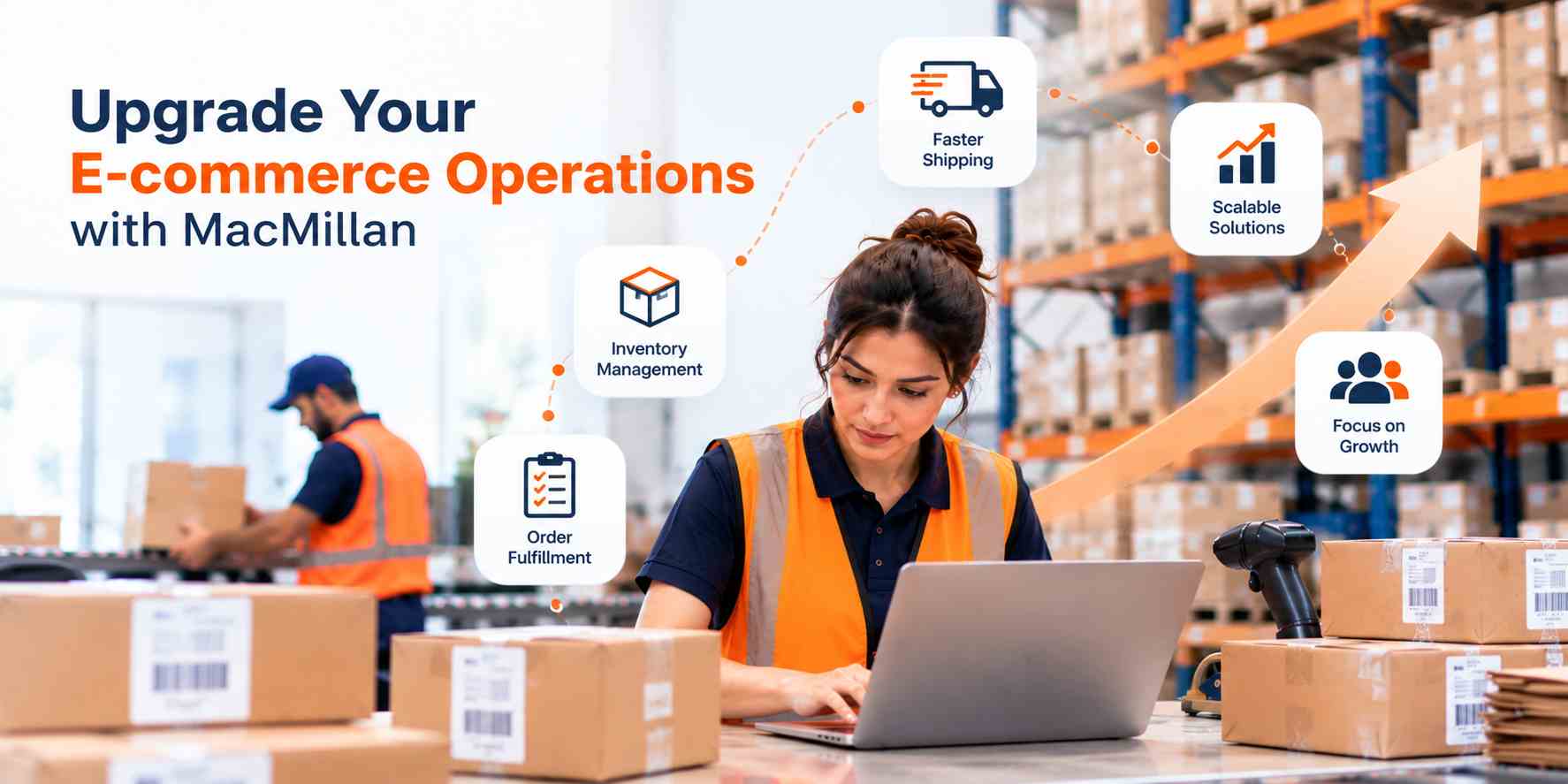
At MacMillan, our expertise in e-commerce fulfillment services is designed to cater to the diverse requirements of online businesses.
We provide end-to-end solutions that cover the entire product lifecycle, from efficient warehousing and inventory management to seamless last-mile delivery and reverse logistics.
Partner with MacMillan for a fulfillment strategy that’s not just effective but also adaptable to the ever-changing e-commerce landscape.
Our tailored solutions ensure that your business can meet market demands and customer expectations with ease and efficiency.
Explore MacMillan’s E-commerce Fulfillment Services and let us be the driving force behind your thriving e-commerce strategy.