
Understanding the Economics of 3PL Warehousing
Navigating Carrier Costs and 3PL Surcharges can be a major headache for how 3PL warehousing operators, not only inflating costs but also introducing unpredictability into budget forecasts. With shipping rates constantly fluctuating, accurately predicting expenses becomes a complex challenge. To safeguard profitability, how 3PL warehouses such as MacMillan use effective strategies for managing these costs. Fortunately, there are several tactics available to help contain expenses and preserve margins. Base Rate vs. Accessorial Charges Determining the true cost of shipping involves more than just looking at base rates. While base rates provide a foundational cost, they don’t encompass the full picture. Accessorial charges, additional fees for specialized services like lift gates or residential delivery, can quickly accumulate. Understanding these charges is crucial for managing outbound shipping costs effectively. What is a Base Rate? A base rate is the fundamental cost of moving goods from one location to another, usually negotiated between you and the carrier. Unlike base rates, accessorial charges are extra fees for additional services that aren’t part of the basic delivery. While base rates are generally fixed according to contract terms, accessorial fees can vary based on specific service needs. Choosing the Optimal Base Rate Selecting the best base rate involves evaluating various factors beyond just the quoted rate. Although base rates across carriers might seem similar, differences in package specifications such as size, weight, and distance can impact the overall cost. Additionally, accessorial charges and other fees can significantly affect the final expense. Tools like MacMillan’s rate shopping feature can help compare base rates in real-time, how 3pl warehouses use for ensuring you secure the most cost-effective shipping option for each order. Understanding Accessorial Charges Accessorial charges are additional fees imposed by carriers for services beyond the standard delivery. These can include costs for loading, unloading, packing, or delays. Recently, these surcharges have become more prevalent as carriers seek to enhance revenue streams. A recent survey indicates that more than 75% of carriers view these fees as essential to their financial stability. Being informed about these charges will help you develop effective shipping strategies and negotiate better rates with carriers. Impact of General Rate Increases (GRI) on Base Rates General Rate Increases (GRI) are an inevitable aspect of the shipping industry, influenced by rising costs in fuel, insurance, wages, and other operational expenses. Carriers often pass these increased costs onto shippers through adjusted rates. Typically announced in October or November, GRIs can lead to noticeable hikes in base rates. For instance, recent GRIs for major carriers include: UPS: 6.9% increase, effective December 27, 2022 FedEx: 6.7% increase, effective January 2, 2023 USPS: 5.5% increase, effective January 22, 2023 These increments, though seemingly modest at 4-6%, can significantly raise the base rates that 3PLs pay, impacting overall costs. Key Insights and Strategies for mastering shipping costs As the logistics landscape becomes increasingly intricate, managing how 3pl warehousing implement accessorial charges and other fees can be challenging. These supplementary costs can significantly impact a 3PL’s bottom line, but they also present an opportunity for negotiation. The key to negotiating effectively lies in understanding these surcharges and their impact on your total shipping volume. Leverage Detailed Fee Knowledge To negotiate better terms, it’s essential to understand the percentage of accessorial charges relative to your overall shipping volume. Armed with this knowledge, you can present a well-informed case for adjustments. MacMillan offers regular audits of your shipping bills to identify and dispute errors or overcharges can lead to cost recovery and increased carrier accountability. Estimating Your Shipping Costs Our Invoice Analysis tool offers a detailed breakdown of your UPS expenses. By importing your data and using our template, you can swiftly pinpoint where your money is being spent. This tool presents charges in a clear, organized format, highlighting the most impactful fees on your bottom line. Say goodbye to hidden fees and make informed decisions by checking out the link above. Prevalence of Industry Standards Many shippers 67% believe they are paying standard industry rates. However, understanding specific surcharges imposed by carriers can help you manage and reduce costs effectively. Common Carrier Surcharges Carriers impose various surcharges to manage operational costs and handle exceptions. While automation has streamlined many processes, certain scenarios still require manual intervention, leading to additional charges. Understanding how 3pl warehousing uses these common surcharges to help you take proactive measures to minimize expenses: USPS Shipping Surcharges: Non-Machinable Surcharge: Applied to packages requiring manual sorting. Fuel Surcharge: Adjusted based on fluctuations in fuel costs, calculated as a percentage of the shipping fee. FedEx Shipping Surcharges: International Fuel Surcharges: Fluctuate weekly based on jet fuel prices. Delivery/Pick-Up Surcharge: Additional fee for deliveries or pick-ups in remote areas. Handling Surcharge: Applied to packages exceeding 48 x 29 inches. Oversize Charge: For packages longer than 96 inches or with a combined length and width of over 129 inches. UPS Shipping Surcharges: Fuel Surcharge: Based on jet fuel prices from Canada. Address Correction: Charged to the shipper for incorrect addresses. Over Maximum Limits Fee: Applied to packages over 154 pounds or 108 inches in length. Optimize Shipping with MacMillan WMS MacMillan WMS offers live rate shopping to help you select the most cost-effective carrier for each shipment. By comparing rates, transit times, service levels, and surcharges, you can make smarter shipping decisions and reduce costs. Analyzing how 3PL warehousing optimizes real-time rate access ensures you always choose the best option for your needs. Additional Surcharges to Consider DIM Weight: Carriers use dimensional weight to calculate shipping costs based on package size. Lightweight items in large boxes can lead to higher charges. Seasonal Peak or Demand Surcharge: Added during peak seasons fluctuations or high-demand periods to cover increased operational costs. These surcharges can affect both incoming inventory and outbound shipments. Accurate demand planning such as MacMillan can mitigate these costs by forecasting product needs and optimizing distribution strategies. By anticipating peak season demands and ordering inventory ahead of time, you can minimize extra charges and reduce transit times, fuel costs, and other transportation expenses. Understanding these elements and implementing strategic planning can lead to significant savings and improved shipping
How to avoid Canadian Warehousing Congestion with MacMillan
Navigating a crowded space is challenging, and this holds true for a cluttered Canadian 3PL warehousing where inventory management becomes a struggle. For a 3PL Warehouse, congestion can cause inefficiencies, safety issues, and fulfillment mistakes. To ensure a safe and efficient operation, it’s crucial to prevent warehouse congestion. This article explores the causes of Canadian 3pl warehouse congestion, its impact on brands, and strategies for effective warehouse and inventory planning to reduce it. What is Canadian 3PL Warehousing Congestion-2024? Warehouse congestion occurs when overcrowding, clutter, or excessive traffic obstructs movement and disrupts normal warehousing operations. When navigating a congested warehouse becomes difficult, it impacts workers’ efficiency and can lead to: Disruption in inventory flow Increased confusion and frustration among staff Elevated safety risks Delays in fulfilling customer orders Common Causes of a 3PL Warehousing Congestion in Canada Several factors can lead to a Canadian 3PL warehouse congestion, particularly for e-commerce brands. Here are some frequent causes: Insufficient Storage Space: Overcrowding often arises when a warehouse cannot accommodate the volume of inventory needed. Whether due to an undersized facility or excess stock, exceeding storage capacity typically results in congestion. However, MacMillan SCG offers real-time inventory management which provides tracking and visibility. Poor Layout Design: Ineffective warehouse layouts that hinder movement or create inefficiencies can contribute to congestion. For instance, narrow aisles that restrict equipment movement force workers to navigate around obstacles, slowing down operations. Inefficient Processes and Technology: Outdated procedures and technology can exacerbate congestion. For example, requiring pickers to handle one order at a time and deliver it to a packing station before starting another can limit productivity. Additionally, unreliable or complex technology that is difficult to use or train on can further impede efficiency and increase congestion. MacMillan SCG uses the latest tech-based solutions including RIFD’s and WMS integrated to your systems with trackable inventory for scalable solutions. What is the Impact on Businesses and the Logistics Market? Warehouse congestion goes beyond being a mere inconvenience, it can be detrimental to business operations. Here are some key ways it affects e-commerce: Delayed Shipments: Congestion hampers workers’ efficiency, leading to slower order picking and packing. This results in delayed shipments and dissatisfied customers. Customer Dissatisfaction: Delays, fulfillment errors, and inventory damage caused by overcrowded spaces can significantly impact customer satisfaction. These issues may lead to negative feedback and lost sales. Amazon prime with their FBA program provides customer satisfaction through high-end deliveries with zero error rates. Increased Costs: Inefficiencies in a congested Canadian 3pl Warehouse led to longer task completion times, raising labor costs and overhead expenses. Additionally, managing inventory becomes more challenging, often resulting in inaccuracies that can cause costly stock outs and overstock situations. Strategies for Managing a 3PL Warehouse Congestion To tackle a Canadian 3PL warehouse congestion in today’s logistics market effectively, it’s crucial to implement strategies that enhance both layout and processes. Here’s how you can manage and reduce congestion in your warehouse: Optimize Layout and Design: Efficient warehousing begins with a well-thought-out layout. Analyze your internal workflows and configure your storage and workstations to minimize travel distances and create clear pathways for both workers and equipment. Consider employing a slotting strategy that aligns with your business needs. Organize inventory by size, weight, or other relevant criteria, or use dynamic slotting for high-turnover products. Enhance space utilization with advanced storage solutions like vertical carousels, which capitalize on vertical space. Implement Efficient Processes: Streamlining operations can significantly reduce congestion. Focus on: Leverage Technology: Advanced technology is key to alleviating a Canadian 3PL Warehouse congestion. Utilize inventory management software to track stock levels and analyze historical sales data. This helps in accurate demand forecasting, preventing overstocking and maintaining optimal inventory levels. By optimizing layout, refining processes, and harnessing technology, you can effectively manage and reduce warehouse congestion, leading to smoother operations and better overall efficiency. Leveraging Technology to Combat Warehouse Congestion in Canada Technological tools such as RFID tags and barcode scanners are essential for effective inventory management. Scanning SKU barcodes and storage location tags during picking and packing helps update stock counts in real-time, keeping your inventory and storage well-organized. Warehouse management systems are crucial for mitigating warehouse congestion. A robust WMS enhances visibility and control over warehouse operations. For example, MacMillan SCG WMS offers several key benefits: Track Staff Productivity: Monitor employee performance to ensure efficiency. Location-Specific Inventory Visibility: Gain detailed insights into inventory levels across different areas. Intelligent Cycle Counts: Access accurate order fulfillment metrics and cycle counts across all warehouses. Flexible Picking Methods: Utilize various picking strategies, including batch, auto-cluster, custom cluster, and single-order picking, to optimize workflow. Reduced Packing Errors: Use visual, step-by-step packing guides to minimize mistakes. E-commerce Integration: Seamlessly connect with major e-commerce platforms and tools to streamline omnichannel fulfillment. These features enable you to identify and address inefficiencies proactively, preventing them from escalating into significant congestion issues. Key Takeaways Addressing congestion in Canadian 3PL warehouses is essential for maintaining operational efficiency, safety, and customer satisfaction. Overcrowded spaces not only impede workflow but also increase the risk of errors and safety hazards, which can lead to delayed shipments and elevated costs. By implementing effective strategies such as optimizing warehouse layouts, streamlining processes, and leveraging advanced technology, businesses can significantly reduce congestion. Solutions like real-time inventory management, efficient picking methods, and robust warehouse management systems play a critical role in enhancing operational efficiency and mitigating the adverse impacts of congestion. As the logistics landscape continues to evolve, proactive management of warehouse congestion will be key to ensuring seamless operations and sustaining customer trust in an increasingly competitive market.
Unlocking Outsourced Fulfillment: Key Advantages and Obstacles
Outsourced fulfillment involves hiring a third-party logistics provider to manage inventory, order processing, packaging, and shipping, allowing businesses to focus on their core activities. This approach streamlines the supply chain and supports scalability, particularly beneficial for small and medium-sized businesses facing demand spikes. Partnering with a 3PL offers several advantages, including access to specialized expertise, advanced technology, and established supply chain relationships, all contributing to cost savings and improved customer service. Businesses can customize fulfillment services to their needs, reducing investment in infrastructure and technology. Overall, outsourced fulfillment helps companies optimize logistics, cut costs, and concentrate on growth and customer satisfaction. What are the components of outsourced fulfillment? Outsourced fulfillment involves several key components that ensure efficient order processing: Inventory Management: A 3PL such as MacMillan SCG tracks and manages inventory levels using advanced systems to prevent stock outs and ensure timely replenishment. Order Processing: The 3PL handles order confirmation, verification, and allocation through automated systems integrated with eCommerce platforms, ensuring fulfillment with accuracy and efficiency. Packaging: Proper packaging is crucial for product protection and a positive customer experience. MacMillan SCG uses industry-standard materials and may offer custom packaging options. Shipping: Leveraging their network, 3PLs select optimal shipping methods and carriers, negotiate rates, and offer various delivery options to ensure timely and safe delivery. Returns Management: The 3PL manages the entire returns process, including authorization, inspection, restocking, and refunds or exchanges, streamlining operations and enhancing customer satisfaction. Customer Service: MacMillan’s dedicated customer service teams handles inquiries, provide updates, and resolve issues, ensuring a smooth customer experience from order to delivery. Outsourcing fulfillment to a skilled 3PL allows businesses to focus on their core functions while benefiting from expert management of these crucial components, leading to improved efficiency and customer satisfaction. Outsourcing fulfillment to a 3PL offers several key advantages Expertise and Resources: MacMillan SCG provide specialized knowledge and access to advanced technology, streamlining inventory management, order processing, and shipping. Cost Savings: By outsourcing, you avoid investing in warehouses, technology, and a dedicated team. This reduces infrastructure costs and operational expenses. Scalability: 3PLs can easily adjust to fluctuating order volumes during peak times, handling increased demand without needing additional resources or infrastructure. Focus on Core Competencies: Outsourcing allows you to concentrate on strategic activities like product development and marketing, leaving logistics to the professionals. What are the considerations to follow in outsourced fulfillment? While outsourcing fulfillment offers many advantages, businesses should be mindful of potential challenges. One key concern is the loss of direct control over fulfillment processes, making it crucial to select a reliable and transparent 3PL. Data security is another significant consideration; sharing sensitive customer and inventory information requires partnering with a 3PL that implements robust security measures. Additionally, effective communication and coordination are essential for successful outsourcing, necessitating regular updates and clear communication channels to ensure smooth operations. Factors to consider when choosing a fulfillment partner When choosing between in-house fulfillment and outsourcing to a 3PL, several key factors should be evaluated: Order Volume: Large order volumes might necessitate advanced technology and infrastructure, which can be more cost-effective through a 3PL provider such as MacMillan for reliability. Product Characteristics: Products that are fragile or perishable often require specialized handling and packaging. A 3PL can offer the expertise needed for these specific requirements. Market Reach: For businesses with a broad geographic footprint or diverse customer base such as Amazon, partnering with a 3PL can enhance fulfillment efficiency and improve delivery across various locations. Ways to successfully outsource a fulfillment partner For a successful outsourcing experience, businesses should adhere to the following best practices: Thorough Research and Due Diligence: Carefully evaluate potential 3PL providers by assessing their experience, reputation, and client feedback. Clear Communication of Expectations: Define your business needs and performance criteria with the 3PL. Set clear key performance indicators (KPIs) and implement regular reporting to track progress. Transparency and Collaboration: Build a transparent and cooperative relationship with the 3PL. Regularly review performance metrics, promptly address any issues, and ensure continuous, open communication. Key Takeaways Outsourced fulfillment offers significant advantages, including specialized expertise, cost savings, scalability, and the ability to concentrate on core business activities. However, businesses must also address potential challenges, such as diminished control, data security concerns, and the need for effective communication. When deciding between in-house fulfillment and outsourcing, it’s important to consider factors like order volume, product specifics, and market reach. Adhering to best practices, such as conducting comprehensive research, setting clear expectations, and maintaining transparency, will help businesses effectively manage their outsourced fulfillment operations and enhance their overall logistics efficiency.
Warehouse Audits: A Guide for 3PL Warehouse Technologies and processes
For 3PL providers, warehouse managers, and COOs overseeing warehouse operation, mastering the art of auditing warehouse technologies and processes is crucial. A well-executed audit highlights areas needing improvement, enhances inventory accuracy, and boosts overall efficiency. MacMillan SCG offers zero error rate and complete sustainability in todays Canadian logistics market. By scrutinizing current warehouse operation and practices, you can pinpoint internal process gaps and explore technological solutions to optimize order fulfillment activities. Let’s delve into what you need to consider for a successful warehouse audit and apply best practices to elevate your warehouse operations. What Is a Warehouse Operation Audit? A warehouse audit is a thorough evaluation of your warehouse’s technology and processes. It systematically reviews operations to identify areas for improvement and optimization. This audit assesses the effectiveness of your warehouse processes, the efficiency of technology systems, and the accuracy of inventory management. How to Conduct a Warehouse Operation Audit? Auditing warehouse operations involves a structured approach. Here’s a step-by-step guide to help you through the process: Create a Warehouse Audit Checklist Develop a comprehensive checklist covering all warehouse operations. This should include areas such as receiving and put-away, order picking, packing and shipping, inventory management, and technology systems. MacMillan offers zero error rate while auditing checklist will serve as a roadmap, ensuring all critical aspects are examined. Evaluate Warehouse Layout and Design The layout and design of your warehouse significantly impact operational efficiency. Assess factors like aisle width, storage density, and the flow of goods to ensure the layout supports your operational needs. Review Receiving and Put-Away Processes Efficient receiving and put-away are vital for smooth warehouse operations. Ensure that incoming shipments are thoroughly inspected and stored correctly. Regular audits of these processes help maintain their efficiency and effectiveness. Analyze Order Picking Processes Order picking is a cornerstone of warehouse operations. Review your picking processes to ensure they are optimized for speed and accuracy. Assess whether the right technology is in place to support efficient picking like Amazon does. Assess Packing and Shipping Processes Evaluate packing and shipping to ensure these processes are streamlined and error-free. Verify that packers use appropriate materials and follow correct procedures throughout. Review Inventory Management Confirm that your inventory tracking systems are current and that staff are effectively managing stock levels. Accurate inventory management is crucial for operational success. Evaluate Warehouse Technology Systems With the increasing complexity of warehouse operations, ensure your technology systems are functioning correctly and fully integrated with your processes. Update and optimize technology systems as needed to meet your warehouse operation requirements. Step-by-Step Warehouse Audit Procedures When planning your warehouse audit, follow these general guidelines for a thorough and effective evaluation: Define the Scope of the Audit: Clearly outline what aspects of your warehouse operations will be audited. This focus allows for a targeted approach, ensuring all critical areas are reviewed. Assign Responsibilities: Designate individuals to lead, conduct, and implement changes based on the audit findings. Clear roles and responsibilities will facilitate a smoother audit process. Conduct the Audit: During the audit, document observations and concerns meticulously. Follow your checklist to ensure comprehensive coverage of all relevant areas. Analyze the Results: Use your checklist and notes to analyze the audit findings. Involve key stakeholders in identifying areas for improvement and opportunities for optimization. Develop an Action Plan: Based on your analysis, create an action plan to address identified issues. Ensure your plan is specific, measurable, achievable, relevant, and time-bound. Implement Changes: Execute the changes outlined in your action plan and monitor their effectiveness. Communicate changes to your team and provide training if necessary. How to Position Your Warehouse for Success? Regularly auditing your warehouse operations technologies and processes helps maintain operational efficiency and accuracy. It also provides an opportunity to identify and resolve issues proactively. To successfully conduct a warehouse operation audit, define the audit scope, assign responsibilities, conduct the audit, analyze results, develop an action plan, and implement necessary changes. Leveraging a robust warehouse management system, like MacMillan SCG, can streamline tasks and reduce errors, enhancing your audit outcomes. Key Takeaways In conclusion, effectively auditing your warehouse’s technology and processes is essential for optimizing operations, enhancing inventory accuracy, and boosting overall efficiency. By systematically reviewing each aspect of your warehouse, from layout and design to technology systems and inventory management, you can identify areas for improvement and implement necessary changes. Adopting a structured approach, including defining the audit scope, assigning responsibilities, and developing a detailed action plan, will help you address inefficiencies and streamline your operations. Utilizing advanced warehouse management systems, such as MacMillan, can further enhance your audit process, providing greater control and reducing errors. Regular audits not only ensure operational success but also position your warehouse for continued growth and efficiency.
Mastering Warehouse Monitoring in 2026: Systems, Trends, and Techniques
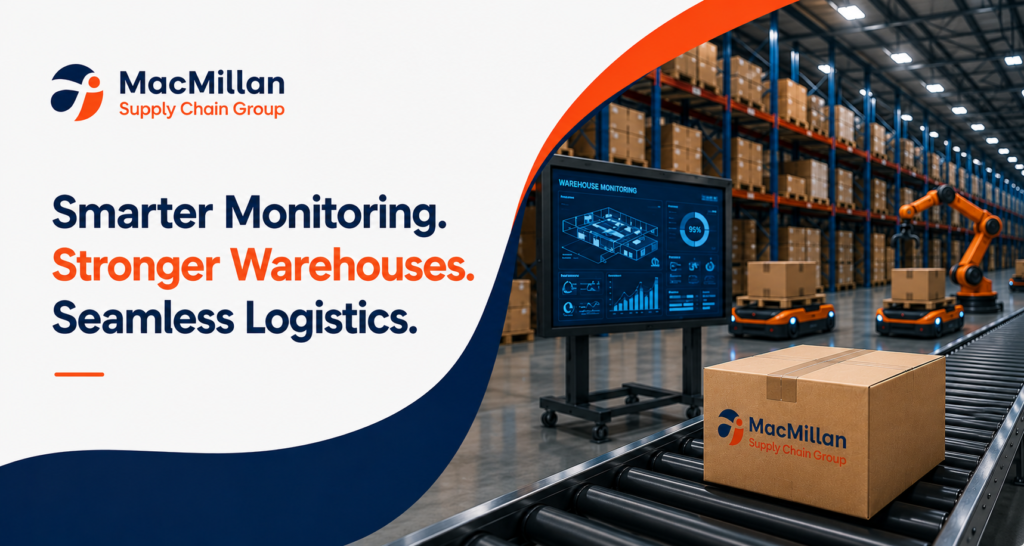
Ecommerce warehouses and logistics company’s Toronto are bustling hubs of activity. From managing daily tasks such as inventory receipt and order fulfillment to more intricate processes like cross-docking and inventory audits, keeping track of every detail can be challenging. Yet, for effective warehouse management, having accurate and real-time information on your warehousing operations is crucial. This is where warehouse monitoring in today’s age for logistics company’s Toronto becomes indispensable. With comprehensive visibility and up-to-date insights into your warehouse processes, you can significantly enhance operational efficiency. In this article, we’ll explore what warehouse monitoring entails, the advantages of a high-quality monitoring system, and the key features to consider when choosing a warehouse monitoring solution for logistics company’s Toronto. What is Warehouse Monitoring? Warehouse monitoring involves the observation, measurement, and tracking of conditions, materials, and activities within a warehouse. This practice typically employs advanced warehousing technologies, such as surveillance cameras, sensors, and IoT devices, to gather, process, and analyze data, enabling workers to make informed decisions based on real-time insights for any logistics company’s Toronto. Brands utilize warehouse monitoring systems to oversee various aspects, including: Assets Inventory Environment Energy Problems How Tech-based warehousing is Transforming Monitoring- 2024? As warehouse operations become increasingly complex, so too does the technology designed to monitor them. Gone are the days when workers spent hours manually recording data and conditions. Today, for logistics company’s Toronto, technology automates many monitoring tasks, providing deeper insights and greater efficiency. Key Components of a Warehouse Monitoring System used by MacMillan Several cutting-edge technologies are enhancing warehouse monitoring. Here are some of the most effective tools used: IoT Devices: MacMillan SCG uses The Internet of Things (IoT) network connects various devices and objects, enabling them to communicate and exchange data. IoT devices include RFID tags, sensors, and other tools that monitor inventory, warehouse locations, storage conditions, and handling processes. RFID Tags: Radio Frequency Identification (RFID) tags are scannable labels that use radio waves to identify objects. These tags allow workers to track items at different stages of the warehouse workflow. The scanned information is automatically transmitted to the warehouse management system(WMS), providing real-time visibility into inventory location and status, proven to be sustainable for any logistics company Toronto. Sensors: Wireless sensors strategically placed throughout the warehouse enable remote tracking of various elements and activities, eliminating the need for constant physical presence. LTH Sensors: Light, temperature, and humidity (LTH) sensors are crucial for maintaining optimal storage conditions. This is particularly important in cold storage warehouses, where even minor deviations in temperature can lead to spoilage. MacMillan provides customers with real-time visibility and responsiveness reducing error rates to be 0.1 percent. Additional Sensors: Certain sensors can detect smoke, providing immediate alerts in case of a fire. Others monitor movement in different areas of the warehouse, and some track air quality, which may be essential in certain industries. Alarm Systems: In large warehouses, detecting issues can be challenging, increasing the risk of damage and theft. Alarm systems are vital for prompt notifications about problems that need attention. These systems can alert you to temperature changes, unusual movements, glass breaks, and other potential issues. Surveillance Cameras: Video surveillance is a key component of warehouse monitoring for any logistics company Toronto. High-definition IP cameras offer detailed video monitoring, while advanced cameras with capabilities like heat detection and text reading provide enhanced surveillance. AI-powered smart surveillance systems further streamline the process by checking inventory availability, tracking misplaced shipments, and more. Centralized Communication Systems: Effective warehouse management relies on seamless communication across departments and locations. MacMillan SCG offers Centralized communication systems, such as wireless or wired intercoms, are essential for efficient interactions without requiring physical travel across the warehouse with geographical presence within the GTA region and 80% of the western regions throughout Canada. Centralized Software Solutions: To integrate data from various systems into a unified view, centralized software solutions are crucial. Warehouse management systems (WMS) and unified IoT platforms consolidate information into a single dashboard, allowing you to monitor stock levels, inventory movement, and order fulfillment processes without switching between multiple platforms. How to Monitor Your Warehouse Operations with MacMillan SCG? A Warehouse Management System (WMS) is crucial for tracking and managing all aspects of warehousing from a single platform. MacMillan offers a comprehensive WMS designed to enhance warehouse monitoring and streamline operations. Advanced Fulfillment Analytics MacMillan’s WMS provides advanced analytics that deliver real-time insights into your warehousing and fulfillment performance for various logistics company’s Toronto. Key metrics include: These analytics enable you to evaluate and optimize warehouse processes, identify inefficiencies, and reduce operating costs. For example, if you observe increased average fulfillment times, you can investigate and refine picking and packing strategies to enhance efficiency. Integration with Existing Systems A unified system for managing warehouse operations is essential for effective monitoring. MacMillan WMS integrates seamlessly with various ecommerce platforms and tools, minimizing the need for multiple platforms and reducing data inaccuracies. Integrations with systems like Amazon for returns management and for sales channel operations ensure that your warehouse monitoring is comprehensive and up-to-date. This cohesive approach allows for accurate inventory tracking and better management of stock levels and orders. Real-Time Inventory Tracking MacMillan’s WMS offers real-time visibility into inventory levels across different SKUs and storage locations. This ensures precise inventory counts, timely updates, and the ability to forecast inventory needs accurately. By monitoring stock levels closely, you can avoid stock outs, manage reordering efficiently, and minimize excess inventory costs. Key Takeaways Ecommerce warehouses and logistics companies in Toronto are dynamic environments where managing daily operations and complex processes can be daunting. Effective warehouse management hinges on accurate, real-time information, making advanced warehouse monitoring essential. By utilizing technologies like IoT devices, RFID tags, and sensors, logistics companies can gain comprehensive visibility into their operations, improving efficiency and responsiveness. This article explores the benefits of top-tier warehouse monitoring systems and their key components, highlighting how cutting-edge tools and centralized software solutions can streamline warehouse management and enhance operational performance in the Toronto logistics sector.
Warehouse Automation and Robotics: Revolutionizing 3PL Services
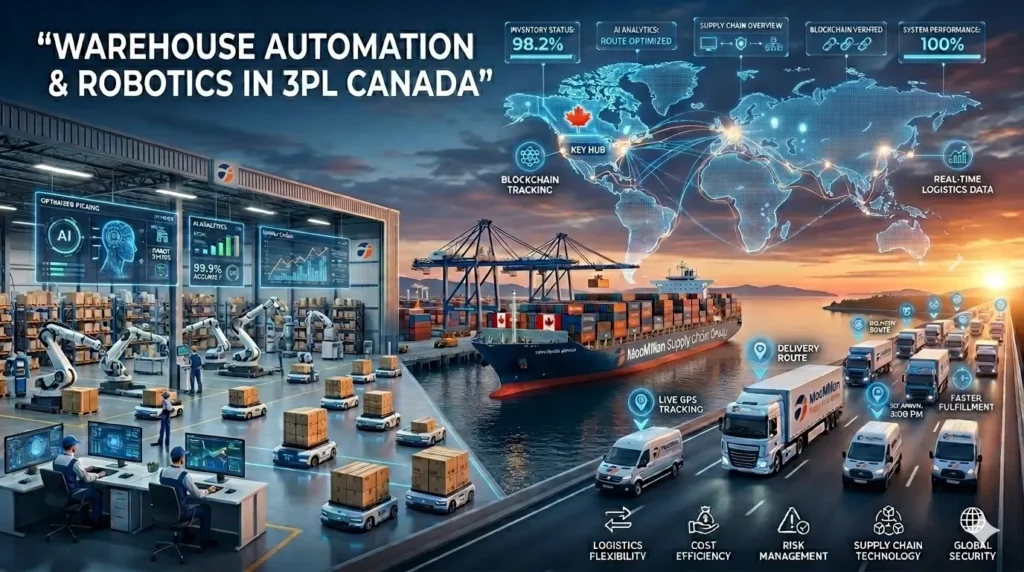
The way third-party logistics (3PL) providers function in Canada is changing due to warehouse automation and robotics. By deploying cutting-edge technologies like AI-driven systems, automated picking solutions, and real-time tracking tools, MacMillan Supply Chain Group is at the forefront of this revolution. These developments assist e-commerce companies in cutting expenses, minimizing mistakes, and expediting product delivery. Businesses in the Canadian market that require dependable fulfillment services benefit from MacMillan’s technological approach, which includes blockchain integration and robotic process automation. This article examines how these developments are changing the logistics industry and helping expanding businesses achieve better outcomes. The Evolution of 3PL Services in Canada Nowhere is the technological renaissance in the logistics sector more apparent than in Canadian fulfillment centers. Traditional warehouse operations find it difficult to keep up with the growing consumer expectations for real-time tracking and faster deliveries. In response, MacMillan Supply Chain Group has adopted robotics and warehouse automation to revolutionize the way 3PL services are provided in Canada. However, how will this change in technology affect your company? Whether you are an established retailer or an e-commerce startup, integrating cutting-edge 3PL technology can significantly increase customer satisfaction, lower costs, and improve operational efficiency. Automated picking systems and AI-driven warehouse management are examples of innovations that are no longer sci-fi ideas but rather workable solutions that are producing quantifiable outcomes now. Let’s explore how MacMillan is leveraging these cutting-edge technologies to revolutionize supply chain management across Canada. Core Technologies Driving Warehouse Automation A number of integrated technologies that function together form the foundation of MacMillan’s warehouse robotics solutions. All operations are coordinated by an AI-powered warehouse management system at the core. In addition to tracking inventory, this clever system anticipates changes in demand, learns from patterns, and automatically optimizes warehouse layouts. In logistics, repetitive tasks that previously required human intervention are handled by robotic process automation, or RPA. These consist of: Incoming shipment sorting that is automated barcode scanning and verification inventory counts and cycle counting order prioritization according to shipping deadlines Compared to more conventional approaches, MacMillan’s use of automated picking systems has shortened order fulfillment times by as much as 65%. These systems retrieve products from storage areas and move them to packing stations using a combination of robotic arms, autonomous mobile robots (AMRs), and conveyor systems. But the communication between these technologies is the true game-changer. With cloud-based warehouse systems, all of the robots, scanners, and sensors instantly exchange data, resulting in a synchronized operation that instantly adjusts to shifting priorities and conditions. Real-Time Visibility and Predictive Analytics E-commerce enterprises have historically struggled with inventory management, with stockouts and overstock scenarios having a major negative financial impact. This area of supply chain management has been completely transformed by MacMillan’s approach to inventory optimization tools. MacMillan gives customers unheard-of insight into the state of their inventory through real-time tracking and monitoring. From the time a product arrives at the warehouse until it is delivered to the final consumer, it is tracked. This visibility also includes: Present stock levels in several locations Patterns and velocity of product movement efficiency metrics for storage locations tracking of perishable goods’ expiration dates By projecting future inventory requirements, supply chain management predictive analytics enhances this visibility. To determine the ideal inventory levels, MacMillan’s demand forecasting software examines past sales data, seasonal patterns, and even outside variables like the weather or approaching holidays. MacMillan’s cold chain management in Canada guarantees product integrity during the fulfillment process for companies that deal with temperature-sensitive goods. From storage to delivery, precise environmental conditions are maintained by specialized packaging solutions and temperature-controlled zones within warehouses. How Automation Enhances Fulfillment Operations Daily fulfillment operations are where warehouse automation and robotics are most clearly used in practice. The Canadian fulfillment centers operated by MacMillan demonstrate how these technologies result in real advantages for CA e-commerce logistics. Order fulfillment time is greatly decreased by automated picking systems. Workers using traditional picking techniques may have to walk through warehouse aisles for several miles each day. On the other hand, MacMillan’s robotics deliver goods straight to packing stations, saving workers’ physical strain and removing unnecessary walking time. The improvements in accuracy are equally striking. The accuracy rates for manual picking are usually between 96 and 98 percent, which means that errors occur in 2-4 orders out of 100. With a 99.9% accuracy rate, MacMillan’s automated systems virtually eliminate expensive returns and unhappy customers. Another significant benefit in robotics is scalability. Without the typical difficulties of recruiting and training temporary employees, MacMillan can quickly scale operations during busy times like Black Friday or holiday shopping periods. The robotic fleet can be expanded with more units or work more hours, guaranteeing steady performance even in the face of volume variations. Challenges in the Logistics Industry Many 3PL providers continue to face major operational obstacles that affect customer satisfaction and profitability in spite of technological advancements: Labor Shortages and High Turnover: Picking, packing, and shipping in traditional warehouses rely largely on human labor. This dependence makes one susceptible to changes in the labor market and seasonal staffing issues. Scalability Limitations: Many 3PLs are unable to effectively manage abrupt volume increases, which causes delays during busy times when prompt fulfillment is most important. Difficulties with Inventory Accuracy: Manual inventory management frequently leads to differences between system records and actual stock levels, which can lead to overselling, stockouts, and dissatisfied customers. Limited Visibility: Traditional logistics operations frequently lack real-time tracking capabilities, leaving clients in the dark about inventory status and order progress. Inefficient Space Utilization: Traditional warehouse designs frequently squander useful space, which raises storage expenses and lowers operational effectiveness. Slow Adaptation to E-commerce Needs: A lot of well-known 3PLs find it difficult to satisfy the particular demands of e-commerce fulfillment, such as the need for quick shipping and single-item picking. High Error Rates: Human error in picking, packing, and shipping is an inevitable part of manual processes, which leads to returns, customer complaints, and a tarnished reputation for the brand. MacMillan’s Innovative Approach
The Impact of Warehouse Location on Shipping Speed and Costs
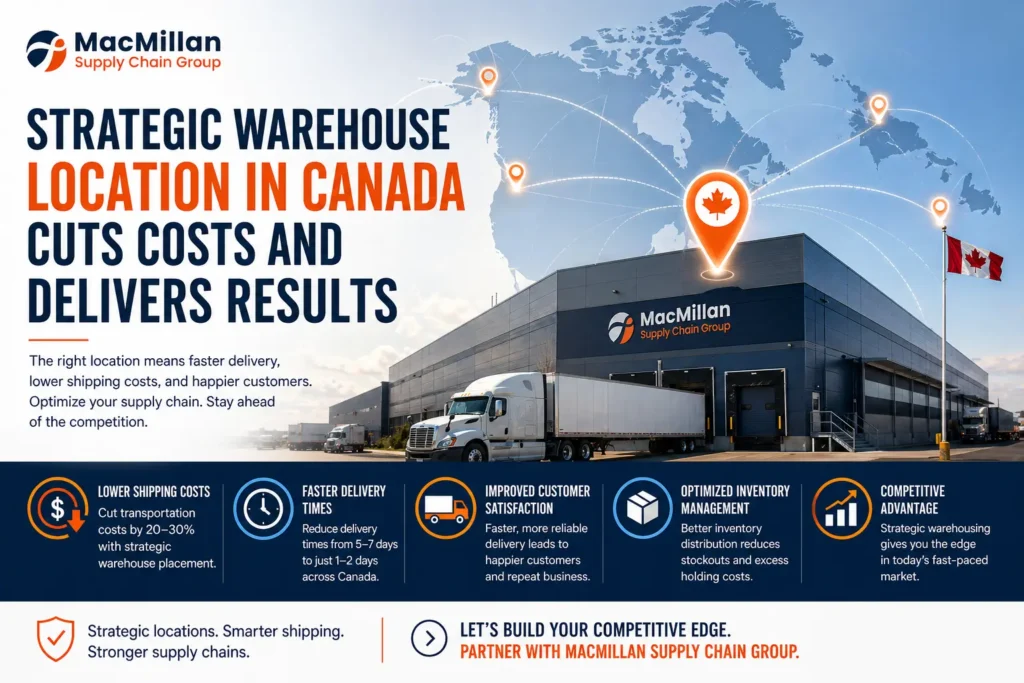
The cost and speed of product delivery to customers are directly impacted by the strategic location of warehouses. Businesses with strategically placed distribution centers in Canada can cut shipping costs by 20–30% and delivery times from 5-7 days to just 1-2 days. This article examines how warehouse location impacts cross-border logistics and last-mile delivery, as well as why companies that work with 3PL providers like MacMillan Supply Chain Group benefit from strategic Canadian warehousing solutions that give them a competitive edge. Why Your Warehouse Location Matters More Than Ever Ever ponder why some orders placed online arrive the following day while others take a week to arrive? In many cases, the warehouse location rather than the shipping method is the key. Customers expect speedy delivery at competitive prices in today’s fast-paced market. Because of this, choosing where to locate your warehouse is one of the most important aspects of your logistics plan. We at MacMillan Supply Chain Group have personally witnessed how a well-chosen warehouse location can revolutionize an organization. 40% of Canadian consumers can be reached in a day by a Toronto fulfillment center, whereas a poorly located warehouse may take three to five days to reach the same customers. The distinction has an impact on your bottom line, customer satisfaction, and competitiveness in the current market in addition to shipping speed. Let’s explore why warehouse location has become the cornerstone of successful supply chain optimization. The Distance Factor The main determinant of shipping speed is distance. Your products will arrive more quickly if your warehouse is located close to your customers. This simple idea has significant business ramifications. A package may arrive the following day if it is shipped from a fulfillment center in Toronto to a customer in Ontario. It might take three to four days to ship the same package from Vancouver to Ontario using the same shipping method. This discrepancy is due to geography rather than efficiency. The size of our nation must be taken into consideration when developing warehousing strategies in Canada. Businesses must carefully consider where to store inventory because major population centers are dispersed over thousands of kilometers. Western provinces could be adequately served by a single warehouse in Calgary, but eastern customers would have to wait days longer than necessary. The best approach? Many businesses find that an Ontario warehouse hub serves as an excellent starting point, with additional distribution centers in Canada’s western and eastern regions as they grow. This multi-node distribution approach ensures that no customer is too far from your products. Breaking Down Shipping Costs The cost of shipping a package increases with each kilometer of travel. You essentially pay for additional distance when your warehouse location is far from your customers. These expenses mount up quickly and can have a big effect on your profit margins. Take a look at these actual numbers: Transporting a 5 kg parcel inside the same province: $8–12 for shipping the identical package to more than three provinces: $18–25 Costs of last-mile delivery in cities: 53 percent of the total cost of shipping Strategic warehouse placement can significantly lower these expenses. Compared to a competitor with a single warehouse, a company with distribution centers in both Toronto and Vancouver may save 40% on shipping. Location affects more than just transportation costs. There are large regional differences in labor availability, real estate values, and utility costs. The Greater Toronto Area, for instance, has more expensive warehouse space per square foot than smaller cities, but the savings on shipping and quicker delivery times frequently make the difference. The secret is figuring out the sweet spot, which our logistics experts at MacMillan Supply Chain Group are skilled at determining, where shipping and operating costs add up to the lowest overall cost. Multi-Node vs. Centralized Distribution Should your business operate from one large warehouse or several smaller ones across Canada? This question faces every growing business, and the answer depends on your specific needs. A centralized approach with one major warehouse offers simplicity and lower facility costs. However, a multi-node distribution network with strategically placed warehouses provides faster shipping speeds and reduced shipping costs. The trade-off is more complex inventory management and higher facility expenses. Consider these approaches: Single Central Hub: Works well for specialized products with nationwide demand but lower order volume East-West Strategy: Two warehouses (typically Ontario and BC) covering eastern and western Canada Regional Network: Multiple smaller facilities near major population centers for fastest possible delivery For businesses shipping to both Canadian and American customers, cross-border logistics adds another layer of complexity. Warehouses near border crossings like Windsor or Niagara Falls can facilitate smooth US-Canada shipping while maintaining fast delivery to Canadian customers. MacMillan’s network of distribution centers in Canada allows businesses to implement the right strategy for their unique needs, whether that’s a single Ontario warehouse hub or a comprehensive national network. Urban Proximity and Delivery Speed More than half of all shipping expenses go toward the “last mile,” which is the last section of delivery from the local distribution center to the customer’s door. The location of the warehouse is essential to making the most of this costly step. Last-mile distances are shortened by urban warehouses located close to city centers, allowing for same-day or next-day delivery options. Reduced delivery expenses and fuel consumption Shorter routes result in lower carbon emissions; more scheduling flexibility for deliveries Local clients can receive same-day delivery from a Toronto fulfillment center, which is not feasible with a warehouse located outside of the city. Beyond just speed, this proximity advantage opens up possibilities for competitive service offerings that are impossible for distant warehouses to match. However, the cost of real estate is usually higher for urban warehouses. Determining whether the cost savings and shipping speed benefits of paying more for city center proximity are sufficient to make the investment worthwhile is crucial. The answer is becoming more and more “yes” for many companies catering to urban clients. The Hidden Costs of Poor Placement The consequences
Retail Ready Packaging Canada for FMCG Brands
A Quick Summary and Overview Retail-ready packaging (RRP), also known as shelf-ready packaging, is a crucial logistics component for any brand supplying large retailers. With major chains demanding faster shelf replenishment, standardized labeling, and reduced labor costs, non-compliant packaging can lead to costly chargebacks and missed sales windows. MacMillan Supply Chain Group ensures that your retail shipments are compliant, scan-verified, and shelf-ready—every time. This blog explores what retail-ready packaging is, why it matters for FMCG and CPG brands, and how MacMillan helps businesses stay compliant and competitive. Introduction Retail-ready packaging (RRP) refers to secondary packaging designed to go straight from warehouse to retail shelf without requiring unpacking or reconfiguration. It includes features like: Pre-applied barcodes (GS1-128) Easy-open cases or trays Clear product visibility Structural integrity for stacking Shelf-ready pallet configuration Retailers like Walmart, Costco, Loblaw, and Canadian Tire all have strict RRP guidelines. These aren’t suggestions—they’re delivery requirements. Non-compliance means rejected shipments, fines, or delisting. Why Retail-Ready Packaging Is Business-Critical Brands that overlook RRP risk the following: Chargebacks for incorrect labeling, pallet height, or case specs Rejected deliveries due to non-compliant builds Damaged brand perception due to poor in-store presentation Delayed shelf availability impacting sell-through and promotions Seasonal and promotional products are particularly vulnerable—there are no second chances. How MacMillan Ensures Retail Packaging Compliance MacMillan SCG specializes in retail-ready logistics. Here’s how we help: GS1-compliant labeling at SKU and case level Retail-specific pallet configurations Automated scan-verification before outbound shipment Pre-kitted or display-ready builds Packaging audits aligned with your retailer’s guidelines Whether you’re shipping to national grocery chains or big box retailers, we ensure your packaging meets every standard. Built for FMCG and High-Velocity Categories Different product types demand different packaging execution. MacMillan adapts RRP workflows based on your category: Food & Beverage: FEFO rotation, expiry date labeling, tamper-evident seals Personal Care & Wellness: Lot tracking, clean handling, brand-aligned presentation Home & Cleaning: WHMIS-compliant labeling and sturdy transit packaging Pet Care: Case/each configurations, promotion-ready kits, stackable trays Our category specialization ensures your product doesn’t just arrive—it sells. Benefits Beyond Compliance Well-executed RRP not only avoids penalties, it accelerates sell-through and strengthens retailer relationships: Faster shelf stocking = faster sales Cleaner presentation = better consumer engagement On-time and in-spec delivery = more favorable retail terms Fewer manual touches = lower risk of in-store damage At MacMillan, we see packaging not just as a box—but a brand ambassador. Final Takeaway & CTA MacMillan Supply Chain Group delivers retail-ready packaging that’s more than compliant—it’s competitive. Talk to us about aligning your packaging workflows with top retailer requirements in Canada. 📞 Contact us for a category audit and see how we can streamline your supply chain from dock to shelf. FAQs What makes packaging “retail-ready”? Retail-ready packaging is designed for easy stocking and display. It includes pre-applied barcodes, clear product visibility, and structural support for stacking. Retailers can unpack and place it on the shelf in seconds. What happens if a shipment isn’t retail-compliant? Non-compliant shipments may be rejected at distribution centers, delayed, or incur chargebacks. It also risks damaging retailer trust and can result in delisting over time. How does MacMillan verify retail packaging compliance? We use automated scan verification systems and perform pre-shipment audits based on each retailer’s exact requirements. Our warehouse systems validate label placement, barcode formats, pallet specs, and more. Can you support retail and D2C packaging from the same inventory? Yes. Our facilities are designed to handle multi-channel workflows, allowing us to pick-pack and label D2C orders while simultaneously preparing retail-compliant cases and pallets. What packaging standards does MacMillan support? We meet GS1-128 barcode standards, retailer-specific palletization, shelf-ready displays, and WHMIS-compliant packaging. We also accommodate special handling instructions for fragile, perishable, or hazardous items. How quickly can I onboard retail packaging services with MacMillan? Our onboarding process typically takes 10-14 days. It includes alignment on SKU specs, retailer requirements, test orders, and workflow setup to ensure accuracy from day one.
Scalable Beverage Warehousing & Transportation Solutions in Canada

A quick summary and overview Beverage brands operate in a fast-paced, highly competitive environment where freshness, regulatory compliance, and perfect timing are critical. Whether you’re distributing carbonated drinks, juices, bottled water, or alcoholic beverages, having a reliable logistics partner is essential. MacMillan Supply Chain Group offers specialized beverage warehousing and transportation solutions that ensure your products remain secure, traceable, and delivered on time across Canada. Understanding Beverage Warehousing Beverage warehousing goes beyond storing products—it’s about preserving quality, optimizing shelf life, and enabling fast access to inventory. Beverages are sensitive to temperature fluctuations, contamination, and improper handling, which can lead to spoilage or loss of carbonation. Therefore, storage facilities must maintain tight environmental controls, follow strict hygiene practices, and ensure rapid product movement. At MacMillan SCG, our beverage warehouses are GMP-certified and equipped with ambient and climate-regulated zones. Our racking systems support palletized inventory, and our WMS ensures complete traceability for lot, expiry, and FIFO controls. Why Beverage Logistics Requires Specialization The beverage industry comes with unique supply chain demands: Temperature sensitivity (ambient or refrigerated) Strict hygiene and GMP requirements Palletized and bulk storage configuration.s Seasonal surges and promotional spikes Regulatory compliance for food safety and labeling Fast replenishment cycles for both retail and DTC models MacMillan’s Beverage Warehousing Capabilities Certified, Scalable Storage MacMillan offers over 250,000 sq. ft. of GMP-certified storage across dedicated and shared spaces. Our temperature-controlled warehouses prevent spoilage, ensure product integrity, and are ideal for carbonated and non-carbonated beverages alike. Cross-Dock & Fast Turnaround Our facilities are optimized for 8-hour dock-to-stock transitions and rapid fulfillment. Whether you’re staging for distribution or need fast turnarounds, MacMillan’s beverage warehousing solutions streamline your operations. Mantis-Powered WMS Every SKU is traceable with real-time visibility and automated inventory alerts. Lot control, FIFO, and compliance are built into our WMS to ensure precision. Learn more: Warehousing & Distribution Advanced Beverage Transportation Services Nationwide Fleet with Next-Day Reach With over 3,000 drivers and 45 cross-dock locations, MacMillan’s transportation network reaches 90% of FSAs the next day. Our AI-powered routing ensures beverages arrive fresh and on schedule. Secure Final Mile Solutions From big box retailers to last-mile home deliveries, we offer room-of-choice delivery , tracking visibility, and signature capture. Custom Handling and Packaging Support We manage special requests like branded packaging, promotional bundling, and high-volume restocking with agility. Discover more: Transportation Services. Benefits for Beverage Companies Preserve quality with temperature-regulated storage.e Reduce shrinkage and handling ris.ks. Speed up delivery with a high-density carrier network. Gain visibility through integrated WMS & TMS. Scale easily for demand surges, seasonal shifts, or expansion Industries We Serve We support beverage producers, importers, distributors, and direct-to-consumer brands across: Soft Drinks & Carbonated Beverages Juices & Functional Drinks Energy Drinks & Isotonics Alcoholic Beverages (Compliant with provincial distribution laws) Bottled Water & Flavored Water Why MacMillan SCG? MacMillan SCG is one of Canada’s leading 3PL providers, trusted by over 40 global brands. We specialize in warehousing, e-commerce fulfillment, container destuffing, and last-mile transportation, with advanced systems for traceability, compliance, and performance reporting. From onboarding to optimization, MacMillan provides full visibility, rapid turnaround, and scalability for beverage companies needing reliable, certified warehousing and logistics support. Conclusion MacMillan SCG’s beverage warehousing and transportation solutions are designed to protect your product integrity and boost delivery efficiency. Whether you’re storing energy drinks in bulk, managing seasonal soda shipments, or launching a new bottled water brand, our logistics solutions help you deliver with confidence. 👉 Get a custom quote to start storing and shipping your beverage inventory with MacMillan SCG today.
The Benefits of Value-Added Packaging in Your Supply Chain
A quick summary and overview Value-added packaging goes beyond basic product protection to deliver strategic advantages throughout your supply chain. By incorporating specialized services like custom labeling, kitting, assembly, and sustainable materials, businesses can significantly improve operational efficiency while reducing costs. MacMillan Supply Chain Group offers comprehensive value-added packaging solutions that help Canadian companies enhance product presentation, meet compliance requirements, and achieve sustainability goals. Our expertise spans various industries, providing tailored packaging strategies that optimize your entire supply chain process. How Value-Added Packaging Transforms Your Supply Chain In today’s competitive marketplace, packaging is no longer just about protecting products during transit. Value-added packaging has emerged as a strategic tool that can dramatically improve your supply chain efficiency while delivering significant business advantages. But what exactly is value-added packaging, and how can it benefit your operations? Value-added packaging encompasses specialized services that enhance standard packaging processes. These include custom labeling, kitting, assembly, product customization, and implementing sustainable packaging solutions. At MacMillan Supply Chain Group, we’ve seen firsthand how these services help Canadian businesses streamline operations, reduce costs, and improve customer satisfaction. Whether you’re in retail, food and beverage, pharmaceuticals, or manufacturing, the right packaging strategy can be a game-changer for your business. Let’s explore how value-added packaging solutions in Canada can transform your supply chain from a cost center into a competitive advantage. Key Components of Value-Added Packaging Services Value-added packaging extends far beyond simply placing products in boxes. It’s a comprehensive approach that can include numerous specialized services tailored to your specific needs. Understanding these components helps you identify which solutions will deliver the greatest impact for your business. Custom Labeling and Branding Custom labeling ensures your products comply with Canadian packaging regulations while enhancing brand recognition. This includes bilingual labeling (essential for the Canadian market), barcode generation, and brand-consistent design elements. Our advanced printing capabilities allow for high-quality graphics that make your products stand out on shelves. Kitting and Assembly Kitting involves grouping related items together in a single package, while assembly focuses on putting product components together before shipment. These services save time and resources by consolidating operations. For example, retail promotions often require special kitting of multiple products, which we can handle efficiently within our facilities. Product Customization We can modify standard products to meet specific customer requirements. This might include adding accessories, creating special bundles, or adjusting packaging sizes for different markets. This flexibility allows you to respond quickly to changing consumer demands without maintaining excessive inventory. Sustainable Materials Selection Our team helps you select eco-friendly materials that align with your sustainability goals while meeting product protection requirements. From biodegradable fillers to recyclable containers, we source materials that reduce environmental impact without compromising on quality or protection. This approach supports circular economy packaging principles that increasingly matter to Canadian consumers. How Value-Added Packaging Drives Supply Chain Efficiency Implementing strategic packaging solutions creates ripple effects of efficiency throughout your entire supply chain. These improvements touch everything from warehouse operations to final delivery, creating measurable benefits at each stage. Streamlined Warehouse Operations Value-added packaging services consolidate multiple steps into a single process, reducing handling time and warehouse space requirements. By integrating packaging with other logistics functions, we eliminate redundant steps and minimize the risk of errors. Our contract packaging services can be performed within our facilities, freeing up your valuable warehouse space for core operations. Optimized Transportation Properly designed packaging maximizes container and truck utilization by optimizing product dimensions and weight. This means you can fit more products in each shipment, reducing transportation costs and carbon emissions. Our packaging engineers analyze your products to design solutions that minimize dimensional weight charges while ensuring adequate protection. Reduced Handling Damage Custom-designed packaging provides superior product protection, significantly reducing damage rates during transit. This means fewer returns, less waste, and higher customer satisfaction. For fragile or high-value items, we develop specialized protective solutions using appropriate materials and designs that prevent movement and absorb shock. Improved Inventory Management Value-added packaging facilitates better inventory control through clear labeling and organized kitting. When products arrive pre-packaged and ready for sale, you can implement just-in-time inventory strategies that reduce carrying costs. Our IoT-enabled packaging solutions can also provide real-time visibility into inventory levels and product location. Cost Benefits of Strategic Packaging Solutions While some businesses view packaging as simply a necessary expense, strategic value-added packaging actually delivers significant cost savings throughout your supply chain. Understanding these financial benefits helps justify investment in improved packaging solutions. Reduced Labor Costs By consolidating packaging operations with a specialized provider like MacMillan Supply Chain Group, you can significantly reduce labor costs associated with in-house packaging. Our efficient processes, specialized equipment, and experienced staff complete packaging tasks faster and with fewer errors than most in-house operations. This allows your team to focus on core business activities that drive growth. Lower Materials Expenses Our packaging expertise helps identify opportunities to reduce material usage without compromising protection. We can implement returnable packaging systems for regular shipments between fixed locations, dramatically cutting ongoing packaging expenses. Our volume purchasing power also means we secure better pricing on packaging materials than most individual companies can achieve. Decreased Transportation Expenses Optimized packaging reduces dimensional weight charges and allows more products per shipment. For example, properly designed packaging can sometimes reduce shipping costs by 15-25% by eliminating unnecessary space and weight. Our packaging engineers analyze your current solutions and recommend improvements that maximize transportation efficiency. Minimized Product Damage Well-designed packaging significantly reduces product damage during transit, cutting replacement costs and eliminating the administrative burden of processing returns. For products with high damage rates, the savings from improved packaging can be substantial – often paying for the packaging upgrade many times over. Sustainability Advantages of Modern Packaging Approaches Today’s consumers and businesses increasingly prioritize sustainability, making eco-friendly packaging solutions not just environmentally responsible but commercially advantageous. MacMillan Supply Chain Group helps you navigate the complex world of sustainable packaging to find solutions that work for your products, your customers, and the planet. Eco-Friendly Materials