
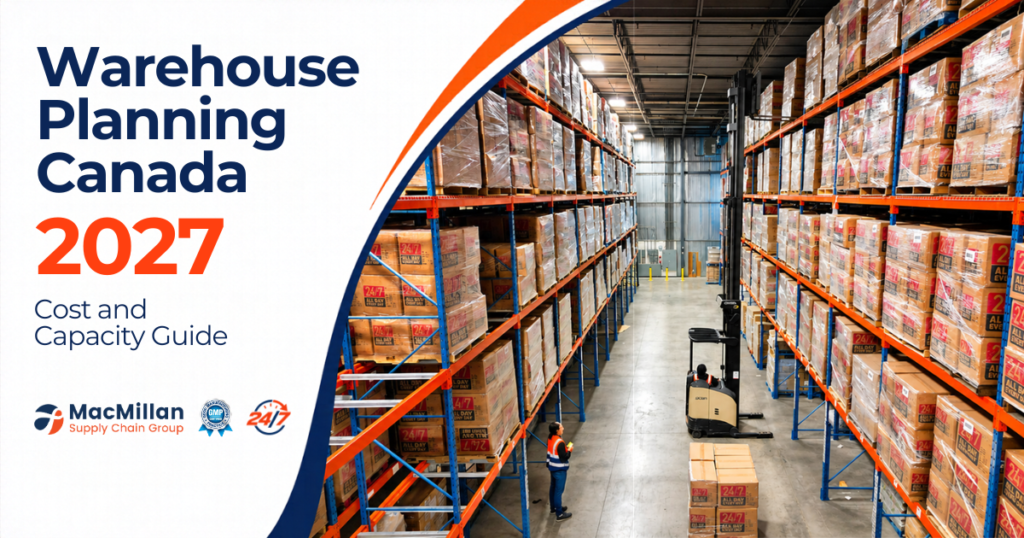
Warehouse Planning Canada | 2027 Cost and Capacity Guide
2027 Warehouse Planning Guide: How Canadian Businesses Can Control Costs and Build Flexible Capacity A warehouse renewal lands on your desk. A cheaper building is available farther from your customers, while your current facility feels crowded every November and half-empty by February. Sales wants room for growth. Finance wants lower overhead. Operations wants enough space to get orders out without moving the same pallet three times. That is where useful warehouse planning in Canada begins: connecting the building decision to how the business actually operates. For 2027, the right question is not simply how much space you can afford. It is how much reliable storage and processing capacity you need, where you need it, and which commitments make sense when demand changes. The lowest warehouse rent does not necessarily produce the lowest overall logistics cost. A sound plan compares transportation, labour, inventory, service and flexibility alongside occupancy costs. Why Warehouse Planning Matters Heading Into 2027 Warehouse decisions often outlast the assumptions used to justify them. A lease signed around one major customer, one import route or one product range may still be in place after those conditions change. Retailers need room for promotions without carrying permanent peak costs. Manufacturers need dependable material flow. Importers need receiving capacity when containers arrive together. E-commerce businesses need enough picking and packing capacity to meet delivery promises. Build the 2027 plan with sales, purchasing, finance and operations together. Otherwise, purchasing may increase order quantities to save freight while the warehouse budget assumes less stock and marketing launches another product line. What Current Canadian Industrial-Market Conditions Mean for Your Decision As of November 2026, published third-quarter reports provide a useful starting point—not a forecast of your 2027 lease terms. CBRE’s Q3 2026 Canada Industrial Figures reported national availability of 5.2%, down 30 basis points from the previous quarter. National net asking rent was CAD $14.77 per square foot, down 2.4% year over year. Those figures show that recovering demand and softer asking rents can coexist. They are market indicators, not an all-in occupancy quote for a specific building. For the GTA, Colliers’ Q3 2026 Toronto report described strong absorption and declining availability alongside continued pressure on net rents. Its findings reinforce the need to assess individual submarkets and properties. Request current comparable offers. Check usable clear height, loading, power, yard access and permitted activities. Available industrial space is not automatically suitable for food storage, high-volume parcel fulfillment or your particular operating hours. Calculate the True Cost of Operating a Warehouse Separate Occupancy From Operational Costs Start with a consistent annual cost model. Include net rent and applicable additional rent, such as taxes, maintenance and insurance charges, then identify which utilities and repairs remain your responsibility. Add the costs required to make the building work: Racking, equipment, fit-out and maintenance. Wages, employer contributions, benefits, supervision and training. Warehouse software, scanners, connectivity and support. Cleaning, security, inspections and product-specific controls. Inbound handling, outbound processing and returns. Transportation, transfers, damage and avoidable rework. Keep one-time cash requirements, recurring operating expenses and depreciation distinct. Avoid counting both the full equipment purchase and its annual depreciation as annual operating costs. Test Whether the Rent Saving Survives the Move Consider a hypothetical 20,000-square-foot requirement. A CAD $2-per-square-foot annual rent saving equals CAD $40,000. If the location adds CAD $45,000 in annual transportation and staffing costs, the apparent saving disappears before relocation expenses. These are illustrative numbers, not market quotes. The same comparison should use your freight lanes, staffing assumptions and property proposals. Review total warehousing and fulfillment costs using equivalent service requirements. How Much Warehouse Space Will You Really Need in 2027? Start With Inventory Positions and Product Characteristics Collect at least a full seasonal cycle of stock records where available. Review average and maximum pallets, cartons, SKU counts, product dimensions, stackability and stock held for inspection or returns. Translate that profile into suitable storage positions. A pallet of fragile displays may not stack like cases of cleaning products. A large number of slow-moving SKUs may require more accessible locations than a small range shipped by full pallet. For illustration, if you need to accommodate 800 occupied pallet positions at an assumed 80% planning occupancy, you need 1,000 compatible positions. The 80% assumption is an example, not a universal operating target. Your layout and product mix determine workable occupancy. Allow for Processing Space and Throughput Convert positions into floor area using an actual layout. Include receiving, staging, pick faces, packing, returns, safety clearances and circulation. Confirm rack design and building constraints before treating vertical space as usable capacity. Then test throughput separately. Can the docks receive the busiest inbound day? Can replenishment keep pickers supplied? Can packing clear orders before carrier collection? A warehouse can have spare storage and still lack dispatch capacity. Document both storage and processing limits before choosing a building. Understand the Cost of Unused and Underutilized Space Empty space creates fixed costs without necessarily supporting sales. It may still require rent, heating, lighting, security and maintenance. Separate necessary working room from speculative expansion. Receiving areas and clear aisles are productive capacity even when they are not holding stock. An unused block leased for a possible customer contract is a different commitment. Review occupancy by month and zone. If expansion demand is uncertain, compare permanent space with a smaller core operation and contracted overflow. Check the lease before assuming you can sublet surplus space. Plan Seasonal and Peak Requirements Separately Your inventory peak may arrive weeks before your order peak. A holiday retailer can need maximum storage in October, maximum packing labour in November and additional returns capacity in January. Build a weekly calendar covering inbound receipts, stored inventory, outbound orders, promotional assembly and returns. Include customer launch dates and retailer delivery appointments. Book extra capacity before it becomes urgent. Confirm the reservation, minimum charges, activation notice and receiving limits in writing. For peak-season fulfillment planning, extra storage only helps if stock can reach the shipping operation in time. Compare Dedicated, Shared, Overflow and 3PL Warehousing These
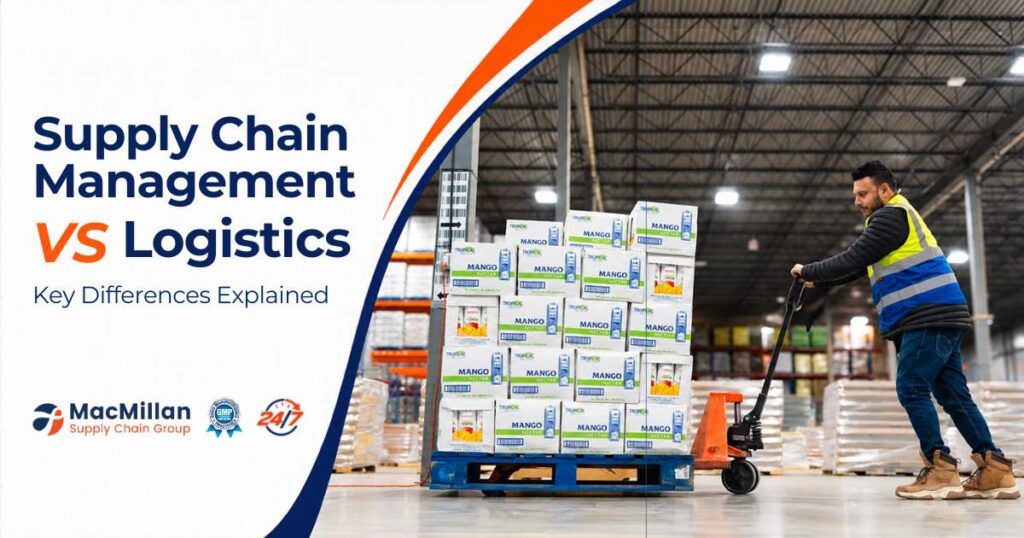
Supply Chain Management vs Logistics: Key Differences Explained
When it comes to business, the words supply chain management and logistics are used often, and some people even use them interchangeably. But do they mean the same? In this article, we discuss the meaning of both terms and the key differences between them. Table of Contents Are Supply Chain Management and Logistics the Same Thing? What Are the Key Differences Between Supply Chain Management and Logistics? What Is Supply Chain Management? And How Does It Differ From Logistics? What Can Good Supply Chain Management Do for Your Business? What Are Logistics? And How Does It Differ From Supply Chain Management Should You Work for a A Supply Chain and Logistics Company? When Should You Hire a Supply Chain and Logistics Company? Are Supply Chain Management and Logistics the Same Thing? No, they’re not the same thing. However, the terms evolved from the same background: Logistics was a term used to describe the supply of goods and services to the end customer, which later evolved into the term supply chain management. A research paper puts it like this: “Practitioners and educators have variously addressed the concept of supply chain management (SCM) as an extension of logistics, the same as logistics, or as an all encompassing approach to business integration.” [efn_note] Cooper, Martha C., et al. “Supply Chain Management: More Than a New Name for Logistics.” The International Journal of Logistics Management, vol. 8, no. 1, 1 Jan. 1997, pp. 1-14 What Are the Key Differences Between Supply Chain Management and Logistics? Logistics is connected to the storage and movement of goods, while supply chain management is used for the chain of activities that lead to the finished goods from raw materials. The goods and information flow from the raw products to the end customer. Supply chain management is concerned with a competitive advantage, whereas logistics leans toward customer service and support. Only one organization is involved with logistics, while supply chain management involves multiple organizations such as suppliers, intermediaries, distributors, and customers. What Is Supply Chain Management? And How Does It Differ From Logistics? To understand what supply chain management means, you first need to know what a supply chain is. A supply chain is the network of individuals and organizations involved in manufacturing and supplying a product. It typically includes a manufacturer, suppliers, and customers. A large company can have multiple supply chains. The complexity changes with the scale; for example, the global supply chain involves suppliers worldwide, which makes it much more difficult to manage. Therefore, supply chain management is the management of the coordination of a product’s creation. It includes sourcing raw materials, manufacturing, logistics, and delivery of the final product. An operations manager oversees the entire process: They ensures that events are properly coordinated and that the right products are supplied at the right place and time. What Can Good Supply Chain Management Do for Your Business? Supply chain management is not just related to goods; It helps control service performance as well. For example, it can … Increase customer value Help you gain a competitive advantage in the marketplace Reduce expenses Deliver products to the customers faster Avoid supply shortages Supply chain management is an important aspect of any business dealing with the shipment or storage of product. Any business that is struggling due to poor supply chain management has a higher risk of facing an economic crisis. What Are Logistics? And How Does It Differ From Supply Chain Management Logistics is a process within supply chain management that oversees the acquiring procedure of materials, storage of goods, and transportation to get to the end customer. Unlike supply chain management, the term logistic has been around for a long time. Logistics is an activity included in the supply chain. It includes … Collection from suppliers Efficient material handling Package labelling Organization and warehousing Inventory management for distribution or production Demand planning Order fulfillment Logistics is an important part of businesses. It revolves around the movement of products. Successful logistics look include … Increased process efficiency Lower production costs Better customer experience Improved use of warehouse area Increased production rates Good inventory control Increased supplier and customer satisfaction A logician, also known as a logistics supply manager, is responsible for appropriate transportation and managing inventory. They also monitor other operations such as warehousing, transportation, and supply chain processes. Should You Work for a A Supply Chain and Logistics Company? Most people don’t grow up wishing to work in supply chain management. You can say the same for most jobs, but here are 8 reasons why one should consider working in this field: Working with a supply chain group exposes people to opportunities and allows them to produce strategies to implement initiatives. They can learn valuable skills, including problem-solving, communication, and analytics. They can watch their hard work pay off as they make a fulfilling difference. The regularly changing environment and the fast pace will keep the employees on their feet, and they won’t get bored. Ever since supply chain organizations have developed and evolved, production has been made efficient, creating high-tech roles. People don’t just get to work and learn in their own company but also with other organizations. Working with supply chain processes gives you a perspective of a business as a whole which is important for anyone working in that field. Various jobs are available, so diversity provides more options for employees to develop their interests. This also welcomes new opportunities to create a portfolio of professional skills. When Should You Hire a Supply Chain and Logistics Company? If you’re not looking for a career in supply chain management or logistics, but want to work with a firm that deals with these services, consider these benefits: Working with supply chains will help you forecast demands so you can be well prepared for unstable economies. Such communication will allow your business to have a higher efficiency rate. Your system will respond better to the customer’s requirements. Your relationship with dealers and distributors will improve. There will
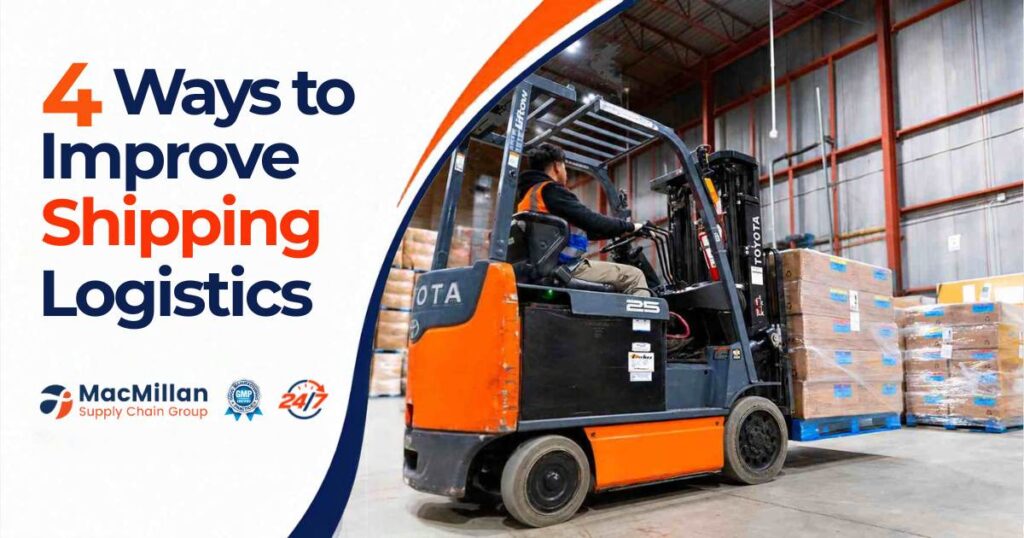
4 Ways to Improve Shipping Logistics
Shipping logistics can be defined as the management and supervision of the movement of goods, products, or raw materials. It encompasses all inbound and outbound logistics involved in moving goods through a supply chain, from first-mile delivery to end-customer shipments. Why care about shipping logistics? With the fast advancements in technology, customer expectations are higher than ever. A big part of maintaining high customer satisfaction is dependent on the shipping process. A high percentage of customers say that the shipping and delivery experience influences their decision to buy from the brand again. Furthermore, one in every three customers leave a negative review on social media if their delivery experience is poor. What’s the Difference Between Shipping and Logistics? What Are the Different Types of Shipping Logistics? How to Optimize The Shipping Logistics Process Efficiency Master Shipping Logistics and Your Business Will Thrive What is the Difference Between Shipping and Logistics? Shipping is the physical transport of goods from a warehouse to the customers. It refers to the processes that occur in the shipping industry as goods move throughout the supply chain, including documentation, working with carriers, tracking, and handling, as well as delivery times and transportation. Logistics refers to the the system that governs this entire process. It starts with the creation of a product and ends when the product is in the hands of the customer. It refers to all the coordinated operations that manage how goods are acquired, stored, and transported to their destination. What Are the Different Types of Shipping Logistics? Shipping logistics can be divided into three major categories: 1. Inbound Logistics Inbound logistics refers to the processes of transporting products from the point of origin, fulfillment centre, or to a warehouse. Everything a company needs to move goods, store, and deliver goods should be included in the inbound logistics network: Product sourcing Lead times for production Receiving in the warehouse 2. Outbound Logistics Outbound logistics, on the other hand, encompasses all operations required to transport products from a fulfillment centre or warehouse to the consumers: Order fulfillment Choosing and packing Shipping and Carrier Partnerships Shipping Services 3. Reverse Logistics By the time reverse logistics may come into play, the customer should already have the products in their hands. It refers to the processing of customer returns and exchanges and includes both inbound and outbound processes, such as creating return labels, inspecting the returns, issuing refunds, and shipping replacement items. How to Optimize The Shipping Logistics Process Efficiency There are many ways to improve the efficiency of a shipping logistics process, some of which are included below. 1. Hold Stock in Strategic Locations The way that you distribute inventory has an impact on shipping logistics. A distributed inventory model reduces shipping costs and delivery times by storing goods in multiple fulfillment centres closer to the customers. When you hold stock in strategic locations, ground shipping allows for quick shipments to the final destination. shipping goods to their final destinations. By ensuring that products are close to the people who buy them, you reduce shipping times and increase customer satisfaction. 2. Select the Appropriate Carrier The shipping carriers are responsible for supplying products from a warehouse to the client. They are responsible for getting the product to the customer in a timely and safe manner. Because different businesses require different shipping capabilities, many businesses find it difficult to select a good carrier for their business. A number of factors influence which carrier is best suited for the job: Location: Depending on whether you ship locally, nationally, or internationally, different carriers provide different services, benefits, and rates. Check out the rates from different providers and choose the best one. When shipping products nation-wide, consider a carrier that can pick up products locally from distributed fulfillment centres as it allows for quicker deliveries. Quick Deliveries: Some carriers have the options to ship within the next two days or even promise a next-day delivery. Transit times are one of the most important factors to consider when selecting a carrier. If you need orders to get into the hands of customers quickly, consider working with a carrier that can accommodate you. 3. Automating Order Management When online stores grow, an automatized order management system can assist you. That is, when scaling your business, it’s critical to streamline order management and inventory control processes. An inventory management software allows you to track inventory levels, orders, sales, and shipments. It can also assist in automating real-time inventory tracking and in preventing common problems such as overstocking, shipment splitting, and backorders. 4. Access Real-Time Data If you are automating your shipment process, you can’t rely on artificial intelligence and participating logistics providers to do a good job. Therefore, ensure that you have access to real-time data on the whereabouts of your products. A good system will help you to gather important data that you can use in the future to further optimize your logistics services. Related: What’s the Difference Between a Storage Facility and a Warehouse? Master Shipping Logistics and Your Business Will Thrive Whether you own a small or large business, it’s important to optimize your shipping logistics to keep customers satisfied. When optimizing shipment logistics, consider inbound, outbound, and reverse shipment logistics so that you can be confident in your overall system. The best practice in shipping logistics is simple: Distribute your stock in more strategic locations, select an appropriate carrier, automize order management, and gain access to real-time data. This is how the logistics industry has been able to satisfy clients, and how you can as well. Frequently Asked Questions What is shipping logistics? Shipping logistics is the process of planning, managing, and monitoring how goods move through the supply chain, including receiving, storage, transportation, delivery, and returns. What are the main types of shipping logistics? The three main types are inbound logistics, outbound logistics, and reverse logistics. Together, they manage the movement of products into a warehouse, out to customers, and back through returns or exchanges. How can businesses improve shipping
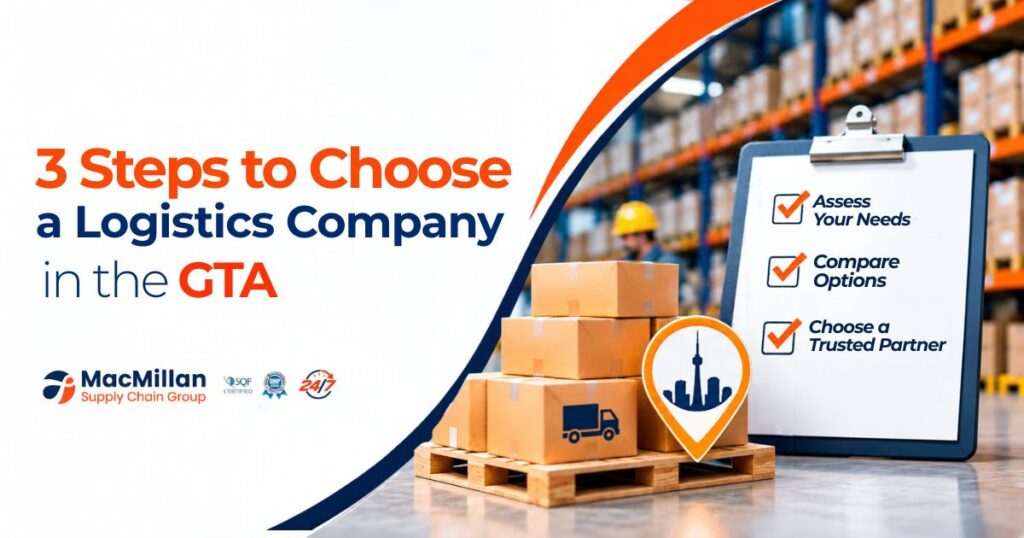
3 Steps to Choose a Logistics Company in the GTA
If you’re looking for complete shipping solutions and want to work with a Greater Toronto Area logistics company, a few factors will need your consideration. Here are 3 simple steps that’ll help you find the right logistics company for your business. Table of Contents Step 1: Know What You’re Looking For Step 2: Look Into Their GTA Logistics Services Step 3: Ensure They Can Accommodate Your Needs The MacMillan Supply Chain Group has several facilities in the GTA to accommodate you. If you’d like to speak to an expert about your situation, you can reach us at 416-941-2759 or here. 3 Steps for Working With a Logistics Company in the GTA Step 1: Know What You’re Looking for Before selecting a 3PL company, you must know the difference between supply chain logistics and management. Is supply chain logistics and management the same thing? The answer is no. Management is related to production and storage, and logistics is concerned with the movement of goods. Once you understand the fundamental differences, here’s what you should consider: Are You Looking for Storage or a Warehouse? You need to decide whether you want a storage facility or a warehouse. The difference between a storage and a warehouse is that a warehouse can hold larger volumes, and you’ll have less inventory control. What Location Works for You? The Greater Toronto area is a high-demand area and hub for supply chain logistics, so you must choose your location and provider carefully. Your warehouse for e-commerce (and other purposes) should be close to the port and your customers to account for efficient customer service. How Does Technology Come into Play? Your logistics partner should have up-to-date technology to track inventory and manage shipping logistics. For example, if you’re working with a 3PL for cosmetics, tracking your products will prevent them from expiring in the warehouse. Step 2: Look Into Their GTA Logistics Services Once you’re clear on what you want, you can look through the company’s services. You can ask them about their customization handling, storage, and other fulfillment services. For example, if you’re looking for consumer electronics fulfillment, you would want to ensure that you get suitable packaging to keep the items safe and secure. You can ask about their transport logistics to make sure that responsible carriers deliver your goods. Most logistics companies in Ontario offer freight forwarding across Canada and North America. The most significant benefit of transportation in supply chain management is that your items will be delivered safely and on time. Step 3: Ensure They Can Accommodate Your Needs Ever since the COVID-19 pandemic, there have been fluctuating demands and disruptions in supply chains in Ontario and the rest of Canada. While the most significant effects were the worst during the first year of the pandemic, the impact will likely be long-lasting. You have to ensure that your 3PL partner is flexible and can accommodate your needs during emergency situations, such as labour shortages, transport-related disruptions, and other issues. This will help you maintain stability and consistent revenue. [efn_note] Large, R.O., Kramer, N. and Hartmann, R.K. (2011), “Customer-specific adaptation by providers and their perception of 3PL-relationship success”, International Journal of Physical Distribution & Logistics Management, Vol. 41 No. 9, pp. 822-838. The MacMillan Supply Chain Group offers complete shipping solutions, specialized services, and everything else you need to fulfill your supply chain and logistics need. We have experienced staff, up-to-date technology, and warehouses all over the GTA. You can call us at 416-941-2759 or email us here for more guidance and more information. Frequently Asked Questions What should I look for in a logistics company in the GTA? Look for a provider with strong warehousing, transportation, technology, communication, scalability, and experience supporting businesses similar to yours. Why is location important when choosing a GTA logistics provider? A strategically located warehouse can improve delivery speed, reduce transportation time, and provide better access to major highways, retailers, and customers across the Greater Toronto Area. Learn more about MacMillan’s warehousing and distribution capabilities. How can a 3PL help a growing business in the GTA? A 3PL can provide storage, inventory management, fulfillment, transportation, and scalable logistics support without requiring the business to build its own infrastructure. What technology should a logistics company provide? A reliable logistics provider should offer inventory visibility, warehouse management systems, order tracking, reporting, and technology that helps businesses monitor operations more efficiently. Can a logistics company help reduce transportation challenges in the GTA? Yes. An experienced provider can coordinate carriers, routes, shipment planning, and freight movement to improve efficiency. MacMillan’s transportation and logistics services can support these requirements.
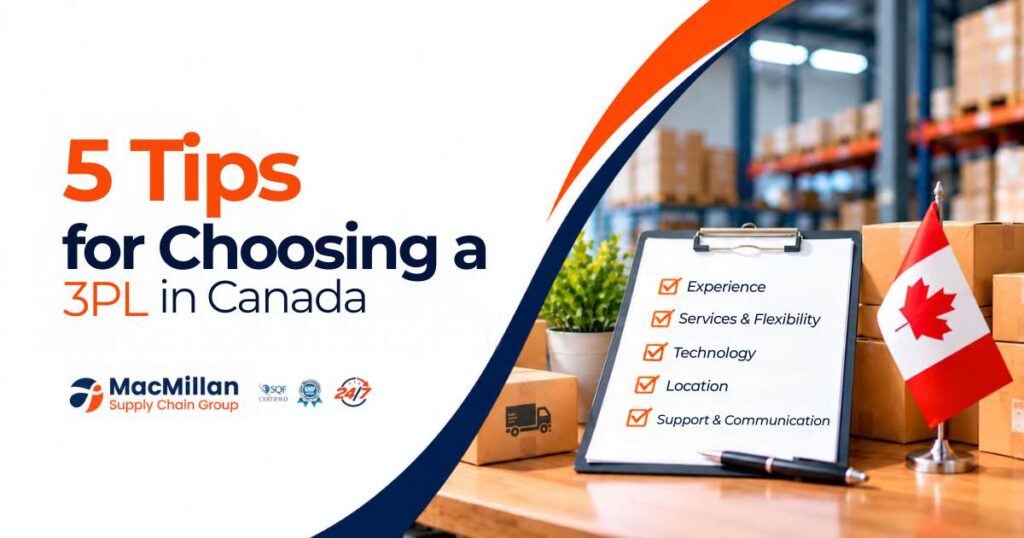
5 Tips for Choosing a 3PL in Canada
Global supply chains have been affected by the pandemic in recent years, causing retail shipping to take a hit. Efficiently transporting goods within a short delivery windows and at lower prices has become one of the biggest challenges that online retailers face. Still, retail freight is an important part of every business, and effective logistics management can help business owner lower their transportation costs. Table of Contents What Is the Importance of Retail Freight and Shipping Logistics? Efficient Supply Chain Fast Delivery Low Costs What Modes of Transportation are Used in Retail Freight? Air Freight Truck Freight Marine Transportation Intermodal Transportation Looking for a Retail Freight Solution What Is the Importance of Retail Freight and Shipping Logistics? There are several advantages that retail freight and shipping logistics can have on a business. 1. Efficient Supply Chain The efficiency of a supply chain can make or break a business. Focusing on logistics allows business owners to oversee the supply chain, from production and storage at the distribution centres to delivery of the orders to the end customer. A smooth supply chain is important especially during the holiday season. Retail sales tend to increase, making an efficient logistics and freight management system a crucial component. 2. Fast Delivery When the shipment and delivery of products is carefully planned, such as when best routes and carriers are narrowed down, retailers can reduce transportation time and deliver products faster. Having a retail freight strategy in place is good for customer satisfaction and retention. Most of the time, consumers abandon their online shopping cart if delivery times are too long. This is why having efficient retail logistics and freight management can be beneficial for you. It’s also essential to get products delivered at retail locations at the right time. 3. Low Costs A proper logistics system isn’t just important for business growth but also for lowering costs. A well-managed supply chain should be efficient and focused on cost-savings. Working with a 3PL professional is better for retail fulfillment because you will get all the benefits of transportation in supply chain management without worrying about handling logistics. A 3PL will save you the money you could have spent on extra warehousing space, staff, and carriers. You’ll also be able to track your inventory and have real-time data as logistics service providers make use of innovative technology to manage every step of the supply chain. If you are looking for logistics companies in Ontario, the MacMillan Supply Chain Group is here for you. We provide complete shipping solutions and can help improve your bottom line. What Modes of Transportation Are Used in Retail Freight? 1. Air Freight Air freight is the shipment of cargo via air. This mode of transporting goods has several benefits. It is ideal for perishable or sensitive goods that require fast delivery. However, air freight is more costly compared to other modes of transportation. You also have to be careful with the size, type, and weight of the items you want to ship because if your goods don’t fall within the air cargo criteria, you may not be able to ship them. 2. Truck Freight Truck freight is one of the most widely used methods of cargo transportation. The retail industry uses different types and sizes of trucks to carry items with different requirements. There are refrigerated trucks available for perishable goods and frozen items. Similarly, different trucks are designed to carry items such as construction goods and automobiles. You can choose between truck-load services or less-than-truckload services. The benefit of less-than-truckload over the former option is that you don’t have to pay for an entire truckload to carry items that don’t reach the maximum capacity. Instead, your products, along with goods from other businesses, will combine to form a truckload. This is a cost-effective option for you and your carrier. 3. Marine Transportation Marine transportation is a good option for businesses that ship their goods internationally. From a cost standpoint, it is better than air freight since it is relatively inexpensive. The downside is that this mode can take longer than air freight since ships move slower. You may also have to pay more if your warehouse isn’t close to the port. The costs of transporting cargo from the distribution centre to the port is typicallly high. 4. Intermodal Transportation Research in the Communications in Computer and Information Science explains intermodal transportation as a mode of transportation that consists of two or more modes of transportation to get cargo to its destination. It is best for goods that aren’t perishable and can stay in optimal condition for a long time. It is a safe method since the cargo is scanned every time it’s loaded, which also gives the retailer better end visibility. “The intermodal terminal only participates in the transport of basic intermodal freight unit translation services and their short-term storage, as basic services of a transition point between different types of transport networks. Intermodal terminals also include other additional services such as technical inspections, maintenance, cleaning or long-term storage of empty intermodal loading units. These services can already be provided by multiple subjects, which is a guarantee of a competitive environment. At the same time, the risk of damage to the goods during handling increases. “ [efn_note] Kubáňová, J., Otáhalová, Z., Senko, Š. (2020). Advantages and Disadvantages of Intermodal Freight Transportation. In: Mikulski, J. (eds) Research and the Future of Telematics. TST 2020. Communications in Computer and Information Science, vol 1289. Springer, Cham. Looking for a Retail Freight Solution? Are you looking for logistics services in the Greater Toronto Area? At the MacMillan Supply Chain Group we have expert teams that can provide innovative supply chain solutions and fulfill all your shipping needs. Whether you want to ship across Canada, or to North America, our services will improve your supply chain efficiency and deliver your goods to the final destination so you can keep your customers satisfied. Frequently Asked Questions What is retail freight? Retail freight is the transportation of
The Importance of Retail Freight in Shipping Logistics
Global supply chains have been affected by the pandemic in recent years, causing retail shipping to take a hit. Efficiently transporting goods within a short delivery windows and at lower prices has become one of the biggest challenges that online retailers face. Still, retail freight is an important part of every business, and effective logistics management can help business owner lower their transportation costs. Table of Contents What Is the Importance of Retail Freight and Shipping Logistics? Efficient Supply Chain Fast Delivery Low Costs What Modes of Transportation are Used in Retail Freight? Air Freight Truck Freight Marine Transportation Intermodal Transportation Looking for a Retail Freight Solution What Is the Importance of Retail Freight and Shipping Logistics? There are several advantages that retail freight and shipping logistics can have on a business. 1. Efficient Supply Chain The efficiency of a supply chain can make or break a business. Focusing on logistics allows business owners to oversee the supply chain, from production and storage at the distribution centres to delivery of the orders to the end customer. A smooth supply chain is important especially during the holiday season. Retail sales tend to increase, making an efficient logistics and freight management system a crucial component. 2. Fast Delivery When the shipment and delivery of products is carefully planned, such as when best routes and carriers are narrowed down, retailers can reduce transportation time and deliver products faster. Having a retail freight strategy in place is good for customer satisfaction and retention. Most of the time, consumers abandon their online shopping cart if delivery times are too long. This is why having efficient retail logistics and freight management can be beneficial for you. It’s also essential to get products delivered at retail locations at the right time. 3. Low Costs A proper logistics system isn’t just important for business growth but also for lowering costs. A well-managed supply chain should be efficient and focused on cost-savings. Working with a 3PL professional is better for retail fulfillment because you will get all the benefits of transportation in supply chain management without worrying about handling logistics. A 3PL will save you the money you could have spent on extra warehousing space, staff, and carriers. You’ll also be able to track your inventory and have real-time data as logistics service providers make use of innovative technology to manage every step of the supply chain. If you are looking for logistics companies in Ontario, the MacMillan Supply Chain Group is here for you. We provide complete shipping solutions and can help improve your bottom line. What Modes of Transportation Are Used in Retail Freight? 1. Air Freight Air freight is the shipment of cargo via air. This mode of transporting goods has several benefits. It is ideal for perishable or sensitive goods that require fast delivery. However, air freight is more costly compared to other modes of transportation. You also have to be careful with the size, type, and weight of the items you want to ship because if your goods don’t fall within the air cargo criteria, you may not be able to ship them. 2. Truck Freight Truck freight is one of the most widely used methods of cargo transportation. The retail industry uses different types and sizes of trucks to carry items with different requirements. There are refrigerated trucks available for perishable goods and frozen items. Similarly, different trucks are designed to carry items such as construction goods and automobiles. You can choose between truck-load services or less-than-truckload services. The benefit of less-than-truckload over the former option is that you don’t have to pay for an entire truckload to carry items that don’t reach the maximum capacity. Instead, your products, along with goods from other businesses, will combine to form a truckload. This is a cost-effective option for you and your carrier. 3. Marine Transportation Marine transportation is a good option for businesses that ship their goods internationally. From a cost standpoint, it is better than air freight since it is relatively inexpensive. The downside is that this mode can take longer than air freight since ships move slower. You may also have to pay more if your warehouse isn’t close to the port. The costs of transporting cargo from the distribution centre to the port is typicallly high. 4. Intermodal Transportation Research in the Communications in Computer and Information Science explains intermodal transportation as a mode of transportation that consists of two or more modes of transportation to get cargo to its destination. It is best for goods that aren’t perishable and can stay in optimal condition for a long time. It is a safe method since the cargo is scanned every time it’s loaded, which also gives the retailer better end visibility. “The intermodal terminal only participates in the transport of basic intermodal freight unit translation services and their short-term storage, as basic services of a transition point between different types of transport networks. Intermodal terminals also include other additional services such as technical inspections, maintenance, cleaning or long-term storage of empty intermodal loading units. These services can already be provided by multiple subjects, which is a guarantee of a competitive environment. At the same time, the risk of damage to the goods during handling increases. “ [efn_note] Kubáňová, J., Otáhalová, Z., Senko, Š. (2020). Advantages and Disadvantages of Intermodal Freight Transportation. In: Mikulski, J. (eds) Research and the Future of Telematics. TST 2020. Communications in Computer and Information Science, vol 1289. Springer, Cham. Looking for a Retail Freight Solution? Are you looking for logistics services in the Greater Toronto Area? At the MacMillan Supply Chain Group we have expert teams that can provide innovative supply chain solutions and fulfill all your shipping needs. Whether you want to ship across Canada, or to North America, our services will improve your supply chain efficiency and deliver your goods to the final destination so you can keep your customers satisfied. Frequently Asked Questions What is retail freight? Retail freight is the transportation of