
US-China Tariff Deal: Impact on Canadian Supply Chains & Trade
Recognizing How the US-China Tariff Deal Affects Canadian Companies Changes in trade policies by the two biggest economies in the world have an impact that goes well beyond their boundaries. With significant ramifications for Canadian companies and supply chains, the recent US-China tariff deal represents a significant change in the dynamics of global trade. This new agreement seeks to lower tariffs and loosen trade restrictions between these two economic titans following years of rising tensions in the US-China trade war. However, what does this entail for middle-tier Canadian businesses? What effects will these modifications have on your supply chain’s overall resilience, export prospects, and import strategy? MacMillan Supply Chain Group, a top 3PL supplier in Canada, is aware of the intricate difficulties these changes bring. We’ll analyze the main features of the US-China tariff deal, look at how it affects Canada’s economy, and provide helpful advice for negotiating this changing trade environment in this article. What’s Changing in the US-China Tariff Deal? The US-China tariff deal is the most recent development in a rocky trade relationship. Under this new agreement, both countries have agreed to significant tariff reductions after imposing tariffs as high as 25% on goods valued at hundreds of billions of dollars. However, what does the deal exactly include? Fundamentally, the deal lowers tariffs on thousands of goods that are traded between the two nations. In order to update your Canada import strategy, it is imperative that Canadian businesses comprehend these changes. A number of important topics are covered in the deal: Lower taxes on consumer goods, electronics, and industrial machinery Agricultural product restrictions were relaxed Promises to buy a certain amount of merchandise Clauses pertaining to intellectual property disputes Frameworks for addressing trade imbalances This isn’t a total overhaul of trade relations, though. The underlying tensions that led to the US-China trade war have not gone away, and many tariffs are still in effect. Consider this to be less of a comprehensive peace treaty and more of a bilateral tariff truce. These changes have an impact on supply chains in Canada. Price changes may occur for goods that pass through the US or contain Chinese components. Businesses that moved their sourcing out of China when tensions were at their highest now need to consider whether to change their approaches once more. The secret is to anticipate how this relationship may change in the future as well as to comprehend what is changing now. Canada’s Economic Impact: Opportunities and Challenges The US-China tariff deal has had a complex economic impact on Canada, posing opportunities and challenges for companies in a wide range of industries. Canada is in a unique position as these two significant trading partners modify their relationship. Positively, the economy of North America as a whole may benefit from lowered tensions between the US and China. Freer trade lowers manufacturing costs, which could help Canadian businesses that: Purchase parts for North American manufacturing from China Export completed goods to markets in China or the United States Connect these important economies by offering logistics services But there are also difficulties. Some manufacturers moved their operations to Canada during the height of the US-China trade war in order to avoid tariffs and keep access to North American markets. Now that tariffs have been lowered, this competitive edge might be lost. The environment for Canadian exporters is not uniform. Chinese suppliers may now present a fresh threat to those who increased their market share during the trade disputes. More reliable supply chains and lower prices for imported parts might help others. The effects differ greatly depending on the industry, with the automotive, electronics, and agricultural sectors all seeing different results. This changing environment necessitates careful consideration for companies in charge of Canadian supply chains. Which of your clients, vendors, or goods will be impacted by these changes in tariffs? What could your rivals say? Maintaining your competitive position in this changing trade environment requires that you respond to these questions. Rethinking Your Approach to Importing from Canada Now is the ideal moment to review your Canada import strategy because the US-China tariff deal is changing trade flows. Rapidly adapting businesses can benefit greatly in terms of price, dependability, and market responsiveness. Start by determining how exposed your present supply chain is to the dynamics of US-China trade: Which of your products have Chinese components? Do you use US middlemen or import straight from China? What effects have past tariff adjustments had on your lead times and expenses? The basis for a more robust strategy is this analysis. While keeping in touch with your most dependable Chinese partners, think about expanding your supplier base outside of China. This well-rounded strategy offers flexibility in the event that tariff escalation risks reappear. In this setting, logistics planning becomes even more important. You can access experience in navigating evolving customs regulations and determining the best trade routes by partnering with a seasoned 3PL like MacMillan Supply Chain Group. We assist clients in determining whether, in light of the new tariff structure, it makes more sense to route through US distribution centers or import directly from China. Modern import strategies heavily rely on technology. You can react swiftly to changes in tariffs by using digital tools for: Tracking shipments Handling customs paperwork Evaluating landed costs These systems offer the transparency required to make wise choices regarding inventory control, routing, and sourcing. Keep in mind that developing a competitive edge is the goal of import strategy, not merely cutting expenses. Businesses that understand the intricacies of global trade can outperform their rivals in terms of pricing, delivery dependability, and flexibility. Managing the New Market Realities for Canadian Exporters The US-China tariff deal alters the competitive environment for Canadian exporters, necessitating strategic adjustment. Maintaining and expanding your export business requires an understanding of how these changes impact your particular markets. The effects differ greatly by sector: US goods may reenter the Chinese market as a threat to agricultural exporters Manufacturers selling to the US may
Canada Trade Shift Away from the U.S.| New Opportunities
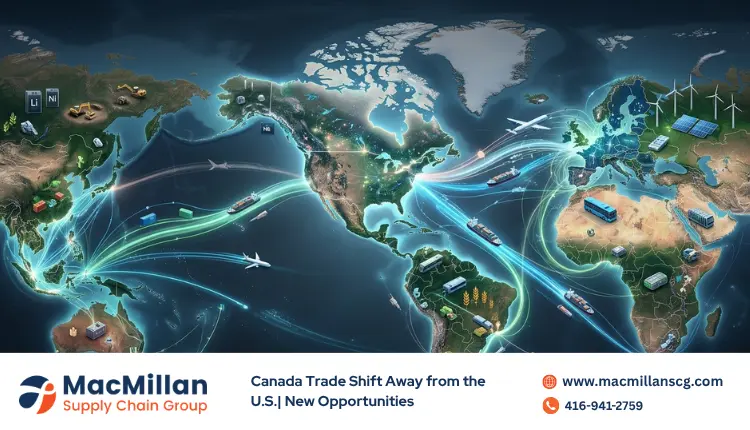
Canada’s trade is changing dramatically, moving away from its previous export strategy that was centered on the United States. According to recent data, exports to the US have decreased 6.6%, while exports to the EU and ASEAN have increased by 24.8% and 11.2%, respectively. Tariff tensions are speeding up this change, which is changing supply chains and opening up new markets in industries ranging from critical minerals to clean technology. Leading this shift is MacMillan Supply Chain Group, which offers the logistics know-how required to successfully negotiate new international markets and support the Canada trade shift away from the U.S. Why Canada’s Trade Landscape Is Changing With about 75% of exports going south of the border, Canada’s economic success has long been closely tied to U.S. trade relations. For Canadian businesses, this dependence put them in a precarious but comfortable position. When new tariffs were placed on Canadian steel (25%) and aluminum (10%) as well as other agricultural products, the comfort came to an abrupt end. Economists refer to the ensuing trade tensions as a “forced diversification” because they have compelled Canadian exporters to investigate markets they had previously disregarded. This article explores how this Canada trade shift away from the U.S. is occurring, which industries are reaping the benefits, what obstacles still exist, and how logistics partners like MacMillan Supply Chain Group are helping to bring about this momentous shift to more equitable international trade relations. The Catalyst: U.S. Tariffs and Their Immediate Impact on Canada Trade Shift Away from the U.S Canada’s export environment has been drastically changed by the recent wave of U.S. tariffs. Exports to the US fell 6.6% in March 2025, costing numerous industries billions of dollars in lost revenue. Crude oil (-8%), machinery (-7.3%), and auto parts (-12%) are the industries most severely impacted. It took some time for these tariffs to appear. They signify a sharp rise in trade tensions that started years earlier but reached a new level in 2024. Section 232 tariffs on aluminum and steel, which were defended on the grounds of “national security,” were only the first step. Expanded tariffs on agricultural products like pork (35%) and automobiles with insufficient North American content (25%) followed shortly after. Canada didn’t do nothing. Targeting politically sensitive U.S. goods from important states, the government imposed strategic counter-tariffs on Wisconsin dairy machinery (15%), Kentucky bourbon (25%), and Florida citrus (22%). Although necessary, this tit-for-tat strategy demonstrated that diversification was not only desirable but also crucial for maintaining economic stability. “When your largest trading partner becomes unpredictable, you don’t just need a Plan B – you need Plans C, D, and E,” notes a senior trade analyst at Export Development Canada. “That’s exactly what we’re seeing Canadian businesses implement now in response to the Canada trade shift away from the U.S.” New Horizons: Where Canadian Exports Are Finding Success Amid Canada Trade Shift Away from the U.S With impressive results, Canadian exporters swiftly shifted to other markets as U.S. trade declined. With Canadian exports rising 24.8% in March 2025 over the previous month, the European Union was the main beneficiary of this change. Throughout this transition, the Comprehensive Economic and Trade Agreement (CETA) between the EU and Canada has shown its value. After 98% of tariffs were removed, Canadian companies discovered ready markets for: Exports of gold to the UK (+32%) Crude oil exports to the Netherlands (+28%) Pharmaceutical ingredients shipped to France and Germany (+19%) Lithium and other essential minerals for EU battery producers (+17%) With exports to ASEAN countries increasing 11.2%, Southeast Asia has also become a crucial growth market. With Canadian agri-food exports up 23% and clean tech components up 16%, Thailand has grown in importance. Since its opening in early 2025, the Export Development Canada (EDC) office in Bangkok has helped close more than $100 million in transactions. The $12 million deal signed by Vancouver-based Terramera to provide biopesticides to Thai agribusinesses is an example of the new prospects that are opening up in these markets. Building more robust supply chains that can endure future geopolitical shocks is the goal of this geographic diversification, not merely replacing lost U.S. sales—truly exemplifying the Canada trade shift away from the U.S. Impacts by Sector: Adapters and Winners in the Canada Trade Shift Away from the U.S The trade shift in Canada is having distinct effects on various industries. While some industries are changing their business models to stay in business, others are discovering new avenues for expansion. Clean Technology: The Undisputed Winner Perhaps the industry that has profited the most from trade diversification in Canada is clean tech. Demand for Canadian innovations in energy storage, renewable energy, and sustainable transportation has increased due to EU climate policies. Lion Electric, a manufacturer based in Ontario, has used EU green subsidies and CETA exemptions to boost EV bus exports to France by 300 units per year. Critical Minerals: Strategic Importance The green transition requires lithium, nickel, and rare earth elements, and Canadian mining companies are finding eager buyers in Asia and Europe. As EU manufacturers look for trustworthy suppliers outside of China, Quebec’s lithium exports to Germany increased by 17%. This industry will be further strengthened by the upcoming EU-Canada Raw Materials Partnership. Automotive: Need for Adaptation The challenges facing the automotive industry are more intricate. Companies like Toyota Cambridge had to make tough choices as a result of U.S. tariffs, moving 40% of their battery production from Kentucky to Ontario. Although market access was maintained, expenses went up by about $200 million a year. The industry is progressively discovering new export markets, especially for electric cars and their parts in Europe. Agriculture: Finding New Markets Farmers in Canada have proven incredibly resilient. They shifted to other markets in response to U.S. restrictions on pork and Chinese tariffs on canola. Thai purchases of halal-certified meats increased 34%, while EU imports of Canadian pulses and lentils increased 22%. An industry that has survived numerous international conflicts is becoming more stable thanks to these new
Navigating Canada’s Internal Trade Reforms: A Guide for SMEs

Canada’s internal trade landscape is changing dramatically with new reforms that remove provincial barriers for SMEs. Ontario’s Bill 2 has eliminated exceptions under the Canadian Free Trade Agreement, enabling easier cross-provincial operations. These changes introduce faster professional credential recognition, direct-to-consumer alcohol sales, and improved market access across provinces. Businesses are assisted in navigating these changes by new support initiatives such as the Ontario Together Trade Fund and the improved BizPaL platform. U.S. tariff pressure prompted these reforms, which encourage Canadian companies to reduce their reliance on foreign suppliers and fortify their domestic supply chains. Overcoming Provincial Obstacles: Novel Prospects for Canadian SMEs For many years, Canadian companies had to deal with the perplexing problem that trading abroad was occasionally simpler than doing business with nearby provinces. For small and medium-sized businesses (SMEs) wishing to grow across Canada, provincial laws, licensing requirements, and trade barriers created a complicated maze. That is rapidly changing. The way Canadian SMEs engage in cross-provincial trade is changing as a result of recent reforms, especially Ontario’s Bill 2 (Protect Ontario Through Free Trade Within Canada Act). These changes eliminate redundant certifications, speed up professional licensing, and open new markets—especially for sectors like construction, healthcare, and craft alcohol production. However, how will these reforms affect your company? How can you find new opportunities in this shifting environment? Let’s dissect these developments and examine how Canada’s changing internal trade environment can help your SME. Comprehending the New Legislative Environment Enacted in April 2025, Ontario’s Bill 2 is the cornerstone of Canada’s internal trade reforms. Significant obstacles that previously hampered cross-provincial business operations are eliminated by this ground-breaking law. Elimination of Party-Specific Exceptions Ontario has abolished all 23 Party-Specific Exceptions (PSEs) under the Canadian Free Trade Agreement (CFTA). What does this mean in practical terms? Provinces used to be able to prohibit specific goods or services from other provinces thanks to these exceptions. Due to their home province, a construction company from Manitoba can now bid on projects in Ontario without encountering extra regulatory obstacles. Agreements for Mutual Recognition Mutual Recognition Agreements that recognize one another’s standards for products, services, and professional qualifications have been established by a number of provinces, including New Brunswick and Nova Scotia. This implies that your product automatically satisfies requirements in participating provinces if it satisfies safety standards in Alberta; no further testing or certification is required. Direct-to-Consumer Sales Reforms Perhaps the most exciting development for craft wineries, breweries, and distilleries is the ability to sell directly to consumers across provincial borders. Small wineries in British Columbia can now ship directly to consumers in Ontario, opening up national markets that were previously inaccessible to small producers, thanks to the removal of the need for provincial liquor boards. Since the Canadian market is now more unified as a result of these legislative changes, your small business can approach provincial expansion more like opening in a new city than entering a foreign nation. Programs and Resources to Encourage Cross-Provincial Development To assist Canadian SMEs in navigating and reaping the benefits of these trade reforms, the federal and provincial governments have launched a number of initiatives. The Enhanced BizPaL Platform AI capabilities have significantly improved the BizPaL Compliance Platform. When conducting business across provincial borders, this digital tool assists companies in determining precisely which licenses, permits, and regulations are applicable. To save you countless hours of research and possible compliance problems, BizPaL offers a customized checklist of requirements, for instance, if you’re a food processor in Quebec wishing to sell in Ontario. The Ontario Together Trade Fund (OTTF) To help businesses adapt to the new trade environment, the OTTF offers $200 million in funding. Other provinces can upgrade their facilities to meet technical standards with the fund’s assistance. Establishing distribution networks in recently discovered provincial markets Supply chain reshoring initiatives to reduce dependency on US suppliers Federal Support Programs Federal programs provide additional support beyond provincial efforts. These include targeted assistance for industries impacted by U.S. tariff pressures and specialized R&D Tax Credits for companies creating creative answers to cross-provincial trade problems. Your SME can reduce the expenses and difficulties of growing across provincial borders by utilizing these resources and funding opportunities, which will make access to interprovincial markets easier than ever. Sector-Specific Opportunities and Impacts Different industries are affected by Canada’s internal trade reforms in different ways, which gives different kinds of businesses different opportunities. Construction and Skilled Trades Reforms in the construction industry have had a particularly significant impact. In the past, materials and equipment that had been approved in one province frequently needed to be recertified in another. Construction companies can now transport equipment across provincial borders without undergoing unnecessary safety inspections thanks to the mutual recognition principles. Additionally, certified electricians, plumbers, and other tradespeople from one province can work in another with minimal administrative challenges thanks to skilled trades integration. Expert Services For professionals like engineers, accountants, and healthcare providers, professional credential recognition has been made easier. Wait times that used to last months have drastically decreased as licensing bodies are now required to process applications within 30 days. Professional service companies can now more easily set up multi-provincial practices and fill labor shortages by hiring people from all over Canada. Alcohol and Beverage Production Craft producers now have access to a nationwide market thanks to reforms in direct-to-consumer alcohol sales. Bypassing provincial liquor boards, small wineries, distilleries, and breweries can now sell directly to customers in other provinces. The increased market access offers a substantial growth opportunity for this industry, even though producers still have to deal with provincial tax structures and labeling regulations. Regardless of industry, these sector-specific adjustments show how internal trade reforms can benefit Canadian SMEs in real ways. Labor Mobility and Supply Chain Reshoring Increased labor mobility and supply chain reshoring opportunities are two important components of the internal trade reforms that are especially pertinent in the current economic environment. Advantages of Increased Labor Mobility The ability of workers to travel freely between provinces without facing restrictions
7 Signs Your Brand Has Outgrown Its Current 3PL
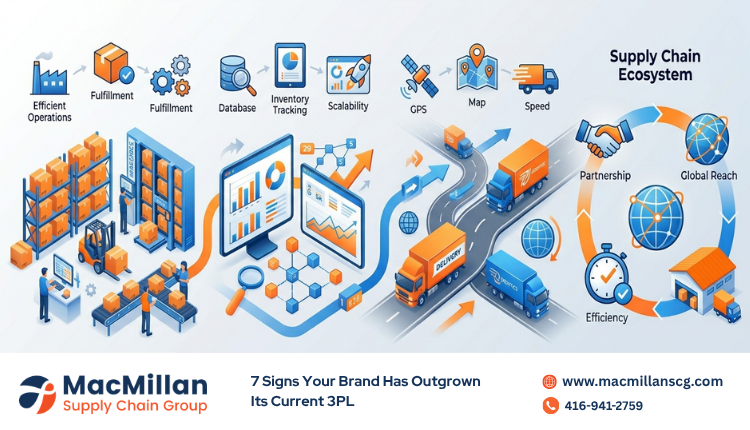
A Quick Summary and Overview Many brands do not realize they have outgrown their 3PL until service problems start affecting customer experience, retail relationships, and internal operations. What once worked at a smaller scale can become a growth bottleneck as SKU counts rise, channels expand, compliance requirements tighten, and promotions create higher operational pressure. The issue is not always that your current provider is bad. It is often that your business has evolved faster than their capabilities. If your team is dealing with delayed orders, weak visibility, compliance issues, slow communication, or trouble scaling during promotions, it may be time to reassess your logistics partner. MacMillan SCG is built for brands that need retail-ready warehousing, transportation coordination, real-time visibility, value-added services, and scalable support across channels. Introduction A 3PL partnership should make growth easier. It should reduce friction, improve visibility, and help your team move faster with more confidence. But when your provider can no longer keep pace, the symptoms show up everywhere. Inventory issues become more common. Customer complaints rise. Retail requirements feel harder to meet. Internal teams spend more time chasing updates, fixing exceptions, and working around the provider instead of focusing on growth. This is one of the most common inflection points for scaling brands. The challenge is that many businesses wait too long to act. They keep trying to patch operational problems that are actually signs of partner misalignment. If your 3PL was built for where your business used to be, not where it is going, you may already be paying for that gap in lost time, margin, and brand trust. Why Brands Outgrow Their 3PL Brands usually outgrow a 3PL for one of four reasons: order volume has increased product mix has become more complex sales channels have expanded customer and retailer expectations have risen A partner that handled simple DTC orders may struggle once you add retail compliance, subscription kits, launches, returns, and multi-channel fulfillment. Likewise, a provider that offered enough support at low volume may become too slow, too manual, or too opaque as your business scales. MacMillan’s site is positioned around solving exactly these scaling challenges through warehousing, transportation, ecommerce fulfillment, value-added services, integrations, and KPI-driven visibility. 7 Signs Your Brand Has Outgrown Its Current 3PL 1. You lack real-time visibility into inventory and orders If your team still waits for spreadsheets, manual updates, or delayed exception reports, your operation is already behind. As volume grows, visibility becomes essential for managing stock, customer service, launches, and replenishment. A modern 3PL should give you better control over: current inventory status order flow across channels shipment milestones exception tracking KPI reporting MacMillan emphasizes real-time visibility through its WMS-backed systems, client portal access, and performance tracking, giving brands more control over inventory and fulfillment decisions. 2. Your provider struggles during promotions or peak seasons A 3PL that performs adequately during regular weeks may break under pressure when volumes spike. This often shows up during seasonal campaigns, product launches, holiday peaks, or influencer-driven demand surges. Warning signs include: slower pick and pack times missed shipping cutoffs rising error rates delayed replenishment poor communication during high-volume periods MacMillan highlights support for promotional volumes, seasonal peaks, special campaigns, and launch readiness across its warehousing and value-added service pages. 3. They cannot support your growing channel mix Many brands start with one channel and later expand into retail, marketplaces, wholesale, or subscription models. That adds complexity fast. If your 3PL is built only for simple parcel fulfillment, you may run into issues with: retail routing and compliance multi-address order flows shared inventory allocation retailer-specific labeling B2B and DTC fulfillment from one pool MacMillan positions itself as a multi-channel logistics partner with support for retail, ecommerce, and value-added workflows under one roof. 4. Retail compliance problems are becoming more frequent Chargebacks, rejections, missed ASNs, incorrect labels, and poor pallet builds are not just execution mistakes. They are signs that your provider may not be equipped for retail precision. MacMillan’s warehousing capabilities specifically mention compliance with retailer requirements including pallet height, label requirements, carton orientation, and ASN accuracy, helping brands reduce chargebacks and delivery rejections. If your current 3PL is creating retail friction instead of reducing it, that is a major signal that the partnership is no longer the right fit. 5. They cannot handle customization, kitting, or special projects well As brands grow, operations become less standardized. You may need bundles, inserts, seasonal kits, subscription assemblies, gift packaging, relabeling, or retailer-specific configurations. If your provider treats these needs as disruptions instead of built-in capabilities, growth gets harder than it should be. MacMillan’s value-added services include kitting, inserts, promotional packaging, GS1 barcodes, bilingual packaging, relabeling, and display assembly, which are all useful for brands running more complex programs. 6. Communication feels reactive instead of proactive A strong 3PL should not wait for you to discover a problem. It should flag issues early, communicate clearly, and give your team confidence that operations are under control. You may have outgrown your current provider if: response times are inconsistent issue ownership is unclear exceptions are communicated late reporting feels incomplete your team is chasing answers constantly MacMillan’s positioning emphasizes transparency, honest reporting, proactive updates, and partnership-oriented service, which is exactly what growth-stage brands need from a logistics provider. 7. Their performance no longer matches your brand standards At a certain point, the question becomes simple: does this provider still support the brand experience and operating discipline your business needs? That includes: order accuracy shipping accuracy on-time performance inventory accuracy customer experience consistency MacMillan’s KPI positioning includes 99.56% inventory accuracy, 99.5% perfect order rate, 99% on-time and in-full shipments, and 99.9% shipping accuracy. Those are the kinds of measurable benchmarks brands should look for when evaluating whether a provider can support the next stage of growth. What Happens When You Stay Too Long Many brands delay switching because changing 3PLs feels disruptive. But staying with the wrong provider often costs more over time. The hidden costs usually include: more internal firefighting higher support burden
How to Scale Your Operations Without Scaling Your Payroll

Scale Your Operations Without Scaling Your Payroll Expanding your team isn’t always necessary to grow your business. Astute Canadian business owners of today are figuring out how to grow their companies while maintaining stable payroll expenses. You can scale your operations without scaling your payroll by utilizing automation tools, strategic outsourcing, and flexible workforce models. This manual examines tried-and-true methods that enable companies in the Greater Toronto Area (GTA) and throughout Canada to grow sustainably without having to worry about rising payroll costs. These techniques, which range from lean methodologies to no-code automation, are applicable to a variety of industries and can help you get more out of your current workforce. Introduction Is your company prepared for expansion, but your budget isn’t prepared for a hiring frenzy? You’re not by yourself. Scaling operations without increasing payroll is a challenge for many Canadian business owners. The good news? It is completely feasible. “More business = more employees” is an antiquated growth model. The most prosperous businesses of today are figuring out more intelligent ways to grow. The fundamentals are the same whether you’re a Mississauga manufacturer, a Toronto e-commerce company, or a Brampton service provider: make use of technology, streamline procedures, and design adaptable systems that can expand with you. Numerous companies throughout the GTA have benefited from our assistance at MacMillan Supply Chain Group in putting these strategies into practice. We’ll go over doable strategies in this guide that will help you grow your capacity, serve more clients, and increase sales without having to hire a lot more staff. Let’s look at how to scale your operations without scaling your payroll. Use Automation to Scale Your Operations Without Scaling Your Payroll Automation of business processes is no longer limited to big businesses. These days, businesses of all sizes can automate tedious tasks and free up their workforce for higher-value work by using reasonably priced tools. Although it sounds complicated, robotic process automation (RPA) is just software that manages repetitive tasks. Imagine them as digital employees who never take breaks, sleep, or make mistakes. Without human assistance, these “bots” can update inventory records, process orders, send confirmation emails, and enter data. Modern automation is great because it doesn’t require you to be an expert in technology to use. Anyone on your team can create robust workflows without knowing a single line of code thanks to no-code automation tools like Make.com, Airtable, and Zapier. For instance, you can automatically: Create and distribute reports to stakeholders; Send customized follow-up emails to customers; Transfer data between your accounting software and shipping system; Adjust stock levels in various sales channels. We worked with a retailer in Toronto who automated their order processing system, resulting in an 85% reduction in manual data entry. Without adding more employees, they were able to triple their order volume during busy times. Their current staff just redirected their attention to strategic projects and customer service, leaving the repetitive tasks to automation. Remind yourself that automation is about enabling people to perform more meaningful work while technology takes care of the repetitive tasks, not about replacing them. Automation is one of the smartest ways to scale your operations without scaling your payroll. Strategic Outsourcing to Grow Your Business Without Growing Payroll A tried-and-true strategy for expanding small businesses in Canada is cost-cutting outsourcing. You can access capacity and expertise by partnering with specialized service providers without having to pay full-time employees. It’s one of the most efficient ways to scale your operations without scaling your payroll. Finding the right functions to outsource is crucial. Usually, these consist of: Fulfillment and warehouse operations IT management and support Customer service, especially after-hours assistance Expert marketing services Bookkeeping and accounting Logistics and transportation Virtual assistant services have also become increasingly popular for handling administrative tasks. On a flexible, as-needed basis, a virtual assistant can take care of social media, prepare documents, answer emails, and manage your calendar. MacMillan Supply Chain Group was hired to handle the warehouse operations for one of our clients, a developing manufacturing company in the Greater Toronto Area. This enabled them to concentrate their internal team on product development and quality control while increasing their production capacity by 40%. The outcome? Improved quality, higher output, and stable payroll expenses. Seek out partners who can easily integrate with your operations and have a thorough understanding of your industry when thinking about outsourcing. The ideal partner turns into more than just a supplier; they become an extension of your team. Build an Agile Workforce to Scale Operations on a Budget Developing flexibility in your staffing strategy is the goal of agile workforce management. Instead of employing full-time workers for every position, think about using a core-flex staffing model that can be adjusted to meet your company’s needs. This strategy entails keeping a core group of full-time workers who manage consistent, necessary tasks. Then, add adaptable personnel to this team for special projects or during busy times. These adaptable resources could consist of: Temporary workers Contract specialists Part-time workers Freelancers Gig workers Cross-training employees is another powerful strategy. You can change resources as needed without hiring more people when team members are capable of performing multiple tasks. A warehouse worker who can also answer calls from customers, for instance, offers a great deal of flexibility during peak hours. This model was applied by a distribution company we collaborate with in Mississauga, and the results were remarkable. They keep a small staff of 15 full-time employees during regular business operations. They use temporary workers to scale up to 35 people during the holiday rush. By using this strategy, they were able to manage their permanent payroll while managing a 300% increase in volume during peak season. Developing transparent procedures and training materials that facilitate the rapid onboarding of adaptable team members is essential to success. When properly trained, these workers can be productive in a matter of days as opposed to weeks. This approach is a practical way to scale your operations without
Canada Post Workers Strike Notice Impact on Canadian Business
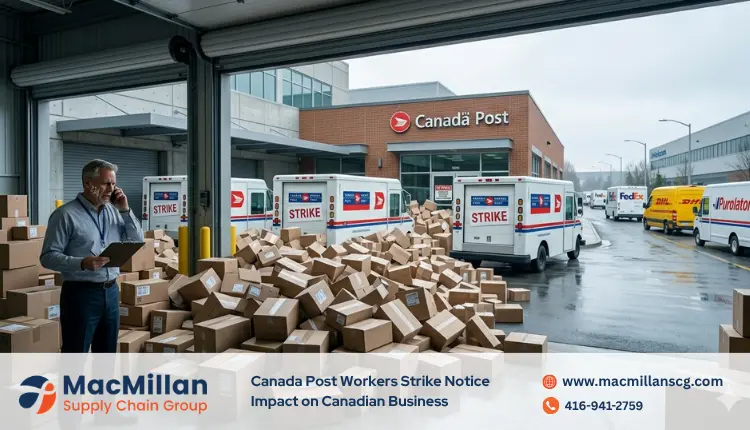
Canada Post Workers Strike: What It Means for Your Business A Quick Summary and Overview The Canada Post workers strike has threatened to stop mail and parcel delivery across the country by issuing a strike notice for May 23, 2025. Unresolved disagreements over pay, job security, and Canada Post’s financial viability are the root cause of this strike. Businesses need to be ready for major shipping disruptions, as Canada Post has lost $3 billion since 2018 and has needed a $1 billion government bailout. The reasons behind the strike, its possible effects, and how companies can continue to operate despite the postal service outage with the support of logistics partners like MacMillan Supply Chain Group are all covered in this article. Introduction Understanding the Canada Post Workers Strike The CUPW declared on May 19, 2025, that a nationwide strike would start on May 23 at midnight local time. Following a 32-day strike in late 2024, this is the second significant labor disruption in six months. This announcement causes a great deal of uncertainty for companies that depend on Canada Post to ship goods, send bills, or collect payments. Wage increases to offset inflation, opposition to increased use of temporary workers, resistance to pension reforms, and disputes over weekend delivery models are some of the main issues at the heart of the strike. The Industrial Inquiry Commission (IIC) recently deemed the Crown corporation “effectively insolvent,” indicating that Canada Post is facing significant financial difficulties. You must be aware of what is going on and know how to get ready as a manager or owner of a business. To keep your supply chain running during this postal service outage, let’s dissect the situation, look at how it might impact your business, and consider potential solutions. Canada Post Workers Strike’s Fundamental Causes Financial Crisis and Modernization Initiatives The financial difficulties faced by Canada Post did not occur suddenly. Due to a 63% decline in mail volumes from their peak in 2018, the Crown corporation has lost about $3 billion. The expenses of sustaining nationwide service have surpassed revenues, even though e-commerce has led to an increase in parcel delivery. The government bailed out Canada Post with $1 billion at the beginning of 2025. The Industrial Inquiry Commission issued a report shortly after that included suggestions for resolving the financial insolvency: Close underperforming rural post offices and replace daily door-to-door mail delivery with community mailboxes. To meet the demand from e-commerce, introduce part-time weekend parcel couriers. The management of Canada Post embraced these suggestions as a “roadmap for modernization.” However, CUPW rejected the report, arguing it prioritizes cost-cutting over worker rights and public service ideals. “These changes would fundamentally alter Canada’s postal service while creating more precarious employment,” said the CUPW president in a recent statement. “We cannot accept a plan that undermines job security and service quality for Canadians.” The current Canada Post workers strike notice is the result of a perfect storm created by the conflict between worker concerns and modernization requirements. Businesses can better understand why a speedy resolution might be challenging by comprehending these underlying causes. Canada Post workers strikeImportant Bargaining Points in the Canada Post Workers Strike Models of Weekend Delivery and Wage Conflicts A number of significant issues that directly impact postal workers and the future of Canada Post services have caused the collective bargaining process to stall. The weekend delivery model represents one of the most contentious points. With e-commerce driving demand for seven-day delivery, Canada Post wants to introduce flexible part-time workers for weekend shifts. CUPW strongly opposes this plan, insisting on full-time positions with benefits to prevent what they call “gig economy precarity.” Another significant point of contention is wage demands versus austerity measures: To combat inflation, CUPW wants wage increases of 5% per year; management only offers 2% raises, citing budgetary constraints; the difference amounts to millions of dollars in extra expenses for a system that is already losing money. The sustainability of pensions is still a third important concern. Canada Post wants to switch from defined-benefit pensions, which provide a fixed retirement income, to hybrid plans, which increase flexibility. Employees worry about less retirement security, while management cites growing pension obligations as support for changes. These disputes draw attention to the core problem: how to update a traditional mail service for the digital era while safeguarding the interests of employees. These disputes have a direct impact on shipping costs and service reliability for companies that depend on mail delivery. Effect on Businesses in Canada Disturbances in the Supply Chain and Shipping Delays Businesses across Canada will face immediate difficulties if the May 23 Canada Post workers strike goes ahead. Small and medium-sized businesses that depend on reasonably priced postal shipping options will be especially at risk. The biggest disruption might be felt by e-commerce companies. Online retailers reported during the last strike in late 2024: Order cancellations are up 15–25% Twofold increase in customer service complaints 30-45% increase in shipping costs when using private carriers Businesses in rural areas face even more difficulties. Canada Post is the only reasonably priced shipping choice in a lot of isolated communities. Other carriers may not offer service in these areas or may charge exorbitant prices that make shipping financially unfeasible. The timing couldn’t be worse for companies that accept or send payments via mail. The final week of May is usually when month-end invoices and payments take place, which could cause cash flow issues for businesses that haven’t switched to electronic payments. If manufacturing and supply chain companies receive parts or materials via Canada Post, they may also face inventory issues. Systems for just-in-time inventory are especially susceptible to shipping delays, which could result in production halts or slowdowns. Businesses can create backup plans before the strike starts by being aware of these possible effects. Even in the midst of this postal service uncertainty, you can minimize operational disruptions and preserve customer satisfaction by being well-prepared. Canada Post workers strikeCommon Problems with the Topics Misconceptions
How to Reduce Retail Chargebacks and Delivery Rejections in 2026
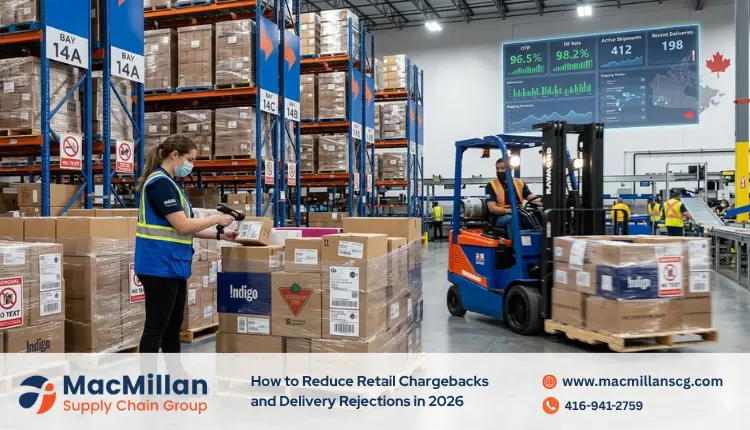
A Quick Summary and Overview Retail chargebacks are not just annoying deductions on an invoice. They are a direct signal that something in your supply chain is breaking down before your product reaches the shelf. For FMCG, wellness, beauty, pet care, and home care brands, the most common causes are preventable: incorrect labeling, missed ASNs, non-compliant pallet builds, incomplete shipments, and missed delivery windows. Retailers are tightening performance expectations, and brands that miss the mark risk more than penalties. They risk weaker retailer relationships, poor supplier scorecards, and lost growth opportunities. MacMillan Supply Chain Group helps brands reduce that risk through retail-ready warehousing, compliant labeling, real-time visibility, and transportation execution built for high-precision consumer goods operations across Canada. Introduction One mislabeled pallet can trigger a chargeback. One missed ASN can create confusion at the receiving dock. One late or early shipment can result in a rejected delivery and a damaged retailer relationship. That is why chargeback prevention is no longer a back-office issue. It is a growth issue. Retailers and wholesalers continue to hold suppliers to strict fulfillment standards. When brands miss retailer routing guide requirements, send incomplete orders, or fail to hit delivery expectations, the costs add up quickly through penalties, delays, rework, and lost trust. Competitor content that is performing well in 2025 and 2026 is speaking directly to this reality with practical, operational guidance, not generic logistics commentary. For brands selling into major retail channels, the goal is not simply shipping product. The goal is shipping product in a way that is accurate, compliant, on time, and easy for retailers to receive. That is where MacMillan SCG creates value. The Retail Chargeback Problem Retail chargebacks are financial penalties retailers impose when orders fail to meet operational requirements. Common triggers include incorrect labeling, missed ASNs, incomplete shipments, and late or early deliveries. Poor performance can also affect retailer scorecards, preferred supplier status, and future order volume. In practice, most chargebacks do not start at the retail dock. They start earlier in the process: inventory is received incorrectly labels do not match retailer requirements pallets are not built to spec ASN data is late or inaccurate orders leave too early, too late, or incomplete teams lack visibility to catch issues before dispatch When OTIF and fill rates are strong, brands spend less on expediting and face fewer chargebacks. Shopify’s current B2B KPI guidance highlights OTIF and fill rate as two of the clearest indicators of supply chain health, noting that stronger performance reduces penalties and helps retain customers. Why This Matters More in 2026 Retail operations are becoming less forgiving, not more. Brands are expected to support omnichannel demand, tighter replenishment cycles, and retailer-specific compliance standards all at once. At the same time, more content from leading ecommerce and fulfillment brands is emphasizing visibility, cross-functional coordination, and logistics strategy as competitive differentiators in 2026. That means a reactive approach is expensive. If your team only finds out about a compliance issue after a retailer dispute, you are already paying for it in some combination of margin loss, internal rework, delayed sell-through, and strained relationships. The Most Common Reasons Retailers Reject Deliveries 1. Labeling errors Retailers often require strict barcode, carton, pallet, and GS1-compliant labeling standards. A small labeling mistake can delay receiving or trigger a penalty. Metro Supply Chain’s B2B fulfillment guidance highlights labeling and routing guide compliance as a major challenge for brands supplying retail channels. 2. Missed or inaccurate ASNs An ASN is not just a paperwork step. It prepares the retailer for inbound receipt. When ASN data is wrong or delayed, receiving teams lose trust in the shipment before it is even unloaded. Competitor guidance consistently points to missed ASNs as a chargeback trigger. 3. Pallet configuration issues Wrong pallet height, carton orientation, packaging configuration, or load stability can cause rejections at the dock. These are execution failures, not transportation failures. 4. Late or early delivery Retail appointments matter. Missing the delivery window can create downstream receiving issues and result in penalties or refusal. OTIF remains one of the core measures retailers and brands use to judge fulfillment performance. 5. Incomplete shipments Even when a truck arrives on time, missing units can still damage retailer confidence and affect fill rate performance. High fill rates reduce friction, penalties, and service failures. How to Reduce Chargebacks Before They Happen Build compliance into inbound, not just outbound Chargeback prevention starts when goods enter the warehouse. Inventory verification, exception logging, and ASN or PO matching during receiving help stop downstream errors before they reach a retailer. Evolution Fulfillment’s Canadian warehouse guidance explicitly notes that early-step receiving accuracy helps prevent chargebacks and inventory mismatches. Standardize retailer-specific SOPs Every retailer has its own routing guides, packaging rules, scheduling requirements, and compliance details. Your warehouse and transportation workflows need retailer-specific execution, not one generic process for all orders. Prioritize OTIF and fill rate as executive KPIs If your team tracks only shipped orders, you are missing the metrics retailers care about. OTIF and fill rate expose the gap between “we shipped it” and “the retailer received it exactly as expected.” Shopify’s current guidance suggests mature companies often aim for 95%–98% OTIF and at least 95% fill rate on core stocked items. Improve inventory visibility Weak visibility causes mispicks, stockouts, rushed substitutions, and last-minute errors. Real-time inventory tracking and order visibility help teams catch problems before a shipment is staged. Align warehousing and transportation Compliance does not end at pick and pack. It continues through appointment scheduling, route planning, dispatch accuracy, milestone updates, and proof of delivery. Retail-ready fulfillment needs tight coordination between warehouse execution and final-mile or linehaul performance. How MacMillan SCG Helps Brands Stay Retail-Ready MacMillan SCG is positioned around exactly the capabilities brands need to reduce chargebacks and delivery rejections: retail-compliant warehousing, transportation built for FMCG velocity, real-time visibility, and value-added services that support promotional readiness and channel-specific execution. According to MacMillan’s site, the company supports warehousing and distribution, transportation and logistics, ecommerce fulfillment, and value-added services under one roof,
Supply Chain Disruption 2025 – Red Sea, Panama & Tariff Risks
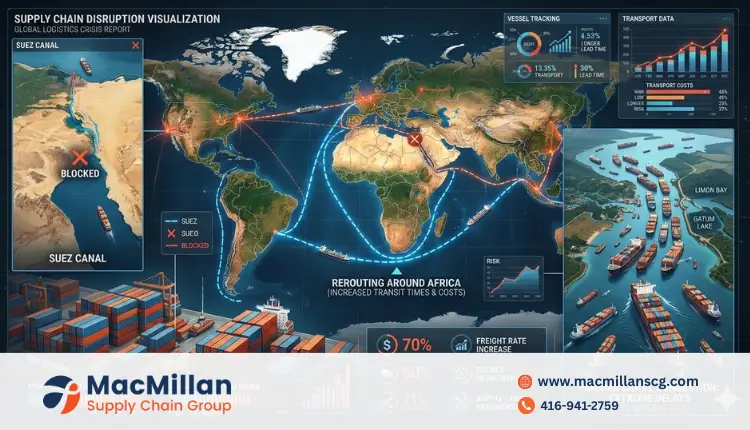
What You Need to Know About Supply Chain Disruption 2025 Global supply chains will face previously unheard-of difficulties due to supply chain disruption 2025. Ships have had to reroute around Africa due to the Red Sea crisis, which has increased shipping times by weeks and cost millions of dollars. Water shortages and maintenance problems are the main causes of the ongoing congestion in the Panama Canal. In the meantime, trade relations are changing as a result of post-election tariffs, especially between the US and China. Retail and the automotive industries are both feeling the effects of these disruptions. This playbook provides useful tactics for companies to overcome these obstacles, such as developing backup routing plans, deploying AI-driven forecasting, and nearshoring to Canada. Fast-adapting businesses will have a competitive edge in the face of supply chain disruption 2025. Introduction Why Supply Chain Resilience Matters in the Era of Supply Chain Disruption 2025 In 2025, a perfect storm is threatening the global supply chain. The Panama Canal congestion, the Red Sea shipping crisis, and new tariffs after recent elections have all combined to create previously unheard-of difficulties for businesses around the world. These are not merely short-term disruptions; rather, they signify significant changes in the global flow of goods. These disruptions present opportunities as well as challenges for Canadian companies. Everyone is impacted by increased costs and longer shipping times, but businesses that adjust swiftly can benefit greatly. The question is how you will handle these geopolitical challenges, not if they will have an impact on your supply chain. Each of these significant supply chain disruptions in 2025 will be covered in this playbook, along with an analysis of their effects on various industries and useful tactics to help your company not only survive but flourish. Maintaining competitiveness in today’s volatile global market requires an understanding of these changes, regardless of your industry—manufacturing, retail, or logistics. Red Sea Crisis and Its Role in Supply Chain Disruption 2025 In the context of supply chain disruption 2025, the Red Sea has changed from being an essential shipping route to a high-risk area. This vital maritime route has become more hazardous due to ongoing conflicts, which has forced shipping companies to make tough choices about how to transport goods between Asia and Europe. The Disruption Scale Nearly 80% of container ships have been forced to completely avoid the Suez Canal due to the Red Sea shipping crisis. Ships are instead choosing to take the longer route around the Cape of Good Hope in Africa, which adds 7–10 days to transit times and costs about $1 million more per voyage. An estimated 15% less shipping capacity has been available worldwide as a result of this rerouting, which has had an impact on supply chains. Emergency surcharges of $500 to $1,500 per container have been imposed by major carriers such as Maersk and ZIM. Raw materials to final goods are all impacted by these rising costs, which are unavoidably passed down the supply chain. Industry-Specific Impacts The automotive industry has been hit particularly hard by the Red Sea shipping crisis. Just-in-time manufacturing systems rely on predictable delivery schedules, and delays of even a few days can halt production lines. Similar issues arise for electronics manufacturers when parts from Asia take longer to arrive at assembly facilities in North America. This means that Canadian importers should budget for increased shipping expenses and longer lead times. Businesses that used to order inventory six weeks in advance now have to plan for eight to ten weeks, which causes smaller businesses to face more cash flow issues and ties up more capital in goods in transit. While the Red Sea situation dominates headlines, the Panama Canal is another major factor contributing to supply chain disruption 2025. Panama Canal Challenges: Water Shortages and Geopolitical Tensions In 2025, the Panama Canal will have its own set of issues, even as the Red Sea crisis makes headlines. The dependability of this vital trade route between the Atlantic and Pacific Oceans is in jeopardy due to political and natural issues. Environmental and Operational Restrictions The Panama Canal’s operations have been significantly impacted by climate change. Authorities have been forced to cut the number of daily transits from 36 to just 18 due to water shortages, causing a bottleneck that impacts shipping schedules worldwide. Ships now have to wait up to three weeks, as opposed to the usual three to five days in the past. With premium slots going to the highest bidders, the Panama Canal Authority has instituted a reservation system that ranks vessels according to cargo type and destination. For non-reserved vessels, this auction system has increased transit costs by 200–300%, putting further financial strain on shipping companies and their clients. Strategic Consequences For Canadian companies that depend on Asian imports reaching East Coast ports, the Panama Canal congestion is especially important. Although the volume of traffic using alternative routes through West Coast ports such as Vancouver and Prince Rupert has increased, the amount of traffic that can be diverted is limited by rail and truck capacity limitations. This disruption is accelerating the trend toward nearshoring, with many companies reconsidering their dependence on trans-Pacific supply chains. As businesses look for alternatives to Asian production, Mexican manufacturing has seen a 22% increase in capacity utilization. This change is also helping Canadian manufacturers, especially in industries like electronics assembly and automotive components where being close to US markets has major benefits. Election Tariffs: Navigating the New Trade Landscape With new tariffs reshaping supply chain economics in 2025, the US election of 2024 has brought about significant changes to the trade landscape. Businesses are being compelled by these policy changes to reevaluate their supply chain setups and sourcing tactics. The New Tariff Reality Under Trump’s 2025 tariffs, all imports will now be subject to 10% general duties, with targeted increases of up to 60% on Chinese goods. The cost equation for many products has been significantly changed by these actions, especially in the consumer goods, textile,
Electronics Supply Chain: Reshoring & 3PL in Canada
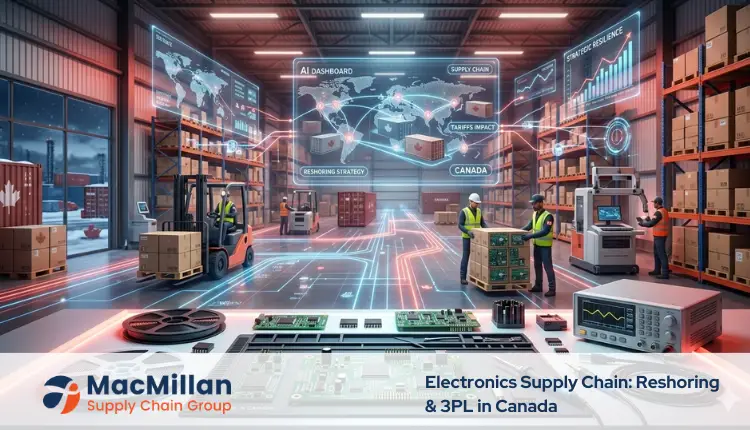
Growing tariffs, geopolitical unrest, and changing manufacturing environments present the electronics supply chain with previously unheard-of difficulties. This thorough guide examines the ways in which digital transformation, tariff mitigation, and strategic reshoring can help Canadian companies manage these challenges. Specialized 3PL solutions are provided by MacMillan Supply Chain Group to assist businesses in strengthening their supply chains, cutting expenses, and increasing resilience. Learn useful strategies to prosper in the face of trade disruptions and set up your company for long-term success in Canada’s developing electronics industry, from utilizing foreign trade zones to putting blockchain traceability into place. This guide will help Canadian companies future-proof their electronics supply chain. The Changing Landscape of Electronics Manufacturing The electronics manufacturing industry is changing dramatically. Major economy-to-economy tariffs have risen to all-time highs, with some electronic components subject to 245% duties. Global supply chains have been rocked by this, and businesses are now being forced to reconsider where and how they manufacture their products. These issues offer opportunities as well as challenges to Canadian companies. Effectively managing tariffs has emerged as a crucial business ability, and reshoring in Canada presents a viable substitute for manufacturing that is done abroad. More flexibility, transparency, and resilience are now more important than ever in the electronic supply chain. Numerous Canadian electronics manufacturers have benefited from our assistance at MacMillan Supply Chain Group in adjusting to these shifting circumstances. In today’s intricate trading environment, our specialized 3PL services offer the infrastructure and know-how required to overcome supply chain interruptions and preserve competitive advantage. Understanding Tariff Impacts on Canadian Electronics For Canadian electronics companies, tariffs have become a major headache. Canadian companies are frequently caught in the crossfire of trade disputes between the United States and China. Before a Chinese-made component reaches its final destination in North America, it may be subject to several tariffs, which would significantly raise supply chain costs. Think about the effects of tariffs on semiconductors, which are the fundamental components of contemporary electronics. Everything from smartphones to medical devices is impacted when these tiny chips are subjected to 50% or more of the workload. Higher production costs, reduced margins, and challenging pricing decisions are what this means for Canadian manufacturers. Strategies for mitigating tariffs are now crucial business tools. Smart businesses are looking into possibilities such as: Strategic inventory control (purchasing prior to the imposition of tariffs) Replacement of components with non-tariffed substitutes Moving assembly to areas that comply with the USMCA Utilizing the benefits of foreign trade zones to postpone duty payments Through specialized logistics planning, MacMillan assists Canadian companies in putting these strategies into practice. Our customs compliance specialists examine tariff codes, spot areas for improvement, and create customized solutions that reduce duty exposure while preserving supply chain effectiveness. Reshoring: Relocating Electronics Production to Canada As companies reevaluate their global manufacturing strategies, the idea of reshoring in Canada has gained a lot of traction. While tariffs reduced the economic appeal of offshore production, the pandemic revealed weaknesses in extended supply chains. Many electronics manufacturers are moving their manufacturing closer to home these days. This change has been largely attributed to Canadian manufacturing incentives. Companies that invest in domestic production can receive grants, tax breaks, and other forms of assistance from federal and provincial programs. By creating more robust supply networks, these incentives aid in offsetting the higher labor costs connected to North American manufacturing. Reshoring has advantages beyond just the bottom line: Shorter lead times and lower transportation expenses Improved quality assurance and protection of intellectual property Easier adherence to North American trade laws Reduced shipping distances result in a smaller carbon footprint Increased responsiveness and visibility in the supply chain At MacMillan, we provide specialized warehousing, distribution, and logistics services to support reshoring initiatives. Our well-positioned facilities across Canada give businesses the framework they need to successfully execute reshoring plans, and our cross-border knowledge guarantees seamless integration with American markets. Digital Transformation in the Canadian Electronics Supply Chain Canadian businesses in the electronics supply chain are turning to digital platforms the way electronic supply chains function is being revolutionized by technology. Businesses can now confidently navigate complex trade environments thanks to AI-driven supply chain solutions, which offer previously unheard-of visibility and control. Among the most potent uses of this technology are BOM optimization tools. Before production starts, these systems find cost-saving options by comparing bills of materials to tariff databases. Manufacturers can incorporate tariff mitigation into their product designs from the outset by choosing components according to origin, classification, and duty exposure. Another significant benefit is blockchain traceability. Immutable records of a component’s movement through the supply chain are produced by this technology, offering: Verifiable proof of origin for customs declarations Defense against the supply of fake parts Automated documentation for regulatory compliance Visibility in real time over intricate multi-tier networks MacMillan helps customers use technology to gain a competitive edge by incorporating these digital capabilities into our logistics services. Our systems offer real-time data flows that facilitate improved decision-making across the supply chain by integrating seamlessly with manufacturer ERPs. Regional Alternatives and Trade Agreements Pure domestic production isn’t always possible, even though reshoring has many advantages. For this reason, a lot of Canadian electronics companies are looking into regional options that strike a balance between supply chain resilience and cost considerations. Opportunities for nearshoring to Mexico have garnered a lot of interest. Mexico provides competitive labor rates and duty-free access to the U.S. and Canadian markets as a member of the USMCA trade zone. Mexico is now the production center for many electronics manufacturers’ “China+1” strategies in the Western Hemisphere. Important frameworks for cross-border trade are provided by the USMCA agreement itself. Electronics manufacturers can avoid tariffs and preserve effective production networks by adhering to regional content requirements. For competitive positioning, it is essential to comprehend and take advantage of these provisions. Southeast Asian countries for large-scale manufacturing, such as Vietnam and Malaysia Eastern European locations for access to European markets India’s expanding electronics industry, bolstered by the PLI
Trump’s 50% Steel Tariffs: Supply Chain Disruption Explained

Former U.S. President Donald Trump announced Trump’s 50% steel tariffs, doubling the previous 25% rate — a move that has rocked North American supply chains. Numerous industries are deeply concerned about this sharp rise, which is justified by Section 232 measures as necessary for national security. There are currently significant obstacles facing Canada’s steel industry, which exports steel products worth billions of dollars to the United States each year. These tariffs cause a complicated web of supply chain issues for companies that operate across the Canada-U.S. border. Consumer prices could rise and economic growth could be slowed by higher material costs, possible shortages, and logistical issues. Strategic supply chain management is more important than ever as Canadian manufacturers and their American consumers scramble to adapt. Understanding Trump’s 50% Steel Tariffs Trade tensions between the US and its trading partners, including Canada, have significantly increased as a result of Trump’s 50% steel tariffs. The Trade Expansion Act’s Section 232 measures, which give the US the authority to defend domestic industries considered essential to national security, are the basis for these tariffs. International partners and trade experts have criticized the national security rationale. Many contend that this line of thinking expands the meaning of security concerns to encompass economic protectionism. By raising the price of imported steel considerably, the policy seeks to support domestic steel producers in the United States. These tariffs present immediate difficulties for Canadian companies: Higher border crossing costs for steel-based materials Possible supply disruptions as trade patterns change Price and availability uncertainty for manufacturing inputs Difficult customs procedures and extra paperwork Businesses have limited time to modify their supply chains or look for alternate sourcing options due to the implementation timeline. The economy as a whole is impacted by this abrupt change, which forces businesses to either absorb increased costs or pass them on to customers. How Canadian Steel Industry and Manufacturers Are Affected The steel sector in Canada is at the forefront of this trade conflict. Canadian steel producers, a significant supplier to American markets, could suffer catastrophic repercussions. According to industry analysts, if these tariffs are maintained over time, domestic steel producers may lose billions of dollars in revenue. A double challenge confronts Canadian manufacturers who depend on steel inputs, in addition to the steel producers themselves. As Canadian producers adjust to lost U.S. market share, domestic steel buyers may see price increases. In the meantime, possible retaliatory tariffs increase the costs for manufacturers who import specialty steel from the United States. Among the issues facing the manufacturing sector are: Reduced ability to compete with international competitors Pressure to move production to avoid tariffs Difficulty keeping customer prices stable Difficulties with long-term planning and investment Because they frequently lack the resources to swiftly change their supply chains or absorb large cost increases, small and medium-sized manufacturers face especially difficult obstacles. Some businesses are already delaying plans for expansion and reevaluating their cross-border business strategies, according to industry associations. How Trump’s 50% Steel Tariffs Are Driving Up Construction and Auto Costs Trump’s 50% steel tariffs are putting immediate pressure on the construction sector. Steel accounts for a sizeable portion of material costs in both residential and commercial construction projects. According to industry experts, steel-intensive projects may see construction costs rise by 15% to 20%, making Canada’s housing affordability crisis worse. For Canada’s construction industry, which is already struck by high material costs and a lack of workers, the timing couldn’t be worse. Builders report: Delays in projects while budgets and material sourcing are reevaluated Contracts should be renegotiated to take price volatility into account Accurate quotes for upcoming projects are difficult to come by Project viability is a concern as costs increase In a similar vein, the automotive industry has particular difficulties. Vehicle manufacturing depends on components that cross borders several times due to integrated supply chains that span both nations. This carefully calibrated system could be upset by the tariffs, which could result in: Consumers paying more for cars Assembly plant production slowdowns Job losses in auto manufacturing regions A quicker transition to sourcing from overseas markets Tinplate Packaging and Consumer Goods Price Increases Tinplate packaging is one frequently disregarded area that is experiencing major disruption. This specialty steel product is necessary for many consumer goods, including beverage containers and food canning. Packaging manufacturers must deal with significant cost increases as a result of the tariffs, which will eventually affect consumers. Within months of going into effect, the 50% tariff could raise the cost of canned food by 8–12%, according to the Can Manufacturers Institute. Lower-income households that depend on reasonably priced canned goods would be disproportionately affected by this price inflation. In addition to food, consumers can anticipate price increases in a variety of categories: Steel-based appliances and household items Costs of auto parts and repairs Building supplies and home remodeling items Office supplies and furnishings At a time when many households are already experiencing financial strain, these price increases add to concerns about consumer price inflation in general. Economists caution that the tariffs might act as a regressive tax, burdening the most vulnerable. Challenges Facing Businesses Under the New Tariff Regime Businesses on both sides of the border face many operational difficulties as a result of Trump’s 50% steel tariffs. These issues go beyond straightforward price hikes to include serious supply chain interruptions. Planning becomes nearly impossible due to the uncertainty surrounding the policy’s implementation. Companies struggle to decide whether to pass costs on to customers, seek alternative suppliers, or lock in current prices — all while facing delayed investment decisions and a wait-and-see mentality. Beyond steel, the global supply chain faces ripple effects as manufacturers shift their sourcing strategies, causing potential shortages of other materials and components. Legal complications further muddy the waters. With disputes progressing through the WTO and domestic courts, businesses must prepare for outcomes ranging from tariff reductions to retaliatory measures. Fourth, simple substitution isn’t always feasible due to the specialized nature of many steel products. Regardless of cost,