


How Does a Supply Chain Firm Plan for High Demand?
With the right approach, supply chain planning can lower costs…


With the right approach, supply chain planning can lower costs…
Time-critical shipments can be defined in many ways. Critical shipping…

A shopper asks an AI assistant to find a fragrance-free…

As an online store business owner, offering the best customer…
Canada is undergoing a major trade transition as businesses reduce overreliance on the U.S. market and expand into Europe and Southeast Asia. The shift has been accelerated by tariff tensions, changing policy conditions, and the need for more resilient supply chains. As exporters explore new markets, sectors like clean tech, critical minerals, and agri-food are finding fresh demand. For Canadian businesses, this is not just a trade story. It is a logistics, warehousing, and distribution story too. MacMillan Supply Chain Group helps support that transition through warehousing, transportation, visibility, and export-ready supply chain execution.
For decades, Canada’s economy has been deeply tied to the United States. That relationship created scale and convenience, but it also created concentration risk. When tariffs, policy shifts, or trade disputes disrupt one dominant market, Canadian exporters feel the impact quickly. Your article frames this as a move away from a U.S.-centric export model toward a more diversified one, with more attention on Europe and ASEAN markets.
That shift matters because diversification is no longer just a growth strategy. It is a resilience strategy.
Recent tariff pressure has pushed Canadian exporters to rethink where and how they sell. Your draft explains that this change has affected multiple sectors and accelerated the need for diversification. It also positions this shift as a practical response to unpredictability in a historically dominant market.
For many businesses, this has changed the conversation from “Should we diversify?” to “How fast can we build a more balanced export strategy?”
As U.S. trade has become more uncertain, Canadian exporters have looked to other regions with strong results. Your article highlights the European Union and ASEAN countries as two of the most important growth areas, supported by trade agreements and rising demand across key sectors.
The EU has become a key destination for Canadian exporters looking for market stability and tariff advantages. CETA has played a major role by reducing trade barriers and opening more opportunities for Canadian businesses. Your article highlights gains in exports such as gold, crude oil, pharmaceutical ingredients, and critical minerals.
ASEAN markets are also becoming increasingly important. Your draft points to Thailand and other Southeast Asian markets as rising opportunities for agri-food, clean tech, and export diversification overall.
Together, these regions show that Canada’s export future is becoming more geographically balanced.
Clean tech appears to be one of the clearest beneficiaries of Canada’s trade diversification. Your article connects European climate policy and global demand for renewable and sustainable solutions with stronger export opportunities for Canadian clean tech businesses.
Critical minerals have become strategically important as global battery, electronics, and energy supply chains evolve. Your draft positions Canadian lithium and related mineral exports as especially relevant to Europe’s efforts to secure reliable supply outside traditional sources.
The automotive sector has faced more complicated adaptation. Your article shows that some manufacturers are shifting production decisions and market strategies to deal with tariff exposure and changing trade economics.
Agriculture is another sector that has had to pivot quickly. Your article highlights how exporters have redirected products into new markets when traditional routes became less stable.
Your article rightly points out that market diversification is not only about finding buyers. It also depends on whether Canada’s infrastructure can support the change.
Canadian exporters need efficient port operations to support growing trade with Europe and Asia. Your draft identifies port bottlenecks as a real constraint on long-term diversification.
As production grows to meet export demand, energy availability and industrial capacity also become major factors. Your article notes that this is especially relevant in export-heavy provinces.
Modern export execution depends on visibility, documentation, customs coordination, and digital systems. Your article makes the case that digital trade tools are now essential, especially for small and mid-sized exporters entering unfamiliar markets.
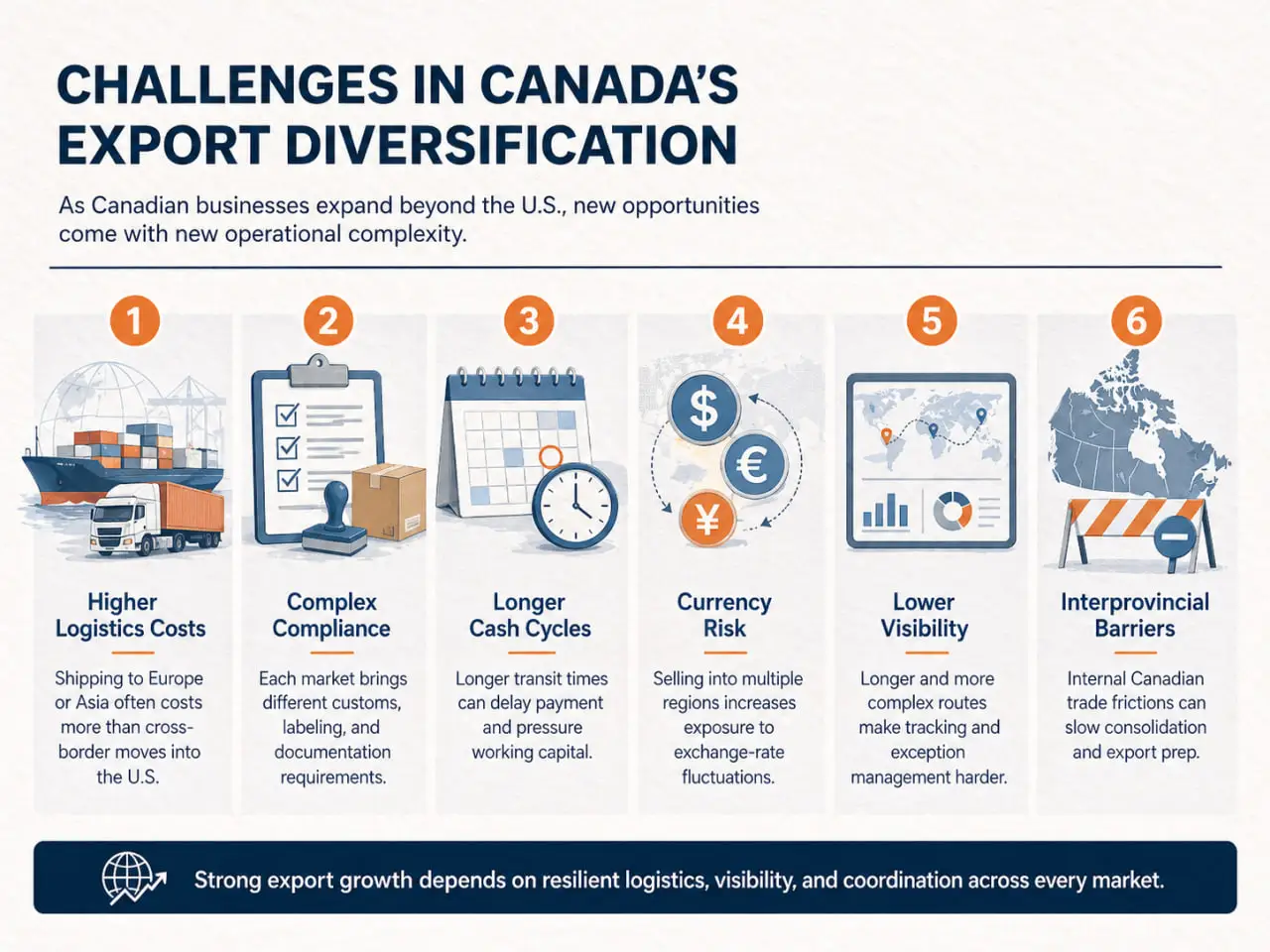
Trade diversification creates opportunity, but it also creates complexity. Your article identifies the most common obstacles businesses face when they expand beyond the U.S.:
Higher logistics costs
Shipping to Europe or Asia is usually more expensive than moving freight into the U.S.
More complex compliance
Each new market brings its own customs, labeling, documentation, and regulatory requirements.
Longer cash cycles
Longer transit times can create cash flow pressure, especially for smaller businesses.
Currency exposure
Multiple markets increase exchange-rate risk and forecasting complexity.
Lower visibility across longer routes
Tracking and managing overseas shipments is more demanding than regional cross-border freight.
Language and business culture differences
New markets often require more localized communication and relationship building.
Internal Canadian trade friction
Interprovincial barriers can still complicate export preparation and consolidation.
This is where your article becomes commercially valuable. Instead of inserting MacMillan too early, it works best once the reader understands the operational difficulty of diversification.
MacMillan SCG is positioned as a logistics partner that helps Canadian exporters adapt to a more global trade model through:
Global logistics coordination
Support for international shipping routes and container planning.
Real-time supply chain visibility
Tracking and visibility tools that help businesses manage more complex export movements.
Customs and compliance support
Help with documentation, market requirements, and smoother international movement.
Warehousing and consolidation
Strategically located warehousing and cross-docking that can improve export preparation and container utilization.
Digital trade enablement
Systems that reduce paperwork friction and improve documentation accuracy.
Research target markets carefully
Look at demand, trade barriers, local standards, and buyer expectations before committing inventory.
Start with test shipments
Use smaller shipments to validate routing, compliance, and market response before scaling.
Work with an experienced logistics partner
A capable 3PL can reduce the learning curve, especially when new markets involve different customs, documentation, and shipping patterns.
Use Canadian export support programs
Government-backed market intelligence and financing can lower risk during expansion.
Adapt your product and packaging strategy
Different markets may require different labeling, packaging, or product specifications.
Canada’s trade shift away from the U.S. is more than a reaction to tariffs. It is part of a broader move toward export resilience, diversified market access, and more flexible supply chains. Your article captures that well.
To compete in that environment, Canadian businesses need more than demand in new markets. They need the warehousing, visibility, transportation, compliance support, and operational structure to serve those markets reliably. That is the role MacMillan SCG can play within the story.
Talk to MacMillan Supply Chain Group about building a logistics strategy that supports export diversification, stronger supply chain visibility, and more resilient access to global markets.