
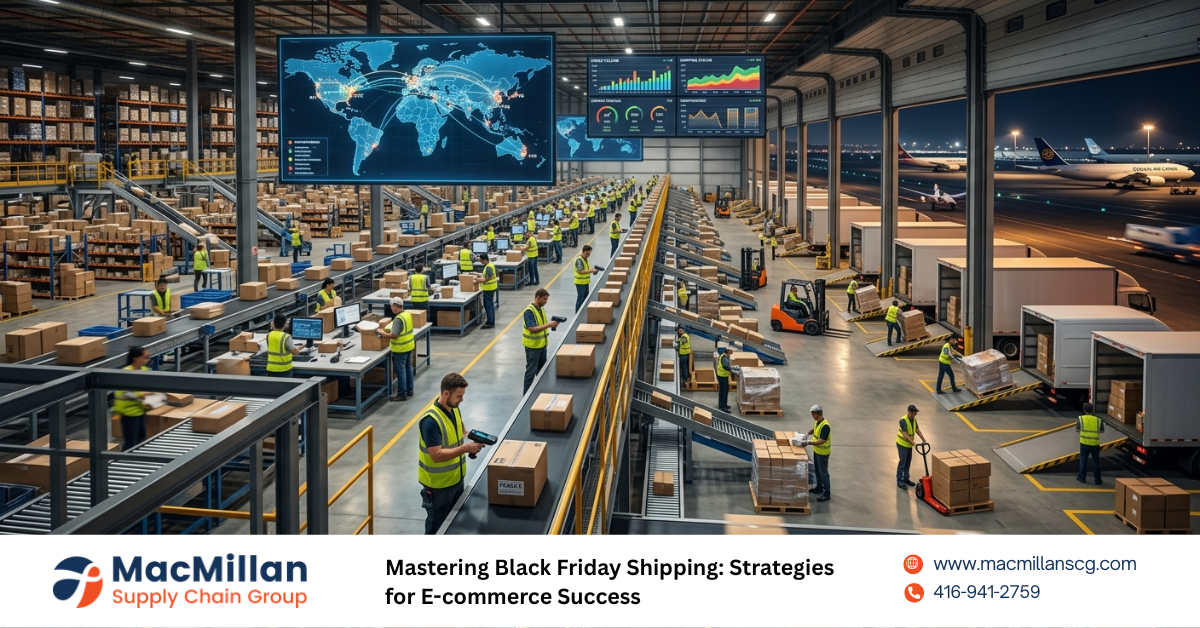
Mastering Black Friday Shipping: Strategies for E-commerce Success
A Quick Summary and Overview Black Friday presents significant challenges…
A Quick Summary and Overview Black Friday presents significant challenges…
A Quick Summary and Overview The worldwide shipping industry is…
Summary and Overview In today’s competitive e-commerce landscape, partnering with…

Introduction The logistics industry is synonymous with constant movement and…
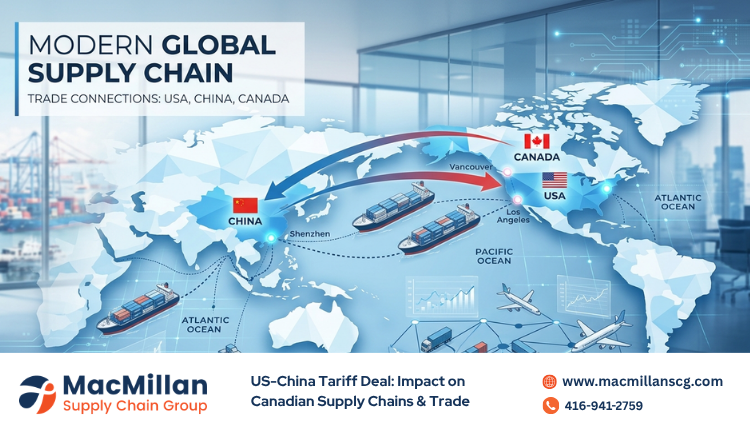
Changes in trade policies by the two biggest economies in the world have an impact that goes well beyond their boundaries. With significant ramifications for Canadian companies and supply chains, the recent US-China tariff deal represents a significant change in the dynamics of global trade. This new agreement seeks to lower tariffs and loosen trade restrictions between these two economic titans following years of rising tensions in the US-China trade war.
However, what does this entail for middle-tier Canadian businesses? What effects will these modifications have on your supply chain’s overall resilience, export prospects, and import strategy? MacMillan Supply Chain Group, a top 3PL supplier in Canada, is aware of the intricate difficulties these changes bring. We’ll analyze the main features of the US-China tariff deal, look at how it affects Canada’s economy, and provide helpful advice for negotiating this changing trade environment in this article.
The US-China tariff deal is the most recent development in a rocky trade relationship. Under this new agreement, both countries have agreed to significant tariff reductions after imposing tariffs as high as 25% on goods valued at hundreds of billions of dollars. However, what does the deal exactly include?
Fundamentally, the deal lowers tariffs on thousands of goods that are traded between the two nations. In order to update your Canada import strategy, it is imperative that Canadian businesses comprehend these changes. A number of important topics are covered in the deal:
This isn’t a total overhaul of trade relations, though. The underlying tensions that led to the US-China trade war have not gone away, and many tariffs are still in effect. Consider this to be less of a comprehensive peace treaty and more of a bilateral tariff truce.
These changes have an impact on supply chains in Canada. Price changes may occur for goods that pass through the US or contain Chinese components. Businesses that moved their sourcing out of China when tensions were at their highest now need to consider whether to change their approaches once more. The secret is to anticipate how this relationship may change in the future as well as to comprehend what is changing now.
The US-China tariff deal has had a complex economic impact on Canada, posing opportunities and challenges for companies in a wide range of industries. Canada is in a unique position as these two significant trading partners modify their relationship.
Positively, the economy of North America as a whole may benefit from lowered tensions between the US and China. Freer trade lowers manufacturing costs, which could help Canadian businesses that:
But there are also difficulties. Some manufacturers moved their operations to Canada during the height of the US-China trade war in order to avoid tariffs and keep access to North American markets. Now that tariffs have been lowered, this competitive edge might be lost.
The environment for Canadian exporters is not uniform. Chinese suppliers may now present a fresh threat to those who increased their market share during the trade disputes. More reliable supply chains and lower prices for imported parts might help others. The effects differ greatly depending on the industry, with the automotive, electronics, and agricultural sectors all seeing different results.
This changing environment necessitates careful consideration for companies in charge of Canadian supply chains. Which of your clients, vendors, or goods will be impacted by these changes in tariffs? What could your rivals say? Maintaining your competitive position in this changing trade environment requires that you respond to these questions.
Now is the ideal moment to review your Canada import strategy because the US-China tariff deal is changing trade flows. Rapidly adapting businesses can benefit greatly in terms of price, dependability, and market responsiveness.
Start by determining how exposed your present supply chain is to the dynamics of US-China trade:
The basis for a more robust strategy is this analysis. While keeping in touch with your most dependable Chinese partners, think about expanding your supplier base outside of China. This well-rounded strategy offers flexibility in the event that tariff escalation risks reappear.
In this setting, logistics planning becomes even more important. You can access experience in navigating evolving customs regulations and determining the best trade routes by partnering with a seasoned 3PL like MacMillan Supply Chain Group. We assist clients in determining whether, in light of the new tariff structure, it makes more sense to route through US distribution centers or import directly from China.
Modern import strategies heavily rely on technology. You can react swiftly to changes in tariffs by using digital tools for:
These systems offer the transparency required to make wise choices regarding inventory control, routing, and sourcing.
Keep in mind that developing a competitive edge is the goal of import strategy, not merely cutting expenses. Businesses that understand the intricacies of global trade can outperform their rivals in terms of pricing, delivery dependability, and flexibility.
The US-China tariff deal alters the competitive environment for Canadian exporters, necessitating strategic adjustment. Maintaining and expanding your export business requires an understanding of how these changes impact your particular markets.
The effects differ greatly by sector:
A proactive approach to Canadian market access in the US and China is necessary in light of this environment. Reevaluating your competitive position should be your first step. Are your goods sufficiently unique to resist price competition? Do you provide benefits in terms of quality, dependability, or service that go beyond just financial considerations?
Building stronger ties with your clients becomes even more crucial. Building trust in your dependability as a supplier requires regular communication about how you’re handling these changes. Think about how you could modify your value proposition, maybe putting more emphasis on aspects like sustainability, quality assurance, or supply chain transparency that go beyond price.
Another important differentiator is logistics excellence. Despite shifting trade patterns, working with a specialized 3PL partner like MacMillan Supply Chain Group guarantees that your products efficiently reach customers abroad. Our proficiency in international distribution, customs paperwork, and cross-border shipping enables Canadian exporters to maintain dependable and competitive delivery times.
Keep in mind that trade agreements, like the tariff deal between the United States and China, present both opportunities and difficulties. The lowered tensions might make it possible for Canadian businesses to join supply chains that connect China and the United States, making you an important player in the dynamics of international trade.
Even with the US-China tariff deal, there are still a lot of obstacles for companies doing business in these markets.
For Canadian companies that need to manage their relationships with both trading giants while preserving supply chain resilience against future disruptions, these difficulties are especially severe.
We at MacMillan Supply Chain Group have created all-inclusive solutions to support Canadian companies in the face of shifting US-China tariff deal conditions. Our method addresses the unique difficulties brought about by changing tariff structures by fusing operational excellence, technological prowess, and strategic expertise.
We start by carefully examining how exposed your present supply chain is to US-China trade factors. This entails:
Our team of trade experts stays up to date on the most recent developments in the US-China tariff deal, converting intricate policy changes into practical business suggestions.
We create tailored strategies that strike a balance between cost, speed, and dependability for businesses importing from China. This could consist of:
This new environment presents opportunities as well as challenges for Canadian exporters. Among our export options are:
Visibility is even more important in a volatile trading environment. Our online resources offer:
We are able to adjust to shifting trade patterns thanks to our well-located warehouse facilities across Canada:
We help clients make their supply chains more resilient by:
By combining these capabilities, MacMillan Supply Chain Group helps Canadian businesses transform trade complexity from a challenge into a competitive advantage. Our clients maintain more stable costs, more reliable delivery, and greater agility than competitors who lack sophisticated supply chain partners.
For Canadian businesses, the US-China tariff deal presents an opportunity as well as a pressing need to fortify their supply chains. The following are doable actions you can take right now to successfully manage these changes:
Don’t put off strengthening your supply chain’s resilience until the next trade crisis occurs. Businesses that proactively adjust to shifting conditions rather than responding to disruptions after they happen are the ones that prosper in today’s environment.
To discuss how MacMillan Supply Chain Group can assist your company in navigating the challenges of global trade while preserving affordable prices and dependable service, get in touch with us today. In this changing trade environment, our team of professionals is prepared to create tailored solutions that take advantage of your unique opportunities and challenges.
The deal impacts Canadian businesses in multiple ways. It changes the competitive landscape for both imports and exports, potentially reducing costs for goods containing Chinese components while increasing competition in some export markets. Canadian companies that serve as intermediaries in US-China trade may see shifting demand patterns. The economic impact on Canada includes both opportunities in more stable supply chains and challenges from renewed competition.
Not necessarily right away. While lower tariffs make Chinese sourcing more attractive again, it’s important to avoid over-reliance on a single country. Many businesses shifted away from China to reduce risk during the trade war. A smarter approach now is a hybrid sourcing strategy—maintain trusted Chinese suppliers while also keeping alternative sources in other regions. This ensures flexibility if tariffs rise again or disruptions occur.
The deal provides short-term relief but is not guaranteed to be stable long-term. Trade relations between the US and China are still influenced by political, economic, and strategic tensions. Key issues like intellectual property, technology control, and geopolitical competition remain unresolved. Businesses should treat this as a temporary easing rather than a permanent solution and plan accordingly.
Several industries are directly impacted, including:
Each sector experiences different effects depending on how integrated it is with US-China trade flows.
Start with a detailed supply chain and product analysis:
Using trade data tools or working with a logistics/3PL partner can make this process faster and more accurate.
The Phase One deal (2020) focused mainly on:
The current tariff deal, however:
In simple terms, Phase One was a starting framework, while the current deal is more of a partial reset or adjustment in ongoing trade relations—not a full resolution.