
Trump’s 50% Steel Tariffs: Supply Chain Disruption Explained

Former U.S. President Donald Trump announced Trump’s 50% steel tariffs, doubling the previous 25% rate — a move that has rocked North American supply chains. Numerous industries are deeply concerned about this sharp rise, which is justified by Section 232 measures as necessary for national security. There are currently significant obstacles facing Canada’s steel industry, which exports steel products worth billions of dollars to the United States each year. These tariffs cause a complicated web of supply chain issues for companies that operate across the Canada-U.S. border. Consumer prices could rise and economic growth could be slowed by higher material costs, possible shortages, and logistical issues. Strategic supply chain management is more important than ever as Canadian manufacturers and their American consumers scramble to adapt. Understanding Trump’s 50% Steel Tariffs Trade tensions between the US and its trading partners, including Canada, have significantly increased as a result of Trump’s 50% steel tariffs. The Trade Expansion Act’s Section 232 measures, which give the US the authority to defend domestic industries considered essential to national security, are the basis for these tariffs. International partners and trade experts have criticized the national security rationale. Many contend that this line of thinking expands the meaning of security concerns to encompass economic protectionism. By raising the price of imported steel considerably, the policy seeks to support domestic steel producers in the United States. These tariffs present immediate difficulties for Canadian companies: Higher border crossing costs for steel-based materials Possible supply disruptions as trade patterns change Price and availability uncertainty for manufacturing inputs Difficult customs procedures and extra paperwork Businesses have limited time to modify their supply chains or look for alternate sourcing options due to the implementation timeline. The economy as a whole is impacted by this abrupt change, which forces businesses to either absorb increased costs or pass them on to customers. How Canadian Steel Industry and Manufacturers Are Affected The steel sector in Canada is at the forefront of this trade conflict. Canadian steel producers, a significant supplier to American markets, could suffer catastrophic repercussions. According to industry analysts, if these tariffs are maintained over time, domestic steel producers may lose billions of dollars in revenue. A double challenge confronts Canadian manufacturers who depend on steel inputs, in addition to the steel producers themselves. As Canadian producers adjust to lost U.S. market share, domestic steel buyers may see price increases. In the meantime, possible retaliatory tariffs increase the costs for manufacturers who import specialty steel from the United States. Among the issues facing the manufacturing sector are: Reduced ability to compete with international competitors Pressure to move production to avoid tariffs Difficulty keeping customer prices stable Difficulties with long-term planning and investment Because they frequently lack the resources to swiftly change their supply chains or absorb large cost increases, small and medium-sized manufacturers face especially difficult obstacles. Some businesses are already delaying plans for expansion and reevaluating their cross-border business strategies, according to industry associations. How Trump’s 50% Steel Tariffs Are Driving Up Construction and Auto Costs Trump’s 50% steel tariffs are putting immediate pressure on the construction sector. Steel accounts for a sizeable portion of material costs in both residential and commercial construction projects. According to industry experts, steel-intensive projects may see construction costs rise by 15% to 20%, making Canada’s housing affordability crisis worse. For Canada’s construction industry, which is already struck by high material costs and a lack of workers, the timing couldn’t be worse. Builders report: Delays in projects while budgets and material sourcing are reevaluated Contracts should be renegotiated to take price volatility into account Accurate quotes for upcoming projects are difficult to come by Project viability is a concern as costs increase In a similar vein, the automotive industry has particular difficulties. Vehicle manufacturing depends on components that cross borders several times due to integrated supply chains that span both nations. This carefully calibrated system could be upset by the tariffs, which could result in: Consumers paying more for cars Assembly plant production slowdowns Job losses in auto manufacturing regions A quicker transition to sourcing from overseas markets Tinplate Packaging and Consumer Goods Price Increases Tinplate packaging is one frequently disregarded area that is experiencing major disruption. This specialty steel product is necessary for many consumer goods, including beverage containers and food canning. Packaging manufacturers must deal with significant cost increases as a result of the tariffs, which will eventually affect consumers. Within months of going into effect, the 50% tariff could raise the cost of canned food by 8–12%, according to the Can Manufacturers Institute. Lower-income households that depend on reasonably priced canned goods would be disproportionately affected by this price inflation. In addition to food, consumers can anticipate price increases in a variety of categories: Steel-based appliances and household items Costs of auto parts and repairs Building supplies and home remodeling items Office supplies and furnishings At a time when many households are already experiencing financial strain, these price increases add to concerns about consumer price inflation in general. Economists caution that the tariffs might act as a regressive tax, burdening the most vulnerable. Challenges Facing Businesses Under the New Tariff Regime Businesses on both sides of the border face many operational difficulties as a result of Trump’s 50% steel tariffs. These issues go beyond straightforward price hikes to include serious supply chain interruptions. Planning becomes nearly impossible due to the uncertainty surrounding the policy’s implementation. Companies struggle to decide whether to pass costs on to customers, seek alternative suppliers, or lock in current prices — all while facing delayed investment decisions and a wait-and-see mentality. Beyond steel, the global supply chain faces ripple effects as manufacturers shift their sourcing strategies, causing potential shortages of other materials and components. Legal complications further muddy the waters. With disputes progressing through the WTO and domestic courts, businesses must prepare for outcomes ranging from tariff reductions to retaliatory measures. Fourth, simple substitution isn’t always feasible due to the specialized nature of many steel products. Regardless of cost,
3PL Risk Management: Building Resilient Supply Chains
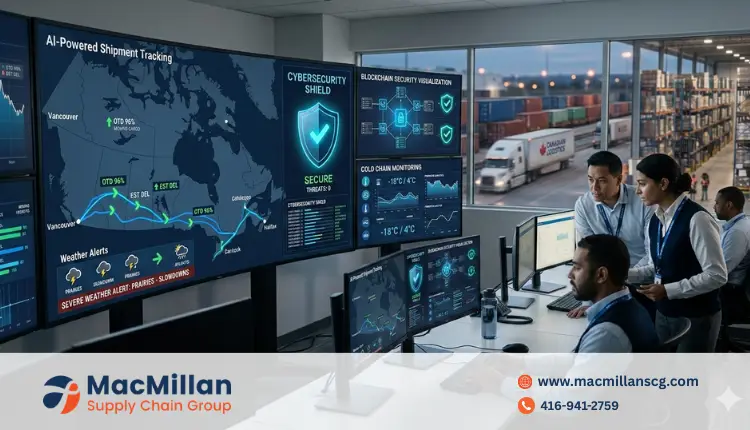
Businesses approaches to supply chain management were drastically altered by the COVID-19 pandemic. Resilience and adaptability must now be given top priority in a system that was previously primarily built for efficiency. This change has increased the importance of effective risk management for businesses that depend on third-party logistics (3PL) providers. We at MacMillan Supply Chain Group have seen directly how supply chain disruptions in Canada can affect companies of all sizes. The difficulties are numerous and frequently unforeseen, ranging from labor shortages to extreme weather events, from border closures to cybersecurity threats. For this reason, we have created thorough 3PL risk management plans that assist our clients in surviving disruptions and using them to their advantage. Let’s examine how contemporary 3PL risk management practices are constructing more robust supply chains for Canadian companies and adjusting to post-pandemic realities. Comprehending the New Risk Environment in Canadian Logistics In recent years, supply chains’ risk environment has significantly grown. Traditional issues like inventory control and delays in transit are still significant, but new problems have surfaced that call for creative answers. Changing Threat Trends Disruptions to the Canadian supply chain can now take many different forms. Cross-border shipping can be seriously delayed by border restrictions between the USA and Canada. Transportation networks are frequently impacted by extreme weather events, such as floods in British Columbia and ice storms in Quebec. Meanwhile, since 2019, the number of cybersecurity threats aimed at logistics systems has grown by more than 300%, with ransomware attacks having the ability to completely stop operations. The Interconnected Nature of Modern Risks The interconnectedness of today’s challenges is what makes them especially challenging. Transportation compliance problems could result from a cybersecurity breach. Failures in cold-chain management could be brought on by a weather event. During peak seasons, e-commerce fulfillment capabilities may be impacted by labor shortages. According to our Director of Operations, “the post-pandemic logistics environment requires thinking about risk in layers.” “Having a single backup plan is no longer sufficient; you need comprehensive strategies that address multiple potential failure points at the same time.” Working with 3PL partners who comprehend global supply chain dynamics and the particular difficulties of conducting business in Canada’s varied geographic and regulatory environment is essential for Canadian companies. Diversification and strategic sourcing are now crucial elements of successful 3PL risk management. Technology-Driven Solutions for 3PL Risk Management and Supply Chain Resilience Modern logistics technology is now essential to 3PL risk management success. To improve supply chain resilience for our clients, MacMillan Supply Chain Group makes use of a number of important technologies. AI-Powered Visibility in 3PL Risk Management Your whole logistics network is visible in real time thanks to our AI-powered supply chain platforms. This technology anticipates possible disruptions before they affect your operations, in addition to tracking shipments. By analyzing weather patterns, traffic data, border crossing times, and historical performance metrics, our systems can recommend proactive adjustments to routing and scheduling. For instance, our AI system automatically detected shipments that were at risk and recommended alternate routes when severe weather threatened deliveries throughout Ontario last winter, preventing delays for 94% of the impacted orders.This level of predictive control strengthens overall 3PL risk management capabilities. Blockchain for Enhanced Security and Transparency Blockchain has been incorporated into logistics processes for goods that need rigorous chain-of-custody documentation. This is especially helpful for food supply chains and pharmaceutical logistics, where product authenticity and temperature control are crucial. Our Technology Director observes that “Blockchain provides an immutable record of every touchpoint in the supply chain.” “This improves security and streamlines compliance paperwork for international shipping between the United States and Canada.” By adopting these technologies, we assist customers in creating resilient supply chains in Canada’s distinct and difficult logistics landscape, guaranteeing business continuity even in the face of interruptions. Together, these technologies form a core pillar of advanced 3PL risk management. Strategic Sourcing and Relationship Management Beyond technology, strategic sourcing and relationship management techniques that act as organic barriers against interruptions are also essential components of effective 3PL risk management. Diversification as a Strategy for Risk Mitigation We learned a valuable lesson from the pandemic: relying too much on a single supplier or transportation route can lead to dangerous vulnerabilities. At MacMillan Supply Chain Group, we assist customers in putting 3PL risk management-driven diversification plans into action that strike a balance between resilience and efficiency. Maintaining connections with several carriers for every transportation lane and setting up warehouse capacity in various geographical areas are two examples of what this could entail. Creating options for LTL and TL shipping to handle different volumes. Making backup plans for different ports of entry for shipments coming from abroad. “Strategic sourcing isn’t just about finding the lowest price,” explains our Supply Chain Director. “It’s about creating a network that can adapt when disruptions occur.” Contractual Frameworks for 3PL Risk Management Contemporary innovations in contracts have emerged as crucial instruments for risk management. We collaborate with clients to create contracts that contain the following: – Explicit force majeure provisions that cover pandemic situations. Metrics of performance that encourage proactive risk management. Provisions for managing tariffs on international shipping. Frameworks for shared responsibility regarding cybersecurity threats. We assist clients in developing supply chains that continue to function even in the event of disruptions to individual components by fusing strategic diversification with strong contractual frameworks. For Canadian companies negotiating the challenging post-pandemic logistics environment, this strategy has proven especially helpful. This layered approach to contracts plays a central role in our overall 3PL risk management model. Industry-Specific Risk Management Approaches Supply chain issues vary by industry, necessitating customized 3PL risk management techniques. We at MacMillan Supply Chain Group have created specialized strategies for a number of important industries. Medicine and Healthcare Maintaining product integrity throughout the supply chain is a non-negotiable requirement for pharmaceutical logistics. Our approach to risk management consists of: Cold chain management systems that are redundant and have backup power sources. Temperature tracking with blockchain verification and real-time alerts. Expert contingency
Geopolitical Risks in Canadian Supply Chains
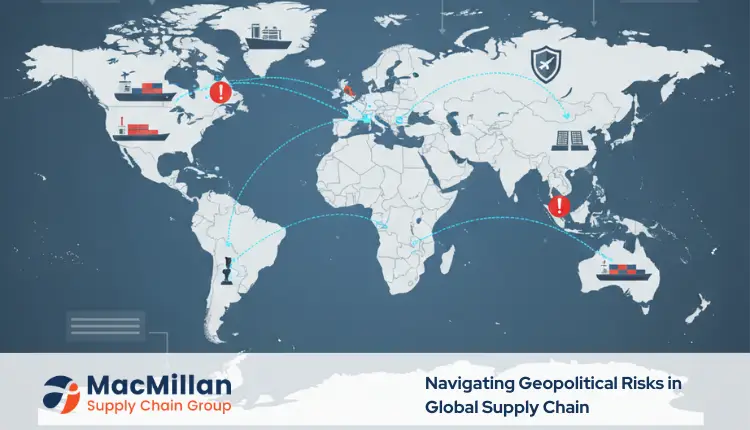
Introduction The world’s supply chains are more interconnected and vulnerable than ever in this age of rapid globalization. Geopolitical risks, which range from trade wars and sanctions to cyber threats and regional conflicts, are now a defining challenge for multinational corporations navigating geopolitical risks in global supply chain operations. For Canadian businesses, these risks are more than just news stories; they are actual, day-to-day challenges that have the potential to impair operations, raise expenses, and jeopardize business continuity. We at Macmillan SCG have personally witnessed how these difficulties affect our clients. As a top Canadian supply chain provider, we help companies handle the challenges of international trade by running warehouses and providing last-mile delivery services all over the nation. The most important risks to Canadian supply chains, the changing geopolitical risk landscape, and tried-and-true methods for enhancing resilience in an unpredictable world will all be covered in this blog. The New Geopolitical Reality: What’s Changed? 1. The Rise of Trade Wars and Tariffs Growing trade tensions, especially between the US, China, and the EU, have made things unstable for importers and exporters since 2018. The cost structure of goods and raw materials can be abruptly altered by the imposition of tariffs. The implications for Canadian companies are substantial: Unexpected cost increases: Some Canadian manufacturers have seen price increases of 10–40% as a result of steel, aluminum, and electronics tariffs. Reconfiguring the supply chain forces businesses to reconsider their sourcing strategies; in order to avoid penalties, they frequently change suppliers or reroute shipments. Regulatory uncertainty: The rules of the game can change with every new administration or international dispute. 2. Regional Conflicts and Disrupted Trade Routes Regional conflicts can quickly block important shipping lanes, delay cargo, and raise insurance and security costs, as demonstrated by the Russia-Ukraine war and the unrest in the Middle East and Asia-Pacific. For instance: In 2021, the blockage of the Suez Canal caused a daily delay of $9.6 billion in goods. Ships were forced to reroute around Africa due to the Red Sea crisis in 2024, which resulted in longer delivery times and higher fuel prices. The world’s semiconductor supply is under threat due to tensions in the Taiwan Strait, which affects everything from consumer electronics to automobiles. These real-world disruptions emphasise the need for navigating geopolitical risks in global supply chain networks with greater agility. 3. Sanctions, Export Controls, and Compliance Headaches Sanctions regimes are becoming more widespread, focusing on particular businesses, people, and even entire industries in addition to nations. Businesses in Canada have to negotiate a complicated web of: restrictions on exporting sensitive technologies prohibitions on sourcing from areas where human rights are violated The US Uyghur Forced Labor Prevention Act (UFLPA), for example, requires evidence that products are not manufactured using forced labor 4. Digital Espionage and Cyberthreats Supply chains are increasingly being targeted by state-sponsored hackers and cybercriminals as they digitize. The number of ransomware attacks on logistics companies grew by 300% in 2024 alone. Inventory systems can become paralyzed, sensitive data compromised, and operations halted for days or weeks due to a single breach. 5. Geopolitical Risks Associated with the Environment and Climate With nations enacting carbon border taxes, limiting imports of high-emission goods, and calling for increased supply chain emissions transparency, climate change has become a geopolitical issue. This implies the following for Canadian exporters: adjusting to the US and EU’s new carbon pricing plans fulfilling more stringent environmental, social, and governance (ESG) reporting requirements getting ready for “green trade wars,” in which sustainability is used as a weapon to compete The Canadian Viewpoint: Navigating Geopolitical Risks in Global Supply Chain Geographically, economically, and politically, Canada is unique, which presents a unique set of opportunities and challenges for our supply chains. Strong reliance on international trade: Since the US accounts for more than 75% of Canadian exports, changes in US policy will have a significant impact on us. Long, difficult supply chains: Because of our large geographic area and reliance on rail and maritime transportation, Canada is susceptible to infrastructure disruptions and chokepoints. Diverse sourcing: A large number of Canadian businesses rely on international vendors for essential parts, ranging from Asia to Europe and Latin America. We at Macmillan SCG have assisted clients in navigating these complexities across a variety of industries, from electronics and automotive to food and pharmaceuticals. Our experience demonstrates that although risks are present, they can be used as opportunities for growth if proactive measures are taken. Significant Geopolitical Risks Affecting Canadian Supply Chains 1. Trade and Tariff Policy Volatility Example: New regulations for labor, digital trade, and automotive content were introduced by the US-Mexico-Canada Agreement (USMCA/CUSMA), which superseded NAFTA. Impact: Businesses were forced to invest in compliance systems, renegotiate contracts, and quickly modify their sourcing. 2. Export Controls and Sanctions Example: Exports of specific metals, energy products, and technology were prohibited as a result of sanctions imposed on Russia in response to the conflict in Ukraine. Impact: Due to shortages, Canadian manufacturers had to look for other suppliers, frequently at a higher cost. 3. Disruptions to Shipping Routes Example: Carriers had to reroute around the Cape of Good Hope due to the Red Sea crisis in 2024, which extended shipments from Asia to North America by up to 20 days. Impact: The requirement for greater safety stocks, higher shipping expenses, and inventory delays. These factors highlight why navigating geopolitical risks in global supply chain operations is now a strategic necessity. 4. ESG Regulations and Forced Labor Example: New regulations in the US and the EU demand evidence that products are not produced using forced labor or in a way that violates environmental regulations. Impact: Businesses need to invest in clear reporting systems, trace materials, and audit suppliers. 5. Cybersecurity Risks Example: Ransomware attacks on logistics companies have the potential to stop operations, compromise data, and result in fines from the government. Impact: Strong cybersecurity procedures, staff education, and incident response strategies are required. Techniques for Navigating Geopolitical Risks in Global Supply Chain 1. Diversification Strategies for Navigating Geopolitical Risks in Global Supply Chain Find substitute suppliers in other areas (the
Hybrid Logistics Model Canada: 5 Key Benefits
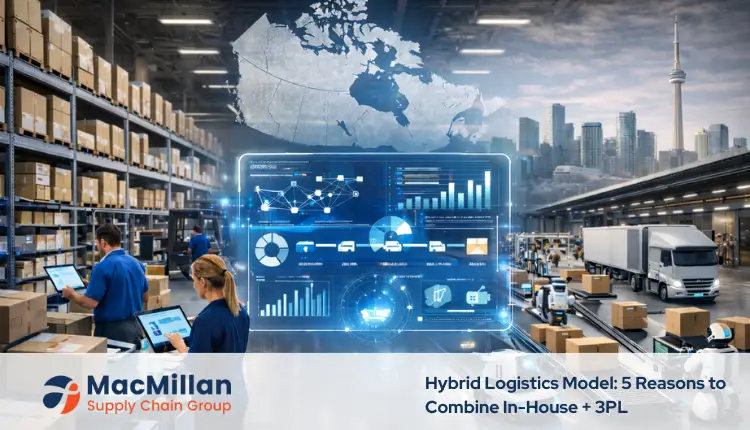
Introduction In today’s evolving logistics landscape, businesses must choose between working with a third-party logistics (3PL) provider or keeping operations fully in-house. But increasingly, the smart move is adopting a hybrid logistics model—a strategy that combines the strengths of both. But what if neither/or isn’t the best option? A powerful trend that combines the capabilities of internal teams with the know-how and technology of a third-party logistics provider is emerging at Macmillan Supply Chain Group. This hybrid logistics approach is a long-term strategic choice rather than merely a short-term fix. And it’s turning out to be the best course of action for a lot of Canadian companies, particularly those dealing with seasonal fluctuations or fast growth. We’ll outline the top five reasons in this post for why you can get the best of both worlds by integrating your internal logistics team with a 3PL provider — particularly one that uses cutting-edge technologies like AI 3PL operating systems. 1. Hybrid Logistics Model =Adaptability Without Losing Command To be honest, it can be a leap of faith to relinquish complete control over your logistics operations. Your team is familiar with your standards, customers, and products. That’s a worthwhile experience. However, there are drawbacks to doing everything in-house, particularly when your company expands or enters new markets. A hybrid strategy can help with that. You can expand your capacity and geographic reach without sacrificing your internal capabilities by outsourcing certain tasks — such as last-mile delivery in a densely populated metro area or warehousing in a new province. The AI 3PL operating systems we implement seamlessly integrate with your current workflows when you work with a partner like Macmillan SCG. This implies that even if our infrastructure handles the execution, your team maintains control over visibility and decision-making. Imagine it as an addition to a beloved house. You’re not going anywhere. Simply put, you’re creating space where it’s most needed. 2. How a Hybrid Logistics Model Helps You Scale Cost Efficiently Keeping everything in-house can quickly become costly. Fixed logistics costs include things like fleet maintenance, warehouse rent, and full-time employees. And when business slows down, those costs don’t just vanish. You can change fixed costs into variable ones with a hybrid model. While relying on your 3PL for specialized services or varying demand, you maintain your core team and assets focused on what they do best. One of our retail clients, for instance, uses Macmillan SCG for regional distribution and returns processing, but manages central fulfillment internally. We increase capacity for them during busy times of the year and then decrease it once things settle down. Their clients receive reliable service, and they save a lot of money on overhead. We can also predict demand trends, optimize resource allocation, and cut waste thanks to AI 3PL operating systems, which helps our hybrid clients save even more money. 3. Boost Supply Chain Visibility With a Hybrid Logistics Model Outsourcing is often associated with a loss of visibility. That isn’t the case in 2025, though, at least not if you’re working with the correct 3PL. Our AI-powered logistics platform at Macmillan SCG offers real-time insights into both internal and external operations and integrates easily with your ERP or WMS. Whether inventory is sitting in your warehouse or en route in ours, you’ll see it all in one place. Our AI 3PL operating systems make it possible to: Track order status from purchase to final delivery Monitor inventory levels across multiple locations View delivery ETAs, exception reports, and carrier performance Get automated notifications when stock needs to be rerouted or replenished That kind of data-sharing means better decisions, faster. Your internal team gains strategic clarity in addition to oversight. Additionally, your clients enjoy more seamless, open service without even being aware that it’s a hybrid operation. 4. Distribute Tasks Using Core Skills Every logistics team has advantages and disadvantages. Perhaps your team excels at local business-to-business distribution but finds it difficult to fulfill orders for online retailers. Or perhaps you are an expert at storage but still struggle with last-mile delivery in rural areas. A hybrid approach enables you to divide responsibilities purposefully, as opposed to hiring for every niche need or attempting to push your team beyond its comfort zone. This is how it might appear: In-house: Manage expensive shipments, delicate goods, or packaging that is essential to the brand. 3PL partner: Oversee cross-border logistics, same-day fulfillment, and excess inventory. At Macmillan SCG, we routinely work with clients who want to retain specific logistics functions internally — and we build our services around that. Our AI-driven systems ensure that our portion of the supply chain aligns with your processes, customer SLAs, and performance metrics. It has nothing to do with changing your team. Giving them a logistics partner who can cover the gaps and improve performance is the goal. 5. Hybrid Logistics Model = Advanced Tech Without High Investment The harsh reality is that the logistics sector is evolving quickly, and it costs money to stay up to date with new developments. It can take months and a six-figure budget to implement sophisticated robotics, route optimization tools, or real-time tracking. Investing in all of that internally is simply not feasible for many businesses. However, working with a forward-thinking 3PL like Macmillan SCG gives you immediate access to effective tools like: AI-powered 3PL operating systems that automate inventory control and forecast demand Real-time machine learning models that modify delivery routes in response to traffic and weather conditions Up to 65% faster picking and packing with robotics and warehouse automation Better yet, our facilities have already tested, improved, and implemented these technologies. No learning curve. No delays. Just better performance — from day one. This means your hybrid model isn’t just a cost-saving move. It’s a chance to upgrade your supply chain while avoiding the sunk cost of building from scratch. Real Clients. Real Hybrid Wins. Here’s a brief illustration: All logistics used to be managed internally by one of our B2C clients, an Ontario-based skincare brand. However, their staff was overworked during the pandemic
Top 5 3PL Companies in Canada: A Comprehensive Review
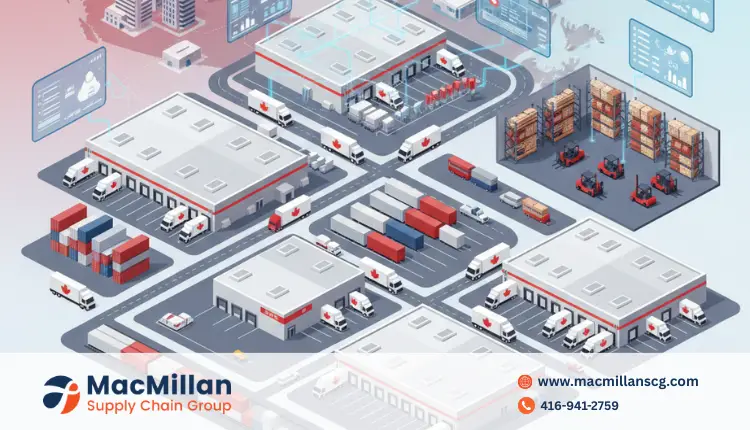
A Quick Summary and Overview When growing your business in Canada, choosing the right 3PL partner is crucial for success. The top 3PL companies in Canada offer comprehensive services including warehousing, e-commerce fulfillment, and cross-border shipping solutions. This guide examines the five leading third-party logistics providers based on service quality, technology integration, geographic reach, and customer satisfaction. Whether you’re an e-commerce startup or an established manufacturer, understanding these logistics powerhouses will help you make informed decisions to optimize your supply chain and deliver exceptional customer experiences. Introduction In today’s fast-paced business environment, efficient logistics management can make or break your company’s success. That’s where third-party logistics providers (3PLs) come in. These specialized companies handle the complex tasks of warehousing, transportation, and fulfillment, allowing businesses to focus on their core competencies. For Canadian businesses, especially those in e-commerce, finding the right 3PL partner is essential for managing the unique challenges of Canada’s vast geography, cross-border trade with the US, and growing consumer expectations for fast delivery. The best 3PL companies in Canada offer more than just storage and shipping – they provide end-to-end supply chain solutions that can transform your business operations. In this comprehensive review, we’ll examine the top five 3PL companies in Canada, analyzing their strengths, service offerings, and what makes them stand out in a competitive market. Whether you’re looking for a Toronto fulfillment center, cross-border logistics expertise, or sustainable shipping solutions, this guide will help you make an informed decision for your business needs. Understanding 3PL Services in Canada Third-party logistics providers have become essential partners for businesses of all sizes across Canada. But what exactly do these companies offer? At their core, 3PL companies in Canada provide outsourced logistics services that handle various aspects of your supply chain. The Canadian 3PL landscape has evolved significantly in recent years, driven by e-commerce growth and changing consumer expectations. Today’s top providers offer comprehensive services including: Warehousing in Canada Order Fulfillment Transportation Management Cross-Border Logistics Customs Clearance Services Reverse Logistics Value-Added Services What separates leading 3PLs from average providers is their technology integration. Modern 3PL companies leverage advanced warehouse management systems (WMS), transportation management systems (TMS), and real-time tracking capabilities to provide visibility and efficiency throughout the supply chain. For Canadian businesses, working with a specialized 3PL means gaining access to established shipping networks, volume discounts, and logistics expertise that would be difficult and costly to develop in-house. This partnership approach has made 3PL services increasingly popular among both startups and established enterprises looking to optimize their operations. Evaluation Criteria for Top 3PLs Selecting the right 3PL partner requires careful consideration of several key factors. Our comprehensive evaluation of the top 3PL companies in Canada is based on the following criteria: Geographic Coverage and Network Strength The best 3PL providers offer strategic warehouse locations near major population centers and transportation hubs. We assessed each company’s network of facilities, with special attention to Toronto fulfillment centers, Vancouver operations, and cross-border capabilities. Companies with multiple locations across Canada received higher ratings for their ability to provide faster delivery times to more customers. Technology Integration and Visibility In today’s digital economy, technology separates leading 3PLs from the competition. Our evaluation examined each provider’s technological capabilities, including: Service Diversity and Specialization The top 3PL companies in Canada offer comprehensive service portfolios while also demonstrating expertise in specific industries or logistics functions. We evaluated each provider’s capabilities in: Scalability and Flexibility Business needs change, especially for growing companies. The best 3PLs offer flexible solutions that can scale with your business, accommodating seasonal fluctuations and long-term growth without requiring new partnerships or significant disruption to operations. By applying these criteria consistently across our research, we’ve identified the five 3PL companies that truly stand out in the Canadian logistics landscape. Top 5 3PL Companies in Canada After thorough research and analysis, we’ve identified the five leading third-party logistics providers serving the Canadian market. Each offers unique strengths while maintaining excellence across core logistics functions. MacMillan Supply Chain Group MacMillan Supply Chain Group has established itself as a premier 3PL provider with exceptional warehousing in Canada and specialized e-commerce fulfillment services. Based in the Greater Toronto Area with additional facilities across Canada, MacMillan combines decades of logistics expertise with cutting-edge technology. Key Strengths: InterFulfillment With strategic Toronto fulfillment centers and Vancouver operations, InterFulfillment has built a reputation for excellence in e-commerce logistics. Their technology-first approach integrates seamlessly with major platforms like Shopify, Amazon, and WooCommerce. Key Strengths: Stallion Express Stallion Express has carved out a niche as a cross-border logistics specialist, offering streamlined shipping between Canada and the US. Their focus on affordable international shipping makes them particularly valuable for Canadian e-commerce businesses selling to American consumers. Key Strengths: Manitoulin Transport As one of Canada’s largest transportation providers, Manitoulin Transport offers comprehensive logistics services with particular strength in less-than-truckload (LTL) shipping across North America. Their extensive network makes them ideal for businesses shipping larger orders throughout Canada. Key Strengths: Day & Ross Rounding out our top five is Day & Ross, a well-established logistics provider with particular expertise in temperature-controlled shipping and dedicated fleet services. Their comprehensive approach to supply chain management makes them suitable for businesses with complex logistics requirements. Key Strengths: Each of these top 3PL companies in Canada offers distinct advantages, allowing businesses to select the provider that best aligns with their specific logistics needs and growth objectives. Common Problems with 3PL Services While partnering with a 3PL offers numerous benefits, businesses should be aware of potential challenges that can arise. Understanding these common problems can help you select the right provider and establish effective working relationships. Integration Difficulties Many businesses struggle with integrating their existing systems with their 3PL’s technology platform. This can lead to data inconsistencies, communication breakdowns, and fulfillment errors. Service Level Inconsistencies Quality control can become an issue, particularly during peak seasons when 3PLs handle increased volumes. This might manifest as slower processing times, packing errors, or shipping delays. Cost Transparency Challenges Some 3PL companies in Canada use complex