Black Friday Fulfillment Canada: 2026 Peak Season Guide
Black Friday Fulfillment Canada: How E-commerce Brands Can Prepare for…
Black Friday Fulfillment Canada: How E-commerce Brands Can Prepare for…
When discussing e-commerce, what typically springs to mind? Most likely,…
As the busiest time of the year draws near, the…
As the busiest time of the year draws near, the…
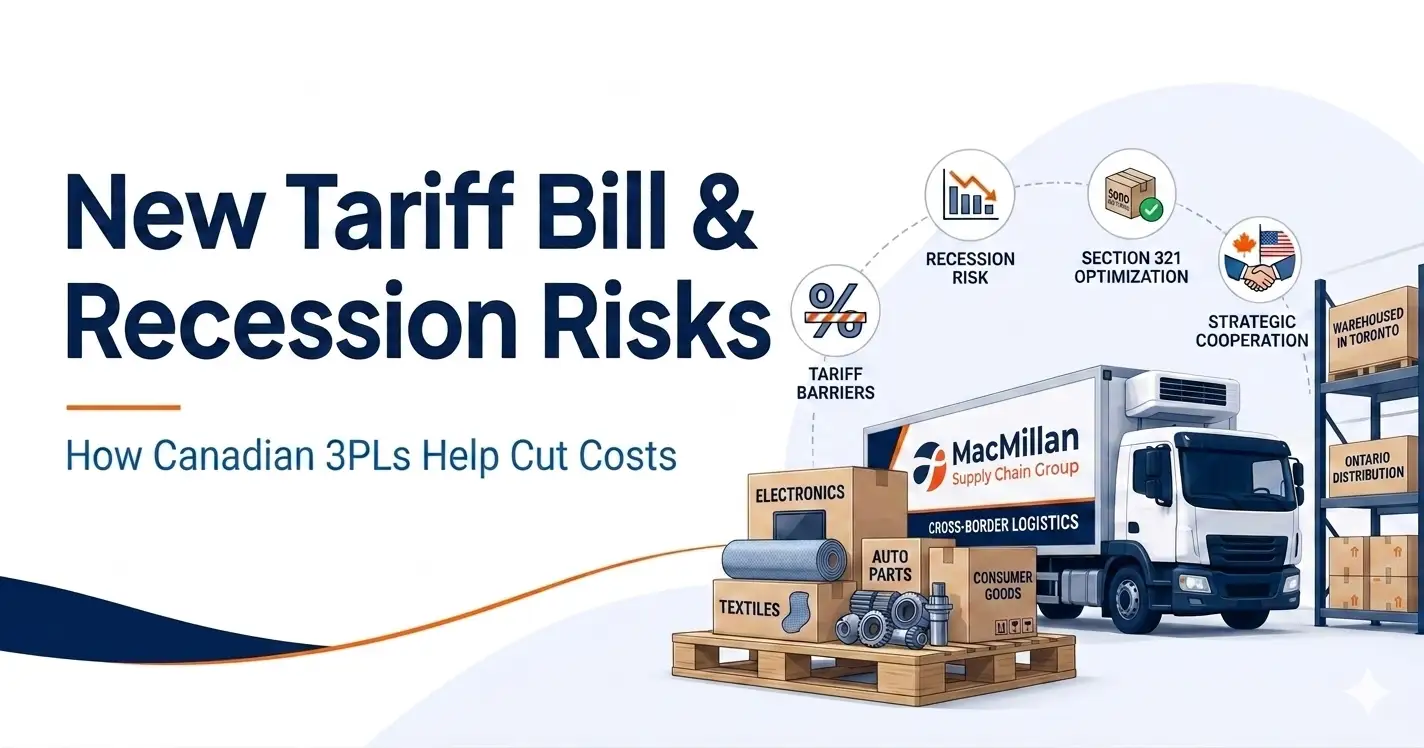
Businesses incur increased expenses that may jeopardize profitability when governments impose tariffs on imported goods. Businesses on both sides of the border now face additional difficulties as a result of the recent tariff bill that affects trade between the United States and Canada. These tariffs raise the risk of a recession when combined with earlier trade restrictions. Nonetheless, there is a strategic benefit to working with a Canadian 3PL like MacMillan Supply Chain Group. Our proficiency in warehouse management, Section 321 optimization, and cross-border logistics can assist you in overcoming these obstacles while cutting expenses. This article describes how our 3PL services in Toronto, Ontario, and throughout Canada can shield your company from the effects of tariffs and the dangers of a recession.
The implementation of new tariffs between the United States and Canada in early 2025 brought about significant changes to the trade landscape in North America. Supply chains on both sides of the border have been impacted by these tariffs, which were imposed to address a number of political and economic issues.
These new tariffs, when paired with earlier trade restrictions, pose a significant threat to companies that depend on cross-border trade. Complicated compliance requirements, higher expenses, and delayed shipments can reduce profit margins and possibly trigger a recession or slowdown in the economy as a whole.
The good news is that your company can overcome these obstacles by collaborating with a strategic 3PL partner in Canada. At MacMillan Supply Chain Group, we’ve created customized solutions to assist businesses in reducing the effects of tariffs, streamlining their logistics processes, and utilizing clauses like Section 321 to keep prices competitive.
This post will explain the recession risks, break down the new tariff situation, and demonstrate how our 3PL services in Ontario, Toronto, and throughout Canada can help your company not only survive but flourish in this difficult climate.
The rules for businesses operating across the U.S.-Canada border have been significantly altered by the recent tariff bill. Let’s examine the situation and the reasons it affects your company.
A number of new tariffs imposed by the US on Canadian goods include:
Canada didn’t do nothing in response. Retaliatory 25% tariffs were imposed by the Canadian government on US imports valued at about $29.8 billion. These countermeasures target a variety of products, such as consumer goods, agricultural products, steel, and aluminum.
This trade tension creates significant challenges for businesses on both sides of the border. If you’re importing or exporting across the U.S.-Canada border, you’re likely feeling the pinch in several ways:
Higher prices for both raw materials and completed goods; more complicated requirements for customs documentation; longer border clearance times; and uncertainty regarding future trade policies
These tariffs pose a significant risk to the profitability of numerous businesses, making them more than just a minor annoyance. When faced with an additional 25% cost on essential imports, a company that had previously operated with healthy margins may find it difficult to maintain profitability.
A strategic alliance with a 3PL Canada provider is extremely beneficial in this situation. You can create plans to reduce tariff effects and preserve your competitive advantage with the correct logistics partner.
Economic theory and historical data support the link between tariffs and recessions. It is easier to understand why the current tariff situation raises recessionary concerns when one is aware of this relationship.
Several detrimental economic effects usually occur when tariffs raise the price of goods:
As demonstrated by Canada’s response, retaliatory actions frequently follow tariffs, resulting in a vicious cycle of increasing trade restrictions.
These elements work together to produce formidable obstacles to economic expansion. The economy may contract and possibly enter a recession if both consumers and businesses reduce their spending.
Since many economists are already seeing warning signs in the overall economy, the current situation is especially worrisome. The risk of an economic contraction is increased when tariff pressures are added to already-existing difficulties.
This implies that you must take proactive measures to control expenses and preserve operational flexibility for your company. Engaging with a 3PL warehouse in Toronto or Ontario provides you with access to key locations and knowledge that can make overcoming these obstacles easier.
You can quickly adjust to shifting trade conditions and maintain a seamless supply chain by working with MacMillan Supply Chain Group, a logistics partner that is knowledgeable about both the Canadian and American markets.
Section 321 of the U.S. Tariff Act is one of the most effective instruments for reducing the effects of tariffs. This clause permits shipments worth $800 or less to enter the country duty-free, which presents a big opportunity for companies that know how to take advantage of it properly
Section 321 offers several key benefits:
For e-commerce businesses and companies that ship directly to consumers in the U.S., Section 321 represents a valuable opportunity to avoid tariffs entirely on many shipments. However, careful preparation and execution are necessary to fully benefit.
A Canadian 3PL partner is crucial in this situation. We at MacMillan Supply Chain Group have created unique procedures to help our customers get the most out of Section 321:
You can access warehouse space that is ideally situated for cross-border shipping by collaborating with our 3PL Toronto or 3PL Ontario facilities. Because of this close proximity, Section 321 benefits can still be utilized while enabling quicker delivery times to U.S. customers.
By using MacMillan Supply Chain Group to implement a Section 321 strategy, companies with high tariff exposure can save a lot of money, frequently enough to keep competitive pricing in spite of the difficult trade environment.
Working with a Canadian 3PL has clear benefits over alternative logistics options when dealing with tariff issues and recession risks. For companies navigating the modern trade environment, MacMillan Supply Chain Group’s status as a leading 3PL in Canada offers special advantages.
First, we have a big geographic advantage. With 3PL warehouses situated in key areas of Toronto and Ontario, we provide:
Second, our specific expertise in international trade is priceless:
Third, we can adjust to shifting circumstances thanks to our operational flexibility:
You get more than just warehouse space when you work with MacMillan Supply Chain Group; you also get a strategic partner who knows how to handle tariff issues. Our 3PL services in Canada are designed to help you maintain competitiveness even as trade conditions change.
For businesses concerned about recession risks, our flexible model also provides important cost advantages. Rather than investing in fixed infrastructure during uncertain economic times, working with our 3PL allows you to convert fixed costs to variable expenses—scaling up or down as needed while maintaining excellent service levels.
Companies that must deal with tariffs and the possibility of a recession often face the following issues:
Many businesses experience immediate cash flow issues when tariffs abruptly raise costs by 10% to 25%. This issue is made worse if your rivals are exempt from the same tariffs, which forces you to absorb expenses rather than pass them on to clients.
When tariffs render some sourcing routes unprofitable, established supply chains may become chaotic. Restructuring logistics networks or locating substitute suppliers takes time and introduces operational uncertainty.
Inventory management is very challenging when tariffs and recession risks are combined. While having too much inventory requires financial investment, having too little can result in lost sales opportunities.
There is a substantial administrative burden associated with navigating the intricate regulations surrounding tariffs, country of origin requirements, and exemption qualifications. Errors may lead to fines or unforeseen expenses.
Tariffs can force companies to make tough choices about which customer segments to prioritize and which to possibly abandon, effectively pricing them out of some markets.
Long-term planning is very difficult due to the erratic nature of trade policies. When future costs are unpredictable, businesses find it difficult to decide what investments to make.
When compared to rivals situated in nations that are not subject to the same trade restrictions, businesses caught in the crossfire of tariff disputes may find themselves at a disadvantage.
Resolving tariff issues frequently necessitates taking important management time and funds away from expansion plans and core business operations.
These problems can create a perfect storm for businesses, especially when combined with broader economic slowdown. However, with the right 3PL partner, many of these challenges can be effectively addressed.
We at MacMillan Supply Chain Group have created all-inclusive solutions to deal with the current recession and tariff issues that businesses face. To assist you in navigating these intricate issues, our approach combines customs knowledge, strategic warehouse positioning, and adaptable logistics models.
Our 3PL warehouse network in Toronto and Ontario offers the best location for international trade:
Our specific expertise assists you in navigating the intricate realm of trade laws and tariffs:
In order to lower the possibility of delays, inspections, or fines at the border, we make sure that all customs documentation is accurate and complete.
In order to find opportunities for reduced duty rates or exemptions, our professionals assist in determining the appropriate Harmonized Tariff Schedule (HTS) codes for your products.
Our flexible strategy keeps you flexible in unpredictable economic times:
We assist you in putting strategies into place that keep you competitive even when the economy is struggling:
Our value-added services, which include kitting, assembly, and customization, can help you stand out from the competition and keep profits high in the face of price pressure.
More than just 3PL services in Canada are provided by working with MacMillan Supply Chain Group; you also get a strategic partner who is aware of the complex interactions between trade laws, tariffs, and the state of the economy. Our products are made to help you thrive in this difficult environment, not just get by.
It’s easy to take advantage of our recession-proofing and tariff mitigation strategies. To get started with MacMillan Supply Chain Group, follow these steps:
In order to determine tariff exposure and areas for optimization, we start by examining your current operations:
Examine your product catalog to find HTS codes. Examine current shipping trends and client locations.
Assess fulfillment and inventory placement tactics. Determine possible Section 321 opportunities.
This evaluation gives you a clear picture of how tariffs are affecting your company and which tactics will yield the biggest returns.
We create a customized strategy for your company based on the assessment:
Utilizing our 3PL Ontario and 3PL Toronto facilities, design the best possible warehouse network. Develop Section 321 shipping guidelines for qualified goods.
Establish protocols for USMCA compliance records. – Establish rules for allocating inventory to various locations.
Your strategy will take into account your particular products, markets, and business objectives while optimizing opportunities for tariff avoidance.
Our team works closely with yours to implement the new plan:
Install inventory in our facilities for 3PL warehouses.
Link your order management system to ours. Inform your employees of the new protocols and required paperwork.
Create performance metrics and reporting.
We guarantee a seamless transition with little interference with your present business operations.
Following implementation, we continue to refine the plan:
Keep tabs on modifications to trade and tariff regulations.
Monitor important performance metrics
Find more ways to cut costs. Modify inventory placement in response to shifting demand trends.
Your supply chain will stay robust despite shifting economic conditions thanks to this continuous optimization.
Don’t wait for recession risks and tariffs to affect your profits. To find out how our 3PL Canada services can safeguard and expand your company, get in touch with MacMillan Supply Chain Group right now.
Our team of logistics specialists is prepared to assess your particular circumstance and create a tailored solution that tackles your particular difficulties. We have the infrastructure and experience to assist, whether your main concerns are recession readiness, tariff mitigation, or both.
Contact our team today for a free consultation, or explore our specialized services for [3PL], and [Section 321 optimization]
Allow MacMillan Supply Chain Group to guide you through these difficult economic times. Together, we will create plans that will position your company for sustained success while shielding it from tariffs and recession threats.
The new tariff bill implements a 25% duty on non-USMCA compliant goods from Canada and Mexico, plus a 10% tariff on Canadian energy products and potash outside USMCA preferences. Goods that qualify under USMCA rules of origin are exempt from these tariffs. In response, Canada has imposed 25% retaliatory tariffs on approximately $29.8 billion worth of U.S. imports, affecting products ranging from steel and aluminum to consumer goods. These measures significantly impact cross-border supply chains and increase costs for many businesses.
Tariffs increase the cost of imported goods, which raises prices for businesses and consumers. As companies face higher expenses, they often reduce investment, delay expansion, or pass costs to customers—lowering overall demand. At the same time, supply chain disruptions and retaliatory tariffs between countries can reduce trade volume. When both consumer spending and business activity decline, it creates economic pressure that can lead to a slowdown or recession.
Section 321 is a U.S. trade provision that allows shipments valued at $800 or less to enter the United States duty-free. Businesses can use this rule to avoid tariffs by splitting larger shipments into smaller, qualifying packages. This is especially beneficial for e-commerce and direct-to-consumer brands shipping to the U.S. By leveraging Section 321 through a Canadian 3PL, companies can significantly reduce duty costs, simplify customs clearance, and maintain competitive pricing.
A Canadian 3PL offers strategic advantages for tariff mitigation because inventory can be stored in Canada and shipped to the U.S. under optimized conditions, including Section 321 eligibility. Canadian 3PLs are also well-positioned near key border crossings, enabling faster and more cost-efficient cross-border distribution. Additionally, they have expertise in both Canadian and U.S. trade regulations, helping businesses navigate tariffs, USMCA compliance, and customs requirements more effectively than a U.S.-only provider.
MacMillan Supply Chain Group supports USMCA compliance by helping businesses determine whether their products meet rules of origin requirements for preferential tariff treatment. Their team assists with proper classification using Harmonized Tariff Schedule (HTS) codes, ensures accurate documentation, and verifies eligibility to avoid unnecessary duties. By managing compliance correctly, MacMillan helps businesses reduce or eliminate the 25% tariffs on qualifying goods.
Businesses that rely on cross-border trade, e-commerce fulfillment, or high inventory turnover benefit the most from 3PL warehouse services during economic uncertainty. This includes retailers, manufacturers, wholesalers, and direct-to-consumer brands. A 3PL provides flexible storage, scalable fulfillment, and cost-efficient logistics, allowing companies to reduce fixed costs, adapt to demand changes, and maintain service levels even during market fluctuations.