

Enhancing Supply Chain Resilience Amid Geopolitical Tensions: Strategies and Best Practices
Quick Summary Picture this: Your supply chain is a Jenga…

Quick Summary Picture this: Your supply chain is a Jenga…
Introduction In our modern world, being environmentally and socially responsible…
In today’s global economy, navigating trade policies and tariffs has…
Quick Summary Imagine a world where every product’s journey from…
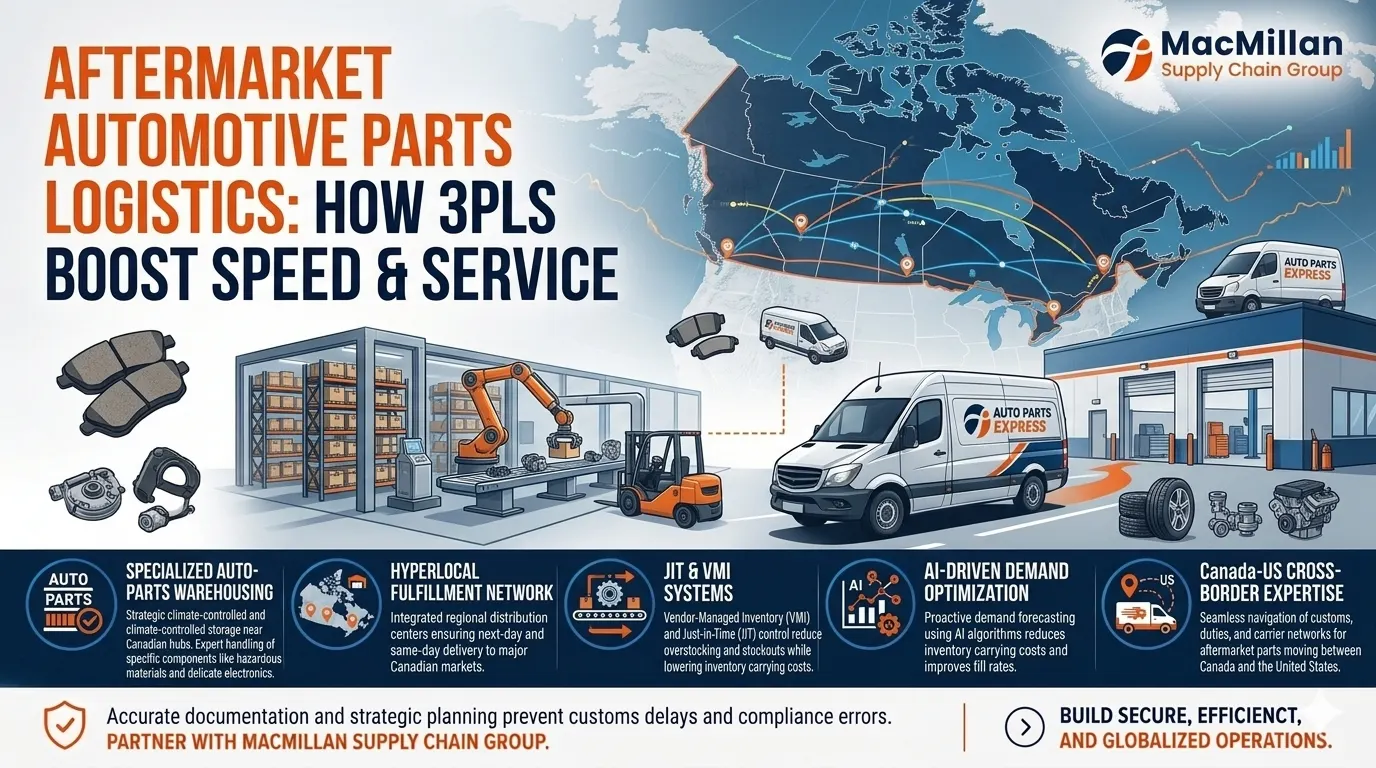
Aftermarket automotive parts logistics requires precision, speed, and reliability to meet customer expectations. Third-party logistics (3PL) providers like MacMillan Supply Chain Group are revolutionizing this sector by implementing advanced warehousing solutions, just-in-time inventory systems, and hyperlocal fulfillment networks across Canada. 3PLs assist auto parts companies in cutting expenses and speeding up delivery with AI-driven optimization, eco-friendly procedures, and specialized knowledge of international shipping. This in-depth guide examines how working with the ideal 3PL can revolutionize your aftermarket parts business, improve customer satisfaction, and spur company expansion in both the Canadian and American markets.
Logistics frequently make the difference between success and failure in the cutthroat automotive aftermarket of today. The speed and dependability of delivery can make or break the customer experience, whether a repair shop needs a critical part to get a customer’s car back on the road or a do-it-yourself enthusiast orders a performance upgrade.
This is where third-party logistics (3PL) companies come in quite handy. Businesses like MacMillan Supply Chain Group, which specialize in aftermarket automotive parts logistics, provide knowledge that revolutionizes the flow of parts through the Canadian automotive supply chain. 3PLs give parts suppliers the resources and expertise they need to succeed, from advanced warehouse management to last-mile delivery options.
However, what precisely makes 3PL solutions for auto parts so successful? How do they strike a balance between cost effectiveness and the requirement for speed? And why are more suppliers of aftermarket parts in the US and Canada outsourcing their logistics? Let’s explore the logistics of aftermarket auto parts and see how the ideal 3PL partner can transform your company..
The cornerstone of efficient aftermarket parts logistics is automotive warehousing solutions. Auto parts storage, in contrast to general warehousing, necessitates specific skills and knowledge to manage the particular difficulties of the sector.
Strategic facility placement close to major transportation hubs and population centers; sophisticated inventory management systems that track parts down to the bin level; climate-controlled environments for sensitive components; specialized handling for hazardous materials and delicate parts; and scalable space allocation that expands with your business
When these warehouse capabilities are combined with cross-docking strategies, the real magic happens. Cross-docking drastically cuts down on handling time and storage expenses by allowing high-demand items to go straight from inbound to outbound shipping rather than storing every component.
For instance, a popular brake pad model may be sorted and redistributed to trucks going to repair shops throughout Ontario as soon as it arrives at our facility, all without ever being placed on a shelf. Delivery times and storage expenses are reduced with this just-in-time strategy.
3PLs like MacMillan assist parts suppliers in striking the ideal balance between keeping enough inventory to meet demand and tying up capital in excess inventory by centralizing inventory across key locations.
Speed is not only desirable but also necessary in the automotive aftermarket. Every hour that a car is in the shop waiting for parts results in disgruntled customers and possible lost revenue for repair shops.
Even in less populated areas, our hyperlocal fulfillment strategy allows for quick commerce for automotive parts by placing inventory closer to end users. We are able to offer delivery times that were previously unattainable for many parts suppliers because we maintain facilities in strategic locations across Canada.
The outcomes speak for themselves: after using our services, our clients usually experience an average delivery time reduction of 40–60%. Stronger ties with repair shops, fewer canceled orders, and increased customer satisfaction are all directly correlated with this improvement.
Furthermore, real-time visibility during the delivery process is provided by our integrated tracking systems. From the warehouse to the customer’s door, customers can track their orders and receive proactive updates that boost confidence and cut down on customer support requests.
One of the biggest obstacles in the logistics of aftermarket auto parts is efficiently managing inventory. Overstocking causes capital to be locked up in slow-moving areas. You run the risk of stockouts and lost sales if you have too little inventory.
MacMillan uses cutting-edge inventory management techniques to resolve this conundrum:
With the help of our VMI systems, suppliers can keep an eye on stock levels in real time and automatically restock items in response to real usage trends. Without the need for manual ordering procedures, this cooperative approach guarantees that the appropriate parts are available when needed.
We assist clients in lowering their overall inventory investment while preserving high service levels by putting JIT principles into practice. Parts arrive when needed, lowering the need for storage and the chance of obsolescence.
To forecast future demand, our in-house algorithms examine market indicators, seasonal patterns, and historical data. By proactively modifying inventory levels, this AI-driven inventory optimization helps avoid both overstocking and stockouts.
Together, these systems provide an effective, responsive inventory management strategy that can be adjusted to reflect shifting market conditions. For instance, our systems can identify a pattern of increased demand and automatically adjust stock levels before manual intervention is feasible when a specific vehicle model experiences a common failure.
The result? Our clients typically reduce their inventory carrying costs by 20-30% while simultaneously improving their fill rates and customer satisfaction scores.
Many aftermarket parts suppliers continue to face major obstacles in spite of the advancements in logistics technology and procedures:
Numerous businesses run several warehouses with redundant inventory, which results in inefficiency and uneven service quality across geographies.
It’s challenging to track parts in the supply chain without sophisticated tracking systems, which can result in poor customer service and unfulfilled delivery commitments.
Failed deliveries, damaged goods, and incorrect parts shipments lead to expensive returns and unhappy customers.
Seasonal variations in the demand for automotive parts can make it challenging to maintain proper staffing and inventory levels.
Navigating customs laws, duties, and various carrier networks is necessary when moving parts between Canada and the United States.
There are particular delivery challenges when trying to reach clients in far-flung locations or crowded cities.
Traditional distribution models are under pressure from modern consumers who demand delivery speeds and tracking features comparable to those of Amazon.
Environmental concerns are becoming more and more significant to both consumers and regulators, necessitating innovative packaging and shipping strategies.
We at MacMillan Supply Chain Group have created all-inclusive solutions to deal with these typical issues in the logistics of aftermarket auto parts:
We provide a unified network of well-positioned distribution centers throughout Canada and the United States as opposed to operating disparate, ineffective facilities. Redundancy is removed with this integrated approach, which also guarantees quick delivery to all markets.
Our knowledge of the Canadian automotive supply chain enables us to strategically position inventory where it is most needed. We keep inventory in several places for parts that are in high demand so that same-day or next-day delivery is possible. We centralize inventory for specialty items that move more slowly in order to increase efficiency without compromising availability.
All supply chain visibility is provided by our in-house warehouse management system. You will be aware of the precise location and arrival time of parts from the time they enter our facilities until they arrive at their destination.
This openness also applies to your clients. Accurate delivery estimates, automated delivery notifications, and real-time tracking information boost trust and cut down on “where’s my order” questions.
A conventional pain point is turned into a competitive advantage by our returns management procedure.We offer:
Our scalable operations adapt to seasonal fluctuations without compromising service levels. We can quickly increase capacity to accommodate higher volume during peak times. You only pay for the space and services you use during slower times.
We easily handle customs requirements because we have a great deal of experience shipping from the United States to Canada. Our knowledge of duties and taxes, carrier connections, and documentation experience guarantee seamless cross-border part transportation.
For both urban and rural locations, we have created customized last-mile delivery solutions. Our extensive network allows for same-day options and rapid automotive part commerce in urban areas. We use strategic alliances to deliver to remote locations in a dependable and economical manner.
Everything we do is designed around your customers’ expectations. From packaging that protects parts during transit to delivery windows that accommodate repair shop schedules, we optimize every touchpoint in the customer experience.
Our dedication to sustainability consists of:
MacMillan Supply Chain Group turns the logistics of aftermarket auto parts from a problem into a competitive advantage for our customers by putting these all-inclusive solutions into practice.
Making the switch to a 3PL partner such as MacMillan Supply Chain Group doesn’t have to be difficult. To begin, follow these steps:
Start by assessing the logistics performance you currently have. Find areas where costs appear out of proportion to value, as well as pain points and service gaps. Common metrics to look at are: Average delivery time, order accuracy rate, and carrying costs for inventory. The percentage of returns and customer satisfaction ratings.
What goals do you hope to accomplish by working with a 3PL? Reducing delivery times, reaching a wider audience, cutting logistics expenses, or raising customer satisfaction are typical objectives. Clearly define your priorities.
Seek out a 3PL that specializes in the logistics of aftermarket auto parts. It’s possible that general logistics companies lack the specific expertise required to handle the particular difficulties faced by the automotive aftermarket.
Think about starting with a small-scale implementation, maybe focusing on a single product line or area. This enables you to evaluate the collaboration and procedures prior to a comprehensive implementation.
Work with your 3PL to connect your ordering systems, inventory management tools, and customer service platforms. The more seamless this integration, the better your results will be.
After implementation, collaborate with your 3PL to make ongoing improvements and evaluate performance metrics on a regular basis. The most successful collaborations change over time to meet shifting business requirements and market conditions.
Are you prepared to revolutionize the logistics of aftermarket parts? Get a consultation with MacMillan Supply Chain Group right now. After examining your current operations, our team of professionals will create a solution tailored to your unique opportunities and challenges.
We are in a unique position to support your company’s success in the cutthroat industry of today thanks to our vast knowledge of Canadian automotive supply chain management and our dedication to ongoing innovation. From hyperlocal fulfillment in Canada to cross-border shipping expertise, MacMillan Supply Chain Group provides the comprehensive logistics support that modern aftermarket parts suppliers need.
Don’t let logistics limitations hold your business back. Partner with MacMillan Supply Chain Group and discover how the right 3PL relationship can drive growth, improve customer satisfaction, and boost your bottom line.
Automotive parts logistics requires specialized handling due to the diversity of parts (from tiny sensors to large body panels), varying urgency levels (some repairs are critical safety issues), and the need for perfect accuracy (the wrong part can cause significant problems). Additionally, the automotive aftermarket has unique seasonal patterns and specific requirements for hazardous materials handling. At MacMillan Supply Chain Group, we've developed expertise specifically for these challenges, with systems designed around automotive industry standards and practices.
A 3PL like MacMillan Supply Chain Group reduces inventory carrying costs by optimizing stock levels using data-driven forecasting, Just-in-Time (JIT) delivery, and Vendor-Managed Inventory (VMI) systems. Instead of holding excess stock in multiple locations, inventory is centralized and distributed based on real demand. This lowers warehousing costs, reduces obsolescence risk, and frees up capital tied in slow-moving inventory.
Delivery timeframes depend on location and service level, but typically include same-day shipping for orders placed before cutoff times and next-day delivery to major Canadian markets. With hyperlocal fulfillment hubs, many automotive parts reach customers within 24–48 hours, significantly improving turnaround times for repair shops and end customers.
Cross-border shipping is managed through integrated customs processes, documentation handling, and established carrier partnerships. MacMillan Supply Chain Group ensures compliance with customs regulations, duties, and taxes while minimizing delays. This streamlined approach reduces border friction and ensures smoother movement of automotive parts between the U.S. and Canada.
Advanced warehouse management systems (WMS), AI-driven demand forecasting tools, and real-time tracking systems are used to manage inventory. These technologies track parts down to bin-level accuracy, predict demand patterns, and automatically adjust stock levels to prevent both overstocking and stockouts. Customers also benefit from real-time order visibility.
Returns are handled through a structured reverse logistics process that includes easy return initiation, fast processing, inspection, and classification. Returned parts are either restocked, repaired, or disposed of based on condition. Warranty parts are processed efficiently to minimize downtime for customers and maintain service continuity.