How Do 3PLs Help Automotive Sellers?
Automotive retailers have historically relied on brick-and-mortar stores due to…
Automotive retailers have historically relied on brick-and-mortar stores due to…
In today’s fast-paced market place, efficiency is paramount. To enhance…
In the past two years, the logistics industry has experienced…
Selecting a reliable third-party logistics (3PL) provider is crucial for…
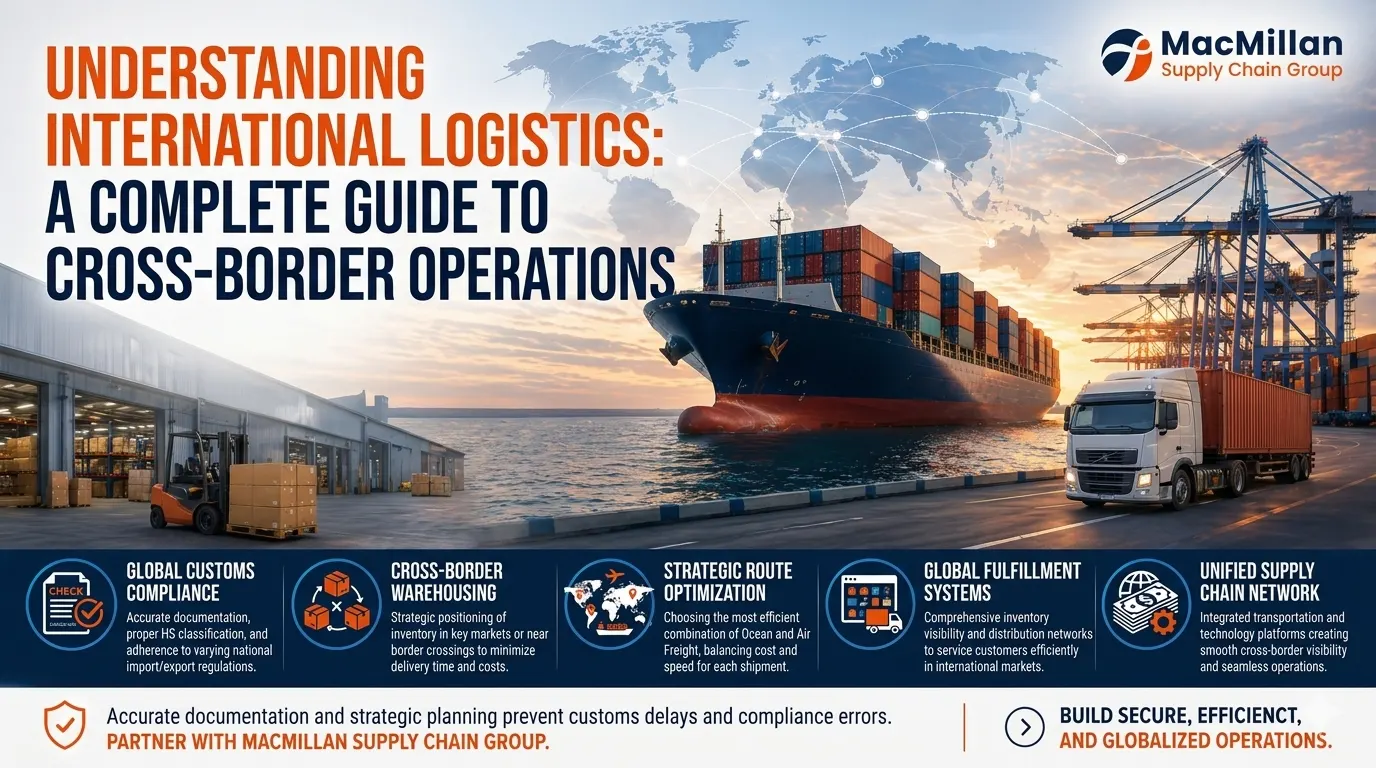
The intricate movement of goods across national borders is known as international logistics, and it calls for knowledge of distribution, warehousing, transportation, and customs clearance. Knowing the basics of cross-border operations is crucial for companies growing internationally to succeed. From choosing modes of transportation to overseeing cross-border warehousing and fulfillment, this guide examines important aspects of international logistics. MacMillan Supply Chain Group provides the infrastructure and experience to effectively handle international logistics challenges, regardless of your level of experience with international trade or your desire to streamline current operations.
Have you ever pondered how goods from around the globe make their way to your neighborhood shops or homes? International logistics the difficult process of transporting goods across borders while negotiating complex regulations, transportation networks, and fulfillment systems holds the key to the solution.
Choosing the best shipping option, overseeing cross-border storage, and guaranteeing efficient customs clearance are all included in international logistics. Gaining proficiency in these areas is essential for companies growing outside of their home markets in order to preserve their competitive edge and client satisfaction.
International shipping presents special difficulties for Canadian companies in the linked economy of today. Given Canada’s size and closeness to the US market, businesses require strategic approaches to fulfillment and warehousing that strike a balance between speed, cost, and compliance. Knowing the basics of international logistics can mean the difference between success and expensive errors, whether you’re shipping from Vancouver to Vienna or Toronto to Tokyo.
The most economical way to transport big loads of goods across international borders is still by sea. It’s critical for Canadian companies shipping abroad to comprehend their container options:
It usually takes 20 to 30 days for ocean freight from Asia to Canadian ports, which makes it perfect for routine inventory replenishment or non-urgent shipments. Although ocean shipping is slower than air freight, it is usually 4-6 times less expensive, making it the best choice for large orders or bulky items.
According to logistics specialists at MacMillan Supply Chain, “timing is everything when planning international logistics.” “Ocean freight offers outstanding value for routine inventory movements, but it requires longer lead times if planned properly.“
When time is critical, air freight becomes the go-to solution for international logistics. Air freight Canada services connect businesses to global markets in days rather than weeks:
Despite being more expensive than ocean shipping, air freight has benefits beyond speed. Products travel less, which lowers the risk of damage and the cost of carrying inventory. The higher cost of air freight is frequently justified by increased cash flow and customer satisfaction for valuable items, perishables, or urgent shipments.
The global location of your inventory has a significant impact on shipping costs and delivery times. Cross-border warehousing solutions give companies the freedom to effectively service global markets:
MacMillan Supply Chain Group operates strategically located warehouses throughout Canada, providing businesses with flexible storage solutions that minimize transit times and customs delays. Businesses can lower shipping costs and increase delivery times by putting inventory closer to end users.
International inventory management poses special difficulties. Advanced systems are necessary for efficient international logistics in order to track inventory levels, keep an eye on movement, and guarantee that goods are available when and where they are needed.
Contemporary warehouse management systems give companies real-time visibility across international facilities, allowing them to:
According to supply chain experts, “having facilities in multiple countries isn’t the key to successful international warehousing.” “It’s having the systems and knowledge to run those facilities as a unified global logistics network.”
Navigating customs clearance procedures is one of the most difficult parts of international logistics. Every nation has different regulations, standards for documentation, and things that are not allowed. Working with knowledgeable customs brokers is crucial for companies shipping between Canada and foreign locations.
Customs clearance typically requires:
Shipment delays, extra inspections, or even fines may result from mistakes in customs paperwork. Working with a reputable freight forwarder in Canada, such as MacMillan Supply Chain Group, helps guarantee adherence to all applicable laws.
Navigating intricate import/export laws that differ by nation and product type is part of international logistics, which goes beyond simple customs clearance. These could consist of:
Staying compliant with these regulations requires ongoing vigilance and expertise. As regulations change frequently, businesses engaged in international trade need partners who actively monitor regulatory developments and adapt procedures accordingly.
Numerous obstacles in international logistics have the potential to upset supply chains and lower customer satisfaction. Typical issues include:
These difficulties can have a big effect on how businesses operate, which can result in higher expenses, unhappy customers, and lost chances in foreign markets.
We at MacMillan Supply Chain Group have created all-inclusive solutions to deal with the challenges of international logistics. Our integrated approach creates smooth cross-border operations by combining strategic warehousing, transportation expertise, and cutting-edge technology.
For every international move, our transportation management solutions provide companies with the best shipping choices:
Our transportation experience reduces transit times and keeps costs under control for companies shipping from Canada to foreign locations. To increase efficiency, we bargain with carriers for lower prices and, when practical, combine shipments.
With the help of our warehousing solutions, companies can strategically place inventory, cutting down on delivery times and transportation expenses while preserving the best possible service standards across all markets.
Businesses that work with MacMillan have access to customs knowledge that helps them avoid expensive delays and compliance problems.
Our technological platform offers complete visibility into global supply chains:
Proactive management of international shipments is made possible by this visibility, which enables companies to spot possible problems early on and take action before they affect clients.
Effective international logistics implementation necessitates careful planning and the appropriate alliances. Here are some tips for improving your cross-border business operations:
Examine your current international logistics procedures first:
Determine current cross-border movement pain points; determine total landed costs for international shipments; gauge current international customer delivery times; and examine compliance procedures and documentation requirements.
This assessment provides a starting point for advancement and identifies priority areas for improvement.
Create a strategic plan for international logistics based on your assessment:
A thorough plan tackles particular operational issues while coordinating global logistics with overarching business goals.
Working with a seasoned 3PL provider like MacMillan Supply Chain Group is the best strategy to maximize international logistics. Our all-inclusive services lower expenses and increase customer satisfaction while streamlining cross-border operations.
Are you prepared to revolutionize your international logistics? To find out how our fulfillment, shipping, and warehousing solutions can improve your cross-border operations, get in touch with MacMillan Supply Chain Group right now. Our team of professionals will assess your unique requirements and create a tailored international logistics strategy that promotes customer satisfaction and business expansion.
You can cross international borders with assurance when MacMillan is your logistics partner because you know that your products will reach international markets effectively, legally, and economically.
When you ship enough goods to fill an entire container, you are granted exclusive use of that space, which is known as full container load, or FCL. When you don't have enough volume to fill a container, you can share container space with other shippers using LCL (Less than Container Load). While LCL offers flexibility for smaller shipments, FCL usually offers better security and possibly lower costs per unit.
Choosing between air and sea freight depends mainly on speed, cost, and the nature of your shipment. Air freight is the best option when time is critical, such as for urgent deliveries, high-value goods, or perishable items, as it can deliver within a few days. However, it comes at a significantly higher cost. Sea freight, on the other hand, is more suitable for large, heavy, or non-urgent shipments. It is far more economical but takes longer, often several weeks. Businesses need to balance urgency and budget to make the right decision.
Shipping internationally requires several essential documents to ensure smooth customs clearance. The most important ones include a commercial invoice, which outlines the value and details of the goods, a packing list that specifies the contents of the shipment, and a bill of lading or air waybill that serves as the transport document. Additionally, a certificate of origin may be required to indicate where the goods were produced, along with the correct HS code to classify the products for customs purposes. Accurate documentation is critical to avoid delays or penalties.
Reducing customs delays starts with proper preparation and attention to detail. Ensuring that all documentation is complete, accurate, and consistent is essential. Using the correct HS codes and providing clear, detailed product descriptions can help customs officials process shipments more efficiently. Working with an experienced customs broker or third-party logistics provider can also significantly reduce the risk of errors. Staying informed about the import regulations of the destination country further helps prevent unexpected issues at the border.
Incoterms, or International Commercial Terms, are globally recognized rules that define the responsibilities of buyers and sellers in international trade. They determine who is responsible for transportation costs, insurance, duties, and at what point the risk transfers from the seller to the buyer. For example, terms like FOB, CIF, and DDP clearly outline different levels of responsibility. Their significance lies in providing clarity and consistency in global transactions, reducing misunderstandings, and helping both parties manage costs and risks effectively.
Outsourcing international logistics to a third-party logistics provider offers multiple advantages for businesses. It provides access to specialized expertise in shipping, customs compliance, and global regulations, which reduces the risk of costly errors. It also helps lower operational costs through better carrier rates and optimized shipping routes. Additionally, businesses save time and can focus on their core operations while the logistics provider handles complex supply chain tasks. With advanced technology and real-time tracking, companies gain better visibility and control over their international shipments, making the entire process more efficient and scalable.