Is Your Fulfillment Ready for AI Shopping in Canada?
A shopper asks an AI assistant to find a fragrance-free…
A shopper asks an AI assistant to find a fragrance-free…
As an online store business owner, offering the best customer…
The logistics industry in Canada is growing at an impressive…
In today’s competitive business landscape, staying ahead of the curve…
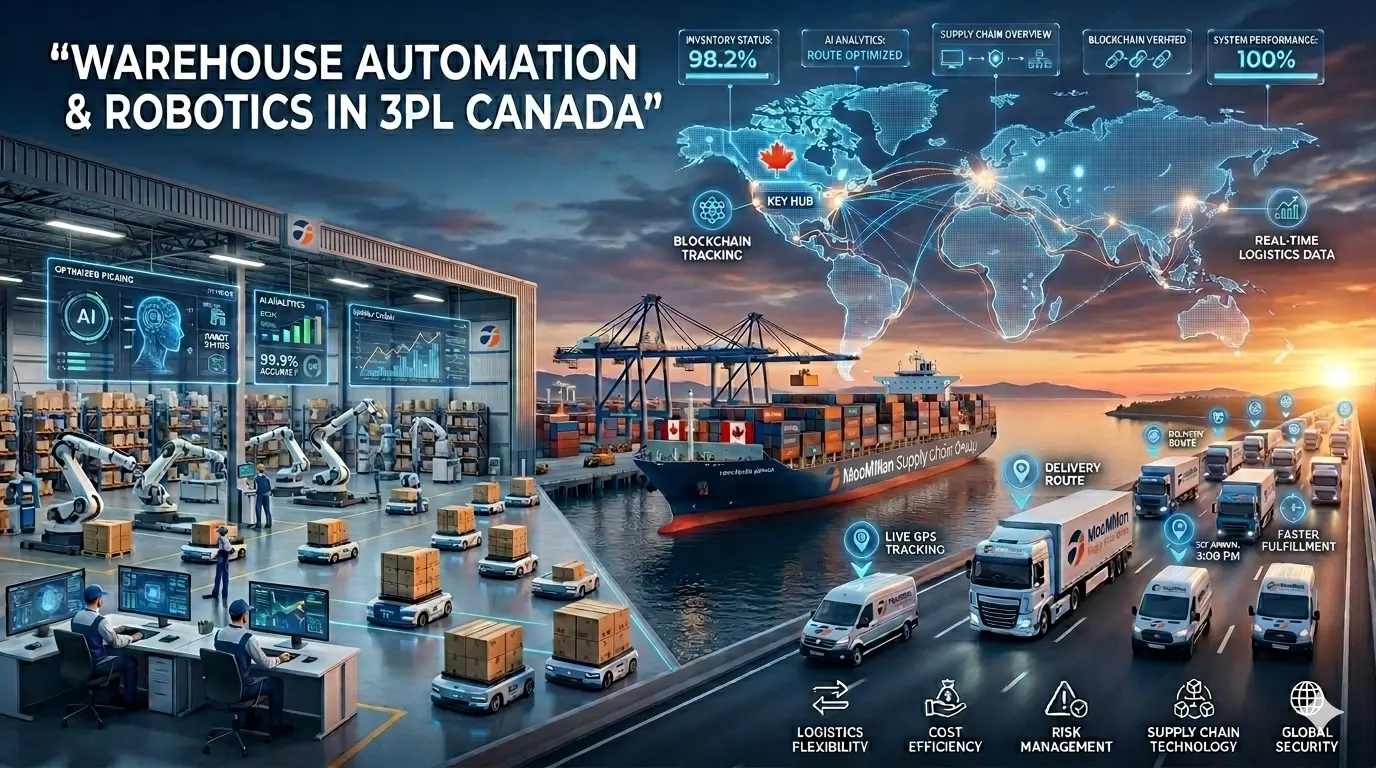
The way third-party logistics (3PL) providers function in Canada is changing due to warehouse automation and robotics. By deploying cutting-edge technologies like AI-driven systems, automated picking solutions, and real-time tracking tools, MacMillan Supply Chain Group is at the forefront of this revolution. These developments assist e-commerce companies in cutting expenses, minimizing mistakes, and expediting product delivery. Businesses in the Canadian market that require dependable fulfillment services benefit from MacMillan’s technological approach, which includes blockchain integration and robotic process automation. This article examines how these developments are changing the logistics industry and helping expanding businesses achieve better outcomes.
Nowhere is the technological renaissance in the logistics sector more apparent than in Canadian fulfillment centers. Traditional warehouse operations find it difficult to keep up with the growing consumer expectations for real-time tracking and faster deliveries. In response, MacMillan Supply Chain Group has adopted robotics and warehouse automation to revolutionize the way 3PL services are provided in Canada.
However, how will this change in technology affect your company? Whether you are an established retailer or an e-commerce startup, integrating cutting-edge 3PL technology can significantly increase customer satisfaction, lower costs, and improve operational efficiency. Automated picking systems and AI-driven warehouse management are examples of innovations that are no longer sci-fi ideas but rather workable solutions that are producing quantifiable outcomes now.
Let’s explore how MacMillan is leveraging these cutting-edge technologies to revolutionize supply chain management across Canada.
A number of integrated technologies that function together form the foundation of MacMillan’s warehouse robotics solutions. All operations are coordinated by an AI-powered warehouse management system at the core. In addition to tracking inventory, this clever system anticipates changes in demand, learns from patterns, and automatically optimizes warehouse layouts.
In logistics, repetitive tasks that previously required human intervention are handled by robotic process automation, or RPA. These consist of:
Compared to more conventional approaches, MacMillan’s use of automated picking systems has shortened order fulfillment times by as much as 65%. These systems retrieve products from storage areas and move them to packing stations using a combination of robotic arms, autonomous mobile robots (AMRs), and conveyor systems.
But the communication between these technologies is the true game-changer. With cloud-based warehouse systems, all of the robots, scanners, and sensors instantly exchange data, resulting in a synchronized operation that instantly adjusts to shifting priorities and conditions.
E-commerce enterprises have historically struggled with inventory management, with stockouts and overstock scenarios having a major negative financial impact. This area of supply chain management has been completely transformed by MacMillan’s approach to inventory optimization tools.
MacMillan gives customers unheard-of insight into the state of their inventory through real-time tracking and monitoring. From the time a product arrives at the warehouse until it is delivered to the final consumer, it is tracked. This visibility also includes:
By projecting future inventory requirements, supply chain management predictive analytics enhances this visibility. To determine the ideal inventory levels, MacMillan’s demand forecasting software examines past sales data, seasonal patterns, and even outside variables like the weather or approaching holidays.
MacMillan’s cold chain management in Canada guarantees product integrity during the fulfillment process for companies that deal with temperature-sensitive goods. From storage to delivery, precise environmental conditions are maintained by specialized packaging solutions and temperature-controlled zones within warehouses.
Daily fulfillment operations are where warehouse automation and robotics are most clearly used in practice. The Canadian fulfillment centers operated by MacMillan demonstrate how these technologies result in real advantages for CA e-commerce logistics.
Order fulfillment time is greatly decreased by automated picking systems. Workers using traditional picking techniques may have to walk through warehouse aisles for several miles each day. On the other hand, MacMillan’s robotics deliver goods straight to packing stations, saving workers’ physical strain and removing unnecessary walking time.
The improvements in accuracy are equally striking. The accuracy rates for manual picking are usually between 96 and 98 percent, which means that errors occur in 2-4 orders out of 100. With a 99.9% accuracy rate, MacMillan’s automated systems virtually eliminate expensive returns and unhappy customers.
Another significant benefit in robotics is scalability. Without the typical difficulties of recruiting and training temporary employees, MacMillan can quickly scale operations during busy times like Black Friday or holiday shopping periods. The robotic fleet can be expanded with more units or work more hours, guaranteeing steady performance even in the face of volume variations.
Many 3PL providers continue to face major operational obstacles that affect customer satisfaction and profitability in spite of technological advancements:
Using cutting-edge 3PL technology and creative strategies, MacMillan Supply Chain Group has created all-encompassing solutions to address these industry-wide issues:
The use of warehouse robotics solutions by MacMillan considerably lessens reliance on manual labor. While human workers concentrate on quality control and exception handling, automated picking systems manage the most labor-intensive tasks. In addition to addressing the labor shortage, this strategy gives warehouse employees more interesting roles, which lowers turnover and boosts job satisfaction.
A significant return on investment is offered by the economical robotic operations. Although a capital investment is needed for the initial implementation, these costs are usually recouped in 18 to 24 months by the continuous operational savings. This positive return on investment is a result of increased throughput, better accuracy, and lower labor costs.
One of MacMillan’s biggest advantages in robotics is scalability. Without sacrificing accuracy or performance, our systems are built to scale operations up or down in response to changes in demand. Our automated systems maintain constant processing speeds and error rates even during peak seasons, when order volumes can rise by 300–400%.
Our cloud-based warehouse systems are just as scalable as physical robots. These platforms guarantee that system performance stays at its best regardless of transaction volume by automatically adjusting processing capacity to handle increased data volumes during times of high demand.
MacMillan’s inventory optimization tools have revolutionized the way businesses handle their inventory. By removing the inconsistencies frequently found in conventional systems, real-time tracking and monitoring offer constant visibility into inventory levels. Instead of conducting recurring audits, our technology conducts continuous inventory counts, quickly detecting and resolving inconsistencies.
Our cold chain management in Canada preserves product integrity during the fulfillment process for companies that need specialized handling. Specialized packaging options and temperature-controlled areas in warehouses guarantee that delicate goods stay within the necessary temperature ranges from delivery to receipt.
Our real-time tracking systems are an example of MacMillan’s dedication to openness. Customers have access to an extensive dashboard that displays:
Blockchain is also visible in Canadian supply chains for goods that need better traceability. Our blockchain implementation produces an unchangeable record of product movement, which is especially useful for luxury goods, food products, and pharmaceuticals where authenticity verification is essential.
By examining product attributes, order trends, and seasonal patterns, AI-driven warehouse management maximizes storage capacity. Fast-moving items are positioned for easy access while optimizing overall storage density thanks to the system’s constant product placement adjustments. This clever use of available space improves picking efficiency while lowering storage expenses.
Although implementing robotics and automation in warehouses may seem intimidating, working with MacMillan Supply Chain Group makes the process simple and seamless. Here’s how to use our cutting-edge technology to revolutionize your logistics business:
A thorough evaluation of your current operations is the first step in the journey. To create a personalized automation plan, our logistics specialists examine your product attributes, order trends, and corporate objectives. This evaluation creates a plan for long-term change and pinpoints areas that can be improved right away.
The systems from MacMillan are made to work with your current order processing, inventory management, and e-commerce platforms. Our technical staff manages every facet of integration, guaranteeing that data moves between systems without interfering with your current business operations.
It’s not necessary to automate everything at once. You can start with the most important parts of your business and increase automation as it expands with MacMillan’s scalable implementation options. This strategy offers instant advantages while requiring less initial investment.
After implementation, our collaboration continues. The team at MacMillan keeps a close eye on system performance, spots areas for optimization, and makes adjustments. Our cutting-edge 3PL technology changes with your business to keep your logistics operations competitive.
Are you prepared to use robotics and warehouse automation to transform your supply chain? To arrange a consultation, get in touch with MacMillan Supply Chain Group right now. Our professionals will assess your unique requirements and show you how our technology can revolutionize your logistics processes while cutting expenses and raising customer satisfaction.
Together, let’s create a supply chain that is more accurate, scalable, and efficient.
Robots, artificial intelligence (AI) systems, and automated machinery are examples of technology that can be used to manage warehouse tasks with little assistance from humans. Our warehouse automation and robotics at MacMillan Supply Chain Group enhance 3PL services by processing orders up to four times faster than manual methods, increasing accuracy to over 99%, and running error-free and fatigue-free around-the-clock. This implies that your products are delivered to clients more quickly and with fewer errors.
Automated picking systems use a combination of robotic arms, autonomous mobile robots (AMRs), and conveyor systems to retrieve products directly from storage locations. Instead of workers walking through aisles, the system brings items to packing stations automatically, which reduces time, increases speed, and improves order accuracy significantly.
Yes, warehouse automation can be cost-effective for SMEs in the long term. Although the initial setup requires investment, businesses usually recover costs within 18–24 months through reduced labor expenses, fewer errors, faster order processing, and improved operational efficiency.
MacMillan uses scalable robotic systems and cloud-based warehouse management tools that can quickly adjust to demand changes. During peak seasons like Black Friday or holidays, additional robotic units and processing capacity can be activated, allowing the system to handle 300–400% higher order volumes without delays or accuracy loss.
Real-time tracking provides full visibility of inventory and order status from warehouse to delivery. Businesses can monitor stock levels, shipment progress, and performance metrics instantly, while customers get accurate delivery updates. This improves transparency, reduces customer complaints, and enhances trust.
Yes, MacMillan’s systems are designed for seamless integration with existing e-commerce platforms, order management systems, and inventory tools. Their technical team ensures smooth data synchronization without disrupting current operations, making the transition to automation simple and efficient.