Black Friday Fulfillment Canada: 2026 Peak Season Guide
Black Friday Fulfillment Canada: How E-commerce Brands Can Prepare for…
Black Friday Fulfillment Canada: How E-commerce Brands Can Prepare for…
When discussing e-commerce, what typically springs to mind? Most likely,…
As the busiest time of the year draws near, the…
As the busiest time of the year draws near, the…
Advanced robotics, AI-powered decision-making systems, and strategic alliances are driving a radical change in the supply chain environment. Logistics networks are becoming more robust, sustainable, and efficient as a result of these advancements. Leading the way in this evolution is MacMillan Supply Chain Group, which uses state-of-the-art technologies and builds cooperative partnerships to maximize the flow of goods across borders and throughout Canada. This article examines how supply chains are changing as a result of these developments and how companies can use them to their advantage in a market that is becoming more and more complex.
The world of supply chains is evolving more quickly than in the past. What used to involve a lot of manual labor, paper records, and reactive problem-solving is now being automated, digitalized, and proactive. We at MacMillan Supply Chain Group are seeing directly how the transportation of goods from producers to customers is being transformed by robotics, artificial intelligence, and strategic alliances.
Large geographic distances, complicated cross-border relations with the US, and seasonal weather extremes that can cause logistical disruptions are some of the particular difficulties faced by Canadian businesses. Supply chain management in the future tackles these issues by fostering cooperative partnerships and technological advancements that build stronger networks.
Understanding these new trends is essential for retailers, manufacturers, and distributors to stay competitive in the quick-paced market of today. Let’s examine how intelligent strategies, robust partnerships, and robots are constructing tomorrow’s supply chains.
Robotics in logistics is bringing about a technological renaissance on the warehouse floor. These days, autonomous mobile robots, or AMRs, move inventory and help human workers by precisely navigating warehouse aisles. These robots significantly boost productivity in the Ontario logistics hub and beyond by avoiding obstacles and optimizing their routes using advanced sensors and artificial intelligence.
Warehouse automation has increased throughput by 40% and decreased picking errors by almost 67% at MacMillan Supply Chain Group. These enhancements focus on consistency and dependability rather than just speed. No matter the time of day, robots perform at the same level, never get tired, and never require breaks.
In contemporary warehousing, human-robot collaboration is the sweet spot. Instead of taking the place of employees, robots perform physically taxing, repetitive tasks while humans concentrate on intricate decision-making and quality assurance. Collaborative picking systems, for instance, pair humans with robots; the human chooses items that need judgment and dexterity, while the robot moves bins.
In Canada, industrial automation is growing, especially as companies continue to face labor shortages. By operating in areas with less heating and lighting, automated storage and retrieval systems (AS/RS) can maximize vertical storage space while lowering energy expenses. In cities where warehouse space is scarce, this efficiency is especially beneficial.
Big businesses are not the only ones embracing the robotics revolution. Mid-sized companies can now use this technology thanks to scalable solutions, which enables them to compete with bigger players in the logistics industry, which is becoming more and more technologically advanced.
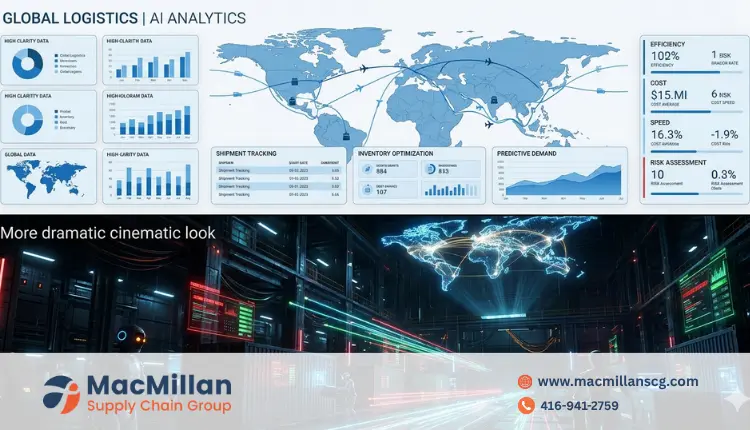
Artificial intelligence has developed from simple automation to a tool for strategic decision-making in modern supply chains. Large volumes of data are used by the AI-powered supply chain to forecast interruptions, optimize inventory levels, and improve customer service. Human analysts are unable to process information at the speed and scale that this technology can.
The foundation of this revolution is predictive analytics. Artificial intelligence (AI) systems can predict demand with remarkable accuracy by examining historical data as well as external factors like weather patterns, economic indicators, and social media trends. This entails minimizing stockouts and excess inventory by having the appropriate products in the right quantities at the right locations for a retailer getting ready for the holidays.
Another innovation in supply chain management is the use of digital twins. Businesses can model changes and disruptions before they happen with these virtual versions of real supply chains. Businesses can minimize risk and maximize results by testing scenarios in the digital environment before deciding on new warehouse layouts or transportation routes.
These technologies are used by MacMillan Supply Chain Group to build robust supply chain networks for our customers. Our AI systems swiftly recalculate the best routes and resource allocations in the event of unforeseen circumstances, such as snowstorms or border delays. Your customers will experience fewer disruptions as a result of this proactive approach.
The impact of AI extends to cross-border trade between Canada and the US as well. Machine learning algorithms can predict customs clearance times, recommend optimal shipping methods, and even anticipate tariff impacts before they affect your bottom line. International logistics are turned from a source of uncertainty to a strategic advantage thanks to this intelligence.
Relationships are more important to supply chain management in the future than technology alone. Across the supply chain ecosystem, transactional interactions are giving way to strategic partnerships. Beyond just purchasing and selling, these cooperative partnerships add value.
These collaborations are becoming more transparent than ever thanks to blockchain technology. All supply chain participants have access to a single, unchangeable record of transactions and movements thanks to blockchain technology. Disagreements regarding delivery schedules, product quality, and contractual duties are resolved by this common truth. For businesses engaged in cross-border trade between Canada and the US, this transparency reduces delays and administrative burdens.
Successful supply chain strategy now depends on collaboration rather than competition. When manufacturers, logistics providers, and retailers align their systems and share data, the entire network becomes more efficient. At MacMillan Supply Chain Group, we facilitate these connections, helping businesses build integrated supply chains that respond quickly to changing market conditions.
The benefits of strategic partnerships extend to sustainability in logistics as well. By coordinating transportation and sharing warehouse space, companies can reduce their carbon footprints while cutting costs. These green supply chain initiatives satisfy growing consumer demand for environmental responsibility while improving operational efficiency.
The most successful businesses are those that view their logistics providers not as vendors but as strategic partners. This mindset shift opens opportunities for innovation, cost reduction, and competitive advantage that transactional relationships simply cannot deliver.
Sustainability is evolving from a desirable attribute to a business necessity as environmental concerns shift supply chain priorities. Reducing carbon emissions, minimizing packaging waste, and putting circular economy principles into practice are all included in the green supply chain concept.
Electric delivery vehicles are becoming more and more popular in Canada, according to supply chain trends, especially for last-mile logistics in cities. These cars use less fuel and require less maintenance, which lowers emissions and frequently lowers operating costs. We at MacMillan Supply Chain Group are assisting customers in making the switch to these more environmentally friendly modes of transportation without compromising on dependability or efficiency.
Energy-efficient heating, cooling, and lighting systems are also making warehouse operations more ecologically friendly. Automated systems can work in environments with less light and temperature control, which further saves energy. Instead of following set schedules, smart building management systems optimize resource use based on actual needs.
Another frontier in supply chain sustainability is packaging. Waste reduction is facilitated by biodegradable materials, reusable shipping containers, and appropriately sized packaging. These programs frequently lower material costs while also satisfying consumer preferences for companies that practice environmental responsibility.
By creating systems where materials and products are recycled, refurbished, or reused at the end of their lifecycle, the circular supply chain concept goes even farther in promoting sustainability. This strategy necessitates tight collaboration between producers, logistics companies, retailers, and customers—exactly the kind of strategic alliances that will shape supply chain management in the future.
Businesses encounter major implementation and adaptation challenges in spite of the encouraging developments in supply chain technology and strategy. When trying to integrate new technologies with legacy systems, integration issues frequently come up. Many businesses still use warehouse management systems (WMS) that are decades old, which makes them incompatible with contemporary robotics and artificial intelligence (AI) technologies.
Another significant obstacle is the skills gap. Workers require new technical skills to program, maintain, and work together with warehouse automation and AMR technology as these technologies become more common. Finding and retaining talent with these skills remains difficult, particularly in competitive job markets.
Cybersecurity issues are brought up by supply chains becoming more and more digital. Despite being designed to be secure, blockchain solutions still require proper implementation and management, and linked systems present additional security risks. Whole supply chain networks can be jeopardized by data breaches, not just a single business.
Regulatory compliance presents an additional level of complexity for Canadian companies that trade internationally with the US. Rapid changes in tariff effects necessitate quick thinking and a thorough comprehension of international trade regulations. Without specialized knowledge, smaller businesses usually struggle to meet these demands.
Small and medium-sized businesses face obstacles to entry due to the high initial investment costs associated with robotics and AI systems. Even though the long-term return on investment might be strong, the initial capital outlay might be too high, which could cause the gap between big businesses and their smaller rivals to grow.
Last but not least, perceived costs and implementation difficulties frequently lead to opposition to sustainability initiatives. Coordination between several organizations, each with their own priorities and limitations, is necessary to create supply chains that are truly green. These initiatives may stall or produce less than ideal results if incentives are not aligned.
We at MacMillan Supply Chain Group have created all-encompassing strategies to deal with these typical issues in the changing supply chain environment. Our solutions assist companies in navigating the intricacies of contemporary logistics by fusing technology, knowledge, and cooperative tactics.
We provide modular implementation of new technologies that can coexist with current systems in order to overcome integration challenges. With our phased approach, companies can implement AI-powered supply chain solutions and robotics in logistics without interfering with ongoing business operations. We offer middleware solutions that build a bridge between new capabilities and legacy warehouse management systems by connecting them with state-of-the-art automation tools.
Our extensive training programs and knowledge transfer initiatives help to close the skills gap. We do more than just install equipment when deploying AMR or warehouse automation; we also build your team’s capabilities. Our training ensures your staff can optimize the value of these investments by covering both technical operation and strategic utilization of new systems.
We use multi-layered protection protocols at every digital supply chain touchpoint to address cybersecurity concerns. Advanced encryption and access controls are features of our blockchain solutions, and our systems are regularly updated and subject to security audits. We maintain dedicated cybersecurity specialists who monitor emerging threats and develop countermeasures before they can impact your operations.
Our expertise in cross-border trade between Canada and the US helps clients navigate regulatory complexities with confidence. We maintain current knowledge of customs requirements, tariff impacts, and international shipping regulations. Our predictive analytics tools forecast potential compliance issues before they arise, allowing proactive adjustments to shipping strategies.
To make advanced technology accessible to businesses of all sizes, we offer flexible engagement models including technology-as-a-service options. These arrangements convert large capital expenditures into manageable operational costs, allowing smaller companies to access the same advanced capabilities as larger competitors. Our scalable solutions offer the appropriate degree of assistance at every stage of your development, growing with your company.
Our efforts to improve logistics sustainability benefit the environment and increase operational effectiveness. Through shared transportation resources that maximize vehicle utilization, packaging optimization that minimizes waste, and optimized routing that lowers fuel consumption, we assist clients in implementing green supply chain practices. These methods cut expenses and lessen their negative effects on the environment.
Through digital twins and simulation modeling, we help clients test new strategies before full implementation. This approach reduces risk and increases confidence in new initiatives, whether you’re redesigning warehouse layouts, implementing new automation systems, or developing more resilient supply chain networks.
We work together to establish strategic alliances across your supply chain. By fostering relationships between businesses that complement one another, we open doors for resource sharing, cooperative planning, and reciprocal development. In ways that isolated operations cannot, these partnerships improve resilience and generate competitive advantages.
MacMillan Supply Chain Group provides comprehensive solutions to the problems that contemporary supply chains face by fusing technological innovation with real-world knowledge and cooperative tactics. Our integrated strategy guarantees that developments in sustainability, artificial intelligence, and robotics result in real business advantages for our clients.
A strategic approach that strikes a balance between innovation and pragmatic realities is necessary for the implementation of advanced supply chain solutions. Begin by thoroughly evaluating your current operations to pinpoint specific problems and areas that could use improvement. This foundational knowledge will assist you in setting investment priorities and tracking outcomes.
Instead of trying a complete transformation, create a plan for a phased implementation. To test new technologies and procedures without upsetting your entire business, start with pilot projects in controlled settings. Before implementing AMR technology throughout your entire facility, for instance, start with a single warehouse section.
Invest in your team’s capabilities alongside technology investments. The most sophisticated warehouse automation systems will underperform without properly trained staff. Create dedicated training programs and consider hiring specialists who can bridge the gap between traditional logistics knowledge and emerging technologies.
Give preference to technology partners with industry-specific experience and integration expertise. The ideal partner will be aware of your operational environment’s realities as well as the potential of new systems. We apply this dual viewpoint to every client interaction at MacMillan Supply Chain Group, guaranteeing solutions that function in practical settings.
Build data collection and analysis capabilities early in your transformation journey. AI-powered supply chain solutions depend on quality data, so establish systems to capture relevant information from throughout your operations. Clean, consistent data provides the foundation for predictive analytics and digital twins that drive strategic decision-making.
Don’t undervalue the significance of change management. Workflows and mindsets must be modified to accommodate new technologies and procedures. To create momentum, explain the change’s justifications in detail, include frontline staff in the planning stages, and acknowledge early victories.
When it comes to supply chain transformation, think about collaborating with MacMillan Supply Chain Group. We are in a position to assist you in navigating the technological and regulatory complexities of cross-border trade with the United States and Canadian supply chain trends. We provide comprehensive solutions that tackle your unique problems and set up your company for future expansion.
Get in touch with us right now to find out how we can assist you in putting the supply chain tactics and technologies that will propel your company forward into action. Together, you and our team of professionals will create a tailored strategy that creates long-term competitive advantages and yields immediate benefits.
Robotics in logistics delivers multiple benefits including increased accuracy (typically reducing errors by 60-70%), improved throughput (often 30-50% higher than manual operations), enhanced safety (reducing workplace injuries), and consistent performance regardless of time of day or staffing challenges. At MacMillan Supply Chain Group, we've helped clients achieve these improvements while maintaining flexibility to handle changing business requirements.
AI improves supply chain decision-making by analyzing large volumes of data in real time to identify patterns, predict demand, and detect disruptions before they happen. It helps businesses optimize inventory levels, reduce stockouts, improve delivery routes, and respond faster to unexpected events like weather delays or supply shortages. This makes supply chains more efficient, accurate, and proactive rather than reactive.
Cross-border trade between Canada and the US is challenging due to complex customs regulations, changing tariff policies, documentation requirements, and compliance standards. Even small errors can cause delays at the border. Additionally, differences in trade rules, shipping times, and geopolitical or economic shifts can create uncertainty and increase costs for businesses operating across both countries.
Small businesses can compete by adopting scalable and cost-effective solutions such as cloud-based logistics platforms, AI-as-a-service tools, and flexible warehouse automation systems. Instead of large upfront investments, they can use subscription or service-based models. Partnering with logistics providers and focusing on niche markets also helps them gain efficiency without needing massive infrastructure.
The first steps include measuring current carbon emissions, identifying waste in packaging and transportation, and improving energy efficiency in warehouses. Businesses can also start using eco-friendly packaging, optimizing delivery routes, and choosing greener transportation options. Setting clear sustainability goals and working with environmentally responsible suppliers is also essential.
Blockchain provides a secure and transparent digital record of all transactions and product movements across the supply chain. It helps improve traceability, reduces fraud, and ensures all parties have access to the same verified data. This increases trust between suppliers, manufacturers, and retailers while reducing disputes, paperwork, and delays—especially in cross-border logistics.