Black Friday Fulfillment Canada: 2026 Peak Season Guide
Black Friday Fulfillment Canada: How E-commerce Brands Can Prepare for…
Black Friday Fulfillment Canada: How E-commerce Brands Can Prepare for…
When discussing e-commerce, what typically springs to mind? Most likely,…
As the busiest time of the year draws near, the…
As the busiest time of the year draws near, the…
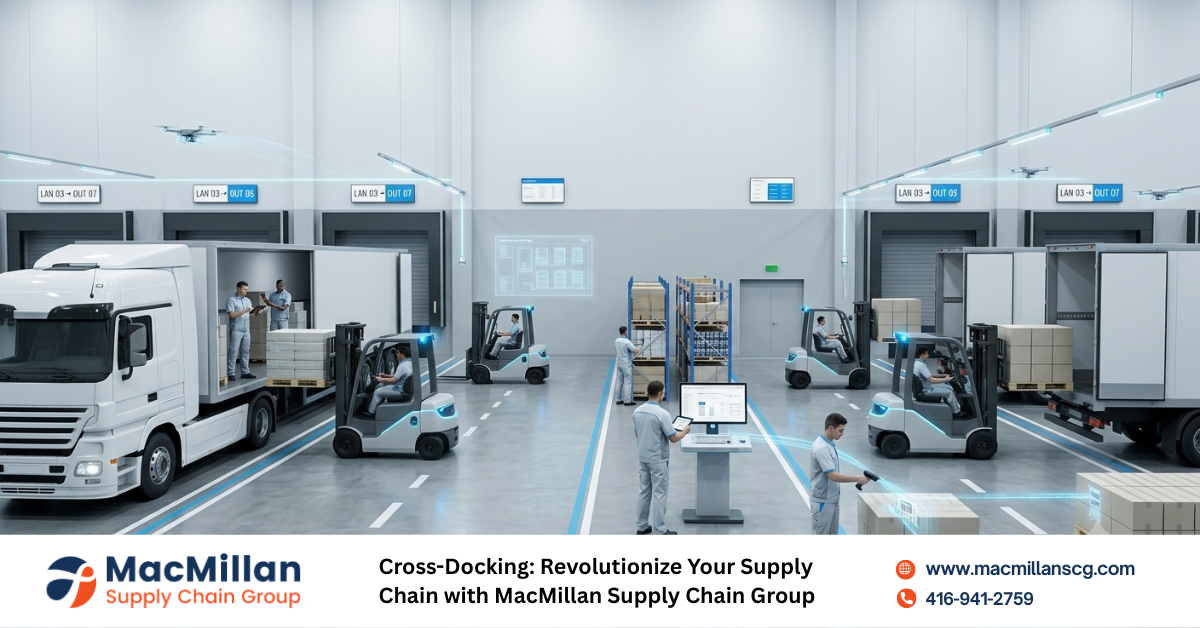
Cross-docking is a game-changing logistics strategy that eliminates the need for warehouse storage, moving products directly from inbound to outbound transportation. This innovative approach significantly reduces handling time, storage costs, and order fulfillment cycles. At MacMillan Supply Chain Group, we specialize in implementing cross-docking solutions that optimize your supply chain, enhance customer satisfaction, and boost your bottom line. Whether you’re in retail, manufacturing, or eCommerce, our tailored cross-docking services can revolutionize your logistics operations. Discover how this powerful technique can transform your business and give you a competitive edge in today’s fast-paced market.
In today’s rapidly evolving business landscape, staying ahead of the competition means constantly seeking ways to optimize your supply chain. Enter cross-docking – a revolutionary logistics strategy that’s transforming the way companies handle their inventory and fulfill orders. But what exactly is cross-docking, and how can it benefit your business?
Cross-docking is the practice of unloading materials from incoming trucks or rail cars and loading these materials directly into outbound trucks, trailers, or rail cars, with little or no storage in between. This process eliminates the need for warehouse storage, reducing handling time and costs while speeding up the order fulfillment process.
At MacMillan Supply Chain Group, we’ve mastered the art of cross-docking, helping businesses across various industries streamline their operations, reduce costs, and improve customer satisfaction. In this comprehensive guide, we’ll explore the ins and outs of cross-docking, its benefits, and how you can implement this powerful strategy in your own supply chain.
Cross-docking is a logistics practice that focuses on the quick distribution of goods with minimal handling and storage time. The process typically involves these key steps:
There are two main types of cross-docking:
Cross-docking is particularly effective for:
By eliminating the need for long-term storage and reducing handling time, cross-docking can significantly improve supply chain efficiency. It’s especially valuable in industries where speed and precision are crucial, such as retail, manufacturing, and eCommerce fulfillment.
At MacMillan Supply Chain Group, we tailor our cross-docking solutions to meet the unique needs of each client, ensuring optimal results regardless of industry or scale of operations.
Implementing a cross-docking strategy in your supply chain can yield numerous benefits:
At MacMillan Supply Chain Group, we’ve helped numerous clients realize these benefits through our expertly designed and implemented cross-docking solutions. Our tailored approach ensures that you maximize the advantages of cross-docking for your specific business needs.
Successfully implementing cross-docking requires careful planning and execution. Here are key steps to consider:
At MacMillan Supply Chain Group, we guide you through each of these steps, leveraging our expertise to ensure a smooth transition to cross-docking. Our comprehensive approach covers everything from initial assessment to ongoing optimization, helping you maximize the benefits of this powerful logistics strategy.
Cross-docking has proven valuable across various industries, each with its unique applications:
Retail:
– Quickly move seasonal products to stores
– Efficiently distribute high-demand items
– Consolidate shipments from multiple vendors
Manufacturing:
– Streamline the flow of raw materials to production lines
– Quickly distribute finished products to customers
– Manage just-in-time inventory more effectively
eCommerce:
– Speed up order fulfillment for fast-moving products
– Efficiently handle returns and exchanges
– Manage flash sales and promotional events
Food and Beverage:
– Ensure rapid distribution of perishable goods
– Manage temperature-controlled products effectively
– Quickly respond to changing consumer demands
Automotive:
– Efficiently distribute spare parts to dealerships
– Manage just-in-time delivery of components to assembly plants
– Handle recalls and service campaigns effectively
Pharmaceuticals:
– Ensure rapid distribution of time-sensitive medications
– Manage cold chain logistics efficiently
– Handle product recalls quickly and effectively
At MacMillan Supply Chain Group, we understand the nuances of cross-docking in different industries. Our team of experts works closely with you to develop industry-specific cross-docking solutions that address your unique challenges and maximize your competitive advantage.
While cross-docking offers numerous benefits, it’s not without its challenges. Here are some common problems and how MacMillan Supply Chain Group addresses them:
Coordination Complexity:
Problem: Cross-docking requires precise timing and coordination between inbound and outbound shipments.
Solution: We implement advanced scheduling systems and real-time communication tools to ensure seamless coordination. Our team of experts manages the entire process, acting as a central point of contact to streamline operations.
Technology Integration:
Problem: Effective cross-docking requires sophisticated technology that many companies struggle to implement.
Solution: MacMillan Supply Chain Group offers state-of-the-art Warehouse Management Systems (WMS) tailored to your needs. We handle the integration process, ensuring your systems work seamlessly with our cross-docking operations.
Space Constraints:
Problem: Cross-docking facilities require specific layouts that can be challenging to design and implement.
Solution: Our team of logistics experts designs optimal cross-docking facilities, maximizing space utilization and product flow. We can either optimize your existing space or help you find and set up a new facility tailored to cross-docking operations.
Quality Control:
Problem: The speed of cross-docking can sometimes lead to errors or quality issues.
Solution: We implement rigorous quality control measures, including barcode scanning and automated checks, to ensure accuracy without sacrificing speed. Our trained staff is vigilant in maintaining quality standards throughout the process.
Demand Fluctuations:
Problem: Unexpected changes in demand can disrupt cross-docking operations.
Solution: MacMillan Supply Chain Group employs advanced forecasting tools and flexible staffing models to adapt quickly to demand fluctuations. We work closely with your team to anticipate changes and adjust operations accordingly.
Supplier Reliability:
Problem: Cross-docking relies heavily on timely deliveries from suppliers.
Solution: We establish strong relationships with reliable carriers and implement performance tracking systems to ensure consistent, on-time deliveries. Our team works proactively to address any potential delays or issues.
Product Mix Complexity:
Problem: Managing a diverse product mix can complicate cross-docking operations.
Solution: Our sophisticated sorting systems and trained staff efficiently handle diverse product mixes. We develop customized processes for each client to ensure all products are handled appropriately.
Scalability:
Problem: As businesses grow, scaling cross-docking operations can be challenging.
Solution: MacMillan Supply Chain Group’s solutions are designed with scalability in mind. We continuously assess your needs and adjust our operations to accommodate your growth, ensuring your cross-docking strategy evolves with your business.
By partnering with MacMillan Supply Chain Group, you gain access to our wealth of experience in overcoming these common cross-docking challenges. Our comprehensive solutions ensure that you can fully leverage the benefits of cross-docking while minimizing potential pitfalls.
To successfully implement cross-docking and avoid common pitfalls, consider the following steps:
While these steps can help you get started, implementing an effective cross-docking strategy can be complex and challenging. That’s where MacMillan Supply Chain Group comes in. Our team of experts has years of experience in designing and implementing successful cross-docking solutions across various industries.
Don’t let the complexities of cross-docking hold your business back. Partner with MacMillan Supply Chain Group today and transform your supply chain. Our tailored solutions, cutting-edge technology, and industry expertise will help you overcome challenges and maximize the benefits of cross-docking.
Contact us now for a free consultation and discover how we can revolutionize your logistics operations with cross-docking. Let’s work together to streamline your supply chain, reduce costs, and boost your competitive edge in today’s fast-paced market.
Cross-docking is a logistics practice where products are transferred directly from inbound to outbound vehicles with minimal or no storage in between. This process significantly reduces handling time and storage costs.
Solution: MacMillan Supply Chain Group can implement a tailored cross-docking system that fits your specific business needs, optimizing your supply chain and reducing costs.
Traditional warehousing stores inventory for days, weeks, or even months before it is shipped. Cross-docking, on the other hand, minimizes or eliminates storage by transferring products directly from inbound trucks to outbound transportation. This streamlined approach reduces storage costs, speeds up deliveries, and improves overall supply chain efficiency.
Cross-docking is ideal for products that require fast movement through the supply chain. These include perishable goods, fresh food, retail merchandise, consumer packaged goods, promotional items, and high-demand products with predictable sales. It is also effective for pre-sorted customer orders and products that require minimal handling.
Cross-docking significantly reduces the time products spend in storage by moving them directly from receiving to shipping. This allows businesses to process customer orders faster, reduce delivery lead times, and improve customer satisfaction while lowering inventory handling costs.
The biggest challenges include coordinating inbound and outbound shipments, maintaining real-time inventory visibility, integrating warehouse management technology, and ensuring supplier reliability. Successful cross-docking also requires accurate demand forecasting and well-trained logistics teams to prevent delays and errors.
Yes. Small businesses can benefit from cross-docking if they manage consistent product demand and have reliable suppliers. By partnering with an experienced logistics provider like MacMillan Supply Chain Group, small businesses can reduce storage costs, improve inventory flow, and deliver orders more efficiently without investing heavily in warehouse infrastructure.