
E-commerce Fulfillment Costs: Complete Guide for 2026
As the busiest time of the year draws near, the…

As the busiest time of the year draws near, the…
As the busiest time of the year draws near, the…
As the busiest time of the year draws near, the…
Did you know that only 21% of businesses feel really…
Global supply chains will face previously unheard-of difficulties due to supply chain disruption 2025. Ships have had to reroute around Africa due to the Red Sea crisis, which has increased shipping times by weeks and cost millions of dollars. Water shortages and maintenance problems are the main causes of the ongoing congestion in the Panama Canal. In the meantime, trade relations are changing as a result of post-election tariffs, especially between the US and China. Retail and the automotive industries are both feeling the effects of these disruptions. This playbook provides useful tactics for companies to overcome these obstacles, such as developing backup routing plans, deploying AI-driven forecasting, and nearshoring to Canada. Fast-adapting businesses will have a competitive edge in the face of supply chain disruption 2025.
In 2025, a perfect storm is threatening the global supply chain. The Panama Canal congestion, the Red Sea shipping crisis, and new tariffs after recent elections have all combined to create previously unheard-of difficulties for businesses around the world. These are not merely short-term disruptions; rather, they signify significant changes in the global flow of goods.
These disruptions present opportunities as well as challenges for Canadian companies. Everyone is impacted by increased costs and longer shipping times, but businesses that adjust swiftly can benefit greatly. The question is how you will handle these geopolitical challenges, not if they will have an impact on your supply chain.
Each of these significant supply chain disruptions in 2025 will be covered in this playbook, along with an analysis of their effects on various industries and useful tactics to help your company not only survive but flourish. Maintaining competitiveness in today’s volatile global market requires an understanding of these changes, regardless of your industry—manufacturing, retail, or logistics.
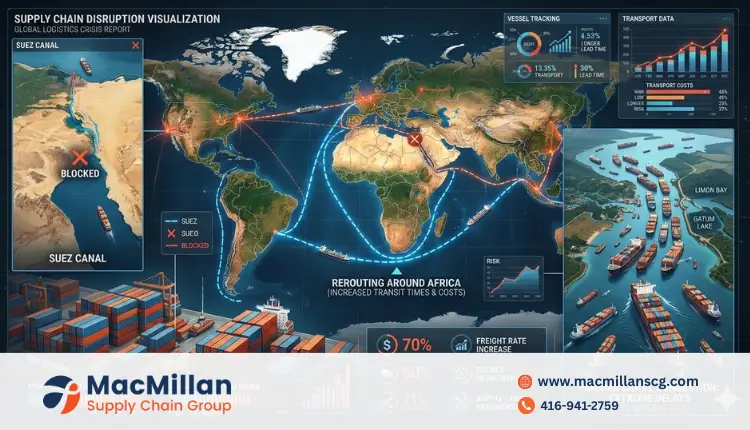
In the context of supply chain disruption 2025, the Red Sea has changed from being an essential shipping route to a high-risk area. This vital maritime route has become more hazardous due to ongoing conflicts, which has forced shipping companies to make tough choices about how to transport goods between Asia and Europe.
Nearly 80% of container ships have been forced to completely avoid the Suez Canal due to the Red Sea shipping crisis. Ships are instead choosing to take the longer route around the Cape of Good Hope in Africa, which adds 7–10 days to transit times and costs about $1 million more per voyage. An estimated 15% less shipping capacity has been available worldwide as a result of this rerouting, which has had an impact on supply chains.
Emergency surcharges of $500 to $1,500 per container have been imposed by major carriers such as Maersk and ZIM. Raw materials to final goods are all impacted by these rising costs, which are unavoidably passed down the supply chain.
The automotive industry has been hit particularly hard by the Red Sea shipping crisis. Just-in-time manufacturing systems rely on predictable delivery schedules, and delays of even a few days can halt production lines. Similar issues arise for electronics manufacturers when parts from Asia take longer to arrive at assembly facilities in North America.
This means that Canadian importers should budget for increased shipping expenses and longer lead times. Businesses that used to order inventory six weeks in advance now have to plan for eight to ten weeks, which causes smaller businesses to face more cash flow issues and ties up more capital in goods in transit. While the Red Sea situation dominates headlines, the Panama Canal is another major factor contributing to supply chain disruption 2025.
In 2025, the Panama Canal will have its own set of issues, even as the Red Sea crisis makes headlines. The dependability of this vital trade route between the Atlantic and Pacific Oceans is in jeopardy due to political and natural issues.
The Panama Canal’s operations have been significantly impacted by climate change. Authorities have been forced to cut the number of daily transits from 36 to just 18 due to water shortages, causing a bottleneck that impacts shipping schedules worldwide. Ships now have to wait up to three weeks, as opposed to the usual three to five days in the past.
With premium slots going to the highest bidders, the Panama Canal Authority has instituted a reservation system that ranks vessels according to cargo type and destination. For non-reserved vessels, this auction system has increased transit costs by 200–300%, putting further financial strain on shipping companies and their clients.
For Canadian companies that depend on Asian imports reaching East Coast ports, the Panama Canal congestion is especially important. Although the volume of traffic using alternative routes through West Coast ports such as Vancouver and Prince Rupert has increased, the amount of traffic that can be diverted is limited by rail and truck capacity limitations.
This disruption is accelerating the trend toward nearshoring, with many companies reconsidering their dependence on trans-Pacific supply chains. As businesses look for alternatives to Asian production, Mexican manufacturing has seen a 22% increase in capacity utilization. This change is also helping Canadian manufacturers, especially in industries like electronics assembly and automotive components where being close to US markets has major benefits.
With new tariffs reshaping supply chain economics in 2025, the US election of 2024 has brought about significant changes to the trade landscape. Businesses are being compelled by these policy changes to reevaluate their supply chain setups and sourcing tactics.
Under Trump’s 2025 tariffs, all imports will now be subject to 10% general duties, with targeted increases of up to 60% on Chinese goods. The cost equation for many products has been significantly changed by these actions, especially in the consumer goods, textile, and electronics sectors.
The effects on Canadian companies differ depending on the industry. Canadian businesses that use Chinese components in their products may encounter “country of origin” issues when exporting to the US, even though the USMCA offers some protection against direct tariffs. Because of this, there is now a complicated compliance environment that needs to be carefully navigated.
In 2025, businesses are using a variety of strategies to handle supply chain disruptions brought on by tariffs. The “China+1” approach is now commonplace, with companies keeping their Chinese suppliers while creating substitutes in nations like Mexico, Vietnam, and India.
Nearshoring efforts are being accelerated by larger manufacturers; supply chain changes in the automotive industry are especially noteworthy. Opportunities for Canadian parts manufacturers have been created by Ford and GM’s 30% annual increase in their contracts with Canadian suppliers. In a similar vein, manufacturers of electronics are shifting their operations from Asia to North America, with major investments being made in new facilities in Ontario and Quebec.
Because they frequently lack the resources to swiftly establish alternative supplier networks, smaller businesses have a harder time adjusting to these tariff changes. Through trade facilitation services and supplier matching programs, government organizations and industry associations are providing assistance.
In 2025, digital threats are intensifying the challenges of supply chain disruption 2025, becoming just as critical as physical risks when it comes to supply chain issues. As systems grow increasingly interconnected, cybersecurity has emerged as a crucial element of supply chain resilience.
In 2025, supply chain infrastructure has seen a sharp rise in the frequency and sophistication of cyberattacks. Vulnerabilities in supplier relationships, transportation networks, and logistics systems are being exploited by criminal organizations and state-sponsored actors.
Port management systems have been the target of recent attacks, which have caused delays at important terminals in Montreal and Vancouver. Similarly, shipping schedules and inventory visibility have been affected by ransomware incidents that have affected transportation management systems. The difficulties brought on by the physical supply chain disruption in 2025 are exacerbated by these digital disruptions.
Prominent businesses are putting in place thorough cybersecurity plans that cover suppliers and logistics partners in addition to their own operations. This “supply chain of trust” method acknowledges that a network’s security is only as strong as its weakest link.
Blockchain technology is being embraced by Canadian companies more and more to improve supply chain security and transparency. Because these systems offer unchangeable records of movements and transactions, it is more difficult for bad actors to compromise the integrity of the data.
In this context, artificial intelligence is both a possible weakness and an effective defensive tool. Predictive analytics helps businesses foresee and reduce risks before they become a reality, while AI-powered security systems can spot unusual patterns that could point to an attack.
When coping with supply chain disruption 2025 and the geopolitical factors impacting global supply chains, businesses encounter a number of common issues:
Real-time visibility into their extensive supply networks is lacking for many businesses. Businesses frequently don’t realize the effects of Red Sea or Panama Canal disruptions until after operations have been impacted by delays. Reactive posture raises disruption costs and restricts response options.
Supply chains have become fragile and less flexible as a result of years of cost-effective optimization. Just-in-time inventory models and single-sourcing tactics function well in stable settings but rapidly falter in the face of geopolitical challenges related to global trade.
Developing and implementing comprehensive response strategies is especially difficult for smaller businesses. While a lack of talent in supply chain management impedes efficient planning, limited financial resources make it challenging to maintain higher inventory levels or create alternative supplier networks.
The effects of complicated geopolitical events have not been adequately predicted by conventional forecasting models. Businesses find it difficult to convert high-level risk assessments into detailed operational plans, which paralyzes decision-making.
When a supply chain disruption occurs, several departments and organizations must coordinate their responses. Effective collaboration between the manufacturing, logistics, and procurement teams is frequently hampered by internal silos, and during times of crisis, external communication with suppliers and customers frequently breaks down.
We at MacMillan Supply Chain Group have created all-encompassing plans to assist companies in overcoming supply chain disruption obstacles in 2025. Our solutions build robust supply networks by fusing cutting-edge technology, strategic planning, and operational know-how.
End-to-end supply chain visibility is possible with our control tower solution. We establish a single source of truth that facilitates proactive decision-making by combining data from various sources, such as carriers, ports, customs authorities, and suppliers. When tracking shipments impacted by the Red Sea shipping crisis or Panama Canal congestion, this visibility is especially helpful.
Features include:
We assist customers in putting strategic buffer inventory plans into place that strike a balance between carrying costs and resilience. Our method finds essential parts and completed goods that need more safety stock rather than just raising inventory overall.
Our network of warehouses across Canada offers a variety of flexible storage options that preserve agility while keeping inventory near important markets. This dispersed strategy minimizes delivery times and transportation expenses while lowering susceptibility to localized disruptions.
MacMillan’s multi-modal transportation strategy creates built-in redundancy for critical shipping lanes. When primary routes are compromised, we can swiftly change course by preserving relationships with carriers across air, rail, road, and ocean transportation.
Because our staff keeps a close eye on international shipping conditions, we are able to predict disruptions before they affect your business operations. We can swiftly put alternative routing plans that have been planned and tested beforehand into action when problems like the Red Sea crisis arise.
We offer complete nearshoring support to clients who want to lessen their reliance on extensive global supply chains. Potential Canadian and North American partners who can supplement or replace foreign suppliers impacted by tariffs or shipping delays are found and qualified by our supplier development team.
This strategy reduces transportation time and risk while creating supply options that avoid duties, making it especially beneficial for businesses impacted by Trump’s 2025 tariffs. Products made with our nearshoring partners satisfy all requirements for preferential tariff treatment thanks to our proficiency in USMCA compliance.
Artificial intelligence is used by MacMillan’s risk intelligence platform to track world events and evaluate possible effects on the supply chain. To find new threats, this system examines thousands of data points every day, such as news articles, weather trends, port conditions, and political events.
Our clients can use the resulting insights to inform their data-driven choices regarding supplier selection, transportation options, and inventory levels. This proactive strategy enables companies to strategically position themselves before issues arise, as opposed to responding to disruptions after they happen.
Even though supply chain disruption in 2025 will present many difficulties, there are practical actions your company can take to reduce risks and improve resilience. Here’s how to begin:
Map out your entire supply chain first, noting important routes and possible weak points. Assess your exposure to particular geopolitical risks, such as Trump’s 2025 tariffs, the Red Sea shipping crisis, and the congestion in the Panama Canal. Both direct suppliers and sub-tier relationships that could result in hidden vulnerabilities should be taken into account in this assessment.
Make thorough plans for handling various disruption situations. These ought to consist of pre-approved action steps, distinct activation trigger points, and distinct roles and responsibilities. Before a true crisis arises, regular tabletop exercises can help test these plans and acquaint your team with emergency protocols.
Use digital tools that improve decision-making and visibility. These could be software for inventory optimization, platforms for monitoring supplier risk, or transportation management systems. Instead of only collecting data, concentrate on solutions that offer insights that can be put into practice.
No business can become truly resilient on its own. Establish cooperative ties with important logistics companies, suppliers, and even rival businesses that may pool resources in the event of disruptions. Information-sharing networks and industry consortiums can offer group problem-solving skills and early warning of new problems.
MacMillan Supply Chain Group provides end-to-end solutions that are customized to meet your unique requirements for companies looking to quickly improve the resilience of their supply chains. Our team of professionals can assist you in navigating the geopolitical challenges of global trade while preserving operational effectiveness.
We have the infrastructure and experience to help you achieve your objectives, whether they involve nearshoring to Canada, putting advanced visibility systems in place, or creating thorough backup plans. Our well-established networks and tested strategies help your business stay agile during supply chain disruption 2025 while meeting your particular needs.
Contact MacMillan Supply Chain Group today to schedule a resilience assessment and discover how we can help your business thrive despite supply chain disruption 2025
📞 Call us at: 1-800-555-1234
🌐 Visit: www.macmillanscg.com
Current intelligence suggests the Red Sea shipping crisis will continue throughout 2025. Maritime security experts anticipate that regional conflicts will persist, making the route unsafe for commercial vessels. Businesses should plan for long-term rerouting around the Cape of Good Hope rather than expecting a quick resolution. This means permanently adjusting lead times and transportation budgets to account for the longer journey.
When congestion or restrictions affect the Panama Canal, companies often use alternative routes such as shipping through the Suez Canal, routing vessels around the Cape of Good Hope in Africa, or diverting shipments to West Coast ports like Vancouver and Prince Rupert. Businesses may also use intermodal transportation, combining ocean freight with rail and trucking to move goods across North America more efficiently.
During uncertain supply chain conditions, companies often adopt strategies such as increasing safety stock for critical items, diversifying supplier sources, and strategically positioning inventory across multiple warehouses. Using demand forecasting and inventory optimization tools can also help businesses maintain the right balance between product availability and storage costs.