


How the Right White Glove Service Benefits Your Brand
You’ve sent your product out for delivery, they’ve received it,…


You’ve sent your product out for delivery, they’ve received it,…
In the fast-evolving landscape of global trade and e-commerce, supply…

Following its success with Prime delivery and becoming the business…
Partnering with a third-party logistics (3PL) provider like MacMillan Supply…
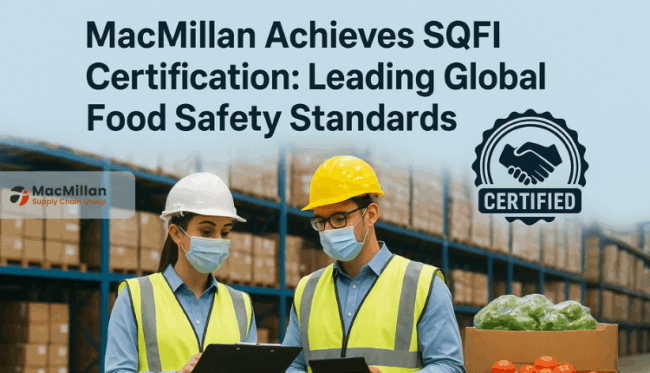
MacMillan Supply Chain Group has achieved the prestigious SQFI Certification, positioning the company at the forefront of global food safety standards in Canada. This certification demonstrates MacMillan’s commitment to maintaining rigorous food safety protocols throughout their temperature maintained facilities and logistics operations. By adhering to the GFSI Framework and implementing comprehensive HACCP programs, MacMillan now offers certified supply chain solutions that meet the highest industry standards. This achievement strengthens our position as a trusted partner for food manufacturers and retailers across North America, particularly in the Canadian food industry where safety compliance is paramount.
Food safety has become a critical concern in today’s complex global supply chains. With consumers and regulators demanding greater transparency and accountability, logistics providers must demonstrate unwavering commitment to maintaining product integrity throughout the distribution process. MacMillan Supply Chain Group has risen to this challenge by achieving SQFI Certification—one of the most respected and comprehensive food safety certifications available worldwide.
This milestone represents more than just compliance with regulations; it signals MacMillan’s dedication to excellence in the Canadian food logistics landscape. As a premier 3PL provider with specialized temperature maintained facilities throughout the Greater Toronto Area and beyond, MacMillan has integrated advanced food safety protocols into every aspect of their operations. This certification validates years of investment in infrastructure, training, and quality management systems designed specifically for the unique requirements of food handling and distribution.
SQFI (Safe Quality Food Institute) Certification represents one of the most comprehensive food safety management systems recognized worldwide. Operating under the GFSI Framework (Global Food Safety Initiative), this certification verifies that organizations maintain rigorous standards throughout their food handling operations. Unlike basic compliance programs, SQFI takes a risk-based approach that focuses on preventing food safety issues before they occur.
The certification process evaluates everything from facility design and construction to operational methods and employee training. Companies must implement detailed HACCP (Hazard Analysis Critical Control Points) programs that identify potential risks and establish monitoring procedures for critical control points. Documentation requirements are extensive, ensuring complete traceability from receipt through storage and distribution.
What makes SQFI particularly valuable is its global recognition. With over 12,000 certified facilities across 40 countries, this standard facilitates international trade by providing consistent benchmarks for food safety. For Canadian companies like MacMillan Supply Chain, this certification opens doors to partnerships with multinational food manufacturers and retailers who require GFSI-recognized certifications from their logistics providers.
Food safety standards continue to evolve, and MacMillan’s certification coincides with the implementation of SQF Edition 10—the latest update to the SQF Code. This new edition represents a significant advancement in how food safety is assessed and managed throughout the supply chain.
Key innovations in SQF Edition 10 include:
These changes reflect the growing understanding that food safety isn’t just about passing audits—it’s about building organizational cultures that prioritize safety at every level. For MacMillan Supply Chain, achieving certification under this enhanced standard demonstrates their forward-thinking approach to food safety management.
The certification process itself is rigorous, requiring extensive documentation, multiple stages of audits, and verification of corrective actions. By successfully navigating this process, MacMillan has proven their ability to maintain the highest standards of food safety throughout their Canadian supply chain solutions.
At the heart of MacMillan’s food safety program are their state-of-the-art temperature-controlled facilities. These specialized warehouses maintain precise environmental conditions tailored to the specific requirements of different food products. From ambient storage to refrigerated and frozen environments, MacMillan’s infrastructure ensures product integrity throughout the storage period.
Each facility incorporates advanced design elements specifically for food safety:
Beyond physical infrastructure, MacMillan has implemented comprehensive monitoring systems throughout their facilities. Temperature sensors continuously track environmental conditions, with automated alerts triggered by any deviations from established parameters. This real-time monitoring, combined with regular verification checks by trained personnel, ensures that temperature-sensitive products remain within safe ranges at all times.
The company’s investment in these specialized facilities demonstrates their understanding that food safety begins with proper infrastructure. By creating environments specifically designed for food products, MacMillan provides their clients with confidence that their products will maintain safety and quality throughout the storage phase.
MacMillan’s approach to food safety extends beyond facilities to encompass comprehensive HACCP programs throughout their operations. These programs systematically identify potential hazards and establish preventive measures to ensure food safety from receipt through storage and distribution.
Key elements of MacMillan’s HACCP implementation include:
What distinguishes MacMillan’s approach is their integration of HACCP principles across the entire supply chain. Rather than treating food safety as a siloed responsibility, they’ve built interconnected systems that maintain product integrity at every touchpoint. This comprehensive approach aligns perfectly with the SQFI Certification requirements, which emphasize systemic food safety management rather than isolated compliance measures.
The company has also invested heavily in staff training, ensuring that all personnel understand their roles in maintaining food safety. From warehouse associates to transportation providers, everyone receives specialized training on food handling best practices, allergen management, and sanitation procedures. This culture of food safety awareness creates multiple layers of protection against potential hazards.
The Canadian food industry operates under increasingly stringent regulatory requirements and consumer expectations. From the Safe Food for Canadians Act to provincial regulations and retailer-specific requirements, food manufacturers and distributors must navigate a complex compliance landscape. MacMillan’s SQFI Certification positions them as an ideal partner for navigating these challenges.
By achieving this globally recognized certification, MacMillan demonstrates compliance with standards that meet or exceed regulatory requirements. This provides several advantages for their clients in the Canadian food industry:
The certification is particularly valuable for clients engaged in food distribution across Canada, where different provinces may have varying requirements. The comprehensive nature of SQFI Certification typically satisfies the highest provincial standards, allowing for seamless distribution nationwide.
MacMillan’s certification also addresses specific Canadian food industry challenges, such as the management of temperature-sensitive products during extreme seasonal temperature variations. Their protocols account for these unique conditions, ensuring year-round compliance regardless of external environmental factors.
In today’s consumer environment, transparency has become a competitive advantage. End consumers increasingly want to know where their food comes from and how it’s been handled throughout the supply chain. MacMillan’s SQFI Certification supports this transparency by implementing robust traceability systems throughout their operations.
The company’s digital infrastructure allows for complete product tracking from receipt through storage and distribution. This includes:
This traceability extends beyond just tracking product movement. MacMillan’s systems also document environmental conditions, handling procedures, and quality checks throughout the product journey. This comprehensive approach creates an unbroken chain of documentation that verifies proper handling at every stage.
For food manufacturers and retailers, this level of traceability provides significant value. In the event of a quality concern or recall situation, MacMillan can provide detailed records showing exactly how products were handled while in their care. This transparency builds trust with both direct clients and end consumers, creating a competitive advantage in the marketplace.
The food supply chain presents numerous challenges for maintaining product safety and integrity. Even with the best intentions, companies often encounter obstacles that can compromise food safety:
These challenges become particularly acute in the Canadian food logistics landscape, where vast geographical distances, extreme temperature variations, and complex regulatory requirements create additional layers of complexity.
Comprehensive Temperature Management Systems
MacMillan has developed sophisticated temperature management protocols that maintain product integrity throughout the supply chain. Their approach includes:
These systems work together to create a protective cocoon around temperature-sensitive products, ensuring they remain within safe ranges throughout storage and handling. The company’s investment in redundant systems demonstrates their understanding that temperature control isn’t just about maintaining quality—it’s a critical food safety requirement.
Recognizing the serious risks associated with allergen cross-contact, MacMillan has implemented comprehensive allergen management throughout their operations:
These protocols create multiple barriers against allergen cross-contact, protecting consumers with food allergies and helping manufacturers maintain the integrity of allergen-free claims.
MacMillan’s digital infrastructure creates unparalleled visibility throughout the supply chain:
This comprehensive approach to traceability not only satisfies regulatory requirements but provides valuable business intelligence that helps clients optimize their supply chains.
Recognizing that people are the foundation of any food safety system, MacMillan has developed specialized training programs:
By investing in their people, MacMillan ensures that food safety isn’t just a documented program—it’s a lived reality throughout their operations. This cultural commitment to food safety excellence distinguishes them from competitors who may focus solely on meeting minimum requirements.
For food manufacturers and retailers looking to enhance their supply chain food safety, partnering with a certified provider like MacMillan Supply Chain offers significant advantages. Here’s how to leverage their expertise:
First, conduct a thorough assessment of your current supply chain vulnerabilities. Identify points where temperature control, product integrity, or traceability might be compromised. MacMillan’s food safety experts can help with this evaluation, bringing their SQFI-certified perspective to identify improvement opportunities.
Next, develop integrated food safety requirements that span your entire supply chain. Rather than treating manufacturing, storage, and distribution as separate domains, create unified standards that maintain consistency throughout the product journey. MacMillan’s experience with the GFSI Framework provides valuable guidance for developing these comprehensive standards.
Implement robust supplier qualification processes that verify food safety capabilities before partnerships begin. MacMillan’s SQFI Certification provides immediate validation of their food safety systems, simplifying your qualification process and reducing the need for extensive on-site audits.
Establish clear communication channels for sharing critical food safety information between supply chain partners. MacMillan’s client portal facilitates this communication, providing real-time access to temperature records, inventory status, and handling documentation.
Finally, regularly review and refine your supply chain food safety program based on performance metrics and emerging risks. The food safety landscape continues to evolve, and your program should adapt accordingly. MacMillan’s commitment to continuous improvement aligns perfectly with this approach, ensuring that your supply chain remains at the forefront of food safety excellence.
Ready to enhance your supply chain food safety? Contact MacMillan Supply Chain Group today to learn how their SQFI-certified services can protect your products and your brand. Their team of food safety experts will work with you to develop customized solutions that address your specific challenges while maintaining the highest standards of compliance and quality.