MacMillan’s 99/100 SQF Audit Score | What It Means?
What a 99/100 SQF Audit Score Means for Our Clients…
What a 99/100 SQF Audit Score Means for Our Clients…
If you handle the shipping, your warehouse storage, and the…
If you handle the shipping, your warehouse storage, and the…
Are you looking for a supply chain and logistics company…
A food safety issue can start with an everyday decision. A pallet arrives with damaged wrapping. A lot number on a case doesn’t match the receiving paperwork. A product comes back from a customer, but its storage history is unclear. In each case, the warehouse team needs to know what to check, when to stop and who can decide what happens next.
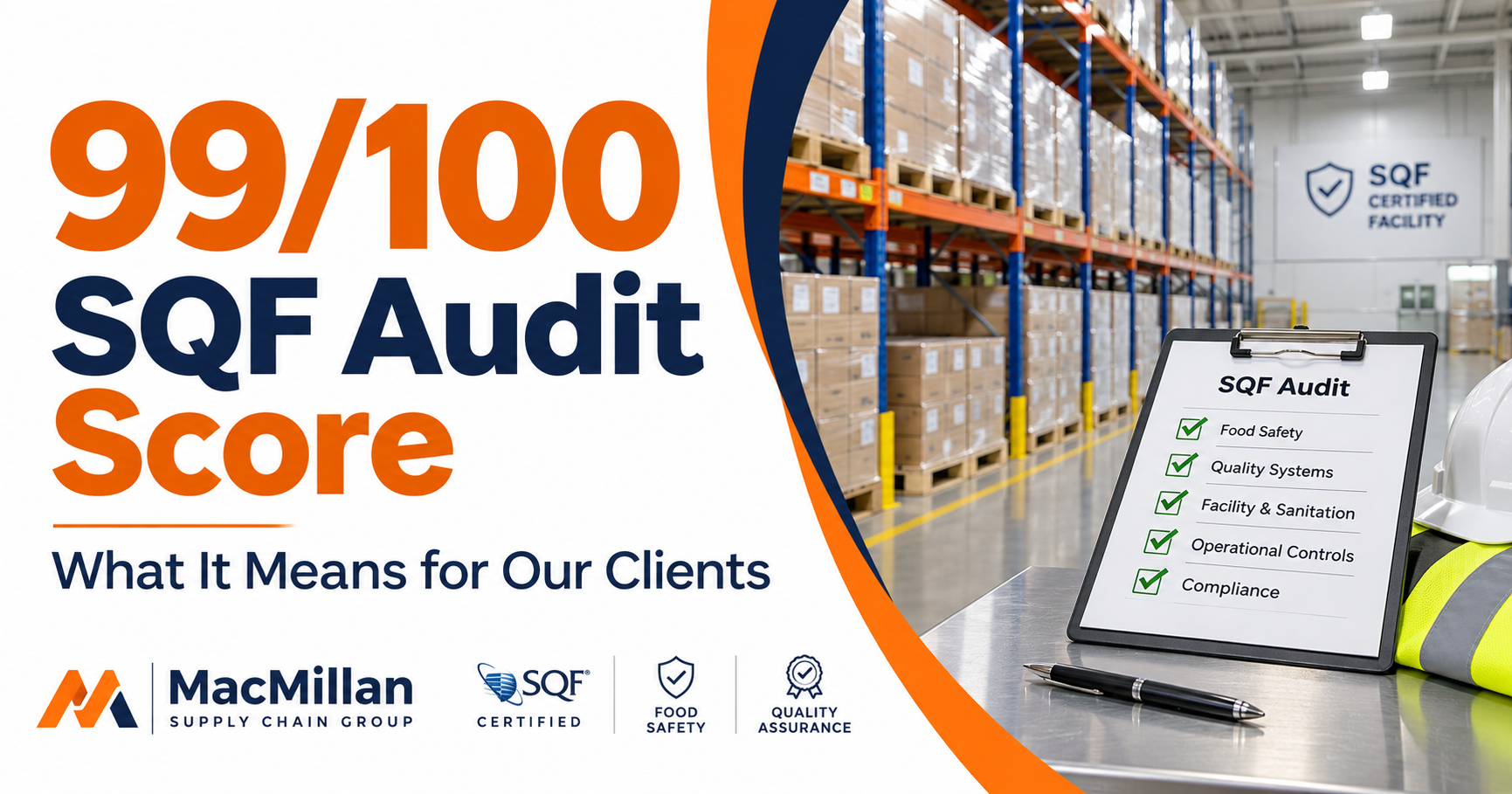
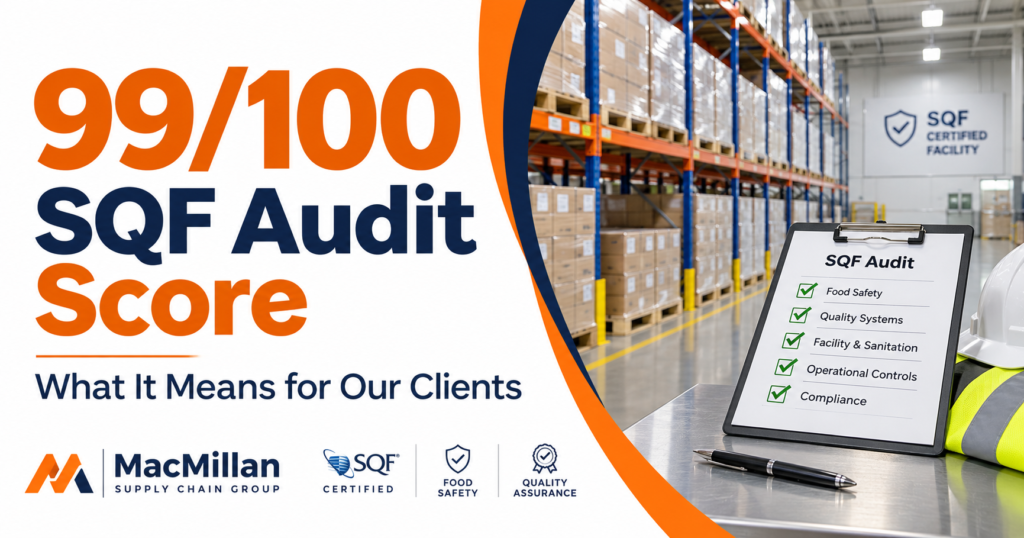
Those decisions are why we’re proud to share that MacMillan Supply Chain Group scored 99 out of 100 on our SQF audit. It’s an achievement our team earned through the everyday work of keeping the facility clean, following procedures and paying attention when something doesn’t look right.
For our clients, the score offers an independent assessment of the food safety system at the audited site. Here’s what that means for the products you trust us to handle.
SQF stands for Safe Quality Food. The Safe Quality Food Institute (SQFI) administers the program, which uses independent audits to assess how a site implements and maintains its food safety system.
The SQF Food Safety Code for Storage and Distribution applies to eligible operations that store and distribute food. It calls for a food safety system based on hazard analysis and critical control points (HACCP), supported by programs such as sanitation, pest control, traceability and temperature control where applicable.
For a food or beverage brand evaluating a warehouse partner, SQF provides a common standard for asking practical questions: How is stock handled when it arrives? What happens when a shipment doesn’t meet requirements? Can the team show records of the checks it performs?
Once a finished product leaves the manufacturer, its condition still depends on how it’s received, stored and moved. A sealed case can be damaged during handling. A product with a shorter shelf life can sit behind newer inventory. A shipment that needs temperature control can be delayed at a handoff.
These risks vary by product. Shelf-stable snacks, bottled beverages and temperature-sensitive goods don’t all need the same controls. A food-grade warehouse needs to understand the requirements for the products it handles and apply them at the right points in the process.
That’s why food and beverage logistics starts with agreeing on receiving criteria, storage conditions, stock rotation and how exceptions will be handled before inventory arrives.
A score of 99/100 is a strong result against the requirements assessed during the audit. The result applies to the audited site and scope. For clients with specific product or retailer requirements, the certificate and its scope are the documents to review when confirming whether an operation fits their needs.
The result also belongs to the people doing the work. The employee who flags damaged packaging, the supervisor who follows up on a hold and the team member who completes a cleaning check all contribute to how the system works on an ordinary day.
Food-grade warehousing depends on routine work that can be easy to overlook. A spill needs to be cleaned promptly. Cleaning supplies need designated storage. Receiving and staging areas need enough space for staff to spot damage and handle stock without creating new problems.
A sanitation program makes that work repeatable. It defines what gets cleaned, who is responsible, when it happens and how completion is checked. When a problem is found, the team needs a way to record it and make sure it gets addressed.
For clients, that discipline helps protect product condition as inventory moves through receiving, storage and dispatch.
Standard operating procedures, or SOPs, help people make consistent decisions across shifts. A receiving procedure, for example, can tell an employee how to verify the shipment, record lot details and flag stock that doesn’t meet the client’s requirements.
Consider a pallet with crushed cases. The immediate question is whether the damage could affect the product. A clear procedure tells the receiving team how to separate the affected cases, record what they found and escalate the decision. The stock stays out of available inventory until the appropriate person reviews it.
That consistency matters during a busy shift, when pressure to clear the dock could otherwise lead people to handle the same issue differently.
A written procedure only helps if the person doing the work understands it. Employees need to know which checks apply to their role, what an exception looks like and when to ask for help.
Training is most useful when it connects the instruction to a real task. If a picker finds two lots of the same product in one location, they should know which lot to select, how to verify it and what to do if the system instructions don’t match the stock in front of them.
Accountability also means making it easy to raise a concern. Catching a discrepancy while the product is still in the warehouse gives everyone more options than finding it after delivery.
Lot traceability connects products received at the warehouse to inventory records and outbound shipments. Depending on the product and the agreed process, records can also support expiry checks, quality holds and stock rotation.
For products with an expiry date, first-expired, first-out (FEFO) prioritizes stock with the earliest expiry, subject to the client’s rules. A retailer may also require a minimum remaining shelf life at delivery. In that case, a unit can be physically in stock and still be unsuitable for that order.
Traceability also matters when a client needs to investigate a lot. If the records connect incoming stock with storage and shipment activity, the team can identify what’s still on hand, what needs to be held and which shipments may be affected. That helps the client make decisions using specific information.
A strong audit result gives clients another piece of evidence when evaluating how a warehouse manages food safety. The practical value comes from how those controls support day-to-day work:
A short-dated shipment, an unresolved product hold or an incomplete lot record can create work far beyond the warehouse. A brand may need to investigate a complaint, arrange a replacement or explain a missed delivery to a retailer.
Documented checks reduce the chance that a small issue goes unnoticed. If a problem does occur, good records help establish what happened, what inventory is affected and who needs to act. That can narrow the scope of the response and help clients communicate with confidence.
That’s the value of a food safety system between audits: it helps people spot problems early and respond consistently when things don’t go to plan.
We’re proud of the 99/100 result, and we’re grateful to the MacMillan team members whose work made it possible. The best way to build on it is to keep paying attention to the details: review recurring exceptions, reinforce training when processes change and check whether corrective actions solve the problem.
For clients, the score is a useful starting point. The next conversation should be about your products: how they need to be stored, which lots or expiry dates need tracking and what your customers expect at delivery.
If you’re evaluating a food-grade warehouse or reviewing your current setup, talk to MacMillan Supply Chain Group about your product and handling requirements.
Cosmetics fulfillment includes receiving, storing, managing, picking, packing, shipping, and processing returns for beauty, skincare, and personal care products.
Accurate inventory management helps brands track stock levels, batch information, product movement, and expiry-sensitive items. MacMillan’s warehousing and distribution services can support organized inventory handling.
Look for experience with beauty products, proper storage conditions, inventory visibility, scalable capacity, careful handling, packaging support, and reliable customer service.
Yes. A 3PL can manage storage, picking, packing, shipping, inventory tracking, and returns for cosmetics brands. MacMillan’s e-commerce order fulfillment services can support these operations.
A brand may benefit from a 3PL when order volume increases, storage becomes difficult to manage, fulfillment takes too much time, or the business needs more scalable logistics support.