



Work With an Ecommerce Fulfillment Company in the GTA
As an online store business owner, offering the best customer…


As an online store business owner, offering the best customer…

The logistics industry in Canada is growing at an impressive…

In today’s competitive business landscape, staying ahead of the curve…
When embarking on the journey to select an ideal Third-Party…
Keeping up with customer demands in e-commerce is crucial, especially considering that over 70% of online shoppers will look for a product on another site if it’s out of stock. This fact alone highlights how important inventory forecasting is for any e-commerce business.
Inventory forecasting isn’t just about ensuring you have enough stock; it’s a main part of keeping your customers happy, making sales, and keeping your business profitable. In e-commerce, where trends can change overnight and competition is tough, getting your inventory forecasting right is really important.
This crucial process involves a collaborative effort across various departments, utilizing historical sales data to craft an accurate and responsive forecasting strategy. The goal is to maintain a perfect balance between demand and supply, ensuring that popular items are always available while avoiding the costly mistake of overstocking less popular items.
In this blog, we will dive into the best ways to handle inventory forecasting if you’re running an e-commerce business. We’ll discuss how you can manage your stock to meet your customers’ wants and help your business grow.
Effective inventory management is necessary for e-commerce businesses. It involves a delicate balance: having too much inventory can escalate costs and reduce profits, while too little can hamper customer satisfaction and sales.
Based on historical sales data and market analysis, inventory forecasting predicts future sales trends. This process allows businesses to make informed decisions about when, how often, and how much stock to order, thus optimizing inventory levels.

Here, we explore the advantages of implementing precise inventory forecasting strategies in your e-commerce business.
The primary advantage of accurate inventory forecasting is maintaining optimal inventory levels. By using data-driven insights, businesses can avoid the pitfalls of overstocking, which ties up capital and potentially leads to inventory obsolescence.
This strategic approach to inventory ensures that funds are available for other critical business areas, enhancing overall financial health and operational flexibility.
Accurate forecasting directly reduces stockouts, ensuring products are available when customers need them. This reliability boosts sales by meeting immediate consumer demand and strengthens brand reputation.
Maintaining adequate inventory levels ensures that marketing campaigns and sales efforts are effectively supported, maximizing their impact.
Implementing robust inventory forecasting reduces the need for manual labor in inventory management. Businesses can optimize labor allocation and minimize warehousing costs by accurately predicting demand and automating reordering processes.
This efficiency extends across the supply chain, from warehouse management to staff workload distribution, ultimately reducing operational expenses.
Inventory forecasting plays a crucial role in streamlining production cycles. It allows businesses to understand and anticipate the lead times required by manufacturers and align them with warehouse receiving schedules and stock level needs.
This strategic planning eliminates guesswork, reducing the necessity for rushed production and expedited shipping, fostering a more efficient and cost-effective production process.
Effective inventory management through forecasting significantly reduces the risk of accumulating dead stock – unsellable items due to being outdated, obsolete, or out of season. By aligning inventory orders with accurate demand predictions, businesses can avoid over-ordering and reduce waste.
Understanding product demand variations helps make informed decisions about the product lifecycle, including the potential discontinuation of underperforming products.
Understanding inventory forecasting and replenishment roles is crucial in effective inventory management. While closely related and often working in tandem, each serves a unique purpose in the supply chain process.
Below is a tabular representation highlighting the key differences between inventory forecasting and replenishment.
| Aspect | Inventory Forecasting | Inventory Replenishment |
| Definition | The process of predicting future inventory needs based on historical data, seasonality, and external factors. | The act of ordering more stock from suppliers or manufacturers. |
| Purpose | To estimate the types and quantities of inventory needed for future periods. | To refill stock levels as per the requirements of the business. |
| Key Factors Considered | Historical sales data, market trends, seasonal variations, and external influences. | Current stock levels, lead times, and supply chain dynamics. |
| Focus | Strategic planning for future inventory requirements. | Operational process of acquiring more stock. |
| Outcome | Informs the replenishment strategy by predicting what, when, and how much stock will be needed. | Execution of the replenishment plan to maintain inventory. |
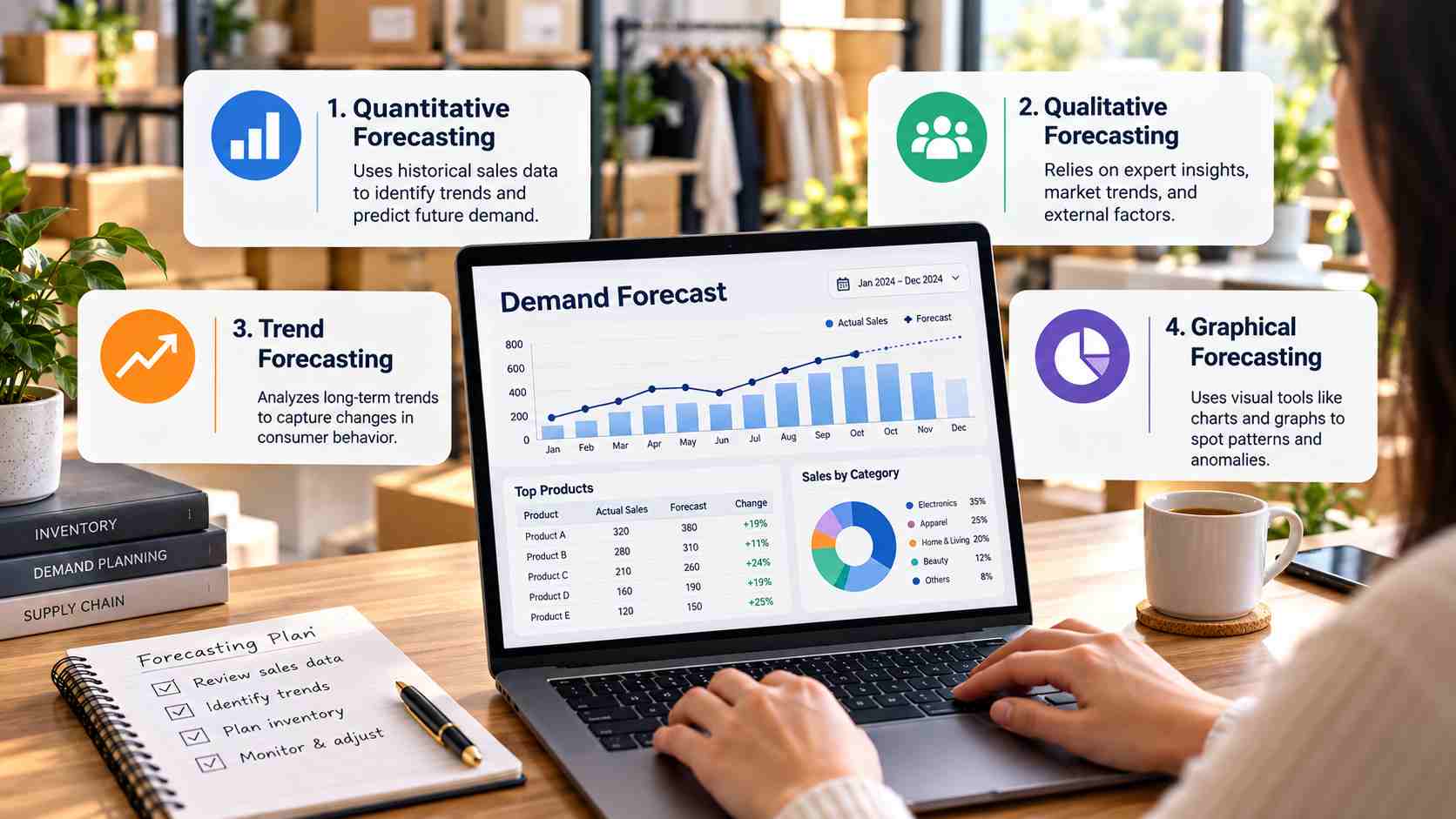
In demand planning, understanding and utilizing various inventory forecasting methods is vital. Each method offers unique insights and caters to different aspects of inventory management. Here, we explore four key types of inventory forecasting, detailing their purposes and applications:
1. Quantitative Forecasting
Quantitative forecasting is grounded in analyzing historical sales data to predict future demand. This method is particularly effective for businesses with a substantial history, as it identifies consistent trends and seasonal patterns. Key elements include:
2. Qualitative Forecasting
Qualitative forecasting focuses less on historical data and more on external factors such as market trends, economic conditions, and environmental shifts. It often involves expert analysis and is not typically a task for novices. Key aspects include:
3. Trend Forecasting
Trend forecasting involves monitoring and analyzing sales trends beyond seasonal variations. It aims to identify broader changes in consumer behavior. Essential considerations include:
4. Graphical Forecasting
Graphical forecasting employs visual tools to analyze data, making it easier to spot patterns and discrepancies. This method can be applied to any of the above data sets. Key features include:
Each of these forecasting methods offers valuable insights into inventory management and can be combined to provide a comprehensive understanding of demand planning. By integrating these techniques, businesses can make more informed decisions, ensuring their inventory levels are optimized to meet customer demand efficiently.

Forecasting inventory is vital for e-commerce businesses, involving careful analysis and planning to ensure optimal stock levels. While more complex methods are available, this guide provides a simplified approach suitable for small-scale operations or those new to inventory forecasting.
Here’s how to forecast inventory in four essential steps:
Determine the time frame for your inventory forecast. Choose between weekly, monthly, quarterly, or annual periods. A yearly view helps identify seasonality, but shorter periods may suit your business’s needs better.
Analyze your past sales data to establish a baseline for future demand. Annotate any outliers that won’t repeat in the future (e.g., one-time events like media appearances). Review past sales data for seasonal trends and previous promotions. Assess geographical growth and compare changes from past periods. This helps understand historical performance and sets realistic expectations for future sales.
Project future demand based on your historical data and upcoming plans. Review upcoming marketing activities and product changes. Consider market share dynamics, new competitors, and external factors like economic conditions. Plan inventory replenishment timelines, factoring in supplier lead times and potential supply chain delays. Prepare for different scenarios (conservative, average, aggressive) and include a buffer for unforeseen events.
Continuously update your forecast based on actual performance. Regularly compare actual sales with forecasted figures. Adjust your forecast as necessary, keeping key stakeholders informed. Set and regularly review reorder points for each SKU, considering maximum stock levels, manufacturer lead times, and safety stock. This step ensures your inventory levels align with current market demands and operational realities.

As an e-commerce business expands, inventory forecasting becomes more complex. Leveraging the right tools and methodologies is essential to maintaining accuracy in demand planning. Let’s explore four effective tools for inventory forecasting, each catering to different aspects of the process, ensuring that businesses can adapt to their growing needs.
1. Microsoft Excel
It is a common starting point for inventory management and basic forecasting. However, it provides a static snapshot, lacks real-time updates, and doesn’t integrate with other systems, making it less effective for dynamic inventory forecasting. It is best for small-scale operations or initial planning stages.
2. Third-party logistics
Outsourcing fulfillment to a 3PL provider like Macmillan can streamline inventory management. Your e-commerce business can access sophisticated order and inventory management systems and handle large volumes and rapid growth. Maintaining open communication for anticipated demand spikes is essential. 3PLs can offer valuable insights and support in inventory planning and execution. It is ideal for growing businesses needing robust logistics support without building in-house infrastructure.
3. Inventory Management Software
This software offers comprehensive solutions for tracking inventory levels, sales velocity, and SKU performance. It includes real-time inventory tracking, detailed reports on best-selling SKUs, and insights into business performance. It enhances inventory visibility and allows for more accurate forecasting based on detailed data analysis. It is ideal for businesses managing their fulfillment or those whose 3PL doesn’t provide sufficient software support.
4. Specialized Inventory Forecasting Tools
These are dedicated tools for advanced inventory forecasting, including distribution metrics, data visualizations, and analytics for detailed sales and stock analysis. These tools often integrate with other systems to comprehensively view purchasing, manufacturing, and sales activities. These assist in accurately connecting upstream and downstream activities, aiding in efficient inventory management and reducing stockouts. It suits businesses seeking in-depth forecasting capabilities beyond their basic management systems.
Each tool offers unique benefits and can be integral to shaping a successful inventory forecasting strategy for e-commerce businesses. The choice of tool depends on the scale of the operation, specific business needs, and the level of complexity in inventory management.

Inventory forecasting is a critical component in the efficient management of e-commerce businesses. It involves various tools and techniques that aid in predicting future inventory requirements, ensuring that businesses can meet customer demand without overstocking.
Here, we explore several key tools and techniques that significantly contribute to effective inventory forecasting.
Each tool and technique is crucial for optimizing inventory management in e-commerce, helping businesses reduce costs and improve customer satisfaction through efficient forecasting.

Effective inventory forecasting is a cornerstone for the success of e-commerce businesses. It involves a blend of strategies and practices to ensure that the right products are available at the right time, optimizing customer satisfaction and profitability. Below, we outline some of the best practices in inventory forecasting that e-commerce businesses can implement.
The forecasting process involves various teams, including operations, finance, marketing, and product development. Each team contributes unique insights, leading to more accurate and comprehensive forecasts.
Track order volumes and annotate significant changes or unusual events for context. Record upcoming sales, holidays, and events that might impact sales or production cycles, using this data for future planning. Note special occurrences like unexpected publicity to refine forecasts for similar future events.
Analyze past sales and inventory data to guide future decisions. Use historical trends to predict future needs, making the process repeatable and consistent.
Implement systems for real-time stock-level monitoring. Adjust forecasts based on actual performance and learn from discrepancies to improve accuracy.
Choose inventory management software that centralizes data across all sales channels. Opt for software that aligns with your business’s size and complexity, offering functionalities like inventory alerts and detailed analytics.
Select forecasting methods that align with your product type and market trends. Regular trend forecasts for fast-moving sectors like health and beauty and quantitative forecasts for more stable product categories.
Calculate inventory turnover to understand product popularity and sales velocity. Use this data to focus on high-performing products and adjust stocking strategies accordingly.
Align inventory forecasts with broader business objectives, like revenue targets or average order value. Stock products strategically to meet these goals, considering bundling options or exclusive items.
By implementing these best practices, e-commerce businesses can enhance their inventory forecasting, leading to improved stock management, reduced costs, and better alignment with market demands and business goals.

In online commerce, the efficiency of your e-commerce fulfillment process is a crucial factor determining customer satisfaction and overall business success.
At MacMillan, we deal with extensive supply chain management and sophisticated reverse logistics capabilities. Our expert handling of your products, from the moment they arrive until they reach your customer, is designed to boost customer trust and satisfaction.
We recognize that every e-commerce venture is unique. That’s why we provide tailor-made solutions crafted to meet your market’s specific demands and dynamics. Our commitment to sustainability and building trust has helped us create a robust network, making MacMillan a reliable ally in the e-commerce sector.
Explore MacMillan’s E-commerce Fulfillment Services and let us be the driving force behind your thriving e-commerce strategy.