
Top 7 3PL Alternatives to Red Stag Fulfillment in Canada
Customers prioritize receiving their orders securely, accurately, and on time, which makes choosing the right 3PL warehousing and fulfillment services crucial for businesses. This article highlights top 3PL service providers in Canada, offering an overview of their strengths and weaknesses to help businesses make informed decisions. Key players today include MacMillan Supply Chain Group, Ship Bob, Ship fusion, Fulfillment by Amazon (FBA), Ship Hero, and Ship Network, each catering to different businesses. This article emphasizes the importance of understanding specific business requirements and evaluating potential 3PL partners based on metrics like accuracy, strategic locations, and transparent pricing models. By conducting market research and assessing these factors we have elaborated the potential logistic partners for your business, to enhance your logistics operations and meet customer expectations effectively. To achieve this, it’s vital to assess and compare top 3PL warehousing companies operating in Canada. However, finding the ideal partner can be a challenging task. This article aims to outline some of the leading warehousing and fulfillment services that are available today. Here is a list of top 3PL’s in Canada 2024 MacMillan Supply Chain Group is providing scalable 3pl solutions to business, offering warehousing, last mile fulfillment and innovative ecommerce solutions customized to your needs. Ship Bob is well-suited for small to medium-sized ecommerce enterprises that ship parcels of small to medium sizes. Operations including a 50-pound parcel weight limit, minimum order volume is none which can be a source for companies with larger volumes and error rate of 0.05%. Ship Fusion is most suitable for sensitive cargo and FDA-compliant, food-grade inventory storage, such as cold chain transportation systems. Operating with a 50-pound product/parcel weight limit, minimum order volume of 500+ and an error rate of 0.2%. Fulfillment by Amazon FBA is a dedicated shipping and order fulfillment company for Amazon sellers with its optimized programs. FBA orders are eligible for prime order fulfilment, to get more insight read out article on Amazon’s Seller Fulfilled Prime. Moreover, FBA has a parcel weight limit of 50- pounds, minimum order volume is none while the error rates remain undisclosed. Ship Hero: is a top ecommerce solution provider for enterprise level with a monthly shipment to SKU ratio of 10:1, cost-effective, and efficient deliveries. Operating with a parcel weight limit of 20- pounds and a minimum order volume of 10,000, while Ship hero offers a 1% error rate. Ship Network is ideal for large volume orders for enterprise level shippers working for optimized solutions. Operational with a parcel weight limit of 30- pound, minimum order volume rates to be 250 and above and an error rate of 0.1%. How to Analyze the best 3PL services for your company? Finding the right 3PL warehousing company isn’t a one-size-fits-all situation. Your ideal partner depends on your unique business needs. Here’s how to navigate the options. A good place to start is by investigating your current business operations and goals, Ask yourself the following questions: This isn’t an exhaustive list, but it gives you a good starting point to understand your specific requirements which can be important while selecting your right 3PL partner. What factors to consider while selecting a 3PL partner? Once you know your business needs, explore the different services offered by the top 3pl companies and consider factors when determining the quality of service provided by a third-party logistic provider. Compare various metrices such as: Product Weight Limits: Can the company handle the size, weight, and any special storage requirements of your products? Order Volume: Do they have minimum order requirements that fit your current and projected sales volume? Accuracy Rates: How does their accuracy rate measure up? Strategic Geographic Locations: Does their network of fulfillment centers align with your target markets for faster delivery times? Presence in GTA and Western Region access to networks? SKU Management: Do they have limitations on the number of products (SKUs) you can store with the 3PL company? Customer satisfaction: Is direct feedback taken from the customers associated with the 3PL provider? Transparency in pricing models: Is the 3PL provider clear about costs with no hidden charges and is the model competitive in terms of other logistics providers such as Red Stag fulfillment? PRODUCT WEIGHT LIMITS: HOW LARGE ARE YOUR PRODUCTS? Businesses selling bulkier items, finding 3pl services with the right expertise is crucial. This ensures your products are safely stored, picked, packed, and shipped to arrive in pristine condition. Beyond size, some products may require specialized handling. The best 3pl providers such as MacMillan supply chain group operating as a cost leader in Canada can accommodate these needs with appropriate warehouse space and properly sized boxes while proving to be a cultural fit for your company’s operations. ORDER VOLUME: WHAT IS THE RATE OF PACKAGES SHIPPED EACH MONTH? If you consistently ship a large number of products monthly, prioritize warehousing services equipped to handle that volume efficiently. Conversely, if your order volume is currently lower, look for fulfillment services specifically designed for businesses like yours. If you’re aiming for rapid expansion, choose a 3pl service that can handle your current volume while offering the flexibility to scale alongside you and your seasonal space requirements. ACCURACY RATE: WHAT IS THE PERCENTAGE OF ACCURATE SHIPMENTS? Knowing that every mishap costs your business money and potentially harms customer satisfaction, be sure to ask potential 3pl partners their errors. Some fulfillment service providers allow up to a 4% error rate. But, the best order 3pl companies such as MacMillan boast an accuracy rate of 99% or higher with their responsiveness and their track record of meeting when problems arise with the lowest percentage rate of damage turn over. STRATEGIC GRAPHIC LOCATIONS: TOP WAREHOUSES ARE STRATEGICLY LOCATED FOR FAST SHIPPING Macmillan’s Presence in GTA allows full geographic coverage and also offers 80% access to Western Regions. Physical warehouse locations are important because they show how quickly your customers will receive their orders. Based on your unique needs, find a third-party logistics company with warehouses in strategic locations that
How Do 3PLs Help Automotive Sellers?
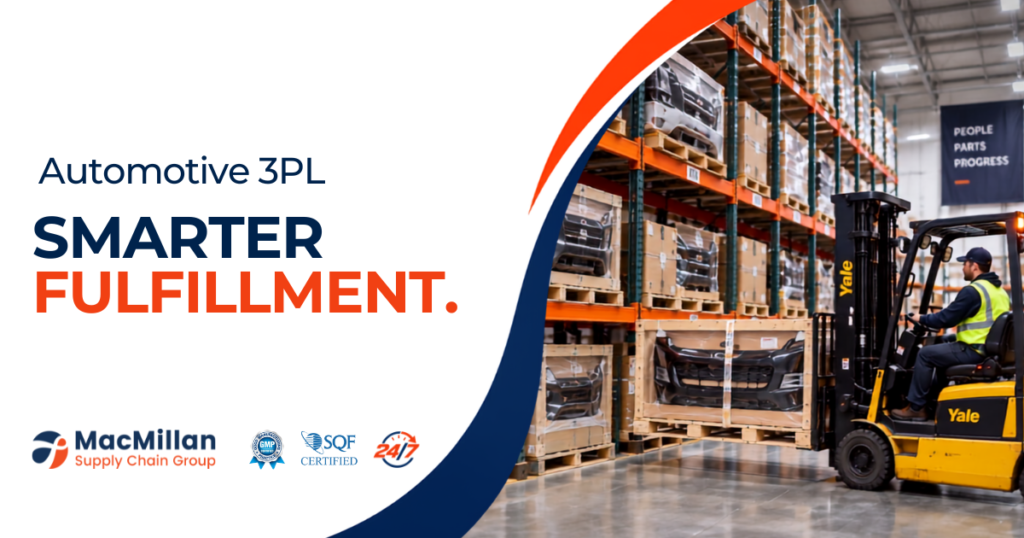
Automotive retailers have historically relied on brick-and-mortar stores due to the operational challenges of warehouse fulfillment for bulky, oversized, or heavy products. However, the automotive market is well-suited for online shopping, offering buyers access to rare parts for various makes and models. 3PL service providers can significantly aid automotive sellers by offering specialized 3PL warehousing and expert fulfillment services for consumers. The role of 3PL in the automotive supply chain involves inventory management, transportation and distribution leading to cost reduction, and compliance. Moreover, this blog outlines five ways a 3PL assists automotive sellers. What is an automotive 3pl? An automotive 3PL is equipped to handle a wide range of auto parts, offering comprehensive logistics services for full-service automotive sellers. This includes 3PL warehousing capabilities to store and ship oversized merchandise such as fenders, tires, seats, and complete engines. Some of the globally recognized 3PL leaders in the automotive industry include DHL supply chain and XPO logistics, which have served as the top innovative logistics solutions in the automotive market with a strong market presence. At MacMillan SCG we excel in shipping heavy and bulky products. Our 3PL warehousing services include extra-wide aisles to accommodate large boxes and robust conveyor belts designed to handle heavy items efficiently. What is the role of 3pl in automotive supply chain? The automotive supply chain is a complex network requiring precision, efficiency, and adaptability. Third-party logistics (3PL) providers play a crucial role in this area, from optimized 3PL warehousing to efficient order fulfillment and delivery to designated area. The demand for automotive fulfillment is only getting bigger in today’s market dynamics, with the growth of online and onsite sales. This blog delves into how 3PLs enhance the automotive supply chain, from inventory management, warehousing, order fulfillment to cost reduction and technology integration for improved customer satisfaction. Enhancing inventory management: In the automotive industry, managing inventory efficiently is essential due to the vast range of parts and components, each with varying demand cycles. MacMillan as a 3pl service provider utilizes advanced inventory management systems (IMS) to track parts in real time, minimizing the risk of stockouts and overstock situations. This real-time visibility allows companies to maintain optimized inventory levels, ensuring that critical components are always available when needed. Streamlining transportation and distribution: Given the need to move heavy and bulky items like engines and transmissions. 3PLs offer specialized transportation solutions tailored to the automotive sector, including multimodal transport options. MacMillan SCG allows a geographic coverage in the Greater Toronto Area and 80% of western region coverage allowing warehousing Toronto and to help your business align networking. Reducing operational costs: By outsourcing logistics to 3PL service providers, automotive companies can significantly reduce their operational costs. 3PLs leverage economies of scale, enabling them to offer competitive pricing for warehousing, transportation, and other logistics services. Ensuring compliance and risk management: Compliance with industry regulations and standards is paramount in the automotive sector. 3pl services providers implement robust risk management practices to mitigate potential disruptions in the supply chain, including contingency planning and disaster recovery strategies. 5 ways a 3pl help automotive sellers Expert fulfillment is essential for business growth, especially for automotive sellers dealing with bulky and fragile auto parts. Here are five ways a 3pl service provider can help an automotive sellers thrive in today’s dynamic market. Inventory management and safe storage: Selling auto parts can be an inventory management challenge. With numerous parts to store, each requiring the correct version for different models, you might need to organize and secure thousands of SKUs, ready for shipment. This is where professional warehousing comes in. Logistics companies such as MacMillan SCG utilizes warehouse management systems (WMS) to track SKUs from inbound shipment through order fulfillment and shipping with a 24/7 security protocol to keep your inventory safe and tracked. Kitting: Kitting involves pre-packing items to ship together, a strategy automotive sellers use to prepare SKUs that usually sell as a group. For example, a customer ordering a steering column for a 1999 Ford Mustang might also need related parts to accompany such as a steering wheel. By using kitting, you can pre-assemble all the necessary components for rebuilding a power steering system into one convenient package. Kitting also facilitates package consolidation, saving on shipping costs. By packing small items with larger products that ship based on dimensional weight. Kitting streamlines the pick and pack process, as a picker can retrieve a single pre-assembled kit instead of multiple individual SKUs to fill an order. Assembly lines are set up to efficiently create kits ready for shipping, and the kitting process can include standard operating procedures (SOPs) to ensure each set is packed safely. Pick, Pack and Ship: An automotive 3PL service provider specializes in timely and complete order shipments. Their warehouse management system (WMS) generates efficient pick lists for warehouse staff. Technologies like RFID tags and barcoding ensure accuracy in item selection. Additionally, experienced packers use the appropriate materials and operational methodologies to pack each order professionally, ensuring it arrives in perfect condition. Cross docking: is labeling orders on the inbound dock and moving them to shipping instead of placing stock into inventory first. Cross-docking is an excellent method to allow order fulfillment and lower storage costs. When evaluating potential 3PL service providers, inquire if they offer cross-docking to enhance the speed of your order processing. Returns management: Return processing in automotive 3PL refers to the management of product returns within the automotive supply chain by 3PLs. Although high-quality automotive logistics can minimize your return rate. Thus, having reverse logistics solutions in place is still crucial. Handling returns like engine blocks or transmissions can be a challenge, partnering with a 3PL can assist you in overcoming these obstacles. Return processing in the automotive 3PL includes several key steps such as: Receiving Storing Inspection and evaluation Inventory update Disposition Reporting Scalability and shipping discounts: Shipping automotive parts, mainly the heavy or oversized ones, can incur significant expenses. Carriers often impose surcharges for packages exceeding certain weight limits, such
Buffer Inventory: The Key to seamless Third-Party Logistics
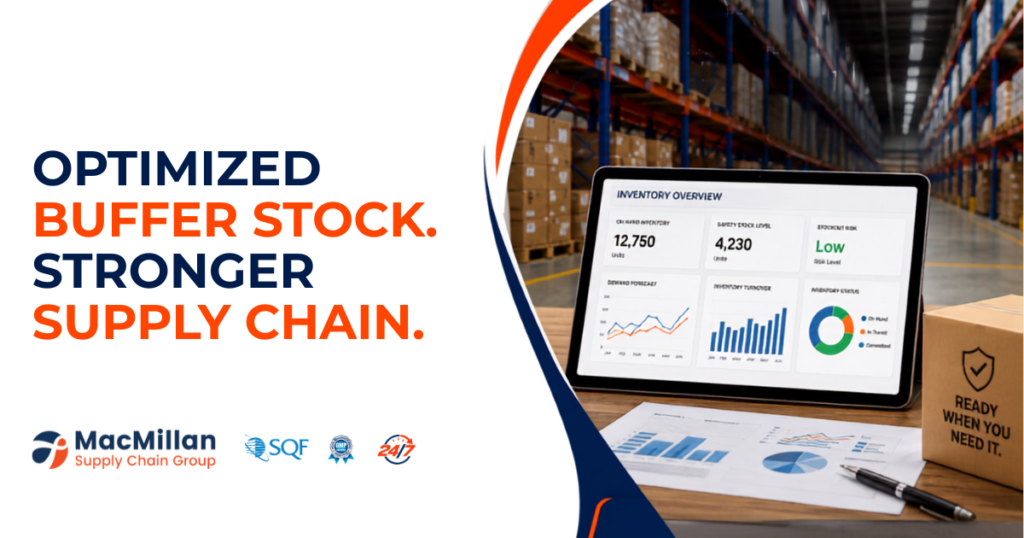
Supply chain demand spikes can often lead to out-of-stock items, risking customer satisfaction. MacMillan helps your business maintain safety stock or buffer stock to meet customer demands even during disruptions or sudden seasonal increases. While having substantial buffer stock offers a safety net in 3pl warehousing, it also incurs significant costs. By employing reliable strategies and leveraging expert insights, you can balance customer demand with optimized operations. Expertise in logistics enables you to provide an exceptional customer experience through order fulfillment, while effectively managing 3PL warehousing challenges and minimizing costs. What is buffer inventory? A buffer serves as a protective layer against potential disruptions within 3PL warehousing operations. Buffer inventory, which is also known as safety stock, or supply chain safety net is a surplus of inventory stored in a warehouse to mitigate risks, logistics failures, transportation delays or unexpected demand spikes. The amount of buffer inventory to be kept depends on several factors such as the type of products sold, average production lead times, historical inventory and order accuracy trends. While some demand changes can be anticipated, such as during flash sales or organized promotions, other increases in sales might be unexpected, as seen with face masks during the COVID-19 pandemic. Safety stock vs buffer inventory The terms “buffer inventory” and “safety stock” are often used interchangeably, both referring to the extra stock an e-Commerce business maintains to protect against potential supply operations and demand uncertainties. In some contexts, “buffer inventory” specifically refers to unexpected spikes in product demand. While “safety stock” means inventory reserved for disruptions in the 3PL warehousing operations, like supplier delays or production halts. Ultimately, both aim to ensure sufficient inventory is available to meet demand and maintain order accuracy rates. MacMillan offers trackable inventory systems for customers for higher accuracy rates and zero errors. What are the benefits of Safety stock? Maintaining buffer stock provides several advantages, minimizing the value of investing in additional inventory. Benefits of having a safety stock in 3PL warehousing are as follows: What are the strategies to optimize buffer Inventory levels? Maintaining the right amount of inventory is crucial as too much inventory can increase capital and costs. While less inventory can lead to stockouts and missed sales opportunities. Here are essential factors to consider when determining your safety stock levels: Lead Time Variability If your lead times are unpredictable, it’s important to maintain higher inventory levels to account for potential delays, ensuring you can meet demand consistently. Inventory Accuracy The accuracy of your demand forecasts directly impacts on your safety stock requirements. When forecasts are reliable, you can keep lower safety stock levels. Acceptable Service Levels Service levels refer to the percentage of time you aim to avoid stockouts. Higher service levels indicate more buffer stock. Cost of Carrying Inventory Evaluate the costs associated with maintaining inventory, including storage and the opportunity cost of tied-up capital. To optimize operations of your safety stock levels, consider the following strategies: Regularly Review and Adjust Inventory Levels: Adapt to changes in lead times, demand patterns, and service level targets. Implement Robust Demand Forecasting Methods: Enhance order accuracy to reduce the need for excessive buffer stock. Collaborate with Suppliers: Work with suppliers to reduce lead time variability and improve reliability. Monitor Inventory Performance Metrics: Continuously analyze metrics such as turnover rates frequency to identify areas for improvement. How to calculate buffer inventory levels? Determining the appropriate amount of buffer inventory is crucial for maintaining 3PL warehousing operations, but it’s not a one-size-fits-all scenario. For accurate buffer inventory, you’ll need robust analytics and reporting tools. These tools provide detailed insights such as historical order data, SKU performance, and demand forecasting. Access to this data allows you to calculate the amount of buffer inventory needed to optimize 3PL warehousing storage and ensure timely order fulfillment. Safety Stock Calculation Methods Basic Safety Stock Formula Formula: Safety Stock = (Maximum Daily Usage × Maximum Lead Time) – (Average Daily Usage × Average Lead Time) Approach: Ideal for scenarios where demand and lead times are relatively stable. Service Level Method Formula: Safety Stock = Z-score × Standard Deviation of Demand × √Lead Time Approach: Suitable for businesses aiming to meet a specific service level target, ensuring a high probability of fulfilling customer demand. Time-Based Calculations Approach: Utilize previous sales information and forecasted demand to set dynamic safety stock levels. Adjustments: Modify safety stock based on demand fluctuations, such as seasonal trends. Regularly review and update buffer levels as new data becomes available. Usage: Best for businesses with predictable demand patterns and reliable forecasting capabilities. Heizer and Render’s Method (for Lead Time Variability) Formula: Safety Stock = Z-score × √((Lead Time × Demand Variance) + (Average Demand² × Lead Time Variance)) Approach: Effective when lead times are inconsistent, incorporating both demand and lead time variability. Buffer Stock calculations: Demand and Lead Time Stability: Evaluate how stable and predictable your demand and lead times are. Data Availability and Accuracy: Ensure you have access to accurate historical sales data and reliable forecasts. Desired Service Level: Determine your service level goals and understand the costs associated with achieving them. Calculation Complexity: Assess the complexity of the chosen method and the resources required to implement and maintain it. How much safety stock 3PL warehousing needs? Managing buffer stock is an ongoing 3PL warehousing process that requires regular attention and adjustment. Here are some strategies to help optimize your safety stock: Conduct 3PL warehousing reviewsContinuously monitor inventory levels, demand patterns, and 3PL warehousing performance. Adjust buffer inventory based on evolving conditions. Prevent OverstockingRegularly assess inventory turnover rates to reduce excess stock that ties up capital and increases carrying costs. Implement strategies like Just-In-Time (JIT) or Economic Order Quantity (EOQ) to optimize stock levels. Strategically Distribute StockIf your business operates in multiple 3PL warehouses, consider strategically distributing buffer inventory across these facilities. Outsource to a 3PL like MacMillan SCG 3PL warehousing and fulfillment can be demanding, consuming time, resources, and effort. However, leveraging the capabilities of a technology-driven 3PL provider such
How to Choose a 3PL for FMCG Brands in Canada
Choosing the right FMCG 3PL in Canada means finding a logistics partner that can do more than store and ship products. FMCG brands need fast inventory turnover, accurate lot and expiry tracking, retailer-compliant preparation, scalable warehouse capacity, reliable transportation and clear inventory visibility. The best 3PL should fit your products, retail channels and growth plans—not force your operation into a generic fulfillment model.That distinction matters because fast-moving consumer goods operate differently from many other product categories. Food, beverages, personal care, household products and general merchandise often move through several channels at once. A single SKU may be shipped by pallet to a retailer, by case to a distributor and by individual unit to an ecommerce customer.If the 3PL cannot manage those workflows accurately, the consequences can include stockouts, retailer chargebacks, excess inventory, delayed launches and higher fulfillment costs. Why FMCG Brands Need a Specialized 3PL FMCG logistics is built around velocity. Products move quickly, customer expectations are high and retailers often operate with strict delivery windows. A general warehouse may be able to store inventory, but an FMCG-focused 3PL should understand how product movement, replenishment, compliance and inventory accuracy interact. Common FMCG requirements include: High-volume receiving and outbound processing Lot, batch or expiry-date tracking FIFO or FEFO inventory rotation Retailer-specific labels and pallet configurations Promotional kitting and repacking Seasonal volume increases B2B and direct-to-consumer fulfillment Inventory visibility across multiple sales channels Retail distribution-centre appointments Returns and damaged-product processing A provider that already works with FMCG categories is more likely to have procedures designed for these requirements rather than treating them as exceptions. MacMillan Supply Chain Group, for example, structures its logistics services around FMCG categories including food and beverage, personal care and wellness, home care and general merchandise. Businesses with food or beverage products can review its food and beverage logistics services for category-specific capabilities. 1. Start With Your Actual Fulfillment Requirements Do not begin the 3PL search by asking providers for their cheapest storage or pick-and-pack rate. First document what your business actually needs. Your requirements should include: Number of active SKUs Average pallet inventory Monthly inbound volume Average monthly orders Peak order volume Average units per order Retail, wholesale and ecommerce channel mix Product dimensions and weights Lot or expiry requirements Retailer compliance requirements Packaging and kitting needs Returns volume System integration requirements This information allows different 3PL providers to quote the same operation. Without it, one provider may price a basic warehouse service while another assumes a much broader scope, making the proposals difficult to compare. 2. Check FMCG and Category Experience Industry experience should be one of the first screening criteria. A 3PL handling apparel or electronics may operate an excellent warehouse, but the processes required for food, beverages, personal care or household products can be very different. Ask prospective providers: Which FMCG categories do you currently handle? Do you manage products with expiry dates? Can you support lot and batch traceability? Do you work with Canadian retailers? Can you manage promotional programs? Can you support both B2B and ecommerce orders? What quality-control procedures apply to my product category? The provider should be able to explain how its existing workflows match your products instead of simply saying that it can “handle anything.” 3. Evaluate Warehouse Location and Distribution Reach Warehouse location affects transportation cost, delivery time and inventory availability. For Canadian FMCG brands, facilities near major population centres, retail distribution networks and transportation corridors can reduce unnecessary freight distance. A warehouse serving Ontario, for example, may benefit from access to the Greater Toronto Area and key Canada-U.S. trade corridors. National brands may require additional geographic coverage or a transportation network capable of reaching other provinces efficiently. When evaluating warehousing and distribution services, consider: Distance from suppliers Distance from major customers Access to highways and transportation hubs Retail distribution-centre locations Parcel delivery zones Cross-border requirements Future expansion plans The warehouse with the lowest storage cost can become more expensive overall if inventory is positioned far from customers. 4. Verify Inventory Accuracy and Visibility Inventory accuracy is especially important for FMCG products because demand can move quickly. If the warehouse system says 500 units are available but only 420 are physically present, the brand may accept orders that cannot be fulfilled. Ask the 3PL how it maintains inventory accuracy. Look for: Barcode-based receiving Scan verification during picking Cycle-counting procedures Real-time inventory reporting Inventory discrepancy workflows Lot and expiry visibility Order allocation controls A modern provider should offer clear inventory visibility so teams can see stock levels, order status and inventory movements without waiting for manual spreadsheets. Visibility becomes even more important when the same inventory supports retail, ecommerce and wholesale channels. 5. Confirm Lot, Batch and Expiry-Date Capabilities For many FMCG categories, knowing how many units are in the warehouse is not enough. The business may also need to know which batch those units came from and when they expire. Food, beverages, supplements, beauty and personal care products may require: Lot tracking Batch tracking Expiry-date capture FIFO or FEFO rotation Minimum shelf-life controls Recall traceability The provider should be able to demonstrate how those attributes are recorded during receiving and how the warehouse system prevents the wrong stock from being allocated. MacMillan provides dedicated lot, batch and expiry control for businesses that require product-level traceability. 6. Assess Retail Compliance Experience Retail compliance can be one of the biggest differences between a general fulfillment provider and an FMCG-focused 3PL. Canadian retailers may require specific: Carton labels GS1 labels Pallet configurations Case quantities Advance shipping notices EDI documents Delivery appointments Routing procedures Remaining shelf life A shipment can contain the correct product and quantity yet still generate a chargeback if it does not meet these requirements. Ask the 3PL which retailers it regularly ships to and how retailer rules are maintained internally. A strong retail compliance preparation process should help catch problems before goods leave the warehouse rather than investigating them after a chargeback arrives. 7. Look for Omnichannel Fulfillment Capability Many Canadian FMCG brands no longer operate
Emerging Growth of A.I In Supply Chain Management
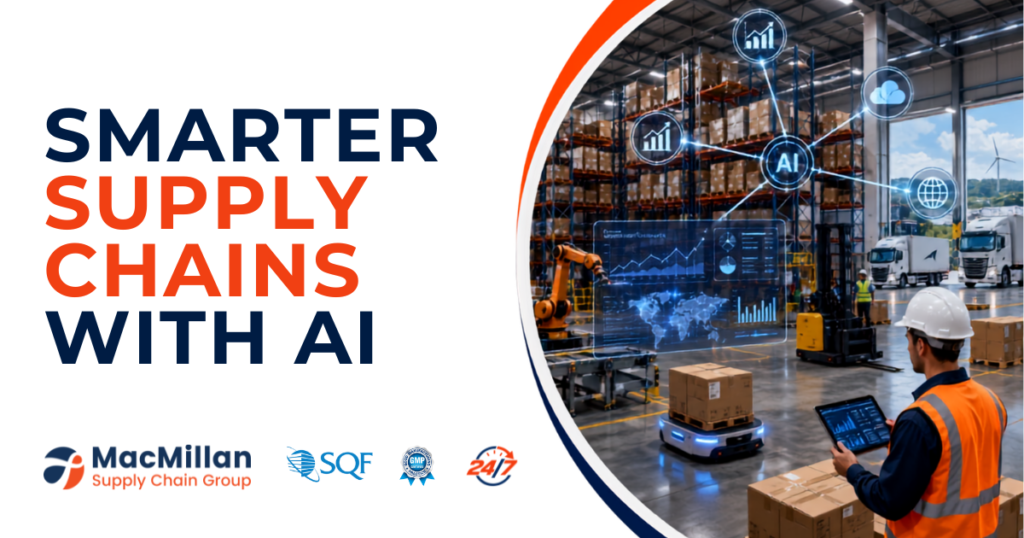
In recent years, supply chains have become more complex and demanding to manage. This is prompted by factors such as the ever changing and fast paced global market, longer and more interconnected physical flows, and recent focus on incorporating sustainability. These factors highlight the need for agility, flexibility, and resilience in supply chain management. As a result, artificial intelligence (AI) has come up as a formidable tool to revolutionize supply chain operations. Thus, the use of AI promises to transform the industry. The Role of AI in Modern Supply Chains AI’s main function is its ability to analyze vast amounts of data, recognize patterns, and provide actionable insights. Since supply chain management needs to have timely and accurate information for decision-making, AI is a very compatible tool to adopt. MacMillan SCG uses AI-based solutions which are revolutionizing several facets in its logistics operations such as demand forecasting, integrated inventory management systems and warehouse management systems (WMS), route optimization and risk mitigation. Demand Forecasting and Inventory Management Precise demand forecasting is crucial for enhancing inventory levels and minimizing stockouts or overstock situations. AI algorithms can analyze historical sales data, market trends, and other variables to generate accurate demand forecasts. As an example, retailers like Walmart and Amazon employ AI to estimate and predict product demand and use that information to guarantee optimal inventory levels which in turn keeps customer satisfaction high. AI-driven inventory management systems can also generate optimized replenishment plan based on real-time demand signals, supplier lead times and inventory levels, decreasing carrying costs and refining fulfillment accuracy. Route Optimization and Transportation Management The usage of AI can decrease transportation costs and improve delivery efficiency, as AI can rapidly optimize transportation routes based on traffic conditions, weather forecasts and delivery deadlines. Generate AI algorithms are one step further as they can autonomously offer alternatives for complex routing problems, prioritizing timely and cost-effective deliveries. MacMillan caters for efficient on time delivery by using automated routes with order tracking options for its customers. Enhancing Supply Chain Resilience with AI In a post-pandemic world, the vulnerabilities in the global supply chain are increasingly obvious. Therefore, companies have opted to prioritize resilience. AI plays a vital role in this as it increases visibility into supply chain operation and aids proactive risk management. Predictive Analytics: AI can analyze historical data to predict demand fluctuations and potential disruptions. Real-Time Monitoring: AI-driven systems provide real-time visibility into supply chain operations, helping to identify and address issues promptly. Inventory Optimization: AI algorithms optimize inventory levels, reducing the risk of stockouts and overstocking. Automated Decision-Making: AI supports automated decision-making, improving response times and operational efficiency. Supplier Risk Management: AI assesses supplier risks by analyzing data from various sources, enabling proactive risk mitigation. Demand Forecasting: AI enhances the accuracy of demand forecasts, leading to better planning and resource allocation. Supply Chain Mapping: AI maps complex supply chains, identifying critical nodes and potential vulnerabilities. Cost Reduction: By optimizing routes and processes, AI helps in reducing transportation and operational costs. Sustainability: AI promotes sustainable practices by optimizing resource usage and reducing waste. These points highlight how AI can be leveraged to enhance the resilience and efficiency of supply chains. Supply Chain Visibility and Risk Management With the use of AI tools, firms such as MacMillan can achieve end-to-end visibility. This facilitates easier monitoring of inventory levels, shipment tracking, and a faster response time to disruptions. For example, AI algorithms can analyze supplier performance data and market conditions to pinpoint possible risks and suggest alternative suppliers or contingency plans. This ability is critical for reducing the impact of disruptions such as natural disasters, geopolitical events, or pandemics. Sustainability and Ethical Sourcing Recently, more and more companies are beginning to take sustainability as a priority and AI can aid supply chains to minimize the environmental impact. AI tools such as scenario analysis can identify ways to reduce carbon emissions, minimize waste and encourage ethical sourcing practices. For instance, the combination of AI with blockchain technology helps to increase the transparency of a product’s origins and its supply chain management strategies. This aids compliance with regulations and improves customer loyalty. Read more about the key tips for greener logistics. Real-World Applications and Benefits The real-world applications of AI in supply chain management are vast and substantial. Companies that employ AI solutions report notable improvements in logistics costs, inventory levels and service levels. Challenges and Considerations While the benefits of AI in supply chain management are plenty, some considerations still need to be made. There may be issues such as data availability, technical expertise and the costs associated with AI adoption. Moreover, to successfully integrate AI into operations, organizational changes, process updates and workforce upskilling are required to truly see the estimated return on investment. The Future of AI in Supply Chain Management As AI technologies continue to progress and they become more integrated into everyday life, their impact on supply chain management will also increase. Predictive analysis, machine learning and automation will have more significant roles in shaping supply chain processes. Future advancements may include AI-powered robots for warehousing and logistics, virtual assistant for customer services and autonomous vehicles for transportation. AI showcases a great promise for changing supply chain management, enhancing efficiency, resilience and sustainability, Companies that strategically adopt and integrate AI tools and solutions will be well equipped to deal with the complexities of modern supply chain and gain a competitive edge in the marketplace. Key Takeaways Artificial intelligence (AI) has emerged as a powerful tool, revolutionizing supply chain operations. By leveraging AI, companies like MacMillan SCG are enhancing demand forecasting, inventory management, route optimization, and risk mitigation. AI’s ability to analyze vast amounts of data and provide actionable insights makes it indispensable for modern supply chains. Adopting AI not only ensures efficiency and resilience but also promotes sustainability, giving businesses a competitive edge in today’s dynamic market. Frequently Asked Questions What is AI in supply chain management? AI in supply chain management uses artificial intelligence and machine learning to
A Guide to Audit your 3PL Warehouse: Technologies and Processes
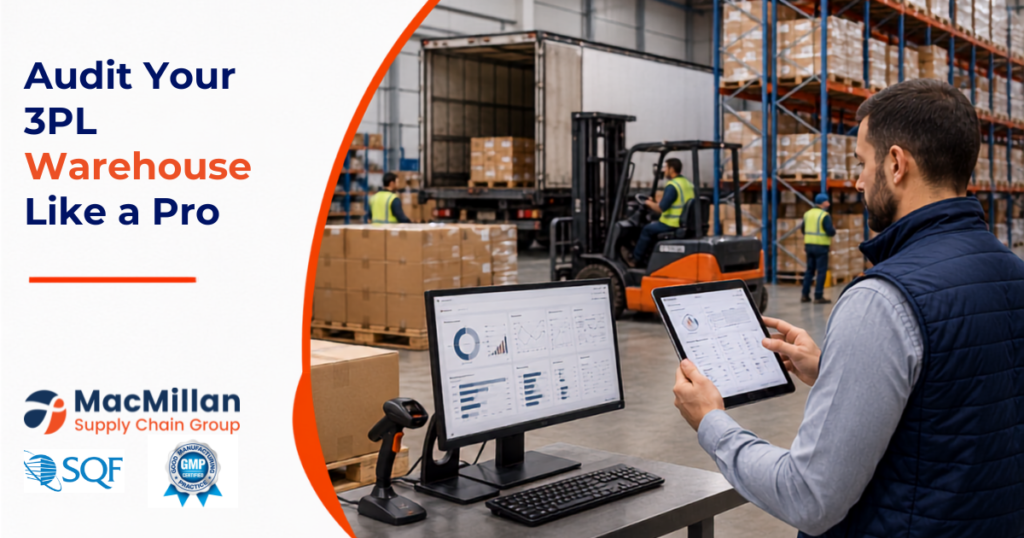
As a 3PL provider, 3PL warehouse manager overseeing warehouse operations, it’s crucial to know how to audit your warehouse technology and processes effectively. Audits help identify areas needing improvement, allowing businesses to enhance inventory accuracy, visibility and boost efficiency. By evaluating your current 3pl warehouse practices, you can pinpoint internal operational gaps and consider technological solutions to optimize all aspects of order fulfillment. So, what should you focus on when auditing your warehouses? Let’s delve into the specifics to ensure you implement best practices for optimized business operations! What is a Warehouse Audit? A warehouse audit is a comprehensive analysis of your warehouse’s technology and processes. This systematic and objective examination identifies areas for needed changes and opportunities for optimization. An audit evaluates the effectiveness of your 3pl warehouse operations, the efficiency of your technology, and the accuracy of your inventory management. Steps to Audit a 3pl warehouse? Auditing a warehouse requires a structured and methodical approach. Here are the key steps to guide you through the process: 1. Create a Warehouse Audit Checklist Develop a detailed warehouse audit checklist covering all aspects of your operations. Include critical areas such as receiving and put-away, order picking, packing and shipping, inventory management, and technology systems. This checklist will serve as your audit roadmap, ensuring thorough coverage of all necessary areas. 2. Evaluate the Warehouse Layout and Design The layout and design of your warehouse significantly impact operational efficiency. Assess factors like pallet width, storage density, and the flow of goods to ensure the design is optimized for your needs. Such as MacMillan provides transparent pricing layouts to storage and inventory tracking using integrated WMS. 3. Review Receiving and Put Away Processes Receiving and put-away are vital daily functions that require regular auditing to ensure efficiency. Ensure your receiving team thoroughly inspects all incoming shipments and stores them correctly with zero error rates for damaged goods. MacMillan provides a 0.01% error rate with responsiveness. 4. Analyze Order Picking Processes Order picking is crucial to warehouse operations, and inefficiencies can lead to errors and delays. Analyze these processes to ensure they are optimized for speed and accuracy, using appropriate procedures and technology. 5. Assess Packing and Shipping Processes Packing and shipping are essential components that must be efficient and error-free as customers want real-time access in today’s market. Verify that packers use correct materials and follow proper procedures to maintain quality throughout the process. 6. Review Inventory Management Processes Effective inventory management is crucial for a 3pl warehouse success. Ensure your inventory tracking systems are up-to-date and that staff manage stock levels accurately. 7. Evaluate 3pl Warehouse Technology Systems Modern warehouses rely heavily on tech-driven operations. Assess your systems to ensure they are functioning correctly and fully integrated with your processes. Make sure your technology is up-to-date and meets your 3pl warehouse’s specific needs. By following these steps, you can conduct a thorough warehouse audit, identify areas for improvement, and implement best practices to enhance your warehouse operations. What are the Warehouse audit procedures can you use? Planning and conducting a 3pl Warehouse Audit Conducting a warehouse audit will vary based on your specific needs and the complexity of your warehouse operations. However, some general guidelines can ensure your audit is thorough and effective: 1. Define the Scope Clearly define the scope of your 3pl warehouse audit, specifying which aspects of your operations you plan to examine. MacMillan focuses on the most critical areas and ensures that all necessary elements of the warehouse operations are covered, i.e. providing on-site visits for the customers has a long-term impact. 2. Assign Responsibilities Start by assigning tasks to individuals who will lead, perform, and implement changes based on the audit findings. Clear responsibility ensures accountability and smooth execution. 3. Conduct the Audit During the audit, take detailed notes and document any areas of concern or opportunities for improvement. Follow your warehouse audit checklist to ensure comprehensive coverage of all relevant areas. 4. Analyze the Results Use your audit checklist and notes to guide your analysis of the audit results. Include key stakeholders in this process to identify areas of concern and opportunities for improvement. 5. Develop an Action Plan Based on your analysis, develop a specific, measurable, achievable, relevant, and time-bound (SMART) action plan to address the identified issues. This plan should outline clear steps and timelines for implementing improvements. 6. Implement Changes Execute the changes identified in your action plan and monitor their effectiveness. Communicate any changes to your team and provide necessary training to ensure a smooth transition and adoption of new practices. By following these guidelines, you can conduct a comprehensive 3pl warehouse audit that identifies key areas for improvement and sets the stage for enhanced efficiency and accuracy in your warehouse operations. Position Your Warehouse for Success Regularly auditing your warehouse technologies and processes is crucial for maintaining efficient operations and ensuring tasks are completed accurately. This thorough review can reveal areas for improvement and provide opportunities to address any issues. A 3pl warehouse management system (WMS) such as that used by MacMillan can significantly aid this process by streamlining tasks and reducing errors. Try Macmillan to gain ultimate control over your inventory with improved visibility into daily activities, ideal for conducting a successful audit! Key Takeaways Conducting regular audits of your 3pl warehouse technology and processes is essential for maintaining operational efficiency and accuracy. By thoroughly evaluating your current practices, you can identify internal process gaps and implement technological solutions to optimize all aspects of order fulfillment. Following a structured approach, from defining the audit scope and assigning responsibilities to analyzing results and implementing a SMART action plan guarantees a comprehensive review. Utilizing a robust warehouse management system like MacMillan’s can streamline this process.
Top Canadian 3PL providers for small businesses
As a small business owner, you understand the significance of finding dependable partners to optimize your operations. One such essential partner is a third-party logistics provider. In this article, we will delve into the top 3PL providers for small businesses and highlight how they can enhance your operational efficiency. As a small business owner in Canada, you understand the importance of partnering with reliable 3PL providers to streamline your operations. How does a Canadian 3PL operate in today’s market? A Canadian 3PL operates by offering a range of services to manage and optimize various aspects of a small or large company’s supply chain. Here’s a breakdown of how a 3PL provider typically operates in the Canadian market and what services it provides: Warehousing and Storage: 3PL providers manage warehousing solutions, including inventory management, storage, and handling. Transportation and Distribution: 3PL providers handle the transportation of goods across Canada and internationally. They coordinate with carriers, manage shipping schedules, and ensure timely delivery. Order Fulfillment: Canadian 3PL providers manage the order fulfillment process, from receiving orders to picking, packing, and shipping products. Inventory Management: 3PL providers use sophisticated inventory management systems to keep track of stock levels, forecast demand, and optimize inventory turnover. Technology Integration: 3PL providers integrate their systems with their clients’ e-commerce platforms, ERP systems, WMS and other software. MacMillan offers seamless integration, which ensures real-time visibility into inventory levels, order status, and shipment tracking. Value-Added Services: Many 3PL providers offer additional services such as kitting, assembly, packaging, labeling, and returns management. Scalability and Flexibility: 3PL providers offer scalable solutions that can grow with a business. Cost Efficiency: By leveraging the expertise and infrastructure of 3PL providers, businesses can reduce operational costs. Top Canadian 3PL Companies for Small Businesses The best 3PL companies do more than just provide logistics services, they become strategic partners in your business’s growth. If you’re searching for a reliable Canadian 3PL provider, start by exploring these five companies: Ship Hero: Known for its comprehensive fulfillment solutions tailored to e-commerce businesses, Ship Hero offers inventory management, order fulfillment, and shipping services through a user-friendly dashboard. Ship Bob: Specializing in e-commerce fulfillment, Ship Bob boasts a robust network of warehouses and an easy-to-use platform, making it an excellent choice for small businesses aiming to scale. MacMillan: Operating throughout the GTA region and covering 80% of the western regions, MacMillan is ideal for small businesses looking to reach international markets. Their offerings include 3pl warehousing solutions, inventory management, and shipping. Red Stag Fulfillment: Focused on handling heavy, large, or high-value products, Red Stag Fulfillment provides specialized services such as same-day fulfillment, highly accurate order processing, and seamless integration with e-commerce platforms. Flexport: Renowned for its digital-first approach, Flexport offers freight forwarding, customs brokerage, and warehousing services. Their platform provides real-time tracking and analytics, giving small businesses transparency and control over their supply chains. When choosing a Canadian 3PL provider, consider factors like technology integration capabilities, scalability, cost-effectiveness, and expertise in your specific market. For businesses looking to expand their operations into Canada, seeking efficient logistics solutions, partnering with a 3PL that understands the local market is essential. Our overview of the best 3PL companies in Canada highlights providers that excel in offering tailored services to meet the diverse needs of businesses within and outside Canada. Benefits of Using a 3PL Provider for Small Businesses Now that you understand what a 3PL is and have identified some of the top providers, let’s explore how partnering with a 3PL can benefit small businesses: Cost Savings: Outsourcing logistics to a 3PL provider eliminates the need for costly investments in warehouses, transportation vehicles, and technology systems. Instead, small businesses can leverage the existing infrastructure and resources of the 3PL provider, sharing costs with other businesses. Expertise: Canadian 3PL providers are experts in supply chain management, transportation, warehousing, and distribution. By partnering with a 3PL provider like MacMillan, small businesses can tap into this expertise to streamline their logistics operations, optimize processes, and ensure efficient and timely delivery of products to customers. Scalability: Flexibility and scalability are crucial for small businesses, especially those with seasonal or unpredictable demand fluctuations (Read more about seasonal demands). 3PL providers have the resources and infrastructure to handle varying shipment volumes, whether during peak seasons or slow periods. Focus on Core Competencies: Outsourcing logistics to a 3PL provider frees up valuable time and resources, allowing small businesses to redirect their focus toward activities that directly contribute to growth and success. By partnering with the right Canadian 3PL provider, small businesses can achieve significant operational efficiencies, cost savings, and enhance customer satisfaction. What types of businesses use Canadian 3PL’s? 3PL providers cater to a wide range of industries and business types. Here are some examples of businesses that can benefit from using 3PL providers: E-commerce Retailers: Online stores that need efficient order fulfillment and shipping services. Manufacturers: Companies that require raw materials to be transported to their production facilities and finished goods to be distributed. Distributors: Businesses that need to manage the storage and transportation of goods to various locations. Wholesalers: Companies that handle bulk orders and require efficient logistics solutions. Startups: New businesses that lack the resources to invest in their own logistics infrastructure. Cost Considerations When Choosing a 3PL for Small Businesses Cost is a crucial factor when selecting a 3PL provider for your small business. Here are some key considerations: Service Fees: Different 3PL providers have varying fee structures. Compare pricing models to find the most suitable option for your business. Additional Charges: Inquire about any additional charges that may apply, such as storage fees, transportation fees, or fees for extra services. Volume Discounts: Some 3PL providers offer discounts based on the volume of business you bring to them. Explore these possibilities to maximize cost savings. By carefully considering these factors and understanding the services offered, small businesses can choose the right 3PL provider to enhance their logistics operations and support their growth. Steps to Choose the Right 3PL for Your Small Business When selecting a 3PL provider for your small business, consider these key factors: Identify Your Needs: Determine which logistics services are essential for your business. Prioritize these needs to focus on what will most impact your operations
Is On-Demand 3PL Warehousing Right for Your Business? Key Considerations
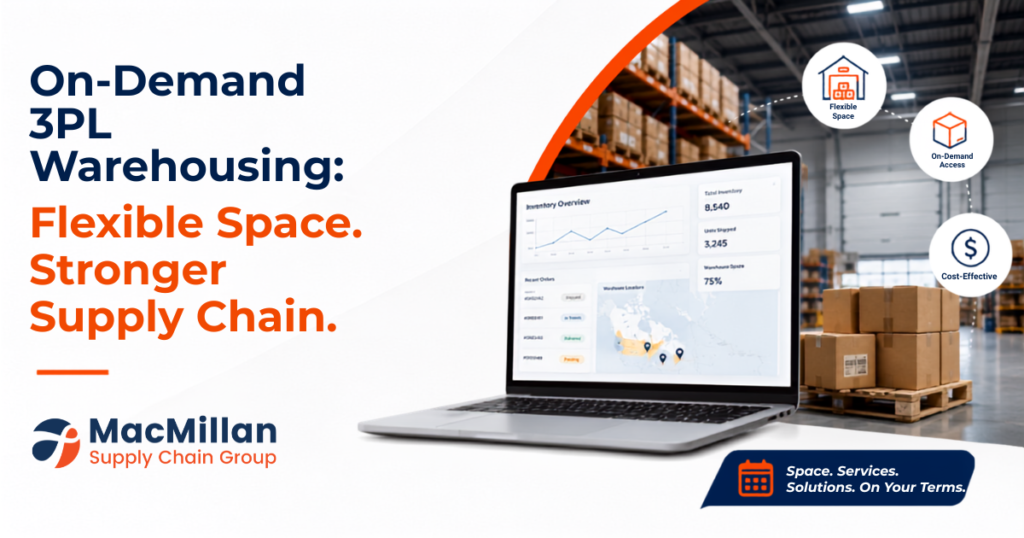
As logistics evolves, brands require flexible and scalable solutions to effectively manage their inventory and fulfillment needs. On-demand 3pl warehousing provides an innovative approach, enabling businesses to adapt to market changes and customer demands. In this article, we will delve into the concept of on-demand 3pl warehousing, explore its benefits, examine real-world applications, and guide you in determining if it is the right solution for your business. Understanding On-Demand Warehousing On-demand 3pl warehousing represents a flexible, modern approach to storage that allows businesses to rent warehouse space and services on a temporary basis. Unlike traditional warehousing, which typically involves long-term leases, on-demand warehousing enables companies to scale their storage capacity up or down in response to real-time needs. By leveraging a network of warehouses with available space, this model allows businesses to efficiently manage their inventory with greater agility and responsiveness. How Does On-Demand 3PL Warehousing Work? On-demand warehousing platforms function as intermediaries, linking businesses with a network of vetted warehouses, including third-party logistics (3PL) warehouses such as MacMillan or fulfillment centers, that have available space. These platforms typically feature an online marketplace where brands can search for warehouse providers based on specific criteria such as location, needed size, and rental duration. Designed to be user-friendly, these platforms allow businesses to quickly compare different options, view pricing, and read reviews before deciding. The pricing transparency and ease of use enable businesses to secure the right warehouse space without lengthy negotiations or commitments. Once a business identifies a suitable3pl warehouse, they can book the space for the required period, which can range from a few weeks to several months. MacMillan also offers value-added warehousing services beyond basic storage, such as inventory management, order fulfillment, and distribution. These services can be seamlessly integrated into the business’s existing supply chain management, providing a comprehensive solution that goes beyond just storage. By leveraging these additional services, businesses can ensure their inventory is managed efficiently, orders are fulfilled accurately, and products are delivered to customers on time. The flexibility of on-demand 3pl warehousing is further enhanced by advanced technological features. Real-time tracking and reporting tools always provide businesses with visibility into their inventory levels and warehouse operations. Additionally, many on-demand 3pl warehousing platforms offer integration capabilities with other systems, WMS integrations and shipping carriers. This ensures a seamless flow of information across the entire supply chain, reducing the risk of errors and improving overall efficiency. What are the examples of On-Demand 3pl Warehousing? On-demand warehousing can significantly benefit various businesses. Here are five examples of how brands have leveraged this model: Seasonal Inventory Management: A retail brand facing fluctuating demand during the holiday season (Learn more about demand fluctuations) can use on-demand warehouses to handle the surge in inventory without committing to a long-term lease. This allows the brand to scale up storage space during peak seasons and reduce it during off-peak times, optimizing costs and efficiency. Geographic Expansion: An e-commerce company expanding to new markets can use on-demand 3pl warehousing to establish a local presence quickly, reducing shipping times and costs. MacMillan allows space in strategic locations; GTA and 80% of the western regions. Short-Term Projects: Companies undertaking special short-term projects, such as limited-term or new product launches, promotional campaigns, can benefit from on-demand warehousing. This allows them to manage initial inventory spikes and timely fulfillment of orders for the duration of the project without the burden of long-term storage commitments. Overflow Management: During periods of unexpected inventory overflow, such as supply chain disruptions or sudden demand spikes, businesses can use on-demand 3pl warehousing to store excess products temporarily. Reverse Logistics: A company handling a large volume of returns, such as an online retailer during the post-holiday season, can use on-demand warehousing to manage and process returns efficiently. Temporary warehousing space can be rented to handle the influx of returned items and streamline the reverse logistics process. What are the benefits of On-Demand 3PL Warehousing? On-demand warehousing offers several key advantages for brands seeking to optimize their supply chain: Scalability: One of the primary benefits of on-demand warehousing is its scalability. Businesses can adjust their 3pl warehousing needs in response to demand fluctuations, seasonal peaks, or sudden market changes. This flexibility ensures that brands are not tied down by long-term contracts and can quickly scale operations up or down as needed. This adaptability allows companies to achieve better cash flow optimization and operational efficiency. Additionally, on-demand warehousing can support rapid business growth and geographic expansion by extending your fulfillment network to new markets. Cost-Effectiveness: By only paying for the space and services they use; businesses can significantly reduce warehousing costs. There are no long-term leases, maintenance fees, or expenses for unused space, making this model highly cost-effective. The ability to avoid large upfront investments in infrastructure, including both physical assets as well as digital assets like specialized warehouse technology- reduces financial risk, particularly for startups and small businesses. This model also minimizes the cost of carrying excess inventory by providing just-in-time storage solutions. Flexibility: On-demand warehousing provides the flexibility to utilize specialized warehouse types for specific fulfillment solutions, test new markets, launch promotional campaigns, and manage unexpected inventory surges without the burden of long-term commitments. Additionally, in situations where there is a sudden spike in orders, such as during a successful marketing campaign, on-demand warehousing ensures that the business can meet customer expectations without delay. How to Know if On-Demand Warehousing Is the Right fit? While on-demand warehousing offers numerous benefits, it may not be the best fit for all businesses. Here are some scenarios where alternative solutions might be more appropriate: High Volume Consistency: If your business consistently maintains a high volume of inventory, a long-term warehousing solution may be more cost-effective. Long-term leases can offer better rates and more stability for businesses that require constant, large-scale storage. This approach also allows for greater customization of the warehouse to meet specific operational needs. Complex Logistics: Businesses with complex logistics requirements might benefit more from a dedicated, long-term warehouse such as MacMillan that can be tailored to their specific needs. Custom warehouse solutions can address unique storage, handling, and distribution requirements that on-demand
Why Canadian FMCG Brands Are Switching 3PL Providers in 2026
Canadian FMCG brands are switching 3PL providers in 2026 because basic storage and shipping are no longer enough. Brands now need accurate inventory visibility, reliable retail compliance, flexible labour, faster order processing and better control over total logistics costs. When an existing provider cannot support changing retailer requirements, seasonal demand or omnichannel growth, changing 3PL partners becomes a business decision rather than a simple warehouse move. Fast-moving consumer goods businesses operate on narrow margins and demanding timelines. A few recurring inventory errors, missed retailer appointments or poorly prepared promotional orders can quickly affect profitability. As grocery, wellness, personal care, home care and general merchandise brands expand across Canadian retail and ecommerce channels, many are questioning whether their current logistics partner can still support the next stage of growth. FMCG Logistics Is Becoming More Complex FMCG logistics once centred largely on moving cases from a warehouse to a distributor or retailer. The modern model is more complicated. A single Canadian brand may now ship full pallets to distribution centres, mixed cases to regional retailers, individual units to ecommerce customers and promotional kits to marketing partners. Each channel has different order formats, cut-off times, packaging requirements and delivery expectations. A 3PL designed mainly for straightforward pallet storage may struggle when the account begins adding direct-to-consumer orders, subscription programs or retailer-specific preparation. The provider may still be capable of moving inventory, but the processes surrounding that inventory may become increasingly manual and expensive. This is one reason FMCG brands are looking for partners that combine warehousing and distribution services with fulfillment, transportation coordination and value-added operations. Limited Inventory Visibility Is No Longer Acceptable Inventory visibility is one of the most common reasons a business begins reviewing its 3PL relationship. FMCG teams need to know what inventory is available, what has been allocated, which products are approaching expiry and whether orders have shipped on time. Receiving a spreadsheet once a day may have been acceptable when a brand had a small number of SKUs and one sales channel. It becomes risky when the company sells through retail, ecommerce, wholesale and marketplace channels at the same time. Poor visibility can lead to: Orders being accepted for unavailable products Excess inventory being purchased unnecessarily Slow-moving products occupying warehouse space Expired or ageing inventory being discovered too late Retail and ecommerce teams working with different stock figures Customer service teams being unable to confirm order status Brands switching providers are increasingly asking for real-time inventory visibility, clear reporting and exception alerts. They want the warehouse management system to support decisions—not simply record what happened after the fact. Retail Compliance Errors Are Costing Too Much Canadian retailers may require specific carton labels, pallet configurations, advance shipping notices, routing instructions and delivery appointments. These requirements can differ by retailer, distribution centre and product category. A shipment can contain the correct products and still be considered non-compliant. A label placed in the wrong position, an incorrect case quantity or a late delivery appointment may result in a chargeback, delayed payment or rejected shipment. For FMCG brands operating on thin margins, repeated compliance issues can erase the savings created by a low warehouse rate. Brands are therefore moving away from providers that treat retail preparation as an occasional manual task. They are looking for 3PLs with documented workflows, retailer-specific knowledge and dedicated retail compliance preparation. The problem is not only the financial penalty. A pattern of inaccurate or late shipments can affect retailer relationships and make future promotions harder to secure. This article on reducing retail chargebacks explains why prevention must begin inside the fulfillment operation. Rising Fulfillment Costs Are Exposing Inefficient Processes Warehouse labour, transportation, packaging and facility costs continue to influence fulfillment pricing. Statistics Canada reported an average hourly wage of C$34.22 in transportation and warehousing for 2025, reflecting the cost environment logistics operators carry into 2026. Higher costs do not automatically mean a 3PL is overpriced. The real concern is whether the provider is using labour efficiently. An FMCG brand may be paying too much because: Inventory is stored in inefficient locations. Orders require repeated manual data entry. Products are touched more times than necessary. Packaging decisions increase dimensional shipping weight. Retail orders regularly require rework. Receiving problems create additional counting and relabelling. Account management fees are not producing operational value. Brands are switching when a provider responds to every challenge by adding another fee rather than improving the process. The lowest pick-and-pack rate is not useful if the business also pays for corrections, rush handling, inventory investigations and preventable retailer penalties. Understanding the complete cost structure is essential. Our guide to the economics of 3PL warehousing outlines why storage and picking should never be evaluated in isolation. FMCG Brands Need Better Lot, Batch and Expiry Control Food, beverage, personal care, wellness and household products may require lot, batch or expiry-date tracking. These controls support inventory rotation, product quality and recall readiness. A warehouse can report an accurate total unit count while still allocating the wrong batch or shipping shorter-dated inventory behind newer stock. For regulated or shelf-life-sensitive products, that is not a minor inventory error. FMCG brands may switch providers when the existing 3PL cannot reliably support: First-expired, first-out inventory rotation Lot-specific order allocation Expiry-date reporting Minimum remaining shelf-life requirements Batch-level inventory holds Product recall traceability A provider offering structured lot, batch and expiry control can help brands maintain better product rotation and respond more quickly when an inventory issue occurs. For food and beverage companies, industry knowledge matters just as much as warehouse space. The facility, systems and operating procedures must match the product’s handling and traceability requirements. MacMillan’s food and beverage logistics solutions are structured around these operational needs. Omnichannel Growth Is Outgrowing Legacy 3PL Models Many FMCG businesses originally selected a 3PL to serve one dominant channel. The relationship becomes strained when the brand adds Shopify, Amazon, wholesale accounts, national retailers or subscription orders. Retail fulfillment and direct-to-consumer fulfillment are not interchangeable. A retail order may involve: Case or pallet picking Retailer labels
Selecting the Optimal 3PL Fulfillment Center Location: 5 Key Factors to Evaluate
The location of your 3PL fulfillment center is crucial to the success of your logistics operations. But how do you select a 3PL partner that will enhance your efficiency and meet your requirements? In this blog, we’ll explore key factors to consider when choosing a 3PL fulfillment center and its geographic location. By understanding and applying these considerations, you can streamline order fulfillment, cut shipping costs, and boost customer satisfaction. Why does Geographic Location Matter? The location of your fulfillment center is a critical factor in your logistics strategy. Here’s why choosing the right spot can significantly impact the success of your warehousing operations: Ensuring Fast Delivery Quick and reliable delivery is essential for customer satisfaction. Many consumers now expect their orders within two days; anything longer may be deemed excessive. Choosing a fulfillment center such as MacMillan, close to major customer hubs means that orders can be processed, picked, packed, and shipped more swiftly. The shorter the distance goods must travel, the faster they reach customers, which directly enhances their satisfaction. MacMillan ensures real-time tracking and a zero-error rate for on time deliveries within the GTA and 80% of the western region, proving to be top tier Canadian warehousing provider. Managing Shipping Costs The strategic placement of your fulfillment center is key to controlling shipping expenses. By positioning fulfillment centers near customer concentrations and major highways, MacMillan avoids the high costs of long-distance shipping. This approach helps maintain competitive shipping rates and can improve overall profit margins. Location Facilitates Business Expansion As your business scales, strategic expansion becomes essential. To accommodate growing demand, you may need to add more fulfillment centers to your network. The choice of these locations is vital for preserving both customer experience and operational efficiency. Selecting optimal locations from the beginning sets the stage for a seamless transition during future expansion, ensuring that your growth is both efficient and effective. 5 Key Factors for Choosing the Right 3PL Fulfillment Center Now that you understand the importance of location for your fulfillment center, the next step is determining the best site. Here are five crucial factors to guide your decision: Proximity to Your Customer Base The foremost consideration is the location relative to your customer base. Shipping carriers use zones to calculate shipping costs and delivery times, the shorter the distance, the lower the cost and the faster the delivery. To enhance efficiency and reduce expenses, select a fulfillment center close to the majority of your customers. For a global reach, partnering with international 3PLs that have centers in various countries can help lower shipping costs and improve delivery speed. Delivery Time Expectations Delivery time directly impacts customer satisfaction. Choose a fulfillment center that can meet or exceed your customers’ expectations for delivery speed. Assess industry standards or gather customer feedback to determine acceptable delivery times and select a location that aligns with these expectations. Free Delivery Feasibility MacMillan offers free delivery which can be a major selling point, but it comes with costs. To offer free shipping without eroding your profit margins, select a fulfillment center location that optimizes shipping costs. Consider a center close to your customer base or one that provides various shipping options to manage costs effectively. Single vs. Multiple Locations Decide whether a single fulfillment center or multiple locations best suits your business. A single center may be ideal for niche businesses, or those with bulky products, simplifying logistics and reducing operational costs. Conversely, multiple centers can benefit larger or more diverse businesses by covering different regions, reducing shipping times, and providing flexibility. Availability of Value-Added Services Value-added services, such as gift wrapping, custom packaging, or personalization can enhance customer experience and differentiate your brand. If these services are important to your business, ensure that your chosen fulfillment center can accommodate them. Partner with a 3PL provider such as MacMillan equipped with the technology and expertise to offer these services effectively. Questions to ask before choosing your 3pl fulfillment Location Choosing the ideal location for your 3PL fulfillment center involves weighing several factors, and there’s no one-size-fits-all solution. Here’s a quick guide to help you make the best choice: Do I need to be close to my fulfillment center? Not necessarily. The location should primarily cater to your customer base to ensure faster and more cost-effective shipping. While proximity to the fulfillment center might offer benefits like easier coordination and local market familiarity, it’s not crucial for success. How do I decide between one or multiple fulfillment centers? One Location: Best for small or niche businesses, products requiring special handling, or limited budgets. Multiple Locations: Ideal for large, diverse businesses with a broad market, complex inventory, or higher budgets that can support the advantages of additional centers such as Walmart and its optimized fulfillment operations. Should my 3PL fulfillment center be centrally located? Central Location: Effective for reaching a broad customer base quickly and managing logistics with fewer locations. Non-Central Location: Beneficial if your customers are concentrated in specific areas or if you want more flexible shipping options and the advantages of multiple centers. Ultimately, the right location for your 3PL fulfillment center will impact shipping costs, delivery times, customer satisfaction, and scalability. Consider these factors to choose the best location for your business and customers. Partner with MacMillan: Your Trusted 3PL Solution Worried about finding the perfect location for your 3PL fulfillment center? It’s time to focus on growing your business operations and leave the logistics to the experts. 3PL Fulfillment and Prep offers reliable and professional services to elevate your fulfillment process. Say goodbye to location headaches and logistics concerns, and let us handle everything for you. Our network of strategically located fulfillment centers across the US ensures your products are stored and shipped efficiently, reducing delivery times and costs. We provide: Cutting-edge facilities and scalable equipment Advanced, integrated technology Transparent and competitive pricing Exceptional customer support Don’t let fulfillment challenges hinder your business growth. Partner with 3PL Fulfillment and Prep and let us manage your order fulfillment