3PL Warehousing and Distribution
3PL providers offer outsourcing logistics and supply chain services, enabling…
3PL providers offer outsourcing logistics and supply chain services, enabling…
Choosing the right FMCG 3PL in Canada means finding…
From independent entrepreneurs to thriving startups, small businesses in the…
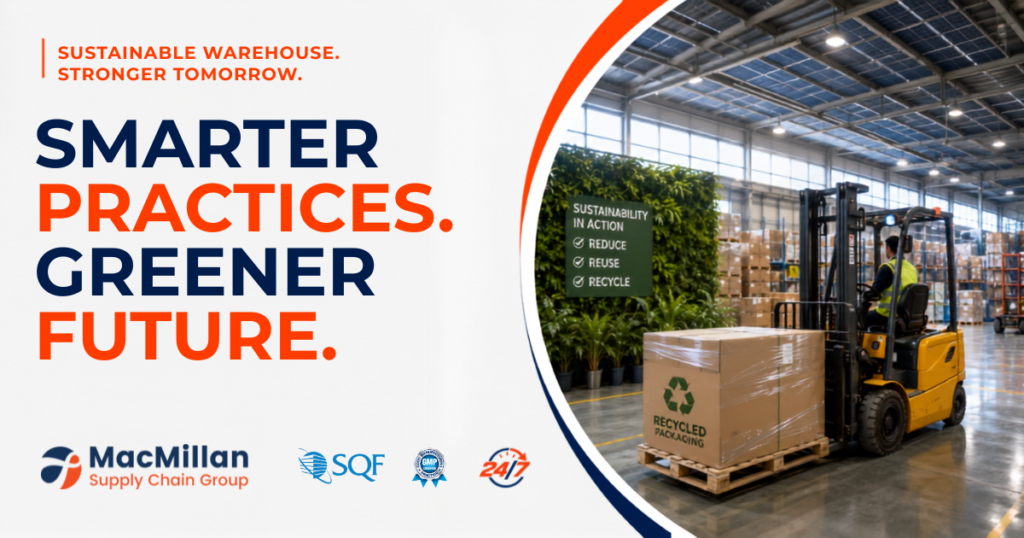
Sustainability and a greener future are crucial in 3pl warehousing…
If the 3PL cannot manage those workflows accurately, the consequences can include stockouts, retailer chargebacks, excess inventory, delayed launches and higher fulfillment costs.
FMCG logistics is built around velocity. Products move quickly, customer expectations are high and retailers often operate with strict delivery windows.
A general warehouse may be able to store inventory, but an FMCG-focused 3PL should understand how product movement, replenishment, compliance and inventory accuracy interact.
Common FMCG requirements include:
A provider that already works with FMCG categories is more likely to have procedures designed for these requirements rather than treating them as exceptions.
MacMillan Supply Chain Group, for example, structures its logistics services around FMCG categories including food and beverage, personal care and wellness, home care and general merchandise. Businesses with food or beverage products can review its food and beverage logistics services for category-specific capabilities.
Do not begin the 3PL search by asking providers for their cheapest storage or pick-and-pack rate.
First document what your business actually needs.
Your requirements should include:
This information allows different 3PL providers to quote the same operation. Without it, one provider may price a basic warehouse service while another assumes a much broader scope, making the proposals difficult to compare.
Industry experience should be one of the first screening criteria.
A 3PL handling apparel or electronics may operate an excellent warehouse, but the processes required for food, beverages, personal care or household products can be very different.
Ask prospective providers:
The provider should be able to explain how its existing workflows match your products instead of simply saying that it can “handle anything.”
Warehouse location affects transportation cost, delivery time and inventory availability.
For Canadian FMCG brands, facilities near major population centres, retail distribution networks and transportation corridors can reduce unnecessary freight distance.
A warehouse serving Ontario, for example, may benefit from access to the Greater Toronto Area and key Canada-U.S. trade corridors. National brands may require additional geographic coverage or a transportation network capable of reaching other provinces efficiently.
When evaluating warehousing and distribution services, consider:
The warehouse with the lowest storage cost can become more expensive overall if inventory is positioned far from customers.
Inventory accuracy is especially important for FMCG products because demand can move quickly.
If the warehouse system says 500 units are available but only 420 are physically present, the brand may accept orders that cannot be fulfilled.
Ask the 3PL how it maintains inventory accuracy.
Look for:
A modern provider should offer clear inventory visibility so teams can see stock levels, order status and inventory movements without waiting for manual spreadsheets.
Visibility becomes even more important when the same inventory supports retail, ecommerce and wholesale channels.
For many FMCG categories, knowing how many units are in the warehouse is not enough. The business may also need to know which batch those units came from and when they expire.
Food, beverages, supplements, beauty and personal care products may require:
The provider should be able to demonstrate how those attributes are recorded during receiving and how the warehouse system prevents the wrong stock from being allocated.
MacMillan provides dedicated lot, batch and expiry control for businesses that require product-level traceability.
Retail compliance can be one of the biggest differences between a general fulfillment provider and an FMCG-focused 3PL.
Canadian retailers may require specific:
A shipment can contain the correct product and quantity yet still generate a chargeback if it does not meet these requirements.
Ask the 3PL which retailers it regularly ships to and how retailer rules are maintained internally.
A strong retail compliance preparation process should help catch problems before goods leave the warehouse rather than investigating them after a chargeback arrives.
Many Canadian FMCG brands no longer operate through one channel.
A typical brand may sell through:
Each channel creates a different warehouse workflow.
Retail orders may involve cases and pallets. Ecommerce orders may require individual-unit picking and parcel shipping. Promotional orders may require custom bundles or inserts.
A capable 3PL should support these workflows while maintaining one reliable inventory picture.
If your business operates across several channels, evaluate whether the provider offers true omnichannel fulfillment rather than simply connecting several order sources.
The warehouse should connect with the systems your business already uses.
Depending on the operation, this may include:
Ask how orders enter the warehouse management system, how quickly inventory is synchronized and what happens when an integration fails.
A good integration should reduce manual work rather than create another layer of complexity.
Brands requiring connected systems should evaluate available platform and ERP integrations before signing a contract.
FMCG brands frequently need more than routine storage and shipping.
Retail promotions, new product launches and seasonal campaigns may require:
If these tasks are performed at a separate facility, inventory must be transported between providers. That adds handling, lead time and risk.
A 3PL with integrated value-added services can move products from storage to preparation and outbound fulfillment within the same operation.
An FMCG 3PL should be evaluated against your busiest month, not your average month.
Ask what happens when order volume doubles during:
The provider should explain how it plans labour, warehouse space, carrier capacity and receiving during peak periods.
A vague answer such as “we can scale” is not enough.
Ask for specific information about:
Your existing provider may look affordable during quiet months and become costly if every peak requires rush fees and overtime.
Warehouse performance means little if orders regularly arrive late.
Transportation requirements for FMCG brands can include:
Ask how the provider coordinates transportation and how shipment status is communicated.
A 3PL with integrated transportation logistics can help coordinate warehouse execution with carrier schedules and retail delivery requirements.
Do not compare 3PL providers using only storage and pick-and-pack rates.
The true cost may include:
Ask each provider to produce a sample invoice using your actual monthly operating profile.
The cheapest line-item rate is not necessarily the lowest total cost. A provider that prevents chargebacks, shipping errors and inventory discrepancies may deliver better economics even with a higher base rate.
For a deeper breakdown, review our guide to the economics of 3PL warehousing.
A strong 3PL should measure its own performance.
Useful FMCG logistics KPIs include:
Ask how frequently KPIs are reviewed and whether your account team will discuss corrective action when performance falls below target.
A dashboard alone is not enough. The provider should be able to explain why a KPI changed and what action will be taken.
Operations rarely run perfectly every day. What matters is how the provider responds when something changes.
Ask:
A good 3PL relationship should provide clear ownership. Your team should not have to contact several departments to find out why an important retailer order has not shipped.
A warehouse visit can reveal things that a proposal cannot.
During the visit, look at:
Ask the provider to walk through exactly how one of your orders would move through the facility.
The discussion should cover receiving, putaway, allocation, picking, packing, shipping and exception handling.
Some warning signs should prompt additional investigation before signing a contract.
A provider does not need to have the most advanced technology or largest warehouse network. It does need to demonstrate control over the processes your business depends on.
Use these questions during your shortlist process:
| Evaluation Area | What to Look For |
|---|---|
| FMCG Experience | Relevant categories, retailers and product handling experience |
| Warehousing | Suitable space, location, scalability and receiving capacity |
| Inventory Control | Scan-based processes, cycle counts and real-time visibility |
| Lot & Expiry | Lot tracking, FEFO/FIFO and recall traceability |
| Retail Compliance | Labels, EDI, routing guides and delivery requirements |
| Technology | WMS, ERP, ecommerce and EDI integrations |
| Omnichannel | Retail, wholesale, marketplace and DTC fulfillment |
| Value-Added Services | Kitting, relabelling, repacking and promotional work |
| Transportation | Carrier options, retail appointments and shipment visibility |
| Pricing | Transparent total-cost model with clearly defined fees |
| Account Support | Named contacts, escalation procedures and regular reviews |
| Scalability | Clear plan for peaks, growth and new sales channels |
The best FMCG 3PL in Canada is not necessarily the largest provider or the company with the lowest storage rate.
The right partner is the one that can reliably execute your actual operating requirements.
For an FMCG brand, that usually means combining accurate inventory management, retailer-compliant fulfillment, scalable warehousing, reliable transportation, technology integration and category-specific product handling.
MacMillan Supply Chain Group supports Canadian FMCG brands across food and beverage, personal care and wellness, home care and general merchandise. Its logistics model combines warehousing, retail preparation, fulfillment, transportation and value-added services within an integrated operation.
MacMillan currently reports more than 300,000 square feet of racked and bulk warehouse space and provides shared and dedicated warehousing options for growing brands.
Before changing providers, document where your current supply chain is creating friction. Is the problem inventory visibility? Retail chargebacks? Storage capacity? Peak-season performance? Transportation? Technology?
Once those problems are clear, evaluating potential 3PL partners becomes much easier.
If your FMCG business is reviewing its Canadian warehousing and fulfillment strategy, request a customized logistics quote from MacMillan Supply Chain Group.
An FMCG 3PL is a third-party logistics provider that manages warehousing, inventory, fulfillment and distribution for fast-moving consumer goods. These providers may also support lot tracking, retail compliance, ecommerce fulfillment, transportation and value-added services.
FMCG brands should evaluate category experience, warehouse location, inventory accuracy, lot and expiry controls, retail compliance, technology integrations, value-added capabilities, transportation, scalability and total pricing.
Retailers may require specific carton labels, pallet configurations, EDI documents, delivery appointments and routing procedures. A 3PL experienced in retail compliance can reduce the risk of rejected shipments, delays and chargebacks.
Yes. A capable omnichannel 3PL can manage pallet and case orders for retailers while also processing individual ecommerce orders. Inventory should remain synchronized across both channels.
Many food, beverage, wellness, beauty and personal care products require lot, batch or expiry-date tracking. These controls support inventory rotation, shelf-life management and recall traceability.
Compare total fulfillment cost rather than one storage or picking rate. Include receiving, storage, pick and pack, packaging, shipping, technology, compliance, returns, account management, minimums and surcharges.
A change may be worth considering when inventory errors, retailer chargebacks, capacity problems, poor visibility, unreliable integrations or communication issues repeatedly affect service and growth.
“`