
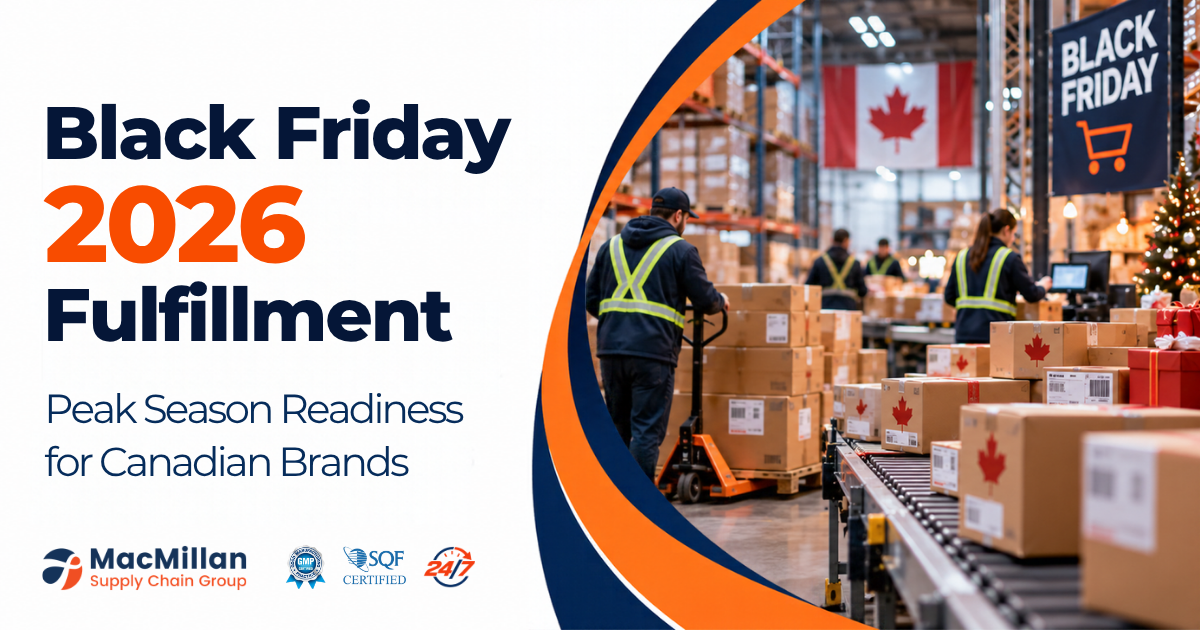
Black Friday Fulfillment Canada: 2026 Peak Season Guide
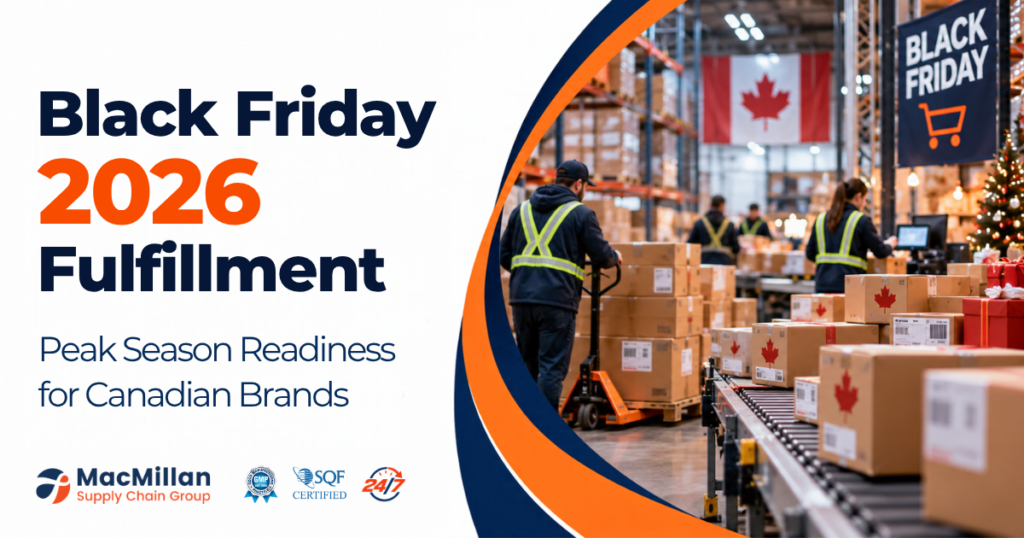
Black Friday Fulfillment Canada: How E-commerce Brands Can Prepare for…
Black Friday Fulfillment Canada: How E-commerce Brands Can Prepare for…
When discussing e-commerce, what typically springs to mind? Most likely,…
As the busiest time of the year draws near, the…
As the busiest time of the year draws near, the…
Winning a purchase order from a major retailer is a big moment.
But for many brands, the real test starts after the buyer says yes.
The product has to arrive correctly.
The labels have to scan.
The ASN has to match.
The pallet has to meet requirements.
The appointment has to be on time.
The cartons have to be packed correctly.
The inventory has to be traceable.
The shipment has to be retail-ready before it ever reaches the dock.
That is where many brands get exposed.
A brand may have a great product, strong packaging, and growing demand — but if the logistics behind the product are not ready for retail, the relationship can get expensive quickly.
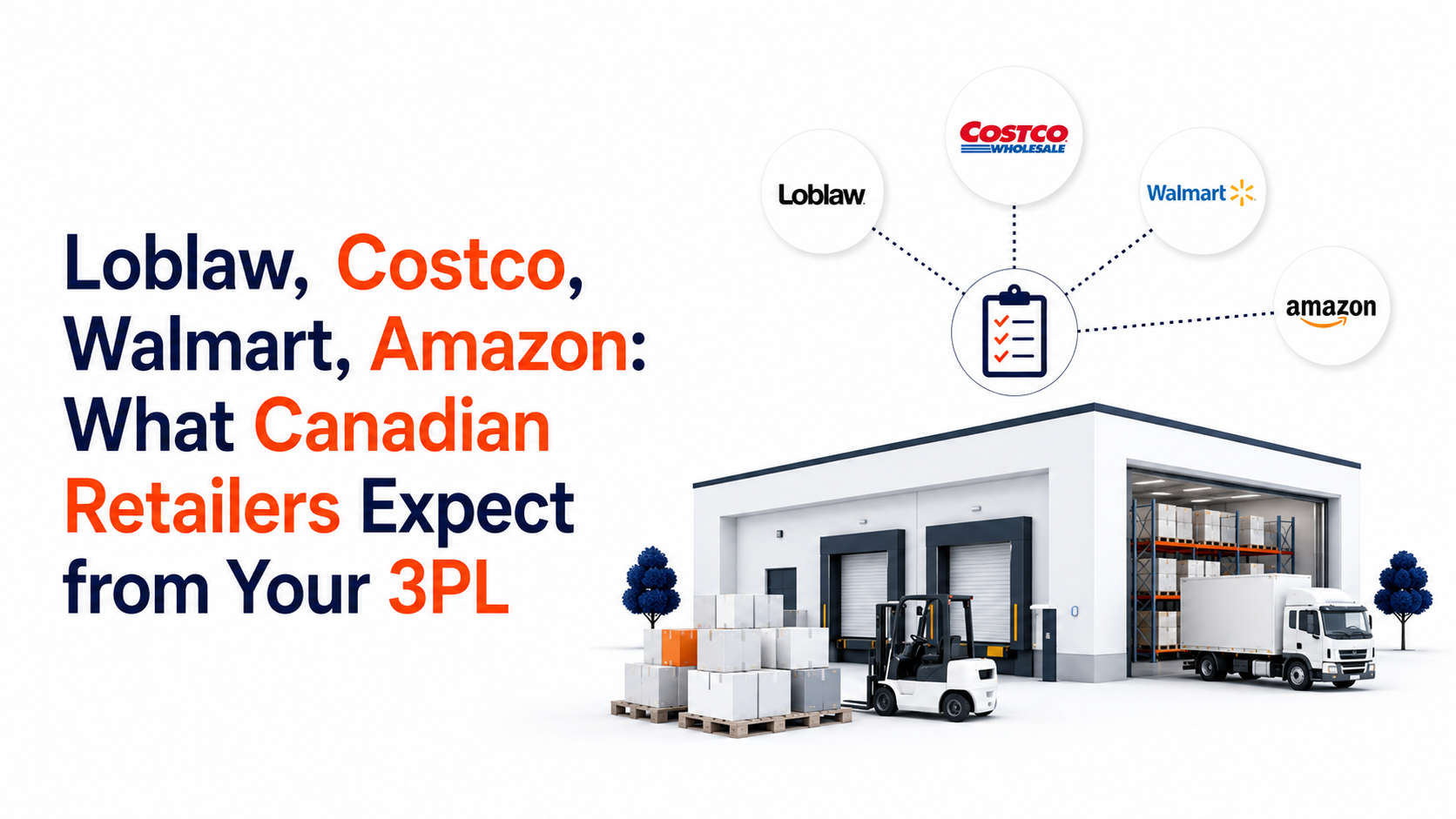
Major Canadian retailers such as Loblaw, Costco, Walmart, and Amazon do not just expect products to arrive. They expect operational discipline.
They expect accuracy, visibility, documentation, compliance, and consistency.
That means your 3PL cannot simply be a warehouse that stores boxes.
Your 3PL has to be a retail execution partner.
Major Canadian retailers expect your 3PL to support accurate inventory, retailer-compliant labeling, EDI and ASN workflows, appointment scheduling, pallet and carton requirements, order accuracy, traceability, on-time delivery, returns handling, and clear shipment visibility.
In simple terms:
Retailers expect your 3PL to make your product easy to receive, easy to track, easy to sell, and hard to reject.
If your 3PL cannot support those basics, your brand risks delays, chargebacks, rejected shipments, lost buyer trust, and avoidable operational costs.
Retail logistics is not the same as basic e-commerce fulfillment.
A DTC order may be one box going to one customer.
A retail order may involve purchase orders, pallet configuration, carton labeling, routing guides, delivery windows, ASN data, EDI documents, lot tracking, and strict receiving rules.
That difference matters.
A 3PL that performs well for online orders may still struggle with retail distribution.
Why?
Because retail compliance is not just about shipping. It is about following the retailer’s operating system.
Each major retailer has its own expectations. The details vary by product category, vendor agreement, distribution center, shipping method, and program type.
But the underlying expectation is the same:
Do not create friction at receiving.
When a shipment arrives at a retail distribution center, the retailer wants it to be accurate, scannable, documented, safe to handle, and easy to move through the network.
Anything that slows that process down can create problems for the supplier.
For brands selling into Loblaw or related banners, logistics discipline matters.
Loblaw is a large, complex grocery and retail environment. That means vendors need to think carefully about product data, shipping documentation, delivery expectations, lot control, and recall readiness.
A retail-ready 3PL should help with:
For food and beverage brands especially, traceability is not optional. Your 3PL should know what lot arrived, where it was stored, when it shipped, and which orders it was connected to.
If your brand cannot answer those questions quickly, you do not have enough visibility.
Retailers need confidence that your supply chain can protect product integrity from warehouse to shelf.
A weak warehouse process can turn into a buyer issue.
A strong 3PL makes retail execution feel controlled, predictable, and easy to audit.
Costco is not built for sloppy logistics.
Its model depends on efficiency, clean pallet movement, durable packaging, strong presentation, and warehouse-ready product flow.
For brands selling into Costco, your 3PL should understand that packaging and pallet requirements are not minor details. They are part of the retail experience.
A Costco-ready 3PL should support:
Costco does not want fragile, messy, unstable, or difficult-to-handle freight.
If a pallet is unstable, overhanging, mislabeled, damaged, or hard to receive, it creates friction.
That friction can cost the brand.
This is why value-added services matter. Kitting, rework, relabeling, display assembly, carton preparation, and quality checks can make the difference between a shipment that moves smoothly and one that gets flagged.
For Costco suppliers, your 3PL should not be asking, “How do you want this shipped?” at the last minute.
They should already be thinking about how the retailer needs to receive it.
Walmart’s supply chain is built around structure, data, and compliance.
That means your 3PL needs to be comfortable with retail documentation, EDI workflows, labels, and shipment timing.
A Walmart-ready 3PL should support:
The ASN is especially important because it tells the retailer what is coming before the truck arrives.
If the ASN does not match the physical shipment, the receiving process breaks down.
If the labels do not scan, the receiving process slows down.
If the shipment is late, incomplete, or misconfigured, the supplier can face penalties or buyer frustration.
For Walmart and similar retailers, “close enough” is not good enough.
Your 3PL has to treat order accuracy, shipment data, and physical execution as one connected process.
The best retail 3PLs do not separate warehouse work from compliance work.
They know that the label, the pallet, the ASN, the appointment, and the shipment all have to tell the same story.
Amazon is different from traditional retail, but it is just as strict in its own way.
Whether a brand is shipping into Amazon FBA or managing marketplace fulfillment, the operational expectations are clear: products need to be properly prepared, labeled, packed, and routed so they can move through Amazon’s network without delays.
An Amazon-ready 3PL should support:
Amazon does not want to troubleshoot your warehouse mistakes.
If boxes are mislabeled, barcodes are covered, cartons are prepared incorrectly, or shipments are not properly created, inventory can be delayed, stranded, rejected, or misrouted.
For fast-moving brands, that creates a direct sales problem.
The product may be in the network, but not available to sell.
That is why a 3PL handling Amazon work needs strong process control. It should understand how marketplace inventory, FBA preparation, labeling, and shipment creation connect to revenue.
With Amazon, small prep mistakes can become big inventory delays.
Each retailer has different rules.
But they all want the same outcome:
They want your product to move through their supply chain without creating problems.
That means your 3PL must be able to deliver:
Retailers do not want to chase missing data.
They do not want to fix bad labels.
They do not want to receive unstable pallets.
They do not want late deliveries.
They do not want surprise substitutions.
They do not want shipments that require manual cleanup.
When your logistics are clean, retailers trust your brand more.
When your logistics are messy, your product becomes harder to work with.
That matters.
In retail, being easy to receive can be a competitive advantage.
One mistake brands make is thinking retail compliance begins when the product is ready to ship.
It starts much earlier.
Retail compliance touches:
Your 3PL should be involved before the order is sitting on the dock.
If the warehouse only sees the problem at shipping time, it may already be too late.
A strong 3PL helps brands prepare earlier by asking the right questions:
That level of preparation is what separates a basic fulfillment provider from a retail-ready 3PL.
Most retail logistics problems are not random.
They usually come from predictable gaps.
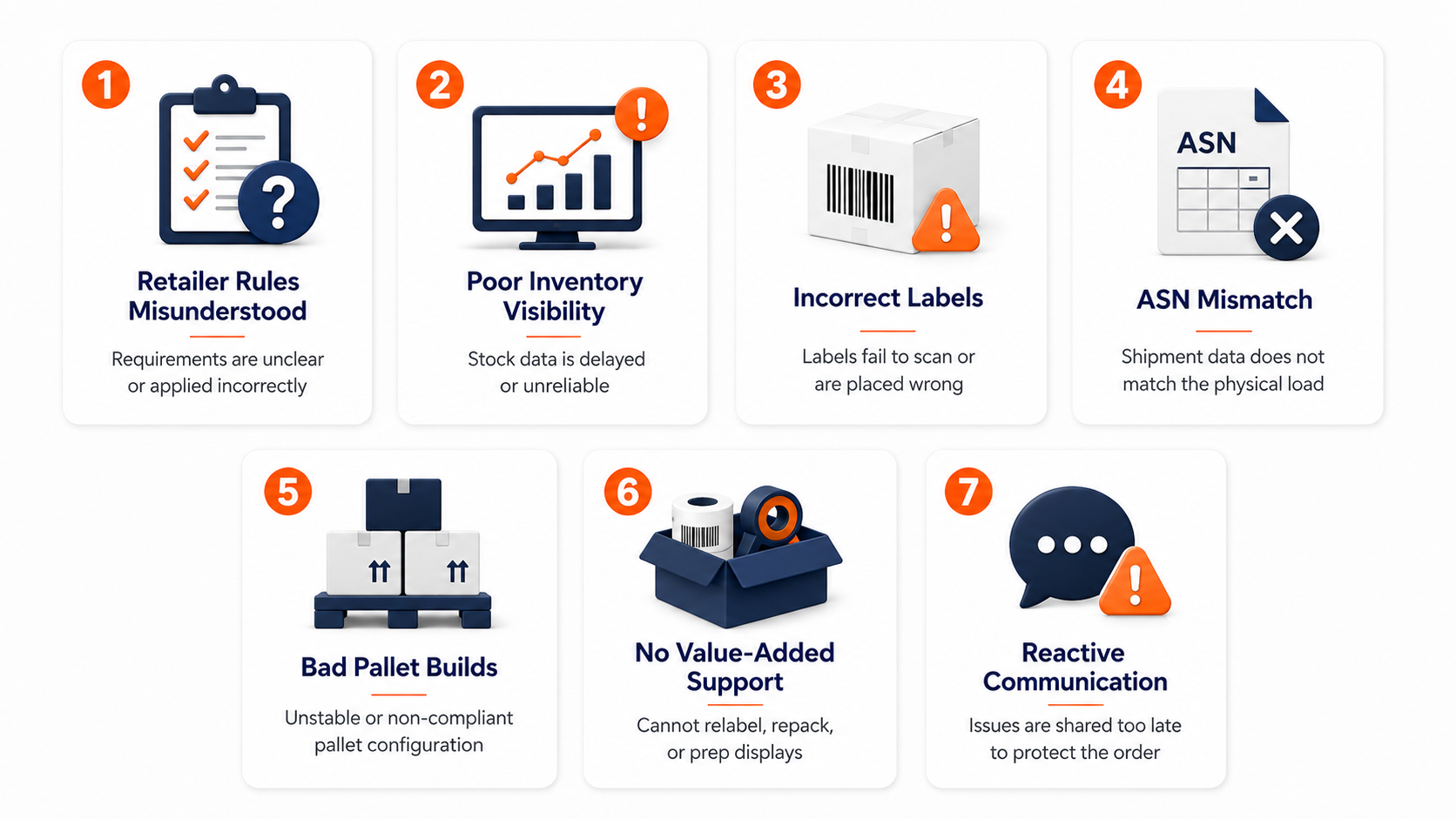
A warehouse may be good at storage and shipping but weak in retail compliance.
That creates problems when each retailer has different documentation, labeling, and delivery expectations.
If your inventory count is wrong, every downstream decision becomes risky.
Retailers expect you to ship accurately and on time. You cannot do that with unreliable stock data.
Retail receiving depends heavily on scannable labels.
Bad labels create delays, manual work, and potential penalties.
If the digital shipment notice says one thing and the physical shipment says another, receiving becomes a problem.
Poor pallet configuration can lead to damage, instability, overhang, rejected loads, or inefficient receiving.
Retail orders often require kitting, relabeling, display assembly, repacking, bundling, inserts, or promotional prep.
A 3PL without value-added services may struggle when orders become more complex.
If your 3PL only tells you there is a problem after the retailer notices it, the process is already broken.
Retail logistics requires proactive communication.
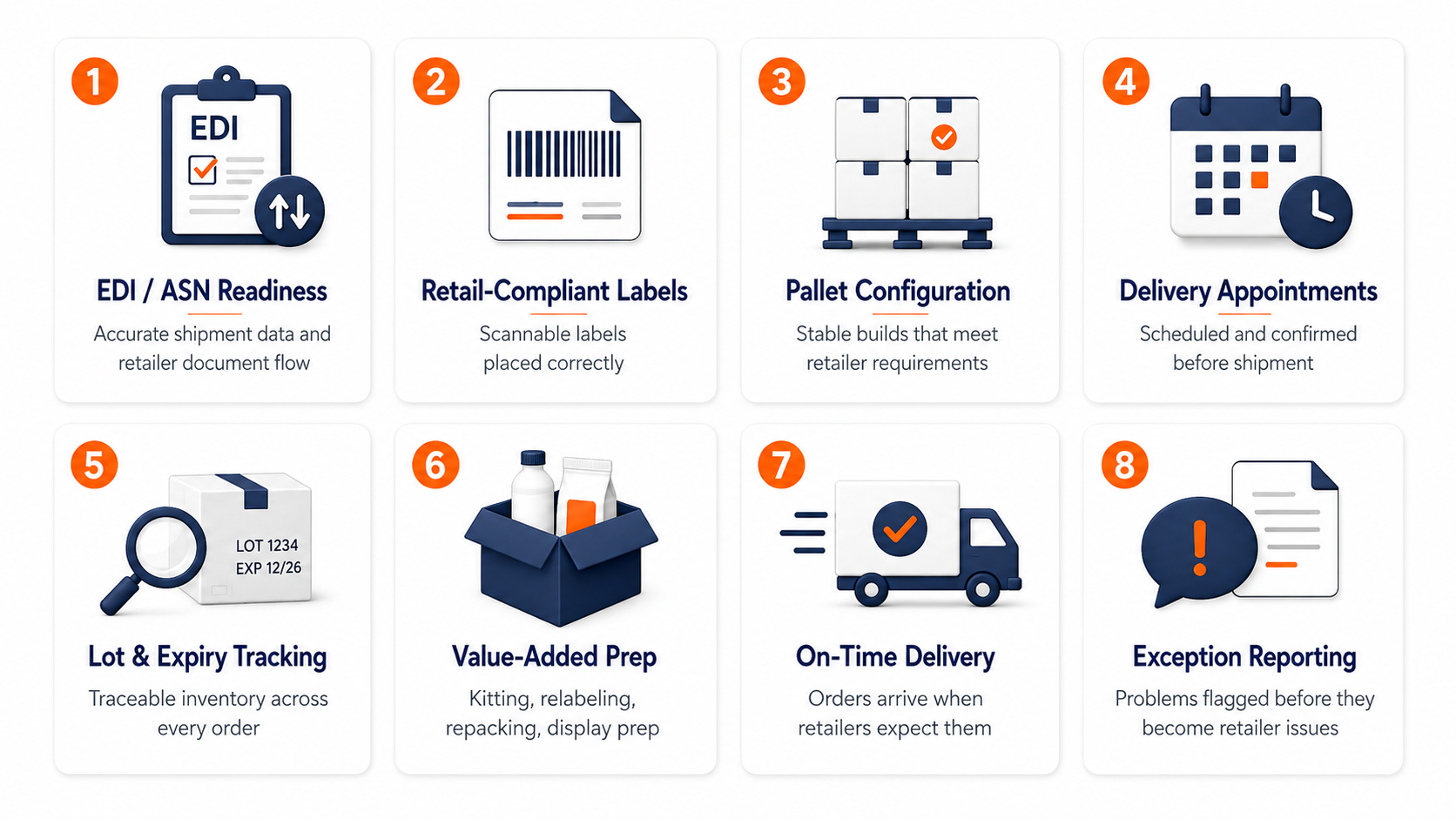
Before a shipment leaves the warehouse, your 3PL should be checking more than whether the boxes are loaded.
A strong pre-shipment process should confirm:
This is the type of discipline retailers expect.
It is also the type of discipline that protects your brand.
If your brand is selling into Loblaw, Costco, Walmart, Amazon, or other major retailers, your 3PL should offer more than warehouse space.
Look for these capabilities:
Your 3PL should understand that each retailer has different operating requirements and that those requirements affect labels, pallets, paperwork, delivery, and data.
Your 3PL should be able to support the flow of retail data, not just the movement of boxes.
You should know what is available, allocated, damaged, returned, quarantined, or at risk.
This is especially important for food, beverage, personal care, wellness, pet care, and other date-sensitive products.
Retail growth often requires kitting, co-packing, repacking, relabeling, display assembly, inserts, and promotional prep.
A retail-ready 3PL should help coordinate carriers, appointments, proof of delivery, and shipment visibility.
Problems happen. The question is whether your 3PL catches them early enough to protect the order.
Your 3PL should report on order accuracy, inventory accuracy, dock-to-stock time, on-time shipping, damage rates, returns processing, and compliance issues.
Retail buyers do not only evaluate your product.
They also experience your operations.
If your shipments are accurate, timely, compliant, and easy to receive, your brand becomes easier to support.
If your shipments create repeated problems, your brand becomes risky.
That is why the 3PL matters.
Your warehouse partner can either strengthen or weaken your retail relationship.
A good 3PL helps you look professional.
A weak 3PL makes your brand look disorganized.
A retail-ready 3PL helps buyers trust that you can scale.
A basic warehouse may only prove that you can store inventory.
Those are not the same thing.
Before trusting a 3PL with retail orders, ask:
The best 3PLs will answer clearly.
The wrong 3PL will make retail compliance sound like an afterthought.
Getting into Loblaw, Costco, Walmart, Amazon, or any major retail channel is a growth opportunity.
But retail growth adds operational pressure.
Your brand needs more than storage.
It needs more than pick and pack.
It needs more than transportation.
It needs a 3PL that understands how retail actually receives product.
That means:
Retailers expect your product to arrive ready.
Your 3PL is the partner responsible for making that happen.
If your logistics are clean, compliant, and easy to receive, your brand becomes easier to buy from.
And in retail, that matters more than most brands realize.
MacMillan Supply Chain Group helps consumer goods brands manage warehousing, fulfillment, transportation, value-added services, and retail-ready distribution across Canada.
Whether your brand is preparing for Loblaw, Costco, Walmart, Amazon, or other major retail channels, MacMillan helps build the operational foundation needed to ship accurately, stay compliant, and scale with confidence.
Talk to MacMillan about retail-ready fulfillment and distribution.
2 Responses
Very relevant for growing retailers in Albania—strong 3PL support is key for smooth international expansion and efficient supply chain performance.
Absolutely! Strong 3PL support makes all the difference.