

Black Friday Fulfillment Canada: 2026 Peak Season Guide
Black Friday Fulfillment Canada: How E-commerce Brands Can Prepare for…

Black Friday Fulfillment Canada: How E-commerce Brands Can Prepare for…

When discussing e-commerce, what typically springs to mind? Most likely,…
As the busiest time of the year draws near, the…
As the busiest time of the year draws near, the…
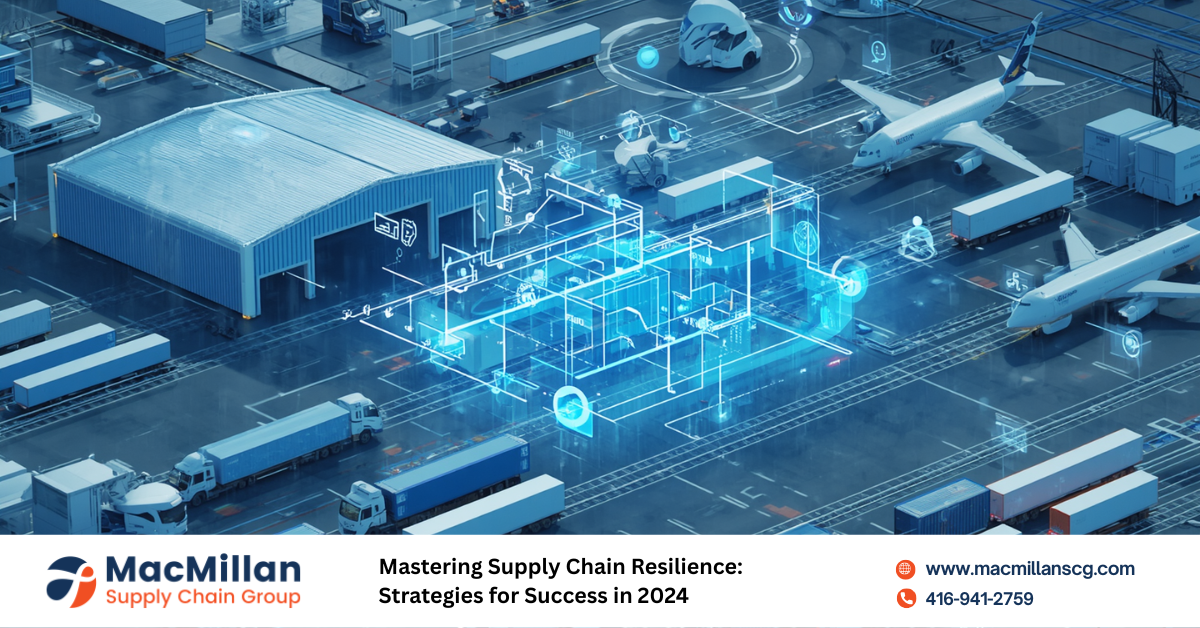
In 2024, supply chain resilience is more critical than ever for businesses navigating global uncertainties. This comprehensive guide explores strategies to build a robust and adaptable supply chain, from leveraging advanced technologies to implementing risk mitigation techniques. We’ll delve into the importance of visibility, flexibility, and collaboration in creating a resilient supply network. By partnering with experts like MacMillan Supply Chain Group, companies can overcome common challenges and transform their supply chains into strategic assets. Discover how to future-proof your operations and gain a competitive edge in today’s dynamic business landscape.
The global business landscape is constantly evolving, presenting new challenges and opportunities for supply chain management. In 2024, building a resilient supply chain is no longer a luxury—it’s a necessity for survival and growth. Recent events, from the COVID-19 pandemic to geopolitical tensions, have highlighted the vulnerabilities in traditional supply chain models and the urgent need for more robust, flexible systems.
This article will guide you through the key strategies and best practices for enhancing supply chain resilience. We’ll explore how cutting-edge technologies, data-driven decision-making, and strategic partnerships can help your business weather disruptions and emerge stronger. Whether you’re a small enterprise or a multinational corporation, the insights shared here will empower you to transform your supply chain into a source of competitive advantage. Let’s dive into the world of supply chain resilience and discover how MacMillan Supply Chain Group can be your partner in this crucial journey.
Supply chain resilience refers to a network’s ability to anticipate, adapt to, and recover from disruptions quickly and efficiently. In 2024, this concept goes beyond mere risk management—it’s about creating a supply chain that can thrive in uncertainty.
Key components of supply chain resilience include:
Building resilience requires a holistic approach that considers all aspects of your supply chain. This means assessing vulnerabilities, implementing robust risk management strategies, and fostering a culture of continuous improvement.
The benefits of a resilient supply chain are manifold:
By prioritizing resilience, you’re not just protecting your business—you’re positioning it for sustainable growth. In the following sections, we’ll explore specific strategies to achieve this crucial goal.
In 2024, technology plays a pivotal role in building resilient supply chains. Advanced solutions offer unprecedented visibility, predictive capabilities, and automation that can transform your operations.
Key technologies enhancing supply chain resilience include:
Implementing these technologies requires careful planning and often, expert guidance. MacMillan Supply Chain Group specializes in integrating cutting-edge solutions tailored to your specific needs. Our team can help you:
By harnessing the power of technology, you can create a more agile, responsive, and resilient supply chain ready to face the challenges of 2024 and beyond.
Flexibility and agility are cornerstones of supply chain resilience in 2024. These qualities enable your organization to respond swiftly to disruptions and capitalize on new opportunities.
Strategies to enhance flexibility and agility include:
MacMillan Supply Chain Group can help you implement these strategies by:
By building flexibility and agility into your supply chain, you’ll be better equipped to navigate the uncertainties of the global market, maintain customer satisfaction, and stay ahead of the competition.
In 2024, no business is an island. Collaborative partnerships are essential for building truly resilient supply chains. By fostering strong relationships with suppliers, logistics providers, and even competitors, you can create a network that’s greater than the sum of its parts.
Key aspects of collaborative partnerships include:
MacMillan Supply Chain Group excels in facilitating these collaborative relationships. We can help you:
By leveraging our extensive network and expertise, you can build a web of partnerships that enhances your supply chain’s resilience. These collaborations not only help mitigate risks but also open up new opportunities for growth and innovation in the dynamic landscape of 2024.
Despite best efforts, many businesses struggle to achieve true supply chain resilience. Common problems include:
At MacMillan Supply Chain Group, we’ve developed comprehensive solutions to address these challenges:
By partnering with MacMillan Supply Chain Group, you gain access to a team of experts dedicated to transforming your supply chain into a resilient, adaptable, and efficient network ready to face the challenges of 2024 and beyond.
To avoid common pitfalls and successfully implement resilience strategies, consider the following steps:
However, navigating the complex world of supply chain resilience can be challenging. That’s where MacMillan Supply Chain Group comes in. Our team of experts can guide you through every step of the process, from initial assessment to full implementation and ongoing optimization.
Don’t let supply chain vulnerabilities hold your business back. Take the first step towards a more resilient future today. Contact MacMillan Supply Chain Group for a free consultation. Our experts will work with you to develop a customized resilience strategy that addresses your unique challenges and goals.
Call us at 416-941-2759 or visit our website to schedule your consultation. Let’s build a resilient supply chain that will drive your success in 2024 and beyond. Your competitive edge is just a conversation away!
Supply chain resilience refers to a network's ability to anticipate, withstand, and quickly recover from disruptions. It involves creating flexible, adaptable systems that can maintain operations and meet customer needs even in the face of unexpected challenges. MacMillan Supply Chain Group can help you assess your current resilience and develop strategies to enhance it.
Technology strengthens supply chain resilience by providing real-time visibility, predictive analytics, and automation. Solutions such as AI, IoT, cloud platforms, and data analytics help businesses monitor inventory, identify potential disruptions, optimize routes, and make faster, data-driven decisions. These technologies improve operational efficiency while reducing risks across the supply chain.
A resilient supply chain is built on several key components, including end-to-end visibility, operational flexibility, supplier diversification, risk management, collaboration, and technology integration. Together, these elements help businesses respond quickly to disruptions, maintain business continuity, and improve overall supply chain performance.
You can measure supply chain resilience by evaluating key performance indicators (KPIs) such as order fulfillment rates, inventory accuracy, recovery time after disruptions, supplier reliability, delivery performance, and operational flexibility. Regular risk assessments and performance reviews also help identify areas for continuous improvement.
Investing in supply chain resilience helps reduce operational disruptions, improve customer satisfaction, minimize financial losses, and enhance long-term business stability. It also enables companies to respond more effectively to unexpected challenges while maintaining consistent service levels and gaining a competitive advantage.
The timeline depends on the size and complexity of your operations. While some improvements can be implemented within a few months, building a fully resilient supply chain is an ongoing process that involves continuous evaluation, technology upgrades, supplier development, and process optimization.
Absolutely. Small businesses can significantly benefit from resilience strategies by reducing operational risks, improving inventory management, strengthening supplier relationships, and increasing their ability to adapt to market changes. Even simple improvements can enhance efficiency and support long-term business growth.
MacMillan Supply Chain Group continuously monitors industry trends, emerging technologies, and evolving supply chain best practices. Our team invests in ongoing training, technology adoption, and strategic partnerships to deliver modern logistics solutions that help clients build more resilient, efficient, and future-ready supply chains.



2 Responses
Very insightful article on supply chain resilience. The strategies shared are practical and highly relevant for 2024 and beyond. Great read!
Thank you! I appreciate your kind words.