



How the Right White Glove Service Benefits Your Brand
You’ve sent your product out for delivery, they’ve received it,…


You’ve sent your product out for delivery, they’ve received it,…

In the fast-evolving landscape of global trade and e-commerce, supply…

Following its success with Prime delivery and becoming the business…

Partnering with a third-party logistics (3PL) provider like MacMillan Supply…
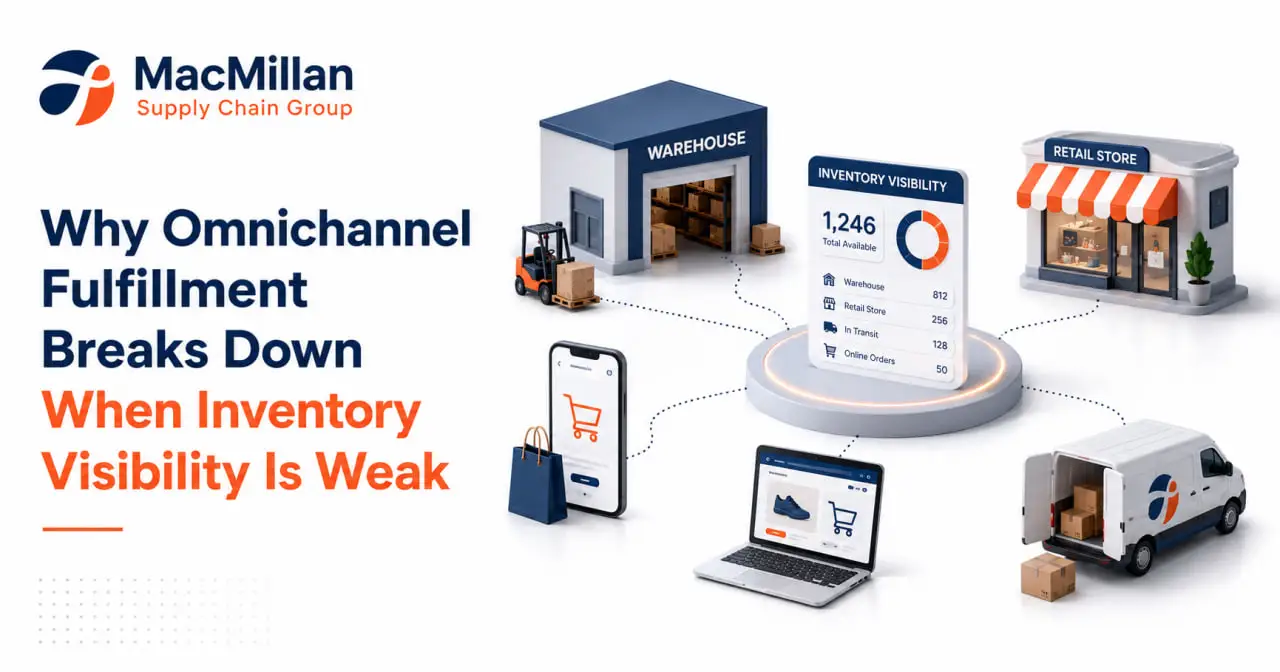
Omnichannel fulfillment only works when inventory data is accurate, current, and shared across channels. When visibility is weak, brands struggle with stockouts, overselling, delayed replenishment, poor order routing, and inconsistent customer experiences across retail, ecommerce, and marketplace channels. Recent industry coverage keeps pointing to the same issue: unified commerce depends on real-time inventory visibility, not disconnected systems or delayed updates.
For MacMillan, this is a highly relevant topic. The company already positions itself around Mantis-powered WMS visibility, real-time order and shipment tracking, scan-verified fulfillment, KPI-led reporting, retail-ready warehousing, and integrated warehousing, transportation, ecommerce fulfillment, and value-added services for FMCG brands.
Omnichannel fulfillment sounds simple on the surface.
A customer orders through one channel, inventory is picked from the best location, and the product arrives on time. But behind that experience is a much more demanding operational reality. Brands have to keep inventory aligned across retail, ecommerce, marketplaces, promotions, and replenishment flows all at once.
That is where many operations start to break down.
The problem is often not channel count alone. It is weak inventory visibility. When teams cannot see what is actually available, where it is located, what is allocated, and what should move next, omnichannel fulfillment becomes reactive, error-prone, and expensive. Current omnichannel and inventory visibility coverage consistently emphasizes real-time inventory as a core requirement for modern fulfillment because delayed or fragmented data undermines everything that follows.
MacMillan’s service model fits this conversation well because its site already emphasizes visibility, synchronization, accurate inventory control, real-time data, and retailer-ready execution for fast-moving consumer goods.
Omnichannel fulfillment is getting harder because brands are serving more channels without gaining more margin for mistakes. Retailers expect tighter execution. Ecommerce customers expect fast delivery and accurate stock information. Internal teams need cleaner data to support launches, promotions, and replenishment decisions.
Recent industry reporting points to the same pressure points: ship-from-store complexity, BOPIS and hybrid fulfillment demands, faster delivery expectations, and the need for real-time inventory data across networks. Shopify’s 2026 logistics coverage says inventory visibility is one of the defining omnichannel supply chain challenges this year. Microsoft’s inventory visibility documentation also frames real-time, cross-source on-hand tracking as a core requirement for modern commerce operations.
For FMCG brands, that matters even more because demand moves quickly, promotions create spikes, and poor inventory decisions can affect both shelf availability and digital conversion.
Inventory visibility is not just knowing how much stock you have in total.
In an omnichannel environment, brands need to know:
Without that level of visibility, omnichannel fulfillment becomes guesswork.
Microsoft’s Inventory Visibility service describes the need for real-time change postings and visibility tracking across all inventory data sources and channels. Radial makes a similar point, noting that real-time visibility is what enables retailers to deliver true omnichannel customer experiences.
MacMillan’s site aligns closely with this need through its emphasis on WMS-powered visibility, real-time updates, inventory access, tracking, and data-driven KPI reporting.
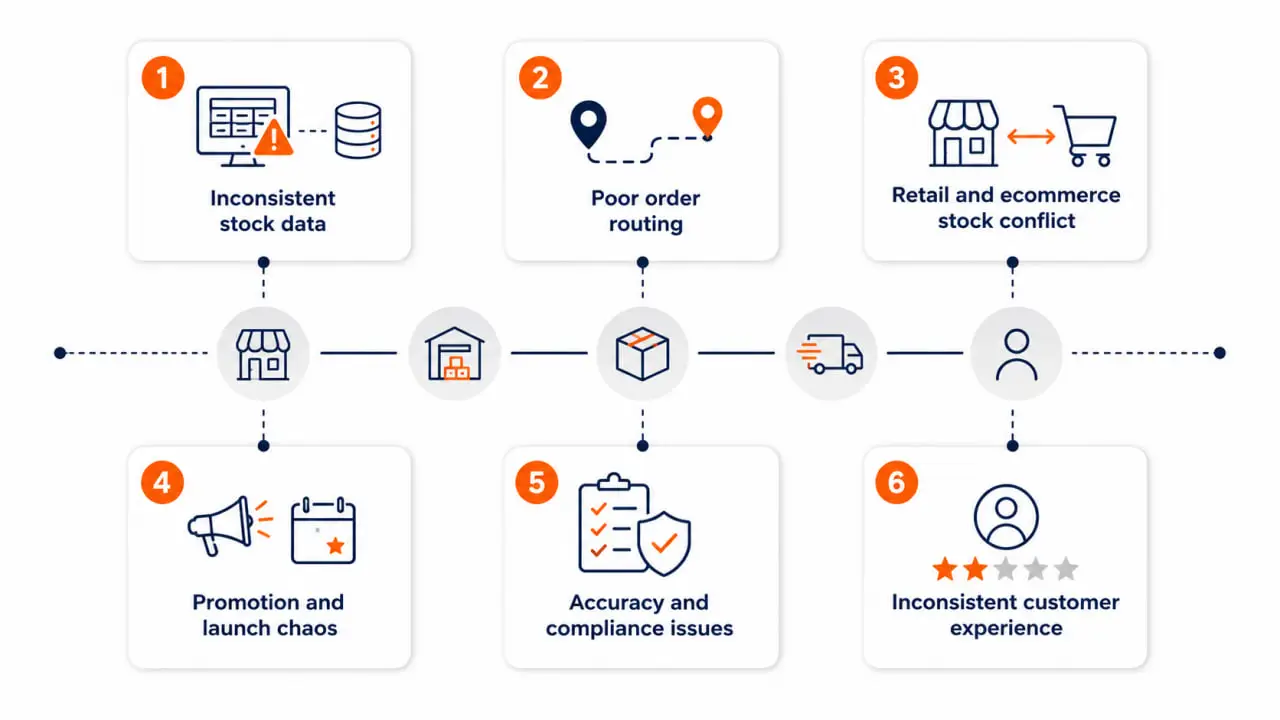
One of the first issues is simple but damaging: different systems show different inventory positions.
That leads to overselling, missed replenishment, and confusion between retail, ecommerce, and operations teams. When channels are not drawing from synchronized inventory data, brands start making decisions based on partial truth.
Industry sources increasingly describe disconnected systems and delayed inventory updates as a central cause of omnichannel friction. Shopify highlights this as part of the broader unified-commerce challenge, while Microsoft’s documentation is built around solving this exact issue through shared visibility across sources.
If inventory visibility is weak, brands cannot reliably decide where to fulfill from.
That causes inefficient routing, slower delivery, higher transportation cost, and more manual intervention. Teams may ship from the wrong node, split orders unnecessarily, or delay fulfillment while they verify what stock is actually available.
MacMillan’s positioning around synchronized platforms, real-time visibility, and integrated transportation helps address this kind of execution gap. The company also highlights national coverage, milestone tracking, and route-aware transportation support.
This is one of the biggest hidden problems in omnichannel operations.
When visibility is weak, inventory meant for store replenishment may be consumed by ecommerce orders, or digital channels may show stock that is effectively unavailable because it is already committed elsewhere. That creates internal conflict and poor service on both sides.
Impact Analytics’ 2026 omnichannel inventory management guide emphasizes that accurate, real-time visibility is essential for balancing inventory across channels with confidence.
Promotions expose weak inventory visibility very quickly.
A campaign can drive demand across multiple channels at once, but if inventory is not tracked accurately by location and status, brands struggle to allocate stock correctly, avoid stockouts, and support rapid replenishment. That leads to missed sales, poor customer experience, and pressure on warehouse teams.
MacMillan’s services speak directly to this challenge. The site highlights support for fluctuating promotional volumes, seasonal peaks, launch readiness, rapid replenishment, and retail-specific preparation.
Weak visibility does not stay an inventory problem for long. It becomes a fulfillment problem, then a compliance problem.
If teams do not have clear, current inventory data, they are more likely to mis-pick, substitute incorrectly, delay outbound orders, or create retailer issues tied to missing inventory, late delivery, or poor prep. MacMillan’s site repeatedly connects visibility with scan-verified fulfillment, ASN support, retailer-ready execution, and performance reporting.
When inventory visibility is weak, customers see the symptoms even if they never see the system problem.
They experience:
Radial notes that real-time inventory visibility is essential to delivering the omnichannel experience customers now expect.
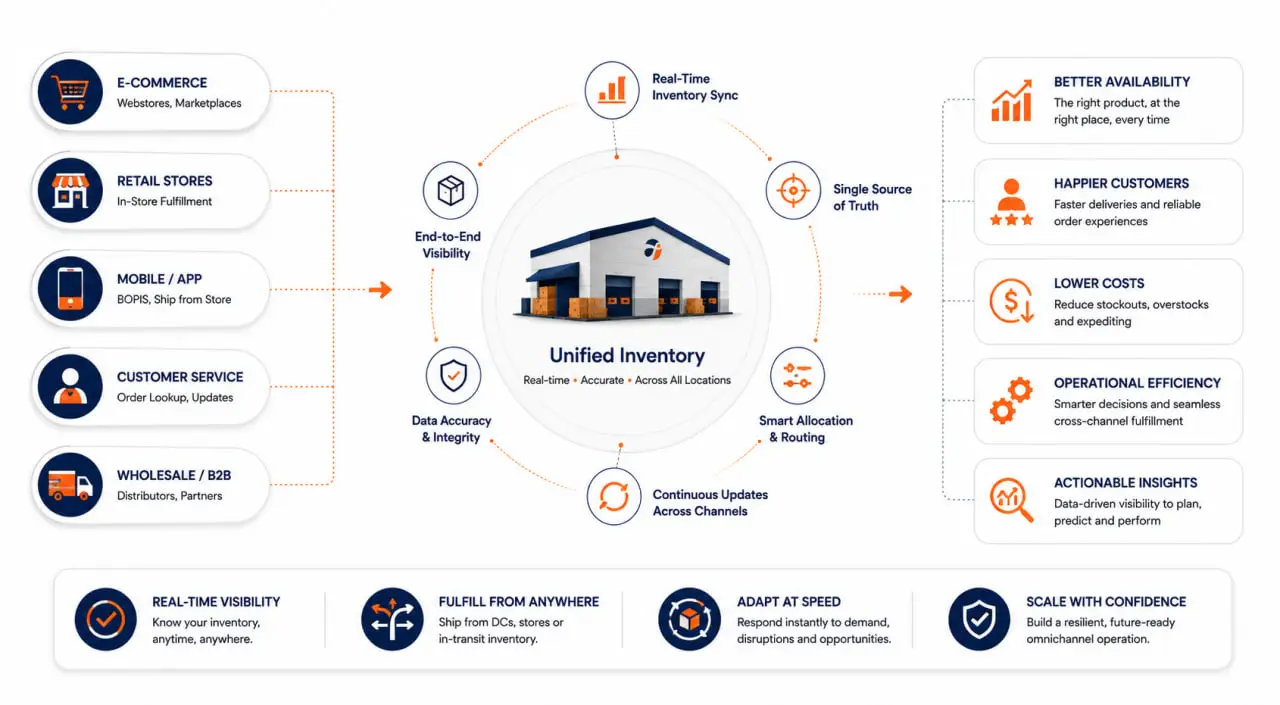
Strong inventory visibility gives teams a shared operational view.
That usually means:
Microsoft describes this as visibility across all data sources and channels, while current industry coverage increasingly frames it as a non-negotiable part of unified commerce.
MacMillan already reflects much of that model through WMS-backed inventory visibility, order status, live tracking, digital PODs, KPI reporting, and connected integrations.
If different teams or channels are working from different numbers, visibility will always break down. Brands need one operational source of truth that updates quickly and can be shared across the network.
Visibility should include more than on-hand stock. Teams need current status on what is reserved, in motion, delayed, picked, or staged for outbound.
Inventory visibility loses value if outbound execution is still opaque. Teams need to see inventory position and shipment status together.
MacMillan supports this through its combined warehousing, transportation, and fulfillment model, with milestone tracking and live updates across operations.
Promotions, retail rollouts, and seasonal spikes should be planned through the same visibility model, not treated as separate fire drills. MacMillan’s site highlights this exact capability in its warehousing and value-added services.
The more fulfillment depends on manual confirmation, the greater the risk of inventory drift. Scan-based workflows, system validation, and structured inventory controls help reduce that gap. MacMillan’s site references scan-verified fulfillment, barcode and RFID support, and automated workflows.
MacMillan is well positioned for this article because the company already presents itself as a visibility-driven, retail-ready fulfillment partner for FMCG brands.
Its site highlights:
That makes this topic commercially relevant and credible. It is not a forced trend angle. It directly reflects what MacMillan already offers to growing consumer brands.
Omnichannel fulfillment does not break because brands sell through too many channels. It breaks when the inventory layer underneath those channels is weak.
Without strong visibility, brands cannot route orders well, allocate stock with confidence, support launches smoothly, or deliver consistent customer experiences. Recent industry guidance keeps reinforcing the same point: real-time inventory visibility is a core requirement for unified commerce and omnichannel execution.
For FMCG brands, the solution is not just more channels or more software. It is better control over inventory truth, movement, and execution. MacMillan SCG’s visibility-led, retail-ready fulfillment model is well aligned with that need.