Black Friday Fulfillment Canada: 2026 Peak Season Guide
Black Friday Fulfillment Canada: How E-commerce Brands Can Prepare for…
Black Friday Fulfillment Canada: How E-commerce Brands Can Prepare for…
When discussing e-commerce, what typically springs to mind? Most likely,…
As the busiest time of the year draws near, the…
As the busiest time of the year draws near, the…
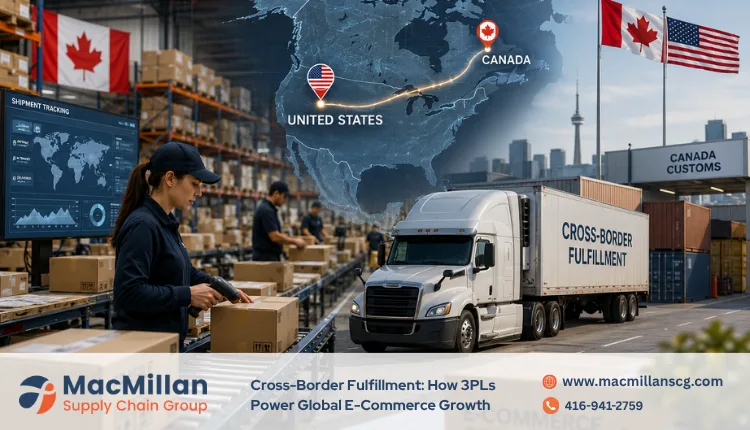
Cross border fulfillment is revolutionizing the global expansion of e-commerce companies. Businesses can handle difficult international shipping laws, Canadian customs clearance, and quick delivery to customers throughout the world by collaborating with third party logistics providers (3PLs). 3PLs provide specialized services including multi node distribution networks, technology-driven solutions that optimize the entire fulfillment process, and warehousing in major regions like British Columbia and Ontario. Through effective, affordable logistics solutions, the ideal 3PL collaboration eliminates obstacles to international trade while preserving customer satisfaction for Canadian companies seeking to expand overseas or US companies entering the Canadian market.
Global boundaries have been erased by the e-commerce industry, giving companies previously impossible chances to connect with clients abroad. However, logistics, customs laws, and satisfying customers’ demands for prompt delivery present serious obstacles when selling goods internationally, especially between the US and Canada.
This is where third-party logistics companies (3PLs) and cross-border fulfillment become crucial allies in your international e-commerce growth. By managing everything from warehousing to customs clearance in Canada, a professional 3PL can simplify complex international shipping procedures.
Knowing how 3PLs facilitate cross-border trade is essential for businesses trying to enter the Canadian market or for Canadian businesses growing internationally. Let’s examine how these logistics professionals can assist you in navigating global waters and expanding your online store internationally.
Sending parcels from point A to point B is only one part of shipping goods across international borders.In spite of possible delays at border crossings, it involves organizing customs paperwork, understanding complicated procedures, and guaranteeing on-time delivery.
For e-commerce companies, third-party logistics companies are excellent at streamlining these procedures. They know the ins and outs of cross border transportation in Canada and have built-up connections with customs officers. Because of their experience, they can transfer your things quickly and with the least amount of hassle.
Working with a 3PL that specializes in shipping from the US to Canada gives you access to their well-established infrastructure as well. In order to put your products closer to your Canadian clients, this includes strategically positioned warehouses in Ontario and other important Canadian provinces.
The advantages go beyond the infrastructure itself. 3PLs use advanced tracking systems that provide you real time visibility into your shipments as they travel across international boundaries. You can proactively handle any problems that may occur during transit and keep clients updated on their orders thanks to this transparency.
Furthermore, 3PLs manage every piece of complex paperwork involved in overseas transportation, such as tax filing, duty computations, and customs documents. This knowledge guarantees compliance to rules while averting expensive delays that can affect client satisfaction.
One of the most significant advantages of working with a third party logistics provider is access to their network of fulfillment warehouses. For cross border e-commerce between the US and Canada, having inventory stored in strategic locations dramatically improves delivery times and reduces shipping costs.
A fulfillment warehouse in Ontario serves as an ideal hub for serving the densely populated regions of Eastern Canada. Orders can be swiftly processed and dispatched from this central location to key markets like Toronto, Montreal, and Ottawa, usually arriving the following day. The delays that come with crossing the border for each individual order are eliminated because of this close proximity.
In the same way, British Columbia warehouses offer great access to markets in Western Canada and act as a gateway for trade with the Pacific. No matter where your clients are situated, 3PLs maximize delivery times by distributing inventory across several key sites, forming a multi-node distribution network.
Additionally, these storage options provide flexibility. When order volumes increase during peak seasons, 3PLs can set aside more space to handle higher inventory levels. Your company can satisfy seasonal demand thanks to this scalability without having to invest in permanent warehouse space that can be largely empty during slower times.
Automated warehouse systems that accelerate order processing are another element of modern fulfillment warehouses. Conveyor belts, sophisticated picking systems, and sorting technologies guarantee precise and effective order fulfillment, cutting down on the time between order placing and shipment.
The backbone of effective cross border fulfillment is technology. The most successful 3PLs of today use advanced systems which communicate with your e-commerce platform, ensuring a smooth information flow from the time a consumer places an order till it is delivered to their door.
Real-time inventory management across several warehouse sites is made possible by 3PL technology integration.Strategic inventory placement based on regional demand patterns is made possible by this visibility, which also helps to avoid stockouts.The program automatically chooses the optimum fulfillment center for a customer’s order based on factors like inventory availability, delivery schedules, and shipping distance.
Proactive inventory management is made possible by AI-driven shipment projections that help forecast changes in demand. Businesses with seasonal products or those running marketing initiatives that could cause unexpected spikes in order volume will find these predictive analytics very useful.
Order management systems provide picking lists, packing guidelines, and shipping labels automatically, streamlining the fulfillment process. Orders are filled precisely and quickly thanks to this technology, which also cuts down on processing time and human error.
For cross border shipments, technology plays a crucial role in customs clearance. Advanced systems prepare and submit customs documentation electronically, speeding up the clearance process. Real time tracking allows both you and your customers to monitor shipments as they move through customs and toward their final destination.
Navigating the complex web of customs laws, taxes, and charges is arguably the most difficult part of cross-border e-commerce. This is where companies growing into foreign markets find that specific 3PL knowledge is extremely helpful.
In Canada, clearing customs includes a number of requirements, such as exact valuation, country of origin documentation, correct classification of commodities, and adherence to various trade agreements. Errors in any of these areas may result in penalties, unforeseen expenses, or even delays in shipments.
Customs laws and requirements are kept updated by third-party logistics companies that specialize in cross-border fulfillment. They reduce the possibility of delays at the border by making sure that all required paperwork is accurately prepared and presented on time.
3PLs help businesses that sell regulated goods like food, cosmetics, or electronics in navigating additional compliance requirements particular to these industries. They make sure your shipments adhere to all relevant standards and are aware of the certification and labeling requirements for various product categories.
Customs brokerage services are provided by most 3PLs as a component of their cross-border shipping packages. These services include creating customs entries, calculating and collecting taxes and duties, and speaking on your company’s behalf while dealing with customs officials. 3PLs manage these complicated processes so you may concentrate on expanding your company rather than getting bogged down in legal jargon.
Even though international e-commerce offers many advantages, companies nonetheless encounter a number of difficulties when delivering internationally:
The following comprehensive solutions have been developed by MacMillan Supply Chain Group to handle the difficulties associated with cross-border fulfillment, specifically for companies that operate between the US and Canada:
Our network of fulfillment warehouses in Ontario, British Columbia, and other strategic locations creates a powerful distribution system that puts your products closer to your customers.This multi-node approach reduces shipping distances, cuts delivery times, and lowers transportation costs.
In order to guarantee that your bestseller products are consistently available close to areas with strong demand, we carefully place your inventory based on sales trends and consumer locations. This strategy reduces the need for individual orders to cross the border, making it especially useful for companies who serve both US and Canadian markets.
Each aspect of cross-border compliance is managed by our team of customs specialists, from product classification to paperwork preparation. We are able to promptly resolve problems and keep your goods flowing because of our relationships with customs officials on both sides of the US-Canada border.
For businesses new to international shipping, we provide guidance on harmonized system (HS) codes, duty rates, and documentation requirements. Our proactive strategy ensures that your products move across borders smoothly by preventing customs delays before they happen.
Our proprietary platform creates a consolidated overview of your inventory, orders, and shipments across all locations by seamlessly integrating with major e-commerce systems. This connectivity gives you full supply chain visibility and allows for real-time decision-making.
To predict demand trends and maximize inventory placement, we use AI-driven shipping projections. Our automated warehouse solutions, such as conveyor networks and robotic picking systems, increase accuracy and speed order processing.
For international purchases, our reverse logistics techniques streamline the returns procedure. From creating return labels to processing merchandise at our facilities and refilling, restoring, or discarding things in accordance with your requirements, we manage all aspects of international returns.
We save time and money for you and your customers by removing the requirement for individual returns to be sent across borders by localizing returns processing within the country of purchase.
Our e-commerce peak season management solutions ensure that your fulfillment operations can handle volume spikes during holidays and promotional periods.We keep flexible workforce and warehouse layouts that may be swiftly adjusted to meet fluctuating demand levels.
In order to prepare for seasonal needs and make appropriate preparations, we collaborate with our clients on forecasting sessions as part of our planning process. By taking this preemptive measure, you avoid capacity limitations that would otherwise restrict your ability to make sales at crucial times of high volume.
We are dedicated to environmentally friendly e-commerce logistics that preserve operational effectiveness. Our efforts include energy-efficient warehouse buildings, appropriately sized packaging to minimize waste, and improved routing to lower fuel consumption.
We provide carbon-neutral shipping choices and thorough reporting on environmental parameters for companies with sustainability objectives. In addition to helping the environment, these actions also appeal to customers who are becoming more environmentally concerned.
Ready to expand your e-commerce business across borders? Here’s how to get started with MacMillan Supply Chain Group:
Don’t let logistics barriers limit your global growth potential. Partner with MacMillan Supply Chain Group to transform your cross-border fulfillment operations and unlock new international markets. Our proficiency in international logistics, customs clearance in Canada, and shipping from the United States to Canada gives you all you need to be successful in international e-commerce.
Get in touch with our staff right now to find out how our 3PL services for Canadian e-commerce will help you achieve your company’s growth objectives. We are prepared to assist you in effectively and consistently reaching clients anywhere in the world with our well-located fulfillment centers in Ontario and across North America.
Cross-border fulfillment involves storing inventory and shipping orders to customers in different countries. Unlike standard domestic fulfillment, it requires navigating customs regulations, international shipping carriers, duty calculations, and compliance with foreign market requirements. A specialized third-party logistics provider manages these complexities, allowing your business to sell internationally without building in-house expertise in global shipping compliance.
A 3PL (third-party logistics provider) helps Canadian businesses enter the US market by handling warehousing, shipping, customs documentation, and last-mile delivery. They often have fulfillment centers in both Canada and the US, allowing you to store inventory closer to American customers. This reduces delivery times, lowers shipping costs, and ensures compliance with US regulations—making expansion faster and more efficient without needing your own infrastructure.
Ontario is a strategic location due to its proximity to the US border and access to major Canadian cities like Toronto and Ottawa. For US businesses, using an Ontario warehouse enables faster delivery to Canadian customers, reduces cross-border shipping delays, and minimizes costs by bulk shipping inventory into Canada instead of shipping individual orders internationally. It also improves customer satisfaction with quicker delivery times.
3PLs manage the entire customs clearance process by preparing and submitting accurate documentation, classifying products with the correct HS codes, and calculating duties and taxes. Many also offer customs brokerage services, acting as intermediaries between your business and customs authorities. Their expertise helps prevent delays, penalties, and unexpected costs, ensuring smooth cross-border shipping.
Multi-node distribution means storing inventory across multiple warehouses in different regions (e.g., Ontario and British Columbia). This reduces shipping distances, speeds up delivery times, and lowers transportation costs. It also improves inventory availability and helps businesses handle demand fluctuations more efficiently, especially during peak seasons.
AI-driven forecasts analyze historical data, sales trends, and seasonal patterns to predict future demand. This allows businesses to position inventory strategically across warehouses, avoid stockouts, and reduce overstocking. It also helps optimize shipping routes and planning, leading to faster deliveries, lower costs, and better overall operational efficiency.