

How Does a Supply Chain Firm Plan for High Demand?
With the right approach, supply chain planning can lower costs…

With the right approach, supply chain planning can lower costs…
Time-critical shipments can be defined in many ways. Critical shipping…

A shopper asks an AI assistant to find a fragrance-free…

As an online store business owner, offering the best customer…
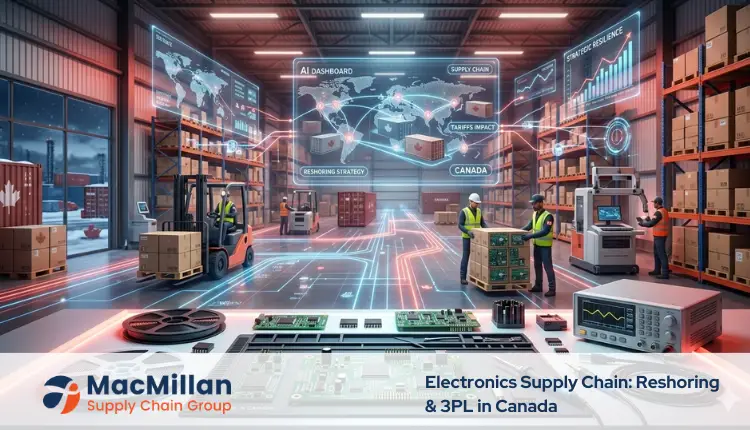
Growing tariffs, geopolitical unrest, and changing manufacturing environments present the electronics supply chain with previously unheard-of difficulties. This thorough guide examines the ways in which digital transformation, tariff mitigation, and strategic reshoring can help Canadian companies manage these challenges. These issues are closely connected to the broader US–China trade war and ongoing shifts in global supply chains. Specialized 3PL solutions are provided by MacMillan Supply Chain Group to assist businesses in strengthening their supply chains, cutting expenses, and increasing resilience. Learn useful strategies to prosper in the face of trade disruptions and set up your company for long-term success in Canada’s developing electronics industry, from utilizing foreign trade zones to putting blockchain traceability into place. This guide will help Canadian companies future-proof their electronics supply chain.
The electronics manufacturing industry is changing dramatically. Major economy-to-economy tariffs have risen to all-time highs, with some electronic components subject to 245% duties. Global supply chains have been rocked by this, and businesses are now being forced to reconsider where and how they manufacture their products.
These issues offer opportunities as well as challenges to Canadian companies. Effectively managing tariffs has emerged as a crucial business ability, and reshoring in Canada presents a viable substitute for manufacturing that is done abroad. More flexibility, transparency, and resilience are now more important than ever in the electronic supply chain.
Numerous Canadian electronics manufacturers have benefited from our assistance at MacMillan Supply Chain Group in adjusting to these shifting circumstances. In today’s intricate trading environment, our specialized 3PL services offer the infrastructure and know-how required to overcome supply chain interruptions and preserve competitive advantage.
For Canadian electronics companies, tariffs have become a major headache. Canadian companies are frequently caught in the crossfire of trade disputes between the United States and China. Before a Chinese-made component reaches its final destination in North America, it may be subject to several tariffs, which would significantly raise supply chain costs.
Think about the effects of tariffs on semiconductors, which are the fundamental components of contemporary electronics. Everything from smartphones to medical devices is impacted when these tiny chips are subjected to 50% or more of the workload. Higher production costs, reduced margins, and challenging pricing decisions are what this means for Canadian manufacturers.
Strategies for mitigating tariffs are now crucial business tools. Smart businesses are looking into possibilities such as:
Through specialized logistics planning, MacMillan assists Canadian companies in putting these strategies into practice. Our customs compliance specialists examine tariff codes, spot areas for improvement, and create customized solutions that reduce duty exposure while preserving supply chain effectiveness.
As companies reevaluate their global manufacturing strategies, the idea of reshoring in Canada has gained a lot of traction. While tariffs reduced the economic appeal of offshore production, the pandemic revealed weaknesses in extended supply chains. Many electronics manufacturers are moving their manufacturing closer to home these days.
This change has been largely attributed to Canadian manufacturing incentives. Companies that invest in domestic production can receive grants, tax breaks, and other forms of assistance from federal and provincial programs. By creating more robust supply networks, these incentives aid in offsetting the higher labor costs connected to North American manufacturing.
Reshoring has advantages beyond just the bottom line:
At MacMillan, we provide specialized warehousing, distribution, and logistics services to support reshoring initiatives. Our well-positioned facilities across Canada give businesses the framework they need to successfully execute reshoring plans, and our cross-border knowledge guarantees seamless integration with American markets.
Canadian businesses in the electronics supply chain are turning to digital platforms the way electronic supply chains function is being revolutionized by technology. Businesses can now confidently navigate complex trade environments thanks to AI-driven supply chain solutions, which offer previously unheard-of visibility and control.
Among the most potent uses of this technology are BOM optimization tools. Before production starts, these systems find cost-saving options by comparing bills of materials to tariff databases. Manufacturers can incorporate tariff mitigation into their product designs from the outset by choosing components according to origin, classification, and duty exposure.
Another significant benefit is blockchain traceability. Immutable records of a component’s movement through the supply chain are produced by this technology, offering:
MacMillan helps customers use technology to gain a competitive edge by incorporating these digital capabilities into our logistics services. Our systems offer real-time data flows that facilitate improved decision-making across the supply chain by integrating seamlessly with manufacturer ERPs.
Pure domestic production isn’t always possible, even though reshoring has many advantages. For this reason, a lot of Canadian electronics companies are looking into regional options that strike a balance between supply chain resilience and cost considerations.
Opportunities for nearshoring to Mexico have garnered a lot of interest. Mexico provides competitive labor rates and duty-free access to the U.S. and Canadian markets as a member of the USMCA trade zone. Mexico is now the production center for many electronics manufacturers’ “China+1” strategies in the Western Hemisphere.
Important frameworks for cross-border trade are provided by the USMCA agreement itself. Electronics manufacturers can avoid tariffs and preserve effective production networks by adhering to regional content requirements. For competitive positioning, it is essential to comprehend and take advantage of these provisions.
Clients can effectively navigate these regional networks with the aid of MacMillan’s cross-border freight optimization services. Our knowledge of customs guarantees adherence to documentation specifications, rules of origin, and other trade laws that affect shipments of electronics.
For any modern electronics supply chain, tariff volatility has become a key threat. Notwithstanding the advantages, businesses encounter several obstacles when negotiating the current electronic supply chain environment:
Planning for the long term is challenging due to the frequent changes in trade policies. Carefully calibrated supply chains may be disrupted if a component that is duty-free today is subject to substantial tariffs tomorrow.
Beyond tariffs, electronics are subject to a complex web of regulations, such as those pertaining to restricted substances, environmental standards, and product safety. Significant compliance burdens result from meeting these diverse demands across several markets.
Many essential components are still concentrated in particular areas despite reshoring initiatives. Battery cells, semiconductors, and display technologies frequently have few sourcing choices, making them susceptible to interruptions.
With container rates varying greatly, transportation costs have skyrocketed. For electronics manufacturers, budget forecasting is difficult due to these erratic expenses.
Many businesses lack the specific knowledge required to handle intricate trade laws. Without this information, companies risk missing out on optimization opportunities or unintentionally breaking compliance regulations.
We at MacMillan Supply Chain Group have created all-inclusive solutions to deal with these issues in the electronic supply chain:
We have assisted electronics clients in lowering duty costs by 15–30% while still adhering to all legal requirements by methodically implementing these tariff mitigation techniques.
Here are some doable actions you can take to put effective solutions in place if your electronics company is having problems with tariffs and supply chain interruptions:
Start by looking through the bill of materials for your product to find any parts that have unstable or high tariffs. Effective mitigation begins with an understanding of this exposure. Pay close attention to batteries, semiconductors, and other expensive parts that frequently receive targeted duties.
Determine which parts of your production could profit from being reshored in Canada. Take into account all landed costs, including risk factors, transportation, tariffs, and inventory carrying, in addition to labor costs. Look into manufacturing incentives in Canada that could help you with your transition.
Implement supply chain visibility technologies. Your capacity to handle interruptions and react to tariff changes can be greatly enhanced by even the most basic track-and-trace features. More sophisticated systems are able to optimize routing choices and automate compliance.
You can access capabilities that would be unaffordable to develop internally by collaborating with MacMillan. Our staff works as an extension of yours, offering infrastructure and specialized knowledge to help you manage tariffs and create a more robust electronic supply chain.
Get in touch with MacMillan Supply Chain Group right now to find out how our customized 3PL solutions can support the success of your electronics company in the competitive market of today. Our professionals will assess your particular requirements and create a tailored strategy to deal with your particular supply chain difficulties.
Recent tariffs have created cascading cost increases throughout the electronic supply chain. Components manufactured in China may face duties of 145-245% before reaching Canada, significantly increasing production costs. Canadian electronics manufacturers have experienced margin compression, supply disruptions, and pricing challenges. Many have responded by diversifying suppliers, reshoring production, or implementing tariff mitigation strategies like foreign trade zones and strategic inventory management.
Diversify suppliers, shift assembly to USMCA regions, use foreign trade zones, apply duty drawback, and optimize HS classifications.
Strategic Innovation Fund (SIF), SR&ED tax credits, provincial manufacturing incentives, and regional development grants.
It strengthens U.S. semiconductor production, improves supply stability, and creates cross-border opportunities but increases competition.
Duty deferral, lower tariffs on finished goods, no duty on re-exports, and improved cash flow.