

Black Friday Fulfillment Canada: 2026 Peak Season Guide
Black Friday Fulfillment Canada: How E-commerce Brands Can Prepare for…

Black Friday Fulfillment Canada: How E-commerce Brands Can Prepare for…

When discussing e-commerce, what typically springs to mind? Most likely,…

As the busiest time of the year draws near, the…
As the busiest time of the year draws near, the…
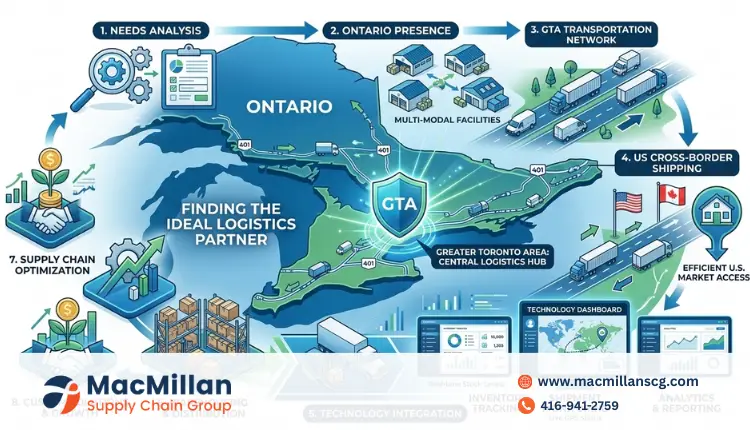
Finding the ideal logistics partner in Ontario can transform your business operations and drive growth.
This comprehensive guide walks you through the essential steps of selecting a logistics company that aligns
with your specific needs. From understanding Ontario’s unique logistics landscape to evaluating technology
capabilities and conducting proper due diligence, we cover everything you need to make an informed decision.
MacMillan Supply Chain Group offers expert insights based on years of experience serving businesses throughout
the Greater Toronto Area and beyond.
Choosing the right logistics company in Ontario represents one of the most consequential decisions your business
will make. The partner you select doesn’t just move your products—they become an extension of your brand,
directly impacting customer satisfaction, operational efficiency, and your bottom line.
Ontario’s strategic location makes it Canada’s logistics powerhouse, with the Greater Toronto Area serving
as a critical hub for domestic and cross-border shipping. With hundreds of 3PL providers in Canada operating
across the province, identifying the right partner requires a structured approach.
Ontario serves as Canada’s economic engine, offering unmatched access to domestic and U.S. markets.
The Greater Toronto Area sits at the center of a transportation network reaching over 135 million consumers
within a day’s drive.
The province features world-class infrastructure, including Toronto Pearson International Airport,
extensive highway systems, and rail connections to major North American markets. This multi-modal connectivity
allows logistics providers to tailor transportation strategies for efficiency and cost control.
Specialized logistics services are another advantage, ranging from temperature-controlled warehousing
to high-security storage. Seasonal weather challenges further emphasize the importance of contingency planning
and operational resilience.
Advanced WMS platforms ensure inventory accuracy, efficient order processing,
barcode scanning, lot tracking, and customizable reporting.
TMS solutions optimize routing, carrier selection, and shipment tracking,
helping reduce transportation costs while maintaining service levels.
Seamless integration with platforms like Shopify and WooCommerce enables
automated order flow and real-time inventory synchronization.
Client-facing dashboards provide visibility into orders, inventory,
and shipment performance without manual intervention.
Analytics tools convert operational data into actionable insights,
supporting data-driven decision-making.
Robust API and EDI connections ensure seamless data exchange between systems,
eliminating errors and manual processes.
MacMillan Supply Chain Group applies a consultative approach focused on long-term partnership success.
We design customized solutions aligned with your operational needs, growth plans, and strategic objectives.
Our GTA-based warehouse facilities, advanced technology systems, and transportation expertise support
domestic and cross-border supply chain operations with precision and scalability.
MacMillan Supply Chain Group provides tailored Ontario logistics services including
warehouse management in the GTA, freight forwarding in Toronto, and cross-border shipping Canada–US.
Contact us today to discover how our customized logistics solutions can reduce costs,
improve efficiency, and support your business growth.
Call (905) 695-1111 or visit our website to start the conversation.
A comprehensive logistics provider in Ontario should offer warehousing and inventory management, order fulfillment, transportation management, cross-border shipping services, returns processing, and value-added services like kitting or light assembly. The best logistics company in Ontario will provide integrated solutions combining these services under unified management with consistent performance reporting. Look for providers offering both standard service packages and customized solutions tailored to your specific requirements. Technology platforms should connect these services, providing visibility across your entire supply chain through user-friendly interfaces.
The ideal warehouse location depends on your customer distribution, supplier locations, and transportation requirements. For e-commerce businesses focusing on urban delivery, facilities near Toronto’s core provide faster delivery times and lower last-mile costs. Companies shipping primarily to other businesses might benefit from locations near major highways with easy access to transportation corridors. Cross-border shippers should consider proximity to border crossings and customs facilities. Analyze your order patterns to identify where most of your customers are located, then select warehouse locations that minimize transportation costs and delivery times to these key markets.
Modern logistics partners should offer comprehensive technology solutions including warehouse management systems, transportation management platforms, order management capabilities, and customer-facing portals. Look for real-time inventory visibility, automated order processing, and detailed performance reporting. Integration capabilities are particularly important—the provider’s systems should connect seamlessly with your ERP, e-commerce platform, or order management system. For e-commerce fulfillment in Canada, ensure the provider integrates with your selling platforms for automated order processing and inventory synchronization. Advanced providers increasingly offer predictive analytics, exception management, and continuous improvement tools.
Logistics pricing typically includes several components: storage fees (usually charged per pallet, square foot, or cubic foot), handling charges (per order, per line item, or per unit), transportation costs (based on weight, distance, and service level), and additional services. Storage costs may include minimum commitments regardless of actual space utilization. Handling fees cover labor for receiving, picking, packing, and shipping operations. Some providers charge technology fees for system access and reporting capabilities. When comparing quotes, look beyond the basic rates to understand all potential charges including minimum commitments, peak season surcharges, and accessorial fees that could significantly impact your total costs.
National logistics companies typically offer broader geographic coverage, more extensive transportation networks, and more sophisticated technology platforms. They may provide more consistent service across multiple regions but sometimes lack the local market knowledge of regional providers. Ontario-based regional logistics providers often deliver more personalized service, deeper understanding of local transportation challenges, and greater flexibility to accommodate unique requirements. They typically excel in urban distribution in Toronto and surrounding areas but may have limited capabilities for nationwide distribution. The best choice depends on your specific needs—businesses with primarily regional distribution might benefit from a local provider’s specialized knowledge, while those requiring national coverage might prefer a larger organization.
Start by clearly documenting your product’s handling requirements, storage conditions, packaging needs, and compliance considerations. Ask potential providers about their experience with similar products and request specific examples of how they address these requirements. During facility tours, look for evidence they can properly handle your products—appropriate storage environments, handling equipment, and quality control processes. For products requiring temperature control, hazardous materials handling, or high-security storage, verify the provider holds appropriate certifications and has documented procedures for maintaining required conditions. Reference checks with clients shipping similar products can provide valuable insights into the provider’s capabilities with your specific product type.
A comprehensive SLA should define specific, measurable performance standards for all key service aspects. Include order accuracy targets (typically 99.5% or higher), on-time delivery expectations (often 98%+), inventory accuracy requirements (99%+ for most operations), and order processing timeframes (same-day processing for orders received by a specified cutoff time). The agreement should also establish reporting frequency, problem resolution procedures, and financial remedies for service failures. Well-structured SLAs include both minimum acceptable performance levels and target performance objectives, creating incentives for continuous improvement. Review and update these agreements regularly to ensure they remain aligned with your changing business requirements.
Successful transitions require careful planning and phased implementation. Start by developing a detailed transition plan with specific milestones and responsibilities. Consider a phased approach, moving product categories or customer segments incrementally rather than all at once. Maintain safety stock during the transition period to prevent stockouts if unexpected issues arise. Conduct thorough system testing before going live to verify order processing and inventory tracking functions work correctly. Develop contingency plans for critical functions and communicate changes proactively to customers who might be affected. The most successful transitions typically involve overlap periods where both the old and new providers operate simultaneously until the new operation demonstrates consistent performance.
When speaking with references, ask specific questions about service consistency, problem resolution, and communication effectiveness. Inquire about how the provider handles unexpected challenges like volume spikes or system issues. Ask about implementation experiences—how smoothly did the transition go, and did the provider meet promised timelines? Discuss billing accuracy and transparency—are invoices clear and consistent with agreed rates? Inquire about staff turnover and whether service quality remains consistent despite personnel changes. The most valuable insights often come from asking how the provider has improved their operation over time and whether the reference would choose the same provider again knowing what they know now.
Assess the provider’s current capacity utilization and expansion capabilities. Ask about their facility network, recent growth, and capital investment plans. Evaluate their ability to add resources—both space and staff—in response to volume increases. Review their technology scalability, ensuring their systems can handle significantly higher transaction volumes without performance degradation. Discuss their experience supporting other growing clients and how they’ve accommodated increased volumes. Consider their financial capacity to invest in additional resources as needed. The most scalable providers typically maintain some excess capacity, employ flexible staffing models, and operate modular technology platforms that can expand without major redevelopment.