
Peak Season E-commerce Fulfillment Canada Solutions
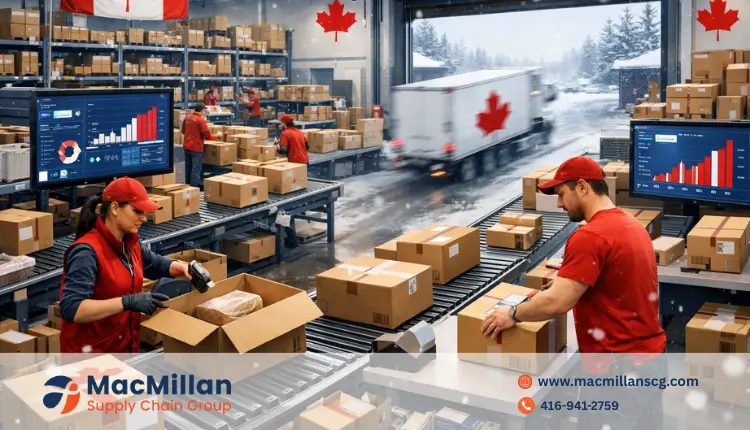
A Quick Summary and Overview Peak season e-commerce fulfillment presents significant challenges for Canadian retailers, with order volumes often increasing by 300-400% during holiday periods. Businesses face inventory shortages, shipping delays, labor constraints, and complex returns management. However, with strategic planning and the right technology, these challenges become manageable. MacMillan Supply Chain Group offers comprehensive solutions including warehouse automation, predictive analytics, and multi-carrier shipping strategies to help businesses navigate peak seasons successfully. By implementing these solutions, retailers can maintain customer satisfaction while controlling costs during the busiest shopping periods of the year. Mastering E-commerce Fulfillment During Peak Season When holiday shopping kicks into high gear or a major sales event arrives, e-commerce operations face their ultimate test. Order volumes skyrocket, customer expectations remain high, and the pressure to deliver quickly and accurately intensifies. This critical period, known as peak season, can make or break your customer relationships and significantly impact your bottom line. For Canadian retailers, these challenges are compounded by our unique geography, cross-border shipping considerations, and seasonal weather disruptions. At MacMillan Supply Chain Group, we’ve helped countless businesses transform peak season chaos into streamlined success through strategic planning and innovative logistics solutions. In this comprehensive guide, we’ll explore the major challenges of E-commerce Fulfillment During Peak Season and provide actionable solutions to help your business thrive when demand is at its highest. Whether you’re preparing for Black Friday, holiday shopping, or back-to-school rushes, these insights will help you deliver exceptional customer experiences while maintaining operational efficiency. Understanding Peak Season Challenges in Canadian E-commerce The landscape of Canadian E-commerce Logistics transforms dramatically during peak seasons. Order volumes can surge by 300-400% during the holiday period, creating immense pressure on fulfillment systems. Black Friday and Cyber Monday (BFCM) have evolved from single-day events to week-long shopping extravaganzas, extending the intensity of peak operations. What makes peak season particularly challenging? First, there’s the sheer volume. During Holiday Fulfillment Canada periods, warehouses that typically process hundreds of orders daily suddenly need to handle thousands. This volume spike affects every aspect of operations—from receiving and storage to picking, packing, and shipping. Second, customer expectations don’t decrease during busy periods. In fact, they often increase, with shoppers expecting same-day or next-day delivery despite the seasonal rush. According to recent studies, 67% of Canadian shoppers expect faster delivery during holiday shopping, even though they intellectually understand the challenges retailers face. Third, the complexity of inventory management increases exponentially. Popular items sell out quickly, creating stockout situations that frustrate customers. Meanwhile, seasonal items require careful forecasting to avoid excess inventory that ties up capital and warehouse space after the rush ends. Weather presents another uniquely Canadian challenge. Snowstorms and freezing temperatures can disrupt Last-Mile Delivery Challenges across the country, adding unpredictability to fulfillment timelines. This is particularly problematic during the winter holiday season when delivery promises are most critical to customer satisfaction. Technology Solutions for Peak Season Success Embracing technology is essential for managing the complexity of peak season fulfillment. Warehouse Automation Canada solutions have become game-changers for businesses facing seasonal surges. Automated sorting systems, conveyor networks, and robotic picking assistants can double or even triple throughput without proportional increases in labor costs. Predictive Analytics for E-commerce represents another technological breakthrough. These systems analyze historical sales data, current trends, and external factors like weather forecasts or promotional calendars to predict demand patterns with remarkable accuracy. This allows for proactive inventory management and staffing decisions weeks before peak season begins. Inventory Management Software provides real-time visibility across your entire supply chain. When integrated with your e-commerce platform, these systems can automatically update product availability, preventing overselling during high-traffic periods. They also enable dynamic reordering based on actual sales velocity rather than static thresholds. A Multi-Carrier Shipping Strategy supported by intelligent software allows businesses to optimize delivery routes, compare carrier rates in real-time, and select the most efficient shipping method for each order. This flexibility becomes crucial during peak seasons when primary carriers often reach capacity limits or implement surcharges. Mobile scanning technology improves accuracy while speeding up warehouse operations. Handheld devices guide pickers through optimized routes, verify correct items, and capture real-time data about inventory movements. This reduces errors during the hectic pace of peak season while providing valuable operational insights. For businesses engaged in Cross-Border E-commerce, specialized software can automate customs documentation, calculate duties and taxes, and ensure compliance with international shipping regulations. This streamlines what would otherwise be a highly manual process during your busiest time of year. Operational Strategies to Optimize Peak Performance Beyond technology, operational strategies play a crucial role in peak season success. Effective BFCM Fulfillment Tactics begin with warehouse organization. Rearranging your fulfillment center to position high-velocity items in easily accessible locations can dramatically improve picking efficiency. Some businesses create dedicated “peak season zones” that consolidate seasonal bestsellers. Batch processing orders by shipping method or destination can significantly increase throughput. Rather than processing each order individually, grouping similar orders allows for more efficient picking paths and consolidated shipping preparation. This approach can increase productivity by 30-40% during high-volume periods. Staggered shipping cutoff times help distribute the workload throughout the day. By setting different cutoff times for different shipping methods (standard, express, overnight), you can process orders in waves rather than facing a single end-of-day crunch when all orders must be fulfilled simultaneously. Pre-packing popular items or bundles before peak season begins can alleviate bottlenecks. If historical data shows certain products consistently sell well during holiday periods, preparing inventory in advance reduces the time needed to fulfill these orders when volume spikes. Cross-training staff across different fulfillment functions creates operational flexibility. When team members can pivot between receiving, picking, packing, and shipping roles, you can quickly reallocate resources to address bottlenecks as they emerge during peak periods. Implementing a Return Management Process before peak season begins is equally important. Returns volume typically increases by 30% after holiday periods, creating a “second peak” in January. Having dedicated space, clear procedures, and adequate staffing for returns processing prevents this wave from disrupting your
How Specialized 3PL Solutions Are Redefining Logistics

A Quick Summary and Overview The era of “one-size-fits-all” 3PL providers is over. As brands scale across food, wellness, pet care, CPG, and retail sectors, logistics complexity increases and generic fulfillment models simply can’t keep up. Category-tailored fulfillment is redefining the 3PL industry by aligning warehousing, compliance, inventory management, packaging, and last-mile delivery with the specific demands of each product category. MacMillan Supply Chain Group (SCG) leads this shift in Canada by delivering specialized 3PL solutions designed around industry requirements not retrofitted after the fact. The result? Higher accuracy, stronger compliance, faster sell-through, and a more resilient supply chain. The Problem with One-Size-Fits-All 3PL Models Many third-party logistics providers promote flexibility but operate on standardized workflows designed to serve the “average” product. Here’s where that approach breaks down: Food requires expiry management and FEFO rotation Nutraceuticals demand GMP-compliant environments Pet care products often need mixed-SKU kitting and retail display builds High-value electronics require strict lot traceability and shrink control Retail CPG brands must meet retailer-specific compliance standards When categories are treated the same, brands face: Chargebacks and compliance penalties Inventory inaccuracies Damaged goods or improper storage Missed retail windows Increased operational costs The reality is simple: logistics should adapt to the product—not the other way around. What Is Category-Tailored Fulfillment? Category-tailored fulfillment is a logistics strategy where warehouse design, SOPs, compliance frameworks, KPIs, and technology workflows are built around the specific needs of a product category. At MacMillan SCG, this means: GMP-certified warehousing for regulated goods Temperature-controlled storage for sensitive SKUs Lot tracking and expiry management for food & wellness Retail-ready pallet builds for national chains High-accuracy pick-and-pack systems for e-commerce brands AI-powered route optimization for last-mile delivery It’s not customization as an afterthought it’s operational design from day one. How MacMillan SCG Specializes by Category 1. Food & Beverage Fulfillment Food logistics requires precision, speed, and compliance. MacMillan’s approach includes: FEFO (First Expiry, First Out) inventory rotation Expiry date validation Temperature-controlled and ambient storage Fast dock-to-stock timelines (as low as 8 hours) CFIA-aligned processes Rapid container destuffing (under 4 hours) With 99%+ inventory accuracy and strict quality control, food brands gain both compliance and shelf confidence. Result: Reduced spoilage, faster retail replenishment, and fewer chargebacks. 2. Nutraceutical & Wellness Logistics The wellness industry demands traceability, hygiene standards, and regulatory alignment. MacMillan provides: GMP-certified warehouse space Lot and batch tracking Secure storage with shrink control Clean handling procedures Integrated reporting for compliance audits For supplement brands and wellness companies scaling in Canada, this level of precision protects brand reputation and regulatory standing. Result: Audit-ready operations with scalable fulfillment capacity. 3.Pet Care & Consumer Packaged Goods (CPG) Pet care brands and CPG companies often operate in high-velocity environments with both retail and DTC channels. MacMillan supports this with: Mixed-SKU case configurations Promotion-ready kitting Retail display builds Omnichannel fulfillment (B2B + DTC from same inventory) Real-time WMS integration via Mantis-powered systems With over 250,000 sq. ft. of racked and bulk storage and scalable shared or dedicated space options, brands can grow without operational friction. Result: Seamless retail compliance + high-speed e-commerce fulfillment. 4. Big & Bulky, Retail & Last-Mile Solutions Large-format products require specialized transportation and delivery execution. MacMillan’s last-mile network includes: 45 cross-dock locations nationally 3000+ dedicated drivers 90% of FSAs serviced next day Real-time, Uber-like tracking White glove delivery options Reverse logistics integration For categories where the delivery experience defines the brand, tailored last-mile strategy is non-negotiable. Result: Higher first-attempt success rates and improved customer satisfaction. The Technology Layer That Makes It Work Category specialization requires visibility. MacMillan leverages: Mantis-powered WMS for full SKU-level transparency 350+ KPI tracking metrics AI-driven route optimization Real-time TMS tracking Integrated eCommerce platform connectivity With 99.5%+ perfect order rates and near-zero shrinkage, technology transforms operational promises into measurable performance. Why Category-Tailored 3PL Is the Future of Logistics Consumer expectations are rising. Retailers are stricter. Regulations are tighter. Margins are thinner. Brands can no longer afford generic fulfillment. The future of 3PL includes: Industry-specific SOPs Regulatory-aligned warehousing Real-time data visibility Faster onboarding Sustainable, net-zero aligned operations MacMillan’s rapid onboarding process, predictable pricing models, and scalable infrastructure make transition seamless even for brands switching from another provider. Beyond Fulfillment: A True Supply Chain Partner MacMillan SCG goes beyond pick-pack-ship. Specialized services include: Supply chain network design Workflow optimization Product lifecycle management ESG and carbon reporting Promotional print & packaging Crisis planning & contingency logistics Instead of juggling multiple vendors, brands work with one integrated 3PL partner under one roof. That’s the difference between outsourcing logistics and transforming it. Final Takeaway Category-tailored fulfillment isn’t a trend. It’s a competitive necessity. Brands in food, wellness, pet care, retail, and CPG require logistics partners who understand their industry’s compliance standards, operational rhythms, and growth pressures. MacMillan Supply Chain Group delivers specialized 3PL solutions designed around your category—ensuring efficiency, reliability, and trust at every stage. 📞 Ready to align your fulfillment strategy with your product category? Contact MacMillan SCG today for a customized supply chain assessment and discover how specialized 3PL can drive measurable growth. FAQs What is category-tailored fulfillment? Category-tailored fulfillment is a logistics strategy where warehousing, compliance, inventory control, and transportation processes are customized to meet the unique requirements of a specific product category. Why is one-size-fits-all 3PL outdated? Different industries have distinct compliance, storage, and handling needs. Generic 3PL models often create inefficiencies, compliance risks, and operational bottlenecks. Does MacMillan SCG offer GMP-certified warehousing? Yes. MacMillan provides GMP-certified spaces suitable for nutraceutical, wellness, and regulated product categories. Can MacMillan handle both retail and DTC fulfillment? Absolutely. MacMillan supports omnichannel fulfillment, allowing brands to manage retail, e-commerce, and last-mile delivery from the same inventory pool. What industries does MacMillan specialize in? MacMillan supports food & beverage, nutraceuticals, pet care, consumer packaged goods, retail, electronics, fashion, and more. How quickly can I onboard with MacMillan? MacMillan offers a rapid onboarding process with integration testing and go-live support, ensuring minimal disruption to your operations.
Retail Ready Packaging Canada for FMCG Brands
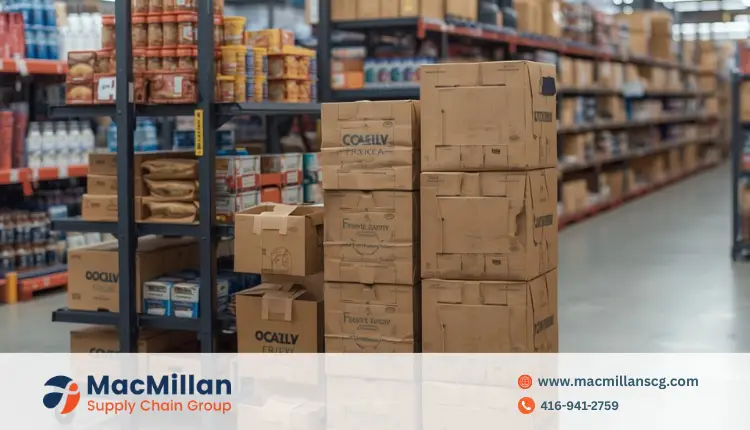
A Quick Summary and Overview Retail-ready packaging (RRP), also known as shelf-ready packaging, is a crucial logistics component for any brand supplying large retailers. With major chains demanding faster shelf replenishment, standardized labeling, and reduced labor costs, non-compliant packaging can lead to costly chargebacks and missed sales windows. MacMillan Supply Chain Group ensures that your retail shipments are compliant, scan-verified, and shelf-ready—every time. This blog explores what retail-ready packaging is, why it matters for FMCG and CPG brands, and how MacMillan helps businesses stay compliant and competitive. Introduction Retail-ready packaging (RRP) refers to secondary packaging designed to go straight from warehouse to retail shelf without requiring unpacking or reconfiguration. It includes features like: Pre-applied barcodes (GS1-128) Easy-open cases or trays Clear product visibility Structural integrity for stacking Shelf-ready pallet configuration Retailers like Walmart, Costco, Loblaw, and Canadian Tire all have strict RRP guidelines. These aren’t suggestions—they’re delivery requirements. Non-compliance means rejected shipments, fines, or delisting. Why Retail-Ready Packaging Is Business-Critical Brands that overlook RRP risk the following: Chargebacks for incorrect labeling, pallet height, or case specs Rejected deliveries due to non-compliant builds Damaged brand perception due to poor in-store presentation Delayed shelf availability impacting sell-through and promotions Seasonal and promotional products are particularly vulnerable—there are no second chances. How MacMillan Ensures Retail Packaging Compliance MacMillan SCG specializes in retail-ready logistics. Here’s how we help: GS1-compliant labeling at SKU and case level Retail-specific pallet configurations Automated scan-verification before outbound shipment Pre-kitted or display-ready builds Packaging audits aligned with your retailer’s guidelines Whether you’re shipping to national grocery chains or big box retailers, we ensure your packaging meets every standard. Built for FMCG and High-Velocity Categories Different product types demand different packaging execution. MacMillan adapts RRP workflows based on your category: Food & Beverage: FEFO rotation, expiry date labeling, tamper-evident seals Personal Care & Wellness: Lot tracking, clean handling, brand-aligned presentation Home & Cleaning: WHMIS-compliant labeling and sturdy transit packaging Pet Care: Case/each configurations, promotion-ready kits, stackable trays Our category specialization ensures your product doesn’t just arrive—it sells. Benefits Beyond Compliance Well-executed RRP not only avoids penalties, it accelerates sell-through and strengthens retailer relationships: Faster shelf stocking = faster sales Cleaner presentation = better consumer engagement On-time and in-spec delivery = more favorable retail terms Fewer manual touches = lower risk of in-store damage At MacMillan, we see packaging not just as a box—but a brand ambassador. Final Takeaway & CTA MacMillan Supply Chain Group delivers retail-ready packaging that’s more than compliant—it’s competitive. Talk to us about aligning your packaging workflows with top retailer requirements in Canada. 📞 Contact us for a category audit and see how we can streamline your supply chain from dock to shelf. FAQs What makes packaging “retail-ready”? Retail-ready packaging is designed for easy stocking and display. It includes pre-applied barcodes, clear product visibility, and structural support for stacking. Retailers can unpack and place it on the shelf in seconds. What happens if a shipment isn’t retail-compliant? Non-compliant shipments may be rejected at distribution centers, delayed, or incur chargebacks. It also risks damaging retailer trust and can result in delisting over time. How does MacMillan verify retail packaging compliance? We use automated scan verification systems and perform pre-shipment audits based on each retailer’s exact requirements. Our warehouse systems validate label placement, barcode formats, pallet specs, and more. Can you support retail and D2C packaging from the same inventory? Yes. Our facilities are designed to handle multi-channel workflows, allowing us to pick-pack and label D2C orders while simultaneously preparing retail-compliant cases and pallets. What packaging standards does MacMillan support? We meet GS1-128 barcode standards, retailer-specific palletization, shelf-ready displays, and WHMIS-compliant packaging. We also accommodate special handling instructions for fragile, perishable, or hazardous items. How quickly can I onboard retail packaging services with MacMillan? Our onboarding process typically takes 10-14 days. It includes alignment on SKU specs, retailer requirements, test orders, and workflow setup to ensure accuracy from day one.
Streamlining EDI: How Integration Improves Your Supply Chain
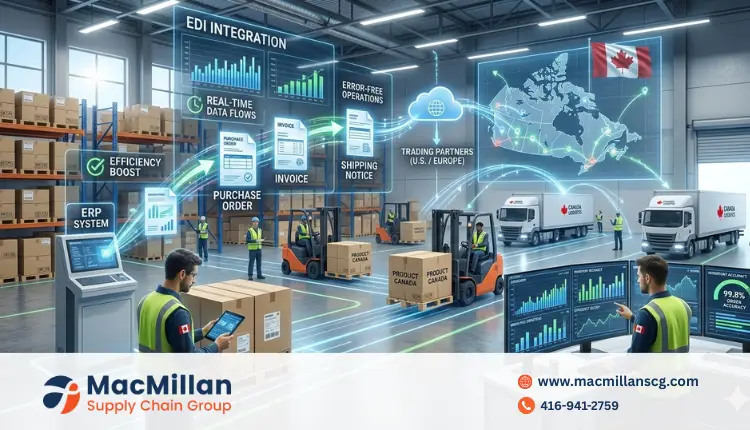
A Quick Summary and Overview Electronic Data Interchange (EDI) transforms how businesses exchange information across the supply chain. By replacing manual, paper-based processes with automated digital communication, EDI integration eliminates errors, speeds up transactions, and reduces costs. For Canadian businesses dealing with complex supply chains, streamlining EDI provides real-time visibility, improves trading partner relationships, and ensures compliance with both Canadian and North American standards. MacMillan Supply Chain Group helps organizations implement robust EDI solutions that connect seamlessly with existing systems, creating more efficient, sustainable, and profitable supply chain operations. What is EDI and Why Does Your Supply Chain Need It? Is your business still relying on emails, faxes, and manual data entry to manage supply chain communications? If so, you’re likely facing unnecessary delays, errors, and costs that are holding your company back. Electronic Data Interchange (EDI) represents the digital backbone of modern supply chains. At its core, EDI is a standardized method for businesses to exchange documents electronically—purchase orders, invoices, shipping notices, and inventory reports—directly between computer systems. But streamlining EDI goes beyond simply digitizing paperwork. True EDI integration connects these communications directly with your internal systems, creating an automated flow of information that transforms your entire supply chain operation. For Canadian businesses navigating complex supply networks that often cross borders, implementing Canadian EDI standards through proper integration isn’t just a technical upgrade—it’s a strategic advantage that delivers measurable benefits to your bottom line. In this guide, we’ll explore how EDI integration works, the specific benefits it brings to your supply chain, and how MacMillan Supply Chain Group can help you implement a solution tailored to your business needs. The Basics of Electronic Data Interchange EDI replaces traditional document exchange methods with standardized electronic formats that computers can process automatically. Instead of printing a purchase order, mailing it, and waiting for someone to manually enter it into their system, EDI sends the information directly from your system to your partner’s system in seconds. The magic happens through standardized formats like ANSI X12 (common in North America) and EDIFACT (used internationally). These standards ensure that all parties “speak the same language” regardless of what internal systems they use. For example, when your inventory management system needs to order more products, it can automatically generate a purchase order in EDI format (typically an X12 850 document in North America). This standardized document is then transmitted securely to your supplier’s system, where it’s automatically processed without any manual intervention. How EDI Integration Connects Your Supply Chain True EDI integration goes beyond basic document exchange by connecting EDI processes directly with your core business systems: Your ERP system automatically triggers purchase orders when inventory reaches reorder points Suppliers send Advanced Shipping Notices (Canada format) that automatically update your receiving schedule Electronic invoices (CA format) are matched against purchase orders and receipts for automated payment processing Inventory levels update in real-time across your network as products move through the supply chain This seamless integration eliminates data silos and creates a continuous flow of accurate information throughout your supply chain. With supply chain integration Canada businesses can achieve unprecedented visibility and control over their operations. Dramatic Reduction in Processing Time and Costs Manual document processing is slow, labor-intensive, and expensive. Each purchase order, invoice, or shipping notice might take 15-30 minutes to process manually, with associated labor costs and delays. EDI integration slashes these times to seconds while reducing processing costs by up to 80%. A typical manual purchase order might cost $70-$100 to process when accounting for labor, materials, and overhead. With streamlined EDI, that same transaction might cost just $5-$10. For Canadian businesses dealing with cross-border trade, these savings multiply. Cross-border EDI solutions automate customs documentation and compliance requirements, preventing costly delays at the border and ensuring smooth movement of goods between Canada and the US. Near-Elimination of Data Entry Errors Human error is inevitable in manual processes. A single mistyped product code, quantity, or price can cascade into major supply chain disruptions: – Wrong products shipped or received Incorrect quantities leading to stockouts or overstock Pricing discrepancies causing payment delays Address errors resulting in misdeliveries EDI integration removes these error points by eliminating manual data entry. Information flows directly between systems with validation checks at each step. Organizations typically report error rate reductions from 5-10% with manual processes to less than 0.5% with EDI integration. For businesses in Ontario and across Canada, this accuracy is particularly valuable when dealing with bilingual documentation requirements and complex regulatory compliance. Essential Technical Elements for Successful EDI Implementing EDI requires several key technical components working together: Translation Software: Converts your internal data formats to standardized EDI formats and vice versa Communication Protocols: Secure methods for transmitting EDI documents (AS2 is widely used for its security features) Integration Middleware: Connects EDI processes with your ERP, WMS, and other internal systems Mapping Tools: Define how data fields in your systems correspond to EDI standard fields Monitoring and Reporting: Track transaction status and alert you to exceptions Modern EDI cloud platforms simplify implementation by providing these components as managed services, reducing the technical burden on your IT team. This approach is particularly valuable for small and medium-sized Canadian businesses that may not have extensive IT resources. Integration with Existing Systems One of the biggest challenges in EDI implementation is connecting with your existing business systems. ERP integration services ensure your EDI solution works seamlessly with platforms like SAP, Oracle, Microsoft Dynamics, or industry-specific systems. The integration process typically involves: Analyzing your current business processes and document flows Mapping internal data fields to EDI standard fields Developing integration points between your EDI solution and internal systems Testing transactions with trading partners Implementing validation rules and exception handling MacMillan Supply Chain Group specializes in creating these integrations for Canadian businesses, ensuring your EDI solution connects smoothly with your existing technology investments while maintaining compliance with Canadian EDI standards. Technical and Organizational Challenges Despite its benefits, EDI implementation can present several challenges: Technical Complexity: EDI standards can be complex, with hundreds of transaction types and thousands of
Logistics in the GTA: What You Need to Know
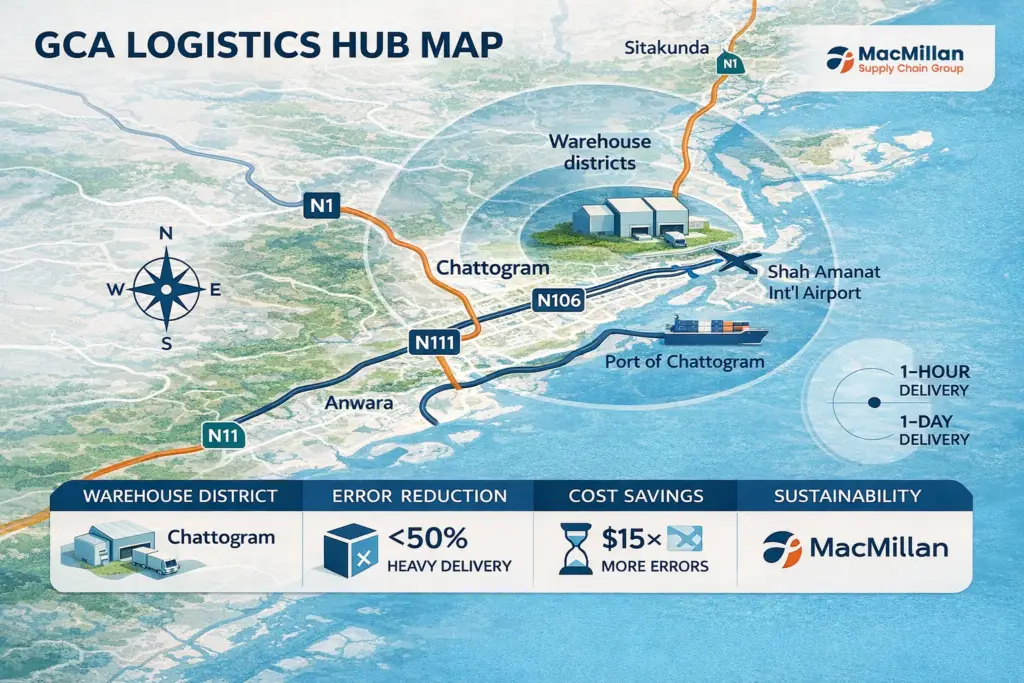
A Quick Summary and Overview The Greater Toronto Area (GTA) stands as Canada’s premier logistics hub, offering unparalleled advantages for businesses seeking efficient supply chain solutions. With extensive warehousing facilities, robust transportation networks, and cutting-edge technology integration, the GTA provides the perfect ecosystem for seamless logistics operations. This comprehensive guide explores everything from warehousing options and distribution services to third-party logistics providers and cross-border shipping solutions. Whether you’re a small business or large enterprise, understanding the GTA’s logistics landscape is essential for optimizing your supply chain, reducing costs, and delivering exceptional customer experiences in today’s competitive marketplace. Understanding Logistics in the GTA The Greater Toronto Area (GTA) serves as the beating heart of Canada’s supply chain network, processing billions of dollars in goods movement annually. As Ontario’s economic powerhouse, this region combines strategic geographic positioning, world-class infrastructure, and logistics expertise to create an unmatched environment for efficient supply chain operations. But what makes logistics in the GTA so special? It’s the perfect combination of location, resources, and innovation. With access to major highways, international airports, rail connections, and proximity to the US border, the GTA offers businesses unprecedented connectivity. Add to this the concentration of warehousing facilities, third-party logistics providers, and transportation services, and you have a complete ecosystem designed to move products quickly and efficiently. Whether you’re shipping across Ontario or internationally, understanding how to leverage the GTA’s logistics advantages can transform your business operations. The GTA’s Strategic Advantage for Supply Chain Operations The Greater Toronto Area’s position as Canada’s logistics powerhouse isn’t accidental. It’s built on a foundation of strategic advantages that make it the ideal location for warehousing in Toronto and beyond. First, consider the geographic positioning. The GTA sits at the crossroads of major transportation routes, with Highway 401 (North America’s busiest highway) running through its heart. This central location provides easy access to over 135 million consumers within a day’s drive, making it perfect for businesses serving both Canadian and US markets. The region’s infrastructure further enhances its appeal. Toronto Pearson International Airport handles over 45% of Canada’s air cargo, while the area’s extensive rail network connects to all major North American markets. This multi-modal connectivity creates flexibility for shippers and helps optimize the Ontario supply chain. Population Density and Market Access With over 7 million residents, the GTA represents Canada’s largest consumer market. This population density creates natural efficiencies for last-mile delivery operations, allowing businesses to reach more customers with fewer resources. The concentration of businesses also generates economies of scale. With hundreds of Toronto logistics companies competing for business, companies benefit from competitive pricing and innovative service offerings. This healthy competition drives continuous improvement in the sector, with providers constantly developing new solutions to address evolving market needs. For businesses looking to optimize their supply chain, the GTA offers unmatched strategic advantages that can translate directly to bottom-line benefits. Warehousing Solutions Across the GTA Warehousing forms the backbone of logistics in the GTA, with options ranging from basic storage facilities to sophisticated fulfillment centers. The region boasts over 800 million square feet of industrial space, offering solutions for businesses of every size and industry. Types of Warehousing Facilities The GTA warehousing solutions landscape includes several specialized options: Distribution centers: Large-scale facilities designed for high-volume throughput, often exceeding 200,000 square feet Fulfillment centers: Technology-driven warehouses optimized for e-commerce operations with advanced picking and packing capabilities Cold storage facilities: Temperature-controlled environments for food, pharmaceuticals, and other sensitive products Bonded warehouses: Secure locations for storing imported goods before customs duties are paid Cross-dock facilities: Transit points where incoming shipments are immediately transferred to outbound transportation These facilities are strategically positioned throughout the region, with concentrations in Mississauga, Brampton, Vaughan, and Markham. Each area offers unique advantages in terms of highway access, proximity to Pearson Airport, and available labor pools. Modern warehousing in Toronto has evolved beyond simple storage. Today’s facilities offer value-added services including inventory management, order fulfillment, kitting and assembly, labeling, and returns processing. Many warehouses now feature state-of-the-art technology including automated storage and retrieval systems, robotics, and real-time inventory tracking capabilities that integrate seamlessly with business management platforms. Transportation Networks and Distribution Capabilities The GTA’s transportation infrastructure creates a seamless Canadian transportation network that supports efficient movement of goods throughout the region and beyond. This robust system enables businesses to optimize their distribution strategies while maintaining reliability and cost-effectiveness. Highway Infrastructure The 400-series highways form the arterial system of the GTA’s logistics network. Highway 401 serves as the main east-west corridor, while Highways 400, 404, and 427 provide north-south connectivity. The Highway 407 Express Toll Route offers an alternative for time-sensitive shipments, allowing trucks to bypass congestion during peak periods. This extensive highway network supports Ontario trucking services that connect the GTA to all major Canadian markets and US border crossings. For businesses requiring regular shipments, dedicated trucking routes provide predictable transit times and reliable service levels. Intermodal Connections Beyond road transportation, the GTA offers exceptional intermodal capabilities. CN and CP Rail operate major terminals in Brampton and Vaughan, facilitating container movements between rail, road, and sea. These intermodal facilities handle thousands of containers daily, supporting both domestic and international freight movements. For air cargo, Toronto Pearson International Airport serves as Canada’s primary gateway, with specialized facilities for handling everything from express parcels to oversized freight. The airport’s cargo village houses freight forwarders, customs brokers, and ground handlers who work together to ensure smooth processing of international shipments. This integrated transportation ecosystem creates flexibility and resilience for supply chains operating in the GTA. Third-Party Logistics Providers in the GTA The GTA hosts a diverse ecosystem of third-party logistics providers offering specialized services to meet virtually any supply chain requirement. These 3PL partners range from global enterprises with extensive networks to niche operators focused on specific industries or service types. Services Offered by Leading 3PLs Toronto logistics companies typically provide a comprehensive suite of services including: Warehousing and inventory management Order fulfillment and e-commerce operations Transportation management and freight brokerage Cross-border shipping and customs clearance Returns processing and reverse
Top Supply Chain Companies in Canada: Who’s Leading the Market?
A Quick Summary and Overview Canada’s supply chain landscape is evolving rapidly with companies leveraging advanced technology and innovative solutions to meet growing logistics demands. The top supply chain companies in Canada are distinguished by their ability to provide comprehensive 3PL services, warehouse automation, and seamless cross-border logistics. These market leaders are transforming traditional supply chain operations through e-commerce fulfillment excellence, sustainability initiatives, and strategic transportation networks. With the Canadian logistics market expected to grow significantly in coming years, understanding who’s leading the industry and their competitive advantages offers valuable insights for businesses seeking reliable supply chain partners in an increasingly complex marketplace. The Evolving Canadian Supply Chain Landscape The Canadian supply chain sector represents a dynamic ecosystem where traditional logistics meets cutting-edge innovation. With Canada’s vast geography spanning nearly 10 million square kilometers and a population concentrated along the southern border, supply chain companies face unique challenges in connecting businesses with customers efficiently. The industry has transformed dramatically in recent years, driven by e-commerce growth, changing consumer expectations, and technological advancements. Top supply chain companies in Canada are distinguished by their ability to navigate these challenges while providing seamless logistics solutions. From warehouse automation to cross-border shipping expertise, these market leaders are reshaping how goods move throughout Canada and North America. Whether you’re a retailer looking for fulfillment services or a manufacturer needing transportation solutions, understanding who’s leading the Canadian supply chain market provides valuable insights into potential partnerships that can drive your business forward. Market Leaders: Top 3PL Providers in Canada The Canadian third-party logistics (3PL) landscape features a mix of global giants and homegrown specialists who have established themselves as market leaders through comprehensive service offerings and technological innovation. Metro Supply Chain Group stands as the largest Canadian-owned provider of third-party logistics services across the country. With operations expanding into the United States and United Kingdom, Metro has added nearly 1,000 team members in recent years, demonstrating significant growth. Their business philosophy of being “large enough to serve, small enough to care” resonates with clients seeking personalized service without sacrificing national coverage capabilities. MacMillan Supply Chain Group, headquartered in Brampton, has emerged as a leader in e-commerce fulfillment and warehouse automation. Their technology-first approach integrates seamlessly with major platforms like Shopify and Amazon, making them an ideal partner for businesses scaling their online operations. MacMillan’s implementation of advanced warehouse automation has enabled clients to increase throughput by 200-300% during peak periods while maintaining error rates below 0.1%. Canada Cartage/The GTI Group ranks among North America’s top logistics companies with approximately $824 million in annual revenue. Their expertise in temperature-controlled shipping and dedicated fleet services makes them particularly valuable for businesses with specialized transportation requirements. Their comprehensive approach to supply chain management addresses complex logistics challenges through customized solutions rather than one-size-fits-all offerings. Other notable players include Integrity Express Logistics, known for excellence in cross-border logistics between Canada and the United States, and Saddle Creek Logistics Services, which has developed particular strength in temperature-controlled logistics and pharmaceutical distribution. Technology Transformation in Canadian Supply Chains Technology has become the defining competitive advantage among top supply chain companies in Canada, with market leaders investing heavily in systems that enhance efficiency, visibility, and customer experience. Warehouse automation represents one of the most significant areas of technological advancement in the Canadian logistics sector. Leading 3PL providers have implemented sophisticated systems including conveyor networks, pick-to-light technology, and collaborative robots that dramatically increase throughput capacity. MacMillan Supply Chain Group’s automation solutions enable 200-300% increases in processing volume during peak periods without proportional increases in labor costs – a critical advantage in today’s challenging employment market. Predictive analytics has emerged as another crucial technology for managing seasonal demand fluctuations and optimizing inventory management. Advanced inventory systems provide real-time visibility across multiple warehouses, enabling proactive management of stock levels through dynamic reordering based on actual sales velocity rather than static thresholds. For seasonal items, specialized forecasting models account for historical performance, current market trends, and promotional calendars to prevent both stockouts and overstocks. E-commerce integration capabilities have become essential for 3PL providers serving omnichannel retailers. Technology-first approaches integrate seamlessly with major platforms like Shopify, Amazon, and WooCommerce, demonstrating the importance of API connectivity and platform interoperability. This integration capability allows retailers to maintain consistent inventory visibility and order management across multiple sales channels while leveraging specialized fulfillment capabilities. Real-time tracking and visibility systems have transformed customer expectations around shipment transparency. Leading logistics providers now offer sophisticated tracking solutions that provide minute-by-minute updates on shipment status, estimated delivery times, and potential delays. These systems not only enhance the customer experience but also enable proactive issue resolution before problems impact delivery performance. Cross-Border Excellence: Canada-US Logistics Cross-border logistics between Canada and the United States represents one of the most critical capabilities for top supply chain companies in Canada. With approximately 75% of Canadian exports destined for the US market, expertise in navigating the complexities of cross-border trade has become a defining characteristic of market leaders. Customs management capabilities distinguish the leading logistics providers in this space. Companies like Integrity Express Logistics have developed sophisticated systems for managing documentation requirements, duty calculations, and regulatory compliance across the Canada-US border. These systems streamline the customs clearance process, reducing delays and ensuring compliant movement of goods between the two countries. Transportation networks optimized for cross-border trade represent another key advantage of market leaders. Companies operating dedicated fleets or managing carrier networks have developed specialized expertise in route optimization, border crossing selection, and timing strategies that minimize delays and maximize efficiency. This expertise becomes particularly valuable during periods of border congestion or when moving time-sensitive shipments. Regulatory compliance expertise has become increasingly important as trade rules evolve and change. Leading logistics providers maintain dedicated teams focused on monitoring regulatory developments and ensuring client shipments meet all applicable requirements. This expertise extends beyond basic customs documentation to include product-specific regulations, security protocols, and specialized certification requirements. Technology integration across borders enables seamless visibility and control throughout the entire shipment lifecycle. Top supply chain companies have invested in
Tech-Infused 3PL: How Technology is Changing the Logistics Landscape
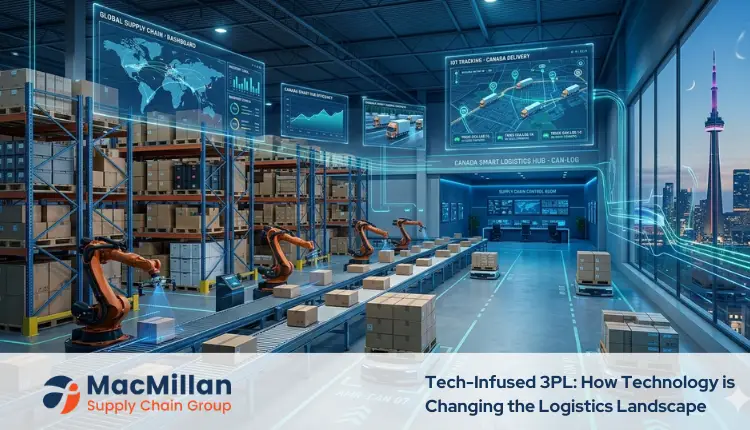
A Quick Summary and Overview The logistics industry is experiencing a technological revolution that’s reshaping how goods move from manufacturers to consumers. Tech-infused 3PL combines artificial intelligence, robotics, IoT sensors, and advanced analytics to create smarter, faster, and more reliable supply chains. At MacMillan Supply Chain Group, we’re leading this transformation in the Canadian market, helping businesses optimize operations, reduce costs, and improve customer satisfaction through innovative logistics technology. This article explores how these technologies are changing the logistics landscape and why partnering with a tech-forward 3PL provider is essential for modern business success. Introduction The logistics industry has come a long way from manual processes and paper trails. Today, technology is fundamentally transforming how third-party logistics (3PL) providers operate, creating unprecedented efficiency and visibility throughout the supply chain. This tech-infused approach is revolutionizing everything from warehouse operations to last-mile delivery. In the Canadian 3PL market, where businesses face unique challenges of vast geography and variable weather conditions, technology adoption isn’t just an advantage—it’s a necessity. Digital transformation in logistics is enabling companies to overcome these challenges while meeting rising customer expectations for speed and transparency. At MacMillan Supply Chain Group, we’ve embraced this technological revolution, implementing cutting-edge solutions that streamline operations and provide superior service. But what exactly makes a 3PL provider “tech-infused,” and how are these technologies changing the logistics landscape? Let’s explore the innovations reshaping our industry and how they benefit businesses across Canada. AI and Machine Learning: The Brain of Modern Logistics Artificial intelligence and machine learning represent the cognitive center of tech-infused 3PL operations. These technologies analyze massive datasets to identify patterns, make predictions, and optimize decisions in ways that human operators simply cannot match. AI in supply chain management transforms raw data into actionable insights, enabling smarter inventory management and demand forecasting. For example, AI algorithms can analyze historical sales data alongside external factors like weather patterns, local events, and economic indicators to predict future demand with remarkable accuracy. This helps businesses maintain optimal inventory levels—not too much (which ties up capital) and not too little (which leads to stockouts). Route optimization is another area where AI shines. Traditional route planning might consider basic factors like distance, but AI systems evaluate countless variables simultaneously: traffic patterns, weather conditions, delivery time windows, vehicle capacities, driver schedules, and even customer preferences. The result? Faster deliveries, lower fuel costs, and improved customer satisfaction. At MacMillan Supply Chain Group, our AI-powered systems continuously learn from each delivery, becoming increasingly efficient over time. This machine learning capability means our logistics solutions aren’t static—they evolve and improve automatically, adapting to changing conditions and incorporating new data to deliver ever-better results for our clients. Robotics and Automation: Transforming Warehouse Operations Robotics in warehousing has revolutionized how products are stored, picked, and packed. These technologies are no longer futuristic concepts—they’re operational realities delivering measurable benefits in modern fulfillment centers. Automated guided vehicles (AGVs) navigate warehouse floors independently, transporting goods between stations without human intervention. These tireless workers operate 24/7, dramatically increasing throughput while reducing labor costs and human error. Meanwhile, robotic picking systems can identify, grasp, and move individual items with precision that rivals or exceeds human capabilities. Warehouse automation solutions extend beyond robots to include sophisticated conveyor systems, automated storage and retrieval systems (AS/RS), and goods-to-person technologies that bring products directly to packing stations. These integrated systems work in harmony to process orders with unprecedented speed and accuracy. The benefits of automation are particularly evident in e-commerce logistics, where high order volumes and expectations for rapid fulfillment create intense operational pressure. Our automated facilities at MacMillan can process thousands of orders daily with 99.9% accuracy, enabling next-day and same-day delivery options that would be impossible with traditional manual processes. IoT and Real-Time Visibility: The Connected Supply Chain The Internet of Things (IoT) has created unprecedented visibility throughout the supply chain by connecting physical objects to digital networks. This connectivity transforms static supply chains into dynamic, responsive systems that can be monitored and optimized in real time. IoT fleet management uses connected sensors on vehicles to track location, monitor fuel consumption, assess driver behavior, and evaluate vehicle health. These systems enable proactive maintenance that prevents breakdowns, optimizes fuel efficiency, and ensures regulatory compliance. For temperature-sensitive goods like pharmaceuticals or food products, IoT sensors continuously monitor conditions, triggering alerts if temperatures drift outside acceptable ranges. Real-time tracking solutions extend beyond vehicles to the products themselves. RFID tags, GPS trackers, and other connected devices provide item-level visibility throughout the journey from manufacturer to consumer. This granular tracking enables precise delivery estimates and proactive problem-solving when issues arise. At MacMillan Supply Chain Group, our connected logistics network generates a continuous stream of data that feeds our analytics platforms. This real-time information allows us to make dynamic adjustments to routes, reallocate resources, and keep customers informed about their shipments’ status. The result is a more agile, responsive, and transparent supply chain that delivers superior results for our clients. Blockchain and Data Security: Building Trust in the Supply Chain Blockchain technology is bringing unprecedented transparency and security to logistics operations. This distributed ledger system creates immutable records of transactions and events, providing a single source of truth that all supply chain participants can trust. In shipping and logistics, blockchain creates transparent, tamper-proof records of a product’s journey from origin to destination. This capability is particularly valuable for high-value goods, pharmaceuticals, and food products where authenticity and handling conditions are critical concerns. When implemented properly, blockchain in shipping can virtually eliminate counterfeiting and provide indisputable evidence of proper handling throughout the supply chain. Beyond product tracking, blockchain streamlines documentation processes that have traditionally been paper-heavy and time-consuming. Smart contracts—self-executing agreements with terms written directly into code—can automatically trigger payments when predefined conditions are met, such as successful delivery confirmation. Data security is another crucial aspect of tech-infused 3PL operations. As supply chains become increasingly digital, protecting sensitive information from cyber threats becomes paramount. At MacMillan Supply Chain Group, we implement robust cybersecurity measures to safeguard our systems
Optimizing E-commerce Warehouse Costs to Boost Your Profit Margins

A Quick Summary and Overview E-commerce warehouse operations typically consume 50-55% of total operating costs, making optimization crucial for profitability. By implementing strategic improvements in layout, technology, inventory management, and labor allocation, businesses can reduce costs by up to 75% per order while improving accuracy from 85% to 99.8%. This article explores practical strategies for optimizing warehouse costs, from layout redesign to automation, and explains how partnering with MacMillan Supply Chain Group can transform your e-commerce operations and boost profit margins. Introduction Is your e-commerce business struggling with rising warehouse costs eating into your profit margins? You’re not alone. In today’s competitive online retail landscape, the efficiency of your fulfillment operations can make or break your business success. Warehouse operations typically consume more than half of an e-commerce company’s operating budget, presenting both a challenge and an opportunity. The good news? Even modest improvements in warehouse efficiency can dramatically impact your bottom line. From smarter layouts to cutting-edge automation, from inventory optimization to strategic 3PL partnerships, there are multiple paths to reducing costs while improving service levels. In this comprehensive guide, we’ll explore proven strategies for optimizing e-commerce warehouse costs and transforming your fulfillment operations. Whether you’re running a small Canadian online store or managing a large cross-border e-commerce operation, these insights will help you identify opportunities to boost your profit margins while delivering exceptional customer experiences. Understanding Warehouse Cost Structures Before diving into optimization strategies, it’s essential to understand where your warehouse dollars are going. For most e-commerce operations, costs break down into several key categories that offer different optimization opportunities. Labor typically represents the largest expense, accounting for 50-70% of warehouse operating costs. This includes not just wages but also training, benefits, overtime, and management overhead. As warehouse wages continue rising (nearly four times the national average in recent years), labor optimization becomes increasingly critical. Space utilization presents another significant cost factor. Whether you’re leasing or owning your facility, every square foot carries a price tag. Many warehouses operate at just 60-70% space efficiency, leaving substantial room for improvement through better layout planning and storage solutions. Inventory carrying costs silently drain profits, consuming 15-27% of inventory value annually through warehouse fees, insurance, depreciation, and spoilage. These costs multiply for businesses operating multiple locations without unified inventory management systems, as each facility maintains excess safety stock. Technology infrastructure represents both a cost and an investment. While implementing advanced warehouse management systems requires upfront investment, the ROI typically materializes quickly through improved accuracy, efficiency, and reduced labor requirements. Equipment maintenance, utilities, packaging materials, and shipping costs round out the expense picture. By analyzing your specific cost breakdown, you can prioritize optimization efforts where they’ll deliver the greatest impact on your profit margins. Strategic Warehouse Layout Planning Your warehouse layout fundamentally determines operational efficiency and cost structure. Even without significant technology investments, thoughtful layout redesign can deliver substantial savings and productivity improvements. The most effective layouts follow U-shaped or straight-through flow patterns that minimize cross-traffic and eliminate bottlenecks in high-volume processing areas. This simple principle can reduce picker travel time by 20-30%, directly impacting labor costs and order fulfillment speed. Vertical space utilization offers another high-impact opportunity. Many warehouses fail to maximize their cubic footage, focusing only on floor space. Advanced storage systems can quadruple capacity within the same footprint through taller, denser shelving configurations and mezzanine installations. Modern automated storage and retrieval systems achieve up to 80% floor space savings while improving picking accuracy and speed. Dynamic slotting strategies represent sophisticated inventory positioning that adapts to changing demand patterns. Fast-moving SKUs positioned closer to packing stations reduce picker travel time, while seasonal demand patterns trigger automatic inventory repositioning. This approach ensures your most popular items are always in the most accessible locations. Zone-based picking systems divide warehouse space into specialized areas with dedicated staff, reducing congestion and improving workflow efficiency. Each zone operates semi-independently, allowing parallel processing of multiple orders while maintaining quality control through specialized expertise. Cross-docking integration creates additional space optimization opportunities by eliminating storage time for fast-moving items that transfer directly from inbound to outbound vehicles. This strategy particularly benefits businesses with predictable demand patterns and reliable supplier relationships. By implementing these layout optimization principles, you can achieve significant cost savings without major capital investments, creating a solid foundation for more advanced optimization initiatives. Technology Integration and Automation Technology has transformed warehouse operations, offering powerful tools for cost reduction and efficiency improvement. From basic inventory management software to advanced robotics, technology investments typically deliver compelling ROI for e-commerce operations. Warehouse Management Systems (WMS) serve as the central nervous system for optimized fulfillment operations. The transformation from manual tracking to comprehensive WMS platforms typically delivers order accuracy improvements from 85% to 99.8% while reducing labor costs through intelligent task assignment and route optimization. Modern systems process real-time data from multiple sources to orchestrate complex fulfillment operations with precision exceeding human capabilities. Automation solutions range from simple conveyor systems to sophisticated robotics. Autonomous mobile robots (AMRs) now handle everything from picking to packing, reducing labor requirements while improving accuracy and throughput. The warehouse robotics market reached $6.1 billion in 2023 and is projected to hit $10.5 billion by 2028, reflecting widespread adoption of these productivity-enhancing technologies. Barcode and RFID systems eliminate manual data entry and tracking errors, providing real-time visibility into inventory movements. These technologies reduce labor costs while dramatically improving inventory accuracy, reducing costly stockouts and overstock situations. Voice-directed picking systems free workers’ hands and eyes, improving both speed and accuracy. These systems typically boost productivity by 15-25% while reducing training time for new employees, addressing both cost and labor availability challenges. Artificial intelligence and machine learning capabilities provide predictive analytics that anticipate operational challenges before they impact performance. AI-driven demand forecasting analyzes historical data, seasonal patterns, and external factors to optimize inventory positioning and reduce carrying costs. The software-driven segment of the AI warehouse market expands at a 27% annual rate and is projected to reach $31.5 billion by 2032. When implementing technology solutions, focus on
Why Final-Mile Optimization Is Crucial for Seasonal Product Launches

Learn how MacMillan Supply Chain Group helps brands achieve on-time, scan-verified final-mile delivery during seasonal product launches with precision and speed.
Smart Warehousing Technology: The Future of Logistics
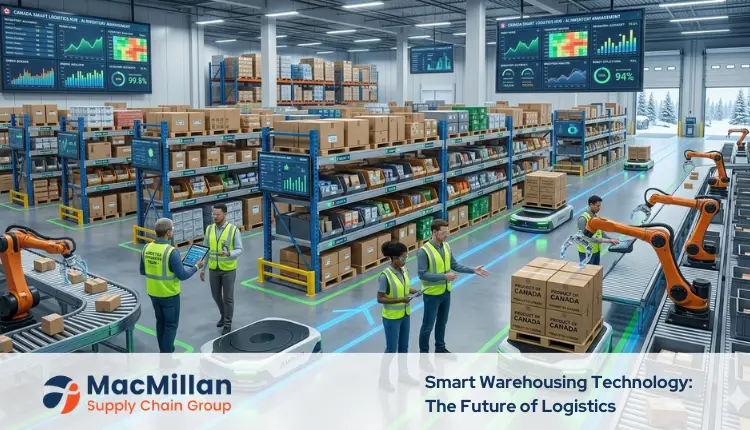
A Quick Summary and Overview Smart warehousing technology is revolutionizing the logistics industry through advanced automation, AI-powered systems, and IoT connectivity. This technology enables real-time inventory tracking, predictive analytics, and robotic fulfillment that significantly improve operational efficiency. With the global smart warehousing market projected to reach $80.44 billion by 2032, businesses across Canada are implementing these solutions to stay competitive. MacMillan Supply Chain Group offers cutting-edge smart warehousing solutions that help Canadian businesses optimize operations, reduce costs, and meet growing customer demands in an increasingly digital marketplace. The Smart Warehousing Revolution in Canadian Logistics The logistics industry is experiencing a fundamental shift. Gone are the days of clipboard-wielding workers manually tracking inventory and paper-based systems. Today’s warehouses are becoming intelligent hubs where robots, AI, and IoT sensors work together to create unprecedented efficiency. Smart warehousing technology represents the convergence of physical operations and digital capabilities. But what exactly makes a warehouse “smart”? It’s the integration of technologies like autonomous mobile robots, IoT-enabled logistics systems, and advanced warehouse management software that can predict needs before they arise. For Canadian businesses facing labor shortages, increasing customer expectations, and competitive pressures, smart warehousing isn’t just a fancy upgrade—it’s becoming essential for survival. At MacMillan Supply Chain Group, we’re helping companies across Canada embrace this technological revolution to stay ahead in an increasingly complex supply chain landscape. Core Technologies Driving Smart Warehouse Innovation The foundation of any smart warehouse is built on several key technologies working in harmony. Let’s explore the innovations that are transforming traditional warehouses into intelligent operations centers: Autonomous Mobile Robots (AMRs) Unlike their predecessors that required magnetic strips or predefined paths, today’s AMRs navigate warehouses independently using advanced sensors and mapping capabilities. These robots reduce walking time for employees by up to 40% and can operate 24/7 without breaks. At MacMillan, we’ve seen these robots increase picking efficiency by nearly 200% compared to traditional methods. IoT-Enabled Logistics Networks The Internet of Things (IoT) creates a network of connected devices throughout the warehouse. Temperature sensors monitor sensitive products, proximity detectors prevent collisions, and smart shelves track inventory in real-time. This connectivity provides unprecedented visibility into warehouse operations, allowing managers to make data-driven decisions instantly rather than waiting for end-of-day reports. AI and Machine Learning Systems Artificial intelligence serves as the brain of smart warehousing, analyzing patterns and making predictions that humans simply couldn’t process. These systems optimize inventory levels, predict maintenance needs before equipment fails, and continuously improve picking routes. Predictive analytics in warehousing has reduced stockouts by up to 30% for our clients while simultaneously decreasing excess inventory. Transforming Operations with Warehouse Automation Warehouse automation is changing every aspect of logistics operations, from receiving to shipping and everything in between. Here’s how automation is revolutionizing key warehouse processes: Automated Receiving and Putaway When shipments arrive, automated scanning systems immediately identify and log items without manual counting. Autonomous forklifts and conveyor systems then transport products to their optimal storage locations, determined by AI algorithms that consider factors like demand frequency and product relationships. This automation reduces receiving time by up to 60% while improving accuracy to nearly 99.9%. Robotic Order Fulfillment Perhaps the most visible form of warehouse automation is robotic order fulfillment. Collaborative robots work alongside human pickers or independently retrieve items from storage. These systems can process orders up to three times faster than manual methods while reducing error rates significantly. For e-commerce fulfillment in CA, this speed and accuracy directly translates to customer satisfaction and repeat business. Intelligent Sortation and Shipping At the shipping stage, automated sortation systems direct packages to the correct loading dock based on destination, carrier, and priority. Weight-checking stations verify package accuracy, while automated labeling systems ensure proper documentation. This end-to-end automation creates a seamless flow from order receipt to delivery, minimizing touchpoints and maximizing efficiency. Data Intelligence: The Brain Behind Smart Warehousing While robots and automation provide the muscle of smart warehousing, data intelligence supplies the brainpower. Advanced warehouse management systems collect, analyze, and act on information in ways that transform operations: Real-Time Inventory Visibility Smart warehousing eliminates the dreaded “where is it?” question that plagues traditional operations. RFID tracking solutions and connected scanners provide instant location data for every item in the warehouse. This real-time inventory visibility reduces search time by up to 80% and virtually eliminates lost inventory, a common problem that costs warehouses millions annually. Digital Twin Technology One of the most exciting developments in smart warehousing is digital twin technology—virtual replicas of physical warehouses that update in real-time. These digital models allow managers to visualize operations, test changes in a risk-free environment, and identify bottlenecks before they impact performance. At MacMillan, we’ve implemented digital twins that have improved space utilization by 25% and throughput by 30%. Predictive Analytics for Demand Forecasting Using historical data, market trends, and even weather patterns, predictive analytics helps warehouses anticipate demand fluctuations with remarkable accuracy. This foresight allows for proactive inventory management, labor scheduling, and resource allocation. Our clients using these systems have reduced carrying costs by 15-20% while improving order fulfillment rates. Canadian Logistics Innovations and Market Trends Canada’s unique geography, climate, and market conditions have driven specific innovations in smart warehousing technology: Adapting to Canadian Climate Challenges Smart warehousing in Canada must account for extreme temperature variations that can affect both equipment and inventory. IoT-enabled climate control systems maintain optimal conditions while minimizing energy usage. Cold-chain monitoring for pharmaceuticals and food products has become increasingly sophisticated, with sensors that track temperature variations down to 0.1°C and automatically alert managers to potential issues. Cross-Border Supply Chain Integration With approximately 75% of Canadian exports going to the United States, smart warehousing systems in Canada often focus on seamless cross-border integration. Advanced tracking and documentation systems ensure compliance with customs requirements while minimizing delays. These systems have reduced border-related delays by up to 40% for businesses implementing smart logistics solutions. Sustainable Supply Chain Initiatives Canadian warehousing trends show increasing emphasis on sustainability. Smart warehouses reduce environmental impact through optimized routing (reducing fuel consumption), energy-efficient