
3PL Risk Management: Building Resilient Supply Chains
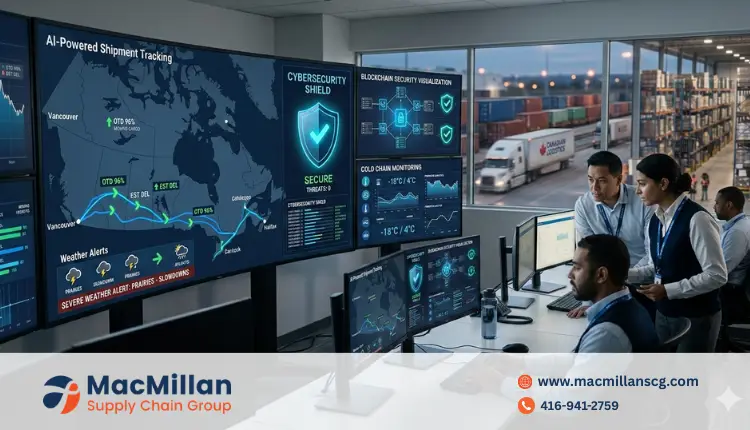
Businesses approaches to supply chain management were drastically altered by the COVID-19 pandemic. Resilience and adaptability must now be given top priority in a system that was previously primarily built for efficiency. This change has increased the importance of effective risk management for businesses that depend on third-party logistics (3PL) providers. We at MacMillan Supply Chain Group have seen directly how supply chain disruptions in Canada can affect companies of all sizes. The difficulties are numerous and frequently unforeseen, ranging from labor shortages to extreme weather events, from border closures to cybersecurity threats. For this reason, we have created thorough 3PL risk management plans that assist our clients in surviving disruptions and using them to their advantage. Let’s examine how contemporary 3PL risk management practices are constructing more robust supply chains for Canadian companies and adjusting to post-pandemic realities. Comprehending the New Risk Environment in Canadian Logistics In recent years, supply chains’ risk environment has significantly grown. Traditional issues like inventory control and delays in transit are still significant, but new problems have surfaced that call for creative answers. Changing Threat Trends Disruptions to the Canadian supply chain can now take many different forms. Cross-border shipping can be seriously delayed by border restrictions between the USA and Canada. Transportation networks are frequently impacted by extreme weather events, such as floods in British Columbia and ice storms in Quebec. Meanwhile, since 2019, the number of cybersecurity threats aimed at logistics systems has grown by more than 300%, with ransomware attacks having the ability to completely stop operations. The Interconnected Nature of Modern Risks The interconnectedness of today’s challenges is what makes them especially challenging. Transportation compliance problems could result from a cybersecurity breach. Failures in cold-chain management could be brought on by a weather event. During peak seasons, e-commerce fulfillment capabilities may be impacted by labor shortages. According to our Director of Operations, “the post-pandemic logistics environment requires thinking about risk in layers.” “Having a single backup plan is no longer sufficient; you need comprehensive strategies that address multiple potential failure points at the same time.” Working with 3PL partners who comprehend global supply chain dynamics and the particular difficulties of conducting business in Canada’s varied geographic and regulatory environment is essential for Canadian companies. Diversification and strategic sourcing are now crucial elements of successful 3PL risk management. Technology-Driven Solutions for 3PL Risk Management and Supply Chain Resilience Modern logistics technology is now essential to 3PL risk management success. To improve supply chain resilience for our clients, MacMillan Supply Chain Group makes use of a number of important technologies. AI-Powered Visibility in 3PL Risk Management Your whole logistics network is visible in real time thanks to our AI-powered supply chain platforms. This technology anticipates possible disruptions before they affect your operations, in addition to tracking shipments. By analyzing weather patterns, traffic data, border crossing times, and historical performance metrics, our systems can recommend proactive adjustments to routing and scheduling. For instance, our AI system automatically detected shipments that were at risk and recommended alternate routes when severe weather threatened deliveries throughout Ontario last winter, preventing delays for 94% of the impacted orders.This level of predictive control strengthens overall 3PL risk management capabilities. Blockchain for Enhanced Security and Transparency Blockchain has been incorporated into logistics processes for goods that need rigorous chain-of-custody documentation. This is especially helpful for food supply chains and pharmaceutical logistics, where product authenticity and temperature control are crucial. Our Technology Director observes that “Blockchain provides an immutable record of every touchpoint in the supply chain.” “This improves security and streamlines compliance paperwork for international shipping between the United States and Canada.” By adopting these technologies, we assist customers in creating resilient supply chains in Canada’s distinct and difficult logistics landscape, guaranteeing business continuity even in the face of interruptions. Together, these technologies form a core pillar of advanced 3PL risk management. Strategic Sourcing and Relationship Management Beyond technology, strategic sourcing and relationship management techniques that act as organic barriers against interruptions are also essential components of effective 3PL risk management. Diversification as a Strategy for Risk Mitigation We learned a valuable lesson from the pandemic: relying too much on a single supplier or transportation route can lead to dangerous vulnerabilities. At MacMillan Supply Chain Group, we assist customers in putting 3PL risk management-driven diversification plans into action that strike a balance between resilience and efficiency. Maintaining connections with several carriers for every transportation lane and setting up warehouse capacity in various geographical areas are two examples of what this could entail. Creating options for LTL and TL shipping to handle different volumes. Making backup plans for different ports of entry for shipments coming from abroad. “Strategic sourcing isn’t just about finding the lowest price,” explains our Supply Chain Director. “It’s about creating a network that can adapt when disruptions occur.” Contractual Frameworks for 3PL Risk Management Contemporary innovations in contracts have emerged as crucial instruments for risk management. We collaborate with clients to create contracts that contain the following: – Explicit force majeure provisions that cover pandemic situations. Metrics of performance that encourage proactive risk management. Provisions for managing tariffs on international shipping. Frameworks for shared responsibility regarding cybersecurity threats. We assist clients in developing supply chains that continue to function even in the event of disruptions to individual components by fusing strategic diversification with strong contractual frameworks. For Canadian companies negotiating the challenging post-pandemic logistics environment, this strategy has proven especially helpful. This layered approach to contracts plays a central role in our overall 3PL risk management model. Industry-Specific Risk Management Approaches Supply chain issues vary by industry, necessitating customized 3PL risk management techniques. We at MacMillan Supply Chain Group have created specialized strategies for a number of important industries. Medicine and Healthcare Maintaining product integrity throughout the supply chain is a non-negotiable requirement for pharmaceutical logistics. Our approach to risk management consists of: Cold chain management systems that are redundant and have backup power sources. Temperature tracking with blockchain verification and real-time alerts. Expert contingency
How Cross-Docking Streamlines Logistics Operations
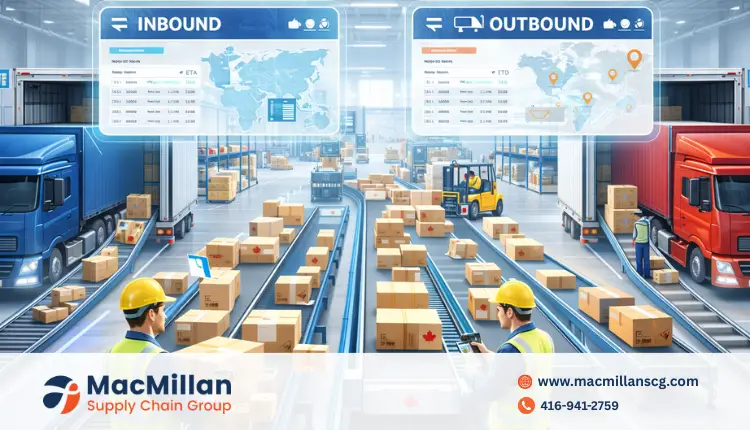
A quick summary and overview Cross-docking transforms traditional logistics by eliminating unnecessary storage and handling steps. Instead of warehousing products for extended periods, items move directly from inbound to outbound vehicles with minimal dwell time. This streamlined approach reduces costs, accelerates delivery times, and enhances supply chain efficiency. For Canadian businesses facing logistics challenges, cross-docking offers a strategic solution that improves inventory management, supports just-in-time distribution, and promotes sustainability. MacMillan Supply Chain Group provides comprehensive cross-docking services that help companies optimize their logistics operations while meeting customer demands for faster, more reliable deliveries. What Is Cross-Docking and Why Does It Matter? In today’s fast-paced business environment, efficiency isn’t just a goal—it’s a necessity. Cross-docking represents a revolutionary approach to logistics that’s changing how products move through supply chains across Canada and North America. But what exactly is it? Cross-docking is a logistics practice where products from incoming shipments are unloaded, sorted, and directly loaded onto outbound transportation with minimal or no storage time in between. Think of it as a well-choreographed dance: goods arrive at a distribution facility, move across the “dock” (hence the name), and depart to their next destination—all within hours, not days or weeks. This process eliminates traditional warehousing steps, reducing handling costs and accelerating delivery times. For businesses in Toronto, Calgary, Vancouver, or those managing cross-border shipping between Canada and the US, cross-docking offers a competitive edge in today’s speed-focused marketplace. The Mechanics of Effective Cross-Docking Cross-docking transforms logistics operations through a simple yet powerful concept: keep products moving. Unlike traditional warehousing where items might sit in storage for weeks, cross-docking facilities function as transfer points where goods typically remain for less than 24 hours. The process begins when inbound trucks arrive at designated doors of a cross-docking terminal. Workers quickly unload these shipments and sort them according to their outbound destinations. Some facilities use sophisticated conveyor systems that automatically scan and route items to the appropriate loading areas. Others rely on manual sorting with clear floor markings and staging areas. Either way, the goal remains the same—minimize handling and maximize flow. For this system to work effectively, timing is everything. Inbound and outbound schedules must be carefully synchronized. This is where warehouse management systems become essential, providing real-time visibility and coordination. These systems track every item from arrival to departure, ensuring nothing gets lost in the shuffle. Canadian distribution centers often adapt cross-docking to address unique regional challenges. For example, Toronto logistics solutions might emphasize cross-border capabilities, while Calgary cross-docking operations might focus on connecting western Canadian markets efficiently. The beauty of cross-docking lies in its flexibility—it can be customized to meet specific business needs while maintaining core efficiency principles. Key Benefits That Drive Cross-Docking Adoption Why are more Canadian businesses embracing cross-docking? The advantages extend far beyond simple cost savings. First and foremost, cross-docking dramatically reduces inventory holding costs. When products don’t sit in warehouses, you avoid expenses related to storage space, insurance, and inventory management. For businesses in expensive urban markets like Toronto or Vancouver, this space saving translates to significant financial benefits. Transportation efficiency represents another major advantage. Through freight consolidation services, cross-docking allows multiple smaller shipments to be combined into fuller truckloads. This consolidation reduces the total number of trips required, cutting fuel consumption and transportation costs by 25-30% in many cases. For companies managing cross-border shipping between Canada and the US, these savings can be substantial. Speed to market gives cross-docking users a competitive edge. In retail and e-commerce fulfillment, reducing delivery times by even a day can significantly improve customer satisfaction. Cross-docking supports just-in-time distribution models, allowing businesses to respond quickly to market demands without maintaining excessive inventory. Product quality benefits too, especially for time-sensitive goods. Fresh food, pharmaceuticals, and seasonal items spend less time in transit, reducing the risk of damage or obsolescence. This is particularly important in Canada’s varied climate zones, where temperature control during shipping presents ongoing challenges. Finally, cross-docking supports supply chain optimization by increasing visibility and control. With products spending minimal time in the system, managers can track inventory more accurately and respond faster to changing conditions. Industries That Benefit Most From Cross-Docking While cross-docking offers advantages for many businesses, certain industries see particularly impressive results. Retail stands at the forefront, with major chains using cross-docking to replenish stores quickly and efficiently. Rather than sending individual shipments from multiple suppliers to each store, retailers consolidate these deliveries at cross-docking facilities. This approach has helped Canadian retail chains reduce inventory costs by up to 15% while improving on-shelf availability. The food and grocery sector benefits enormously from cross-docking’s speed. Fresh produce, dairy, and frozen goods require rapid handling to maintain quality and shelf life. Cross-docking facilities equipped with temperature-controlled zones ensure these products move quickly from producers to grocery shelves. Montreal warehouse operations specializing in food distribution often use cross-docking to serve Quebec and eastern Canadian markets efficiently. E-commerce fulfillment in Canada has embraced cross-docking to meet rising consumer expectations for fast delivery. Online retailers use these facilities to sort incoming inventory directly into outbound customer orders, dramatically reducing processing time. This approach supports same-day or next-day delivery options that today’s online shoppers increasingly demand. Manufacturing operations benefit from cross-docking’s support of just-in-time production. Components and materials arrive precisely when needed, reducing factory storage requirements and supporting lean manufacturing principles. For companies with cross-border supply chains between Canada and the US, this coordination helps overcome potential customs delays. The automotive industry has long used cross-docking to manage complex supply chains. Parts from hundreds of suppliers converge at cross-docking facilities near assembly plants, arriving in sequence with production schedules. This precision helps manufacturers maintain efficient operations while minimizing costly production interruptions. Technology Enabling Modern Cross-Docking Today’s cross-docking success depends heavily on sophisticated technology systems that coordinate complex movements with precision. At the heart of these operations sits the warehouse management system (WMS), which orchestrates the entire process. Modern WMS platforms provide real-time inventory tracking, automatically directing where each item should go and when it should
Handling Hazards: WHMIS-Compliant Logistics for Homecare Brands
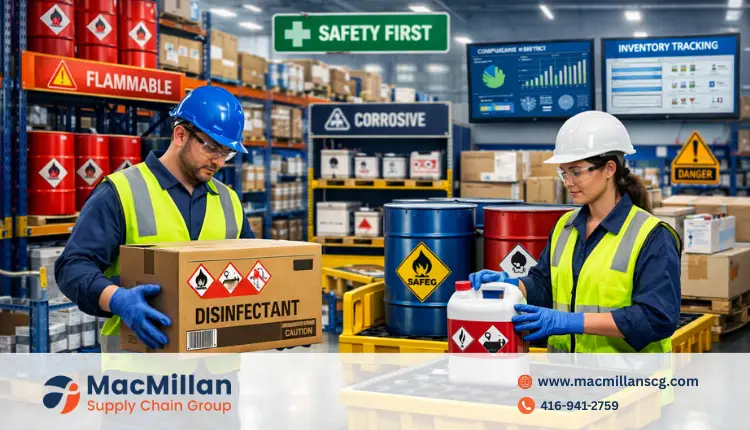
A Quick Summary and Overview Homecare brands dealing in cleaning agents, disinfectants, aerosols, and chemical-based products operate in a highly regulated environment. From storage and labeling to transportation and last-mile delivery, every step must comply with Canada’s Workplace Hazardous Materials Information System (WHMIS).Failure to meet compliance standards can result in fines, shipment delays, product recalls, or reputational damage.WHMIS-compliant logistics ensures hazardous materials are properly labeled, segregated, handled, documented, and transported according to federal and provincial regulations.At MacMillan Supply Chain Group, we design specialized 3PL solutions that protect homecare brands from compliance risks while maintaining operational efficiency and speed to market.The result? Safer operations, audit readiness, and a supply chain built for regulatory confidence. The Compliance Risks Facing Homecare Brands Homecare products often include: Disinfectants Surface cleaners Aerosols Solvents Flammable liquids Corrosive substances Without proper logistics controls, brands face: Improper labeling violations Cross-contamination risks Fire or safety hazards Transport rejections Regulatory fines Retailer non-compliance penalties Generic warehouses are not equipped to handle regulated goods safely. Hazardous product logistics requires structured SOPs, certified staff, and infrastructure designed for chemical storage. What Is WHMIS-Compliant Logistics? WHMIS-compliant logistics refers to warehousing and transportation processes aligned with Canada’s hazard communication and chemical handling regulations.This includes: Proper GHS labeling and documentation Safety Data Sheet (SDS) management Segregated storage by hazard class Controlled access storage zones Spill containment procedures Certified handling personnel Transport documentation and carrier compliance Compliance is not a single checklist—it is an integrated operational framework.At MacMillan SCG, hazardous product handling is built into our warehouse design, training programs, and transportation workflows from day one. How MacMillan SCG Protects Homecare Brands 1.Proper Labeling & Documentation Control Accurate labeling is the foundation of WHMIS compliance.MacMillan ensures: Verification of hazard symbols and classifications SDS tracking and digital record management Barcode integration tied to hazard data Real-time inventory visibility Audit-ready documentation access This reduces the risk of mislabeled shipments and retailer rejections. Result: Fewer compliance flags and smoother inspections. 2.Hazard-Based Storage Segregation Not all chemicals can be stored together. Improper storage increases safety risks and liability exposure.MacMillan’s warehouse controls include: Segregated storage zones by hazard class Flammable-rated storage areas Spill containment systems Controlled temperature environments Restricted-access handling protocols With over 250,000 sq. ft. of scalable space, brands can maintain compliance without sacrificing growth capacity. Result: Reduced cross-contamination risk and improved workplace safety. 3.Compliant Transport & Last-Mile SOPs Hazardous materials require specialized documentation and carrier coordination.MacMillan’s transportation network includes: Trained carrier partners familiar with regulated goods Verified transport documentation processes Secure palletization and load stabilization Real-time shipment tracking Reverse logistics for damaged or recalled goods For brands distributing nationally, our network supports efficient Canada-wide coverage with regulatory alignment at every stage. Result: Reduced transport delays and higher on-time delivery rates. 4.Inventory Control & Traceability In regulated environments, traceability protects your brand during audits or recalls.MacMillan leverages: Lot and batch tracking SKU-level visibility 350+ KPI monitoring metrics Near-zero shrinkage controls 99%+ inventory accuracy standards If a recall occurs, affected SKUs can be identified and isolated quickly—minimizing financial and reputational impact. Result: Faster response times and stronger risk mitigation. Why Specialized 3PL Matters for Homecare Products Homecare logistics isn’t standard pick-pack-ship. It involves: Regulatory oversight Retail compliance requirements Carrier restrictions Insurance considerations Safety audits Environmental reporting A specialized 3PL understands these nuances and builds infrastructure accordingly. At MacMillan SCG, compliance is embedded into operations—not treated as an add-on service.This ensures: Safer warehouse environments Reduced liability exposure Audit readiness Retailer trust Sustainable growth The Technology Layer Behind Compliance Regulatory control requires visibility.MacMillan integrates: Advanced WMS for hazard-tagged SKUs Real-time inventory dashboards Integrated SDS management workflows AI-supported route planning Digital proof-of-delivery tracking With transparent reporting and measurable KPIs, compliance becomes trackable—not reactive. Beyond Compliance: Protecting Brand Reputation In the homecare industry, one compliance incident can damage years of brand equity.WHMIS-compliant logistics protects more than inventory—it protects: Consumer trust Retail relationships Market access Insurance standing Long-term growth By aligning storage, fulfillment, and transportation with regulatory best practices, brands reduce operational risk while improving performance. Final Takeaway Handling hazardous homecare products demands precision, compliance, and structured execution. WHMIS-compliant logistics ensures proper labeling, storage segregation, documentation control, and safe transport—protecting your brand from costly disruptions. MacMillan Supply Chain Group delivers specialized hazardous product fulfillment solutions designed to safeguard your operations while supporting scalable growth. 📞 Ready to strengthen your compliance framework?Contact MacMillan SCG today for a customized hazardous product logistics assessment. FAQS What is WHMIS-compliant logistics? WHMIS-compliant logistics ensures hazardous products are labeled, stored, documented, and transported according to Canadian regulatory standards. Can MacMillan SCG handle flammable and chemical-based homecare products? Yes. MacMillan supports compliant storage, segregation, and transport SOPs for regulated chemical and cleaning products. Why is storage segregation important for homecare brands? Certain chemicals cannot be stored together due to safety risks. Proper segregation reduces liability and compliance violations. Does MacMillan provide traceability for regulated goods? Yes. Advanced WMS systems provide lot tracking, SKU-level visibility, and audit-ready documentation. Can MacMillan support national distribution across Canada? Yes. MacMillan’s integrated warehousing and transportation network supports compliant distribution across Canada. How quickly can I onboard hazardous product fulfillment? MacMillan offers structured onboarding with compliance review, SOP alignment, and integration testing to ensure a smooth go-live process.
Green Supply Chain Management Barriers in Canada
Green Supply Chain Management: Getting Past Implementation Obstacles in Canadian Logistics Canadian companies are under increasing pressure to convert their supply chains into sustainable, eco-friendly operations in the current environmentally conscious marketplace. Although 71% of Canadian CEOs believe stakeholder scrutiny of ESG performance will only increase and 53% of organizations plan to increase their focus on sustainable sourcing, green supply chain management barriers still stand in the way of successful GSCM adoption. Since we have firsthand experience with these challenges, we at Macmillan SCG have created strategic solutions to assist Canadian companies in overcoming the obstacles preventing a successful transition to sustainable logistics. The stakes have never been higher. With over 25% of global carbon dioxide emissions coming from logistics operations—a figure that could reach 40% by 2050 without significant intervention—the supply chain industry stands at a critical juncture. For Canadian logistics providers managing 3.1 million shipments annually across 90% of FSAs, like Macmillan SCG, addressing these implementation barriers isn’t just about compliance—it’s about competitive survival and environmental stewardship. Understanding Green Supply Chain Management Barriers Green supply chain management integrates environmental thinking into traditional supply chain operations, encompassing everything from material sourcing to end-of-life product management. Beyond just reducing waste, the idea encompasses water conservation, energy efficiency, greenhouse gas emission reduction, sustainable packaging, and green procurement methods. This shift is both a huge challenge and an unheard-of opportunity for Canadian logistics firms. According to research, businesses that use GSCM practices see impressive results, with an average 15% decrease in greenhouse gas emissions and a 12% decrease in overall energy use. While cutting distribution costs, best-in-class logistics companies report successful increases in service differentiation and distribution efficiency. Because of these observable advantages, sustainable logistics is now not only a business strategy but also an environmental necessity. However, the journey toward green supply chain implementation is complex. Studies find 20–25 different barriers in a variety of categories, ranging from technological limitations to financial constraints. For GSCM to be successfully adopted in the Canadian logistics environment, it is imperative to comprehend and methodically address these challenges. The Main Financial and Economic Obstacles to Implementation The biggest challenge for Canadian logistics companies is the high upfront cost of green technologies. Many businesses, especially SMEs, find the significant capital expenditure required to switch to electric vehicle fleets, renewable energy infrastructure, and sustainable packaging materials to be prohibitive. Additional financial strain is brought on by the lack of startup capital and the challenge of obtaining loan funds for environmental development projects. However, short-term thinking is frequently the cause of this perception of high costs. Through their Fuel Sense program, which saved 11.3 million gallons of jet fuel in 2023 alone, FedEx and other companies have shown the long-term value proposition. The secret is realizing that even though initial investments are high, they eventually generate positive financial returns through cost optimization, regulatory benefits, and efficiency gains. The lack of infrastructure and technology for GSCM implementation presents major obstacles for Canadian logistics companies. The absence of uniformity among green logistics technologies makes integration and decision-making more difficult. Many businesses suffer from antiquated IT systems that are unable to provide the tracking and data transparency needed for efficient, sustainable supply chain management. The problem of integration also affects supplier networks, where varying technological capacities lead to bottlenecks in sustainability projects from start to finish. Infrastructure deficiencies pose additional operational challenges for businesses operating throughout Canada’s vast territory, especially with regard to access to renewable energy sources and electric vehicle charging stations. Cultural and Organizational Opposition Organizational culture resistance to change is one of the most enduring obstacles. Conventional supply chain models have long placed a higher priority on speed and cost effectiveness than on environmental concerns, fostering deeply ingrained attitudes that thwart long-term change. These issues are made worse by staff members’ poor environmental awareness and the lack of commitment from upper management. According to research, 38% of Canadian logistics companies struggle with a labor shortage, which makes it challenging to fund the training initiatives required for GSCM implementation. Employees may perceive sustainability initiatives as extra responsibilities rather than as strategic opportunities in the absence of appropriate education and awareness campaigns. Complexities of Regulation and Compliance For Canadian logistics companies, the changing regulatory environment offers both opportunities and difficulties. Although government initiatives such as Bill S-211 require environmental reporting and supply chain transparency, the absence of standardized guidelines makes compliance requirements unclear. Businesses have to manage complicated regulations while making sure suppliers in international networks adhere to the same standards. Long-term investment viability is uncertain when federal and provincial governments lack consistent fiscal incentives and supportive policies. It is challenging for businesses to create thorough business cases for GSCM initiatives because of this regulatory ambiguity. Pressures from the Market and Competition Implementing GSCM is significantly hampered by market competition and unpredictability. Despite the fact that 86% of consumers worldwide expect businesses to address environmental issues, many consumers are still unwilling to pay more for sustainable services. As a result, businesses face a difficult situation where they have to absorb transition costs while keeping prices competitive. Implementation decisions are made more difficult in some market segments by a lack of end-user pressure and a lack of customer awareness regarding the advantages of GSCM. When the direct market demand for green services is still erratic, businesses find it difficult to defend their investments. Macmillan SCG’s Strategic Solutions to Green Supply Chain Management Barriers Overcoming Financial Green Supply Chain Management Barriers We at Macmillan SCG have created cutting-edge financial frameworks that solve cost issues and show a definite return on investment. Our strategy is centered on phased implementation tactics that provide immediate operational benefits while distributing capital expenditures over time. We assist clients in making the shift to sustainable operations without requiring significant upfront investments by utilizing our 250,000 square feet of GMP-certified warehouse space. Smaller businesses now have access to green technologies and infrastructure that would otherwise be prohibitively expensive thanks to our shared warehouse model. This cooperative strategy preserves the environmental advantages of
AI 3PL Operating Systems: Transforming Canadian Logistics
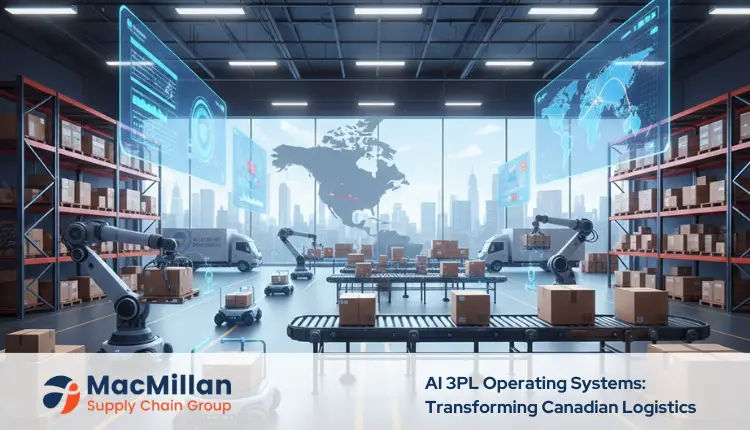
AI’s Revolutionary Potential: 3PL Operating Systems Changing the game Logistics in Canada The next era of third-party logistics (3PL) excellence is being propelled by artificial intelligence (AI), which is no longer a futuristic idea in the field of logistics. AI 3PL operating systems are providing previously unheard-of levels of efficiency. AI-powered 3PL operating systems are providing previously unheard-of levels of efficiency, visibility, and customer satisfaction for Canadian businesses, particularly those negotiating the challenges of e-commerce, omnichannel fulfillment, and last-mile delivery. We at Macmillan SCG are leading this change by using AI to transform supply chain difficulties into competitive advantages. Understanding the Impact of AI 3PL Operating Systems on 3PL Logistics The way 3PLs function is being drastically altered by AI. AI-driven systems are now able to analyze enormous volumes of data, identify patterns, and produce actionable insights more quickly and accurately than ever before by utilizing machine learning, predictive analytics, robotics, and real-time data processing. From last-mile delivery to warehouse management, this technological revolution is changing every aspect of logistics. Why AI 3PL Operating Systems Matter for 3PLs Intelligent Demand Forecasting: AI reduces stockouts and overstocking by forecasting order volumes and seasonal trends. Real-Time Visibility: Complete inventory, shipment, and delivery status tracking and monitoring. Warehouse Automation: Picking, packing, and sorting are optimized by robotics and AI-powered systems, which can reduce order fulfillment times by up to 65%. Personalized Customer Experience: AI chatbots and virtual assistants offer customized communication and real-time updates, which encourage repeat business and loyalty. Cost Reduction: Transportation and operating expenses are reduced by automated procedures and optimized routes. How Macmillan SCG Leverages AI in 3PL Operations 1. Inventory control and demand forecasting The foundation of effective logistics is precise demand forecasting. To forecast changes in demand, Macmillan SCG’s AI-driven models examine past sales, market trends, meteorological conditions, and promotional activities. This makes it possible to make more informed purchases, cut down on excess inventory, and guarantee that goods are available when and where consumers need them. AI is used by our integrated inventory management systems to: Monitor the current stock levels in every warehouse. Determine which inventory is at risk or moving slowly. Automate promotional or restocking tactics to maximize cash flow. 2. Robotics and Automation in Warehouses Advanced AI 3PL operating systems, including warehouse management systems (WMS) that manage conveyor systems, robotics, and autonomous mobile robots (AMRs) power our fulfillment centers in Canada. These technologies: Automate repetitive processes such as packing, sorting, and picking. Boost order accuracy to over 99% and minimize human error. Reduce order fulfillment times, even during periods of high demand when order volumes increase by 300–400%. Robots, scanners, and sensors all communicate with each other without interruption when all warehouse systems are integrated into the cloud. This allows them to instantly adapt to changing conditions and priorities for optimal efficiency. 3. Last-mile delivery and route optimization Real-time delivery route optimization by AI takes weather, traffic, and delivery deadlines into account. In addition to lowering transportation expenses, this raises the percentage of on-time deliveries, which is crucial for client satisfaction. Even in Canada’s most difficult regions, our committed fleet of more than 3,000 drivers, driven by AI, guarantees that deliveries are always made on time. Customers and shippers receive live tracking links with Uber-like transparency, reducing customer service inquiries by up to 70% and offering peace of mind. 4. Strengthening the Resilience of the Supply Chain The necessity of robust supply chains has been brought to light by the post-pandemic world. Macmillan SCG can do the following thanks to AI: Determine key nodes and map intricate supply chains. For proactive risk management, keep an eye on market conditions and supplier performance. In the event of disruptions such as natural disasters or geopolitical events, propose backup suppliers or plans. For our clients, this proactive approach guarantees business continuity and lessens the impact of disruptions. 5. Ethical sourcing and sustainability AI is a potent instrument for advancing sustainability as well. Our systems are able to: Reduce waste and carbon emissions by analyzing warehouse operations and routes. Monitor supplier adherence to social and environmental standards to promote ethical sourcing. Optimize resource use to support regulatory compliance and clients’ ESG objectives. The foundation of contemporary logistics is real-time visibility. In today’s supply chain, visibility is essential. The AI-powered platforms of Macmillan SCG offer real-time insights into: levels of inventory in several warehouses. order status from the time of receipt to the last delivery. Performance indicators for perishable goods and storage facilities. This transparency improves operational agility and customer trust while facilitating quicker, data-driven decisions. How AI 3PL Operating Systems Help Overcome Labor Challenges In Canadian logistics, labor shortages are a recurring problem. Macmillan SCG increases job satisfaction and lowers turnover by automating the most labor-intensive tasks, freeing up human workers to concentrate on quality control and exception handling. With operational savings, increased throughput, and lower labor costs, automation offers a substantial return on investment, with the majority of costs being recovered in 18 to 24 months. Scalability and Integration: Expanding with Your Company AI-powered 3PL operating systems are naturally scalable. The platforms from Macmillan SCG maintain consistent performance and accuracy by automatically adjusting processing capacity to handle increased volumes during peak periods. To ensure a smooth and disruption-free adoption of technology, our systems are built to integrate seamlessly with well-known e-commerce platforms like Shopify, WooCommerce, Amazon, and custom storefronts. Tailored Client Experience with AI 3PL Operating Systems Macmillan SCG can provide a better customer experience thanks to AI by: Proactive alerts and real-time order updates. AI-powered chatbots that offer individualized advice and assistance. Customization of services based on data, fostering loyalty and improving client relationships. Data Integrity and Security AI 3PL operating systems must prioritize security. Macmillan SCG uses strong security measures: warehouses with controlled access and separate storage spaces. encrypted data connections and multi-factor authentication. Blockchain technology provides tamper-proof records of all transactions and movements, particularly for sensitive or expensive goods. AI’s Return on Investment in 3PL: Real Business Gains Measurable business results are obtained when 3PL operations integrate
Geopolitical Risks in Canadian Supply Chains
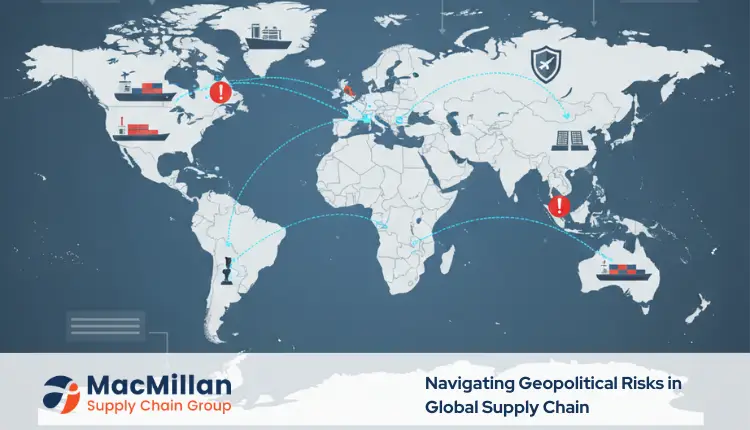
Introduction The world’s supply chains are more interconnected and vulnerable than ever in this age of rapid globalization. Geopolitical risks, which range from trade wars and sanctions to cyber threats and regional conflicts, are now a defining challenge for multinational corporations navigating geopolitical risks in global supply chain operations. For Canadian businesses, these risks are more than just news stories; they are actual, day-to-day challenges that have the potential to impair operations, raise expenses, and jeopardize business continuity. We at Macmillan SCG have personally witnessed how these difficulties affect our clients. As a top Canadian supply chain provider, we help companies handle the challenges of international trade by running warehouses and providing last-mile delivery services all over the nation. The most important risks to Canadian supply chains, the changing geopolitical risk landscape, and tried-and-true methods for enhancing resilience in an unpredictable world will all be covered in this blog. The New Geopolitical Reality: What’s Changed? 1. The Rise of Trade Wars and Tariffs Growing trade tensions, especially between the US, China, and the EU, have made things unstable for importers and exporters since 2018. The cost structure of goods and raw materials can be abruptly altered by the imposition of tariffs. The implications for Canadian companies are substantial: Unexpected cost increases: Some Canadian manufacturers have seen price increases of 10–40% as a result of steel, aluminum, and electronics tariffs. Reconfiguring the supply chain forces businesses to reconsider their sourcing strategies; in order to avoid penalties, they frequently change suppliers or reroute shipments. Regulatory uncertainty: The rules of the game can change with every new administration or international dispute. 2. Regional Conflicts and Disrupted Trade Routes Regional conflicts can quickly block important shipping lanes, delay cargo, and raise insurance and security costs, as demonstrated by the Russia-Ukraine war and the unrest in the Middle East and Asia-Pacific. For instance: In 2021, the blockage of the Suez Canal caused a daily delay of $9.6 billion in goods. Ships were forced to reroute around Africa due to the Red Sea crisis in 2024, which resulted in longer delivery times and higher fuel prices. The world’s semiconductor supply is under threat due to tensions in the Taiwan Strait, which affects everything from consumer electronics to automobiles. These real-world disruptions emphasise the need for navigating geopolitical risks in global supply chain networks with greater agility. 3. Sanctions, Export Controls, and Compliance Headaches Sanctions regimes are becoming more widespread, focusing on particular businesses, people, and even entire industries in addition to nations. Businesses in Canada have to negotiate a complicated web of: restrictions on exporting sensitive technologies prohibitions on sourcing from areas where human rights are violated The US Uyghur Forced Labor Prevention Act (UFLPA), for example, requires evidence that products are not manufactured using forced labor 4. Digital Espionage and Cyberthreats Supply chains are increasingly being targeted by state-sponsored hackers and cybercriminals as they digitize. The number of ransomware attacks on logistics companies grew by 300% in 2024 alone. Inventory systems can become paralyzed, sensitive data compromised, and operations halted for days or weeks due to a single breach. 5. Geopolitical Risks Associated with the Environment and Climate With nations enacting carbon border taxes, limiting imports of high-emission goods, and calling for increased supply chain emissions transparency, climate change has become a geopolitical issue. This implies the following for Canadian exporters: adjusting to the US and EU’s new carbon pricing plans fulfilling more stringent environmental, social, and governance (ESG) reporting requirements getting ready for “green trade wars,” in which sustainability is used as a weapon to compete The Canadian Viewpoint: Navigating Geopolitical Risks in Global Supply Chain Geographically, economically, and politically, Canada is unique, which presents a unique set of opportunities and challenges for our supply chains. Strong reliance on international trade: Since the US accounts for more than 75% of Canadian exports, changes in US policy will have a significant impact on us. Long, difficult supply chains: Because of our large geographic area and reliance on rail and maritime transportation, Canada is susceptible to infrastructure disruptions and chokepoints. Diverse sourcing: A large number of Canadian businesses rely on international vendors for essential parts, ranging from Asia to Europe and Latin America. We at Macmillan SCG have assisted clients in navigating these complexities across a variety of industries, from electronics and automotive to food and pharmaceuticals. Our experience demonstrates that although risks are present, they can be used as opportunities for growth if proactive measures are taken. Significant Geopolitical Risks Affecting Canadian Supply Chains 1. Trade and Tariff Policy Volatility Example: New regulations for labor, digital trade, and automotive content were introduced by the US-Mexico-Canada Agreement (USMCA/CUSMA), which superseded NAFTA. Impact: Businesses were forced to invest in compliance systems, renegotiate contracts, and quickly modify their sourcing. 2. Export Controls and Sanctions Example: Exports of specific metals, energy products, and technology were prohibited as a result of sanctions imposed on Russia in response to the conflict in Ukraine. Impact: Due to shortages, Canadian manufacturers had to look for other suppliers, frequently at a higher cost. 3. Disruptions to Shipping Routes Example: Carriers had to reroute around the Cape of Good Hope due to the Red Sea crisis in 2024, which extended shipments from Asia to North America by up to 20 days. Impact: The requirement for greater safety stocks, higher shipping expenses, and inventory delays. These factors highlight why navigating geopolitical risks in global supply chain operations is now a strategic necessity. 4. ESG Regulations and Forced Labor Example: New regulations in the US and the EU demand evidence that products are not produced using forced labor or in a way that violates environmental regulations. Impact: Businesses need to invest in clear reporting systems, trace materials, and audit suppliers. 5. Cybersecurity Risks Example: Ransomware attacks on logistics companies have the potential to stop operations, compromise data, and result in fines from the government. Impact: Strong cybersecurity procedures, staff education, and incident response strategies are required. Techniques for Navigating Geopolitical Risks in Global Supply Chain 1. Diversification Strategies for Navigating Geopolitical Risks in Global Supply Chain Find substitute suppliers in other areas (the
Hybrid Logistics Model Canada: 5 Key Benefits
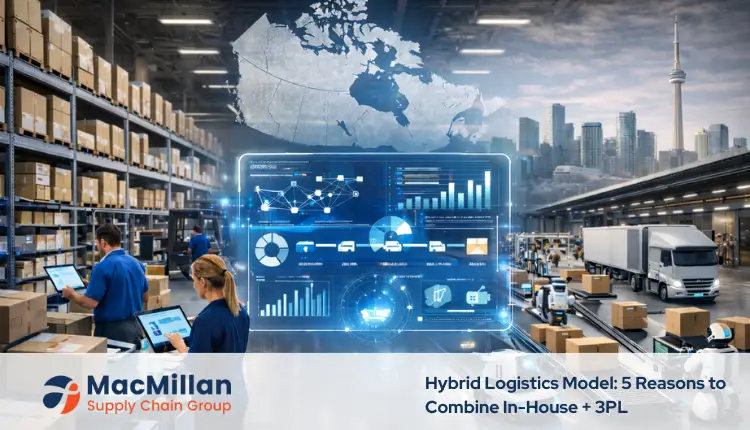
Introduction In today’s evolving logistics landscape, businesses must choose between working with a third-party logistics (3PL) provider or keeping operations fully in-house. But increasingly, the smart move is adopting a hybrid logistics model—a strategy that combines the strengths of both. But what if neither/or isn’t the best option? A powerful trend that combines the capabilities of internal teams with the know-how and technology of a third-party logistics provider is emerging at Macmillan Supply Chain Group. This hybrid logistics approach is a long-term strategic choice rather than merely a short-term fix. And it’s turning out to be the best course of action for a lot of Canadian companies, particularly those dealing with seasonal fluctuations or fast growth. We’ll outline the top five reasons in this post for why you can get the best of both worlds by integrating your internal logistics team with a 3PL provider — particularly one that uses cutting-edge technologies like AI 3PL operating systems. 1. Hybrid Logistics Model =Adaptability Without Losing Command To be honest, it can be a leap of faith to relinquish complete control over your logistics operations. Your team is familiar with your standards, customers, and products. That’s a worthwhile experience. However, there are drawbacks to doing everything in-house, particularly when your company expands or enters new markets. A hybrid strategy can help with that. You can expand your capacity and geographic reach without sacrificing your internal capabilities by outsourcing certain tasks — such as last-mile delivery in a densely populated metro area or warehousing in a new province. The AI 3PL operating systems we implement seamlessly integrate with your current workflows when you work with a partner like Macmillan SCG. This implies that even if our infrastructure handles the execution, your team maintains control over visibility and decision-making. Imagine it as an addition to a beloved house. You’re not going anywhere. Simply put, you’re creating space where it’s most needed. 2. How a Hybrid Logistics Model Helps You Scale Cost Efficiently Keeping everything in-house can quickly become costly. Fixed logistics costs include things like fleet maintenance, warehouse rent, and full-time employees. And when business slows down, those costs don’t just vanish. You can change fixed costs into variable ones with a hybrid model. While relying on your 3PL for specialized services or varying demand, you maintain your core team and assets focused on what they do best. One of our retail clients, for instance, uses Macmillan SCG for regional distribution and returns processing, but manages central fulfillment internally. We increase capacity for them during busy times of the year and then decrease it once things settle down. Their clients receive reliable service, and they save a lot of money on overhead. We can also predict demand trends, optimize resource allocation, and cut waste thanks to AI 3PL operating systems, which helps our hybrid clients save even more money. 3. Boost Supply Chain Visibility With a Hybrid Logistics Model Outsourcing is often associated with a loss of visibility. That isn’t the case in 2025, though, at least not if you’re working with the correct 3PL. Our AI-powered logistics platform at Macmillan SCG offers real-time insights into both internal and external operations and integrates easily with your ERP or WMS. Whether inventory is sitting in your warehouse or en route in ours, you’ll see it all in one place. Our AI 3PL operating systems make it possible to: Track order status from purchase to final delivery Monitor inventory levels across multiple locations View delivery ETAs, exception reports, and carrier performance Get automated notifications when stock needs to be rerouted or replenished That kind of data-sharing means better decisions, faster. Your internal team gains strategic clarity in addition to oversight. Additionally, your clients enjoy more seamless, open service without even being aware that it’s a hybrid operation. 4. Distribute Tasks Using Core Skills Every logistics team has advantages and disadvantages. Perhaps your team excels at local business-to-business distribution but finds it difficult to fulfill orders for online retailers. Or perhaps you are an expert at storage but still struggle with last-mile delivery in rural areas. A hybrid approach enables you to divide responsibilities purposefully, as opposed to hiring for every niche need or attempting to push your team beyond its comfort zone. This is how it might appear: In-house: Manage expensive shipments, delicate goods, or packaging that is essential to the brand. 3PL partner: Oversee cross-border logistics, same-day fulfillment, and excess inventory. At Macmillan SCG, we routinely work with clients who want to retain specific logistics functions internally — and we build our services around that. Our AI-driven systems ensure that our portion of the supply chain aligns with your processes, customer SLAs, and performance metrics. It has nothing to do with changing your team. Giving them a logistics partner who can cover the gaps and improve performance is the goal. 5. Hybrid Logistics Model = Advanced Tech Without High Investment The harsh reality is that the logistics sector is evolving quickly, and it costs money to stay up to date with new developments. It can take months and a six-figure budget to implement sophisticated robotics, route optimization tools, or real-time tracking. Investing in all of that internally is simply not feasible for many businesses. However, working with a forward-thinking 3PL like Macmillan SCG gives you immediate access to effective tools like: AI-powered 3PL operating systems that automate inventory control and forecast demand Real-time machine learning models that modify delivery routes in response to traffic and weather conditions Up to 65% faster picking and packing with robotics and warehouse automation Better yet, our facilities have already tested, improved, and implemented these technologies. No learning curve. No delays. Just better performance — from day one. This means your hybrid model isn’t just a cost-saving move. It’s a chance to upgrade your supply chain while avoiding the sunk cost of building from scratch. Real Clients. Real Hybrid Wins. Here’s a brief illustration: All logistics used to be managed internally by one of our B2C clients, an Ontario-based skincare brand. However, their staff was overworked during the pandemic
Top 5 3PL Companies in Canada: A Comprehensive Review
A Quick Summary and Overview When growing your business in Canada, choosing the right 3PL partner is crucial for success. The top 3PL companies in Canada offer comprehensive services including warehousing, e-commerce fulfillment, and cross-border shipping solutions. This guide examines the five leading third-party logistics providers based on service quality, technology integration, geographic reach, and customer satisfaction. Whether you’re an e-commerce startup or an established manufacturer, understanding these logistics powerhouses will help you make informed decisions to optimize your supply chain and deliver exceptional customer experiences. Introduction In today’s fast-paced business environment, efficient logistics management can make or break your company’s success. That’s where third-party logistics providers (3PLs) come in. These specialized companies handle the complex tasks of warehousing, transportation, and fulfillment, allowing businesses to focus on their core competencies. For Canadian businesses, especially those in e-commerce, finding the right 3PL partner is essential for managing the unique challenges of Canada’s vast geography, cross-border trade with the US, and growing consumer expectations for fast delivery. The best 3PL companies in Canada offer more than just storage and shipping – they provide end-to-end supply chain solutions that can transform your business operations. In this comprehensive review, we’ll examine the top five 3PL companies in Canada, analyzing their strengths, service offerings, and what makes them stand out in a competitive market. Whether you’re looking for a Toronto fulfillment center, cross-border logistics expertise, or sustainable shipping solutions, this guide will help you make an informed decision for your business needs. Understanding 3PL Services in Canada Third-party logistics providers have become essential partners for businesses of all sizes across Canada. But what exactly do these companies offer? At their core, 3PL companies in Canada provide outsourced logistics services that handle various aspects of your supply chain. The Canadian 3PL landscape has evolved significantly in recent years, driven by e-commerce growth and changing consumer expectations. Today’s top providers offer comprehensive services including: Warehousing in Canada Order Fulfillment Transportation Management Cross-Border Logistics Customs Clearance Services Reverse Logistics Value-Added Services What separates leading 3PLs from average providers is their technology integration. Modern 3PL companies leverage advanced warehouse management systems (WMS), transportation management systems (TMS), and real-time tracking capabilities to provide visibility and efficiency throughout the supply chain. For Canadian businesses, working with a specialized 3PL means gaining access to established shipping networks, volume discounts, and logistics expertise that would be difficult and costly to develop in-house. This partnership approach has made 3PL services increasingly popular among both startups and established enterprises looking to optimize their operations. Evaluation Criteria for Top 3PLs Selecting the right 3PL partner requires careful consideration of several key factors. Our comprehensive evaluation of the top 3PL companies in Canada is based on the following criteria: Geographic Coverage and Network Strength The best 3PL providers offer strategic warehouse locations near major population centers and transportation hubs. We assessed each company’s network of facilities, with special attention to Toronto fulfillment centers, Vancouver operations, and cross-border capabilities. Companies with multiple locations across Canada received higher ratings for their ability to provide faster delivery times to more customers. Technology Integration and Visibility In today’s digital economy, technology separates leading 3PLs from the competition. Our evaluation examined each provider’s technological capabilities, including: Service Diversity and Specialization The top 3PL companies in Canada offer comprehensive service portfolios while also demonstrating expertise in specific industries or logistics functions. We evaluated each provider’s capabilities in: Scalability and Flexibility Business needs change, especially for growing companies. The best 3PLs offer flexible solutions that can scale with your business, accommodating seasonal fluctuations and long-term growth without requiring new partnerships or significant disruption to operations. By applying these criteria consistently across our research, we’ve identified the five 3PL companies that truly stand out in the Canadian logistics landscape. Top 5 3PL Companies in Canada After thorough research and analysis, we’ve identified the five leading third-party logistics providers serving the Canadian market. Each offers unique strengths while maintaining excellence across core logistics functions. MacMillan Supply Chain Group MacMillan Supply Chain Group has established itself as a premier 3PL provider with exceptional warehousing in Canada and specialized e-commerce fulfillment services. Based in the Greater Toronto Area with additional facilities across Canada, MacMillan combines decades of logistics expertise with cutting-edge technology. Key Strengths: InterFulfillment With strategic Toronto fulfillment centers and Vancouver operations, InterFulfillment has built a reputation for excellence in e-commerce logistics. Their technology-first approach integrates seamlessly with major platforms like Shopify, Amazon, and WooCommerce. Key Strengths: Stallion Express Stallion Express has carved out a niche as a cross-border logistics specialist, offering streamlined shipping between Canada and the US. Their focus on affordable international shipping makes them particularly valuable for Canadian e-commerce businesses selling to American consumers. Key Strengths: Manitoulin Transport As one of Canada’s largest transportation providers, Manitoulin Transport offers comprehensive logistics services with particular strength in less-than-truckload (LTL) shipping across North America. Their extensive network makes them ideal for businesses shipping larger orders throughout Canada. Key Strengths: Day & Ross Rounding out our top five is Day & Ross, a well-established logistics provider with particular expertise in temperature-controlled shipping and dedicated fleet services. Their comprehensive approach to supply chain management makes them suitable for businesses with complex logistics requirements. Key Strengths: Each of these top 3PL companies in Canada offers distinct advantages, allowing businesses to select the provider that best aligns with their specific logistics needs and growth objectives. Common Problems with 3PL Services While partnering with a 3PL offers numerous benefits, businesses should be aware of potential challenges that can arise. Understanding these common problems can help you select the right provider and establish effective working relationships. Integration Difficulties Many businesses struggle with integrating their existing systems with their 3PL’s technology platform. This can lead to data inconsistencies, communication breakdowns, and fulfillment errors. Service Level Inconsistencies Quality control can become an issue, particularly during peak seasons when 3PLs handle increased volumes. This might manifest as slower processing times, packing errors, or shipping delays. Cost Transparency Challenges Some 3PL companies in Canada use complex
The Benefits of Value-Added Packaging in Your Supply Chain

A quick summary and overview Value-added packaging goes beyond basic product protection to deliver strategic advantages throughout your supply chain. By incorporating specialized services like custom labeling, kitting, assembly, and sustainable materials, businesses can significantly improve operational efficiency while reducing costs. MacMillan Supply Chain Group offers comprehensive value-added packaging solutions that help Canadian companies enhance product presentation, meet compliance requirements, and achieve sustainability goals. Our expertise spans various industries, providing tailored packaging strategies that optimize your entire supply chain process. How Value-Added Packaging Transforms Your Supply Chain In today’s competitive marketplace, packaging is no longer just about protecting products during transit. Value-added packaging has emerged as a strategic tool that can dramatically improve your supply chain efficiency while delivering significant business advantages. But what exactly is value-added packaging, and how can it benefit your operations? Value-added packaging encompasses specialized services that enhance standard packaging processes. These include custom labeling, kitting, assembly, product customization, and implementing sustainable packaging solutions. At MacMillan Supply Chain Group, we’ve seen firsthand how these services help Canadian businesses streamline operations, reduce costs, and improve customer satisfaction. Whether you’re in retail, food and beverage, pharmaceuticals, or manufacturing, the right packaging strategy can be a game-changer for your business. Let’s explore how value-added packaging solutions in Canada can transform your supply chain from a cost center into a competitive advantage. Key Components of Value-Added Packaging Services Value-added packaging extends far beyond simply placing products in boxes. It’s a comprehensive approach that can include numerous specialized services tailored to your specific needs. Understanding these components helps you identify which solutions will deliver the greatest impact for your business. Custom Labeling and Branding Custom labeling ensures your products comply with Canadian packaging regulations while enhancing brand recognition. This includes bilingual labeling (essential for the Canadian market), barcode generation, and brand-consistent design elements. Our advanced printing capabilities allow for high-quality graphics that make your products stand out on shelves. Kitting and Assembly Kitting involves grouping related items together in a single package, while assembly focuses on putting product components together before shipment. These services save time and resources by consolidating operations. For example, retail promotions often require special kitting of multiple products, which we can handle efficiently within our facilities. Product Customization We can modify standard products to meet specific customer requirements. This might include adding accessories, creating special bundles, or adjusting packaging sizes for different markets. This flexibility allows you to respond quickly to changing consumer demands without maintaining excessive inventory. Sustainable Materials Selection Our team helps you select eco-friendly materials that align with your sustainability goals while meeting product protection requirements. From biodegradable fillers to recyclable containers, we source materials that reduce environmental impact without compromising on quality or protection. This approach supports circular economy packaging principles that increasingly matter to Canadian consumers. How Value-Added Packaging Drives Supply Chain Efficiency Implementing strategic packaging solutions creates ripple effects of efficiency throughout your entire supply chain. These improvements touch everything from warehouse operations to final delivery, creating measurable benefits at each stage. Streamlined Warehouse Operations Value-added packaging services consolidate multiple steps into a single process, reducing handling time and warehouse space requirements. By integrating packaging with other logistics functions, we eliminate redundant steps and minimize the risk of errors. Our contract packaging services can be performed within our facilities, freeing up your valuable warehouse space for core operations. Optimized Transportation Properly designed packaging maximizes container and truck utilization by optimizing product dimensions and weight. This means you can fit more products in each shipment, reducing transportation costs and carbon emissions. Our packaging engineers analyze your products to design solutions that minimize dimensional weight charges while ensuring adequate protection. Reduced Handling Damage Custom-designed packaging provides superior product protection, significantly reducing damage rates during transit. This means fewer returns, less waste, and higher customer satisfaction. For fragile or high-value items, we develop specialized protective solutions using appropriate materials and designs that prevent movement and absorb shock. Improved Inventory Management Value-added packaging facilitates better inventory control through clear labeling and organized kitting. When products arrive pre-packaged and ready for sale, you can implement just-in-time inventory strategies that reduce carrying costs. Our IoT-enabled packaging solutions can also provide real-time visibility into inventory levels and product location. Cost Benefits of Strategic Packaging Solutions While some businesses view packaging as simply a necessary expense, strategic value-added packaging actually delivers significant cost savings throughout your supply chain. Understanding these financial benefits helps justify investment in improved packaging solutions. Reduced Labor Costs By consolidating packaging operations with a specialized provider like MacMillan Supply Chain Group, you can significantly reduce labor costs associated with in-house packaging. Our efficient processes, specialized equipment, and experienced staff complete packaging tasks faster and with fewer errors than most in-house operations. This allows your team to focus on core business activities that drive growth. Lower Materials Expenses Our packaging expertise helps identify opportunities to reduce material usage without compromising protection. We can implement returnable packaging systems for regular shipments between fixed locations, dramatically cutting ongoing packaging expenses. Our volume purchasing power also means we secure better pricing on packaging materials than most individual companies can achieve. Decreased Transportation Expenses Optimized packaging reduces dimensional weight charges and allows more products per shipment. For example, properly designed packaging can sometimes reduce shipping costs by 15-25% by eliminating unnecessary space and weight. Our packaging engineers analyze your current solutions and recommend improvements that maximize transportation efficiency. Minimized Product Damage Well-designed packaging significantly reduces product damage during transit, cutting replacement costs and eliminating the administrative burden of processing returns. For products with high damage rates, the savings from improved packaging can be substantial – often paying for the packaging upgrade many times over. Sustainability Advantages of Modern Packaging Approaches Today’s consumers and businesses increasingly prioritize sustainability, making eco-friendly packaging solutions not just environmentally responsible but commercially advantageous. MacMillan Supply Chain Group helps you navigate the complex world of sustainable packaging to find solutions that work for your products, your customers, and the planet. Eco-Friendly Materials Selection We help
What Supply Chain Issues Can We Expect This Holiday Season?
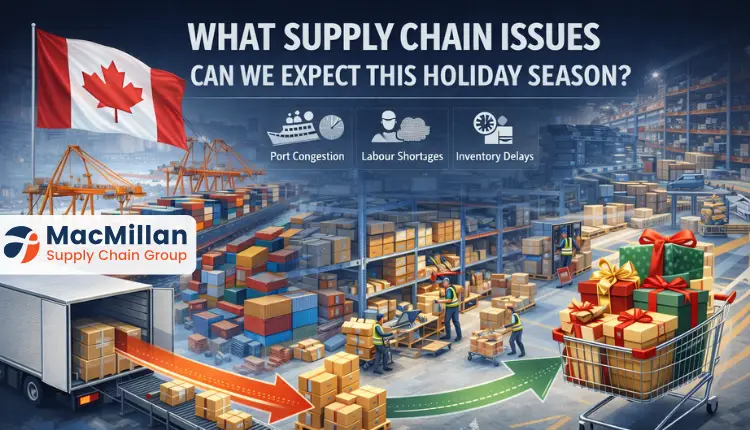
A Quick Summary and Overview The 2025 holiday season brings significant supply chain challenges for businesses across Canada and the US. From port congestion and cross-border shipping complications to labour shortages and tariff impacts, companies need to prepare now. Global freight disruptions and Chinese New Year shutdowns will affect inventory availability, while consumer demand shifts toward essentials and value purchases. This guide explores the major holiday supply chain issues you’ll face and provides actionable solutions to keep your business running smoothly during the busiest time of year. Why This Holiday Season Will Test Your Supply Chain The holiday rush is approaching, and this year’s supply chain landscape looks more complex than ever. With e-commerce continuing to grow and global trade facing new pressures, businesses need to understand what’s coming and how to adapt. Whether you’re a retailer preparing for Black Friday or a manufacturer ensuring product availability, the 2025 holiday season presents unique challenges. What makes this year different? A combination of factors including tariff changes, labour market shifts, and evolving consumer behavior are creating a perfect storm. Canadian businesses face particular challenges with cross-border shipping and port congestion. Meanwhile, global events like Chinese New Year shutdowns will impact production schedules months before the holidays arrive. Let’s explore the key supply chain issues you can expect this holiday season and, more importantly, how MacMillan Supply Chain Group can help you navigate them successfully. Port Congestion and Shipping Delays: The First Hurdle Port congestion in Canada remains one of the biggest obstacles this holiday season. Major ports like Vancouver and Halifax are already experiencing backups that will only worsen as peak season approaches. When ships can’t dock and unload promptly, the entire supply chain feels the ripple effect. What’s causing these bottlenecks? Several factors are at play: Record import volumes as retailers stock up early for the holidays Weather disruptions affecting loading and unloading schedules Equipment shortages (containers, chassis, etc.) at key ports Labour constraints limiting port operating capacity For businesses shipping to or within Canada, these delays mean planning further ahead than ever. Products that once took 2-3 days to clear ports might now take 7-10 days or longer. This extended timeline affects everything downstream, from warehouse receiving to store shelves. Canadian shipping delays also impact cross-border trade with the US. When goods are stuck at ports, trucks sit idle waiting for loads, creating a domino effect of delays. Smart businesses are already adjusting their timelines, building in buffer days, and working with experienced 3PL partners like MacMillan who understand these local challenges and can help navigate them effectively. Labour Shortages and Warehouse Capacity Constraints Labour shortages in warehouses continue to plague the supply chain industry as we head into the holiday season. Finding and retaining qualified workers for picking, packing, and shipping operations remains challenging across Canada. When you combine this with the seasonal surge in order volume, you have a recipe for potential fulfillment disasters. The numbers tell the story: Warehouse job openings are up 20% compared to last year Turnover rates in logistics positions hover around 40% Training new staff takes valuable time during the busiest season Overtime costs are skyrocketing as existing teams stretch to meet demand This labour crunch hits hardest during peak season logistics operations when order volumes can triple or quadruple overnight. Warehouses that normally process 5,000 orders daily might suddenly face 20,000 orders with the same staff. The result? Longer processing times, more errors, and frustrated customers. Warehouse capacity is equally concerning. With businesses ordering earlier to avoid delays, storage space is at a premium. Many facilities are already at 85-90% capacity months before the holiday rush begins. This leaves little flexibility for unexpected inventory surges or returns processing. Companies without solid warehousing solutions in Canada find themselves scrambling for expensive short-term options or facing stockouts during critical selling periods. Inventory Challenges and Supply Uncertainties Just-in-time inventory challenges have never been more apparent than during this holiday season. The once-reliable system of ordering precisely what you need when you need it has become increasingly risky. With global freight disruptions affecting shipping times and availability, businesses can no longer count on predictable replenishment cycles. What makes inventory management particularly difficult this year: Longer lead times from overseas suppliers (especially Asia) Unpredictable transit delays once goods are shipped Higher costs forcing difficult decisions about stock levels Changing consumer demand patterns making forecasting trickier Chinese New Year shutdowns present another inventory planning hurdle. Falling in late January/early February 2025, these factory closures will affect production schedules months before the holidays. Businesses that don’t place orders by December 2024 may miss their window for pre-holiday delivery. This means planning for Christmas must happen nearly a year in advance! Effective inventory management solutions are essential for navigating these uncertainties. Businesses need real-time visibility into stock levels, incoming shipments, and sales trends. Without these tools, you risk either tying up too much capital in excess inventory or missing sales opportunities due to stockouts during the most profitable time of year. Consumer Behavior and Demand Shifts Consumer demand shifts are reshaping holiday shopping patterns in significant ways. Economic pressures and changing priorities mean customers aren’t buying the same things or shopping the same way they did in previous years. Key trends we’re seeing: Greater focus on essential purchases over luxury items Increased price sensitivity across all product categories Earlier shopping to avoid last-minute availability issues Growing preference for omnichannel options (buy online, pick up in store) These shifts directly impact what retailers should stock and how they should position their offerings. Businesses that understand these changing patterns can adjust their inventory mix accordingly, focusing on value-oriented products while maintaining some premium options for less price-sensitive segments. Tariff impacts on holiday goods are also influencing consumer behavior. Recent tariff changes mean higher prices on many imported products, particularly electronics, toys, and apparel. Retailers must decide whether to absorb these costs (reducing margins) or pass them along to consumers (potentially reducing sales). Either way, tariffs are reshaping what’s available on