Black Friday Fulfillment Canada: 2026 Peak Season Guide
Black Friday Fulfillment Canada: How E-commerce Brands Can Prepare for…
Black Friday Fulfillment Canada: How E-commerce Brands Can Prepare for…
When discussing e-commerce, what typically springs to mind? Most likely,…
As the busiest time of the year draws near, the…
As the busiest time of the year draws near, the…
The Canadian logistics industry is undergoing its most significant transformation in decades. Artificial intelligence is no longer a futuristic concept reserved for tech giants — it has become the operational backbone of third-party logistics (3PL) providers across Ontario, British Columbia, and beyond. In 2026, AI is reshaping everything from how inventory is managed to how last-mile deliveries are optimized, giving Canadian brands a smarter, faster, and more cost-effective supply chain.
For FMCG brands, e-commerce retailers, and growing businesses that rely on 3PL partners, understanding this shift is no longer optional. It is a strategic imperative. This article breaks down exactly how AI is changing the 3PL warehousing landscape in Canada and what it means for your business.
Before diving into the technology, it is worth understanding the scale of this industry. Canada’s third-party logistics market is valued at approximately USD 20.7 billion in 2026, with projections to reach USD 25.59 billion by 2031 — growing at a CAGR of 4.33%. E-commerce alone accounts for over 27% of that market share and is expanding at nearly 6.67% annually.
This growth is being driven by three primary forces: the explosion of online retail, rising consumer expectations for faster delivery, and the adoption of AI and automation technologies that allow 3PL providers to do more with less. Large fulfillment operations in Ontario and British Columbia have already reported productivity improvements of up to 30% after implementing AI-driven inventory systems and warehouse robotics.
The question for Canadian brands is simple: is your 3PL partner keeping pace?
One of the most costly challenges in traditional warehousing is the constant struggle between overstocking and running out of inventory. Manual forecasting methods — spreadsheets, historical averages, gut instinct — simply cannot keep up with the speed and complexity of modern supply chains.
AI changes this entirely. Machine learning models now analyze historical sales data, seasonal trends, promotional calendars, weather patterns, and even social media activity to produce demand forecasts that are dramatically more accurate than any human method. The result is a more intelligent, responsive inventory management system that keeps your products available when and where customers need them.
Studies show that AI-based inventory optimization can reduce stockouts by 25%, improve inventory turnover by 20%, and boost profits by up to 12%. For FMCG brands managing dozens of SKUs across multiple retail channels, that is a transformative improvement.
At MacMillan SCG, AI-driven demand models examine past sales, market trends, meteorological conditions, and promotional activities to enable smarter purchasing decisions, reduce excess inventory, and guarantee product availability across all channels.
Traditional warehouse picking required workers to walk miles of aisles every single day. It was time-consuming, error-prone, and difficult to scale during peak periods like Black Friday or holiday seasons. AI-powered robotics have fundamentally changed this reality.
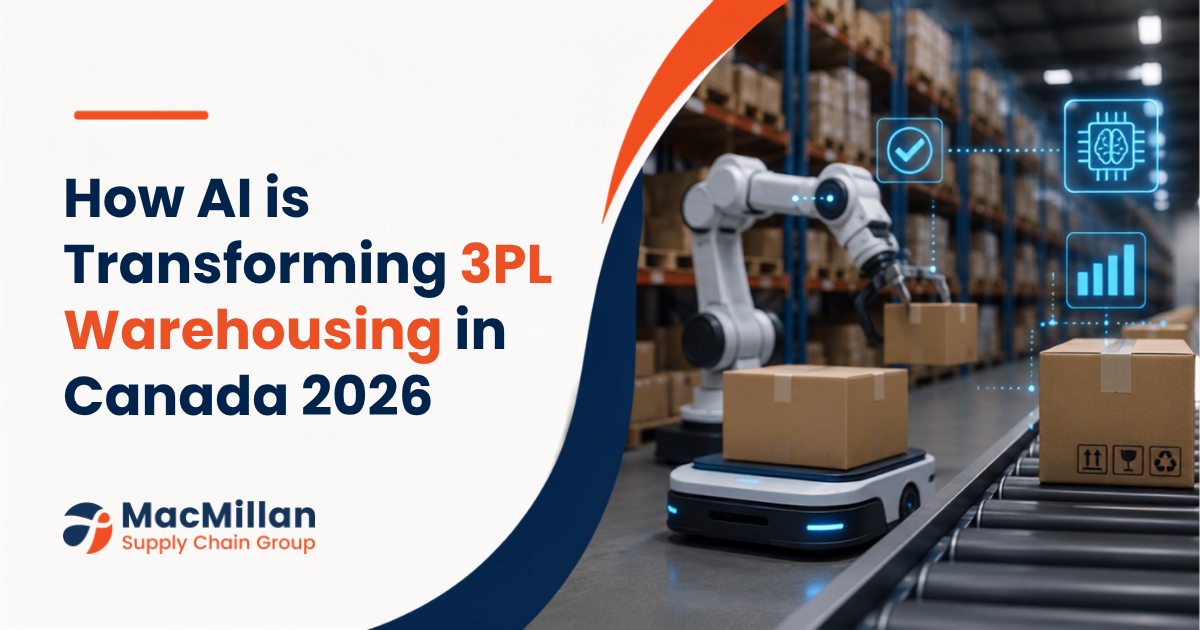
Modern 3PL warehouses now deploy Autonomous Mobile Robots (AMRs) that transport goods directly to packing stations, robotic arms that handle sorting, scanning, and stacking, and AI vision systems that achieve 99.9% label-scanning accuracy. These systems do not replace human workers — they extend what human teams can accomplish.
The performance numbers are compelling. Where manual picking achieves accuracy rates of 96–98%, automated AI systems push that figure above 99%. Order processing speeds can be up to four times faster than manual methods. And unlike human teams, robotic systems operate around the clock without fatigue, errors, or downtime.
For brands managing high-velocity pick, pack, and ship operations, this level of precision and speed is the difference between delighting customers and losing them to a competitor.
The rise of Robotics-as-a-Service (RaaS) is also democratizing access to this technology. Rather than requiring large capital investments, mid-market brands can now access enterprise-grade robotic systems through flexible subscription models — making cutting-edge automation available regardless of company size.
A modern AI-powered Warehouse Management System is the central nervous system of a high-performance 3PL operation. It connects every element of the warehouse — dock sensors, robot telemetry, conveyor systems, order management software, and human teams — into a single, cohesive intelligence layer.
The capabilities of today’s AI-native WMS platforms go far beyond simple inventory tracking. These systems provide real-time stock synchronization across multiple facilities, predictive bottleneck detection before delays occur, automated restocking triggers based on live inventory levels, and dynamic task allocation between human staff and robotic systems.
MacMillan SCG’s Mantis-powered WMS gives clients complete inventory visibility from anywhere — real-time data on every SKU, every order, and every shipment. This transparency eliminates the uncertainty that typically plagues brand-3PL relationships and allows for confident, data-driven decision-making.
Clients can review inventory status, track inbound containers, and monitor fulfillment performance at any time, from any device. In an era where supply chain visibility is a competitive advantage, this level of real-time intelligence is invaluable.
Traditional supply chains were reactive — problems were identified after they happened and then corrected. AI-powered predictive analytics flips this model entirely. Instead of responding to disruptions, intelligent systems anticipate them in advance.
By analyzing data from weather patterns, port traffic, carrier performance, and historical shipment data, AI algorithms help logistics planners make proactive decisions before delays materialize. In Canada’s busy logistics corridors — from the Port of Vancouver to the GTA’s dense distribution networks — this predictive capability is especially valuable.
For food and beverage brands managing tight expiry windows and FEFO rotation, predictive analytics also plays a critical role in lot, batch, and expiry control. AI systems can flag at-risk inventory automatically, trigger replenishment before stockouts occur, and ensure compliance with retailer shelf-life requirements without manual oversight.
Machine learning models also improve predictive maintenance for warehouse equipment — anticipating mechanical failures before they cause downtime, reducing maintenance costs, and maintaining consistent throughput even during peak demand periods.
The final mile of delivery has historically been the most expensive and unpredictable part of the supply chain — accounting for up to 53% of total shipping costs in some estimates. AI is now tackling this challenge directly.
Real-time route optimization powered by AI considers live traffic conditions, weather, delivery time windows, and vehicle capacity to identify the most efficient delivery paths dynamically. This reduces fuel consumption, lowers transportation costs, and improves on-time delivery rates — all simultaneously.
AI-powered last-mile coordination also enables Uber-like tracking transparency, where customers and shippers receive live tracking links with real-time updates. This level of visibility has been shown to reduce customer service inquiries by up to 70% — freeing up operational resources while dramatically improving the customer experience.
For D2C brands and e-commerce retailers where delivery experience directly impacts repeat purchase rates and brand loyalty, AI-optimized last-mile delivery is not just an efficiency gain — it is a customer retention strategy.
Sustainability is no longer optional for logistics providers operating in Canada. With tightening environmental regulations and growing consumer demand for greener supply chains, 3PL providers are under increasing pressure to demonstrate measurable environmental responsibility.
AI contributes to sustainability in several meaningful ways. Route optimization reduces empty miles and fuel consumption across the transportation network. Predictive demand forecasting minimizes overproduction and excess inventory disposal. Energy management systems within warehouses use AI to optimize lighting, heating, and cooling based on real-time occupancy and workload data.
MacMillan SCG’s commitment to sustainable operations aligns with GRI and UN SDG frameworks, and AI is a central tool in delivering on those commitments. Partnering with a 3PL that uses AI to actively reduce its carbon footprint means your brand’s logistics operations are aligned with your sustainability values — and with where regulatory requirements are heading.
The modern Canadian consumer shops across multiple channels simultaneously — a brand’s website, Amazon, Shopify, and retail shelves. Managing inventory and fulfillment across all of these channels without AI is extraordinarily complex, leading to overselling, delayed orders, and frustrated customers.
AI-powered omnichannel fulfillment systems resolve this by maintaining a single, real-time view of inventory across all channels and automatically allocating stock based on order priority, channel requirements, and delivery commitments. When a Shopify order comes in simultaneously with a retail replenishment order, AI determines the optimal fulfillment sequence without human intervention.
This intelligence extends to returns management as well. AI vision systems can assess returned goods automatically — grading condition, identifying defects, and routing items back to the appropriate inventory location or disposal pathway without manual inspection. This speeds up the returns process while maintaining inventory accuracy.
The adoption of AI in 3PL warehousing is not a distant future — it is happening right now across Canadian distribution centers. For FMCG brands, the implications are direct and significant.
Brands that partner with AI-enabled 3PL providers gain access to faster order processing, fewer errors, better inventory accuracy, and real-time supply chain visibility — without having to build or manage the technology themselves. They benefit from the economies of scale that come from sharing AI infrastructure with other brands in the same facility.
Brands that continue working with legacy 3PL operations — manual picking, reactive inventory management, limited visibility — will find it increasingly difficult to meet retailer compliance standards, customer delivery expectations, and the cost benchmarks that AI-powered competitors are achieving.
The choice of 3PL partner in 2026 is effectively a choice about your supply chain’s technological future. MacMillan SCG’s warehousing and distribution services, e-commerce fulfillment, and AI-powered WMS are designed specifically to give Canadian brands the competitive advantage that modern logistics demands.
MacMillan SCG does not just talk about AI — it delivers measurable results. With 99.4% pick accuracy, dock-to-stock in under 24 hours, container destuffing completed in under 4 hours, and over 350 trackable KPIs available to every client, the performance impact of AI integration is visible, verifiable, and consistent.
Whether you are managing food-grade inventory with strict FEFO requirements, scaling a D2C subscription business, or distributing across Canadian retail networks, MacMillan’s AI-enabled platform adapts to your specific operational needs.
Explore how MacMillan SCG’s platform and ERP integrations connect your existing systems — Shopify, Amazon, WooCommerce, Magento — seamlessly with our WMS for real-time data synchronization from day one.
AI is not coming to Canadian 3PL warehousing — it is already here, and it is already separating the providers who are building the future of logistics from those who are managing the logistics of the past.
From intelligent demand forecasting and robotic picking to real-time WMS visibility and AI-optimized last-mile delivery, the technology is proven, the results are measurable, and the competitive advantage is real. For Canadian brands looking to scale efficiently, fulfill accurately, and deliver consistently, partnering with an AI-enabled 3PL is the single most impactful supply chain decision you can make in 2026.
Ready to see what AI-powered 3PL looks like in practice? Get in touch with MacMillan SCG or request a quick quote today.