
Warehouse Planning Canada | 2027 Cost and Capacity Guide
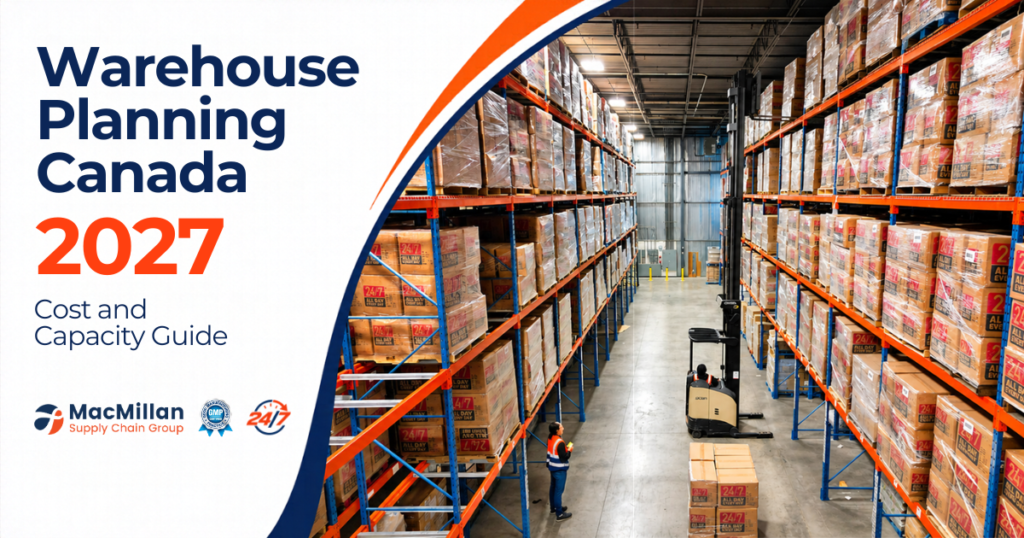
2027 Warehouse Planning Guide: How Canadian Businesses Can Control Costs and Build Flexible Capacity A warehouse renewal lands on your desk. A cheaper building is available farther from your customers, while your current facility feels crowded every November and half-empty by February. Sales wants room for growth. Finance wants lower overhead. Operations wants enough space to get orders out without moving the same pallet three times. That is where useful warehouse planning in Canada begins: connecting the building decision to how the business actually operates. For 2027, the right question is not simply how much space you can afford. It is how much reliable storage and processing capacity you need, where you need it, and which commitments make sense when demand changes. The lowest warehouse rent does not necessarily produce the lowest overall logistics cost. A sound plan compares transportation, labour, inventory, service and flexibility alongside occupancy costs. Why Warehouse Planning Matters Heading Into 2027 Warehouse decisions often outlast the assumptions used to justify them. A lease signed around one major customer, one import route or one product range may still be in place after those conditions change. Retailers need room for promotions without carrying permanent peak costs. Manufacturers need dependable material flow. Importers need receiving capacity when containers arrive together. E-commerce businesses need enough picking and packing capacity to meet delivery promises. Build the 2027 plan with sales, purchasing, finance and operations together. Otherwise, purchasing may increase order quantities to save freight while the warehouse budget assumes less stock and marketing launches another product line. What Current Canadian Industrial-Market Conditions Mean for Your Decision As of November 2026, published third-quarter reports provide a useful starting point—not a forecast of your 2027 lease terms. CBRE’s Q3 2026 Canada Industrial Figures reported national availability of 5.2%, down 30 basis points from the previous quarter. National net asking rent was CAD $14.77 per square foot, down 2.4% year over year. Those figures show that recovering demand and softer asking rents can coexist. They are market indicators, not an all-in occupancy quote for a specific building. For the GTA, Colliers’ Q3 2026 Toronto report described strong absorption and declining availability alongside continued pressure on net rents. Its findings reinforce the need to assess individual submarkets and properties. Request current comparable offers. Check usable clear height, loading, power, yard access and permitted activities. Available industrial space is not automatically suitable for food storage, high-volume parcel fulfillment or your particular operating hours. Calculate the True Cost of Operating a Warehouse Separate Occupancy From Operational Costs Start with a consistent annual cost model. Include net rent and applicable additional rent, such as taxes, maintenance and insurance charges, then identify which utilities and repairs remain your responsibility. Add the costs required to make the building work: Racking, equipment, fit-out and maintenance. Wages, employer contributions, benefits, supervision and training. Warehouse software, scanners, connectivity and support. Cleaning, security, inspections and product-specific controls. Inbound handling, outbound processing and returns. Transportation, transfers, damage and avoidable rework. Keep one-time cash requirements, recurring operating expenses and depreciation distinct. Avoid counting both the full equipment purchase and its annual depreciation as annual operating costs. Test Whether the Rent Saving Survives the Move Consider a hypothetical 20,000-square-foot requirement. A CAD $2-per-square-foot annual rent saving equals CAD $40,000. If the location adds CAD $45,000 in annual transportation and staffing costs, the apparent saving disappears before relocation expenses. These are illustrative numbers, not market quotes. The same comparison should use your freight lanes, staffing assumptions and property proposals. Review total warehousing and fulfillment costs using equivalent service requirements. How Much Warehouse Space Will You Really Need in 2027? Start With Inventory Positions and Product Characteristics Collect at least a full seasonal cycle of stock records where available. Review average and maximum pallets, cartons, SKU counts, product dimensions, stackability and stock held for inspection or returns. Translate that profile into suitable storage positions. A pallet of fragile displays may not stack like cases of cleaning products. A large number of slow-moving SKUs may require more accessible locations than a small range shipped by full pallet. For illustration, if you need to accommodate 800 occupied pallet positions at an assumed 80% planning occupancy, you need 1,000 compatible positions. The 80% assumption is an example, not a universal operating target. Your layout and product mix determine workable occupancy. Allow for Processing Space and Throughput Convert positions into floor area using an actual layout. Include receiving, staging, pick faces, packing, returns, safety clearances and circulation. Confirm rack design and building constraints before treating vertical space as usable capacity. Then test throughput separately. Can the docks receive the busiest inbound day? Can replenishment keep pickers supplied? Can packing clear orders before carrier collection? A warehouse can have spare storage and still lack dispatch capacity. Document both storage and processing limits before choosing a building. Understand the Cost of Unused and Underutilized Space Empty space creates fixed costs without necessarily supporting sales. It may still require rent, heating, lighting, security and maintenance. Separate necessary working room from speculative expansion. Receiving areas and clear aisles are productive capacity even when they are not holding stock. An unused block leased for a possible customer contract is a different commitment. Review occupancy by month and zone. If expansion demand is uncertain, compare permanent space with a smaller core operation and contracted overflow. Check the lease before assuming you can sublet surplus space. Plan Seasonal and Peak Requirements Separately Your inventory peak may arrive weeks before your order peak. A holiday retailer can need maximum storage in October, maximum packing labour in November and additional returns capacity in January. Build a weekly calendar covering inbound receipts, stored inventory, outbound orders, promotional assembly and returns. Include customer launch dates and retailer delivery appointments. Book extra capacity before it becomes urgent. Confirm the reservation, minimum charges, activation notice and receiving limits in writing. For peak-season fulfillment planning, extra storage only helps if stock can reach the shipping operation in time. Compare Dedicated, Shared, Overflow and 3PL Warehousing These
What Supply Chain Issues Can We Expect This Holiday Season?

Two years after the pandemic and the supply chain bottleneck doesn’t seem to be getting any easier. Especially during the holiday season when wholesalers and retailers look forward to stocking up on their hot list items to fulfil the holiday shopping season frenzy between Black Friday and Christmas shopping. It is essential that the global supply chain boards now learn how to balance the lapse of crisis response with the strategic approach required beyond these immediate holiday supply chain challenges. Below are the lists of the supply chain issues driving board-level discussions. What Supply Chain Issues Can We Expect in 2026 1. Higher Prices Supply chain costs are skyrocketing. From paying workers to raw materials needed for production, the increase in costs prompts businesses to raise their prices. The increase in prices cut across businesses to consumers, and small businesses especially, although no one is exempted from the disruptions. About 42 percent of small and medium-sized business retailers say their inability to meet minimum order sizes set by vendors is a key challenge, whilst 41 percent say they’re unable to pay higher prices, which can sometimes help a company earn a prioritized status and reduce the likelihood of cancelled orders. Some SMBs are getting dropped by vendors for reasons precisely related to being small businesses. To make up for the increased supply chain cost, SMBs increase their retail prices, ultimately leading to consumer price inflation. To remain competitive, enterprises are looking for new and improved ways to position themselves for higher supply chain costs without necessarily passing the full impact of cost increase onto their customers, some of which are having a strong relationship with your suppliers, or having vendor diversity. 2. Truck Driver Shortages Like in other various industries, the trucking industry is still in recovery from the pandemic, with some companies going out of business making many drivers redundant. The number of drivers also reduced as many of the drivers have ventured into alternative careers to protect their income and health, or due to certain restrictions being in place. This makes it difficult to employ and train new drivers. The demographics of truck drivers in the United States are populated with ageing truck drivers, with an average age of 48.2, which means drivers will be nearing retirement age or early retirement. As there’s a continuity in the trend for the next decade, the situation is then worsened by the federal requirements, restricting the recruitment of young people, making the average age of a new driver being trained 35 years old. Coupled with a lack of young drivers being admitted into the workforce, there is a lack of diversity in the trucking industry, although females make up almost 50.4% of the United States workforce. Only 6.6 percent of truck drivers are female. And unless a diverse workforce is encouraged, the chance of combatting the shortage of truck drivers will be a long shot. While there may be different supply chain issues to look forward to, a lack of truck drivers able to transport the available goods worsens the labour shortages that consumers will have to deal with. 3. Shipping Delays Some consumers deliberately wait for the holiday sales before adding certain holiday items and gifts to their carts. This results in a spike in orders, which in turn causes an increase in shipping container volume that may overwhelm couriers, especially if they lack an efficient delivery system network. This can result in shipping delays at times when most shoppers need their goods delivered faster. Amongst the different causes of shipping delays is worker shortages; There is a backlog of shipments filled with orders that were supposed to leave the ports within a certain period but couldn’t due to a lack of labour. Businesses that offer online shopping for brick-and-mortar stores are advised to have an early start in the processes involved to satisfy their customers’ orders. One of the ways to achieve this is to consult a supply chain expert about the shipping solutions available to help you scale, as shipping delays could lead to product shortages on shelves, which can also make some customers drop some vendors after several failures at meeting their supply demand. 4. Short Supply It should be clear now that with one supply chain disruption may arise another one, and while the scarcity of raw materials may be part of why a product will be in short supply, it’s mostly not the case during the holiday season. Enterprises know that the holiday is a recurring period, and as such, preparations are made towards the availability of the items that’ll be in high demand (High demand may be the reason for short supply). It is not because companies didn’t make the right provisions, but because other factors, like truck driver shortages or shipping delays, cancelled orders because the minimum sizes or amount was not met. 5. Longer Lead Times While we may want to blame product shortages on shipping delays only, sometimes it starts from the time it takes for a supplier or manufacturing company to complete the processes that transform raw materials into finished products. Inventory shortages occur as a result of stocks taking a long time to get replenished, which is known as lead time delays. This may be caused by inefficient inventory management systems, natural disasters, scarcity of raw materials or human errors. Out-of-stock messages often inconvenience customers who must wait for orders to be filled. Companies are not left out as well, as they continue to incur utility and overhead costs despite employees and production machines sitting idle for a time. Lead time delays can occur at any point in time of the processes involved in meeting consumer demand. An example is the shipping methods, transitioning to more flexible shipping methods would gradually help reduce the lead times. Holiday Supply Chain Issues in 2026 It is the time of the year again to get a lot of things off our shopping list for the holiday, and if you haven’t already