
How the U.S.-Iran Conflict Increases Global Supply Chain Risk | Supply Chain Guide
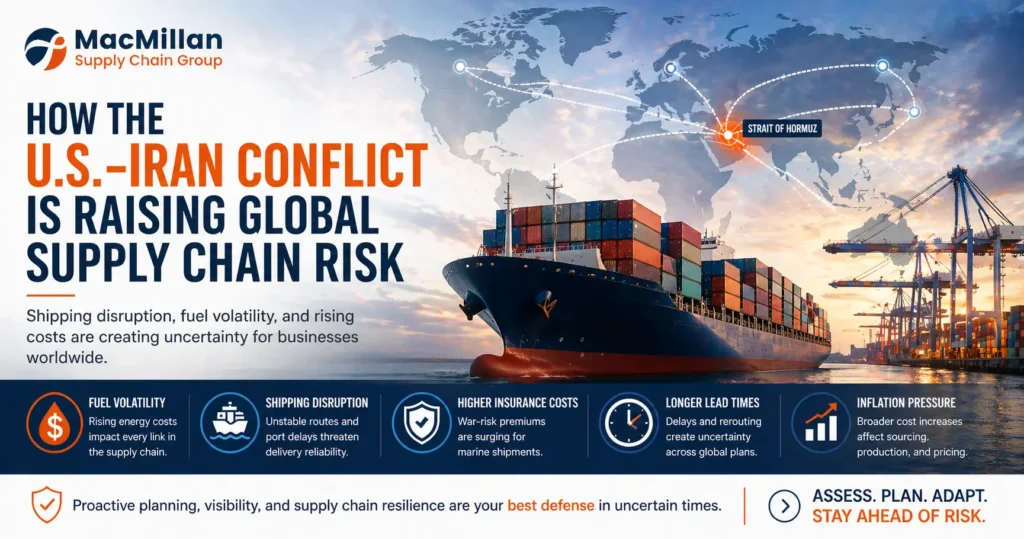
A Quick Summary and Overview The U.S.-Iran conflict has become a major supply chain risk story because it affects the Strait of Hormuz, one of the world’s most important energy and shipping corridors. Reuters reports that vessel traffic through Hormuz has fallen sharply from normal levels, while thousands of seafarers have been stranded and shipping companies remain cautious about resuming normal operations. That kind of disruption can ripple into fuel prices, freight rates, insurance costs, transit reliability, and inventory planning across global supply chains. For importers, exporters, retailers, and manufacturers, the real issue is not politics. It is operational resilience. Introduction Global supply chains do not need a direct hit to feel pressure. They only need a major chokepoint to become unstable. That is why the U.S.-Iran conflict matters to businesses far beyond the Middle East. The Strait of Hormuz is one of the world’s most important maritime routes for oil and LNG, and Reuters reports that recent disruption there sharply reduced vessel traffic and stranded hundreds of ships and around 20,000 crew in the Gulf. Even with talk of a ceasefire, shipping activity has remained well below normal because carriers are still worried about safety, seizures, mines, and fast-boat threats. For supply chain teams, the smarter question is not who is right. It is what happens to cost, lead time, and continuity if disruption lasts longer than expected. That is the lens this article uses. Why This Conflict Matters to Supply Chains The Strait of Hormuz matters because a large share of global oil and LNG moves through it. Reuters reports that the conflict has disrupted roughly a fifth of global oil flows and pushed shipping companies to slow or avoid normal passage through the corridor. When that happens, the impact is not limited to energy traders. It spreads into trucking, ocean freight, air cargo, manufacturing, procurement, and retail replenishment. When traffic through a route this critical becomes unstable, supply chains usually feel it in several places at once: fuel becomes more volatile shipping schedules become less reliable war-risk and marine insurance costs rise inventory buffers become more important lead-time planning becomes harder Those are the issues most businesses should be watching now. 5 Supply Chain Risks Businesses Should Watch 1. Fuel and energy cost volatility One of the fastest ways the conflict affects supply chains is through fuel. Reuters reported that oil prices jumped on renewed uncertainty around Hormuz and that the conflict has already been feeding broader price pressure in business surveys. Higher diesel, marine fuel, and jet fuel prices can raise trucking, ocean, and airfreight costs even for companies with no direct sourcing in the region. 2. Ocean shipping disruption Shipping companies do not need a full closure to change behavior. Reuters reported that only a handful of ships passed through Hormuz in a 24-hour period compared with a normal daily average around 140, while alternate nearby routes could not handle normal traffic volumes. That means even a technically open corridor can still operate like a constrained one. 3. Longer lead times and weaker reliability When carriers delay sailings, wait offshore, or reroute cargo, lead times start stretching. Reuters has described stranded vessels, near-standstill traffic, and ongoing safety concerns despite temporary truce language. For supply chain teams, that means historic transit assumptions may no longer be reliable. 4. Higher insurance and risk premiums Conflict-related maritime risk almost always drives up insurance. Reuters reported that war-risk premiums for Gulf shipping surged by more than 1000% in some cases as insurers repriced exposure. Those costs can show up directly in freight quotes or indirectly through carrier surcharges and tighter capacity. 5. Broader inflation and sourcing pressure Reuters also reported that the conflict has been pushing up input costs, slowing factory activity, and adding pressure across the global economy. That means the issue is not just transport. It can also affect packaging, manufacturing inputs, procurement budgets, and consumer demand patterns at the same time. Industries Most Exposed Energy-intensive sectors Industries with high transport or production energy use usually feel the impact first. That includes manufacturing, food production, chemicals, distribution, and bulk goods. When diesel, marine fuel, and power-linked costs rise, margins can tighten quickly. Retail and consumer goods Retailers and consumer goods companies can be affected through inbound freight costs, packaging costs, and replenishment timing. Even if the finished product does not come from the Middle East, upstream materials and freight networks can still be exposed to fuel and capacity shocks. Automotive and industrial supply chains Complex manufacturing sectors are especially vulnerable when lead times become unstable. If inbound materials are delayed or freight costs spike, production planning becomes harder and just-in-time models come under pressure. Reuters’ coverage of rising input costs and disrupted logistics supports that broader industrial risk. Food and perishables Perishable supply chains are exposed because time matters more. If carriers slow down, reroute, or reduce service reliability, spoilage risk and cold-chain cost can rise. That is especially important when maritime schedules become harder to predict. Common Problems with the Topic 1. Cost planning becomes less accurate Fuel, freight, and surcharge assumptions can change faster than normal. Reuters reported oil spikes and broader price pressure tied to the conflict. 2. Lead-time assumptions stop working Historic transit averages can become unreliable when carriers slow or avoid risky corridors. Reuters reported traffic through Hormuz dropping far below normal levels. 3. Inventory policy becomes outdated If transit times stretch, reorder points and safety-stock assumptions may no longer protect service levels. Reuters linked the conflict to delivery delays and global logistics disruption. 4. Customer service risk increases Longer and less predictable delivery windows can weaken fill rates, OTIF performance, and customer confidence. That becomes more likely when routes remain open only in name but not in stable practice. 5. Expediting becomes more tempting and more expensive When businesses try to protect service levels during disruption, they often shift to more expensive transport options, which can quickly erode margins. 6. Supplier concentration becomes more dangerous If one route, one region,
Future of Supply Chain: Robots, Strategy & Relationships

The Future of Supply Chain: Innovations, Challenges, and Strategic Solutions Advanced robotics, AI-powered decision-making systems, and strategic alliances are driving a radical change in the supply chain environment. Logistics networks are becoming more robust, sustainable, and efficient as a result of these advancements. Leading the way in this evolution is MacMillan Supply Chain Group, which uses state-of-the-art technologies and builds cooperative partnerships to maximize the flow of goods across borders and throughout Canada. This article examines how supply chains are changing as a result of these developments and how companies can use them to their advantage in a market that is becoming more and more complex. Introduction The world of supply chains is evolving more quickly than in the past. What used to involve a lot of manual labor, paper records, and reactive problem-solving is now being automated, digitalized, and proactive. We at MacMillan Supply Chain Group are seeing directly how the transportation of goods from producers to customers is being transformed by robotics, artificial intelligence, and strategic alliances. Large geographic distances, complicated cross-border relations with the US, and seasonal weather extremes that can cause logistical disruptions are some of the particular difficulties faced by Canadian businesses. Supply chain management in the future tackles these issues by fostering cooperative partnerships and technological advancements that build stronger networks. Understanding these new trends is essential for retailers, manufacturers, and distributors to stay competitive in the quick-paced market of today. Let’s examine how intelligent strategies, robust partnerships, and robots are constructing tomorrow’s supply chains. Robotics Revolution in Warehouse Operations Robotics in logistics is bringing about a technological renaissance on the warehouse floor. These days, autonomous mobile robots, or AMRs, move inventory and help human workers by precisely navigating warehouse aisles. These robots significantly boost productivity in the Ontario logistics hub and beyond by avoiding obstacles and optimizing their routes using advanced sensors and artificial intelligence. Warehouse automation has increased throughput by 40% and decreased picking errors by almost 67% at MacMillan Supply Chain Group. These enhancements focus on consistency and dependability rather than just speed. No matter the time of day, robots perform at the same level, never get tired, and never require breaks. In contemporary warehousing, human-robot collaboration is the sweet spot. Instead of taking the place of employees, robots perform physically taxing, repetitive tasks while humans concentrate on intricate decision-making and quality assurance. Collaborative picking systems, for instance, pair humans with robots; the human chooses items that need judgment and dexterity, while the robot moves bins. In Canada, industrial automation is growing, especially as companies continue to face labor shortages. By operating in areas with less heating and lighting, automated storage and retrieval systems (AS/RS) can maximize vertical storage space while lowering energy expenses. In cities where warehouse space is scarce, this efficiency is especially beneficial. Big businesses are not the only ones embracing the robotics revolution. Mid-sized companies can now use this technology thanks to scalable solutions, which enables them to compete with bigger players in the logistics industry, which is becoming more and more technologically advanced. AI-Driven Supply Chain Decision Making Artificial intelligence has developed from simple automation to a tool for strategic decision-making in modern supply chains. Large volumes of data are used by the AI-powered supply chain to forecast interruptions, optimize inventory levels, and improve customer service. Human analysts are unable to process information at the speed and scale that this technology can. The foundation of this revolution is predictive analytics. Artificial intelligence (AI) systems can predict demand with remarkable accuracy by examining historical data as well as external factors like weather patterns, economic indicators, and social media trends. This entails minimizing stockouts and excess inventory by having the appropriate products in the right quantities at the right locations for a retailer getting ready for the holidays. Another innovation in supply chain management is the use of digital twins. Businesses can model changes and disruptions before they happen with these virtual versions of real supply chains. Businesses can minimize risk and maximize results by testing scenarios in the digital environment before deciding on new warehouse layouts or transportation routes. These technologies are used by MacMillan Supply Chain Group to build robust supply chain networks for our customers. Our AI systems swiftly recalculate the best routes and resource allocations in the event of unforeseen circumstances, such as snowstorms or border delays. Your customers will experience fewer disruptions as a result of this proactive approach. The impact of AI extends to cross-border trade between Canada and the US as well. Machine learning algorithms can predict customs clearance times, recommend optimal shipping methods, and even anticipate tariff impacts before they affect your bottom line. International logistics are turned from a source of uncertainty to a strategic advantage thanks to this intelligence. Creating Strategic Alliances in the Supply Chain Relationships are more important to supply chain management in the future than technology alone. Across the supply chain ecosystem, transactional interactions are giving way to strategic partnerships. Beyond just purchasing and selling, these cooperative partnerships add value. These collaborations are becoming more transparent than ever thanks to blockchain technology. All supply chain participants have access to a single, unchangeable record of transactions and movements thanks to blockchain technology. Disagreements regarding delivery schedules, product quality, and contractual duties are resolved by this common truth. For businesses engaged in cross-border trade between Canada and the US, this transparency reduces delays and administrative burdens. Successful supply chain strategy now depends on collaboration rather than competition. When manufacturers, logistics providers, and retailers align their systems and share data, the entire network becomes more efficient. At MacMillan Supply Chain Group, we facilitate these connections, helping businesses build integrated supply chains that respond quickly to changing market conditions. The benefits of strategic partnerships extend to sustainability in logistics as well. By coordinating transportation and sharing warehouse space, companies can reduce their carbon footprints while cutting costs. These green supply chain initiatives satisfy growing consumer demand for environmental responsibility while improving operational efficiency. The most successful businesses are
Massive Tariff on Americans De Minimis Removal |Canadian Impact
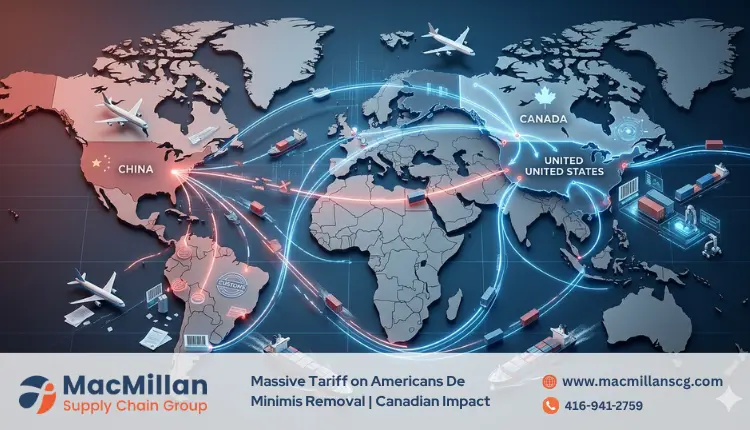
De Minimis Removal 2025: What It Means for Canadian Cross-Border E-Commerce The Trump administration’s removal of the de minimis exemption for Chinese goods on May 2, 2025, is causing a massive upheaval in the cross-border e-commerce environment between the United States and Canada. This legislative change impacts supply chains across North America, especially for Canadian companies that depend on international commerce. Though the regulation reform is initially directed at China, it signals broader changes that could affect all exports into the US market—including those from Canada. How Canadian Logistics Firms Can Benefit from the 2025 De Minimis Removal The disruption presents an opportunity for Canadian logistics firms like Macmillan SCG to act as strategic intermediaries. Canada’s location and trade connections make it a favorable collection and consolidation hub as Chinese exporters seek middle-tier nations still eligible for tariff exemptions. “The de minimis exemption still applies to non-China origins,” said Gabriel Wildau, a China specialist at Teneo. He predicts, “Chinese e-commerce retailers will increasingly use countries like Mexico and Canada as collection points for low-value packages.” Canadian firms with warehousing capacity and logistics know-how can position themselves as vital consolidation hubs for rerouted Chinese goods. How Macmillan SCG Helps Companies Navigate Tariff Transitions After De Minimis Changes Macmillan SCG, a prominent Canadian supply chain company with an expansive warehouse network and last-mile delivery expertise, is uniquely positioned to help businesses adjust to the post–de minimis exemption landscape. Expert Customs Compliance Support Post–De Minimis Removal Our expert team monitors evolving regulations to help clients stay compliant and minimize costs. We assist with tariff classification, accurate valuation methods, and documentation preparation to reduce unnecessary expenses and ensure regulatory alignment. Strategic Warehousing in Response to De Minimis Policy Shifts Macmillan SCG offers warehousing solutions throughout Canada to support logistics network restructuring. These facilities act as consolidation points for rerouted or staged goods bound for the U.S. market. Technology-Driven Supply Chain Visibility Amid 2025 Tariff Changes In a regulatory environment marked by uncertainty, real-time tracking is vital. Our advanced visibility tools keep clients updated on shipment status, customs processes, and compliance issues—empowering proactive management. Last-Mile Delivery Optimization Under New De Minimis Rules As companies reconfigure supply chains, last-mile delivery remains a critical differentiator. Our proven expertise in this area ensures clients maintain competitive delivery timelines despite upstream disruptions. Preparing for Future Tariff Expansions Beyond the 2025 De Minimis Removal The 2025 exemption removal may only be the beginning. Canadian businesses must prepare for the potential extension of these restrictions to other nations—including Canada itself. Tracking U.S. Policy Changes Post–De Minimis Removal The decision to eliminate de minimis for China carries political weight. Though enforcement has faced logistical setbacks, the White House emphasized this as “a critical step” toward national security. Canadian companies must monitor developments closely. Building a Resilient Supply Chain After De Minimis Reform Adaptive supply chains are essential. This involves: Diversifying suppliers and sourcing regions Creating alternate transportation routes Partnering with customs brokers in key markets Implementing technology for full supply chain control Modeling financial impacts from potential tariffs These enhancements build resilience regardless of how trade policies evolve. Exploring Alternative Markets to Reduce Tariff Exposure While the U.S. remains vital, Canadian businesses should explore trade opportunities in other stable markets. Diversifying away from U.S.-China-centric models could reduce risk significantly. Thriving in a Post–De Minimis Removal 2025 Trade Environment The end of de minimis exemptions for Chinese imports marks a major turning point in U.S. trade policy. Although focused on China for now, the possibility of broader application introduces strategic urgency. Partnering with supply chain experts like Macmillan SCG provides the infrastructure, knowledge, and flexibility needed to stay competitive. We help clients understand implications, formulate responses, and implement efficient logistics solutions. To thrive in this evolving landscape, businesses must adapt quickly—with experienced partners who turn regulatory challenges into opportunities. What Is De Minimis and Why Was It Removed in 2025? The de minimis exemption allowed goods under $800 to enter the U.S. duty-free, streamlining customs and accelerating growth in direct-to-consumer shipping. Its 2015 increase from $200 to $800 fueled a fourfold rise in shipments, now exceeding 4 million per day. On April 2, 2025, President Trump signed an Executive Order to eliminate the de minimis exemption for Hong Kong and China starting May 2, citing national security concerns—particularly China’s alleged role in the fentanyl crisis via abuse of de minimis channels. Timeline: Key Events Leading to the 2025 De Minimis Removal Feb 1, 2025: Trump announces intent to end de minimis for China Feb 4, 2025: 10% tariff implemented on Chinese and Hong Kong goods Feb 5, 2025: Temporary rollback due to USPS and customs backlog Mar 4, 2025: Tariff increased to 20% Apr 2, 2025: Trump finalizes plan, adds 34% reciprocal tariff on 60 countries Apr 5, 2025: 10% baseline reciprocal tariff imposed globally (excluding China) May 2, 2025: De minimis exemption officially removed for Chinese goods Chinese goods now face either 120% tariffs or a flat postal fee of $100 per shipment, increasing to $200 in June. Cross-Border Supply Chain Impacts of De Minimis Removal Canadian businesses importing from China and shipping to the U.S. face tough choices. The change affects not just Chinese goods but hints at wider reform that could impact Canadian exports. How E-Commerce Operations Are Responding to De Minimis Elimination Before the May 2 deadline, platforms like Temu and Shein adjusted early. Both raised prices in April, leading to buyer stockpiling. Temu saw 60% revenue growth, and Shein had a 38% sales spike. Logistics networks faced pressure as shipments surged. Canadian companies using similar shipping models must watch these developments closely. The de minimis exemption’s removal—while currently limited to China—could soon affect all nations. Reconfiguring Supply Chains After the 2025 Tariff Changes Forward-looking companies are already acting. Temu and Shein are diversifying sourcing to Mexico and Southeast Asia and building U.S. warehouses. Canadian firms face decisions: absorb costs, restructure supply chains, or optimize logistics. Options include: Establishing or expanding U.S. warehouses Shifting sourcing to countries with
Canada-US Trade War Supply Chain Solutions by Macmillan
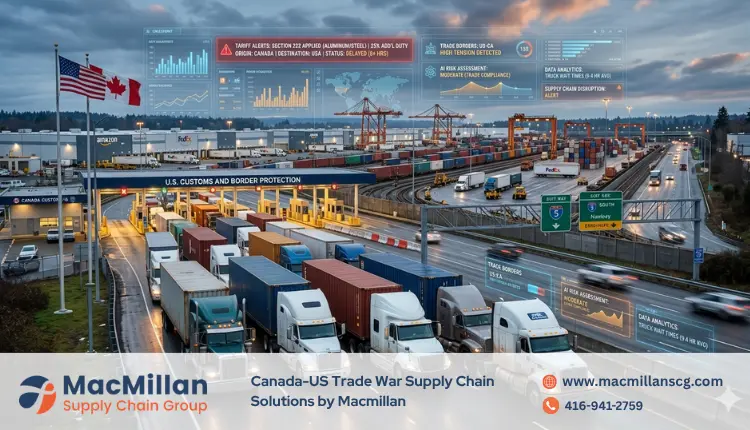
How Macmillan SCG Strengthens Supply Chain Resilience in the Face of the US-Canada Trade War Industries that depend on cross-border trade have been shaken by the recent increase in trade tensions between the US and Canada. Businesses are experiencing supply chain disruptions never seen before as a result of President Trump’s administration’s 25% tariffs on Canadian goods and Prime Minister Mark Carney’s targeted duties on $30 billion worth of US exports in retaliation. At Macmillan Supply Chain Group, we understand that these issues are practical roadblocks that call for quick, technologically advanced solutions. This blog examines how Canadian companies can protect their operations from fluctuations in trade while preserving cost effectiveness and client satisfaction. As a leading provider of Canada-US trade war supply chain solutions, Macmillan SCG offers actionable insights in times of uncertainty. The New Trade Reality: Understanding the Economic Effects of Tariffs on Different Industries 18% of Canada’s yearly cross-border trade volume is directly impacted by the 2025 tariffs, which target industries ranging from consumer goods to auto parts. This means the following for SMEs: Cost increases of 15–30% for imported raw materials from US suppliers Delays of four to six weeks at important border crossings, such as Ambassador Bridge Stockouts in inventory as a result of hasty reshoring attempts Our team recently learned from a Toronto-based electronics retailer that their customs clearance times doubled overnight, putting $2 million in backorders at risk. These anecdotes highlight why supply chain diversification has become a top priority for 73% of Canadian companies looking for Canada-US trade war supply chain solutions. Creating a Supply Chain That Is Tariff-Proof: Four Key Elements 1. Flexible Warehousing Combined with Nearshoring Businesses can do the following thanks to Macmillan’s 45 cross-dock facilities across Canada: Keep products in duty-free areas until tariffs are resolved Depending on current demand, move inventory between our 250,000 square foot GMP-certified warehouses Get 40% less for shared warehouse space than for private leases Case Study: By using our Windsor warehouse for staged US-bound shipments, a Montreal fashion brand was able to reduce border wait times by 58% and avoid $470,000 in tariffs. This is a clear example of how Canada-US trade war supply chain solutions can directly impact profitability. 2. Customs Optimization Driven by AI The CARM system from CBSA is integrated with our proprietary Mantis WMS to: 99.1% accuracy in auto-classification of HS codes Use political sentiment analysis to forecast changes in tariffs During inspections, create alternate routing scenarios Our AI saved clients $28K per day in detention fees by rerouting 1,200 shipments through Sarnia in 4 hours during the Detroit border slowdown last month. These AI-driven capabilities are a cornerstone of our Canada-US trade war supply chain solutions. 3. Last-Mile Agility in Turbulent Times With 90% of Canadian FSAs covered by next-day delivery, we help businesses: Split inventories between urban fulfillment centers to bypass choke points Deploy electric vehicles for tariff-exempt “green” shipments in carbon-tax regions Offer customers real-time duty calculators at checkout “After the tariffs hit, Macmillan’s same-day Toronto delivery let us absorb costs without raising prices,” notes a Kitchener-based medical supplier. This agility is key in implementing effective Canada-US trade war supply chain solutions. 4. Sustainability as a Protective Factor Our Net-Zero Logistics Program converts ROI from regulatory compliance: Compared to diesel alternatives, an electric fleet lowers fuel costs by 34% 22% of tariff-related costs are offset by carbon credit trading AI-optimized routes avoid crowded borders while reducing emissions Sustainability isn’t just a goal—it’s a tool within Canada-US trade war supply chain solutions. Beyond the Headlines: Future-Proofing The Benefit of Automation Given that 38% of logistics companies in Canada are experiencing a labor shortage, our facilities leverage: Autonomous mobile robots (AMRs) that increase picking speed by four times Computer vision systems that audit 100% of inbound/outbound shipments Blockchain-based smart contracts for instant tariff rebate claims Diplomatic Winds of Change While Carney’s team negotiates, we’re preparing clients for multiple scenarios: Status Quo Contingency: Buffer stock management via our Halifax deep-sea port access Escalation Playbook: Temporary manufacturing partnerships through our Mexico 3PL network Resolution Readiness: Just-in-time inventory reactivation protocols Why Canadian Businesses Choose Macmillan A Partner, Not Just a Provider Our 3-Step Migration Guarantee eliminates transition risks: Seamless Integration: 48-hour onboarding with existing 3PLs Stress Testing: Using historical trade data, tariff surges were simulated Support Around-the-Clock: Committed account managers knowledgeable about USCBP and CBSA compliance By the Numbers: 99.4% order accuracy in spite of SKU explosions brought on by tariffs 97% of 3.1 million shipments are handled on time each year Since 2020, last-mile optimization has saved $6.51 billion for clients These figures validate our role as a leader in Canada-US trade war supply chain solutions. Using Trade Difficulties to Gain a Competitive Advantage The Canadian–US trade war is about strategically adapting, not just surviving. At Macmillan SCG, we have assisted more than 40 industry leaders in converting their supply chains into networks that are resilient to tariffs and responsive. The first step toward stability is having a discussion, whether that involves using our cross-dock network or our AI customs platform. If you’re searching for proven Canada-US trade war supply chain solutions, we’re ready to support you. Ready to Future-Proof Your Supply Chain? → Explore our Tariff Mitigation Playbook→ Schedule a free logistics audit with our trade experts→ Follow us on LinkedIn for real-time tariff updates Because in turbulent times, the right partner makes all the difference. FAQS How exactly does Trump's trade war with Canada affect my business if I'm based in the GTA? If you import from or export to the U.S., you’ll face direct impacts through tariffs, increased customs scrutiny, and potential delays at border crossings. Even if you don’t trade directly with the U.S., you may experience indirect effects through your suppliers or customers who do. Many GTA businesses report 15-20% higher input costs due to tariffs being passed through the supply chain. Working with a local 3PL like MacMillan Supply Chain Group can help you navigate these challenges with our expertise in cross-border logistics. What
Canada Post Strike 2025: Shipping Disruption Solutions
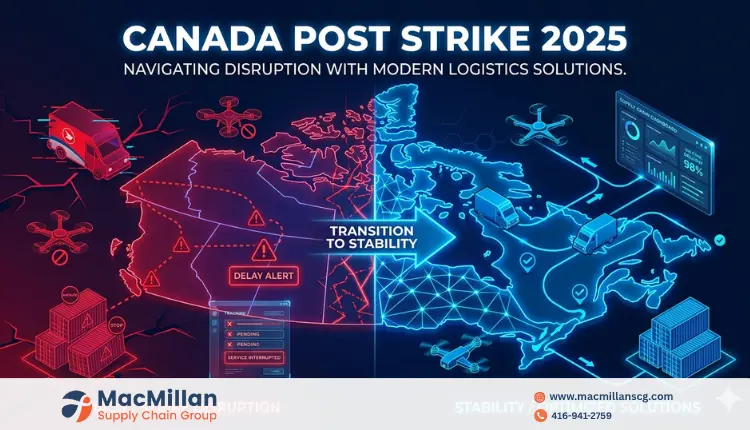
Businesses across Canada are facing major shipping disruptions due to the possible impending Canada Post strike 2025. Mail service across the country could be suspended if Canada Post and the Canadian Union of Postal Workers (CUPW) don’t reach a labor agreement by May 22. This thorough manual examines the existing state of affairs, possible effects on deliveries in both urban and rural areas, and workable business solutions. We offer doable solutions to reduce interruption, ranging from inventory buffering strategies to multi-carrier strategies with substitute providers like Purolator and GoBolt. Find out how MacMillan Supply Chain Group can safeguard your company’s operations in the event of postal service outages. The possibility of a Canada Post strike has many Canadian businesses concerned about continuity in their shipping operations.Businesses must get ready for possible postal service interruptions that could affect deliveries across the country as the May 22 deadline for talks between Canada Post and the Canadian Union of Postal Workers draws near. A strike could result in delayed deliveries, disgruntled customers, and large revenue losses for companies that depend on prompt shipping, particularly those that serve rural areas or oversee e-commerce operations. Small and medium-sized businesses lost an estimated $1 billion in sales and incurred additional costs as a result of the most recent significant postal disruption. We’ll take you through the current labor negotiations in this guide, explain why it’s important for your company, and offer doable tactics to reduce any disruption in the event of a Canada Post strike. If you plan ahead, your company can overcome this obstacle. Understanding the Current Canada Post Labor Dispute The core of the ongoing conflict between CUPW and Canada Post revolves around a number of important issues that, if not settled by May 22, could lead to a strike. What specifically is the point of contention between postal employees and management? One of the main points of contention is weekend staffing models. While the union demands full-time positions to guarantee service reliability and improved worker benefits, Canada Post management wants to use part-time workers for weekend deliveries in order to control costs. This fundamentally different approach to workforce structure has led to a great deal of conflict. Another crucial issue is the distribution of workload. In addition to opposing mandatory overtime, the union wants better protections for rural delivery routes, which account for about 40% of Canada Post’s traffic. Rural carriers frequently encounter particular difficulties, such as longer routes and more challenging delivery circumstances. These negotiations have been mediated by the Industrial Inquiry Commission (IIC), which is expected to release its recommendations by May 15. Experts contend that a resolution prior to the deadline is still improbable, which raises the likelihood of a work stoppage. Knowing these labor negotiations puts the possible disruption in perspective for companies that ship goods. The conflict goes beyond pay; it also raises important issues regarding the proper functioning of Canada’s postal service, specifically how to balance the demands of delivery in rural and urban areas. Impact Assessment: How a Strike Would Affect Different Businesses Depending on your business model, location, and clientele, a Canada Post strike would cause different degrees of disruption. Prioritizing your contingency planning is made easier when you are aware of these possible effects. Rural Business Challenges When postal service is interrupted, rural communities suffer the most. For necessities like government communications and medical supplies, these regions rely significantly on Canada Post. Rural businesses and customers frequently have few backup options because of the high last-mile delivery costs, which limit their options for alternative carriers. This is your biggest weakness if you cater to rural markets. E-Commerce Operations A strike poses a threat to the entire fulfillment process for online retailers. Many small and medium-sized e-commerce companies reported sharp drops in sales during previous postal disruptions as customers were hesitant to place orders because they were unsure about shipping. Furthermore, during previous strikes, private carriers like FedEx and Purolator rapidly reached capacity, frequently limiting new customers and giving priority to their enterprise accounts. Time-Sensitive Shipments Businesses dealing with time-sensitive documents or perishable goods face particular challenges. Legal firms, financial services, and food producers may need to completely overhaul their distribution strategies during a strike. In these cases, having established relationships with alternative carriers becomes not just helpful but essential for business continuity. Alternative Carrier Solutions During Postal Disruptions Diversifying your shipping options becomes essential when dealing with possible Canada Post strike effects. A number of different carriers, each with unique benefits and drawbacks, can support your delivery operations. Key Alternative Carriers Purolator shipping is a great substitute for Canada Post because it provides wide coverage in both urban and rural areas. Being a Canada Post subsidiary, it continues to operate even during strikes, though it might impose volume restrictions when demand is particularly high. They are appropriate for companies shipping across the country due to their well-established infrastructure. With robust regional networks, TForce offers specialized e-commerce solutions. Their e-commerce knowledge makes them useful for online retailers, even though their prices might be higher for large shipments. UPS and FedEx provide worldwide network integration, but when capacity is limited, they usually give priority to their enterprise clients. These carriers are most effective for companies that ship internationally and have existing accounts. Implementing a Multi-Carrier Strategy Rather than relying on a single alternative, consider a multi-carrier approach that combines different providers based on delivery location, package size, and urgency. This approach optimizes expenses and reduces single-point failures. This strategy can be made more manageable by using third-party logistics platforms to simplify carrier rate comparison and integration. A proactive approach to business preparation Your company has the best chance of minimizing disruption if you act before a Canada Post strike happens. As part of your strike contingency plan, you can put these doable actions into action right now. Expand Your Carrier Connections As soon as possible, start assigning 30–40% of your shipping volume to non-Canada Post carriers. This achieves two important goals: it enables you to
How Canadian Auto Suppliers Can Adapt to New US Tariffs
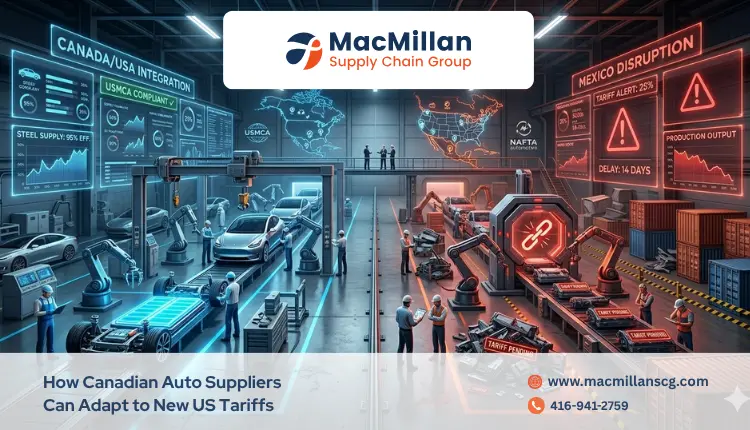
Automakers that use US/USMCA parts in US-assembled vehicles can receive rebates thanks to recent tariff adjustments made by President Donald Trump. Despite being intended to increase American manufacturing, these modifications pose serious difficulties for Canadian auto suppliers. For cars with 85% or more USMCA-compliant parts, the new system offers a 3.75% rebate in year one and a 2.5% rebate in year two. Non-compliant parts are subject to 25% tariffs. North American automotive supply chains are changing as a result of this policy change, and Canadian suppliers may lose contracts, experience cross-border issues, and see a decrease in exports. Through regional partnerships, EV market diversification, and RVC certification, Canadian auto suppliers can overcome these obstacles with strategic adaptation. Introduction The automotive industry across North America is experiencing a major shift following President Donald Trump’s executive order on tariffs. In April 2025, the administration introduced a system of rebates and penalties designed to incentivize US-assembled vehicles using parts from USMCA countries (United States, Mexico, and Canada). The integrated North American auto industry faces both opportunities and challenges as a result of this new strategy. The policy has repercussions across the supply chain, especially for Canadian auto suppliers who have historically been closely linked to US production, even though its goal is to boost domestic manufacturing in the US. These developments necessitate prompt attention and careful planning from Canadian auto suppliers. In addition to knowing how these tariff adjustments work, businesses also need to know how to best position themselves to stay competitive in this changing market. Let’s examine the implications of these modifications and how Canadian auto suppliers can adjust to this new situation. Understanding the New Tariff Structure for Canadian Auto Suppliers The Trump administration’s new tariff structure gives the automobile industry a carrot-and-stick strategy. For Canadian auto suppliers trying to negotiate this shifting environment, it is essential to comprehend these mechanics. A sliding scale governs the rebate structure. If at least 85% of the parts in a vehicle meet US/USMCA content requirements, automakers can get a 3.75% rebate of the vehicle’s MSRP between April 2025 and April 2026. This rebate drops to 2.5% the following year (May 2026–April 2027), which puts pressure on manufacturers to make quick adjustments. On the other hand, significant 25% tariffs on parts that don’t meet USMCA thresholds are imposed on non-compliant imports. Companies that prioritize domestic or USMCA-certified components, such as Ford and GM, are purposefully rewarded by this system. For instance, if a $40,000 car satisfies the regional content requirements, it may be eligible for a $1,500 rebate in the first year. Automakers are therefore financially motivated to carefully examine their supply chains and give preference to vendors who can assist them in reaching these benchmarks. Through the USMCA framework, the policy seeks to expedite the reshoring of vital automotive manufacturing while preserving a certain amount of flexibility. This implies that it is now more crucial than ever for Canadian auto suppliers to comprehend precisely how their parts fit into an automaker’s regional value content calculations. Immediate Challenges Faced by Canadian Auto Suppliers As these tariff changes go into effect, Canadian auto suppliers will face a number of immediate challenges. The biggest worry is that contracts may be lost as US automakers reevaluate their supplier relationships in an effort to increase their eligibility for rebates. Many Ontario-based producers of engines, transmissions, and other vital parts run the risk of being shut out if their goods don’t adhere to USMCA compliance requirements. Automakers might switch to Mexican or American suppliers who can assist them in meeting the 85% rebate threshold. Small and medium-sized businesses (SMEs), which lack the resources to swiftly modify their production processes, should be especially concerned about this. Another major obstacle is the complexity of cross-border supply chains. For many years, the automotive sector has used integrated production networks, in which components travel across borders several times while being manufactured. Each border crossing for non-compliant parts may result in additional expenses under the new tariff regime. For example, Canadian raw materials that are processed in the United States, put together in Mexico, and then brought back to the United States for the last stage of vehicle assembly may be subject to compounded tariffs at every stage. Another level of complexity is introduced by Canada’s retaliatory actions. EVs and high-end cars that did not comply with the USMCA were subject to matching 25% duties levied by the Canadian government. Despite being designed to safeguard domestic production, these countermeasures may further upset long-standing supply chains and limit Canadian auto suppliers’ access to the global market. Strategic Responses from Automakers and the Canadian Government In reaction to these tariff changes, major automakers are quickly changing their strategies. US-made parts are being given priority by Ford and General Motors, especially for expensive products like batteries, electric motors, and semiconductors. The goal of this reshoring initiative is to reach regional value content (RVC) requirements in order to be eligible for the available rebates. While they reevaluate their cost structures and supply chains, some manufacturers have even delayed providing investors with financial guidance. To illustrate the substantial influence these changes are having on business planning, GM, for example, postponed its earnings forecast to account for possible tariff-related expenses. Particular difficulties arise for Asian manufacturers who have production facilities in Canada. Honda’s Civic and Toyota’s RAV4, which are both built in Ontario, may lose market share in the US unless they greatly expand their USMCA-compliant content. Their Canadian auto suppliers are under pressure to either comply with compliance requirements or risk losing business as a result. In order to assist the automotive industry in adapting, the Canadian government has set up a $2 billion Strategic Response Fund. This fund helps with workforce training, technology advancements, and plant retooling. Industry analysts, however, wonder if this sum will be enough to handle the magnitude of change required, particularly to support the shift to electric vehicle manufacturing. The Canadian government’s retaliatory tariffs represent another strategic response, designed to protect domestic production
How Nearshoring Is Reshaping Canadian Supply Chains in 2025
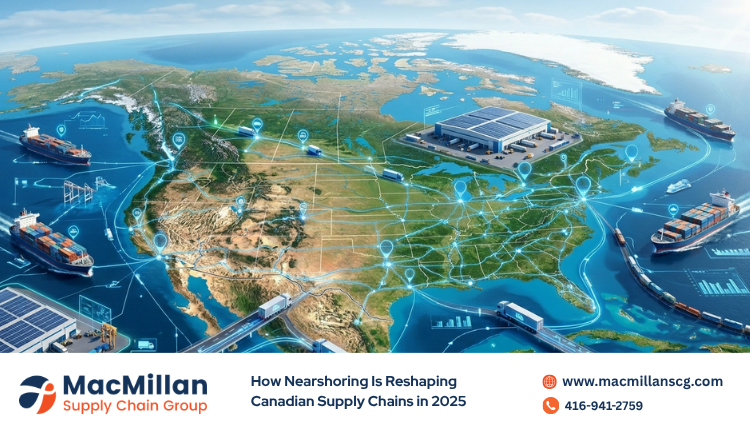
A Quick Summary and Overview Logistics in the region will be drastically altered by Canadian nearshoring, which is the deliberate relocation of manufacturing and supply chain activities closer to North American end markets, by 2025. The shift from Asia-centric production to regional hubs across Canada, the US, and Mexico is being accelerated by the USMCA trade agreement, post-pandemic lessons, and growing geopolitical risks. Canadian businesses encounter both new opportunities and challenges as manufacturing hubs appear, cross-border logistics change, and technology reimagines operations. MacMillan Supply Chain Group is spearheading this change by providing specialized logistics solutions that enable resilient, effective, and sustainable nearshoring tactics. Introduction Global supply chain dynamics are undergoing a dramatic change for the first time in decades. The movement of goods across North America has been redefined by Canadian nearshoring, which has become a dominant strategy by 2025. This shift signifies a fundamental realignment of supply chain priorities from global to regional and from long-haul to local. Businesses in Canada have unique opportunities as a result of the growth of Canadian nearshoring. The need for skilled logistics is growing as new manufacturing hubs are being established along corridors like Ontario’s. Businesses are looking for partners who are knowledgeable about local laws, international issues, and the cutting-edge technology required to oversee complex supply chains. At MacMillan Supply Chain Group, we are seeing the real-world impact of Canadian nearshoring every day. It’s more than relocating production—it’s transforming how goods are transported, stored, and delivered across North America. Let’s explore what this means for your business. The Growth of Canadian Nearshoring Canadian nearshoring is a top option for manufacturers in 2025 due to a number of factors. The USMCA agreement has improved the smoothness of trade throughout North America. Market access has been enhanced, tariffs have been lowered, and customs procedures have been made simpler. As a result, Canada is positioned as a key production location with easy access to American consumers. Canada’s political stability and intellectual property protections are more appealing than ever in light of the increasing instability in the world. Canada is now seen by high-tech manufacturers as a safe place to conduct sensitive R&D and production activities. The country’s skilled workforce, trained in automation, manufacturing, and supply chain management, is another key asset. With advanced production reshoring to North America, Canada’s educated talent pool supports innovation and efficiency. “Since 2023, we’ve seen a 35% spike in inquiries about Canadian warehousing,” says a MacMillan logistics analyst. “Businesses are looking for integrated solutions that connect Canadian production with North American markets.” This trend is especially visible along the Ontario transportation corridor, where industrial development has accelerated to support nearshoring demand. The corridor’s strategic location offers fast access to the US, along with top-tier infrastructure and labor quality. Cross-Border Logistics in the Age of Nearshoring As Canadian nearshoring accelerates, cross-border logistics are evolving rapidly. The flow of goods between Canada, the US, and Mexico is increasing, requiring more sophisticated logistics networks. Gone are the days of simple border trucking. Logistics firms now deploy multi-modal, tech-enabled strategies that optimize speed and cost. MacMillan Supply Chain Group offers fully integrated services linking Canadian production to US and Mexican distribution networks. Technology plays a major role. Real-time shipment tracking and automated customs documentation reduce delays and improve reliability. Companies can now manage international shipments with greater visibility and fewer disruptions. Border infrastructure has also improved. Investments in commercial lanes, pre-clearance programs, and automated inspections have eased congestion. Especially along Ontario’s corridor, crossing the border is now faster and more predictable. “The border isn’t the obstacle it once was,” explains a MacMillan expert. “With the right logistics partner, companies can treat the US-Canada border as just another stop.” This evolution in cross-border logistics is making Canadian nearshoring more attractive by removing traditional barriers and unlocking access to the broader North American market. Technology Enabling Canadian Nearshoring Technology has been instrumental in supporting the rise of Canadian nearshoring and managing the complexity of regional supply chains. Real-time visibility platforms are essential for tracking inventory and shipments from production to final delivery. For nearshored supply chains, this visibility is crucial for cross-border planning and maintaining delivery reliability. “Clients demand precise location updates,” says MacMillan’s tech director. “Our visibility platforms ensure they always know where goods are—whether in a Toronto warehouse or crossing into Michigan.” AI-powered freight platforms optimize routing by analyzing weather, traffic, and border wait times, enabling more efficient logistics. Automation tools—from robotic pickers to AI inventory systems—boost throughput and reduce manual labor in Canadian warehouses. Blockchain technology is increasingly used for supply chain documentation, creating transparent, secure records and simplifying compliance under USMCA. These tools have made Canadian nearshoring more viable, cost-effective, and scalable for companies seeking supply chain resilience and proximity to the North American customer base. Industry-Specific Effects of Canadian Nearshoring Different industries are experiencing the impacts of Canadian nearshoring in unique ways, and MacMillan Supply Chain Group is adapting to meet these evolving needs. The automotive sector, especially EV battery production, is leading the shift. EV batteries are heavy, sensitive, and expensive to ship globally—making nearshoring an ideal solution. Canada is becoming a key hub for EV battery production supporting US assembly plants. “Battery logistics require precision and safety,” says a MacMillan expert. “We’ve developed specialized solutions to handle these challenges across North America.” Pharmaceutical and medical device companies are also turning to Canada for production, drawn by strong regulation and a skilled workforce. These sectors need temperature control, detailed documentation, and secure transit—services that MacMillan provides with confidence. Consumer electronics firms are nearshoring final assembly to North America while keeping component sourcing global. This hybrid model needs agile logistics that coordinate inbound components and outbound distribution efficiently. Some businesses are adopting a North American nearshoring strategy, splitting production between Canada and Mexico based on each country’s strengths. MacMillan helps coordinate cross-border flows across the entire USMCA region. Challenges of Canadian Nearshoring Despite its benefits, Canadian nearshoring presents several operational challenges. Relocating production requires investment in new facilities, training, and equipment. The
US-China Tariff Deal: Impact on Canadian Supply Chains & Trade
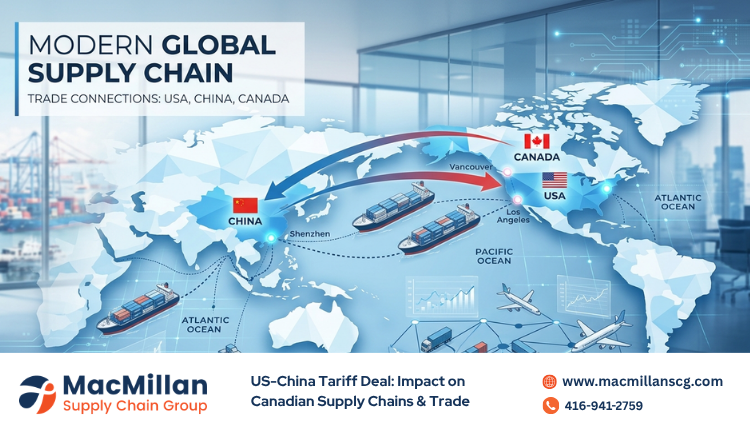
Recognizing How the US-China Tariff Deal Affects Canadian Companies Changes in trade policies by the two biggest economies in the world have an impact that goes well beyond their boundaries. With significant ramifications for Canadian companies and supply chains, the recent US-China tariff deal represents a significant change in the dynamics of global trade. This new agreement seeks to lower tariffs and loosen trade restrictions between these two economic titans following years of rising tensions in the US-China trade war. However, what does this entail for middle-tier Canadian businesses? What effects will these modifications have on your supply chain’s overall resilience, export prospects, and import strategy? MacMillan Supply Chain Group, a top 3PL supplier in Canada, is aware of the intricate difficulties these changes bring. We’ll analyze the main features of the US-China tariff deal, look at how it affects Canada’s economy, and provide helpful advice for negotiating this changing trade environment in this article. What’s Changing in the US-China Tariff Deal? The US-China tariff deal is the most recent development in a rocky trade relationship. Under this new agreement, both countries have agreed to significant tariff reductions after imposing tariffs as high as 25% on goods valued at hundreds of billions of dollars. However, what does the deal exactly include? Fundamentally, the deal lowers tariffs on thousands of goods that are traded between the two nations. In order to update your Canada import strategy, it is imperative that Canadian businesses comprehend these changes. A number of important topics are covered in the deal: Lower taxes on consumer goods, electronics, and industrial machinery Agricultural product restrictions were relaxed Promises to buy a certain amount of merchandise Clauses pertaining to intellectual property disputes Frameworks for addressing trade imbalances This isn’t a total overhaul of trade relations, though. The underlying tensions that led to the US-China trade war have not gone away, and many tariffs are still in effect. Consider this to be less of a comprehensive peace treaty and more of a bilateral tariff truce. These changes have an impact on supply chains in Canada. Price changes may occur for goods that pass through the US or contain Chinese components. Businesses that moved their sourcing out of China when tensions were at their highest now need to consider whether to change their approaches once more. The secret is to anticipate how this relationship may change in the future as well as to comprehend what is changing now. Canada’s Economic Impact: Opportunities and Challenges The US-China tariff deal has had a complex economic impact on Canada, posing opportunities and challenges for companies in a wide range of industries. Canada is in a unique position as these two significant trading partners modify their relationship. Positively, the economy of North America as a whole may benefit from lowered tensions between the US and China. Freer trade lowers manufacturing costs, which could help Canadian businesses that: Purchase parts for North American manufacturing from China Export completed goods to markets in China or the United States Connect these important economies by offering logistics services But there are also difficulties. Some manufacturers moved their operations to Canada during the height of the US-China trade war in order to avoid tariffs and keep access to North American markets. Now that tariffs have been lowered, this competitive edge might be lost. The environment for Canadian exporters is not uniform. Chinese suppliers may now present a fresh threat to those who increased their market share during the trade disputes. More reliable supply chains and lower prices for imported parts might help others. The effects differ greatly depending on the industry, with the automotive, electronics, and agricultural sectors all seeing different results. This changing environment necessitates careful consideration for companies in charge of Canadian supply chains. Which of your clients, vendors, or goods will be impacted by these changes in tariffs? What could your rivals say? Maintaining your competitive position in this changing trade environment requires that you respond to these questions. Rethinking Your Approach to Importing from Canada Now is the ideal moment to review your Canada import strategy because the US-China tariff deal is changing trade flows. Rapidly adapting businesses can benefit greatly in terms of price, dependability, and market responsiveness. Start by determining how exposed your present supply chain is to the dynamics of US-China trade: Which of your products have Chinese components? Do you use US middlemen or import straight from China? What effects have past tariff adjustments had on your lead times and expenses? The basis for a more robust strategy is this analysis. While keeping in touch with your most dependable Chinese partners, think about expanding your supplier base outside of China. This well-rounded strategy offers flexibility in the event that tariff escalation risks reappear. In this setting, logistics planning becomes even more important. You can access experience in navigating evolving customs regulations and determining the best trade routes by partnering with a seasoned 3PL like MacMillan Supply Chain Group. We assist clients in determining whether, in light of the new tariff structure, it makes more sense to route through US distribution centers or import directly from China. Modern import strategies heavily rely on technology. You can react swiftly to changes in tariffs by using digital tools for: Tracking shipments Handling customs paperwork Evaluating landed costs These systems offer the transparency required to make wise choices regarding inventory control, routing, and sourcing. Keep in mind that developing a competitive edge is the goal of import strategy, not merely cutting expenses. Businesses that understand the intricacies of global trade can outperform their rivals in terms of pricing, delivery dependability, and flexibility. Managing the New Market Realities for Canadian Exporters The US-China tariff deal alters the competitive environment for Canadian exporters, necessitating strategic adjustment. Maintaining and expanding your export business requires an understanding of how these changes impact your particular markets. The effects differ greatly by sector: US goods may reenter the Chinese market as a threat to agricultural exporters Manufacturers selling to the US may
Canada Trade Shift Away From U.S.: How Export Diversification Is Reshaping Canadian Trade
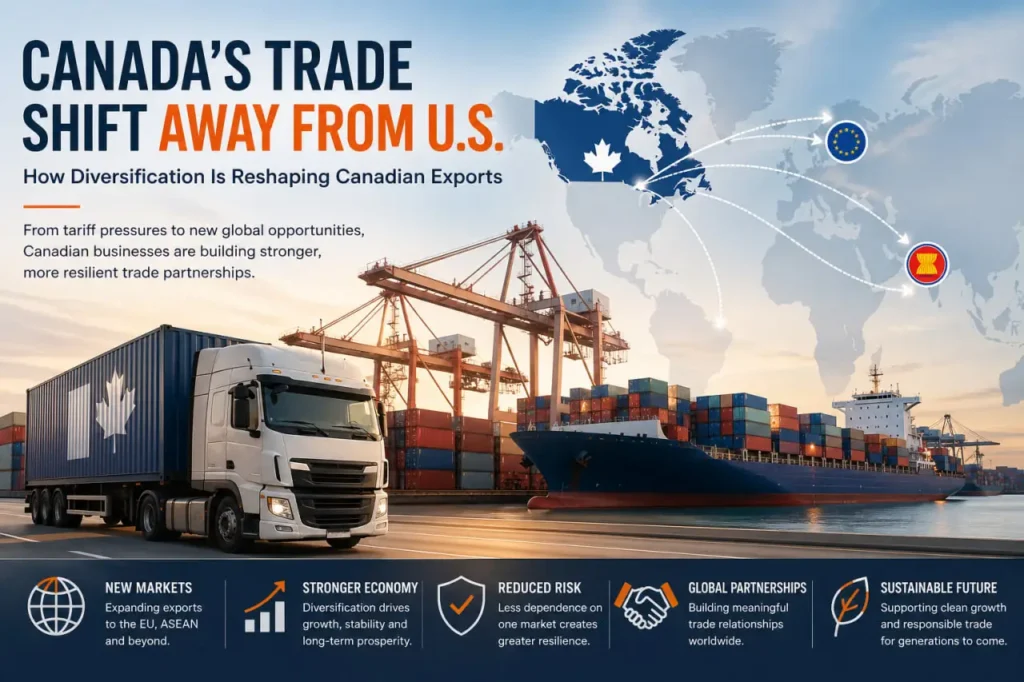
A Quick Summary and Overview Canada is undergoing a major trade transition as businesses reduce overreliance on the U.S. market and expand into Europe and Southeast Asia. The shift has been accelerated by tariff tensions, changing policy conditions, and the need for more resilient supply chains. As exporters explore new markets, sectors like clean tech, critical minerals, and agri-food are finding fresh demand. For Canadian businesses, this is not just a trade story. It is a logistics, warehousing, and distribution story too. MacMillan Supply Chain Group helps support that transition through warehousing, transportation, visibility, and export-ready supply chain execution. Why Canada’s Trade Landscape Is Changing For decades, Canada’s economy has been deeply tied to the United States. That relationship created scale and convenience, but it also created concentration risk. When tariffs, policy shifts, or trade disputes disrupt one dominant market, Canadian exporters feel the impact quickly. Your article frames this as a move away from a U.S.-centric export model toward a more diversified one, with more attention on Europe and ASEAN markets. That shift matters because diversification is no longer just a growth strategy. It is a resilience strategy. The Catalyst: U.S. Tariffs and Their Immediate Impact Recent tariff pressure has pushed Canadian exporters to rethink where and how they sell. Your draft explains that this change has affected multiple sectors and accelerated the need for diversification. It also positions this shift as a practical response to unpredictability in a historically dominant market. For many businesses, this has changed the conversation from “Should we diversify?” to “How fast can we build a more balanced export strategy?” New Growth Markets for Canadian Exporters As U.S. trade has become more uncertain, Canadian exporters have looked to other regions with strong results. Your article highlights the European Union and ASEAN countries as two of the most important growth areas, supported by trade agreements and rising demand across key sectors. Europe The EU has become a key destination for Canadian exporters looking for market stability and tariff advantages. CETA has played a major role by reducing trade barriers and opening more opportunities for Canadian businesses. Your article highlights gains in exports such as gold, crude oil, pharmaceutical ingredients, and critical minerals. Southeast Asia ASEAN markets are also becoming increasingly important. Your draft points to Thailand and other Southeast Asian markets as rising opportunities for agri-food, clean tech, and export diversification overall. Together, these regions show that Canada’s export future is becoming more geographically balanced. Sector-Specific Impacts of Canada’s Trade Diversification Clean Technology Clean tech appears to be one of the clearest beneficiaries of Canada’s trade diversification. Your article connects European climate policy and global demand for renewable and sustainable solutions with stronger export opportunities for Canadian clean tech businesses. Critical Minerals Critical minerals have become strategically important as global battery, electronics, and energy supply chains evolve. Your draft positions Canadian lithium and related mineral exports as especially relevant to Europe’s efforts to secure reliable supply outside traditional sources. Automotive The automotive sector has faced more complicated adaptation. Your article shows that some manufacturers are shifting production decisions and market strategies to deal with tariff exposure and changing trade economics. Agriculture Agriculture is another sector that has had to pivot quickly. Your article highlights how exporters have redirected products into new markets when traditional routes became less stable. Infrastructure Challenges Could Slow Canada’s Trade Shift Your article rightly points out that market diversification is not only about finding buyers. It also depends on whether Canada’s infrastructure can support the change. Port Capacity Canadian exporters need efficient port operations to support growing trade with Europe and Asia. Your draft identifies port bottlenecks as a real constraint on long-term diversification. Energy and Industrial Capacity As production grows to meet export demand, energy availability and industrial capacity also become major factors. Your article notes that this is especially relevant in export-heavy provinces. Digital Trade Infrastructure Modern export execution depends on visibility, documentation, customs coordination, and digital systems. Your article makes the case that digital trade tools are now essential, especially for small and mid-sized exporters entering unfamiliar markets. Common Challenges in Canada’s Export Diversification Trade diversification creates opportunity, but it also creates complexity. Your article identifies the most common obstacles businesses face when they expand beyond the U.S.: Higher logistics costs Shipping to Europe or Asia is usually more expensive than moving freight into the U.S. More complex compliance Each new market brings its own customs, labeling, documentation, and regulatory requirements. Longer cash cycles Longer transit times can create cash flow pressure, especially for smaller businesses. Currency exposure Multiple markets increase exchange-rate risk and forecasting complexity. Lower visibility across longer routes Tracking and managing overseas shipments is more demanding than regional cross-border freight. Language and business culture differences New markets often require more localized communication and relationship building. Internal Canadian trade friction Interprovincial barriers can still complicate export preparation and consolidation. How MacMillan Supply Chain Group Supports Trade Diversification This is where your article becomes commercially valuable. Instead of inserting MacMillan too early, it works best once the reader understands the operational difficulty of diversification. MacMillan SCG is positioned as a logistics partner that helps Canadian exporters adapt to a more global trade model through: Global logistics coordination Support for international shipping routes and container planning. Real-time supply chain visibility Tracking and visibility tools that help businesses manage more complex export movements. Customs and compliance support Help with documentation, market requirements, and smoother international movement. Warehousing and consolidation Strategically located warehousing and cross-docking that can improve export preparation and container utilization. Digital trade enablement Systems that reduce paperwork friction and improve documentation accuracy. How Businesses Can Diversify Exports More Successfully Research target markets carefully Look at demand, trade barriers, local standards, and buyer expectations before committing inventory. Start with test shipments Use smaller shipments to validate routing, compliance, and market response before scaling. Work with an experienced logistics partner A capable 3PL can reduce the learning curve, especially when new markets involve different customs, documentation, and shipping
7 Signs Your Brand Has Outgrown Its Current 3PL
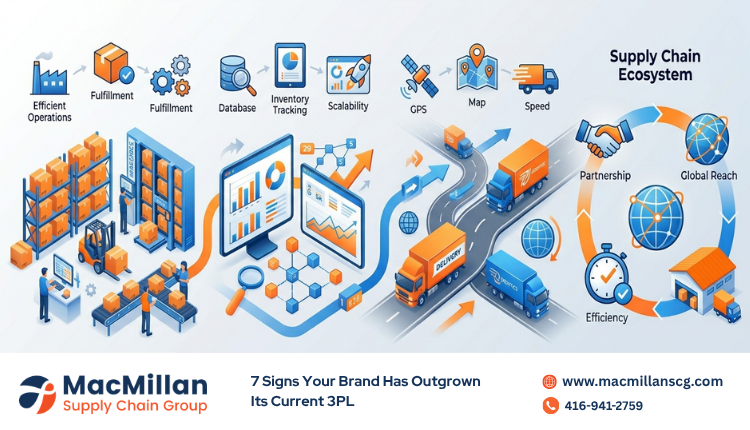
A Quick Summary and Overview Many brands do not realize they have outgrown their 3PL until service problems start affecting customer experience, retail relationships, and internal operations. What once worked at a smaller scale can become a growth bottleneck as SKU counts rise, channels expand, compliance requirements tighten, and promotions create higher operational pressure. The issue is not always that your current provider is bad. It is often that your business has evolved faster than their capabilities. If your team is dealing with delayed orders, weak visibility, compliance issues, slow communication, or trouble scaling during promotions, it may be time to reassess your logistics partner. MacMillan SCG is built for brands that need retail-ready warehousing, transportation coordination, real-time visibility, value-added services, and scalable support across channels. Introduction A 3PL partnership should make growth easier. It should reduce friction, improve visibility, and help your team move faster with more confidence. But when your provider can no longer keep pace, the symptoms show up everywhere. Inventory issues become more common. Customer complaints rise. Retail requirements feel harder to meet. Internal teams spend more time chasing updates, fixing exceptions, and working around the provider instead of focusing on growth. This is one of the most common inflection points for scaling brands. The challenge is that many businesses wait too long to act. They keep trying to patch operational problems that are actually signs of partner misalignment. If your 3PL was built for where your business used to be, not where it is going, you may already be paying for that gap in lost time, margin, and brand trust. Why Brands Outgrow Their 3PL Brands usually outgrow a 3PL for one of four reasons: order volume has increased product mix has become more complex sales channels have expanded customer and retailer expectations have risen A partner that handled simple DTC orders may struggle once you add retail compliance, subscription kits, launches, returns, and multi-channel fulfillment. Likewise, a provider that offered enough support at low volume may become too slow, too manual, or too opaque as your business scales. MacMillan’s site is positioned around solving exactly these scaling challenges through warehousing, transportation, ecommerce fulfillment, value-added services, integrations, and KPI-driven visibility. 7 Signs Your Brand Has Outgrown Its Current 3PL 1. You lack real-time visibility into inventory and orders If your team still waits for spreadsheets, manual updates, or delayed exception reports, your operation is already behind. As volume grows, visibility becomes essential for managing stock, customer service, launches, and replenishment. A modern 3PL should give you better control over: current inventory status order flow across channels shipment milestones exception tracking KPI reporting MacMillan emphasizes real-time visibility through its WMS-backed systems, client portal access, and performance tracking, giving brands more control over inventory and fulfillment decisions. 2. Your provider struggles during promotions or peak seasons A 3PL that performs adequately during regular weeks may break under pressure when volumes spike. This often shows up during seasonal campaigns, product launches, holiday peaks, or influencer-driven demand surges. Warning signs include: slower pick and pack times missed shipping cutoffs rising error rates delayed replenishment poor communication during high-volume periods MacMillan highlights support for promotional volumes, seasonal peaks, special campaigns, and launch readiness across its warehousing and value-added service pages. 3. They cannot support your growing channel mix Many brands start with one channel and later expand into retail, marketplaces, wholesale, or subscription models. That adds complexity fast. If your 3PL is built only for simple parcel fulfillment, you may run into issues with: retail routing and compliance multi-address order flows shared inventory allocation retailer-specific labeling B2B and DTC fulfillment from one pool MacMillan positions itself as a multi-channel logistics partner with support for retail, ecommerce, and value-added workflows under one roof. 4. Retail compliance problems are becoming more frequent Chargebacks, rejections, missed ASNs, incorrect labels, and poor pallet builds are not just execution mistakes. They are signs that your provider may not be equipped for retail precision. MacMillan’s warehousing capabilities specifically mention compliance with retailer requirements including pallet height, label requirements, carton orientation, and ASN accuracy, helping brands reduce chargebacks and delivery rejections. If your current 3PL is creating retail friction instead of reducing it, that is a major signal that the partnership is no longer the right fit. 5. They cannot handle customization, kitting, or special projects well As brands grow, operations become less standardized. You may need bundles, inserts, seasonal kits, subscription assemblies, gift packaging, relabeling, or retailer-specific configurations. If your provider treats these needs as disruptions instead of built-in capabilities, growth gets harder than it should be. MacMillan’s value-added services include kitting, inserts, promotional packaging, GS1 barcodes, bilingual packaging, relabeling, and display assembly, which are all useful for brands running more complex programs. 6. Communication feels reactive instead of proactive A strong 3PL should not wait for you to discover a problem. It should flag issues early, communicate clearly, and give your team confidence that operations are under control. You may have outgrown your current provider if: response times are inconsistent issue ownership is unclear exceptions are communicated late reporting feels incomplete your team is chasing answers constantly MacMillan’s positioning emphasizes transparency, honest reporting, proactive updates, and partnership-oriented service, which is exactly what growth-stage brands need from a logistics provider. 7. Their performance no longer matches your brand standards At a certain point, the question becomes simple: does this provider still support the brand experience and operating discipline your business needs? That includes: order accuracy shipping accuracy on-time performance inventory accuracy customer experience consistency MacMillan’s KPI positioning includes 99.56% inventory accuracy, 99.5% perfect order rate, 99% on-time and in-full shipments, and 99.9% shipping accuracy. Those are the kinds of measurable benchmarks brands should look for when evaluating whether a provider can support the next stage of growth. What Happens When You Stay Too Long Many brands delay switching because changing 3PLs feels disruptive. But staying with the wrong provider often costs more over time. The hidden costs usually include: more internal firefighting higher support burden