
Canada’s Strategic Response to Trump’s Reciprocal Tariffs | Supply Chain Impact
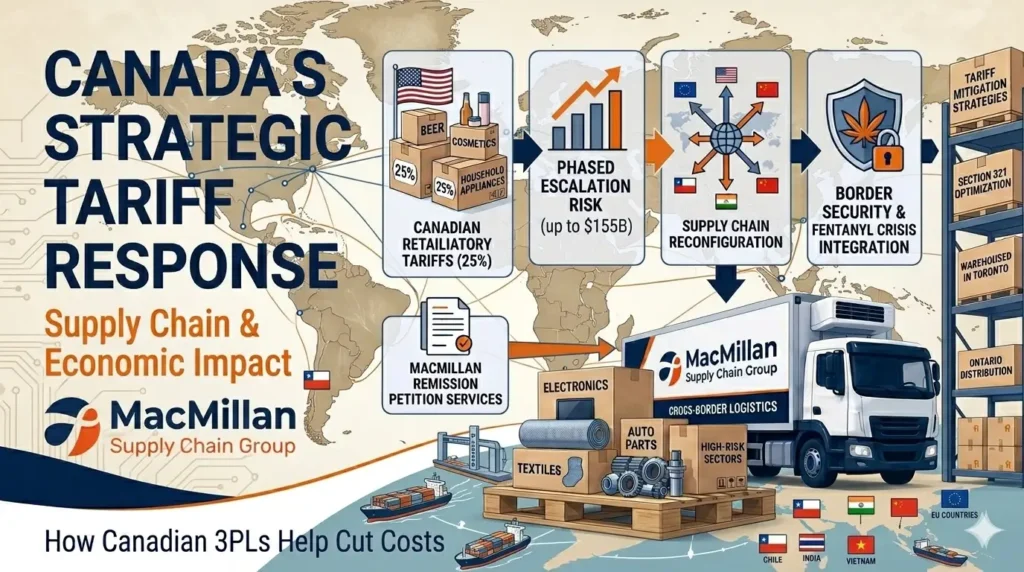
A Quick Summary and Overview In a strong response to President Trump’s massive “reciprocal” tariffs, Canada announced 25% duties on $30 billion worth of American goods, which could rise to $155 billion if U.S. actions continue. Although economic factors like factory reshoring also play a part, border security issues particularly the fentanyl crisis are at the heart of this trade disagreement. The debate poses a threat to the USMCA pact, raises consumer prices, and disrupts supply networks. While maintaining diplomatic efforts to settle the conflict, both countries have put policies in place to safeguard their own sectors. Businesses conducting cross border trade in this unpredictable climate must understand these developments. Introduction The United States-Canada trade relationship is currently dealing with its biggest obstacle in a long time. Citing border security and fentanyl trafficking fears, President Trump has placed new “reciprocal” tariffs on Canadian goods. Canada has responded by announcing a phased strategy of retaliatory tariffs that may eventually affect U.S. exports worth up to $155 billion. Businesses on both sides of the border will be significantly impacted by this intensifying trade war. Decades-old supply networks are suddenly being disrupted, costs are increasing, and businesses need to quickly adjust to the new economic climate. The USMCA pact, which was designed to guarantee stable trade relations between the two countries, is also put to the test by this conflict. For Canadian businesses and those engaged in US-Canada trade, understanding the scope, causes, and potential outcomes of this dispute is essential for strategic planning. Let’s examine the situation and its implications for your business operations. Comprehending the New Tariffs in Canada There are two different stages to Canada’s reaction to Trump’s tariffs. About $30 billion worth of American goods are subject to 25% tariffs under the first phase, which is now in place. These initial retaliatory tariffs strategically target products with political significance in the U.S., including orange juice from Florida, beer from various states, household appliances, cosmetics, and pulp/paper products. The careful choice of these Canada tariffs is what gives them their unique impact. Products that will generate pressure points in politically sensitive areas of the United States have been selected by the Canadian government. Targeting agricultural items, for instance, has an impact on farming communities, which frequently hold considerable political influence. The mechanics of these tariffs are straightforward: when these American products cross the Canadian border, importers must pay an additional 25% tax.This raises the cost of U.S. goods for Canadian companies and consumers, which may lower demand and cause purchases to shift to domestic or other foreign providers. Canada is willing to carry out a second round of retaliatory measures that would extend to cover up to $125 billion in more American goods if the U.S. keeps its tariffs in place. The economic impact of the trade conflict would be greatly increased by this second phase, which would target electronics, cattle, dairy goods, and electric vehicles. Impact on US-Canada Trade Relations The US-Canada trade relationship has historically been one of the world’s largest and most integrated. Bilateral commerce in goods and services was valued at over $800 billion in 2023. Because of this deep economic connectivity, tariffs have an impact on interconnected supply chains as well as individual items. The current trade war poses several risks to this cooperation.. Initially, it upsets long-standing supply chains that span the border several times throughout manufacturing. For instance, before a vehicle is finished, auto parts may cross the border seven times. New levies could now be applied to every crossing, increasing expenses. Second, companies preparing to expand or make investments are left in the dark by these interruptions. Businesses might put off making decisions until the trade environment calms down, which might hinder economic growth on both sides of the border. Third, the disagreement calls into question the basic principles of the USMCA, which was created to offer a secure framework for commerce within the region. Canada argues that the U.S. tariffs violate this agreement by avoiding the established conflict resolution procedures. This undermines confidence in the North American trade deal. These developments necessitate rapid attention to pricing strategies, supply chain resilience, and possible market diversification for companies involved in cross-border trade in order to reduce risks. The Link Between Fentanyl and Border Security The way the United States has connected tariffs to border security issues, specifically fentanyl trafficking, is an unusual aspect of this trade war. The Trump administration asserts that the flow of illegal drugs into the United States is facilitated by Canada’s inadequate border security practices. With thousands of American lives lost, the fentanyl pandemic is a powerful political issue. The U.S. administration has complicated what could otherwise be a simple commercial issue by linking trade policy to this public health disaster. Canada has responded to these concerns by appointing Kevin Brosseau as a dedicated “fentanyl czar” to coordinate anti-trafficking efforts.In order to strengthen law enforcement’s ability to combat drug smuggling, the Canadian government has also labeled seven transnational criminal groups as terrorist entities. However, Canadian officials dispute the American portrayal of the problem, pointing out that less than 1% of fentanyl entering the US goes via Canada. According to Canadian data, the majority of illegal fentanyl in the United States comes from Mexico or enters the country straight from China. Because it shifts the conflict from typical economic negotiations to more extensive diplomatic and security cooperation, this security dimension makes efforts at resolution more difficult. This implies that for companies, the route to tariff removal can rely on advancements in fields unrelated to normal business concerns. Canada’s Support for Affected Industries The Canadian government has put in place a number of support systems for industries impacted by both U.S. tariffs and Canada’s retaliatory actions in recognition of the possible harm to domestic companies. The remission procedure, which enables Canadian businesses to ask for exemptions or relief from retaliatory tariffs if doing so would significantly damage their operations, is at the heart of this support. This procedure recognizes that
New Tariff Bill & Recession Risks: How Canadian 3PLs Help Cut Costs | MacMillan Supply Chain
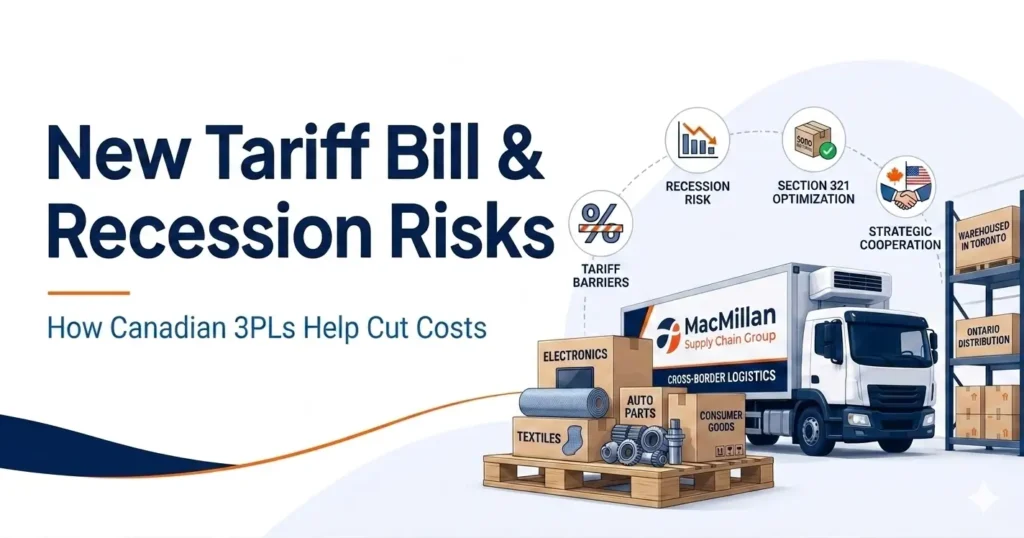
A quick summary and overview Businesses incur increased expenses that may jeopardize profitability when governments impose tariffs on imported goods. Businesses on both sides of the border now face additional difficulties as a result of the recent tariff bill that affects trade between the United States and Canada. These tariffs raise the risk of a recession when combined with earlier trade restrictions. Nonetheless, there is a strategic benefit to working with a Canadian 3PL like MacMillan Supply Chain Group. Our proficiency in warehouse management, Section 321 optimization, and cross-border logistics can assist you in overcoming these obstacles while cutting expenses. This article describes how our 3PL services in Toronto, Ontario, and throughout Canada can shield your company from the effects of tariffs and the dangers of a recession. Introduction The implementation of new tariffs between the United States and Canada in early 2025 brought about significant changes to the trade landscape in North America. Supply chains on both sides of the border have been impacted by these tariffs, which were imposed to address a number of political and economic issues. These new tariffs, when paired with earlier trade restrictions, pose a significant threat to companies that depend on cross-border trade. Complicated compliance requirements, higher expenses, and delayed shipments can reduce profit margins and possibly trigger a recession or slowdown in the economy as a whole. The good news is that your company can overcome these obstacles by collaborating with a strategic 3PL partner in Canada. At MacMillan Supply Chain Group, we’ve created customized solutions to assist businesses in reducing the effects of tariffs, streamlining their logistics processes, and utilizing clauses like Section 321 to keep prices competitive. This post will explain the recession risks, break down the new tariff situation, and demonstrate how our 3PL services in Ontario, Toronto, and throughout Canada can help your company not only survive but flourish in this difficult climate. Understanding the New Tariff Landscape The rules for businesses operating across the U.S.-Canada border have been significantly altered by the recent tariff bill. Let’s examine the situation and the reasons it affects your company. A number of new tariffs imposed by the US on Canadian goods include: 25% tariffs on goods that aren’t covered by the USMCA 10% tariffs outside USMCA preferences on Canadian potash and energy products Exemptions for products that fulfill the requirements of the USMCA rules of origin Canada didn’t do nothing in response. Retaliatory 25% tariffs were imposed by the Canadian government on US imports valued at about $29.8 billion. These countermeasures target a variety of products, such as consumer goods, agricultural products, steel, and aluminum. This trade tension creates significant challenges for businesses on both sides of the border. If you’re importing or exporting across the U.S.-Canada border, you’re likely feeling the pinch in several ways: Higher prices for both raw materials and completed goods; more complicated requirements for customs documentation; longer border clearance times; and uncertainty regarding future trade policies These tariffs pose a significant risk to the profitability of numerous businesses, making them more than just a minor annoyance. When faced with an additional 25% cost on essential imports, a company that had previously operated with healthy margins may find it difficult to maintain profitability. A strategic alliance with a 3PL Canada provider is extremely beneficial in this situation. You can create plans to reduce tariff effects and preserve your competitive advantage with the correct logistics partner. How Tariffs Contribute to Recession Risks Economic theory and historical data support the link between tariffs and recessions. It is easier to understand why the current tariff situation raises recessionary concerns when one is aware of this relationship. Several detrimental economic effects usually occur when tariffs raise the price of goods: Higher consumer prices – Companies frequently pass on tariff costs to consumers, which lowers their purchasing power and spending power. Decreased business investment – Businesses that are confronted with uncertain trade conditions often postpone plans for expansion and capital expenditures. Disruptions to the supply chain – Established supply networks become less effective as companies scramble to find alternative sourcing. As demonstrated by Canada’s response, retaliatory actions frequently follow tariffs, resulting in a vicious cycle of increasing trade restrictions. These elements work together to produce formidable obstacles to economic expansion. The economy may contract and possibly enter a recession if both consumers and businesses reduce their spending. Since many economists are already seeing warning signs in the overall economy, the current situation is especially worrisome. The risk of an economic contraction is increased when tariff pressures are added to already-existing difficulties. This implies that you must take proactive measures to control expenses and preserve operational flexibility for your company. Engaging with a 3PL warehouse in Toronto or Ontario provides you with access to key locations and knowledge that can make overcoming these obstacles easier. You can quickly adjust to shifting trade conditions and maintain a seamless supply chain by working with MacMillan Supply Chain Group, a logistics partner that is knowledgeable about both the Canadian and American markets. Section 321: A Strategic Possibility Section 321 of the U.S. Tariff Act is one of the most effective instruments for reducing the effects of tariffs. This clause permits shipments worth $800 or less to enter the country duty-free, which presents a big opportunity for companies that know how to take advantage of it properly Section 321 offers several key benefits: Duty-free importation for qualifying shipments No merchandise processing fees Streamlined customs clearance for eligible shipments Reduced paperwork requirements For e-commerce businesses and companies that ship directly to consumers in the U.S., Section 321 represents a valuable opportunity to avoid tariffs entirely on many shipments. However, careful preparation and execution are necessary to fully benefit. A Canadian 3PL partner is crucial in this situation. We at MacMillan Supply Chain Group have created unique procedures to help our customers get the most out of Section 321: Strategic order splitting – We assist in organizing shipments to maintain effective delivery while staying below the $800
How Food & Beverage Brands Can Reduce Spoilage, Delays, and Retail Risk in 2026
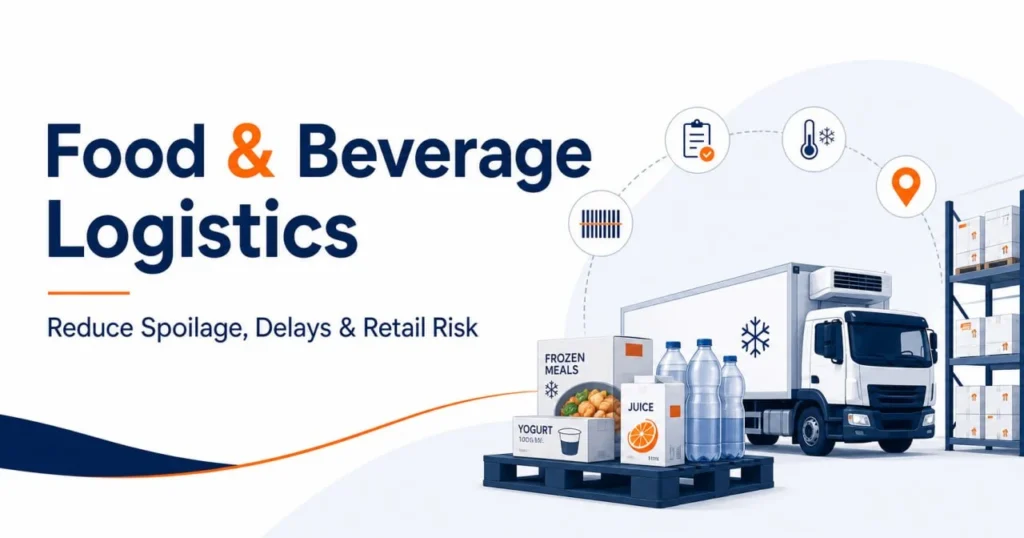
A Quick Summary and Overview Food and beverage brands in 2026 are under pressure to protect shelf life, reduce spoilage, improve traceability, and meet stricter retailer expectations. Strong logistics performance now depends on more than moving product quickly. It depends on controlled storage, accurate lot and expiry tracking, retail-ready execution, and real-time visibility across the supply chain. MacMillan’s food and beverage logistics offering is built around these needs, with SQF and GMP-certified, HACCP-compliant warehousing, temperature-maintained environments, lot control, expiry tracking, and real-time delivery visibility. Introduction In food and beverage logistics, a delay is rarely just a delay. It can shorten shelf life, increase spoilage, create a retailer compliance issue, or leave shelves empty when demand is highest. That is why food and beverage brands need more than basic storage and transport. They need logistics built around product integrity, visibility, and execution from inbound receipt to final delivery. Industry coverage continues to highlight traceability, cold chain performance, and stronger compliance expectations as major priorities in 2026. For MacMillan, this topic is a natural fit. The company’s food and beverage capabilities already focus on temperature-controlled handling, inventory accuracy, lot and expiry tracking, retailer-ready fulfillment, and reliable transportation execution across Canada. Why This Topic Matters More in 2026 Food and beverage logistics is getting more demanding because brands are balancing freshness, compliance, traceability, and speed at the same time. Product integrity has to be maintained across storage, handling, picking, staging, and transport. Retailers are also expecting more precise execution, while brands need tighter control over lot tracking, shelf life, and replenishment timing. Recent industry reporting emphasizes that food supply chains are facing growing pressure around food safety, traceability, and operational responsiveness. For brands, that creates a few urgent questions: how do we reduce spoilage without overstocking how do we improve lot and expiry visibility how do we avoid delivery issues that reduce saleable shelf life how do we stay retail-ready without slowing down fulfillment These are the areas where a strong logistics partner can make a measurable difference. The 5 Biggest Risks Food & Beverage Brands Need to Control 1. Spoilage from weak temperature and handling control Spoilage risk does not begin only when temperatures fail. It can also come from slow receiving, poor staging, inconsistent handling, and delays between inbound receipt and controlled storage. Cold chain integrity matters because even short exposure or poor process discipline can affect freshness, safety, and usable shelf life. Industry coverage continues to stress the importance of end-to-end temperature control and monitoring in food logistics. MacMillan’s food and beverage logistics service emphasizes temperature-maintained warehousing environments designed to preserve product quality and integrity. 2. Poor lot, batch, and expiry visibility Traceability is essential in food and beverage logistics, but visibility alone is not enough. Brands need to know where product is, which lots are aging, which inventory should move first, and how quickly they can isolate an issue if one arises. Strong lot and expiry visibility supports recall readiness, better inventory rotation, and lower write-off risk. Industry reporting continues to highlight traceability as a major requirement in food supply chains. MacMillan already positions lot control and expiry date tracking as core parts of its food and beverage logistics capability. 3. Retail compliance failures before delivery A shipment can leave the warehouse on time and still fail at retail. Incorrect labeling, missed ASN requirements, wrong pallet configuration, or failure to meet retailer-specific receiving standards can all lead to rejected deliveries or lost shelf time. For food and beverage brands, that can quickly turn into spoilage, margin loss, and weaker service performance. MacMillan’s warehousing and value-added services are built around retailer readiness, including labeling, compliance-focused prep, and execution aligned with retail requirements. 4. Forecasting errors that create waste or stockouts Food and beverage brands deal with promotion spikes, seasonal demand, expiry windows, and fast replenishment cycles. When forecasting is weak, the result is usually one of two problems: too much stock, which drives spoilage and carrying cost, or too little stock, which drives missed sales and rushed replenishment. Current industry coverage points to better forecasting and smarter operational planning as critical to reducing waste and improving resilience. MacMillan’s broader service positioning also highlights data-driven inventory visibility and systems designed to support faster, more informed logistics decisions. 5. Slow exception handling Visibility only creates value when it leads to action. If a shipment is delayed, a lot is aging, a retailer requirement changes, or a storage issue appears, brands need fast response. Slow exception handling is one of the easiest ways to lose sellable inventory without noticing until the cost is already locked in. Real-time tracking and operational transparency are increasingly important because supply chains need faster intervention when something changes. MacMillan’s transportation and fulfillment capabilities emphasize real-time tracking, milestone updates, and operational visibility that help teams respond earlier and with more confidence. How Food & Beverage Brands Can Reduce Spoilage, Delays, and Retail Risk 1. Build inventory flow around FEFO In food and beverage logistics, FEFO is often more useful than basic FIFO because expiry risk matters more than receipt order alone. The right inventory needs to move first, especially when multiple lots, multiple facilities, or promotional volumes are involved. MacMillan’s lot and expiry tracking capabilities support more disciplined inventory rotation and better freshness protection. 2. Tighten the gap between receipt and storage Product protection starts at inbound. Faster receiving, scanning, checking, and put-away help protect quality and reduce the risk of avoidable shelf-life loss. This is especially important for sensitive products and high-turnover categories. MacMillan’s warehousing model is built around operational speed, traceability, and product integrity from the moment inventory enters the facility. 3. Treat retailer readiness as part of product protection Retail execution is not separate from food quality. A rejected or delayed shipment can reduce usable shelf life just as quickly as a cold chain issue. Brands need logistics workflows that prepare orders for retailer requirements before the truck leaves the dock. MacMillan supports this through retailer-focused warehousing, labeling, ASN accuracy, and value-added preparation aligned to
Driving Change: What Trump’s Proposed Auto Tariffs Could Mean for Canada’s Automotive Supply Chain
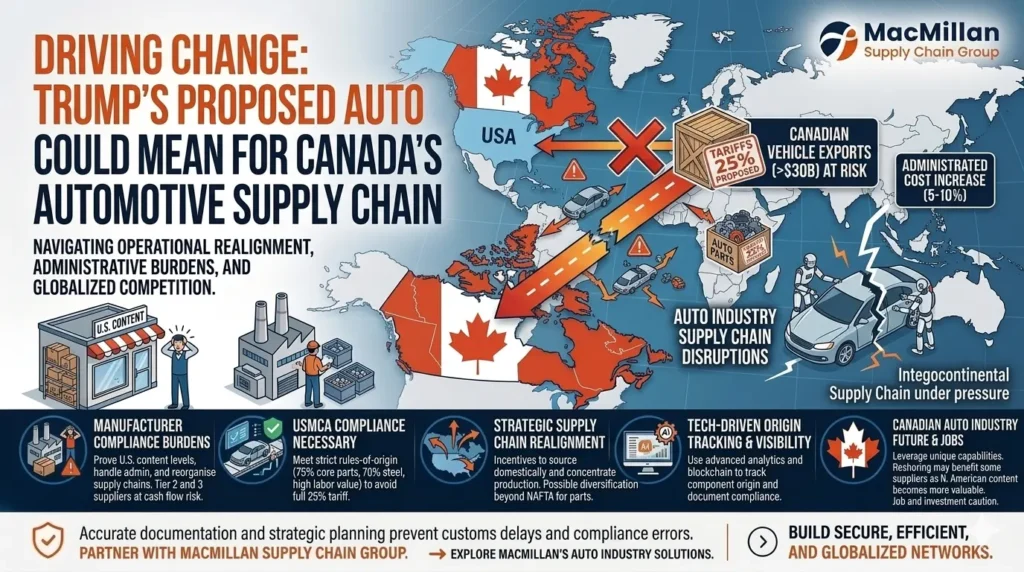
Trump’s Proposed Auto Tariffs and Canada’s Automotive Future Donald Trump, the former president of the United States, has suggested imposing a 25% tariff on imported automobiles and auto parts, which could revolutionize the automotive industry in Canada. The highly intertwined Canadian-American auto industry, where billions of parts and automobiles cross the border each year, would be greatly impacted by this policy. Vehicles that comply with the USMCA may be partially exempt, but Canadian manufacturers must demonstrate U.S. content levels, handle additional administrative requirements, and possibly reorganize supply chains. The MacMillan Supply Chain Group looks at how these tariffs might change the auto industry in North America, what steps need to be taken to comply, and how Canadian suppliers can adjust to stay competitive in this shifting trade landscape. Understanding the Impact of Trump’s Proposed Auto Tariffs The automotive industry is about to undergo significant change, and Canadian manufacturers must be aware of this. The North American auto manufacturing network would be impacted by Trump’s proposed auto tariffs, which would impose a 25% tax on cars and parts entering the country. These tariffs pose a serious threat to the status quo for Canada, which exports more than $30 billion worth of automobile goods to the United States each year. With parts frequently traveling across borders several times before a vehicle is finished, the Canadian auto industry has prospered as a component of an integrated continental supply chain. This smooth movement might become more difficult and expensive under the proposed tariffs. Vehicles that fulfill USMCA requirements might be eligible for partial exemptions, but demonstrating compliance necessitates additional paperwork and verification. We at MacMillan Supply Chain Group are aware of how important these developments are. Let’s examine how these changes may affect cross-border auto manufacturing, what they mean for Canadian auto suppliers, and what tactics can be used to deal with this changing environment. How Trump’s Suggested Auto Tariffs Work A significant change in North American trade relations is reflected in Trump’s proposed auto tariffs.Amid national security concerns, these tariffs would impose a 25% tax on imported cars and parts under Section 232 of the Trade Expansion Act. But, what does this really mean for Canadian Manufacturers? How the Tariffs Would Work Vehicles are treated differently depending on their origin and content thanks to the tariff structure’s tiered system: Vehicles from Europe and Asia that are not covered by the USMCA would be subject to a full 25% tariff on their total value. Only the non-U.S. content of USMCA-compliant vehicles would be subject to tariffs; precise tracking of part origins is necessary for calculation methods. For instance, tariffs would be applied to the remaining 70% ($42,000) of a $60,000 car built in Canada that has 30% U.S. content, resulting in a $10,500 tariff. The economics of cross-border manufacturing are significantly altered by this. According to the implementation timeline, procedures should be in place by June 2025, which leaves businesses with little time to adjust. This calls for a quick review of content sources and supply chains for Canadian auto suppliers. One should not undervalue the administrative burden. Systems for monitoring and certifying the percentage of U.S. content in each component and completed vehicle must be put in place by businesses. This calls for spending money on supply chain visibility tools and documentation systems, which many smaller Canadian parts manufacturers might not have at the moment. USMCA Compliance: The Secret to Effective Tariff Management USMCA compliance is now a business survival strategy for Canadian auto parts manufacturers rather than just a legal necessity. It is now crucial to comprehend the intricate regulations that establish whether a product is eligible for preferential treatment. Critical USMCA Requirements Vehicles must fulfill a number of requirements in order to be eligible for tariff exemptions under the USMCA: 75% of essential components must be made in North America; 70% of steel and aluminum must be obtained locally; and 40–45% of the content must come from businesses that pay employees at least $16 per hour. Many Canadian auto suppliers that source materials from around the world will find it difficult to comply with these thresholds, which are a major increase over earlier NAFTA requirements. Another level of complexity is introduced by the certification procedure. Although USMCA takes a more flexible approach than NAFTA’s formal certificates of origin, it still necessitates thorough documentation.Companies must maintain comprehensive records that specify where each component comes from and what value additions were made in North America. This presents a dual challenge for smaller Canadian parts manufacturers, who must put in place reliable tracking systems in addition to adhering to stricter content requirements. As automakers look for suppliers who can help them avoid tariffs, those who are unable to certify North American content may find themselves at a significant competitive disadvantage. According to industry experts, many auto suppliers have already seen a 5–10% increase in administrative costs as a result of USMCA compliance costs. Businesses must balance these compliance expenses against possible tariff savings in light of the additional pressure from tariffs. Reshaping Cross-Border Supply Chains The way North American automotive supply chains function may be drastically changed by the proposed tariffs. The current system permits parts to cross borders several times during production because it is based on decades of integration. Under new tariff structures, this effective model might no longer be financially viable. Possible Disruptions to the Supply Chain Just-in-time delivery methods, which reduce inventory costs, are crucial to the production of automobiles in Canada. These carefully calibrated systems could be upset by tariffs in a number of ways: Delays at the border due to heightened customs scrutiny; higher inventory costs as businesses prepare for unforeseen events There are incentives to source more components domestically and pressure to concentrate production on one side of the border. Early indications of supply chain diversification are already visible as businesses make backup plans. Some Canadian automakers are looking into opening or growing their operations in the United States, especially for expensive parts that would be
Canadian Supply Chains Under Fire: Navigating the 2025 US-China Trade War
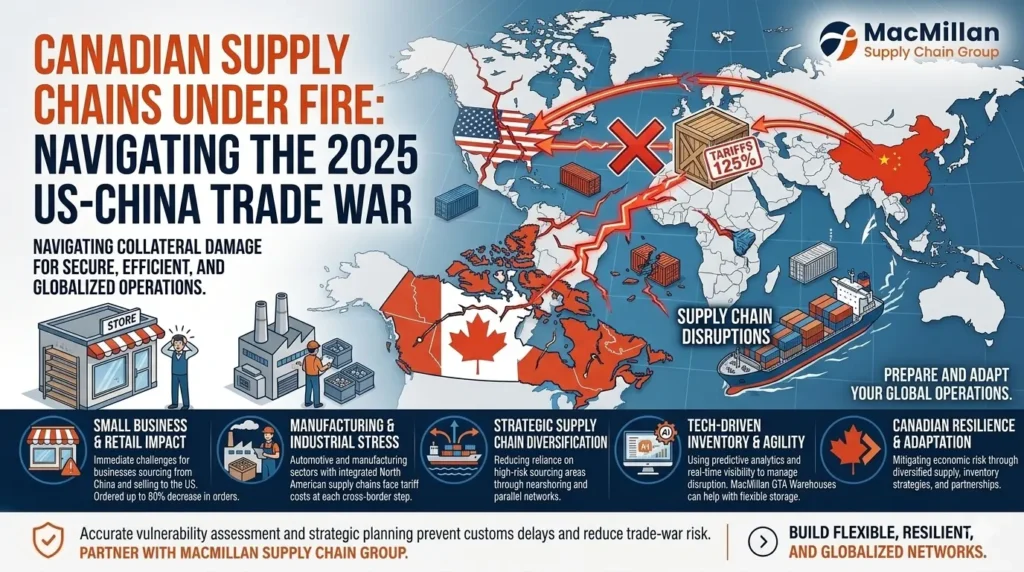
With tariffs on Chinese imports to the US rising to 125% in, the US-China trade war 2025 has escalated to unprecedented levels. Canadian companies are caught in the crossfire even though the country isn’t specifically targeted. For businesses that depend on cross-border trade, this economic conflict threatens market access, raises costs, and disrupts supply chains. While larger businesses struggle with operational disruptions, small retailers who source from China and sell to the US face immediate challenges. Important industries like forestry, textiles, and electronics are especially at risk. This article examines how the trade war has affected Canadian supply chains and provides useful advice for companies looking to weather these choppy waters. Caught in the Crossfire: What the US-China Trade War 2025 Means for Canadian Supply Chains In 2025, the US-China trade war has escalated significantly, sending shockwaves well beyond the boundaries of these two economic superpowers. Despite not being the direct targets, Canadian companies are suffering severe collateral damage as a result of the United States’ imposing tariffs of up to 125% on Chinese goods. Supply chains that Canadian businesses have depended on for decades are being disrupted by this economic conflict, which is also changing patterns of international trade. The impact is getting harder to ignore for companies all over Canada, from manufacturing behemoths in Ontario to tiny retailers in British Columbia. As the ripple effects spread throughout interconnected global markets, even businesses without direct ties to China are impacted. Canadian supply chains face previously unheard-of difficulties as tariffs raise prices and cause uncertainty, necessitating innovative solutions and strategic adaptation. Let’s explore how this trade war is affecting Canadian businesses, which sectors are most vulnerable, and what strategies companies can implement to protect themselves in this volatile environment. Understanding the US-China Trade War 2025: A Perfect Storm It took time for the US and China to develop the current trade tensions. They are the result of years of conflicting global aspirations, political disagreements, and economic rivalry. International trade relations are in a perfect storm in 2025 due to a number of factors. Targeting Chinese imports, the US has imposed a multi-tiered tariff system, with duties on some goods reaching 125%. Raw materials and completed goods, as well as textiles and electronics, are all impacted by these tariffs. Reducing the US trade deficit, preserving American jobs, and resolving national security issues pertaining to vital supply chains and technologies are among the stated objectives. China has retaliated with its own countermeasures, such as import restrictions and tariffs on American goods. For businesses around the world, long-term planning is very challenging due to the climate of uncertainty created by this tit-for-tat escalation. Because of our special position, the situation is especially difficult for Canadian businesses. With China as our second-largest trading partner and the United States as our largest, Canada maintains close economic ties with both nations. Canadian companies are frequently caught in the middle of these titans’ conflicts, with disruptions coming from both sides. As these trade tensions continue to reshape global commerce, many Canadian businesses are also exploring broader strategies to reduce reliance on traditional U.S. trade channels and diversify their international supply chain networks. Another level of complexity is introduced by the unpredictable nature of policy changes. Businesses are frequently given little notice when new tariffs or trade restrictions are announced, leaving them with little time to adjust. Instead of adhering to meticulously crafted strategic plans, this volatility compels businesses to function in a reactive manner. Canada Supply Chain Impact,Who’s Suffering The ways that the US-China trade war 2025 has affected Canadian supply chains differ greatly depending on the kind of business and industry. It is essential to comprehend these effects in order to create efficient response plans. Small and Medium-Sized Businesses Small manufacturers and retailers are especially at risk. They are directly in the crossfire since many import goods or materials from China and resell them in the US market. For instance, a clothing company based in Vancouver that imports fabrics from China and exports completed clothing to the US now has to deal with increased expenses at both ends of their supply chain. Uncertainty and growing expenses have caused some small businesses to halt up to 80% of their Chinese orders. Usually, these smaller businesses don’t have the resources to switch suppliers or markets quickly. They frequently have smaller profit margins, which limits their ability to absorb rising expenses without raising consumer prices. Larger Enterprises There are many obstacles to overcome, even for big Canadian companies with more resources. Businesses that rely heavily on US sales, such as Lululemon, have seen a drop in stock values as investors fear the effects of the trade war. Large manufacturers and retailers have to manage intricate supply chain interruptions while keeping prices competitive. Larger companies frequently have more intricate supply chains with numerous touchpoints in both China and the US, even though they might be more adaptable. Even though they have a lot of resources at their disposal, restructuring these established networks takes a lot of time and money. Sectors Most Affected by US China Tariffs 2025 Different industries are affected by the trade war in very different ways, with some experiencing more serious disruptions than others. Technology and Electronics The electronics sector has been particularly severely impacted. Businesses deal with increased component costs and production delays as a result of intricate global supply chains that are frequently based on Chinese manufacturing. Computers, gaming consoles, and smartphones are becoming more expensive for Canadian consumers. Due to supply constraints and manufacturers’ preference for larger markets, some technology releases have been postponed in the Canadian market. Textiles and Apparel Given that textile production has been largely concentrated in China for decades, clothing manufacturers and retailers face numerous obstacles. Relocating production to other countries, such as Bangladesh, India, or Vietnam, necessitates forging new connections, maintaining quality control, and negotiating various regulatory frameworks, all of which take time and temporarily raise costs. Rural Materials and Forestry Trade disruptions put additional strain on Canada’s
Aftermarket Automotive Parts Logistics: How 3PLs Boost Speed & Service | MacMillan
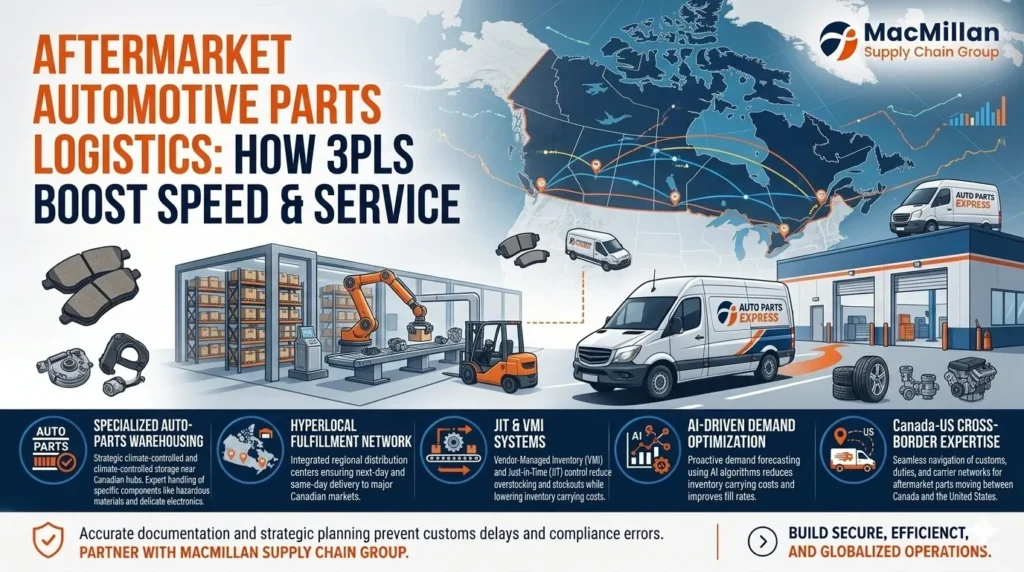
Aftermarket automotive parts logistics requires precision, speed, and reliability to meet customer expectations. Third-party logistics (3PL) providers like MacMillan Supply Chain Group are revolutionizing this sector by implementing advanced warehousing solutions, just-in-time inventory systems, and hyperlocal fulfillment networks across Canada. 3PLs assist auto parts companies in cutting expenses and speeding up delivery with AI-driven optimization, eco-friendly procedures, and specialized knowledge of international shipping. This in-depth guide examines how working with the ideal 3PL can revolutionize your aftermarket parts business, improve customer satisfaction, and spur company expansion in both the Canadian and American markets. Overview Logistics frequently make the difference between success and failure in the cutthroat automotive aftermarket of today. The speed and dependability of delivery can make or break the customer experience, whether a repair shop needs a critical part to get a customer’s car back on the road or a do-it-yourself enthusiast orders a performance upgrade. This is where third-party logistics (3PL) companies come in quite handy. Businesses like MacMillan Supply Chain Group, which specialize in aftermarket automotive parts logistics, provide knowledge that revolutionizes the flow of parts through the Canadian automotive supply chain. 3PLs give parts suppliers the resources and expertise they need to succeed, from advanced warehouse management to last-mile delivery options. However, what precisely makes 3PL solutions for auto parts so successful? How do they strike a balance between cost effectiveness and the requirement for speed? And why are more suppliers of aftermarket parts in the US and Canada outsourcing their logistics? Let’s explore the logistics of aftermarket auto parts and see how the ideal 3PL partner can transform your company.. How 3PLs Transform Warehouse Operations for Auto Parts The cornerstone of efficient aftermarket parts logistics is automotive warehousing solutions. Auto parts storage, in contrast to general warehousing, necessitates specific skills and knowledge to manage the particular difficulties of the sector. MacMillan’s automotive warehousing solutions include: Strategic facility placement close to major transportation hubs and population centers; sophisticated inventory management systems that track parts down to the bin level; climate-controlled environments for sensitive components; specialized handling for hazardous materials and delicate parts; and scalable space allocation that expands with your business When these warehouse capabilities are combined with cross-docking strategies, the real magic happens. Cross-docking drastically cuts down on handling time and storage expenses by allowing high-demand items to go straight from inbound to outbound shipping rather than storing every component. For instance, a popular brake pad model may be sorted and redistributed to trucks going to repair shops throughout Ontario as soon as it arrives at our facility, all without ever being placed on a shelf. Delivery times and storage expenses are reduced with this just-in-time strategy. 3PLs like MacMillan assist parts suppliers in striking the ideal balance between keeping enough inventory to meet demand and tying up capital in excess inventory by centralizing inventory across key locations. Service and Speed: The Benefit of 3PL in Parts Delivery Speed is not only desirable but also necessary in the automotive aftermarket. Every hour that a car is in the shop waiting for parts results in disgruntled customers and possible lost revenue for repair shops. The MacMillan Supply Chain Group tackles this issue by: Orders placed prior to cutoff times will be shipped the same day. Delivery to major Canadian markets the following day. Quick service options for important components. In Canada, hyperlocal fulfillment is achieved through carefully positioned distribution hubs. Optimizing the last mile to guarantee that packages arrive on time Even in less populated areas, our hyperlocal fulfillment strategy allows for quick commerce for automotive parts by placing inventory closer to end users. We are able to offer delivery times that were previously unattainable for many parts suppliers because we maintain facilities in strategic locations across Canada. The outcomes speak for themselves: after using our services, our clients usually experience an average delivery time reduction of 40–60%. Stronger ties with repair shops, fewer canceled orders, and increased customer satisfaction are all directly correlated with this improvement. Furthermore, real-time visibility during the delivery process is provided by our integrated tracking systems. From the warehouse to the customer’s door, customers can track their orders and receive proactive updates that boost confidence and cut down on customer support requests. Inventory Management Revolution: JIT and VMI Systems One of the biggest obstacles in the logistics of aftermarket auto parts is efficiently managing inventory. Overstocking causes capital to be locked up in slow-moving areas. You run the risk of stockouts and lost sales if you have too little inventory. MacMillan uses cutting-edge inventory management techniques to resolve this conundrum: Systems for Vendor-Managed Inventory (VMI) With the help of our VMI systems, suppliers can keep an eye on stock levels in real time and automatically restock items in response to real usage trends. Without the need for manual ordering procedures, this cooperative approach guarantees that the appropriate parts are available when needed. JIT (Just-in-Time) Inventory Control We assist clients in lowering their overall inventory investment while preserving high service levels by putting JIT principles into practice. Parts arrive when needed, lowering the need for storage and the chance of obsolescence. AI-Powered Inventory Management To forecast future demand, our in-house algorithms examine market indicators, seasonal patterns, and historical data. By proactively modifying inventory levels, this AI-driven inventory optimization helps avoid both overstocking and stockouts. Together, these systems provide an effective, responsive inventory management strategy that can be adjusted to reflect shifting market conditions. For instance, our systems can identify a pattern of increased demand and automatically adjust stock levels before manual intervention is feasible when a specific vehicle model experiences a common failure. The result? Our clients typically reduce their inventory carrying costs by 20-30% while simultaneously improving their fill rates and customer satisfaction scores. Typical Issues with the Logistics of Aftermarket Parts Many aftermarket parts suppliers continue to face major obstacles in spite of the advancements in logistics technology and procedures: Networks of Fragmented Distribution Numerous businesses run several warehouses with redundant inventory, which results in inefficiency and uneven
International Logistics 101 | Warehousing & Fulfillment Guide
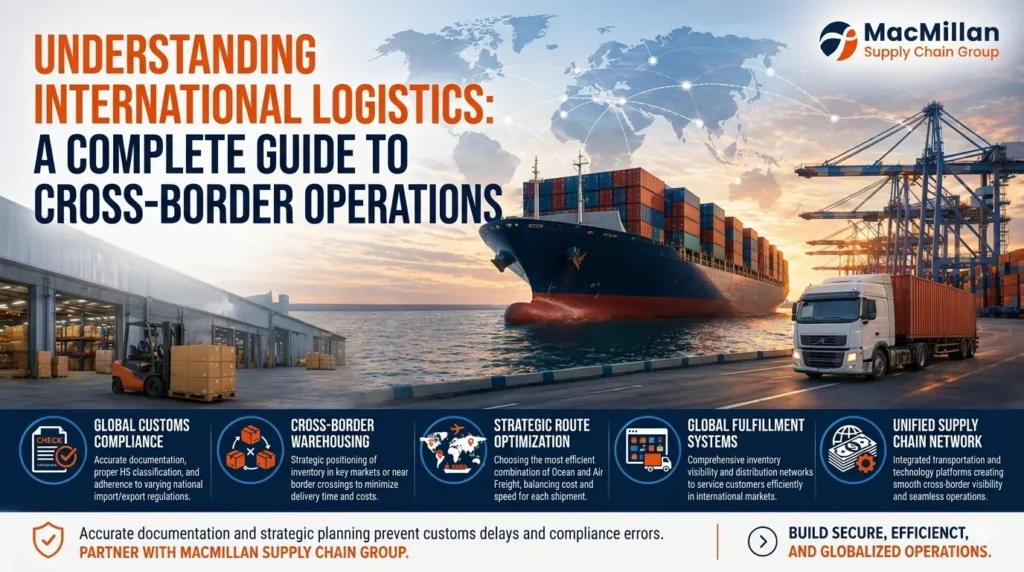
The intricate movement of goods across national borders is known as international logistics, and it calls for knowledge of distribution, warehousing, transportation, and customs clearance. Knowing the basics of cross-border operations is crucial for companies growing internationally to succeed. From choosing modes of transportation to overseeing cross-border warehousing and fulfillment, this guide examines important aspects of international logistics. MacMillan Supply Chain Group provides the infrastructure and experience to effectively handle international logistics challenges, regardless of your level of experience with international trade or your desire to streamline current operations. Introduction: Understanding International Logistics Have you ever pondered how goods from around the globe make their way to your neighborhood shops or homes? International logistics the difficult process of transporting goods across borders while negotiating complex regulations, transportation networks, and fulfillment systems holds the key to the solution. Choosing the best shipping option, overseeing cross-border storage, and guaranteeing efficient customs clearance are all included in international logistics. Gaining proficiency in these areas is essential for companies growing outside of their home markets in order to preserve their competitive edge and client satisfaction. International shipping presents special difficulties for Canadian companies in the linked economy of today. Given Canada’s size and closeness to the US market, businesses require strategic approaches to fulfillment and warehousing that strike a balance between speed, cost, and compliance. Knowing the basics of international logistics can mean the difference between success and expensive errors, whether you’re shipping from Vancouver to Vienna or Toronto to Tokyo. Options for International Shipping Transportation Ocean Freight: The Foundation of International Logistics The most economical way to transport big loads of goods across international borders is still by sea. It’s critical for Canadian companies shipping abroad to comprehend their container options: Full Container Load (FCL): FCL provides superior security and possibly lower prices per unit when your shipment fills an entire container. Least than Container Load (LCL): LCL enables you to share container space with other shippers for smaller shipments, making ocean freight feasible even for small volumes. It usually takes 20 to 30 days for ocean freight from Asia to Canadian ports, which makes it perfect for routine inventory replenishment or non-urgent shipments. Although ocean shipping is slower than air freight, it is usually 4-6 times less expensive, making it the best choice for large orders or bulky items. According to logistics specialists at MacMillan Supply Chain, “timing is everything when planning international logistics.” “Ocean freight offers outstanding value for routine inventory movements, but it requires longer lead times if planned properly.“ Air Freight: Speed When It Matters Most When time is critical, air freight becomes the go-to solution for international logistics. Air freight Canada services connect businesses to global markets in days rather than weeks: Express Air Freight: Can deliver in as little as 1-3 days for urgent shipments; Standard Air Freight: Usually delivers in 5-7 days internationally. Despite being more expensive than ocean shipping, air freight has benefits beyond speed. Products travel less, which lowers the risk of damage and the cost of carrying inventory. The higher cost of air freight is frequently justified by increased cash flow and customer satisfaction for valuable items, perishables, or urgent shipments. International Warehousing Techniques Placement of the Warehouse Strategically The global location of your inventory has a significant impact on shipping costs and delivery times. Cross-border warehousing solutions give companies the freedom to effectively service global markets: Border-Adjacent Warehousing: Facilities near major crossing points between Canada and the U.S. facilitate smooth cross-border commerce Regional Distribution Centers: Strategic warehouses in key markets reduce last-mile delivery times and costs Foreign Trade Zones: Special warehousing areas that allow duty deferment until products enter the domestic market MacMillan Supply Chain Group operates strategically located warehouses throughout Canada, providing businesses with flexible storage solutions that minimize transit times and customs delays. Businesses can lower shipping costs and increase delivery times by putting inventory closer to end users. Managing Inventory in International Logistics International inventory management poses special difficulties. Advanced systems are necessary for efficient international logistics in order to track inventory levels, keep an eye on movement, and guarantee that goods are available when and where they are needed. Contemporary warehouse management systems give companies real-time visibility across international facilities, allowing them to: Ensure that inventory levels are balanced across foreign locations. Expect variations in regional demand. Improved forecasting can lower the need for safety stock. Reduce delays caused by customs by using the right paperwork. According to supply chain experts, “having facilities in multiple countries isn’t the key to successful international warehousing.” “It’s having the systems and knowledge to run those facilities as a unified global logistics network.” Managing Compliance and Customs Comprehending Customs Clearance Navigating customs clearance procedures is one of the most difficult parts of international logistics. Every nation has different regulations, standards for documentation, and things that are not allowed. Working with knowledgeable customs brokers is crucial for companies shipping between Canada and foreign locations. Customs clearance typically requires: Commercial invoices with accurate product descriptions and values Certificates of origin documenting where products were manufactured Bills of lading or air waybills detailing transportation information Proper classification of goods under Harmonized System (HS) codes Shipment delays, extra inspections, or even fines may result from mistakes in customs paperwork. Working with a reputable freight forwarder in Canada, such as MacMillan Supply Chain Group, helps guarantee adherence to all applicable laws. Import/Export Laws and Adherence Navigating intricate import/export laws that differ by nation and product type is part of international logistics, which goes beyond simple customs clearance. These could consist of: Certifications or testing specifications unique to a product Items that are restricted or forbidden Quota restrictions on specific product categories; special licensing for controlled goods Staying compliant with these regulations requires ongoing vigilance and expertise. As regulations change frequently, businesses engaged in international trade need partners who actively monitor regulatory developments and adapt procedures accordingly. Common Problems with International Logistics Numerous obstacles in international logistics have the potential to upset supply chains and lower customer
Warehouse Automation and Robotics: Revolutionizing 3PL Services
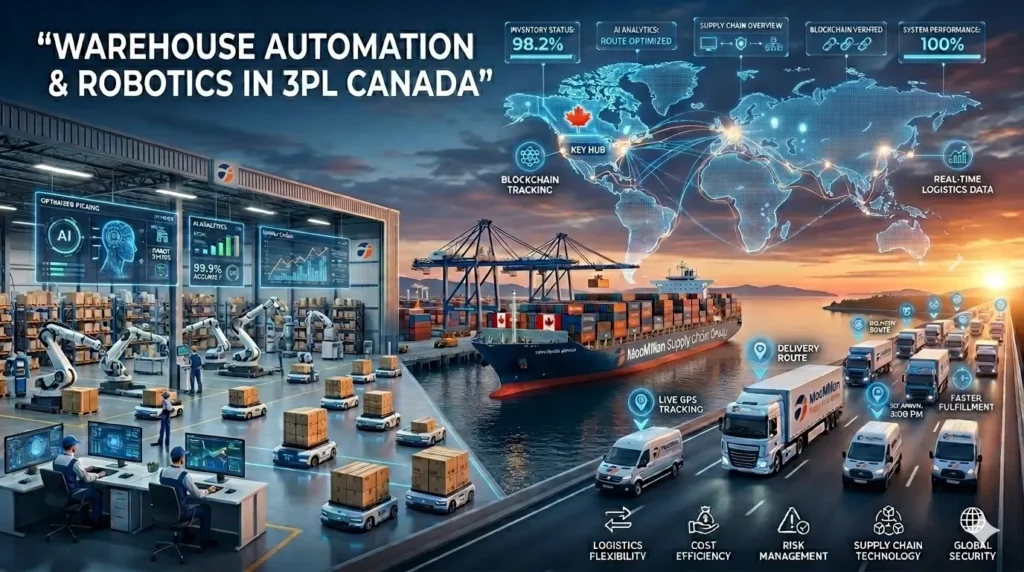
The way third-party logistics (3PL) providers function in Canada is changing due to warehouse automation and robotics. By deploying cutting-edge technologies like AI-driven systems, automated picking solutions, and real-time tracking tools, MacMillan Supply Chain Group is at the forefront of this revolution. These developments assist e-commerce companies in cutting expenses, minimizing mistakes, and expediting product delivery. Businesses in the Canadian market that require dependable fulfillment services benefit from MacMillan’s technological approach, which includes blockchain integration and robotic process automation. This article examines how these developments are changing the logistics industry and helping expanding businesses achieve better outcomes. The Evolution of 3PL Services in Canada Nowhere is the technological renaissance in the logistics sector more apparent than in Canadian fulfillment centers. Traditional warehouse operations find it difficult to keep up with the growing consumer expectations for real-time tracking and faster deliveries. In response, MacMillan Supply Chain Group has adopted robotics and warehouse automation to revolutionize the way 3PL services are provided in Canada. However, how will this change in technology affect your company? Whether you are an established retailer or an e-commerce startup, integrating cutting-edge 3PL technology can significantly increase customer satisfaction, lower costs, and improve operational efficiency. Automated picking systems and AI-driven warehouse management are examples of innovations that are no longer sci-fi ideas but rather workable solutions that are producing quantifiable outcomes now. Let’s explore how MacMillan is leveraging these cutting-edge technologies to revolutionize supply chain management across Canada. Core Technologies Driving Warehouse Automation A number of integrated technologies that function together form the foundation of MacMillan’s warehouse robotics solutions. All operations are coordinated by an AI-powered warehouse management system at the core. In addition to tracking inventory, this clever system anticipates changes in demand, learns from patterns, and automatically optimizes warehouse layouts. In logistics, repetitive tasks that previously required human intervention are handled by robotic process automation, or RPA. These consist of: Incoming shipment sorting that is automated barcode scanning and verification inventory counts and cycle counting order prioritization according to shipping deadlines Compared to more conventional approaches, MacMillan’s use of automated picking systems has shortened order fulfillment times by as much as 65%. These systems retrieve products from storage areas and move them to packing stations using a combination of robotic arms, autonomous mobile robots (AMRs), and conveyor systems. But the communication between these technologies is the true game-changer. With cloud-based warehouse systems, all of the robots, scanners, and sensors instantly exchange data, resulting in a synchronized operation that instantly adjusts to shifting priorities and conditions. Real-Time Visibility and Predictive Analytics E-commerce enterprises have historically struggled with inventory management, with stockouts and overstock scenarios having a major negative financial impact. This area of supply chain management has been completely transformed by MacMillan’s approach to inventory optimization tools. MacMillan gives customers unheard-of insight into the state of their inventory through real-time tracking and monitoring. From the time a product arrives at the warehouse until it is delivered to the final consumer, it is tracked. This visibility also includes: Present stock levels in several locations Patterns and velocity of product movement efficiency metrics for storage locations tracking of perishable goods’ expiration dates By projecting future inventory requirements, supply chain management predictive analytics enhances this visibility. To determine the ideal inventory levels, MacMillan’s demand forecasting software examines past sales data, seasonal patterns, and even outside variables like the weather or approaching holidays. MacMillan’s cold chain management in Canada guarantees product integrity during the fulfillment process for companies that deal with temperature-sensitive goods. From storage to delivery, precise environmental conditions are maintained by specialized packaging solutions and temperature-controlled zones within warehouses. How Automation Enhances Fulfillment Operations Daily fulfillment operations are where warehouse automation and robotics are most clearly used in practice. The Canadian fulfillment centers operated by MacMillan demonstrate how these technologies result in real advantages for CA e-commerce logistics. Order fulfillment time is greatly decreased by automated picking systems. Workers using traditional picking techniques may have to walk through warehouse aisles for several miles each day. On the other hand, MacMillan’s robotics deliver goods straight to packing stations, saving workers’ physical strain and removing unnecessary walking time. The improvements in accuracy are equally striking. The accuracy rates for manual picking are usually between 96 and 98 percent, which means that errors occur in 2-4 orders out of 100. With a 99.9% accuracy rate, MacMillan’s automated systems virtually eliminate expensive returns and unhappy customers. Another significant benefit in robotics is scalability. Without the typical difficulties of recruiting and training temporary employees, MacMillan can quickly scale operations during busy times like Black Friday or holiday shopping periods. The robotic fleet can be expanded with more units or work more hours, guaranteeing steady performance even in the face of volume variations. Challenges in the Logistics Industry Many 3PL providers continue to face major operational obstacles that affect customer satisfaction and profitability in spite of technological advancements: Labor Shortages and High Turnover: Picking, packing, and shipping in traditional warehouses rely largely on human labor. This dependence makes one susceptible to changes in the labor market and seasonal staffing issues. Scalability Limitations: Many 3PLs are unable to effectively manage abrupt volume increases, which causes delays during busy times when prompt fulfillment is most important. Difficulties with Inventory Accuracy: Manual inventory management frequently leads to differences between system records and actual stock levels, which can lead to overselling, stockouts, and dissatisfied customers. Limited Visibility: Traditional logistics operations frequently lack real-time tracking capabilities, leaving clients in the dark about inventory status and order progress. Inefficient Space Utilization: Traditional warehouse designs frequently squander useful space, which raises storage expenses and lowers operational effectiveness. Slow Adaptation to E-commerce Needs: A lot of well-known 3PLs find it difficult to satisfy the particular demands of e-commerce fulfillment, such as the need for quick shipping and single-item picking. High Error Rates: Human error in picking, packing, and shipping is an inevitable part of manual processes, which leads to returns, customer complaints, and a tarnished reputation for the brand. MacMillan’s Innovative Approach
Red Sea Crisis: How Canadian Businesses Can Navigate
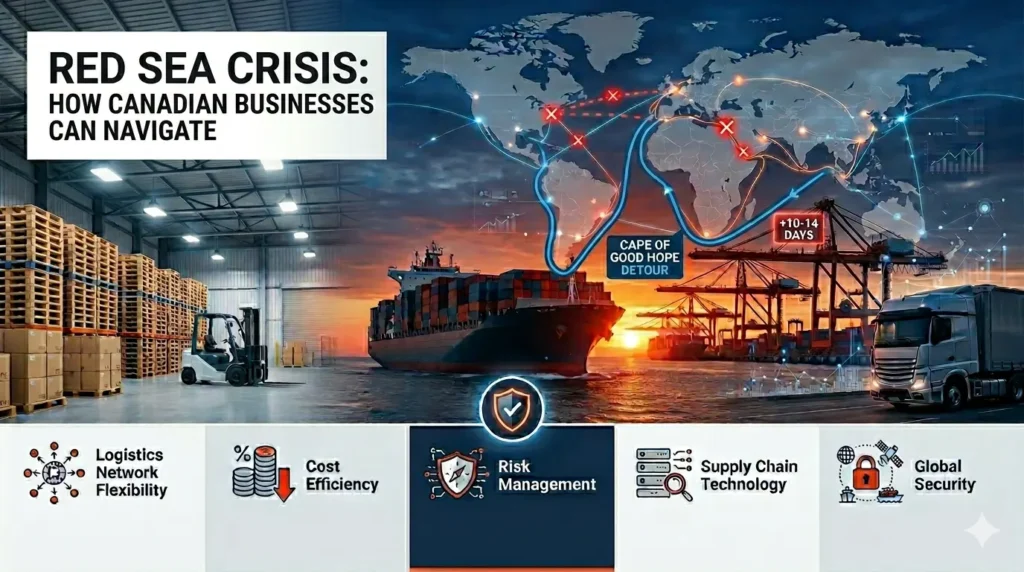
Since late 2023, the Red Sea’s been in turmoil, not weather-wise, but politically. Houthi rebel attacks on cargo ships have basically turned one of the world’s busiest trade routes into a no-go zone. So, what does that mean? Longer shipping times, steeper costs, and a whole lot of headaches for businesses across the globe — yes, even up here in Canada. Retailers are scrambling to restock. Auto manufacturers are battling parts delays. And electronics? Good luck finding certain components on time. This article breaks down how the Red Sea crisis is rippling through global trade routes, what that means for Canadian businesses, and most importantly, what you can do about it. Introduction: Let’s take a moment to go back. Houthi militants have been attacking the Bab al-Mandab Strait, a narrow waterway that connects the Red Sea to the Gulf of Aden, more frequently since October 2023. We are discussing drones, missiles, and attempts at hijacking. These are the kinds of stuff that makes major shipping companies say, “Yeah, let’s take the long way.” And by “long,” we mean really long. Instead of sailing through the Suez Canal and up into Europe, ships are now detouring around the southern tip of Africa. That adds 10 to 14 days of travel. That might not sound like much on paper, but in supply chain time. That’s a lifetime. To give you an idea of how serious this is, Suez Canal traffic has dropped more than 50% — from 4 million metric tons to 1.7 million. And every one of those missing ships has ripple effects: higher fuel costs, congested ports, delays, and tighter inventory all around. So yes, it’s halfway across the world, but for Canadian businesses, it hits close to home. Understanding the Red Sea Crisis You might be thinking, “But we’re not even near the Red Sea.” True, but we’re deeply tied to the global flow of goods. And when a major artery gets blocked, everything backs up. Retailers are having a rough time keeping shelves stocked, especially for seasonal items. Some are missing windows entirely and having to either markdown late winter gear or stash it for next year. A few are even flying in goods at crazy costs just to keep customers happy. Automotive manufacturers are in a jam too. Many operate on just-in-time delivery systems. One delay in a single part can halt an entire assembly line. A major parts supplier in Ontario reported having to switch to air freight to avoid shutting down a plant (and paid five times the normal cost to do it). Food and specialty importers aren’t off the hook either. Coffee, spices, international delicacies a lot of it comes through affected routes. Prices are climbing, and shelf lives are shrinking thanks to longer voyages. The point is, this isn’t some abstract global issue — it’s already showing up in Canadian boardrooms, warehouses, and storefronts. Supply Chain Disruptions Impacting Canadian Businesses Some industries are feeling the squeeze more than others. Here’s how it’s shaking out: Retail: The just-in-time model that once felt so efficient now looks risky. Late deliveries are forcing companies to markdown stock or miss entire seasons. Online sellers are especially feeling the heat as customer patience for delays wears thin. Manufacturing: A lot of manufacturers rely on parts from Asia. When those don’t show up on time, production lines stall. A recent survey found 6 in 10 Canadian manufacturers have faced delays since the crisis started. And when time is money, that hurts. Pharmaceuticals: While most essential medications have safety stock, some niche or specialty drugs are harder to replace. If disruptions drag on, even those reserves may run low. Agriculture and Food Processing: On the export side, grain shipments to markets like the Middle East and North Africa are taking longer and costing more. On the import side, perishable products are arriving late and in smaller quantities. Technology: From semiconductors to finished devices, tech companies are feeling the strain. A few Canadian firms have even had to delay product launches because they just couldn’t get components in time. Canadian Business Strategies for Supply Chain Disruptions Let’s be real — you can’t stop a missile or open the Suez Canal. But you can adapt. Here’s what smart companies are doing (and what you might want to consider): Don’t Put All Your Cargo in One BasketDiversify your routes. Work with multiple freight partners. Ship critical items by air if you can swing it. Some businesses are even exploring rail options through Central Asia or summer routes across the Arctic (yep, that’s a thing now). Mix Up Your SuppliersIf you’re heavily dependent on one country — especially one halfway around the world — consider alternatives. That might mean shifting 20–30% of your sourcing to North American suppliers. One Canadian retailer recently pivoted part of its furniture sourcing to Mexico and the U.S. Result? Faster lead times, less panic. Revisit Your Inventory GameJust-in-time was great — until it wasn’t. Now, it’s all about balance. Buffer stock is back, but smarter this time. Use data to decide where to build up inventory and where to stay lean. Use Tech That Tells You More Than “In Transit”Real-time tracking, predictive analytics, digital twins — these tools can be game-changers. One Canadian electronics company slashed stockouts by a third after implementing a smarter tracking platform. Visibility = power. Rethink Your ContractsIf your current agreements assume perfect conditions, it’s time for an update. Force majeure clauses, shared-risk models, and flexible delivery terms are now a must. It’s not about pointing fingers — it’s about making things work. Common Problems with the Red Sea Crisis Let’s call it like it is. The Red Sea crisis has created some serious headaches: Shipping times are all over the place Rates have spiked (some lanes are up 300%) Containers are either nowhere to be found or stuck in the wrong port Inventory’s either late, too much, or not enough You’re flying blind on where your stuff actually is Insurance may not cover
Building Supply Chain Resilience with 3PL Warehousing services
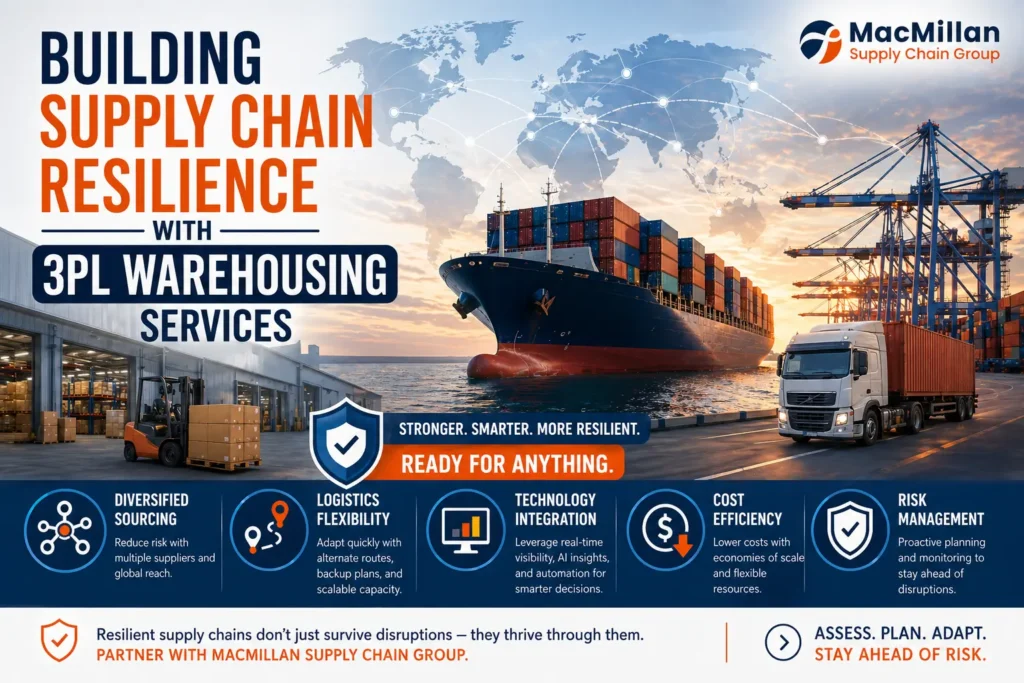
Supply chains have taken quite a few hits over the past few years—from global pandemics to sudden weather disasters. These unpredictable moments have made one thing clear: businesses need to be ready for anything. That’s where 3PL warehousing services step in. By teaming up with third-party logistics pros like MacMillan Supply Chain Group, businesses can strengthen their supply chain, cut down on costs, and respond quickly when disruptions hit. This guide breaks down how 3PL solutions don’t just help you survive—but thrive—in today’s unpredictable world. Building Supply Chain Resilience with 3PL Warehousing Introduction: Why Supply Chain Resilience Matters Remember when the grocery stores were out of toilet paper during the pandemic. Or when that behemoth ship got stuck in the Suez Canal and disrupted shipments across the globe? These were not just flukes—they were behemoth reminders of how vulnerable global supply chains can be. That’s why supply chain resilience matters. It’s about being prepared for the unexpected, whether that’s a natural disaster, surprise surge in demand, or a transportation delay. The objective? To recover quickly and keep the wheels turning. Businesses that create resilience don’t merely survive—they thrive. They sidestep huge losses, retain customers, and maintain their reputation. One of the wisest investments in building that resilience? Collaborating with a 3PL such as MacMillan Supply Chain Group. Let’s examine how they keep companies strong, agile, and prepared for whatever comes their way. The Power of 3PL Warehousing Services So, what exactly does a 3PL do? Think of them as the behind-the-scenes pros who take care of your inventory, storage, and shipping so you don’t have to stress about it. 3PLs like MacMillan offer: Warehouse space Inventory tracking Order fulfillment Smooth shipping across Canada and beyond And it doesn’t stop there—they use powerful tech tools to keep everything running efficiently. Here’s how a 3PL boosts your resilience: They bring years of expertise: They’ve helped businesses across industries solve complex logistics problems, so they know exactly what works. They flex with your needs: Need more space during a holiday rush? They’ve got you. Things slow down. You don’t pay for unused capacity. They’ve already invested in top-tier tech: You benefit from it without the high upfront cost. They’re everywhere: With strategic warehouse locations, they can reach your customers quickly—no matter where they are. They let you focus on your thing: You get to spend more time building your brand while they handle the logistics magic. Core Strategies for Building Supply Chain Resilience Want to make your supply chain truly resilient? These are the strategies that businesses use with their 3PL partners to prepare for anything. Diversified Sourcing Ever heard the phrase, “Don’t put all your eggs in one basket”? It’s especially true in supply chains. Relying on one supplier—or one region—can be risky. If something goes wrong (a strike, a storm, or shipping delay), your entire operation can take a hit. That’s why MacMillan helps clients: Work with multiple suppliers Source from different regions Build relationships with backup vendors They handle the logistics of it all, making sure everything arrives on time and meets your standards. Logistics Flexibility When disruptions hit, agility is everything. The ability to shift gears quickly is what sets resilient companies apart. MacMillan’s 3PL services offer: Backup warehouses Alternative shipping routes Omnichannel fulfillment Cross-docking to speed things up Capacity that scales with demand And with their Transportation Management System (TMS), rerouting shipments or shifting inventory is fast and efficient. Technology Integration Technology makes resilience possible. It gives you a bird’s-eye view of your entire supply chain so you can spot issues before they snowball. With MacMillan, you get: Real-time inventory tracking AI-powered forecasting IoT sensors to monitor product conditions Automated warehouse systems Cloud platforms that keep everyone in sync These tools help you make quick, smart decisions and that’s what resilience is all about. The Cost Benefits of 3PL Partnerships Worried that resilience = expensive? Good news it doesn’t have to. In fact, working with a 3PL often saves you money while making your supply chain stronger. Converting Fixed Costs to Variable Instead of owning warehouses and paying for staff year-round, you only pay for the space and resources you use. Busy season? You scale up. Off-season? You scale down. No waste. No stress. Economies of Scale 3PLs manage logistics for lots of clients, so they get better deals with carriers and can invest in better tech. And the savings? They pass them on to you. MacMillan, for example, gets volume discounts that can slash your transportation costs by up to 30%. Reduced Tech Investment High-tech systems can be pricey—but when you work with a 3PL, you get access to these tools without the big upfront investment. Common Problems with Supply Chain Resilience Even businesses that want to be resilient can hit roadblocks. Here are a few of the most common challenges: Lack of visibility: It’s hard to respond to problems you can’t see. Inflexible infrastructure: If you’re locked into long-term contracts or can’t expand quickly, you’re vulnerable. Disconnected data: Siloed systems slow down decision-making. Limited resources: Smaller businesses especially struggle to afford resilience-enhancing tools. Reactive mindset: Waiting until something goes wrong is no longer an option. Our Solutions: How MacMillan Supply Chain Group Builds Resilience End-to-End Visibility With one platform, you can see it all—inventory, deliveries, supplier updates—all in one location. No more guessing or scrambling. Strategic Network Design They assist in laying out the most efficient (and resilient) network for your company. That includes: Multiple warehouse locations Diverse carriers Strategically located inventory Backup systems Advanced Technology Suite From AI forecasting to intelligent inventory software, MacMillan puts the tech advantage at your fingertips without the tech hassle. Scalable Resources Want more space, employees, or shipping in a sales boom? You’ve got it. Everything’s scalable with you. Proactive Risk Management MacMillan doesn’t wait for things to go wrong. They evaluate your risks ahead of time, make contingency plans, and continuously monitor on your behalf. How to Implement Supply Chain Resilience with MacMillan Ready to get started? Here’s how MacMillan