
Warehouse Automation and Robotics: Revolutionizing 3PL Services
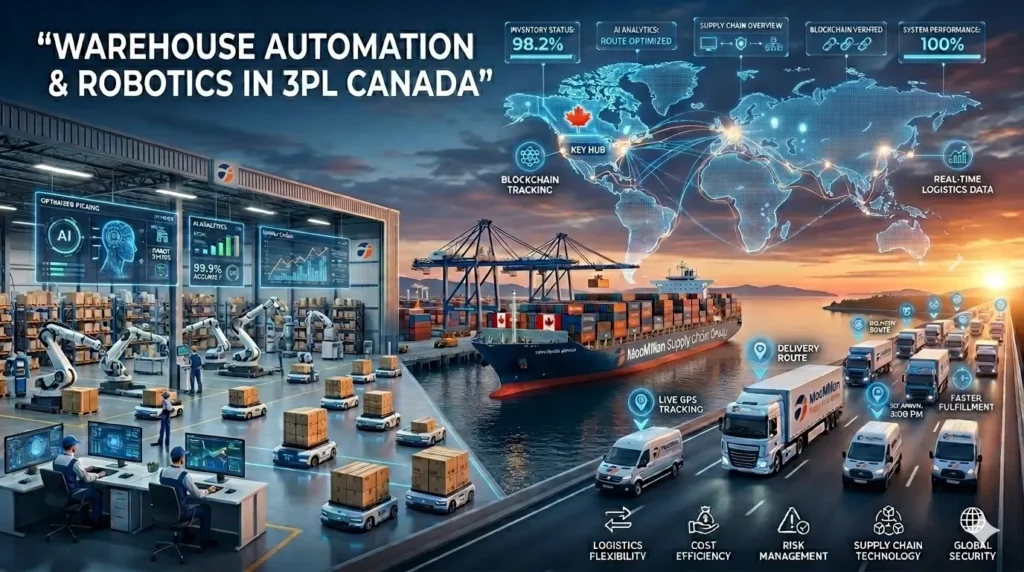
The way third-party logistics (3PL) providers function in Canada is changing due to warehouse automation and robotics. By deploying cutting-edge technologies like AI-driven systems, automated picking solutions, and real-time tracking tools, MacMillan Supply Chain Group is at the forefront of this revolution. These developments assist e-commerce companies in cutting expenses, minimizing mistakes, and expediting product delivery. Businesses in the Canadian market that require dependable fulfillment services benefit from MacMillan’s technological approach, which includes blockchain integration and robotic process automation. This article examines how these developments are changing the logistics industry and helping expanding businesses achieve better outcomes. The Evolution of 3PL Services in Canada Nowhere is the technological renaissance in the logistics sector more apparent than in Canadian fulfillment centers. Traditional warehouse operations find it difficult to keep up with the growing consumer expectations for real-time tracking and faster deliveries. In response, MacMillan Supply Chain Group has adopted robotics and warehouse automation to revolutionize the way 3PL services are provided in Canada. However, how will this change in technology affect your company? Whether you are an established retailer or an e-commerce startup, integrating cutting-edge 3PL technology can significantly increase customer satisfaction, lower costs, and improve operational efficiency. Automated picking systems and AI-driven warehouse management are examples of innovations that are no longer sci-fi ideas but rather workable solutions that are producing quantifiable outcomes now. Let’s explore how MacMillan is leveraging these cutting-edge technologies to revolutionize supply chain management across Canada. Core Technologies Driving Warehouse Automation A number of integrated technologies that function together form the foundation of MacMillan’s warehouse robotics solutions. All operations are coordinated by an AI-powered warehouse management system at the core. In addition to tracking inventory, this clever system anticipates changes in demand, learns from patterns, and automatically optimizes warehouse layouts. In logistics, repetitive tasks that previously required human intervention are handled by robotic process automation, or RPA. These consist of: Incoming shipment sorting that is automated barcode scanning and verification inventory counts and cycle counting order prioritization according to shipping deadlines Compared to more conventional approaches, MacMillan’s use of automated picking systems has shortened order fulfillment times by as much as 65%. These systems retrieve products from storage areas and move them to packing stations using a combination of robotic arms, autonomous mobile robots (AMRs), and conveyor systems. But the communication between these technologies is the true game-changer. With cloud-based warehouse systems, all of the robots, scanners, and sensors instantly exchange data, resulting in a synchronized operation that instantly adjusts to shifting priorities and conditions. Real-Time Visibility and Predictive Analytics E-commerce enterprises have historically struggled with inventory management, with stockouts and overstock scenarios having a major negative financial impact. This area of supply chain management has been completely transformed by MacMillan’s approach to inventory optimization tools. MacMillan gives customers unheard-of insight into the state of their inventory through real-time tracking and monitoring. From the time a product arrives at the warehouse until it is delivered to the final consumer, it is tracked. This visibility also includes: Present stock levels in several locations Patterns and velocity of product movement efficiency metrics for storage locations tracking of perishable goods’ expiration dates By projecting future inventory requirements, supply chain management predictive analytics enhances this visibility. To determine the ideal inventory levels, MacMillan’s demand forecasting software examines past sales data, seasonal patterns, and even outside variables like the weather or approaching holidays. MacMillan’s cold chain management in Canada guarantees product integrity during the fulfillment process for companies that deal with temperature-sensitive goods. From storage to delivery, precise environmental conditions are maintained by specialized packaging solutions and temperature-controlled zones within warehouses. How Automation Enhances Fulfillment Operations Daily fulfillment operations are where warehouse automation and robotics are most clearly used in practice. The Canadian fulfillment centers operated by MacMillan demonstrate how these technologies result in real advantages for CA e-commerce logistics. Order fulfillment time is greatly decreased by automated picking systems. Workers using traditional picking techniques may have to walk through warehouse aisles for several miles each day. On the other hand, MacMillan’s robotics deliver goods straight to packing stations, saving workers’ physical strain and removing unnecessary walking time. The improvements in accuracy are equally striking. The accuracy rates for manual picking are usually between 96 and 98 percent, which means that errors occur in 2-4 orders out of 100. With a 99.9% accuracy rate, MacMillan’s automated systems virtually eliminate expensive returns and unhappy customers. Another significant benefit in robotics is scalability. Without the typical difficulties of recruiting and training temporary employees, MacMillan can quickly scale operations during busy times like Black Friday or holiday shopping periods. The robotic fleet can be expanded with more units or work more hours, guaranteeing steady performance even in the face of volume variations. Challenges in the Logistics Industry Many 3PL providers continue to face major operational obstacles that affect customer satisfaction and profitability in spite of technological advancements: Labor Shortages and High Turnover: Picking, packing, and shipping in traditional warehouses rely largely on human labor. This dependence makes one susceptible to changes in the labor market and seasonal staffing issues. Scalability Limitations: Many 3PLs are unable to effectively manage abrupt volume increases, which causes delays during busy times when prompt fulfillment is most important. Difficulties with Inventory Accuracy: Manual inventory management frequently leads to differences between system records and actual stock levels, which can lead to overselling, stockouts, and dissatisfied customers. Limited Visibility: Traditional logistics operations frequently lack real-time tracking capabilities, leaving clients in the dark about inventory status and order progress. Inefficient Space Utilization: Traditional warehouse designs frequently squander useful space, which raises storage expenses and lowers operational effectiveness. Slow Adaptation to E-commerce Needs: A lot of well-known 3PLs find it difficult to satisfy the particular demands of e-commerce fulfillment, such as the need for quick shipping and single-item picking. High Error Rates: Human error in picking, packing, and shipping is an inevitable part of manual processes, which leads to returns, customer complaints, and a tarnished reputation for the brand. MacMillan’s Innovative Approach
The Impact of Warehouse Location on Shipping Speed and Costs
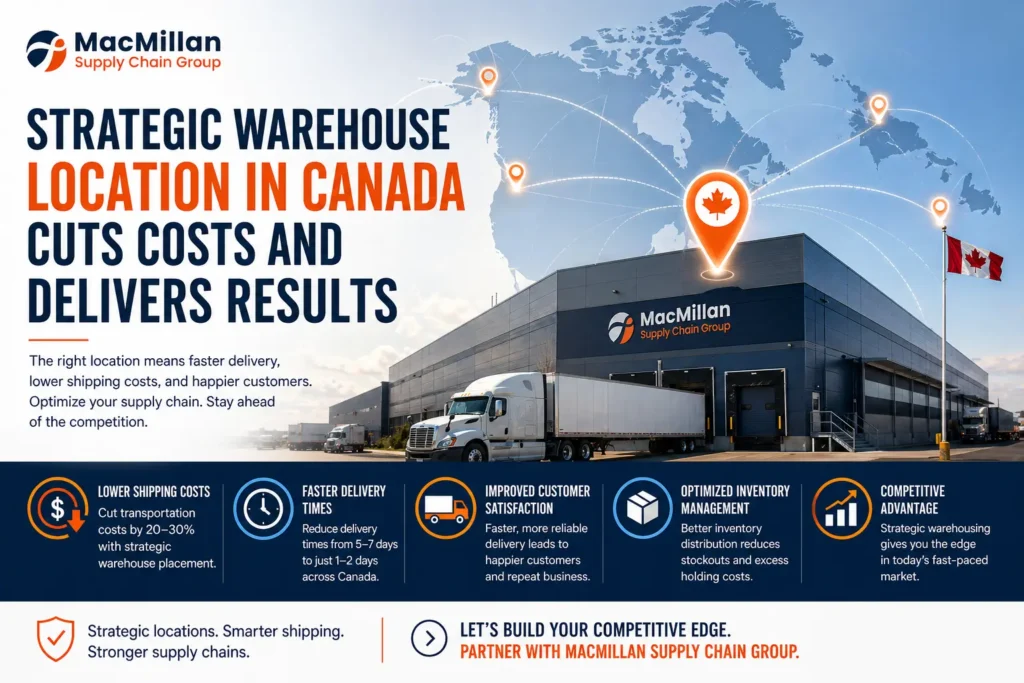
The cost and speed of product delivery to customers are directly impacted by the strategic location of warehouses. Businesses with strategically placed distribution centers in Canada can cut shipping costs by 20–30% and delivery times from 5-7 days to just 1-2 days. This article examines how warehouse location impacts cross-border logistics and last-mile delivery, as well as why companies that work with 3PL providers like MacMillan Supply Chain Group benefit from strategic Canadian warehousing solutions that give them a competitive edge. Why Your Warehouse Location Matters More Than Ever Ever ponder why some orders placed online arrive the following day while others take a week to arrive? In many cases, the warehouse location rather than the shipping method is the key. Customers expect speedy delivery at competitive prices in today’s fast-paced market. Because of this, choosing where to locate your warehouse is one of the most important aspects of your logistics plan. We at MacMillan Supply Chain Group have personally witnessed how a well-chosen warehouse location can revolutionize an organization. 40% of Canadian consumers can be reached in a day by a Toronto fulfillment center, whereas a poorly located warehouse may take three to five days to reach the same customers. The distinction has an impact on your bottom line, customer satisfaction, and competitiveness in the current market in addition to shipping speed. Let’s explore why warehouse location has become the cornerstone of successful supply chain optimization. The Distance Factor The main determinant of shipping speed is distance. Your products will arrive more quickly if your warehouse is located close to your customers. This simple idea has significant business ramifications. A package may arrive the following day if it is shipped from a fulfillment center in Toronto to a customer in Ontario. It might take three to four days to ship the same package from Vancouver to Ontario using the same shipping method. This discrepancy is due to geography rather than efficiency. The size of our nation must be taken into consideration when developing warehousing strategies in Canada. Businesses must carefully consider where to store inventory because major population centers are dispersed over thousands of kilometers. Western provinces could be adequately served by a single warehouse in Calgary, but eastern customers would have to wait days longer than necessary. The best approach? Many businesses find that an Ontario warehouse hub serves as an excellent starting point, with additional distribution centers in Canada’s western and eastern regions as they grow. This multi-node distribution approach ensures that no customer is too far from your products. Breaking Down Shipping Costs The cost of shipping a package increases with each kilometer of travel. You essentially pay for additional distance when your warehouse location is far from your customers. These expenses mount up quickly and can have a big effect on your profit margins. Take a look at these actual numbers: Transporting a 5 kg parcel inside the same province: $8–12 for shipping the identical package to more than three provinces: $18–25 Costs of last-mile delivery in cities: 53 percent of the total cost of shipping Strategic warehouse placement can significantly lower these expenses. Compared to a competitor with a single warehouse, a company with distribution centers in both Toronto and Vancouver may save 40% on shipping. Location affects more than just transportation costs. There are large regional differences in labor availability, real estate values, and utility costs. The Greater Toronto Area, for instance, has more expensive warehouse space per square foot than smaller cities, but the savings on shipping and quicker delivery times frequently make the difference. The secret is figuring out the sweet spot, which our logistics experts at MacMillan Supply Chain Group are skilled at determining, where shipping and operating costs add up to the lowest overall cost. Multi-Node vs. Centralized Distribution Should your business operate from one large warehouse or several smaller ones across Canada? This question faces every growing business, and the answer depends on your specific needs. A centralized approach with one major warehouse offers simplicity and lower facility costs. However, a multi-node distribution network with strategically placed warehouses provides faster shipping speeds and reduced shipping costs. The trade-off is more complex inventory management and higher facility expenses. Consider these approaches: Single Central Hub: Works well for specialized products with nationwide demand but lower order volume East-West Strategy: Two warehouses (typically Ontario and BC) covering eastern and western Canada Regional Network: Multiple smaller facilities near major population centers for fastest possible delivery For businesses shipping to both Canadian and American customers, cross-border logistics adds another layer of complexity. Warehouses near border crossings like Windsor or Niagara Falls can facilitate smooth US-Canada shipping while maintaining fast delivery to Canadian customers. MacMillan’s network of distribution centers in Canada allows businesses to implement the right strategy for their unique needs, whether that’s a single Ontario warehouse hub or a comprehensive national network. Urban Proximity and Delivery Speed More than half of all shipping expenses go toward the “last mile,” which is the last section of delivery from the local distribution center to the customer’s door. The location of the warehouse is essential to making the most of this costly step. Last-mile distances are shortened by urban warehouses located close to city centers, allowing for same-day or next-day delivery options. Reduced delivery expenses and fuel consumption Shorter routes result in lower carbon emissions; more scheduling flexibility for deliveries Local clients can receive same-day delivery from a Toronto fulfillment center, which is not feasible with a warehouse located outside of the city. Beyond just speed, this proximity advantage opens up possibilities for competitive service offerings that are impossible for distant warehouses to match. However, the cost of real estate is usually higher for urban warehouses. Determining whether the cost savings and shipping speed benefits of paying more for city center proximity are sufficient to make the investment worthwhile is crucial. The answer is becoming more and more “yes” for many companies catering to urban clients. The Hidden Costs of Poor Placement The consequences
Retail Ready Packaging Canada for FMCG Brands
A Quick Summary and Overview Retail-ready packaging (RRP), also known as shelf-ready packaging, is a crucial logistics component for any brand supplying large retailers. With major chains demanding faster shelf replenishment, standardized labeling, and reduced labor costs, non-compliant packaging can lead to costly chargebacks and missed sales windows. MacMillan Supply Chain Group ensures that your retail shipments are compliant, scan-verified, and shelf-ready—every time. This blog explores what retail-ready packaging is, why it matters for FMCG and CPG brands, and how MacMillan helps businesses stay compliant and competitive. Introduction Retail-ready packaging (RRP) refers to secondary packaging designed to go straight from warehouse to retail shelf without requiring unpacking or reconfiguration. It includes features like: Pre-applied barcodes (GS1-128) Easy-open cases or trays Clear product visibility Structural integrity for stacking Shelf-ready pallet configuration Retailers like Walmart, Costco, Loblaw, and Canadian Tire all have strict RRP guidelines. These aren’t suggestions—they’re delivery requirements. Non-compliance means rejected shipments, fines, or delisting. Why Retail-Ready Packaging Is Business-Critical Brands that overlook RRP risk the following: Chargebacks for incorrect labeling, pallet height, or case specs Rejected deliveries due to non-compliant builds Damaged brand perception due to poor in-store presentation Delayed shelf availability impacting sell-through and promotions Seasonal and promotional products are particularly vulnerable—there are no second chances. How MacMillan Ensures Retail Packaging Compliance MacMillan SCG specializes in retail-ready logistics. Here’s how we help: GS1-compliant labeling at SKU and case level Retail-specific pallet configurations Automated scan-verification before outbound shipment Pre-kitted or display-ready builds Packaging audits aligned with your retailer’s guidelines Whether you’re shipping to national grocery chains or big box retailers, we ensure your packaging meets every standard. Built for FMCG and High-Velocity Categories Different product types demand different packaging execution. MacMillan adapts RRP workflows based on your category: Food & Beverage: FEFO rotation, expiry date labeling, tamper-evident seals Personal Care & Wellness: Lot tracking, clean handling, brand-aligned presentation Home & Cleaning: WHMIS-compliant labeling and sturdy transit packaging Pet Care: Case/each configurations, promotion-ready kits, stackable trays Our category specialization ensures your product doesn’t just arrive—it sells. Benefits Beyond Compliance Well-executed RRP not only avoids penalties, it accelerates sell-through and strengthens retailer relationships: Faster shelf stocking = faster sales Cleaner presentation = better consumer engagement On-time and in-spec delivery = more favorable retail terms Fewer manual touches = lower risk of in-store damage At MacMillan, we see packaging not just as a box—but a brand ambassador. Final Takeaway & CTA MacMillan Supply Chain Group delivers retail-ready packaging that’s more than compliant—it’s competitive. Talk to us about aligning your packaging workflows with top retailer requirements in Canada. 📞 Contact us for a category audit and see how we can streamline your supply chain from dock to shelf. FAQs What makes packaging “retail-ready”? Retail-ready packaging is designed for easy stocking and display. It includes pre-applied barcodes, clear product visibility, and structural support for stacking. Retailers can unpack and place it on the shelf in seconds. What happens if a shipment isn’t retail-compliant? Non-compliant shipments may be rejected at distribution centers, delayed, or incur chargebacks. It also risks damaging retailer trust and can result in delisting over time. How does MacMillan verify retail packaging compliance? We use automated scan verification systems and perform pre-shipment audits based on each retailer’s exact requirements. Our warehouse systems validate label placement, barcode formats, pallet specs, and more. Can you support retail and D2C packaging from the same inventory? Yes. Our facilities are designed to handle multi-channel workflows, allowing us to pick-pack and label D2C orders while simultaneously preparing retail-compliant cases and pallets. What packaging standards does MacMillan support? We meet GS1-128 barcode standards, retailer-specific palletization, shelf-ready displays, and WHMIS-compliant packaging. We also accommodate special handling instructions for fragile, perishable, or hazardous items. How quickly can I onboard retail packaging services with MacMillan? Our onboarding process typically takes 10-14 days. It includes alignment on SKU specs, retailer requirements, test orders, and workflow setup to ensure accuracy from day one.
Scalable Beverage Warehousing & Transportation Solutions in Canada

A quick summary and overview Beverage brands operate in a fast-paced, highly competitive environment where freshness, regulatory compliance, and perfect timing are critical. Whether you’re distributing carbonated drinks, juices, bottled water, or alcoholic beverages, having a reliable logistics partner is essential. MacMillan Supply Chain Group offers specialized beverage warehousing and transportation solutions that ensure your products remain secure, traceable, and delivered on time across Canada. Understanding Beverage Warehousing Beverage warehousing goes beyond storing products—it’s about preserving quality, optimizing shelf life, and enabling fast access to inventory. Beverages are sensitive to temperature fluctuations, contamination, and improper handling, which can lead to spoilage or loss of carbonation. Therefore, storage facilities must maintain tight environmental controls, follow strict hygiene practices, and ensure rapid product movement. At MacMillan SCG, our beverage warehouses are GMP-certified and equipped with ambient and climate-regulated zones. Our racking systems support palletized inventory, and our WMS ensures complete traceability for lot, expiry, and FIFO controls. Why Beverage Logistics Requires Specialization The beverage industry comes with unique supply chain demands: Temperature sensitivity (ambient or refrigerated) Strict hygiene and GMP requirements Palletized and bulk storage configuration.s Seasonal surges and promotional spikes Regulatory compliance for food safety and labeling Fast replenishment cycles for both retail and DTC models MacMillan’s Beverage Warehousing Capabilities Certified, Scalable Storage MacMillan offers over 250,000 sq. ft. of GMP-certified storage across dedicated and shared spaces. Our temperature-controlled warehouses prevent spoilage, ensure product integrity, and are ideal for carbonated and non-carbonated beverages alike. Cross-Dock & Fast Turnaround Our facilities are optimized for 8-hour dock-to-stock transitions and rapid fulfillment. Whether you’re staging for distribution or need fast turnarounds, MacMillan’s beverage warehousing solutions streamline your operations. Mantis-Powered WMS Every SKU is traceable with real-time visibility and automated inventory alerts. Lot control, FIFO, and compliance are built into our WMS to ensure precision. Learn more: Warehousing & Distribution Advanced Beverage Transportation Services Nationwide Fleet with Next-Day Reach With over 3,000 drivers and 45 cross-dock locations, MacMillan’s transportation network reaches 90% of FSAs the next day. Our AI-powered routing ensures beverages arrive fresh and on schedule. Secure Final Mile Solutions From big box retailers to last-mile home deliveries, we offer room-of-choice delivery , tracking visibility, and signature capture. Custom Handling and Packaging Support We manage special requests like branded packaging, promotional bundling, and high-volume restocking with agility. Discover more: Transportation Services. Benefits for Beverage Companies Preserve quality with temperature-regulated storage.e Reduce shrinkage and handling ris.ks. Speed up delivery with a high-density carrier network. Gain visibility through integrated WMS & TMS. Scale easily for demand surges, seasonal shifts, or expansion Industries We Serve We support beverage producers, importers, distributors, and direct-to-consumer brands across: Soft Drinks & Carbonated Beverages Juices & Functional Drinks Energy Drinks & Isotonics Alcoholic Beverages (Compliant with provincial distribution laws) Bottled Water & Flavored Water Why MacMillan SCG? MacMillan SCG is one of Canada’s leading 3PL providers, trusted by over 40 global brands. We specialize in warehousing, e-commerce fulfillment, container destuffing, and last-mile transportation, with advanced systems for traceability, compliance, and performance reporting. From onboarding to optimization, MacMillan provides full visibility, rapid turnaround, and scalability for beverage companies needing reliable, certified warehousing and logistics support. Conclusion MacMillan SCG’s beverage warehousing and transportation solutions are designed to protect your product integrity and boost delivery efficiency. Whether you’re storing energy drinks in bulk, managing seasonal soda shipments, or launching a new bottled water brand, our logistics solutions help you deliver with confidence. 👉 Get a custom quote to start storing and shipping your beverage inventory with MacMillan SCG today.
The Benefits of Value-Added Packaging in Your Supply Chain
A quick summary and overview Value-added packaging goes beyond basic product protection to deliver strategic advantages throughout your supply chain. By incorporating specialized services like custom labeling, kitting, assembly, and sustainable materials, businesses can significantly improve operational efficiency while reducing costs. MacMillan Supply Chain Group offers comprehensive value-added packaging solutions that help Canadian companies enhance product presentation, meet compliance requirements, and achieve sustainability goals. Our expertise spans various industries, providing tailored packaging strategies that optimize your entire supply chain process. How Value-Added Packaging Transforms Your Supply Chain In today’s competitive marketplace, packaging is no longer just about protecting products during transit. Value-added packaging has emerged as a strategic tool that can dramatically improve your supply chain efficiency while delivering significant business advantages. But what exactly is value-added packaging, and how can it benefit your operations? Value-added packaging encompasses specialized services that enhance standard packaging processes. These include custom labeling, kitting, assembly, product customization, and implementing sustainable packaging solutions. At MacMillan Supply Chain Group, we’ve seen firsthand how these services help Canadian businesses streamline operations, reduce costs, and improve customer satisfaction. Whether you’re in retail, food and beverage, pharmaceuticals, or manufacturing, the right packaging strategy can be a game-changer for your business. Let’s explore how value-added packaging solutions in Canada can transform your supply chain from a cost center into a competitive advantage. Key Components of Value-Added Packaging Services Value-added packaging extends far beyond simply placing products in boxes. It’s a comprehensive approach that can include numerous specialized services tailored to your specific needs. Understanding these components helps you identify which solutions will deliver the greatest impact for your business. Custom Labeling and Branding Custom labeling ensures your products comply with Canadian packaging regulations while enhancing brand recognition. This includes bilingual labeling (essential for the Canadian market), barcode generation, and brand-consistent design elements. Our advanced printing capabilities allow for high-quality graphics that make your products stand out on shelves. Kitting and Assembly Kitting involves grouping related items together in a single package, while assembly focuses on putting product components together before shipment. These services save time and resources by consolidating operations. For example, retail promotions often require special kitting of multiple products, which we can handle efficiently within our facilities. Product Customization We can modify standard products to meet specific customer requirements. This might include adding accessories, creating special bundles, or adjusting packaging sizes for different markets. This flexibility allows you to respond quickly to changing consumer demands without maintaining excessive inventory. Sustainable Materials Selection Our team helps you select eco-friendly materials that align with your sustainability goals while meeting product protection requirements. From biodegradable fillers to recyclable containers, we source materials that reduce environmental impact without compromising on quality or protection. This approach supports circular economy packaging principles that increasingly matter to Canadian consumers. How Value-Added Packaging Drives Supply Chain Efficiency Implementing strategic packaging solutions creates ripple effects of efficiency throughout your entire supply chain. These improvements touch everything from warehouse operations to final delivery, creating measurable benefits at each stage. Streamlined Warehouse Operations Value-added packaging services consolidate multiple steps into a single process, reducing handling time and warehouse space requirements. By integrating packaging with other logistics functions, we eliminate redundant steps and minimize the risk of errors. Our contract packaging services can be performed within our facilities, freeing up your valuable warehouse space for core operations. Optimized Transportation Properly designed packaging maximizes container and truck utilization by optimizing product dimensions and weight. This means you can fit more products in each shipment, reducing transportation costs and carbon emissions. Our packaging engineers analyze your products to design solutions that minimize dimensional weight charges while ensuring adequate protection. Reduced Handling Damage Custom-designed packaging provides superior product protection, significantly reducing damage rates during transit. This means fewer returns, less waste, and higher customer satisfaction. For fragile or high-value items, we develop specialized protective solutions using appropriate materials and designs that prevent movement and absorb shock. Improved Inventory Management Value-added packaging facilitates better inventory control through clear labeling and organized kitting. When products arrive pre-packaged and ready for sale, you can implement just-in-time inventory strategies that reduce carrying costs. Our IoT-enabled packaging solutions can also provide real-time visibility into inventory levels and product location. Cost Benefits of Strategic Packaging Solutions While some businesses view packaging as simply a necessary expense, strategic value-added packaging actually delivers significant cost savings throughout your supply chain. Understanding these financial benefits helps justify investment in improved packaging solutions. Reduced Labor Costs By consolidating packaging operations with a specialized provider like MacMillan Supply Chain Group, you can significantly reduce labor costs associated with in-house packaging. Our efficient processes, specialized equipment, and experienced staff complete packaging tasks faster and with fewer errors than most in-house operations. This allows your team to focus on core business activities that drive growth. Lower Materials Expenses Our packaging expertise helps identify opportunities to reduce material usage without compromising protection. We can implement returnable packaging systems for regular shipments between fixed locations, dramatically cutting ongoing packaging expenses. Our volume purchasing power also means we secure better pricing on packaging materials than most individual companies can achieve. Decreased Transportation Expenses Optimized packaging reduces dimensional weight charges and allows more products per shipment. For example, properly designed packaging can sometimes reduce shipping costs by 15-25% by eliminating unnecessary space and weight. Our packaging engineers analyze your current solutions and recommend improvements that maximize transportation efficiency. Minimized Product Damage Well-designed packaging significantly reduces product damage during transit, cutting replacement costs and eliminating the administrative burden of processing returns. For products with high damage rates, the savings from improved packaging can be substantial – often paying for the packaging upgrade many times over. Sustainability Advantages of Modern Packaging Approaches Today’s consumers and businesses increasingly prioritize sustainability, making eco-friendly packaging solutions not just environmentally responsible but commercially advantageous. MacMillan Supply Chain Group helps you navigate the complex world of sustainable packaging to find solutions that work for your products, your customers, and the planet. Eco-Friendly Materials