
Cross-Border Fulfillment: How 3PLs Power Global E-Commerce Growth | MacMillan Supply Chain
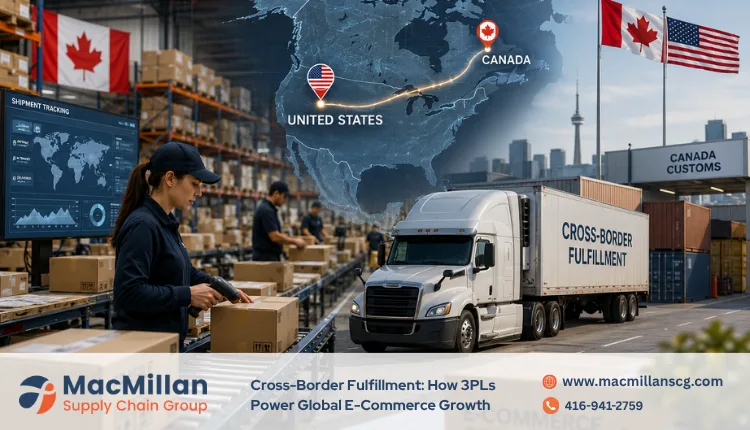
A Brief Summary and Overview Cross border fulfillment is revolutionizing the global expansion of e-commerce companies. Businesses can handle difficult international shipping laws, Canadian customs clearance, and quick delivery to customers throughout the world by collaborating with third party logistics providers (3PLs). 3PLs provide specialized services including multi node distribution networks, technology-driven solutions that optimize the entire fulfillment process, and warehousing in major regions like British Columbia and Ontario. Through effective, affordable logistics solutions, the ideal 3PL collaboration eliminates obstacles to international trade while preserving customer satisfaction for Canadian companies seeking to expand overseas or US companies entering the Canadian market. Overview Global boundaries have been erased by the e-commerce industry, giving companies previously impossible chances to connect with clients abroad. However, logistics, customs laws, and satisfying customers’ demands for prompt delivery present serious obstacles when selling goods internationally, especially between the US and Canada. This is where third-party logistics companies (3PLs) and cross-border fulfillment become crucial allies in your international e-commerce growth. By managing everything from warehousing to customs clearance in Canada, a professional 3PL can simplify complex international shipping procedures. Knowing how 3PLs facilitate cross-border trade is essential for businesses trying to enter the Canadian market or for Canadian businesses growing internationally. Let’s examine how these logistics professionals can assist you in navigating global waters and expanding your online store internationally. How 3PLs Simplify Cross-Border Shipping in Canada Sending parcels from point A to point B is only one part of shipping goods across international borders.In spite of possible delays at border crossings, it involves organizing customs paperwork, understanding complicated procedures, and guaranteeing on-time delivery. For e-commerce companies, third-party logistics companies are excellent at streamlining these procedures. They know the ins and outs of cross border transportation in Canada and have built-up connections with customs officers. Because of their experience, they can transfer your things quickly and with the least amount of hassle. Working with a 3PL that specializes in shipping from the US to Canada gives you access to their well-established infrastructure as well. In order to put your products closer to your Canadian clients, this includes strategically positioned warehouses in Ontario and other important Canadian provinces. The advantages go beyond the infrastructure itself. 3PLs use advanced tracking systems that provide you real time visibility into your shipments as they travel across international boundaries. You can proactively handle any problems that may occur during transit and keep clients updated on their orders thanks to this transparency. Furthermore, 3PLs manage every piece of complex paperwork involved in overseas transportation, such as tax filing, duty computations, and customs documents. This knowledge guarantees compliance to rules while averting expensive delays that can affect client satisfaction. Strategic Warehousing: The Foundation of Effective Cross Border Fulfillment One of the most significant advantages of working with a third party logistics provider is access to their network of fulfillment warehouses. For cross border e-commerce between the US and Canada, having inventory stored in strategic locations dramatically improves delivery times and reduces shipping costs. A fulfillment warehouse in Ontario serves as an ideal hub for serving the densely populated regions of Eastern Canada. Orders can be swiftly processed and dispatched from this central location to key markets like Toronto, Montreal, and Ottawa, usually arriving the following day. The delays that come with crossing the border for each individual order are eliminated because of this close proximity. In the same way, British Columbia warehouses offer great access to markets in Western Canada and act as a gateway for trade with the Pacific. No matter where your clients are situated, 3PLs maximize delivery times by distributing inventory across several key sites, forming a multi-node distribution network. Additionally, these storage options provide flexibility. When order volumes increase during peak seasons, 3PLs can set aside more space to handle higher inventory levels. Your company can satisfy seasonal demand thanks to this scalability without having to invest in permanent warehouse space that can be largely empty during slower times. Automated warehouse systems that accelerate order processing are another element of modern fulfillment warehouses. Conveyor belts, sophisticated picking systems, and sorting technologies guarantee precise and effective order fulfillment, cutting down on the time between order placing and shipment. Technology Driven International Logistics Solutions The backbone of effective cross border fulfillment is technology. The most successful 3PLs of today use advanced systems which communicate with your e-commerce platform, ensuring a smooth information flow from the time a consumer places an order till it is delivered to their door. Real-time inventory management across several warehouse sites is made possible by 3PL technology integration.Strategic inventory placement based on regional demand patterns is made possible by this visibility, which also helps to avoid stockouts.The program automatically chooses the optimum fulfillment center for a customer’s order based on factors like inventory availability, delivery schedules, and shipping distance. Proactive inventory management is made possible by AI-driven shipment projections that help forecast changes in demand. Businesses with seasonal products or those running marketing initiatives that could cause unexpected spikes in order volume will find these predictive analytics very useful. Order management systems provide picking lists, packing guidelines, and shipping labels automatically, streamlining the fulfillment process. Orders are filled precisely and quickly thanks to this technology, which also cuts down on processing time and human error. For cross border shipments, technology plays a crucial role in customs clearance. Advanced systems prepare and submit customs documentation electronically, speeding up the clearance process. Real time tracking allows both you and your customers to monitor shipments as they move through customs and toward their final destination. Navigating Customs Clearance and Compliance Challenges Navigating the complex web of customs laws, taxes, and charges is arguably the most difficult part of cross-border e-commerce. This is where companies growing into foreign markets find that specific 3PL knowledge is extremely helpful. In Canada, clearing customs includes a number of requirements, such as exact valuation, country of origin documentation, correct classification of commodities, and adherence to various trade agreements. Errors in any of these areas may
How Canadian Brands Should Prepare Inventory for Seasonal Product Launches
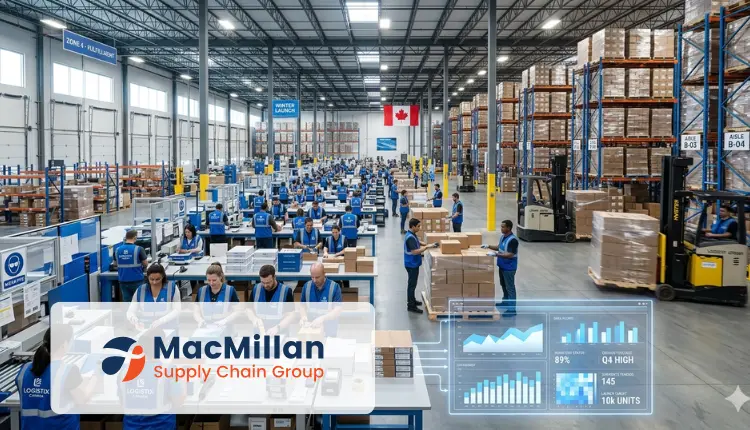
A Quick Summary and Overview Seasonal product launches create a narrow window for success. If inventory arrives late, is staged incorrectly, or is not ready for retail and DTC execution at the same time, the campaign loses momentum before customers ever see the product. Current competitor content that performs well around peak and seasonal fulfillment focuses on forecasting, scalable capacity, real-time visibility, and launch readiness rather than broad logistics education. Shopify’s recent demand-planning and inventory-allocation guidance also emphasizes forecasting, stocking levels, and acting early on seasonal demand signals. MacMillan SCG is positioned around the exact capabilities seasonal launches require: retail-ready warehousing, promotional packaging, kitting, lot and batch tracking, transportation built for retailer precision, and real-time visibility across inventory and orders. Introduction A seasonal launch is not just another replenishment cycle. It is a timed revenue event. Whether you are launching a holiday bundle, spring wellness promotion, limited-edition beauty SKU, or back-to-school retail program, inventory has to be in the right place, in the right format, at the right time. Shopify’s seasonal inventory guidance notes that brands need sales forecasting and early preparation to avoid stockouts or excess stock during seasonal swings. The problem is that many brands prepare marketing before they prepare inventory. By the time demand spikes, they are scrambling to receive product, build kits, allocate stock across channels, and meet retail windows. Competitor content from GoBolt and Metro increasingly frames peak-season and launch support around scalable infrastructure, forecasting tools, flexible labor, and value-added services because those are the operational pressure points buyers actually feel. Why Seasonal Launches Break Down Most seasonal launches fail operationally in one of five places: demand is under-forecasted or over-forecasted inventory is not received early enough stock is not allocated correctly across channels product is not retail-ready when needed teams lack visibility once orders start moving Shopify’s recent inventory-allocation and demand-planning material makes the same basic point: forecasting alone is not enough; brands need a process that turns demand signals into stocking, allocation, and execution decisions. For Canadian brands, this challenge is often more complex because they may need to support national retail, ecommerce, and marketplace demand at the same time, sometimes with bilingual labeling, channel-specific packaging, and retailer compliance requirements layered in. MacMillan’s value-added and warehousing pages specifically highlight bilingual packaging, GS1 barcodes, retailer-specific labeling, and shelf-ready builds for promotional and launch programs. 6 Steps to Prepare Inventory for a Seasonal Product Launch 1. Forecast demand earlier than usual Seasonal launches compress planning timelines. Historical sales, campaign calendars, retailer commitments, regional demand patterns, and product velocity all need to be reviewed early. Shopify’s seasonal forecasting guidance recommends using historical sales data and demand patterns to estimate likely sales swings, while its more recent demand-planning content frames this as a structured process, not a guess. The operational lesson is simple: launch planning should start before procurement deadlines close, not after inventory is already on the water or inbound to the warehouse. 2. Receive and verify inventory before the campaign clock starts Brands often lose launch time because receiving happens too close to go-live. Seasonal inventory should arrive with enough buffer for inbound checks, discrepancy resolution, lot capture, and prep work. MacMillan’s warehousing positioning emphasizes rapid dock-to-stock execution, lot and batch tracking, and visibility for quality control and recalls, which are especially valuable when time-sensitive launch inventory lands close to a promotional window. If the launch involves regulated or sensitive categories such as wellness, beauty, food, or home care, early receiving also reduces the risk of last-minute compliance issues. 3. Allocate inventory by channel before orders begin to surge A seasonal launch rarely lives in one channel. Brands may need to support DTC, retail, wholesale, and marketplaces from one inventory pool. Shopify’s recent inventory-allocation guidance is directly relevant here: allocation strategy determines where stock should sit and how much each channel receives to minimize stockouts and overselling. MacMillan’s service positioning supports this approach through multi-channel fulfillment, real-time inventory visibility, and integrated ecommerce and retail execution. 4. Make inventory retail-ready before the launch window opens For seasonal retail launches, inventory must do more than exist in storage. It must be ready for shelf placement and compliant receiving. That includes pallet specs, labeling, carton orientation, ASN accuracy, displays, and retailer-specific packaging. Metro’s Toronto 3PL page highlights retailer routing-guide compliance and scalable B2B distribution as a core requirement for retail execution, which mirrors how buyers evaluate seasonal launch support. MacMillan states that its warehousing operation is built for retailer requirements including pallet height, label requirements, carton orientation, and ASN accuracy, while its value-added services support display assembly, kitting, relabeling, and promo packaging. 5. Build in promotional packaging, kitting, and inserts early Many seasonal launches include bundles, gift sets, promotional inserts, or limited-edition configurations. Those value-added tasks create bottlenecks if they are treated as last-minute add-ons. Competitor content on DTC and peak execution increasingly promotes custom packaging, kitting, and flexible labor as core launch capabilities rather than optional extras. MacMillan’s value-added services are closely aligned with this need, including product kitting, promo inserts, display builds, bilingual packaging, and retailer-specific labeling. 6. Track launch performance in real time Once the launch begins, speed of insight matters almost as much as inventory position. Brands need to know what is selling, what is delayed, what needs replenishment, and whether retailer or DTC orders are hitting service expectations. MacMillan’s site highlights real-time order and inventory visibility, milestone updates, digital PODs, and KPI-driven reporting, which helps teams react faster during a narrow launch window. This aligns with what is working in competitor messaging too: GoBolt’s peak-season content emphasizes real-time tracking, scalable support, and preventing the problems that otherwise surface during compressed demand spikes. Common Seasonal Launch Inventory Mistakes The most common mistakes are: bringing inventory in too late treating retail and DTC as separate planning exercises underestimating prep time for labeling and kitting not reserving capacity for peaks relying on manual updates during launch week These mistakes usually lead to the same business outcomes: late launches, lost sales, higher expediting costs, retailer frustration,
E-commerce Fulfillment During Peak Season: Key Challenges & Solutions for Canadian Retailers

A quick summary and overview Peak season e-commerce fulfillment presents significant challenges for Canadian retailers, with order volumes often increasing by 300-400% during holiday periods. Businesses face inventory shortages, shipping delays, labor constraints, and complex returns management. However, with strategic planning and the right technology, these challenges become manageable. MacMillan Supply Chain Group offers comprehensive solutions including warehouse automation, predictive analytics, and multi-carrier shipping strategies to help businesses navigate peak seasons successfully. By implementing these solutions, retailers can maintain customer satisfaction while controlling costs during the busiest shopping periods of the year. Mastering E-commerce Fulfillment During Peak Season When holiday shopping kicks into high gear or a major sales event arrives, e-commerce operations face their ultimate test. Order volumes skyrocket, customer expectations remain high, and the pressure to deliver quickly and accurately intensifies. This critical period, known as peak season, can make or break your customer relationships and significantly impact your bottom line. For Canadian retailers, these challenges are compounded by our unique geography, cross-border shipping considerations, and seasonal weather disruptions. At MacMillan Supply Chain Group, we’ve helped countless businesses transform peak season chaos into streamlined success through strategic planning and innovative logistics solutions. In this comprehensive guide, we’ll explore the major challenges of E-commerce Fulfillment During Peak Season and provide actionable solutions to help your business thrive when demand is at its highest. Whether you’re preparing for Black Friday, holiday shopping, or back-to-school rushes, these insights will help you deliver exceptional customer experiences while maintaining operational efficiency. Understanding Peak Season Challenges in Canadian E-commerce The landscape of Canadian E-commerce Logistics transforms dramatically during peak seasons. Order volumes can surge by 300-400% during the holiday period, creating immense pressure on fulfillment systems. Black Friday and Cyber Monday (BFCM) have evolved from single-day events to week-long shopping extravaganzas, extending the intensity of peak operations. What makes peak season particularly challenging? First, there’s the sheer volume. During Holiday Fulfillment Canada periods, warehouses that typically process hundreds of orders daily suddenly need to handle thousands. This volume spike affects every aspect of operations—from receiving and storage to picking, packing, and shipping. Second, customer expectations don’t decrease during busy periods. In fact, they often increase, with shoppers expecting same-day or next-day delivery despite the seasonal rush. According to recent studies, 67% of Canadian shoppers expect faster delivery during holiday shopping, even though they intellectually understand the challenges retailers face. Third, the complexity of inventory management increases exponentially. Popular items sell out quickly, creating stockout situations that frustrate customers. Meanwhile, seasonal items require careful forecasting to avoid excess inventory that ties up capital and warehouse space after the rush ends. Weather presents another uniquely Canadian challenge. Snowstorms and freezing temperatures can disrupt Last-Mile Delivery Challenges across the country, adding unpredictability to fulfillment timelines. This is particularly problematic during the winter holiday season when delivery promises are most critical to customer satisfaction. Technology Solutions for Peak Season Success Embracing technology is essential for managing the complexity of peak season fulfillment. Warehouse Automation Canada solutions have become game-changers for businesses facing seasonal surges. Automated sorting systems, conveyor networks, and robotic picking assistants can double or even triple throughput without proportional increases in labor costs. Predictive Analytics for E-commerce represents another technological breakthrough. These systems analyze historical sales data, current trends, and external factors like weather forecasts or promotional calendars to predict demand patterns with remarkable accuracy. This allows for proactive inventory management and staffing decisions weeks before peak season begins. Inventory Management Software provides real-time visibility across your entire supply chain. When integrated with your e-commerce platform, these systems can automatically update product availability, preventing overselling during high-traffic periods. They also enable dynamic reordering based on actual sales velocity rather than static thresholds. A Multi-Carrier Shipping Strategy supported by intelligent software allows businesses to optimize delivery routes, compare carrier rates in real-time, and select the most efficient shipping method for each order. This flexibility becomes crucial during peak seasons when primary carriers often reach capacity limits or implement surcharges. Mobile scanning technology improves accuracy while speeding up warehouse operations. Handheld devices guide pickers through optimized routes, verify correct items, and capture real-time data about inventory movements. This reduces errors during the hectic pace of peak season while providing valuable operational insights. For businesses engaged in Cross-Border E-commerce, specialized software can automate customs documentation, calculate duties and taxes, and ensure compliance with international shipping regulations. This streamlines what would otherwise be a highly manual process during your busiest time of year. Operational Strategies to Optimize Peak Performance Beyond technology, operational strategies play a crucial role in peak season success. Effective BFCM Fulfillment Tactics begin with warehouse organization. Rearranging your fulfillment center to position high-velocity items in easily accessible locations can dramatically improve picking efficiency. Some businesses create dedicated “peak season zones” that consolidate seasonal bestsellers. Batch processing orders by shipping method or destination can significantly increase throughput. Rather than processing each order individually, grouping similar orders allows for more efficient picking paths and consolidated shipping preparation. This approach can increase productivity by 30-40% during high-volume periods. Staggered shipping cutoff times help distribute the workload throughout the day. By setting different cutoff times for different shipping methods (standard, express, overnight), you can process orders in waves rather than facing a single end-of-day crunch when all orders must be fulfilled simultaneously. Pre-packing popular items or bundles before peak season begins can alleviate bottlenecks. If historical data shows certain products consistently sell well during holiday periods, preparing inventory in advance reduces the time needed to fulfill these orders when volume spikes. Cross-training staff across different fulfillment functions creates operational flexibility. When team members can pivot between receiving, picking, packing, and shipping roles, you can quickly reallocate resources to address bottlenecks as they emerge during peak periods. Implementing a Return Management Process before peak season begins is equally important. Returns volume typically increases by 30% after holiday periods, creating a “second peak” in January. Having dedicated space, clear procedures, and adequate staffing for returns processing prevents this wave from disrupting your