
Sustainable Supply Chain: The Future is Here with AI, IoT, and Renewables
Introduction In our modern world, being environmentally and socially responsible isn’t an option; it’s expected. Consumers and businesses are demanding that companies take steps toward sustainability. With advanced technology and better resource management, businesses can now build supply chains that work smarter and greener. In this article, we’ll look at how AI, IoT, renewable energy, and circular economy principles are reshaping supply chains for a better, cleaner future. AI and IoT: A Perfect Pair for Better Efficiency Imagine having a crystal ball that predicts what customers will need before they even ask. That’s what AI does for supply chains: it helps forecast demand with surprising accuracy, ensuring that inventory levels are just right. Meanwhile, IoT devices act as digital guardians, providing real-time updates and tracking the movement of goods. Together, they help companies reduce waste, cut down on costs, and lower their environmental impact. For example, using AI to forecast demand helps avoid the pitfall of overproduction, and IoT sensors can monitor energy usage in warehouses, ensuring everything runs smoothly and sustainably. It’s a smart way to work and to protect our planet. Renewable Energy: Powering a Greener Future One of the biggest changes in the logistics world is the shift toward renewable energy. More companies are opting for solar, wind, and other clean energy sources to power their operations. Think about DHL’s move to integrate electric vehicles into its fleet, a step that has significantly reduced its greenhouse gas emissions. This change isn’t just great for the environment; it also makes good business sense. By reducing reliance on fossil fuels, companies can save money in the long run and position themselves as true sustainability leaders. Smart Devices and Sensors: The Unsung Heroes Often working behind the scenes, smart devices and sensors are making a big impact on supply chains. Take telematics systems, for example, they offer real-time insights into fuel consumption, driving behavior, and route optimization, all of which help reduce emissions and boost efficiency. In warehouses, smart sensors are hard at work cutting energy consumption by up to 30%, which can make a significant difference in a company’s overall carbon footprint. While they may not always be in the spotlight, their role in driving sustainability is undeniable. The Circular Economy: Rethinking Waste At the heart of sustainable supply chains is the circular economy, a concept that’s all about reusing, recycling, and reducing waste. Instead of throwing away defective products, companies can refurbish or repurpose them, creating a system that benefits both the environment and the bottom line. By adopting practices that focus on sustainability from start to finish, businesses can conserve valuable resources and help build a more resilient economy. It’s about thinking long-term and being mindful of every step in the process. Challenges in Achieving Supply Chain Sustainability Switching to a more sustainable supply chain isn’t always easy. The journey comes with its own set of challenges, including high upfront costs, integrating new technologies, and tracking sustainability metrics. On top of that, change can be tough for everyone involved, especially if stakeholders are used to doing things a certain way. How MacMillan Supply Chain Can Help At MacMillan Supply Chain, we understand that transitioning to sustainable practices can seem overwhelming. That’s why we’re here to help. Our team works closely with you to integrate technology, optimize processes, and offer guidance tailored to your needs. With our support, you can meet your sustainability goals without sacrificing efficiency. Implementation and Next Steps Ready to turn your supply chain into a model of sustainability? It all starts with aligning your sustainability goals with your overall business strategy. Working with experts like those at MacMillan Supply Chain can make the process much smoother. Reach out to us today, and let’s start building a greener future together. FAQS What role does AI play in supply chain sustainability? AI plays a crucial role in supply chain sustainability by enabling precise demand forecasting, optimizing inventory levels, and streamlining delivery routes. These capabilities lead to significant reductions in emissions and improved overall efficiency, making AI a key driver of sustainable supply chain practices. How does renewable energy impact logistics operations? The adoption of renewable energy sources, such as solar and wind power, has a significant impact on logistics operations by reducing dependence on fossil fuels and cutting greenhouse gas emissions. This transition not only minimizes the environmental impact of logistics but also leads to long-term cost savings, making it a win-win for businesses and the planet. Why are electric vehicles crucial for sustainable supply chains? Electric vehicles are crucial for sustainable supply chains because they eliminate carbon dioxide emissions and significantly reduce the environmental impact of transportation, particularly in last-mile deliveries. By incorporating electric vehicles into their fleets, companies can significantly improve their sustainability metrics and contribute to a greener future. Can blockchain technology enhance supply chain transparency and sustainability? Yes, blockchain technology can greatly enhance supply chain transparency and sustainability by providing an immutable, decentralized record of transactions and product movements. This increased traceability ensures compliance with ethical and sustainable practices across the entire supply chain, empowering businesses to make more informed and responsible decisions. How does 3D printing benefit supply chain sustainability? 3D printing can significantly benefit supply chain sustainability by minimizing the need for transportation and enabling local manufacturing. By producing goods closer to the point of consumption, companies can reduce their carbon footprint, lower transportation costs, and increase supply chain agility, all while promoting more sustainable practices. What are circular economy principles, and why are they important for sustainable supply chains? Circular economy principles prioritize the reduction, reuse, and recycling of materials to minimize waste and conserve valuable resources. These principles are crucial for sustainable supply chains because they promote a closed-loop system that minimizes environmental impact and maximizes resource efficiency, ensuring long-term sustainability. How do smart devices contribute to sustainable logistics operations? Smart devices play a vital role in sustainable logistics operations by enabling real-time monitoring and optimization of various processes. For instance, telematics systems can provide insights into vehicle performance,
A Guide to Dodging Trump’s Tariffs: Smart Supply Chain Strategies for 2025
In today’s global economy, navigating trade policies and tariffs has become a necessary part of any successful business strategy. With the legacy of Trump’s tariffs still influencing the market, companies must rethink their supply chain operations to stay competitive. At MacMillan Supply Chain Group, we understand the complexities of warehousing and last-mile delivery. In this guide, we’ll explore actionable strategies to legally and efficiently avoid these tariffs while optimizing your overall supply chain. Understanding How Tariffs Affect Your Business Since their introduction, Trump’s tariffs have reshaped global trade. They were meant to protect U.S. industries, but they’ve also raised costs for companies that rely on imported goods. This means many businesses are now dealing with higher prices and more supply chain hiccups. The key isn’t about dodging legal responsibilities—it’s about smartly navigating the rules to keep your business competitive. With a bit of creative thinking and careful planning, you can lessen these challenges and keep your operations growing. Capitalizing on Canadian Strengths If you’re based in or operate within Canada, you have a clear advantage thanks to your proximity to the U.S. Toronto, for example, is a major logistics hub with top-notch warehousing and delivery networks. By sourcing and distributing products locally, you can reduce the additional costs associated with U.S. import tariffs. This approach not only helps keep your expenses down but also speeds up delivery times and boosts customer satisfaction. Smart Sourcing: Diversify and Adapt A great way to mitigate tariff impacts is to diversify your supply sources. Instead of putting all your eggs in one basket, especially from regions affected by tariffs, you can spread the risk by: Exploring Alternative Markets: Look for suppliers from regions that aren’t hit by these tariffs. Localizing Production: Whenever possible, move part or all of your production closer to home or to other tariff-friendly areas. This can save on import duties and support local economies. Building Reliable Relationships: Develop long-term partnerships with flexible suppliers who can adjust as trade rules change. Streamlining Warehousing and Distribution Good warehousing is essential, especially when tariffs and unexpected trade disruptions are in the mix. Here’s what you can do: Regional Warehousing: Consider setting up or partnering with warehouses in areas with better trade conditions, like around Toronto, to store your goods closer to your customers. Smart Inventory Management: Keep just the right amount of stock on hand. This helps avoid the need for rushed imports, which can come with higher tariff costs. Using Technology: Modern warehouse management systems offer real-time tracking and analytics, helping you plan more efficiently. At MacMillan Supply Chain Group, our expertise in warehousing helps you position your inventory effectively, reducing unnecessary tariff costs along the way. Rethinking the Last Mile The final delivery step is crucial for keeping your customers happy. With tariffs potentially raising costs, optimizing last-mile delivery is more important than ever. Consider these ideas: Local Delivery Networks: Work with local delivery services to cut down on cross-border shipments that could trigger tariffs. Route Optimization: Use smart software to plan the best routes, reducing travel time and fuel use. Flexible Delivery Options: Mix it up with options like curbside pickup, parcel lockers, or local drop-off points to keep your delivery process efficient and cost-effective. Leveraging Technology and Data In today’s digital world, data and tech are your best friends. They can help predict trends, optimize your processes, and make smarter decisions: Predictive Analytics: Anticipate supply chain disruptions, including those related to tariffs, so that you can adjust your strategy early on. Automated Reporting: Keep tabs on inventory, shipping costs, and delivery times in real time. Integrated Platforms: Connect your entire supply chain from warehousing to delivery so every part works in sync. Our team at MacMillan Supply Chain Group is committed to using the latest technology to keep your operations efficient, even when tariff challenges pop up. Staying Compliant: Legal and Ethical Considerations While the idea of “dodging” tariffs may seem to blur the lines, it’s crucial to remain fully compliant with international trade laws. The strategies outlined in this guide focus on legal methods of reducing tariff exposure. Here are a few key points to remember: Consult the Experts: Work with legal and trade professionals to ensure your strategies comply with all regulations. Keep Up-to-Date: Trade policies change quickly, so stay in the loop. Document Everything: Keeping clear records of your operations can be a lifesaver during audits or legal reviews. The MacMillan Supply Chain Group Edge Based in Toronto, we know firsthand how tariffs can shake up a supply chain. That’s why we offer tailored solutions in warehousing and last-mile delivery designed to keep your business efficient and cost-effective. Our services include: Custom Warehousing Solutions: Tailored to your needs for better inventory management. Efficient Last Mile Delivery: Helping your products get to customers quickly without breaking the bank. Data-Driven Insights: Using technology to provide real-time analytics. Expert Guidance: A team ready to help you navigate the twists and turns of international trade. Conclusion Dodging Trump’s tariffs may seem daunting, but with the right strategies in place, it is entirely achievable. By leveraging Canadian logistics, optimizing warehousing and last-mile delivery, diversifying your supply chain, and embracing technology, your business can effectively mitigate the impact of tariffs. MacMillan Supply Chain Group is here to guide you every step of the way, offering innovative solutions that keep your operations running smoothly and efficiently. Navigating the evolving landscape of global trade requires agility, foresight, and a commitment to excellence. As you consider your next steps in supply chain optimization, remember that the key to success lies in strategic planning and leveraging expert partnerships. Let us help you turn tariff challenges into opportunities for growth. For more insights on optimizing your supply chain and how our tailored logistics solutions can help you dodge unwanted tariffs, Contact MacMillan Supply Chain Group today. Together, we can build a resilient, future-ready supply chain that drives your business forward.
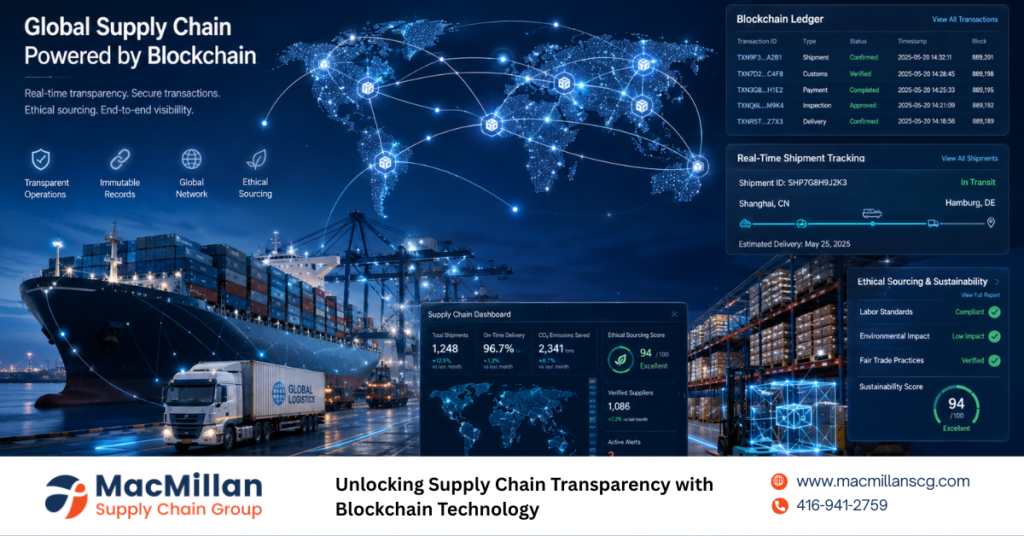
Unlocking Supply Chain Transparency with Blockchain Technology
Quick Summary Imagine a world where every product’s journey from raw materials to your doorstep is as transparent as a glass jar. That’s the promise of blockchain technology. By creating an unbreakable digital ledger, it’s rewriting supply chain rules: eliminating fraud, automating contracts, and proving ethical sourcing. And no, this isn’t sci-fi. Companies like Nestlé and Walmart are already using it to track food safety. Ready to join them? Introduction: Trust Isn’t Optional Anymore In an era where counterfeit goods cost the global economy $500 billion annually, and 66% of consumers demand ethical sourcing, supply chains can’t afford guesswork. Blockchain steps in as the ultimate truth-teller. At MacMillan supply chain transparency, we help businesses harness this technology to turn opacity into opportunity solving compliance headaches, speeding up transactions, and earning customer trust. Transparency: The Blockchain Superpower Think of blockchain as a digital notary. Every transaction shipments, quality checks, payments is stamped into a shared, unchangeable ledger. Traceability in Action: A coffee brand traces beans from Ethiopian farms to supermarket shelves in seconds. Fraud Prevention: Luxury brands like LVMH use blockchain to verify authentic handbags, slashing counterfeit risks. “With blockchain, recalls that once took weeks now take minutes.” – MacMillan Supply Chain Case Study Smart Contracts: The Efficiency Game-Changer What’s smarter than a contract? One that enforces itself. Automated Workflows: Orders trigger payments only when goods arrive undamaged. Error Reduction: Maersk cut paperwork by 80% using blockchain for shipping logistics. Why it matters: Fewer delays, happier customers, and teams freed from chasing invoices Security & Compliance: No More “Oops” Moments Blockchain doesn’t just store data—it guards it. Tamper-Proof Records: Alter a shipment detail? The entire network flags it. Audit-Ready 24/7: Pharma companies like Pfizer use blockchain to meet FDA compliance effortlessly. MacMillan Insight: Compliance isn’t a cost it’s your reputation’s insurance policy. Ethical Sourcing: Prove You Walk the Talk Consumers don’t just want “organic” labels they want proof. Blockchain delivers: Conflict-Free Minerals: Tech giants track cobalt from mine to iPhone. Fair Trade Coffee: Farmers get paid fairly; buyers see the journey. Your move: Turn sustainability claims into irrefutable stories. Challenges? We’ve Got Fixes Blockchain isn’t plug-and-play… yet. Common hurdles include: Legacy System Hang-Ups → Our fix: Hybrid integration that bridges old and new. Regulatory Gray Areas → Our fix: Compliance frameworks tailored to your industry. Sticker Shock → Our fix: Scalable pilots that prove ROI fast. MacMillan’s Playbook: Start Small: Pilot blockchain for one product line. Train Teams: Workshops to demystify the tech. Partner Up: We handle integration; you focus on growth. Your Roadmap to Blockchain Adoption Audit Pain Points: Where’s fraud or inefficiency bleeding profits? Prioritize Use Cases: Start with traceability or smart contracts. Collaborate: Choose a partner (like us) who speaks tech and supply chain transparency. Next Step: Book a free blockchain readiness assessment. Let’s map your leap from legacy to leading-edge. Final Takeaway Blockchain isn’t just for crypto enthusiasts. It’s the trust engine modern supply chain transparency need to thrive in a skeptical world. And with MacMillan? You’re not just adopting tech you’re future-proofing your reputation. If you’re ready to enhance your supply chain transparency with blockchain technology, partner with MacMillan Supply Chain for unparalleled expertise and support. Our team will guide you through the implementation process, ensuring a seamless transition and maximizing the benefits of blockchain for your business. Contact us today to unlock the full potential of blockchain in your operations. FAQS What is the main benefit of using blockchain in supply chain management? The primary benefit is enhanced transparency, with all transactions recorded in a decentralized, immutable ledger. This provides real-time visibility and traceability throughout the supply chain. How does blockchain improve supply chain visibility? Blockchain improves supply chain visibility by creating a transparent and shared digital ledger where every transaction, shipment update, and quality check is recorded in real time. This allows businesses to track products from raw materials to final delivery with greater accuracy and accountability. Can blockchain help in preventing counterfeiting? Yes, blockchain helps prevent counterfeiting by providing tamper-proof product records and authentication data. Brands can verify product origins, serial numbers, and ownership history, making it easier to identify fake or unauthorized goods in the supply chain. How does blockchain impact supply chain efficiency? Blockchain increases supply chain efficiency by automating processes, reducing paperwork, and improving data accuracy. Smart contracts can trigger payments, approvals, or shipment updates automatically, helping businesses minimize delays and operational errors. Is blockchain suitable for all types of industries? Blockchain can benefit many industries including retail, healthcare, food, manufacturing, and logistics. However, the level of implementation depends on business size, operational complexity, regulatory requirements, and supply chain needs. How secure is the data stored on a blockchain? Data stored on a blockchain is highly secure because records are encrypted and distributed across multiple network nodes. Once information is added, it cannot be changed without network validation, making unauthorized alterations extremely difficult. Can blockchain help in ensuring sustainable sourcing practices? Yes, blockchain helps companies verify ethical and sustainable sourcing by tracking materials and suppliers throughout the supply chain. Businesses can provide transparent proof of fair trade practices, environmental compliance, and responsible sourcing. What is the role of smart contracts in blockchain-enabled supply chains? Smart contracts automate agreements between parties in the supply chain. They execute actions such as payments, approvals, or order confirmations automatically when predefined conditions are met, improving speed, trust, and operational efficiency. How does blockchain affect the relationship between suppliers and buyers? Blockchain strengthens supplier and buyer relationships by improving transparency, trust, and communication. Both parties gain access to accurate real-time data, reducing disputes, improving collaboration, and increasing accountability across the supply chain. Are there any challenges to implementing blockchain in supply chain transparency? Yes, some common challenges include integration with legacy systems, implementation costs, scalability concerns, and evolving regulations. Businesses may also require employee training and technical expertise to fully adopt blockchain solutions successfully.
Ocean Freight Bottlenecks 2025 | Supply Chain Resilience
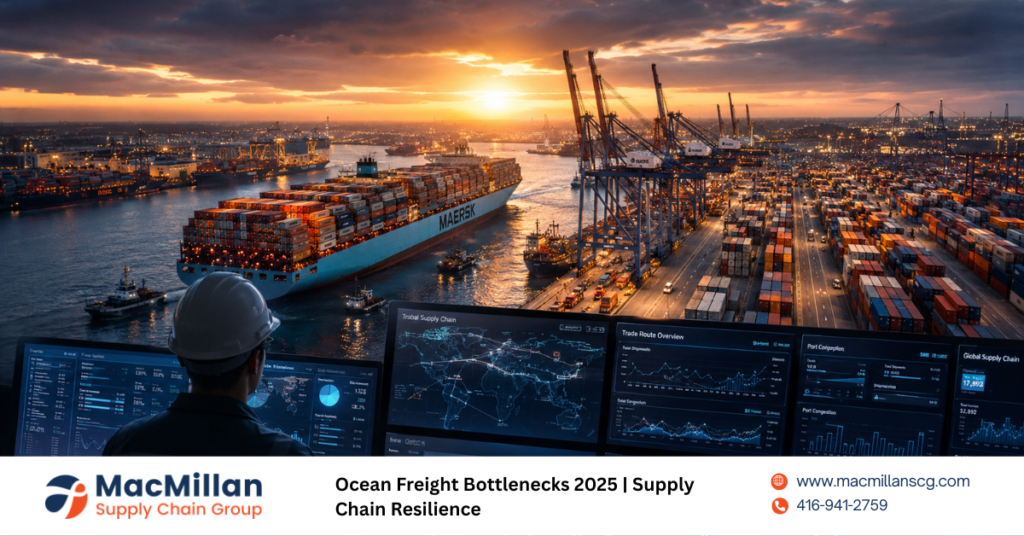
Quick Summary: As we approach 2025, the ocean freight industry faces significant bottlenecks, including port congestion, overcapacity, and evolving regulations. Navigating these challenges requires a proactive approach to ensure supply chain resilience. MacMillan Supply Chain Group offers expert insights and tailored solutions to help businesses overcome these obstacles and maintain efficient operations. Introduction: The ocean freight landscape in 2025 presents a complex web of challenges that can disrupt even the most well-oiled supply chains. Factors such as port congestion, vessel overcapacity, and shifting regulatory frameworks are causing delays, escalating costs, and creating uncertainty for shippers worldwide. At MacMillan Supply Chain Group, we understand the critical importance of addressing these bottlenecks head-on. Our team of seasoned logistics experts provides actionable insights and customized solutions designed to help businesses navigate these turbulent waters and maintain resilient supply chains. The Persistent Challenge of Port Congestion One of the most pressing issues facing the ocean freight sector in 2025 is the persistent challenge of port congestion. Major ports across Asia, Latin America, and North America are experiencing severe delays, with some bottlenecks lasting up to three weeks in critical hubs like Busan and Singapore. These delays are often exacerbated by labor shortages, adverse weather conditions, and inefficient cargo handling processes. Navigating these congested waters requires proactive planning and a willingness to explore alternative routing strategies. At MacMillan Supply Chain Group, we leverage our deep industry expertise to identify and implement the most efficient routes, minimizing delays and avoiding bottlenecks that can cripple supply chain operations. The Double-Edged Sword of Overcapacity The surge in container vessel orders has led to a concerning issue of overcapacity within the ocean freight sector. While this might initially suggest lower freight rates, the reality is far more complex. Overcapacity can strain carrier profitability, leading to cuts in service quality, reliability, and potentially higher costs for shippers in the long run. At MacMillan Supply Chain Group, we understand that navigating these turbulent waters requires strategic planning and a deep understanding of market dynamics. By optimizing shipping schedules, negotiating favorable rates, and leveraging our extensive industry network, we help our clients capitalize on market conditions without sacrificing operational efficiency. Navigating the Evolving Regulatory Landscape As we approach 2025, the ocean freight industry is grappling with the impacts of potential policy shifts and evolving global regulatory requirements. New tariffs, compliance standards, and environmental regulations are increasing the cost and complexity of ocean freight logistics. Failure to adapt to these changes can result in costly penalties, delays, and reputational damage. At MacMillan Supply Chain Group, we prioritize staying ahead of these regulatory shifts, offering comprehensive compliance strategies and adapting swiftly to new mandates. Our focus is on reducing the operational costs associated with compliance, ensuring that our clients remain competitive despite the ever-changing regulatory landscape. The Imperative of Supply Chain Resilience In the face of these multifaceted challenges, building supply chain resilience has become an imperative for businesses seeking to maintain a competitive edge. Resilience encompasses the ability to anticipate disruptions, mitigate their impact, and rapidly adapt to changing circumstances. At MacMillan Supply Chain Group, we partner with our clients to develop robust contingency plans, diversify supply bases, and implement advanced technologies that enhance visibility and agility across the entire supply chain network. Common Problems and Our Solutions: Port Congestion: MacMillan Supply Chain Group addresses port congestion by leveraging our extensive network and deep industry knowledge to identify alternative routing options, optimizing cargo flow, and collaborating with port authorities to streamline operations. Overcapacity: We help clients navigate overcapacity challenges by optimizing shipping schedules, negotiating favorable rates, and providing strategic guidance on market trends and carrier dynamics. Regulatory Compliance: Our dedicated compliance team stays ahead of regulatory changes, offering comprehensive strategies to ensure seamless adherence to evolving mandates, minimizing disruptions and penalties. Supply Chain Disruptions: Through proactive risk management, diversification strategies, and the implementation of cutting-edge technologies, we enhance supply chain visibility, enabling rapid response and adaptation to unforeseen disruptions. How Readers Can Avoid Problems and Implement Solutions: To conquer the ocean freight bottlenecks of 2025 and build resilient supply chains, businesses must take a proactive approach. Partner with MacMillan Supply Chain Group to access our extensive industry expertise, leverage our strategic solutions, and stay ahead of the curve. Our tailored approach ensures that your supply chain operations remain efficient, cost-effective, and agile in the face of evolving challenges. Contact MacMillan Supply Chain Group today to schedule a consultation and learn how our customized solutions can help your business navigate the ocean freight bottlenecks of 2025 and achieve long-term supply chain resilience. FAQS What are the primary causes of port congestion in 2025? Port congestion in 2025 is primarily driven by a combination of factors, including labor shortages, inefficient cargo handling processes, and adverse weather conditions exacerbated by climate change. Additionally, an imbalance in container supply and demand, as well as infrastructure limitations at major ports, contribute to the bottlenecks. How can businesses mitigate the impacts of overcapacity in the ocean freight sector? Businesses can mitigate the impacts of overcapacity by optimizing shipping schedules, diversifying carrier partnerships, negotiating flexible freight rates, and closely monitoring market trends. Strategic planning and efficient route management also help reduce operational disruptions and maintain cost efficiency. What are the potential consequences of non-compliance with evolving regulations in the ocean freight industry? Non-compliance with evolving regulations can lead to costly penalties, shipment delays, increased operational expenses, legal complications, and reputational damage. It may also disrupt supply chain operations and reduce customer trust. How can advanced technologies help build supply chain resilience? Advanced technologies improve supply chain resilience by enhancing real-time visibility, predictive analytics, inventory tracking, and communication across the supply chain network. These tools help businesses identify risks early, respond faster to disruptions, and improve operational efficiency. Why is it important to partner with a specialized logistics provider like MacMillan Supply Chain Group? Partnering with a specialized logistics provider like MacMillan Supply Chain Group gives businesses access to industry expertise, customized logistics solutions, regulatory compliance support, and efficient transportation strategies. This
Barcode Evolution: Driving Supply Chain Visibility and Efficiency
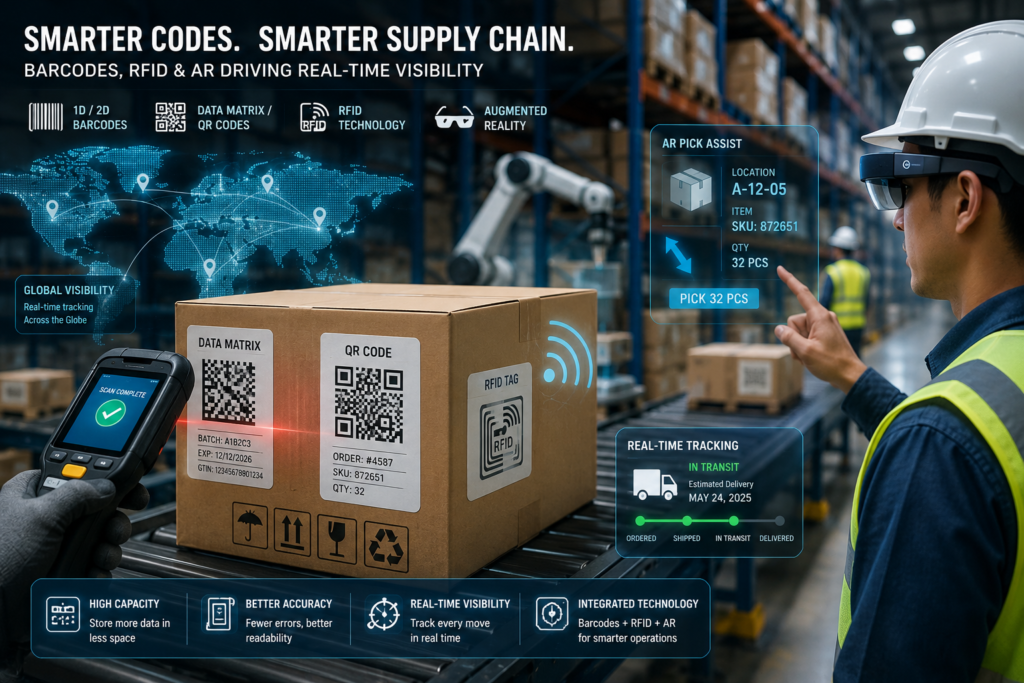
Quick Summary What began as a grocery store experiment in the 1940s is now the backbone of global supply chain visibility. Barcodes have evolved from simple lines to data-rich 2D/3D codes, driving unprecedented accuracy and real-time tracking. With innovations like AR-guided warehouses and RFID hybrids, they’re proving even the smallest label can pack a billion-dollar punch. Introduction: The Silent Workhorse of Modern Logistics Picture a world without barcodes: checkout lines snaking through stores, shipments lost in transit chaos, and inventory counts buried in guesswork. Thankfully, we don’t live there. Since that first beep scanning a pack of Wrigley’s gum in 1974, barcodes have quietly transformed supply chain visibility into precision engines. Today, they’re not just identifiers they’re data powerhouses, merging with AI and IoT to turn logistics into a science. The Evolution of Barcodes The journey of barcodes began with humble linear codes in the 1940s, initially designed for inventory management in grocery stores. These rudimentary designs, consisting of parallel lines, paved the way for the Universal Product Code (UPC) system, which revolutionized retail operations when the first item was scanned in 1974. This pivotal moment marked the widespread adoption of barcodes, simplifying product tracking and inventory management across various sectors. Two-dimensional (2D) barcodes were created as a result of the limits of linear codes becoming evident as technology developed. With the addition of strong errors correcting mechanisms, these cutting-edge designs such as QR codes and Data Matrix codes significantly expanded data storage capacities and ensured dependable reading even on damaged or obscured codes. Modern Trends in Barcode Technology Contemporary barcode technology goes far beyond simple item identification. Advanced systems now integrate sensors, artificial intelligence (AI), and augmented reality (AR) to automate scanning processes and improve accuracy dramatically. AR applications, for instance, enable seamless inventory management by displaying digital information within a worker’s direct line of vision, reducing errors in picking and packing operations. Additionally, the advent of “smart labels” and Internet of Things (IoT) integration has revolutionized supply chain visibility. These intelligent barcodes, equipped with sensors and wireless connectivity, provide real-time tracking of products throughout the entire logistics journey, from manufacturing to final delivery. This level of transparency aligns with modern trends prioritizing optimization and end-to-end supply chain oversight. Industry Specific Innovations: Beyond Retail Different sectors have harnessed barcodes in unique ways, tailoring the technology to their challenges: Healthcare: Data Matrix codes, with their high reliability, track every pill and medical device. Hospitals use them to prevent counterfeit drugs and ensure compliance with stringent regulations. During the COVID-19 pandemic, these codes were critical in managing vaccine distribution. Retail: QR codes bridge online and offline experiences. A customer scanning a code on a clothing tag might see a video of the garment’s sustainable production process or access exclusive discounts, fostering brand loyalty. Manufacturing: Centralized systems sync barcode data across global factories, ensuring components arrive just-in-time. Toyota, for example, slashed production delays by 30% using real time part tracking. These applications highlight barcodes’ versatility they’re not just tools for logistics but catalysts for innovation. RFID and Barcode Integration The integration of radio frequency identification (RFID) technology with traditional barcodes represents a significant leap forward in logistics innovation. By combining RFID’s non-line-of-sight capability with the data capacity of barcodes, businesses can implement faster and more efficient scanning solutions. This hybrid approach addresses the logistical challenges of modern supply chain visibility, emphasizing the necessity for continuous innovation in inventory management. Common Hurdles (and How to Clear Them) Legacy Scanner Woes: Older devices can’t read 2D codes? Retrofit with add-on lenses. Upgrade Costs: Start with pilot projects—e.g., tag high-value items first. Data Silos: Cloud platforms unify scanning data across teams. MacMillan’s Fix: Phased Upgrades: Modernize scanners without breaking budgets. Staff Training: Turn skeptics into barcode pros with hands-on workshops. Custom Tools: APIs that sync barcode data with your existing ERP.. We also provide comprehensive training and support services to ensure your staff maximizes the efficiency of barcode deployments. Our experts work closely with your team to streamline processes, enhance data management practices, and implement best practices for supply chain visibility and accuracy Implementing Solutions: Work with MacMillan To stay ahead in the rapidly evolving landscape of supply chain management, partnering with industry experts is crucial. MacMillan Supply Chain combines deep domain expertise with state-of-the-art technology to deliver optimized logistics solutions tailored to your specific needs. By leveraging our advanced barcode and RFID integration capabilities, you can future-proof your operations, ensuring a smooth transition to emerging technologies while maximizing the value of your existing investments. Contact us today to explore how we can streamline your supply chain, enhance visibility, and drive operational excellence through the power of innovative barcode solutions. FAQS What are 2D barcodes' primary benefits over conventional 1D barcodes? Compared to its linear predecessors, 2D barcodes—such as QR codes and Data Matrix codes offer a number of benefits. These include extra storage space for data, strong error-correction systems, and the ability to record more specific product details like batch numbers and manufacture dates. 2D barcodes are useful for marketing and brand engagement campaigns since they also allow for richer consumer connection through smartphone scanning. Why is the transition to 2D barcodes important for supply chain management? 2D barcodes are important because they can store much more information than traditional barcodes and improve tracking accuracy. They also allow faster scanning and better readability even if the code is damaged, making supply chain operations more efficient and reliable. How does augmented reality contribute to the evolution of barcode technology? Augmented reality helps by showing real-time barcode and inventory data directly in a worker’s view through smart devices. This makes warehouse tasks like picking and packing faster, more accurate, and easier to manage. How is RFID technology integrated into modern barcode systems? RFID is combined with barcode systems to improve tracking speed and accuracy. Unlike barcodes, RFID can scan multiple items without direct line of sight, and when used together they provide stronger real-time visibility across the supply chain.
Top Logistics Trends 2025 | Automation & Sustainability
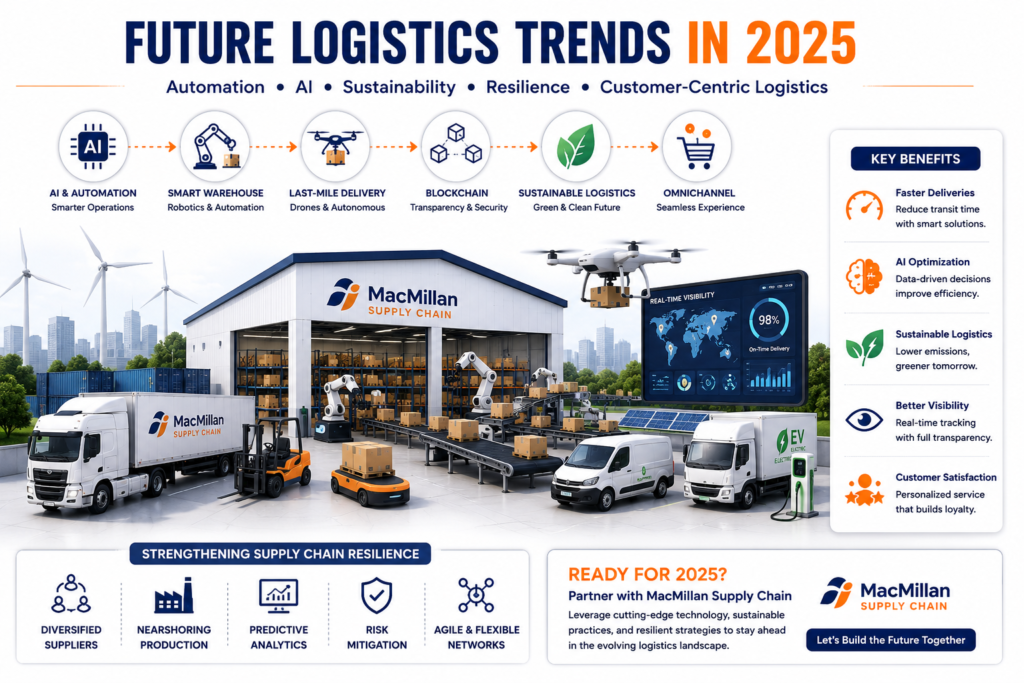
Quick Overview In 2025, logistics will be transformed by automation, AI, sustainability, and personalized services. As logistics trends evolve, companies will leverage advanced technologies to streamline operations, reduce environmental impact, and enhance customer experiences. These shifts will focus on optimizing supply chain resilience, integrating blockchain for transparency, and employing data-driven strategies to stay competitive. Introduction Logistics is undergoing a seismic shift, driven by a combination of technological advancements and the pressing need for sustainable practices. Forecasting into 2025, automation and AI emerge as pivotal players in transforming logistics operations, while sustainability initiatives become crucial for businesses striving to meet eco-friendly goals. At the nexus of innovation and necessity, MacMillan Supply Chain leads as an expert in integrating these transformative trends, poised to unlock new efficiencies and customer experiences in logistics. Automation and AI’s Role in 2025 Automation is transforming logistics and is no longer a sci-fi idea. AI powered solutions improve warehouse management, demand forecasting, and routes. Drones and self driving cars will revolutionize last-mile deliveries, cutting expenses and timeframes. These innovations result in a digital transformation for businesses like MacMillan, guaranteeing quicker, safer, and more dependable logistics services. We lead efficiency by incorporating AI systems, prepared to lead companies into the future. Embracing Sustainability in Logistics In an urgent effort to prevent climate change, logistics companies are embracing sustainability and integrating their operations with green principles. Emissions are reduced by switching to electric and hydrogen powered vehicles, while additional environmental initiatives include redesigning packaging and implementing carbon neutral tactics. Leading the charge in putting these environmental impact reduction measures into action is MacMillan. By restructuring supply chains to meet eco friendly objectives and drawing in sustainability conscious customers, working with us gives you a competitive edge. Importance of E-commerce and Omnichannel Logistics The e-commerce explosion demands an omnichannel logistics approach, requiring swift, flexible delivery methods. Companies are investing in micro-fulfillment centers near cities to guarantee faster deliveries. MacMillan partners with businesses to ensure seamless integration of these strategies, facilitating same-day and scheduled deliveries that delightedly meet customer expectations. As e-commerce evolves, staying ahead involves adopting agile, customer-centric logistic solutions that MacMillan offers expertly. Strengthening Supply Chain Resilience Disruptions in recent years highlight the critical need for supply chain resilience. Strategies like diversifying suppliers, nearshoring production, and predictive analytics of potential disruptions become essential. in MacMillan’s opinion, increases resilience and reduces risks. Companies can handle unpredictable markets with assurance, delivering smooth, effective operations. Common Problems & Our Solutions The rapid tech evolution in logistics can create gaps, causing inefficiencies or prolonged adaptation periods for businesses. Automation and AI implementation may require significant initial investment and strategic planning. Sustainability goals can also face challenges in balancing cost with effective environmental impact. Additionally, ecommerce demands flexible logistics that may overwhelm unprepared supply chains. Our Solutions: MacMillan Supply Chain works to overcome these challenges. In order to minimize risks during transitions, our skilled team creates customized automation plans that integrate advanced AI with your current systems. Our sustainability programs help companies implement environmentally friendly practices without sacrificing efficiency or affordability. Additionally, we deliberately locate fulfillment hubs for maximum reach and efficiency, modeling customer centric e-commerce logistics solutions. Placing Solutions into Practice with MacMillan Collaborate with MacMillan Supply Chain to steer clear of any logistical obstacles. We provide cutting edge automation and artificial intelligence solutions to your company, promoting resilient and sustainable operations that satisfy customer demands and market trends. To begin improving your supply chain and maintain your competitive edge in a constantly changing industry, get in touch with our experts right now. MacMillan’s experience might serve as the foundation for your company’s successful navigation of 2025’s trends if you’re looking for creative logistics solutions and excellent supply chain management. To find out how we can support your journey of transformation, get in touch with us right now. FAQS How will automation and AI reshape logistics by 2025? Automation and AI will considerably enhance logistics through processes like route optimization, demand forecasting, and warehouse management. Drones and autonomous vehicles will be crucial in refining last-mile delivery, making operations faster and more cost-effective. Why is sustainability pivotal in modern logistics? Sustainability is pivotal in modern logistics because businesses are under increasing pressure to reduce environmental impact and meet eco-friendly standards. Sustainable logistics practices, such as using electric vehicles, optimizing transportation routes, and reducing packaging waste, help lower carbon emissions and operational costs. Additionally, companies that prioritize sustainability can improve brand reputation, attract environmentally conscious customers, and stay compliant with evolving regulations. Why is Omnichannel logistics essential for e-commerce? Omnichannel logistics is essential for e-commerce because customers expect fast, flexible, and seamless delivery experiences across multiple sales channels. It enables businesses to integrate online and offline operations efficiently, ensuring accurate inventory management, faster fulfillment, and convenient delivery options such as same-day or scheduled delivery. This approach improves customer satisfaction, strengthens brand loyalty, and helps businesses stay competitive in the growing e-commerce market. What strategies bolster supply chain resilience? Strategies that bolster supply chain resilience include diversifying suppliers, nearshoring production, maintaining safety stock, and using predictive analytics to identify potential disruptions. Businesses also strengthen resilience by investing in digital technologies, improving supply chain visibility, and creating flexible logistics networks. These strategies help companies respond quickly to unexpected disruptions, minimize risks, and maintain smooth operations during uncertain market conditions. How does blockchain enhance logistics transparency? Blockchain enhances logistics transparency by creating a secure and tamper-proof digital record of transactions and product movements across the supply chain. It allows all stakeholders to access real-time information regarding shipments, inventory, and delivery status, reducing fraud and improving accountability. Blockchain also improves traceability, streamlines documentation processes, and builds trust among suppliers, logistics providers, and customers through transparent data sharing.
The Real Cost of Slow Returns Processing for E-commerce Brands
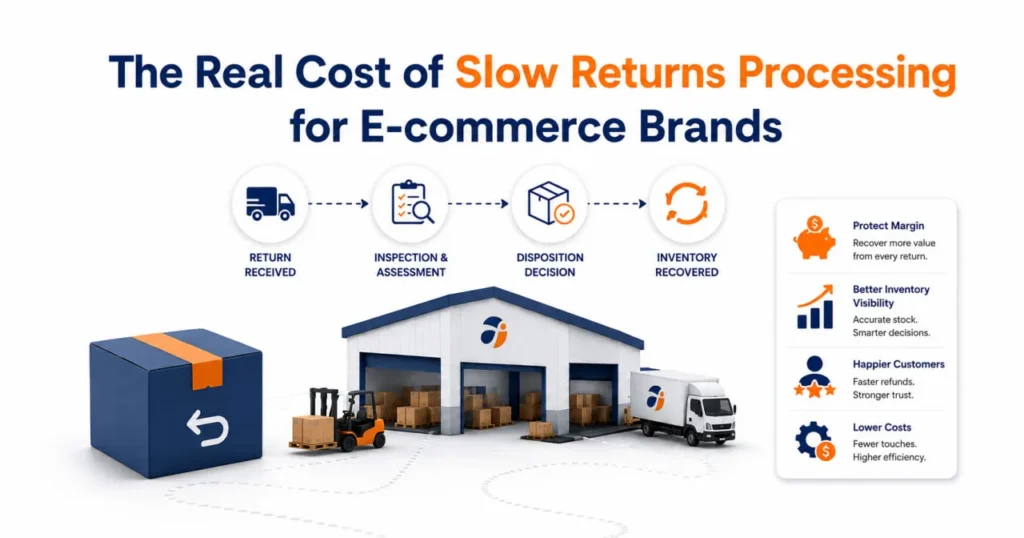
A Quick Summary and Overview For e-commerce brands, returns are not just a customer service issue. They affect inventory recovery, margin, cash flow, warehouse efficiency, and customer trust. When returns move too slowly, sellable stock stays stuck, refunds take longer, operational costs rise, and products can lose value before they ever make it back into inventory. As e-commerce brands grow, reverse logistics becomes harder to manage with manual steps, weak visibility, and disconnected workflows. Brands that process returns well tend to recover value faster, keep inventory more accurate, and create a better post-purchase experience. Introduction A slow return costs more than it looks. At first, it may seem like a minor delay. A product comes back, sits for a while, gets inspected later, and eventually moves through the system. But every extra day adds friction. Inventory stays unavailable. refund timing stretches out. Customer service teams deal with more questions. Warehouse space gets tied up. And in some cases, the product loses its best chance to be resold quickly. That is why returns processing deserves more attention than it often gets. For many e-commerce brands, reverse logistics still sits in the background. Outbound fulfillment gets the focus because it is visible, urgent, and directly tied to sales. Returns are often treated as something to clean up later. But once order volumes grow, that approach starts becoming expensive. Why Returns Processing Matters More Returns matter more now because brands are operating with tighter margins, faster customer expectations, and more pressure to keep inventory moving. A return is no longer just a completed sale reversed. It is part of the full commerce cycle. If the process is slow, the cost shows up in several places at once: slower inventory recovery delayed refunds more warehouse touches less accurate stock visibility higher write-offs weaker customer trust For growing brands, this becomes even more important because there is less room for hidden inefficiency. One slow returns process can create problems across inventory planning, customer support, and cash flow at the same time. What Slow Returns Processing Actually Costs 1. Delayed inventory recovery When returned goods sit too long before being inspected or restocked, sellable inventory stays unavailable. That can make stock levels look tighter than they really are. Teams may reorder too early, expedite inventory unnecessarily, or miss sales opportunities because products that could have been resold are still sitting in a returns area. 2. Lower resale value Time matters in returns. If a product is seasonal, trend-sensitive, promotional, or tied to a fast-moving cycle, a slow return can reduce how much value the brand can recover. What could have gone back into inventory at full price may end up discounted, cleared out, or written off. 3. Higher handling and storage costs Returns that sit too long create extra work. The longer a returned product stays in the system without a clear next step, the more likely it is to be touched multiple times, moved around, manually checked again, or stored in the wrong place. That adds labor cost, warehouse congestion, and operational drag without adding value. 4. Slower refunds and weaker customer experience Customers do not separate returns from the rest of your brand experience. If a return feels slow, unclear, or frustrating, trust drops quickly. Even when the original purchase experience was good, the return process can shape how the customer remembers the brand. Slow refunds, unclear return status, or long inspection times often lead to more support tickets and lower confidence in ordering again. 5. Poorer inventory planning When returns are not processed quickly, inventory data becomes less reliable. Teams may not know what is actually back, what is still being inspected, what can be resold, or what should be removed from usable stock. That weakens forecasting, replenishment, merchandising, and purchasing decisions. 6. Hidden margin erosion One of the biggest problems with slow returns is that the full cost is not always obvious. Brands may see return shipping costs, but miss the deeper margin loss caused by: delayed restocking markdowns on late-returned items extra labor tied-up warehouse space customer support workload lower recovery rates That is why slow returns are not just an operations problem. They are a profitability problem. The Biggest Signs Your Returns Process Is Too Slow A returns workflow is usually too slow when these issues keep showing up: returned items take too long to become sellable again refunds are delayed after the product is physically received teams have weak visibility into return status warehouse teams keep handling the same returned stock more than once inventory numbers become less reliable after returns too many returned products end up discounted or written off customer service spends too much time answering return-related questions If those patterns are common, the issue is usually not returns volume alone. It is the process behind it. 6 Ways E-commerce Brands Can Improve Returns Processing 1. Create a clear returns triage process Every return should move into a defined path quickly. That means deciding early whether the item should be: restocked inspected further held repaired liquidated disposed When returns do not have a clear route, they sit longer than they should. 2. Reintegrate sellable stock faster The faster a sellable product gets back into inventory, the more value the brand can recover. That means reducing the gap between receipt, inspection, decision, and restock. Even a small improvement here can make a meaningful difference in both margin and stock availability. 3. Improve returns visibility Brands need to know what is happening inside the returns process, not just that a return exists. Good visibility includes: what has been returned what has physically arrived what is under review what is approved for restock what is being removed from inventory how long each stage is taking Without that visibility, returns become hard to improve. 4. Use returns data to find repeat problems A good returns process should not only move product. It should also reveal patterns. If certain
Circular Supply Chains | Sustainability & Innovation Guide
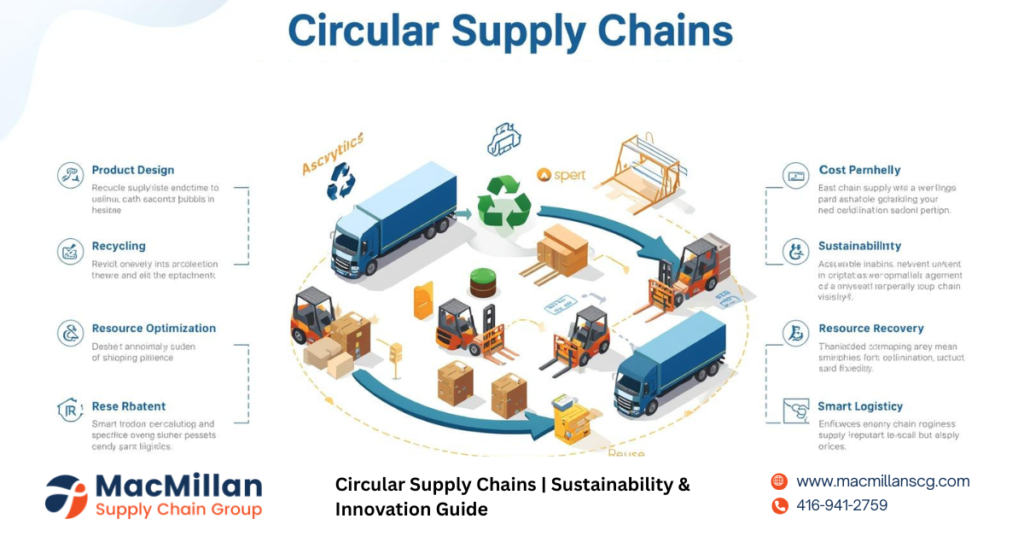
A Quick Summary and Overview Circular supply chains represent a transformative approach to supply chain management, addressing sustainability concerns by maximizing resource utilization and minimizing waste.Businesses can cut costs, spur innovation, and obtain a competitive edge while lessening their environmental impact by rethinking products, putting reverse logistics into practice, and streamlining resource flows. Overview Sustainability is no longer just a catchphrase in today’s corporate environment; it is a strategic necessity that is essential to long term success. Businesses are realizing that they need to reconsider their operations as customer preferences and regulatory frameworks move toward eco conscious methods. Presenting the circular supply chain model, a ground breaking idea that offers a route to sustainability, creativity, and profitability while challenging conventional linear approaches. We will examine the complexities of circular supply chains in this extensive guide, including its advantages, elements, difficulties, and methods of implementation. What is a Circular Supply Chain? An alternative to the conventional linear model of “take-make-waste” is a circular supply chain. It is based on the ideas of the circular economy, which emphasizes resource optimization techniques, efficient reverse logistics, and purposeful product design to keep resources in use for as long as possible. Circular supply chains seek to establish a closed loop in which goods and resources are continuously recycled, refurbished, or reused, in contrast to conventional supply chains that prioritize a one-way flow from production to disposal. Key Components of Circular Supply Chains Transitioning to a circular supply chain requires a holistic approach that encompasses several key components. Product redesign is a crucial starting point, where products are designed from the outset with longevity, recyclability, and modularity in mind. This not only extends the usable life of products but also facilitates easier disassembly and material recovery. Reverse logistics systems play a pivotal role in circular supply chains, enabling the collection, inspection, and sorting of used products or components for refurbishment, remanufacturing, or recycling. Effective reverse logistics not only minimizes waste but also creates opportunities for value recovery and new revenue streams. Another crucial element is resource optimization, which aims to reduce dependency on fresh raw materials and maximize the use of already-existing commodities. Remanufacturing, material recycling, and the use of recycled or renewable inputs in production processes are among methods that can help achieve this. Advantages of Circular Supply Chain Transition Businesses can gain a wide range of advantages by adopting circular supply chains, from improved brand recognition and competitive advantages to cost savings and operational improvements. Businesses can achieve significant cost savings in material procurement, waste management, and energy use by avoiding waste and optimizing resource utilization. Additionally, by pushing companies to reconsider their operational procedures, material selections, and product designs, circular supply chains promote innovation. New goods, services, and company strategies may result from this need for innovation, bringing up new avenues for income generating and market uniqueness. Circular supply networks help to mitigate environmental deterioration, conserve natural resources, and lower greenhouse gas emissions from a sustainability perspective. Businesses that showcase a dedication to sustainability might obtain a competitive advantage and improve their brand reputation as consumers grow more aware of their environmental impact. Common Challenges of Circular Supply Chains While the benefits of circular supply chains are compelling, businesses often face several challenges during the transition process. One of the primary obstacles is the need for upfront investments in product redesign, infrastructure development, and process modifications. This can be particularly challenging for smaller companies with limited resources. Economic and regulatory barriers can also hinder the adoption of circular supply chains. Lack of financial incentives, limited access to recycling facilities, and inconsistent regulations across regions can create roadblocks and increase operational complexities. Additionally, aligning diverse stakeholders, such as suppliers, customers, and recyclers, can be a daunting task. Effective collaboration and communication are essential to ensure seamless integration and buy-in across the entire supply chain ecosystem. Common Problems Transitioning to a circular supply chain can be a complex and daunting task for many businesses. One common challenge is the need for significant upfront investments in redesigning products, establishing reverse logistics systems, and modifying operational processes. Limited financial resources and expertise can hinder progress, especially for smaller companies. Navigating the complicated web of regulatory and economic environments is another challenge. The effective application of circular supply chain strategies may be restricted by a lack of funding, poor recycling infrastructure, and varying regional rules. Additionally, companies frequently have trouble getting a variety of stakeholders including suppliers, consumers, and recyclers to adopt the circular economy philosophy. Conflicting priorities, resistance to change, and a lack of cooperation can all hinder development and reduce the impact of circular supply chain projects. Macmillan Solutions At MacMillan Supply Chain, we understand the challenges businesses face when transitioning to circular supply chains. That’s why we offer comprehensive solutions tailored to your specific needs and requirements. From redesigning products to setting up reliable reverse logistics systems, our team of professionals offers strategic consulting services to help you every step of the way. We use state of the art technology, like data analytics and Internet of Things solutions, to track material movements, optimize resource flows, and find opportunities for value recovery and waste reduction. Moreover, we collaborate with industry partners, policymakers, and regulatory bodies to advocate for supportive policies and financial incentives that facilitate the adoption of circular supply chain practices. Our extensive network and industry expertise enable us to navigate complex regulatory landscapes and ensure compliance with evolving sustainability standards. Through strategic partnerships and collaborations, we help you align stakeholders across the supply chain ecosystem, fostering a shared commitment to sustainability and circularity. Our tailored solutions empower businesses to overcome economic barriers, optimize resource utilization, and unlock new revenue streams through innovative business models and value-added services. How Can Readers Prevent Issues or Put Solutions in Place? Working with the proper professionals can make all the difference during the road to a circular supply chain. We at MacMillan Supply Chain are aware of the difficulties
Conquering Ocean Freight Bottlenecks 2025: A Guide for Supply Chain Resilience
Quick Summary: As we approach Ocean Freight Bottlenecks 2025, the industry faces significant bottlenecks, including port congestion, overcapacity, and evolving regulations. Navigating these challenges requires a proactive approach to ensure supply chain resilience. MacMillan Supply Chain Group offers expert insights and tailored solutions to help businesses overcome these obstacles and maintain efficient operations. Introduction: The ocean freight landscape in 2025 presents a complex web of challenges that can disrupt even the most well-oiled supply chains. Factors such as port congestion, vessel overcapacity, and shifting regulatory frameworks are causing delays, escalating costs, and creating uncertainty for shippers worldwide. At MacMillan Supply Chain Group, we understand the critical importance of addressing these bottlenecks head-on. Our team of seasoned logistics experts provides actionable insights and customized solutions designed to help businesses navigate these turbulent waters and maintain resilient supply chains. The Persistent Challenge of Port Congestion One of the most pressing issues facing the ocean freight sector in 2025 is the persistent challenge of port congestion. Major ports across Asia, Latin America, and North America are experiencing severe delays, with some bottlenecks lasting up to three weeks in critical hubs like Busan and Singapore. These delays are often exacerbated by labor shortages, adverse weather conditions, and inefficient cargo handling processes. Navigating these congested waters requires proactive planning and a willingness to explore alternative routing strategies. At MacMillan Supply Chain Group, we leverage our deep industry expertise to identify and implement the most efficient routes, minimizing delays and avoiding bottlenecks that can cripple supply chain operations. The Double-Edged Sword of Overcapacity The surge in container vessel orders has led to a concerning issue of overcapacity within the ocean freight sector. While this might initially suggest lower freight rates, the reality is far more complex. Overcapacity can strain carrier profitability, leading to cuts in service quality, reliability, and potentially higher costs for shippers in the long run. At MacMillan Supply Chain Group, we understand that navigating these turbulent waters requires strategic planning and a deep understanding of market dynamics. By optimizing shipping schedules, negotiating favorable rates, and leveraging our extensive industry network, we help our clients capitalize on market conditions without sacrificing operational efficiency. Navigating the Evolving Regulatory Landscape As we approach 2025, the ocean freight industry is grappling with the impacts of potential policy shifts and evolving global regulatory requirements. New tariffs, compliance standards, and environmental regulations are increasing the cost and complexity of ocean freight logistics. Failure to adapt to these changes can result in costly penalties, delays, and reputational damage. At MacMillan Supply Chain Group, we prioritize staying ahead of these regulatory shifts, offering comprehensive compliance strategies and adapting swiftly to new mandates. Our focus is on reducing the operational costs associated with compliance, ensuring that our clients remain competitive despite the ever-changing regulatory landscape. The Imperative of Supply Chain Resilience In the face of these multifaceted challenges, building supply chain resilience has become an imperative for businesses seeking to maintain a competitive edge. Resilience encompasses the ability to anticipate disruptions, mitigate their impact, and rapidly adapt to changing circumstances. At MacMillan Supply Chain Group, we partner with our clients to develop robust contingency plans, diversify supply bases, and implement advanced technologies that enhance visibility and agility across the entire supply chain network. Common Problems and Our Solutions: Port Congestion: MacMillan Supply Chain Group addresses port congestion by leveraging our extensive network and deep industry knowledge to identify alternative routing options, optimizing cargo flow, and collaborating with port authorities to streamline operations. Overcapacity: We help clients navigate overcapacity challenges by optimizing shipping schedules, negotiating favorable rates, and providing strategic guidance on market trends and carrier dynamics. Regulatory Compliance: Our dedicated compliance team stays ahead of regulatory changes, offering comprehensive strategies to ensure seamless adherence to evolving mandates, minimizing disruptions and penalties. Supply Chain Disruptions: Through proactive risk management, diversification strategies, and the implementation of cutting-edge technologies, we enhance supply chain visibility, enabling rapid response and adaptation to unforeseen disruptions. How Readers Can Avoid Problems and Implement Solutions To conquer the ocean freight bottlenecks of 2025 and build resilient supply chains, businesses must take a proactive approach. Partner with MacMillan Supply Chain Group to access our extensive industry expertise, leverage our strategic solutions, and stay ahead of the curve. Our tailored approach ensures that your supply chain operations remain efficient, cost-effective, and agile in the face of evolving challenges. Contact MacMillan Supply Chain Group today to schedule a consultation and learn how our customized solutions can help your business navigate the ocean freight bottlenecks of 2025 and achieve long-term supply chain resilience. Frequently Asked Questions What are the primary causes of port congestion in 2025? Port congestion in 2025 is primarily driven by a combination of factors, including labor shortages, inefficient cargo handling processes, and adverse weather conditions exacerbated by climate change. Additionally, an imbalance in container supply and demand, as well as infrastructure limitations at major ports, contribute to the bottlenecks. How can businesses mitigate the impacts of overcapacity in the ocean freight sector? Businesses can reduce the impact of overcapacity by diversifying carriers, improving demand forecasting, and using flexible shipping strategies to control costs and maintain supply chain stability. What are the potential consequences of non-compliance with evolving regulations in the ocean freight industry? Non-compliance can lead to fines, shipment delays, cargo holds, reputational damage, and disruptions across the supply chain. How can advanced technologies help build supply chain resilience? Advanced technologies improve visibility, automate operations, and provide real-time data that helps businesses respond quickly to disruptions and improve efficiency. Why is it important to partner with a specialized logistics provider like MacMillan Supply Chain Group? Working with MacMillan Supply Chain Group helps businesses improve efficiency, reduce logistics risks, ensure compliance, and optimize overall supply chain performance.
Why Omnichannel Fulfillment Breaks Down When Inventory Visibility Is Weak
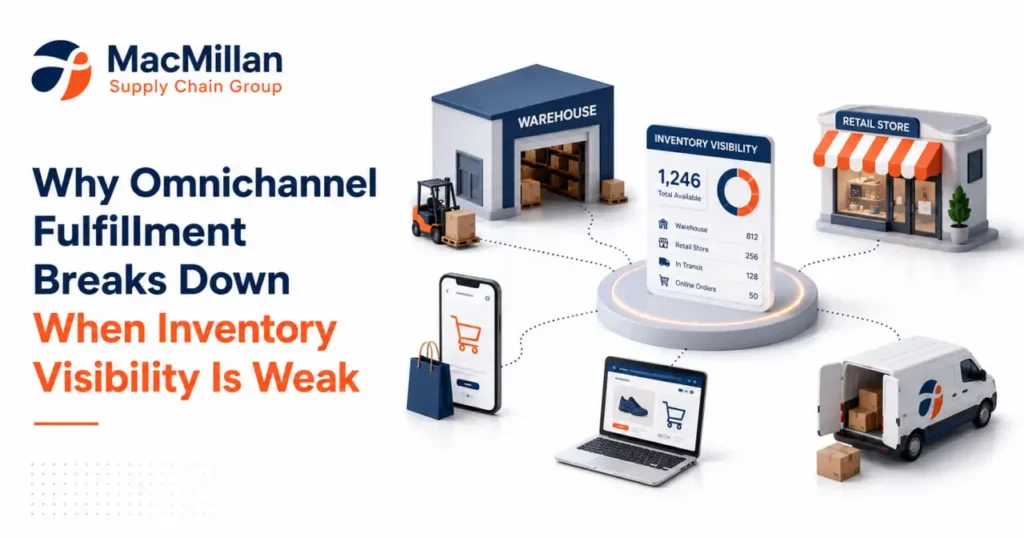
A Quick Summary and Overview Omnichannel fulfillment only works when inventory data is accurate, current, and shared across channels. When visibility is weak, brands struggle with stockouts, overselling, delayed replenishment, poor order routing, and inconsistent customer experiences across retail, ecommerce, and marketplace channels. Recent industry coverage keeps pointing to the same issue: unified commerce depends on real-time inventory visibility, not disconnected systems or delayed updates. For MacMillan, this is a highly relevant topic. The company already positions itself around Mantis-powered WMS visibility, real-time order and shipment tracking, scan-verified fulfillment, KPI-led reporting, retail-ready warehousing, and integrated warehousing, transportation, ecommerce fulfillment, and value-added services for FMCG brands. Introduction Omnichannel fulfillment sounds simple on the surface. A customer orders through one channel, inventory is picked from the best location, and the product arrives on time. But behind that experience is a much more demanding operational reality. Brands have to keep inventory aligned across retail, ecommerce, marketplaces, promotions, and replenishment flows all at once. That is where many operations start to break down. The problem is often not channel count alone. It is weak inventory visibility. When teams cannot see what is actually available, where it is located, what is allocated, and what should move next, omnichannel fulfillment becomes reactive, error-prone, and expensive. Current omnichannel and inventory visibility coverage consistently emphasizes real-time inventory as a core requirement for modern fulfillment because delayed or fragmented data undermines everything that follows. MacMillan’s service model fits this conversation well because its site already emphasizes visibility, synchronization, accurate inventory control, real-time data, and retailer-ready execution for fast-moving consumer goods. Why Inventory Visibility Matters More Than Ever Omnichannel fulfillment is getting harder because brands are serving more channels without gaining more margin for mistakes. Retailers expect tighter execution. Ecommerce customers expect fast delivery and accurate stock information. Internal teams need cleaner data to support launches, promotions, and replenishment decisions. Recent industry reporting points to the same pressure points: ship-from-store complexity, BOPIS and hybrid fulfillment demands, faster delivery expectations, and the need for real-time inventory data across networks. Shopify’s 2026 logistics coverage says inventory visibility is one of the defining omnichannel supply chain challenges this year. Microsoft’s inventory visibility documentation also frames real-time, cross-source on-hand tracking as a core requirement for modern commerce operations. For FMCG brands, that matters even more because demand moves quickly, promotions create spikes, and poor inventory decisions can affect both shelf availability and digital conversion. What Inventory Visibility Really Means Inventory visibility is not just knowing how much stock you have in total. In an omnichannel environment, brands need to know: what is available now what is allocated what is in transit what is committed to retail what is reserved for ecommerce what is at risk of delay or exception which location can fulfill the order most effectively Without that level of visibility, omnichannel fulfillment becomes guesswork. Microsoft’s Inventory Visibility service describes the need for real-time change postings and visibility tracking across all inventory data sources and channels. Radial makes a similar point, noting that real-time visibility is what enables retailers to deliver true omnichannel customer experiences. MacMillan’s site aligns closely with this need through its emphasis on WMS-powered visibility, real-time updates, inventory access, tracking, and data-driven KPI reporting. 6 Reasons Omnichannel Fulfillment Breaks Down When Visibility Is Weak 1. Stock data becomes inconsistent across channels One of the first issues is simple but damaging: different systems show different inventory positions. That leads to overselling, missed replenishment, and confusion between retail, ecommerce, and operations teams. When channels are not drawing from synchronized inventory data, brands start making decisions based on partial truth. Industry sources increasingly describe disconnected systems and delayed inventory updates as a central cause of omnichannel friction. Shopify highlights this as part of the broader unified-commerce challenge, while Microsoft’s documentation is built around solving this exact issue through shared visibility across sources. 2. Order routing decisions get worse If inventory visibility is weak, brands cannot reliably decide where to fulfill from. That causes inefficient routing, slower delivery, higher transportation cost, and more manual intervention. Teams may ship from the wrong node, split orders unnecessarily, or delay fulfillment while they verify what stock is actually available. MacMillan’s positioning around synchronized platforms, real-time visibility, and integrated transportation helps address this kind of execution gap. The company also highlights national coverage, milestone tracking, and route-aware transportation support. 3. Retail and ecommerce start competing for the same stock This is one of the biggest hidden problems in omnichannel operations. When visibility is weak, inventory meant for store replenishment may be consumed by ecommerce orders, or digital channels may show stock that is effectively unavailable because it is already committed elsewhere. That creates internal conflict and poor service on both sides. Impact Analytics’ 2026 omnichannel inventory management guide emphasizes that accurate, real-time visibility is essential for balancing inventory across channels with confidence. 4. Promotions and launches create operational chaos Promotions expose weak inventory visibility very quickly. A campaign can drive demand across multiple channels at once, but if inventory is not tracked accurately by location and status, brands struggle to allocate stock correctly, avoid stockouts, and support rapid replenishment. That leads to missed sales, poor customer experience, and pressure on warehouse teams. MacMillan’s services speak directly to this challenge. The site highlights support for fluctuating promotional volumes, seasonal peaks, launch readiness, rapid replenishment, and retail-specific preparation. 5. Accuracy and compliance problems multiply Weak visibility does not stay an inventory problem for long. It becomes a fulfillment problem, then a compliance problem. If teams do not have clear, current inventory data, they are more likely to mis-pick, substitute incorrectly, delay outbound orders, or create retailer issues tied to missing inventory, late delivery, or poor prep. MacMillan’s site repeatedly connects visibility with scan-verified fulfillment, ASN support, retailer-ready execution, and performance reporting. 6. Customer experience becomes inconsistent When inventory visibility is weak, customers see the symptoms even if they never see the system problem. They experience: inaccurate stock availability delayed shipments