
Building Supply Chain Resilience with 3PL Warehousing services
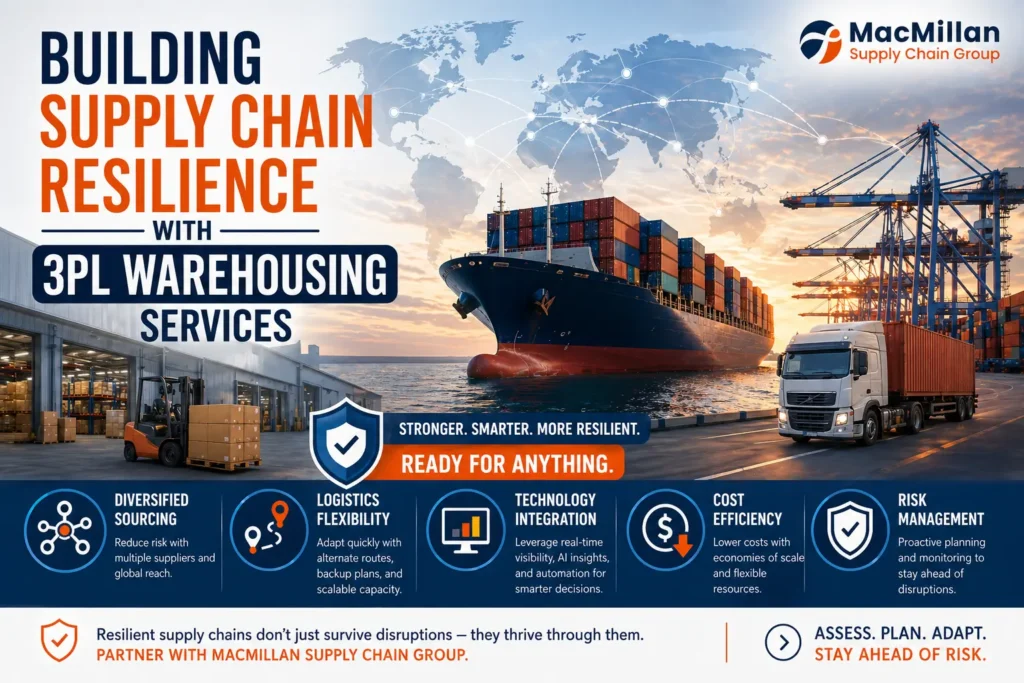
Supply chains have taken quite a few hits over the past few years—from global pandemics to sudden weather disasters. These unpredictable moments have made one thing clear: businesses need to be ready for anything. That’s where 3PL warehousing services step in. By teaming up with third-party logistics pros like MacMillan Supply Chain Group, businesses can strengthen their supply chain, cut down on costs, and respond quickly when disruptions hit. This guide breaks down how 3PL solutions don’t just help you survive—but thrive—in today’s unpredictable world. Building Supply Chain Resilience with 3PL Warehousing Introduction: Why Supply Chain Resilience Matters Remember when the grocery stores were out of toilet paper during the pandemic. Or when that behemoth ship got stuck in the Suez Canal and disrupted shipments across the globe? These were not just flukes—they were behemoth reminders of how vulnerable global supply chains can be. That’s why supply chain resilience matters. It’s about being prepared for the unexpected, whether that’s a natural disaster, surprise surge in demand, or a transportation delay. The objective? To recover quickly and keep the wheels turning. Businesses that create resilience don’t merely survive—they thrive. They sidestep huge losses, retain customers, and maintain their reputation. One of the wisest investments in building that resilience? Collaborating with a 3PL such as MacMillan Supply Chain Group. Let’s examine how they keep companies strong, agile, and prepared for whatever comes their way. The Power of 3PL Warehousing Services So, what exactly does a 3PL do? Think of them as the behind-the-scenes pros who take care of your inventory, storage, and shipping so you don’t have to stress about it. 3PLs like MacMillan offer: Warehouse space Inventory tracking Order fulfillment Smooth shipping across Canada and beyond And it doesn’t stop there—they use powerful tech tools to keep everything running efficiently. Here’s how a 3PL boosts your resilience: They bring years of expertise: They’ve helped businesses across industries solve complex logistics problems, so they know exactly what works. They flex with your needs: Need more space during a holiday rush? They’ve got you. Things slow down. You don’t pay for unused capacity. They’ve already invested in top-tier tech: You benefit from it without the high upfront cost. They’re everywhere: With strategic warehouse locations, they can reach your customers quickly—no matter where they are. They let you focus on your thing: You get to spend more time building your brand while they handle the logistics magic. Core Strategies for Building Supply Chain Resilience Want to make your supply chain truly resilient? These are the strategies that businesses use with their 3PL partners to prepare for anything. Diversified Sourcing Ever heard the phrase, “Don’t put all your eggs in one basket”? It’s especially true in supply chains. Relying on one supplier—or one region—can be risky. If something goes wrong (a strike, a storm, or shipping delay), your entire operation can take a hit. That’s why MacMillan helps clients: Work with multiple suppliers Source from different regions Build relationships with backup vendors They handle the logistics of it all, making sure everything arrives on time and meets your standards. Logistics Flexibility When disruptions hit, agility is everything. The ability to shift gears quickly is what sets resilient companies apart. MacMillan’s 3PL services offer: Backup warehouses Alternative shipping routes Omnichannel fulfillment Cross-docking to speed things up Capacity that scales with demand And with their Transportation Management System (TMS), rerouting shipments or shifting inventory is fast and efficient. Technology Integration Technology makes resilience possible. It gives you a bird’s-eye view of your entire supply chain so you can spot issues before they snowball. With MacMillan, you get: Real-time inventory tracking AI-powered forecasting IoT sensors to monitor product conditions Automated warehouse systems Cloud platforms that keep everyone in sync These tools help you make quick, smart decisions and that’s what resilience is all about. The Cost Benefits of 3PL Partnerships Worried that resilience = expensive? Good news it doesn’t have to. In fact, working with a 3PL often saves you money while making your supply chain stronger. Converting Fixed Costs to Variable Instead of owning warehouses and paying for staff year-round, you only pay for the space and resources you use. Busy season? You scale up. Off-season? You scale down. No waste. No stress. Economies of Scale 3PLs manage logistics for lots of clients, so they get better deals with carriers and can invest in better tech. And the savings? They pass them on to you. MacMillan, for example, gets volume discounts that can slash your transportation costs by up to 30%. Reduced Tech Investment High-tech systems can be pricey—but when you work with a 3PL, you get access to these tools without the big upfront investment. Common Problems with Supply Chain Resilience Even businesses that want to be resilient can hit roadblocks. Here are a few of the most common challenges: Lack of visibility: It’s hard to respond to problems you can’t see. Inflexible infrastructure: If you’re locked into long-term contracts or can’t expand quickly, you’re vulnerable. Disconnected data: Siloed systems slow down decision-making. Limited resources: Smaller businesses especially struggle to afford resilience-enhancing tools. Reactive mindset: Waiting until something goes wrong is no longer an option. Our Solutions: How MacMillan Supply Chain Group Builds Resilience End-to-End Visibility With one platform, you can see it all—inventory, deliveries, supplier updates—all in one location. No more guessing or scrambling. Strategic Network Design They assist in laying out the most efficient (and resilient) network for your company. That includes: Multiple warehouse locations Diverse carriers Strategically located inventory Backup systems Advanced Technology Suite From AI forecasting to intelligent inventory software, MacMillan puts the tech advantage at your fingertips without the tech hassle. Scalable Resources Want more space, employees, or shipping in a sales boom? You’ve got it. Everything’s scalable with you. Proactive Risk Management MacMillan doesn’t wait for things to go wrong. They evaluate your risks ahead of time, make contingency plans, and continuously monitor on your behalf. How to Implement Supply Chain Resilience with MacMillan Ready to get started? Here’s how MacMillan
The Benefits of Value-Added Packaging in Your Supply Chain

A quick summary and overview Value-added packaging goes beyond basic product protection to deliver strategic advantages throughout your supply chain. By incorporating specialized services like custom labeling, kitting, assembly, and sustainable materials, businesses can significantly improve operational efficiency while reducing costs. MacMillan Supply Chain Group offers comprehensive value-added packaging solutions that help Canadian companies enhance product presentation, meet compliance requirements, and achieve sustainability goals. Our expertise spans various industries, providing tailored packaging strategies that optimize your entire supply chain process. How Value-Added Packaging Transforms Your Supply Chain In today’s competitive marketplace, packaging is no longer just about protecting products during transit. Value-added packaging has emerged as a strategic tool that can dramatically improve your supply chain efficiency while delivering significant business advantages. But what exactly is value-added packaging, and how can it benefit your operations? Value-added packaging encompasses specialized services that enhance standard packaging processes. These include custom labeling, kitting, assembly, product customization, and implementing sustainable packaging solutions. At MacMillan Supply Chain Group, we’ve seen firsthand how these services help Canadian businesses streamline operations, reduce costs, and improve customer satisfaction. Whether you’re in retail, food and beverage, pharmaceuticals, or manufacturing, the right packaging strategy can be a game-changer for your business. Let’s explore how value-added packaging solutions in Canada can transform your supply chain from a cost center into a competitive advantage. Key Components of Value-Added Packaging Services Value-added packaging extends far beyond simply placing products in boxes. It’s a comprehensive approach that can include numerous specialized services tailored to your specific needs. Understanding these components helps you identify which solutions will deliver the greatest impact for your business. Custom Labeling and Branding Custom labeling ensures your products comply with Canadian packaging regulations while enhancing brand recognition. This includes bilingual labeling (essential for the Canadian market), barcode generation, and brand-consistent design elements. Our advanced printing capabilities allow for high-quality graphics that make your products stand out on shelves. Kitting and Assembly Kitting involves grouping related items together in a single package, while assembly focuses on putting product components together before shipment. These services save time and resources by consolidating operations. For example, retail promotions often require special kitting of multiple products, which we can handle efficiently within our facilities. Product Customization We can modify standard products to meet specific customer requirements. This might include adding accessories, creating special bundles, or adjusting packaging sizes for different markets. This flexibility allows you to respond quickly to changing consumer demands without maintaining excessive inventory. Sustainable Materials Selection Our team helps you select eco-friendly materials that align with your sustainability goals while meeting product protection requirements. From biodegradable fillers to recyclable containers, we source materials that reduce environmental impact without compromising on quality or protection. This approach supports circular economy packaging principles that increasingly matter to Canadian consumers. How Value-Added Packaging Drives Supply Chain Efficiency Implementing strategic packaging solutions creates ripple effects of efficiency throughout your entire supply chain. These improvements touch everything from warehouse operations to final delivery, creating measurable benefits at each stage. Streamlined Warehouse Operations Value-added packaging services consolidate multiple steps into a single process, reducing handling time and warehouse space requirements. By integrating packaging with other logistics functions, we eliminate redundant steps and minimize the risk of errors. Our contract packaging services can be performed within our facilities, freeing up your valuable warehouse space for core operations. Optimized Transportation Properly designed packaging maximizes container and truck utilization by optimizing product dimensions and weight. This means you can fit more products in each shipment, reducing transportation costs and carbon emissions. Our packaging engineers analyze your products to design solutions that minimize dimensional weight charges while ensuring adequate protection. Reduced Handling Damage Custom-designed packaging provides superior product protection, significantly reducing damage rates during transit. This means fewer returns, less waste, and higher customer satisfaction. For fragile or high-value items, we develop specialized protective solutions using appropriate materials and designs that prevent movement and absorb shock. Improved Inventory Management Value-added packaging facilitates better inventory control through clear labeling and organized kitting. When products arrive pre-packaged and ready for sale, you can implement just-in-time inventory strategies that reduce carrying costs. Our IoT-enabled packaging solutions can also provide real-time visibility into inventory levels and product location. Cost Benefits of Strategic Packaging Solutions While some businesses view packaging as simply a necessary expense, strategic value-added packaging actually delivers significant cost savings throughout your supply chain. Understanding these financial benefits helps justify investment in improved packaging solutions. Reduced Labor Costs By consolidating packaging operations with a specialized provider like MacMillan Supply Chain Group, you can significantly reduce labor costs associated with in-house packaging. Our efficient processes, specialized equipment, and experienced staff complete packaging tasks faster and with fewer errors than most in-house operations. This allows your team to focus on core business activities that drive growth. Lower Materials Expenses Our packaging expertise helps identify opportunities to reduce material usage without compromising protection. We can implement returnable packaging systems for regular shipments between fixed locations, dramatically cutting ongoing packaging expenses. Our volume purchasing power also means we secure better pricing on packaging materials than most individual companies can achieve. Decreased Transportation Expenses Optimized packaging reduces dimensional weight charges and allows more products per shipment. For example, properly designed packaging can sometimes reduce shipping costs by 15-25% by eliminating unnecessary space and weight. Our packaging engineers analyze your current solutions and recommend improvements that maximize transportation efficiency. Minimized Product Damage Well-designed packaging significantly reduces product damage during transit, cutting replacement costs and eliminating the administrative burden of processing returns. For products with high damage rates, the savings from improved packaging can be substantial – often paying for the packaging upgrade many times over. Sustainability Advantages of Modern Packaging Approaches Today’s consumers and businesses increasingly prioritize sustainability, making eco-friendly packaging solutions not just environmentally responsible but commercially advantageous. MacMillan Supply Chain Group helps you navigate the complex world of sustainable packaging to find solutions that work for your products, your customers, and the planet. Eco-Friendly Materials Selection We help
What Supply Chain Issues Can We Expect This Holiday Season?
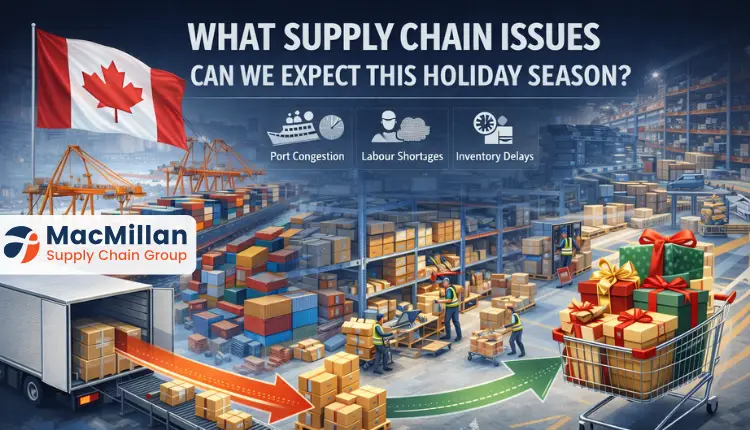
A Quick Summary and Overview The 2025 holiday season brings significant supply chain challenges for businesses across Canada and the US. From port congestion and cross-border shipping complications to labour shortages and tariff impacts, companies need to prepare now. Global freight disruptions and Chinese New Year shutdowns will affect inventory availability, while consumer demand shifts toward essentials and value purchases. This guide explores the major holiday supply chain issues you’ll face and provides actionable solutions to keep your business running smoothly during the busiest time of year. Why This Holiday Season Will Test Your Supply Chain The holiday rush is approaching, and this year’s supply chain landscape looks more complex than ever. With e-commerce continuing to grow and global trade facing new pressures, businesses need to understand what’s coming and how to adapt. Whether you’re a retailer preparing for Black Friday or a manufacturer ensuring product availability, the 2025 holiday season presents unique challenges. What makes this year different? A combination of factors including tariff changes, labour market shifts, and evolving consumer behavior are creating a perfect storm. Canadian businesses face particular challenges with cross-border shipping and port congestion. Meanwhile, global events like Chinese New Year shutdowns will impact production schedules months before the holidays arrive. Let’s explore the key supply chain issues you can expect this holiday season and, more importantly, how MacMillan Supply Chain Group can help you navigate them successfully. Port Congestion and Shipping Delays: The First Hurdle Port congestion in Canada remains one of the biggest obstacles this holiday season. Major ports like Vancouver and Halifax are already experiencing backups that will only worsen as peak season approaches. When ships can’t dock and unload promptly, the entire supply chain feels the ripple effect. What’s causing these bottlenecks? Several factors are at play: Record import volumes as retailers stock up early for the holidays Weather disruptions affecting loading and unloading schedules Equipment shortages (containers, chassis, etc.) at key ports Labour constraints limiting port operating capacity For businesses shipping to or within Canada, these delays mean planning further ahead than ever. Products that once took 2-3 days to clear ports might now take 7-10 days or longer. This extended timeline affects everything downstream, from warehouse receiving to store shelves. Canadian shipping delays also impact cross-border trade with the US. When goods are stuck at ports, trucks sit idle waiting for loads, creating a domino effect of delays. Smart businesses are already adjusting their timelines, building in buffer days, and working with experienced 3PL partners like MacMillan who understand these local challenges and can help navigate them effectively. Labour Shortages and Warehouse Capacity Constraints Labour shortages in warehouses continue to plague the supply chain industry as we head into the holiday season. Finding and retaining qualified workers for picking, packing, and shipping operations remains challenging across Canada. When you combine this with the seasonal surge in order volume, you have a recipe for potential fulfillment disasters. The numbers tell the story: Warehouse job openings are up 20% compared to last year Turnover rates in logistics positions hover around 40% Training new staff takes valuable time during the busiest season Overtime costs are skyrocketing as existing teams stretch to meet demand This labour crunch hits hardest during peak season logistics operations when order volumes can triple or quadruple overnight. Warehouses that normally process 5,000 orders daily might suddenly face 20,000 orders with the same staff. The result? Longer processing times, more errors, and frustrated customers. Warehouse capacity is equally concerning. With businesses ordering earlier to avoid delays, storage space is at a premium. Many facilities are already at 85-90% capacity months before the holiday rush begins. This leaves little flexibility for unexpected inventory surges or returns processing. Companies without solid warehousing solutions in Canada find themselves scrambling for expensive short-term options or facing stockouts during critical selling periods. Inventory Challenges and Supply Uncertainties Just-in-time inventory challenges have never been more apparent than during this holiday season. The once-reliable system of ordering precisely what you need when you need it has become increasingly risky. With global freight disruptions affecting shipping times and availability, businesses can no longer count on predictable replenishment cycles. What makes inventory management particularly difficult this year: Longer lead times from overseas suppliers (especially Asia) Unpredictable transit delays once goods are shipped Higher costs forcing difficult decisions about stock levels Changing consumer demand patterns making forecasting trickier Chinese New Year shutdowns present another inventory planning hurdle. Falling in late January/early February 2025, these factory closures will affect production schedules months before the holidays. Businesses that don’t place orders by December 2024 may miss their window for pre-holiday delivery. This means planning for Christmas must happen nearly a year in advance! Effective inventory management solutions are essential for navigating these uncertainties. Businesses need real-time visibility into stock levels, incoming shipments, and sales trends. Without these tools, you risk either tying up too much capital in excess inventory or missing sales opportunities due to stockouts during the most profitable time of year. Consumer Behavior and Demand Shifts Consumer demand shifts are reshaping holiday shopping patterns in significant ways. Economic pressures and changing priorities mean customers aren’t buying the same things or shopping the same way they did in previous years. Key trends we’re seeing: Greater focus on essential purchases over luxury items Increased price sensitivity across all product categories Earlier shopping to avoid last-minute availability issues Growing preference for omnichannel options (buy online, pick up in store) These shifts directly impact what retailers should stock and how they should position their offerings. Businesses that understand these changing patterns can adjust their inventory mix accordingly, focusing on value-oriented products while maintaining some premium options for less price-sensitive segments. Tariff impacts on holiday goods are also influencing consumer behavior. Recent tariff changes mean higher prices on many imported products, particularly electronics, toys, and apparel. Retailers must decide whether to absorb these costs (reducing margins) or pass them along to consumers (potentially reducing sales). Either way, tariffs are reshaping what’s available on
Peak Season E-commerce Fulfillment Canada Solutions
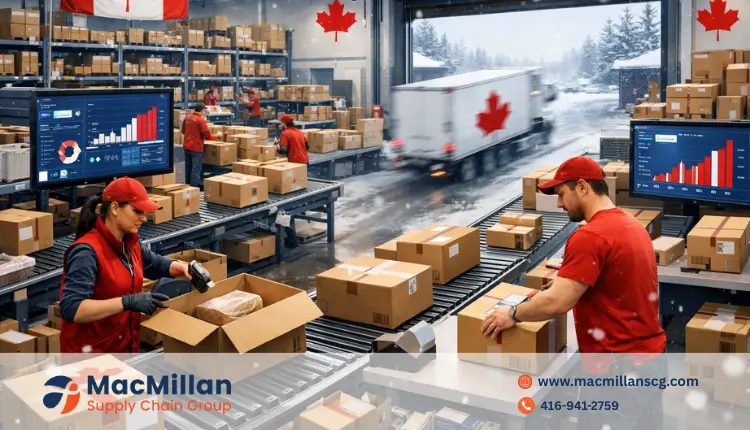
A Quick Summary and Overview Peak season e-commerce fulfillment presents significant challenges for Canadian retailers, with order volumes often increasing by 300-400% during holiday periods. Businesses face inventory shortages, shipping delays, labor constraints, and complex returns management. However, with strategic planning and the right technology, these challenges become manageable. MacMillan Supply Chain Group offers comprehensive solutions including warehouse automation, predictive analytics, and multi-carrier shipping strategies to help businesses navigate peak seasons successfully. By implementing these solutions, retailers can maintain customer satisfaction while controlling costs during the busiest shopping periods of the year. Mastering E-commerce Fulfillment During Peak Season When holiday shopping kicks into high gear or a major sales event arrives, e-commerce operations face their ultimate test. Order volumes skyrocket, customer expectations remain high, and the pressure to deliver quickly and accurately intensifies. This critical period, known as peak season, can make or break your customer relationships and significantly impact your bottom line. For Canadian retailers, these challenges are compounded by our unique geography, cross-border shipping considerations, and seasonal weather disruptions. At MacMillan Supply Chain Group, we’ve helped countless businesses transform peak season chaos into streamlined success through strategic planning and innovative logistics solutions. In this comprehensive guide, we’ll explore the major challenges of E-commerce Fulfillment During Peak Season and provide actionable solutions to help your business thrive when demand is at its highest. Whether you’re preparing for Black Friday, holiday shopping, or back-to-school rushes, these insights will help you deliver exceptional customer experiences while maintaining operational efficiency. Understanding Peak Season Challenges in Canadian E-commerce The landscape of Canadian E-commerce Logistics transforms dramatically during peak seasons. Order volumes can surge by 300-400% during the holiday period, creating immense pressure on fulfillment systems. Black Friday and Cyber Monday (BFCM) have evolved from single-day events to week-long shopping extravaganzas, extending the intensity of peak operations. What makes peak season particularly challenging? First, there’s the sheer volume. During Holiday Fulfillment Canada periods, warehouses that typically process hundreds of orders daily suddenly need to handle thousands. This volume spike affects every aspect of operations—from receiving and storage to picking, packing, and shipping. Second, customer expectations don’t decrease during busy periods. In fact, they often increase, with shoppers expecting same-day or next-day delivery despite the seasonal rush. According to recent studies, 67% of Canadian shoppers expect faster delivery during holiday shopping, even though they intellectually understand the challenges retailers face. Third, the complexity of inventory management increases exponentially. Popular items sell out quickly, creating stockout situations that frustrate customers. Meanwhile, seasonal items require careful forecasting to avoid excess inventory that ties up capital and warehouse space after the rush ends. Weather presents another uniquely Canadian challenge. Snowstorms and freezing temperatures can disrupt Last-Mile Delivery Challenges across the country, adding unpredictability to fulfillment timelines. This is particularly problematic during the winter holiday season when delivery promises are most critical to customer satisfaction. Technology Solutions for Peak Season Success Embracing technology is essential for managing the complexity of peak season fulfillment. Warehouse Automation Canada solutions have become game-changers for businesses facing seasonal surges. Automated sorting systems, conveyor networks, and robotic picking assistants can double or even triple throughput without proportional increases in labor costs. Predictive Analytics for E-commerce represents another technological breakthrough. These systems analyze historical sales data, current trends, and external factors like weather forecasts or promotional calendars to predict demand patterns with remarkable accuracy. This allows for proactive inventory management and staffing decisions weeks before peak season begins. Inventory Management Software provides real-time visibility across your entire supply chain. When integrated with your e-commerce platform, these systems can automatically update product availability, preventing overselling during high-traffic periods. They also enable dynamic reordering based on actual sales velocity rather than static thresholds. A Multi-Carrier Shipping Strategy supported by intelligent software allows businesses to optimize delivery routes, compare carrier rates in real-time, and select the most efficient shipping method for each order. This flexibility becomes crucial during peak seasons when primary carriers often reach capacity limits or implement surcharges. Mobile scanning technology improves accuracy while speeding up warehouse operations. Handheld devices guide pickers through optimized routes, verify correct items, and capture real-time data about inventory movements. This reduces errors during the hectic pace of peak season while providing valuable operational insights. For businesses engaged in Cross-Border E-commerce, specialized software can automate customs documentation, calculate duties and taxes, and ensure compliance with international shipping regulations. This streamlines what would otherwise be a highly manual process during your busiest time of year. Operational Strategies to Optimize Peak Performance Beyond technology, operational strategies play a crucial role in peak season success. Effective BFCM Fulfillment Tactics begin with warehouse organization. Rearranging your fulfillment center to position high-velocity items in easily accessible locations can dramatically improve picking efficiency. Some businesses create dedicated “peak season zones” that consolidate seasonal bestsellers. Batch processing orders by shipping method or destination can significantly increase throughput. Rather than processing each order individually, grouping similar orders allows for more efficient picking paths and consolidated shipping preparation. This approach can increase productivity by 30-40% during high-volume periods. Staggered shipping cutoff times help distribute the workload throughout the day. By setting different cutoff times for different shipping methods (standard, express, overnight), you can process orders in waves rather than facing a single end-of-day crunch when all orders must be fulfilled simultaneously. Pre-packing popular items or bundles before peak season begins can alleviate bottlenecks. If historical data shows certain products consistently sell well during holiday periods, preparing inventory in advance reduces the time needed to fulfill these orders when volume spikes. Cross-training staff across different fulfillment functions creates operational flexibility. When team members can pivot between receiving, picking, packing, and shipping roles, you can quickly reallocate resources to address bottlenecks as they emerge during peak periods. Implementing a Return Management Process before peak season begins is equally important. Returns volume typically increases by 30% after holiday periods, creating a “second peak” in January. Having dedicated space, clear procedures, and adequate staffing for returns processing prevents this wave from disrupting your
How Specialized 3PL Solutions Are Redefining Logistics
A Quick Summary and Overview The era of “one-size-fits-all” 3PL providers is over. As brands scale across food, wellness, pet care, CPG, and retail sectors, logistics complexity increases and generic fulfillment models simply can’t keep up. Category-tailored fulfillment is redefining the 3PL industry by aligning warehousing, compliance, inventory management, packaging, and last-mile delivery with the specific demands of each product category. MacMillan Supply Chain Group (SCG) leads this shift in Canada by delivering specialized 3PL solutions designed around industry requirements not retrofitted after the fact. The result? Higher accuracy, stronger compliance, faster sell-through, and a more resilient supply chain. The Problem with One-Size-Fits-All 3PL Models Many third-party logistics providers promote flexibility but operate on standardized workflows designed to serve the “average” product. Here’s where that approach breaks down: Food requires expiry management and FEFO rotation Nutraceuticals demand GMP-compliant environments Pet care products often need mixed-SKU kitting and retail display builds High-value electronics require strict lot traceability and shrink control Retail CPG brands must meet retailer-specific compliance standards When categories are treated the same, brands face: Chargebacks and compliance penalties Inventory inaccuracies Damaged goods or improper storage Missed retail windows Increased operational costs The reality is simple: logistics should adapt to the product—not the other way around. What Is Category-Tailored Fulfillment? Category-tailored fulfillment is a logistics strategy where warehouse design, SOPs, compliance frameworks, KPIs, and technology workflows are built around the specific needs of a product category. At MacMillan SCG, this means: GMP-certified warehousing for regulated goods Temperature-controlled storage for sensitive SKUs Lot tracking and expiry management for food & wellness Retail-ready pallet builds for national chains High-accuracy pick-and-pack systems for e-commerce brands AI-powered route optimization for last-mile delivery It’s not customization as an afterthought it’s operational design from day one. How MacMillan SCG Specializes by Category 1. Food & Beverage Fulfillment Food logistics requires precision, speed, and compliance. MacMillan’s approach includes: FEFO (First Expiry, First Out) inventory rotation Expiry date validation Temperature-controlled and ambient storage Fast dock-to-stock timelines (as low as 8 hours) CFIA-aligned processes Rapid container destuffing (under 4 hours) With 99%+ inventory accuracy and strict quality control, food brands gain both compliance and shelf confidence. Result: Reduced spoilage, faster retail replenishment, and fewer chargebacks. 2. Nutraceutical & Wellness Logistics The wellness industry demands traceability, hygiene standards, and regulatory alignment. MacMillan provides: GMP-certified warehouse space Lot and batch tracking Secure storage with shrink control Clean handling procedures Integrated reporting for compliance audits For supplement brands and wellness companies scaling in Canada, this level of precision protects brand reputation and regulatory standing. Result: Audit-ready operations with scalable fulfillment capacity. 3.Pet Care & Consumer Packaged Goods (CPG) Pet care brands and CPG companies often operate in high-velocity environments with both retail and DTC channels. MacMillan supports this with: Mixed-SKU case configurations Promotion-ready kitting Retail display builds Omnichannel fulfillment (B2B + DTC from same inventory) Real-time WMS integration via Mantis-powered systems With over 250,000 sq. ft. of racked and bulk storage and scalable shared or dedicated space options, brands can grow without operational friction. Result: Seamless retail compliance + high-speed e-commerce fulfillment. 4. Big & Bulky, Retail & Last-Mile Solutions Large-format products require specialized transportation and delivery execution. MacMillan’s last-mile network includes: 45 cross-dock locations nationally 3000+ dedicated drivers 90% of FSAs serviced next day Real-time, Uber-like tracking White glove delivery options Reverse logistics integration For categories where the delivery experience defines the brand, tailored last-mile strategy is non-negotiable. Result: Higher first-attempt success rates and improved customer satisfaction. The Technology Layer That Makes It Work Category specialization requires visibility. MacMillan leverages: Mantis-powered WMS for full SKU-level transparency 350+ KPI tracking metrics AI-driven route optimization Real-time TMS tracking Integrated eCommerce platform connectivity With 99.5%+ perfect order rates and near-zero shrinkage, technology transforms operational promises into measurable performance. Why Category-Tailored 3PL Is the Future of Logistics Consumer expectations are rising. Retailers are stricter. Regulations are tighter. Margins are thinner. Brands can no longer afford generic fulfillment. The future of 3PL includes: Industry-specific SOPs Regulatory-aligned warehousing Real-time data visibility Faster onboarding Sustainable, net-zero aligned operations MacMillan’s rapid onboarding process, predictable pricing models, and scalable infrastructure make transition seamless even for brands switching from another provider. Beyond Fulfillment: A True Supply Chain Partner MacMillan SCG goes beyond pick-pack-ship. Specialized services include: Supply chain network design Workflow optimization Product lifecycle management ESG and carbon reporting Promotional print & packaging Crisis planning & contingency logistics Instead of juggling multiple vendors, brands work with one integrated 3PL partner under one roof. That’s the difference between outsourcing logistics and transforming it. Final Takeaway Category-tailored fulfillment isn’t a trend. It’s a competitive necessity. Brands in food, wellness, pet care, retail, and CPG require logistics partners who understand their industry’s compliance standards, operational rhythms, and growth pressures. MacMillan Supply Chain Group delivers specialized 3PL solutions designed around your category—ensuring efficiency, reliability, and trust at every stage. 📞 Ready to align your fulfillment strategy with your product category? Contact MacMillan SCG today for a customized supply chain assessment and discover how specialized 3PL can drive measurable growth. FAQs What is category-tailored fulfillment? Category-tailored fulfillment is a logistics strategy where warehousing, compliance, inventory control, and transportation processes are customized to meet the unique requirements of a specific product category. Why is one-size-fits-all 3PL outdated? Different industries have distinct compliance, storage, and handling needs. Generic 3PL models often create inefficiencies, compliance risks, and operational bottlenecks. Does MacMillan SCG offer GMP-certified warehousing? Yes. MacMillan provides GMP-certified spaces suitable for nutraceutical, wellness, and regulated product categories. Can MacMillan handle both retail and DTC fulfillment? Absolutely. MacMillan supports omnichannel fulfillment, allowing brands to manage retail, e-commerce, and last-mile delivery from the same inventory pool. What industries does MacMillan specialize in? MacMillan supports food & beverage, nutraceuticals, pet care, consumer packaged goods, retail, electronics, fashion, and more. How quickly can I onboard with MacMillan? MacMillan offers a rapid onboarding process with integration testing and go-live support, ensuring minimal disruption to your operations.
Top Supply Chain Companies in Canada: Who’s Leading the Market?
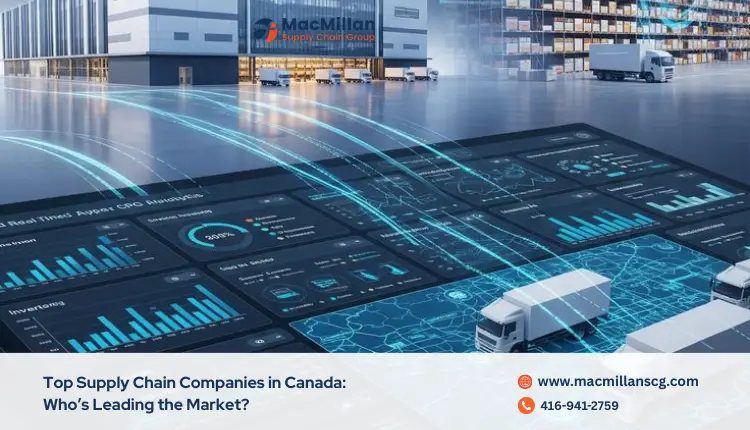
A Quick Summary and Overview Canada’s supply chain landscape is evolving rapidly with companies leveraging advanced technology and innovative solutions to meet growing logistics demands. The top supply chain companies in Canada are distinguished by their ability to provide comprehensive 3PL services, warehouse automation, and seamless cross-border logistics. These market leaders are transforming traditional supply chain operations through e-commerce fulfillment excellence, sustainability initiatives, and strategic transportation networks. With the Canadian logistics market expected to grow significantly in coming years, understanding who’s leading the industry and their competitive advantages offers valuable insights for businesses seeking reliable supply chain partners in an increasingly complex marketplace. The Evolving Canadian Supply Chain Landscape The Canadian supply chain sector represents a dynamic ecosystem where traditional logistics meets cutting-edge innovation. With Canada’s vast geography spanning nearly 10 million square kilometers and a population concentrated along the southern border, supply chain companies face unique challenges in connecting businesses with customers efficiently. The industry has transformed dramatically in recent years, driven by e-commerce growth, changing consumer expectations, and technological advancements. Top supply chain companies in Canada are distinguished by their ability to navigate these challenges while providing seamless logistics solutions. From warehouse automation to cross-border shipping expertise, these market leaders are reshaping how goods move throughout Canada and North America. Whether you’re a retailer looking for fulfillment services or a manufacturer needing transportation solutions, understanding who’s leading the Canadian supply chain market provides valuable insights into potential partnerships that can drive your business forward. Market Leaders: Top 3PL Providers in Canada The Canadian third-party logistics (3PL) landscape features a mix of global giants and homegrown specialists who have established themselves as market leaders through comprehensive service offerings and technological innovation. Metro Supply Chain Group stands as the largest Canadian-owned provider of third-party logistics services across the country. With operations expanding into the United States and United Kingdom, Metro has added nearly 1,000 team members in recent years, demonstrating significant growth. Their business philosophy of being “large enough to serve, small enough to care” resonates with clients seeking personalized service without sacrificing national coverage capabilities. MacMillan Supply Chain Group, headquartered in Brampton, has emerged as a leader in e-commerce fulfillment and warehouse automation. Their technology-first approach integrates seamlessly with major platforms like Shopify and Amazon, making them an ideal partner for businesses scaling their online operations. MacMillan’s implementation of advanced warehouse automation has enabled clients to increase throughput by 200-300% during peak periods while maintaining error rates below 0.1%. Canada Cartage/The GTI Group ranks among North America’s top logistics companies with approximately $824 million in annual revenue. Their expertise in temperature-controlled shipping and dedicated fleet services makes them particularly valuable for businesses with specialized transportation requirements. Their comprehensive approach to supply chain management addresses complex logistics challenges through customized solutions rather than one-size-fits-all offerings. Other notable players include Integrity Express Logistics, known for excellence in cross-border logistics between Canada and the United States, and Saddle Creek Logistics Services, which has developed particular strength in temperature-controlled logistics and pharmaceutical distribution. Technology Transformation in Canadian Supply Chains Technology has become the defining competitive advantage among top supply chain companies in Canada, with market leaders investing heavily in systems that enhance efficiency, visibility, and customer experience. Warehouse automation represents one of the most significant areas of technological advancement in the Canadian logistics sector. Leading 3PL providers have implemented sophisticated systems including conveyor networks, pick-to-light technology, and collaborative robots that dramatically increase throughput capacity. MacMillan Supply Chain Group’s automation solutions enable 200-300% increases in processing volume during peak periods without proportional increases in labor costs – a critical advantage in today’s challenging employment market. Predictive analytics has emerged as another crucial technology for managing seasonal demand fluctuations and optimizing inventory management. Advanced inventory systems provide real-time visibility across multiple warehouses, enabling proactive management of stock levels through dynamic reordering based on actual sales velocity rather than static thresholds. For seasonal items, specialized forecasting models account for historical performance, current market trends, and promotional calendars to prevent both stockouts and overstocks. E-commerce integration capabilities have become essential for 3PL providers serving omnichannel retailers. Technology-first approaches integrate seamlessly with major platforms like Shopify, Amazon, and WooCommerce, demonstrating the importance of API connectivity and platform interoperability. This integration capability allows retailers to maintain consistent inventory visibility and order management across multiple sales channels while leveraging specialized fulfillment capabilities. Real-time tracking and visibility systems have transformed customer expectations around shipment transparency. Leading logistics providers now offer sophisticated tracking solutions that provide minute-by-minute updates on shipment status, estimated delivery times, and potential delays. These systems not only enhance the customer experience but also enable proactive issue resolution before problems impact delivery performance. Cross-Border Excellence: Canada-US Logistics Cross-border logistics between Canada and the United States represents one of the most critical capabilities for top supply chain companies in Canada. With approximately 75% of Canadian exports destined for the US market, expertise in navigating the complexities of cross-border trade has become a defining characteristic of market leaders. Customs management capabilities distinguish the leading logistics providers in this space. Companies like Integrity Express Logistics have developed sophisticated systems for managing documentation requirements, duty calculations, and regulatory compliance across the Canada-US border. These systems streamline the customs clearance process, reducing delays and ensuring compliant movement of goods between the two countries. Transportation networks optimized for cross-border trade represent another key advantage of market leaders. Companies operating dedicated fleets or managing carrier networks have developed specialized expertise in route optimization, border crossing selection, and timing strategies that minimize delays and maximize efficiency. This expertise becomes particularly valuable during periods of border congestion or when moving time-sensitive shipments. Regulatory compliance expertise has become increasingly important as trade rules evolve and change. Leading logistics providers maintain dedicated teams focused on monitoring regulatory developments and ensuring client shipments meet all applicable requirements. This expertise extends beyond basic customs documentation to include product-specific regulations, security protocols, and specialized certification requirements. Technology integration across borders enables seamless visibility and control throughout the entire shipment lifecycle. Top supply chain companies have invested in
Tech-Infused 3PL: How Technology is Changing the Logistics Landscape
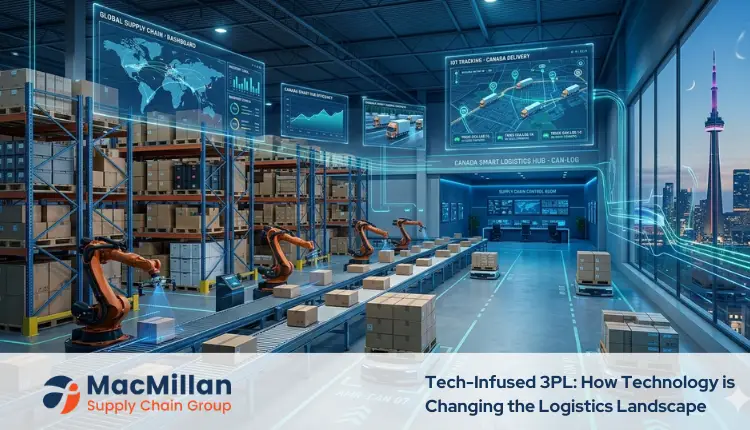
A Quick Summary and Overview The logistics industry is experiencing a technological revolution that’s reshaping how goods move from manufacturers to consumers. Tech-infused 3PL combines artificial intelligence, robotics, IoT sensors, and advanced analytics to create smarter, faster, and more reliable supply chains. At MacMillan Supply Chain Group, we’re leading this transformation in the Canadian market, helping businesses optimize operations, reduce costs, and improve customer satisfaction through innovative logistics technology. This article explores how these technologies are changing the logistics landscape and why partnering with a tech-forward 3PL provider is essential for modern business success. Introduction The logistics industry has come a long way from manual processes and paper trails. Today, technology is fundamentally transforming how third-party logistics (3PL) providers operate, creating unprecedented efficiency and visibility throughout the supply chain. This tech-infused approach is revolutionizing everything from warehouse operations to last-mile delivery. In the Canadian 3PL market, where businesses face unique challenges of vast geography and variable weather conditions, technology adoption isn’t just an advantage—it’s a necessity. Digital transformation in logistics is enabling companies to overcome these challenges while meeting rising customer expectations for speed and transparency. At MacMillan Supply Chain Group, we’ve embraced this technological revolution, implementing cutting-edge solutions that streamline operations and provide superior service. But what exactly makes a 3PL provider “tech-infused,” and how are these technologies changing the logistics landscape? Let’s explore the innovations reshaping our industry and how they benefit businesses across Canada. AI and Machine Learning: The Brain of Modern Logistics Artificial intelligence and machine learning represent the cognitive center of tech-infused 3PL operations. These technologies analyze massive datasets to identify patterns, make predictions, and optimize decisions in ways that human operators simply cannot match. AI in supply chain management transforms raw data into actionable insights, enabling smarter inventory management and demand forecasting. For example, AI algorithms can analyze historical sales data alongside external factors like weather patterns, local events, and economic indicators to predict future demand with remarkable accuracy. This helps businesses maintain optimal inventory levels—not too much (which ties up capital) and not too little (which leads to stockouts). Route optimization is another area where AI shines. Traditional route planning might consider basic factors like distance, but AI systems evaluate countless variables simultaneously: traffic patterns, weather conditions, delivery time windows, vehicle capacities, driver schedules, and even customer preferences. The result? Faster deliveries, lower fuel costs, and improved customer satisfaction. At MacMillan Supply Chain Group, our AI-powered systems continuously learn from each delivery, becoming increasingly efficient over time. This machine learning capability means our logistics solutions aren’t static—they evolve and improve automatically, adapting to changing conditions and incorporating new data to deliver ever-better results for our clients. Robotics and Automation: Transforming Warehouse Operations Robotics in warehousing has revolutionized how products are stored, picked, and packed. These technologies are no longer futuristic concepts—they’re operational realities delivering measurable benefits in modern fulfillment centers. Automated guided vehicles (AGVs) navigate warehouse floors independently, transporting goods between stations without human intervention. These tireless workers operate 24/7, dramatically increasing throughput while reducing labor costs and human error. Meanwhile, robotic picking systems can identify, grasp, and move individual items with precision that rivals or exceeds human capabilities. Warehouse automation solutions extend beyond robots to include sophisticated conveyor systems, automated storage and retrieval systems (AS/RS), and goods-to-person technologies that bring products directly to packing stations. These integrated systems work in harmony to process orders with unprecedented speed and accuracy. The benefits of automation are particularly evident in e-commerce logistics, where high order volumes and expectations for rapid fulfillment create intense operational pressure. Our automated facilities at MacMillan can process thousands of orders daily with 99.9% accuracy, enabling next-day and same-day delivery options that would be impossible with traditional manual processes. IoT and Real-Time Visibility: The Connected Supply Chain The Internet of Things (IoT) has created unprecedented visibility throughout the supply chain by connecting physical objects to digital networks. This connectivity transforms static supply chains into dynamic, responsive systems that can be monitored and optimized in real time. IoT fleet management uses connected sensors on vehicles to track location, monitor fuel consumption, assess driver behavior, and evaluate vehicle health. These systems enable proactive maintenance that prevents breakdowns, optimizes fuel efficiency, and ensures regulatory compliance. For temperature-sensitive goods like pharmaceuticals or food products, IoT sensors continuously monitor conditions, triggering alerts if temperatures drift outside acceptable ranges. Real-time tracking solutions extend beyond vehicles to the products themselves. RFID tags, GPS trackers, and other connected devices provide item-level visibility throughout the journey from manufacturer to consumer. This granular tracking enables precise delivery estimates and proactive problem-solving when issues arise. At MacMillan Supply Chain Group, our connected logistics network generates a continuous stream of data that feeds our analytics platforms. This real-time information allows us to make dynamic adjustments to routes, reallocate resources, and keep customers informed about their shipments’ status. The result is a more agile, responsive, and transparent supply chain that delivers superior results for our clients. Blockchain and Data Security: Building Trust in the Supply Chain Blockchain technology is bringing unprecedented transparency and security to logistics operations. This distributed ledger system creates immutable records of transactions and events, providing a single source of truth that all supply chain participants can trust. In shipping and logistics, blockchain creates transparent, tamper-proof records of a product’s journey from origin to destination. This capability is particularly valuable for high-value goods, pharmaceuticals, and food products where authenticity and handling conditions are critical concerns. When implemented properly, blockchain in shipping can virtually eliminate counterfeiting and provide indisputable evidence of proper handling throughout the supply chain. Beyond product tracking, blockchain streamlines documentation processes that have traditionally been paper-heavy and time-consuming. Smart contracts—self-executing agreements with terms written directly into code—can automatically trigger payments when predefined conditions are met, such as successful delivery confirmation. Data security is another crucial aspect of tech-infused 3PL operations. As supply chains become increasingly digital, protecting sensitive information from cyber threats becomes paramount. At MacMillan Supply Chain Group, we implement robust cybersecurity measures to safeguard our systems
Smart Warehousing Technology: The Future of Logistics
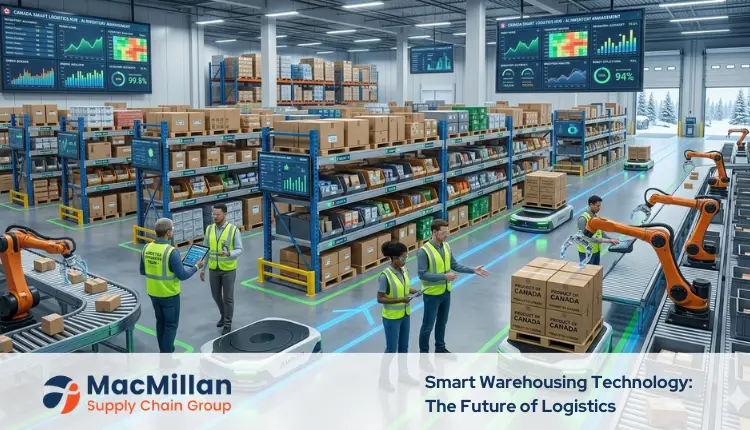
A Quick Summary and Overview Smart warehousing technology is revolutionizing the logistics industry through advanced automation, AI-powered systems, and IoT connectivity. This technology enables real-time inventory tracking, predictive analytics, and robotic fulfillment that significantly improve operational efficiency. With the global smart warehousing market projected to reach $80.44 billion by 2032, businesses across Canada are implementing these solutions to stay competitive. MacMillan Supply Chain Group offers cutting-edge smart warehousing solutions that help Canadian businesses optimize operations, reduce costs, and meet growing customer demands in an increasingly digital marketplace. The Smart Warehousing Revolution in Canadian Logistics The logistics industry is experiencing a fundamental shift. Gone are the days of clipboard-wielding workers manually tracking inventory and paper-based systems. Today’s warehouses are becoming intelligent hubs where robots, AI, and IoT sensors work together to create unprecedented efficiency. Smart warehousing technology represents the convergence of physical operations and digital capabilities. But what exactly makes a warehouse “smart”? It’s the integration of technologies like autonomous mobile robots, IoT-enabled logistics systems, and advanced warehouse management software that can predict needs before they arise. For Canadian businesses facing labor shortages, increasing customer expectations, and competitive pressures, smart warehousing isn’t just a fancy upgrade—it’s becoming essential for survival. At MacMillan Supply Chain Group, we’re helping companies across Canada embrace this technological revolution to stay ahead in an increasingly complex supply chain landscape. Core Technologies Driving Smart Warehouse Innovation The foundation of any smart warehouse is built on several key technologies working in harmony. Let’s explore the innovations that are transforming traditional warehouses into intelligent operations centers: Autonomous Mobile Robots (AMRs) Unlike their predecessors that required magnetic strips or predefined paths, today’s AMRs navigate warehouses independently using advanced sensors and mapping capabilities. These robots reduce walking time for employees by up to 40% and can operate 24/7 without breaks. At MacMillan, we’ve seen these robots increase picking efficiency by nearly 200% compared to traditional methods. IoT-Enabled Logistics Networks The Internet of Things (IoT) creates a network of connected devices throughout the warehouse. Temperature sensors monitor sensitive products, proximity detectors prevent collisions, and smart shelves track inventory in real-time. This connectivity provides unprecedented visibility into warehouse operations, allowing managers to make data-driven decisions instantly rather than waiting for end-of-day reports. AI and Machine Learning Systems Artificial intelligence serves as the brain of smart warehousing, analyzing patterns and making predictions that humans simply couldn’t process. These systems optimize inventory levels, predict maintenance needs before equipment fails, and continuously improve picking routes. Predictive analytics in warehousing has reduced stockouts by up to 30% for our clients while simultaneously decreasing excess inventory. Transforming Operations with Warehouse Automation Warehouse automation is changing every aspect of logistics operations, from receiving to shipping and everything in between. Here’s how automation is revolutionizing key warehouse processes: Automated Receiving and Putaway When shipments arrive, automated scanning systems immediately identify and log items without manual counting. Autonomous forklifts and conveyor systems then transport products to their optimal storage locations, determined by AI algorithms that consider factors like demand frequency and product relationships. This automation reduces receiving time by up to 60% while improving accuracy to nearly 99.9%. Robotic Order Fulfillment Perhaps the most visible form of warehouse automation is robotic order fulfillment. Collaborative robots work alongside human pickers or independently retrieve items from storage. These systems can process orders up to three times faster than manual methods while reducing error rates significantly. For e-commerce fulfillment in CA, this speed and accuracy directly translates to customer satisfaction and repeat business. Intelligent Sortation and Shipping At the shipping stage, automated sortation systems direct packages to the correct loading dock based on destination, carrier, and priority. Weight-checking stations verify package accuracy, while automated labeling systems ensure proper documentation. This end-to-end automation creates a seamless flow from order receipt to delivery, minimizing touchpoints and maximizing efficiency. Data Intelligence: The Brain Behind Smart Warehousing While robots and automation provide the muscle of smart warehousing, data intelligence supplies the brainpower. Advanced warehouse management systems collect, analyze, and act on information in ways that transform operations: Real-Time Inventory Visibility Smart warehousing eliminates the dreaded “where is it?” question that plagues traditional operations. RFID tracking solutions and connected scanners provide instant location data for every item in the warehouse. This real-time inventory visibility reduces search time by up to 80% and virtually eliminates lost inventory, a common problem that costs warehouses millions annually. Digital Twin Technology One of the most exciting developments in smart warehousing is digital twin technology—virtual replicas of physical warehouses that update in real-time. These digital models allow managers to visualize operations, test changes in a risk-free environment, and identify bottlenecks before they impact performance. At MacMillan, we’ve implemented digital twins that have improved space utilization by 25% and throughput by 30%. Predictive Analytics for Demand Forecasting Using historical data, market trends, and even weather patterns, predictive analytics helps warehouses anticipate demand fluctuations with remarkable accuracy. This foresight allows for proactive inventory management, labor scheduling, and resource allocation. Our clients using these systems have reduced carrying costs by 15-20% while improving order fulfillment rates. Canadian Logistics Innovations and Market Trends Canada’s unique geography, climate, and market conditions have driven specific innovations in smart warehousing technology: Adapting to Canadian Climate Challenges Smart warehousing in Canada must account for extreme temperature variations that can affect both equipment and inventory. IoT-enabled climate control systems maintain optimal conditions while minimizing energy usage. Cold-chain monitoring for pharmaceuticals and food products has become increasingly sophisticated, with sensors that track temperature variations down to 0.1°C and automatically alert managers to potential issues. Cross-Border Supply Chain Integration With approximately 75% of Canadian exports going to the United States, smart warehousing systems in Canada often focus on seamless cross-border integration. Advanced tracking and documentation systems ensure compliance with customs requirements while minimizing delays. These systems have reduced border-related delays by up to 40% for businesses implementing smart logistics solutions. Sustainable Supply Chain Initiatives Canadian warehousing trends show increasing emphasis on sustainability. Smart warehouses reduce environmental impact through optimized routing (reducing fuel consumption), energy-efficient
How 3PL Services Power Fast Moving Consumer Goods (FMCG) Logistics
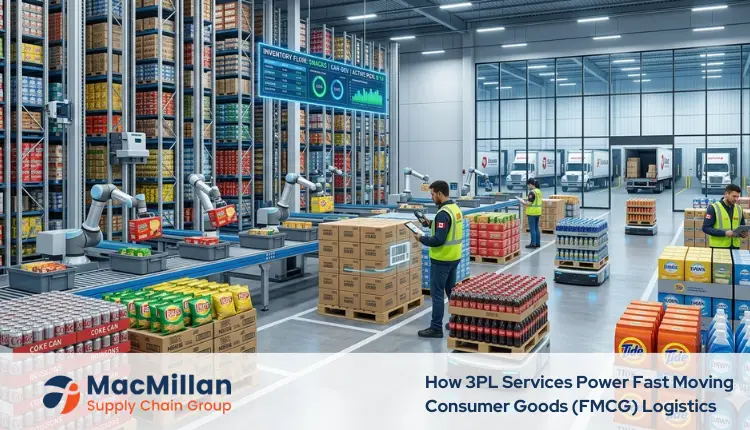
Fast-moving consumer goods (FMCGs), such as snacks, beverages, toiletries, and household items, are essential to daily life and are in constant demand. Their high turnover rate requires supply chains that are not only fast but also reliable, scalable, and cost-effective. In Canada’s competitive retail and e-commerce sectors, businesses handling FMCGs need a logistics partner that can keep pace with demand fluctuations, ensure timely delivery, and maintain product quality. This is where third-party logistics (3PL) providers, such as MacMillan SCG, come in. What Are Fast-Moving Consumer Goods? FMCGs are products that sell quickly at relatively low cost. Examples include packaged foods, soft drinks, over-the-counter medicines, and personal care items. These goods typically have a short shelf life due to high consumer demand or perishability. Therefore, speed and efficiency in warehousing, distribution, and delivery are vital to avoiding stockouts and spoilage. These items often require multiple shipments, specific handling requirements (such as ambient or temperature-controlled storage), and high-frequency order fulfillment. Even minor disruptions in the supply chain can have a significant impact on customer satisfaction and revenue. Logistics Challenges in FMCG Managing the logistics of FMCGs presents several challenges: Products need rapid turnover and replenishment. Inventory must be precisely managed to avoid overstocking or stockouts. Cold or ambient storage may be required. High-volume orders must be fulfilled accurately and quickly. Seasonal or promotional demand spikes require flexible scaling. Efficient last-mile delivery is essential to meeting delivery SLAs and maintaining customer satisfaction. 3PL Solutions from MacMillan SCG MacMillan SCG addresses these challenges with integrated, tech-driven 3PL services tailored for the FMCG sector. With over 20 years of experience, MacMillan is one of Canada’s most trusted logistics partners, offering end-to-end visibility and efficiency throughout the supply chain: Warehousing: GMP-certified, temperature-controlled storage options, with over 250,000 sq. ft. of racked and bulk space strategically positioned across Canada. Learn more about our warehousing and distribution services. Speed & Accuracy: 8-hour dock-to-stock times and 99.56% inventory accuracy ensure products are always ready for sale. Our WMS is Mantis-powered, allowing real-time tracking and reporting. Order Fulfillment: 99.5% perfect order rate backed by seamless integration with major e-commerce platforms. Discover more on our e-commerce fulfillment solutions. Transportation: Our national fleet of 3000+ drivers uses AI-powered route optimization for timely, efficient delivery, covering 90% of FSAs with next-day service. Visit our transportation services page to explore the network. Final Mile Delivery: Our last-mile delivery solutions ensure your FMCGs arrive exactly when and where needed, with options for white-glove service and real-time tracking. Real Results for FMCG Businesses MacMillan’s ability to handle high-volume, fast-turnaround operations makes it a preferred logistics partner for FMCG brands. With 45 cross-dock locations nationally and over 3.1 million shipments handled annually, our clients benefit from scalable logistics, reduced delivery times, and end-to-end support. Whether you’re shipping personal care products across Ontario or distributing beverages nationwide, MacMillan’s precision-driven approach ensures your inventory moves seamlessly through every stage of the supply chain. Why Choose a 3PL for FMCG? Partnering with a specialized 3PL provider like MacMillan gives FMCG businesses: Reduced operational costs through shared infrastructure Flexibility during demand spikes and seasonal surges Enhanced tracking and inventory control via advanced WMS Compliance with Canadian health and safety regulations Scalable logistics infrastructure to support growth Seamless integration with leading e-commerce platforms like Shopify, Amazon, and Walmart About MacMillan SCG MacMillan Supply Chain Group is a Canadian leader in 3PL and logistics services, trusted by over 40 top-tier brands. We specialize in tailored supply chain solutions, including warehousing, container destuffing, final mile delivery, and more. Our systems are designed to scale with your business, using data and automation to reduce errors, improve visibility, and increase profitability. Our same-day and next-day capabilities, combined with 99.00% OTIF performance, make us a reliable choice for FMCG businesses across Canada. Ready to streamline your FMCG supply chain? Partner with MacMillan SCG to simplify your logistics and meet your consumers’ expectations with precision and speed. Request a quote today and experience Canada’s trusted 3PL advantage.
MacMillan Achieves SQFI Certification: Leading Global Food Safety Standards

A Quick Summary and Overview MacMillan Supply Chain Group has achieved the prestigious SQFI Certification, positioning the company at the forefront of global food safety standards in Canada. This certification demonstrates MacMillan’s commitment to maintaining rigorous food safety protocols throughout their temperature maintained facilities and logistics operations. By adhering to the GFSI Framework and implementing comprehensive HACCP programs, MacMillan now offers certified supply chain solutions that meet the highest industry standards. This achievement strengthens our position as a trusted partner for food manufacturers and retailers across North America, particularly in the Canadian food industry where safety compliance is paramount. Introduction Food safety has become a critical concern in today’s complex global supply chains. With consumers and regulators demanding greater transparency and accountability, logistics providers must demonstrate unwavering commitment to maintaining product integrity throughout the distribution process. MacMillan Supply Chain Group has risen to this challenge by achieving SQFI Certification—one of the most respected and comprehensive food safety certifications available worldwide. This milestone represents more than just compliance with regulations; it signals MacMillan’s dedication to excellence in the Canadian food logistics landscape. As a premier 3PL provider with specialized temperature maintained facilities throughout the Greater Toronto Area and beyond, MacMillan has integrated advanced food safety protocols into every aspect of their operations. This certification validates years of investment in infrastructure, training, and quality management systems designed specifically for the unique requirements of food handling and distribution. Understanding the Global Food Safety Standard SQFI (Safe Quality Food Institute) Certification represents one of the most comprehensive food safety management systems recognized worldwide. Operating under the GFSI Framework (Global Food Safety Initiative), this certification verifies that organizations maintain rigorous standards throughout their food handling operations. Unlike basic compliance programs, SQFI takes a risk-based approach that focuses on preventing food safety issues before they occur. The certification process evaluates everything from facility design and construction to operational methods and employee training. Companies must implement detailed HACCP (Hazard Analysis Critical Control Points) programs that identify potential risks and establish monitoring procedures for critical control points. Documentation requirements are extensive, ensuring complete traceability from receipt through storage and distribution. What makes SQFI particularly valuable is its global recognition. With over 12,000 certified facilities across 40 countries, this standard facilitates international trade by providing consistent benchmarks for food safety. For Canadian companies like MacMillan Supply Chain, this certification opens doors to partnerships with multinational food manufacturers and retailers who require GFSI-recognized certifications from their logistics providers. The Evolution of Food Safety Standards: SQF Edition 10 Food safety standards continue to evolve, and MacMillan’s certification coincides with the implementation of SQF Edition 10—the latest update to the SQF Code. This new edition represents a significant advancement in how food safety is assessed and managed throughout the supply chain. Key innovations in SQF Edition 10 include: Introduction of core clauses that represent fundamental requirements for preventing food safety failures Development of a risk-based maturity model that focuses on the severity of non-conformances rather than simple numerical scoring Enhanced requirements for food defense, food fraud mitigation, and environmental monitoring Greater emphasis on continuous improvement and management commitment These changes reflect the growing understanding that food safety isn’t just about passing audits—it’s about building organizational cultures that prioritize safety at every level. For MacMillan Supply Chain, achieving certification under this enhanced standard demonstrates their forward-thinking approach to food safety management. The certification process itself is rigorous, requiring extensive documentation, multiple stages of audits, and verification of corrective actions. By successfully navigating this process, MacMillan has proven their ability to maintain the highest standards of food safety throughout their Canadian supply chain solutions. Temperature-Controlled Facilities Designed for Food Safety At the heart of MacMillan’s food safety program are their state-of-the-art temperature-controlled facilities. These specialized warehouses maintain precise environmental conditions tailored to the specific requirements of different food products. From ambient storage to refrigerated and frozen environments, MacMillan’s infrastructure ensures product integrity throughout the storage period. Each facility incorporates advanced design elements specifically for food safety: Sealed dock doors with inflatable shelters to maintain temperature control during loading/unloading Segregated storage zones to prevent cross-contamination between different product types Specialized flooring systems that facilitate sanitation and prevent harborage points for pests Robust air handling systems with filtration to maintain air quality Redundant refrigeration systems with backup power to ensure temperature stability Beyond physical infrastructure, MacMillan has implemented comprehensive monitoring systems throughout their facilities. Temperature sensors continuously track environmental conditions, with automated alerts triggered by any deviations from established parameters. This real-time monitoring, combined with regular verification checks by trained personnel, ensures that temperature-sensitive products remain within safe ranges at all times. The company’s investment in these specialized facilities demonstrates their understanding that food safety begins with proper infrastructure. By creating environments specifically designed for food products, MacMillan provides their clients with confidence that their products will maintain safety and quality throughout the storage phase. Implementing HACCP Programs Across the Supply Chain MacMillan’s approach to food safety extends beyond facilities to encompass comprehensive HACCP programs throughout their operations. These programs systematically identify potential hazards and establish preventive measures to ensure food safety from receipt through storage and distribution. Key elements of MacMillan’s HACCP implementation include: Detailed hazard analysis for each product category handled Establishment of critical control points with specific monitoring procedures Clear corrective action protocols for addressing deviations Verification activities to confirm that the system is functioning as intended Extensive documentation to demonstrate ongoing compliance What distinguishes MacMillan’s approach is their integration of HACCP principles across the entire supply chain. Rather than treating food safety as a siloed responsibility, they’ve built interconnected systems that maintain product integrity at every touchpoint. This comprehensive approach aligns perfectly with the SQFI Certification requirements, which emphasize systemic food safety management rather than isolated compliance measures. The company has also invested heavily in staff training, ensuring that all personnel understand their roles in maintaining food safety. From warehouse associates to transportation providers, everyone receives specialized training on food handling best practices, allergen management, and sanitation procedures. This culture of