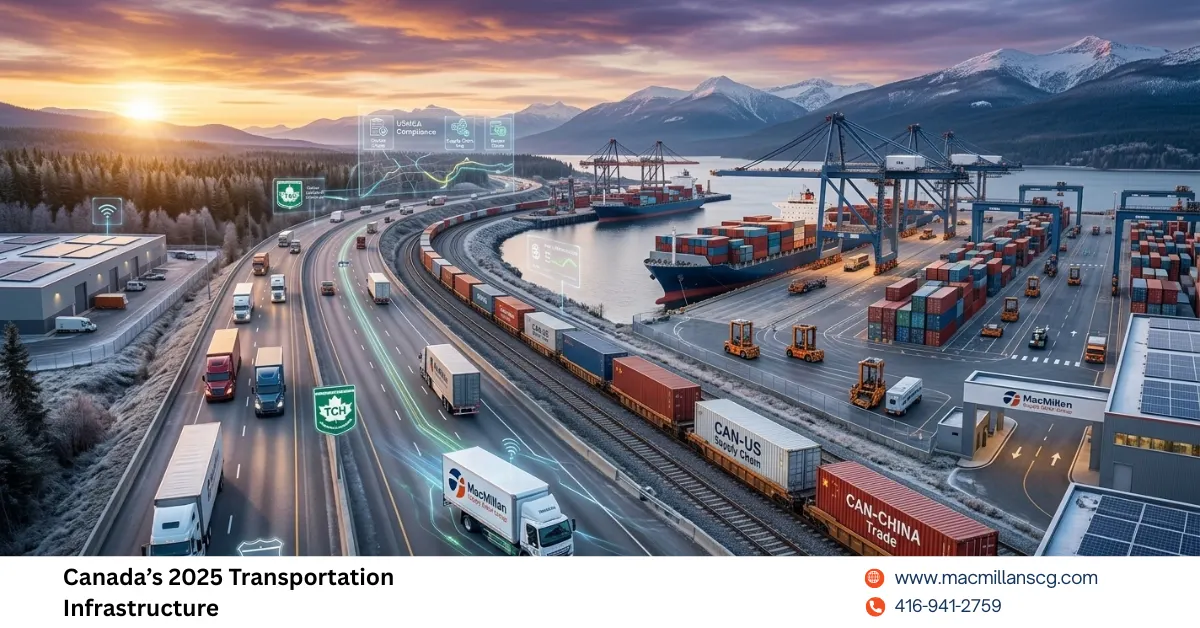
As Canada’s supply chains brace for another transformative year, the interplay of aging infrastructure, climate pressures, and technological innovation is reshaping how goods move across the nation.
With 90% of Canadians living within 100 miles of the U.S. border and cross-border trade accounting for over $1 trillion annually, the stakes for modernizing transportation networks have never been higher. It is not only strategically important for logistics leaders like Macmillan Supply Chain Group (SCG) to comprehend these dynamics, but it is also necessary to maintain the momentum of Canada’s economy.
This blog explores the key issues and possibilities that will shape 2025 and how innovative companies are leveraging infrastructural barriers to gain a competitive edge.
The State of Canada’s Transportation Network: Pressures and Pain Points
Aging Infrastructure Meets Modern Demands
Canada’s transportation infrastructure, which was developed for 20th-century demands, is struggling to handle 21st-century demands. A 7,800-kilometer lifeline for interprovincial trade, the Trans-Canada Highway frequently experiences bottlenecks in Northern Ontario, where single lane sections such as Highway 17 close to Nipigon run the risk of being closed for several days due to severe weather or accidents.
Supply chains are affected by these disruptions:
- 15-20% longer lead times for perishable goods during peak disruption periods
- $2.3 million/hour in lost productivity during major highway shutdowns
Meanwhile, urban last mile delivery faces its own crunch. As e-commerce grows 12% annually, final-mile costs now consume 53% of total shipping expenses a figure exacerbated by Toronto’s 38% increase in delivery vehicle traffic since 2022.
Four Strategic Challenges Reshaping 2025 Logistics
1. Trade Tensions and Tariff Turbulence
The 2025 U.S.-Canada tariff standoff with 25% duties on key imports has forced 68% of manufacturers to reshore operations. While this boosts domestic production, it pressures logistics networks to absorb redirected freight volumes.
Companies now prioritize:
- Nearshoring distribution hubs: Macmillan SCG’s 45 cross dock locations enable rapid inventory repositioning
- AI-driven customs compliance: Real-time tariff calculators integrated with WMS systems
2. Labor Gaps in Critical Roles
Despite 2025’s projected 8% sector growth, 42,000 supply chain roles remain unfilled nationally. The mining boom driving 18 critical mineral projects worth $20B in BC alone competes for heavy machinery operators and safety coordinators.
Forwarders counter this through:
- Upskilling partnerships: Macmillan’s certified forklift operator programs
- Automation investments: Robotics handling 30% of Toronto warehouse pick-pack tasks
3. Climate Resilience Imperatives
Transport Canada’s 2024-25 plan mandates emissions cuts of 40% by 2030 for federally regulated transport.
This pressures fleets to adopt:
- Electric last-mile vehicles: 20% of Macmillan’s urban delivery vans now EV
- Weather-adaptive routing: AI models predicting Northern Ontario road conditions 72hrs ahead
4. First Nations Infrastructure Equity
The Lac-Mégantic Rail Bypass and 18 new Indigenous led port projects highlight growing emphasis on reconciliation through infrastructure.
Partners like Macmillan SCG leverage:
- Community centric warehousing: Shared GMP spaces in Treaty 9 territories
- Cultural competency training: 80% of frontline staff trained in Indigenous protocols
Three High-Impact Opportunities for 2025
1. Government Funding Catalysts
The $30B Canada Public Transit Fund isn’t just about commuters it’s a supply chain game changer.
Strategic alignments include:
- Multimodal hubs: Co-locating warehouses near new LRT terminals (e.g., Toronto’s Finch West line)
- Cold chain expansions: Leveraging transit refrigerated storage for pharmaceutical deliveries
2. AI-Optimized Networks
Macmillan’s AI logistics platform exemplifies next gen efficiency:
- Dynamic rerouting: Avoiding 73% of weather related delays in 2024
- Predictive stockpiling: Machine learning forecasting demand spikes with 94% accuracy
3. Micro-Fulfillment Evolution
With 60% of consumers expecting same-day delivery, companies are:
- Hyperlocal warehousing: Macmillan’s 250,000 sq. ft Toronto facilities enable <4hr fulfillment
- Autonomous middle mile: Testing self driving trucks on Alberta’s twinned Trans Canada sections
Building Resilience Through Technology and Partnership
Case Study: Port Hawkesbury’s Blueprint
A recent $900K investment in Nova Scotia’s Strait Area Transit showcases how rural logistics can thrive through:
- Accessible fleets: 16-passenger buses doubling as goods transporters
- Multi-use pathways: Macmillan’s e-cargo bikes using new active transit routes for emission free deliveries
Transport Canada’s High-Frequency Rail (HFR)
The Québec-Toronto HFR project will reshape Eastern Canada’s logistics by:
- Freeing 22% of highway freight capacity via modal shift
- Enabling just in time manufacturing through precise schedule reliability
Macmillan SCG’s 2025 Infrastructure Playbook
Solutions Addressing Today’s Challenges:
- GMP Certified Agile Warehousing
- Shared/dedicated spaces with 99.4% pick accuracy for tariff-driven inventory swings
- Climate controlled zones for critical minerals storage
- AI-Driven Last Mile Mastery
- Driver fleet utilizing real time traffic/weather data
- Urban consolidation centers cutting final mile costs by 18%
- Cross Border Expertise
- Automated customs brokerage via Mantis WMS integrations
- Buffalo-Toronto corridor optimizations avoiding 2025 tariff pinch points
The Road Ahead: Collaborating for a Connected Canada
As Transport Canada advances its National Supply Chain Strategy, industry leaders must align with public investments while innovating privately.
For Macmillan SCG, this means:
- Piloting hydrogen trucks on Alberta’s upgraded Trans-Canada routes
- Co-developing apprenticeship programs with First Nations communities
- Expanding EV infrastructure to 50% of urban depots by 2026



One Response
Great article! Canada’s 2025 transportation challenges show how important modern infrastructure, AI-driven logistics, climate resilience, and cross-border efficiency are for stronger supply chains.