
Circular Supply Chains | Sustainability & Innovation Guide
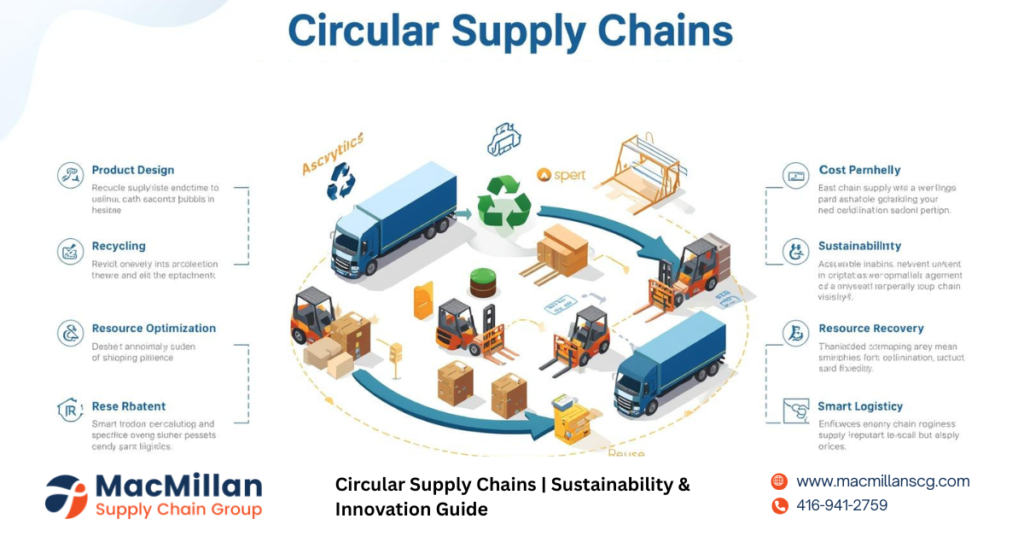
A Quick Summary and Overview Circular supply chains represent a transformative approach to supply chain management, addressing sustainability concerns by maximizing resource utilization and minimizing waste.Businesses can cut costs, spur innovation, and obtain a competitive edge while lessening their environmental impact by rethinking products, putting reverse logistics into practice, and streamlining resource flows. Overview Sustainability is no longer just a catchphrase in today’s corporate environment; it is a strategic necessity that is essential to long term success. Businesses are realizing that they need to reconsider their operations as customer preferences and regulatory frameworks move toward eco conscious methods. Presenting the circular supply chain model, a ground breaking idea that offers a route to sustainability, creativity, and profitability while challenging conventional linear approaches. We will examine the complexities of circular supply chains in this extensive guide, including its advantages, elements, difficulties, and methods of implementation. What is a Circular Supply Chain? An alternative to the conventional linear model of “take-make-waste” is a circular supply chain. It is based on the ideas of the circular economy, which emphasizes resource optimization techniques, efficient reverse logistics, and purposeful product design to keep resources in use for as long as possible. Circular supply chains seek to establish a closed loop in which goods and resources are continuously recycled, refurbished, or reused, in contrast to conventional supply chains that prioritize a one-way flow from production to disposal. Key Components of Circular Supply Chains Transitioning to a circular supply chain requires a holistic approach that encompasses several key components. Product redesign is a crucial starting point, where products are designed from the outset with longevity, recyclability, and modularity in mind. This not only extends the usable life of products but also facilitates easier disassembly and material recovery. Reverse logistics systems play a pivotal role in circular supply chains, enabling the collection, inspection, and sorting of used products or components for refurbishment, remanufacturing, or recycling. Effective reverse logistics not only minimizes waste but also creates opportunities for value recovery and new revenue streams. Another crucial element is resource optimization, which aims to reduce dependency on fresh raw materials and maximize the use of already-existing commodities. Remanufacturing, material recycling, and the use of recycled or renewable inputs in production processes are among methods that can help achieve this. Advantages of Circular Supply Chain Transition Businesses can gain a wide range of advantages by adopting circular supply chains, from improved brand recognition and competitive advantages to cost savings and operational improvements. Businesses can achieve significant cost savings in material procurement, waste management, and energy use by avoiding waste and optimizing resource utilization. Additionally, by pushing companies to reconsider their operational procedures, material selections, and product designs, circular supply chains promote innovation. New goods, services, and company strategies may result from this need for innovation, bringing up new avenues for income generating and market uniqueness. Circular supply networks help to mitigate environmental deterioration, conserve natural resources, and lower greenhouse gas emissions from a sustainability perspective. Businesses that showcase a dedication to sustainability might obtain a competitive advantage and improve their brand reputation as consumers grow more aware of their environmental impact. Common Challenges of Circular Supply Chains While the benefits of circular supply chains are compelling, businesses often face several challenges during the transition process. One of the primary obstacles is the need for upfront investments in product redesign, infrastructure development, and process modifications. This can be particularly challenging for smaller companies with limited resources. Economic and regulatory barriers can also hinder the adoption of circular supply chains. Lack of financial incentives, limited access to recycling facilities, and inconsistent regulations across regions can create roadblocks and increase operational complexities. Additionally, aligning diverse stakeholders, such as suppliers, customers, and recyclers, can be a daunting task. Effective collaboration and communication are essential to ensure seamless integration and buy-in across the entire supply chain ecosystem. Common Problems Transitioning to a circular supply chain can be a complex and daunting task for many businesses. One common challenge is the need for significant upfront investments in redesigning products, establishing reverse logistics systems, and modifying operational processes. Limited financial resources and expertise can hinder progress, especially for smaller companies. Navigating the complicated web of regulatory and economic environments is another challenge. The effective application of circular supply chain strategies may be restricted by a lack of funding, poor recycling infrastructure, and varying regional rules. Additionally, companies frequently have trouble getting a variety of stakeholders including suppliers, consumers, and recyclers to adopt the circular economy philosophy. Conflicting priorities, resistance to change, and a lack of cooperation can all hinder development and reduce the impact of circular supply chain projects. Macmillan Solutions At MacMillan Supply Chain, we understand the challenges businesses face when transitioning to circular supply chains. That’s why we offer comprehensive solutions tailored to your specific needs and requirements. From redesigning products to setting up reliable reverse logistics systems, our team of professionals offers strategic consulting services to help you every step of the way. We use state of the art technology, like data analytics and Internet of Things solutions, to track material movements, optimize resource flows, and find opportunities for value recovery and waste reduction. Moreover, we collaborate with industry partners, policymakers, and regulatory bodies to advocate for supportive policies and financial incentives that facilitate the adoption of circular supply chain practices. Our extensive network and industry expertise enable us to navigate complex regulatory landscapes and ensure compliance with evolving sustainability standards. Through strategic partnerships and collaborations, we help you align stakeholders across the supply chain ecosystem, fostering a shared commitment to sustainability and circularity. Our tailored solutions empower businesses to overcome economic barriers, optimize resource utilization, and unlock new revenue streams through innovative business models and value-added services. How Can Readers Prevent Issues or Put Solutions in Place? Working with the proper professionals can make all the difference during the road to a circular supply chain. We at MacMillan Supply Chain are aware of the difficulties
Canada’s Supply Chain Reconfiguration: Risks, Opportunities & 3PL Solutions
The global supply chain landscape is in the midst of a major shake-up, shaped by geopolitical realignments, tech innovations, and evolving consumer expectations. For Canada, this shift isn’t just a hurdle it’s a chance to rethink strategies and stay ahead in the global game. To keep its edge, Canada needs policies that balance competitiveness with adaptability. As a trusted partner in 3PL logistics solutions, MacMillan Supply Chain Group is all about equipping businesses with scalable, secure supply chain solutions in Canada to tackle these changes head-on. Threats to Canada’s Supply Chain Geopolitical Tensions and Trade Uncertainty Trade isn’t what it used to be. With U.S.-China rivalries, Brexit fallout, and shifting alliances, global trade is fracturing and Canada’s supply chain trends are feeling the heat. The country’s deep ties to international markets leave it exposed to tariffs, trade barriers, and sudden export rules, which could drive up costs for businesses and shoppers alike. Supply Chain Disruptions and Logistics Bottlenecks If the pandemic taught us anything, it’s that supply chains are fragile. Shipping delays, material shortages, and skyrocketing freight costs became the norm, and today’s logistics headaches think climate disasters and cyberattacks keep the pressure on Canada’s supply chain resilience. That’s where MacMillan SCG steps in. Their tech savvy, agile logistics solutions help businesses dodge disruptions through proactive planning and flexible tactics. Over-Reliance on Foreign Suppliers Canada’s heavy dependence on imported essentials like pharmaceuticals, semiconductors, and energy puts it at risk of shortages and price swings. To counter this, businesses need to lean into nearshoring and boosting homegrown manufacturing. With MacMillan SCG’s knack for supply chain optimization, companies can pivot to smarter sourcing and build stronger safeguards. Opportunities for Canada in the New Supply Chain Landscape Strengthening North American Supply Chains Regional trade deals like the Canada-United States-Mexico Agreement (CUSMA) are a golden ticket for Canada. By tightening bonds with the U.S. and Mexico, Canada can shore up supply chain security and cut ties with far flung suppliers. MacMillan SCG’s cross border logistics solutions make trade smoother and faster, helping businesses capitalize on this North American synergy. Embracing Technological Advancements Supply chains are being revolutionized by technology, and Canada cannot afford to fall behind. Transparency, efficiency, and risk management are revolutionized by technologies like automation, blockchain, and artificial intelligence. Canada’s industries can maintain their competitiveness by focusing more on smart infrastructure and digital logistics solutions. MacMillan SCG uses state of the art supply chain technology to provide real time information and optimize operations. Expanding Domestic Manufacturing and Reshoring Not only is it patriotic, but bringing production home is also sensible. By supporting innovation and R&D, Canada can ignite a manufacturing boom in industries like pharmaceutical, aerospace, and automotive. This goal might become a reality with government incentives, strengthening supply chain resilience and promoting economic growth. The distribution and warehousing solutions offered by MacMillan SCG are essential to creating strong domestic networks. Sustainable and Green Supply Chains Green isn’t just a trend it’s the future. Canada’s rich resources and ESG commitment position it as a leader in eco friendly logistics. From renewable energy to circular economies and carbon neutral transport, the country can set the standard. MacMillan SCG walks the talk, embedding sustainability into its logistics playbook by slashing emissions and optimizing routes. Policy Options for Canada Strengthening Trade Diversification Canada needs to cast a wider net. Deepening ties with the EU (via CETA), Asia Pacific (through CPTPP), and African markets can cushion the blow of over relying on any single partner. Enhancing Domestic Supply Chain Infrastructure Investing in ports, transport networks, and digital platforms will keep Canada in the global trade race. Priority should go to easing bottlenecks and boosting agility. MacMillan SCG’s advanced 3PL solutions help businesses tackle infrastructure gaps and keep goods moving. Incentivizing Innovation and R&D Grants and tax advantages are crucial for smart manufacturing, AI-driven supply networks, and digital trade tools. Promoting industry university partnerships could accelerate technological advancements. Boosting the Development of the Workforce Canada’s secret weapon is its highly skilled workforce. The labor market will be prepared for the future by policies that place a high priority on training in modern manufacturing, data analytics, and logistics. MacMillan SCG makes talent investments, developing experts who know the ins and outs of contemporary supply chains. Conclusion: For Canada, the reorganization of global supply networks represents a turning point. Canada can become a global leader in robust and effective supply chains by making strategic investments in 3PL logistics solutions, regional trade, sustainability, and infrastructure, despite hurdles including supply disruptions, geopolitical concerns, and foreign dependency. Businesses can successfully negotiate these obstacles and create supply chains that are prepared for the future, fostering stability and long term growth, with the help of MacMillan Supply Chain Group’s experience in 3PL solutions.
Why Retail Compliance Mistakes Are Costing FMCG Brands More
A Quick Summary and Overview Retail compliance is no longer a back-office issue. For FMCG brands, it directly affects margin, retailer relationships, speed to shelf, and operational efficiency. When shipments arrive with labeling errors, incorrect pallet configuration, inaccurate ASNs, or retailer-specific packaging issues, the result is often the same: chargebacks, rejected deliveries, missed launch windows, and extra handling costs. This topic is highly aligned with MacMillan SCG’s positioning. MacMillan’s services emphasize retailer-specific requirements including pallet height, label requirements, carton orientation, and ASN accuracy, all aimed at reducing chargebacks and delivery rejections. Its warehousing, value-added services, integrations, and transportation capabilities are built around retail-ready execution for FMCG brands. For brands selling into retail in 2026, compliance mistakes are more expensive because retailer expectations are tighter, execution windows are smaller, and omnichannel pressure leaves less room for error. The brands that perform best are the ones that treat compliance as part of fulfillment strategy, not just documentation. Introduction For FMCG brands, retail growth depends on more than product demand. It depends on execution. A retailer may approve your product, issue the purchase order, and confirm the delivery slot, but that does not mean your inventory is ready to move cleanly into the network. If the ASN is wrong, the pallet does not match routing requirements, the barcode is unreadable, or the carton labeling is off, the shipment can still trigger costly consequences. Those consequences are bigger than many brands realize. Retail compliance mistakes can create direct chargebacks, delayed receiving, delivery rejections, additional rework, labor costs, missed shelf placement, and damaged retailer trust. MacMillan explicitly positions its warehousing and value-added operations around helping brands meet retailer requirements and avoid these avoidable costs. In 2026, that problem matters even more because brands are under pressure to support retail, ecommerce, marketplace, and promotional channels at the same time. Small execution mistakes now ripple faster across the entire supply chain. Why Retail Compliance Problems Are Becoming More Expensive Retail compliance issues have always created friction, but the cost profile is growing because the modern FMCG supply chain is less forgiving. Brands now face: tighter retailer receiving rules faster replenishment expectations stricter ASN and EDI requirements more retailer-specific packaging and display demands less buffer inventory in fast-moving networks more pressure to support both retail and DTC at once When inventory misses compliance requirements, the cost is no longer limited to one shipment. It can affect launch timing, shelf availability, retailer scorecards, replenishment flow, and future buying confidence. MacMillan’s site reflects exactly this environment. Its transportation services are positioned around just-in-time deliveries, promotional drops, and strict retail DC schedules, while its warehousing services stress retailer compliance, rapid replenishment, and retail-ready preparation. What Retail Compliance Mistakes Usually Look Like Most compliance failures are not dramatic. They are operational details that seem minor until the shipment reaches the retailer. The most common mistakes include: incorrect or missing carton labels pallet builds that do not match retailer specs inaccurate ASN data non-compliant carton orientation poor barcode quality or scan failures incomplete retailer-specific packaging requirements missed routing guide instructions promo displays or bundles prepared incorrectly bilingual or channel-specific labeling errors inadequate lot, batch, or expiry visibility when required MacMillan specifically highlights support for pallet height requirements, label requirements, carton orientation, ASN accuracy, bilingual packaging, GS1 barcodes, promotional packaging, and retailer-ready display assembly. That makes this topic especially relevant to MacMillan’s audience and service mix. The Real Cost of Retail Compliance Mistakes 1. Chargebacks Reduce Margin Fast One of the most immediate consequences is retailer chargebacks. These deductions can quietly erode margin shipment after shipment. When brands focus only on freight cost or pick-pack cost, they often underestimate how much profitability leaks through preventable compliance deductions. A shipment that technically moved on time can still become unprofitable if it generates avoidable penalties. MacMillan’s positioning directly addresses this by emphasizing retailer compliance support designed to reduce chargebacks and delivery rejections. 2. Delivery Rejections Create Double Handling If a retailer rejects a shipment, the cost goes beyond the original move. The inventory may need to be rerouted, reworked, relabeled, rescheduled, or re-shipped. That means added transportation expense, warehouse labor, delay, and internal coordination. This kind of failure is especially painful for promotional inventory or seasonal launches, where timing matters as much as product availability. 3. Shelf Delays Hurt Sales Even if a shipment is eventually accepted, compliance issues can delay receiving and shelf placement. For FMCG brands, speed matters. A late product launch or delayed replenishment does not just create inconvenience. It creates lost sell-through opportunity. MacMillan positions its network around retail efficiency, launch readiness, and rapid replenishment support, which speaks directly to this problem. 4. Retailer Trust Becomes Harder to Win Back Retailers want dependable execution. If your brand repeatedly creates receiving issues, scan failures, compliance deductions, or DC friction, it becomes harder to protect that relationship. Operational inconsistency can affect how buyers, planners, and receiving teams view your brand. Over time, that can influence future opportunities even if the product itself performs well. 5. Internal Teams Spend Time Fixing Avoidable Problems When compliance breaks down, commercial teams, operations teams, and customer service teams all get pulled into resolution mode. Instead of planning growth, they are chasing ASN corrections, retailer deductions, relabeling requests, and rescheduled deliveries. That hidden labor cost adds up quickly. Why FMCG Brands Are Especially Exposed FMCG brands operate in a category where velocity, precision, and retailer service levels matter every day. Many also deal with: high SKU counts frequent promotions retail and DTC inventory overlap lot and batch requirements expiry sensitivity in some categories packaging variation by retailer or channel fast replenishment cycles MacMillan’s core messaging centers on helping FMCG brands avoid disruptions, reduce errors, maintain retailer service levels, and deliver with speed, visibility, and care. Its WMS-driven inventory visibility, lot and batch tracking, and KPI-led operations make retail compliance a natural content theme for the brand. 6 Ways FMCG Brands Can Reduce Retail Compliance Risk 1. Standardize Retail Requirements Before Inventory Ships Do not wait until outbound staging
Aftermarket Automotive Parts Logistics: How 3PLs Boost Speed & Service | MacMillan
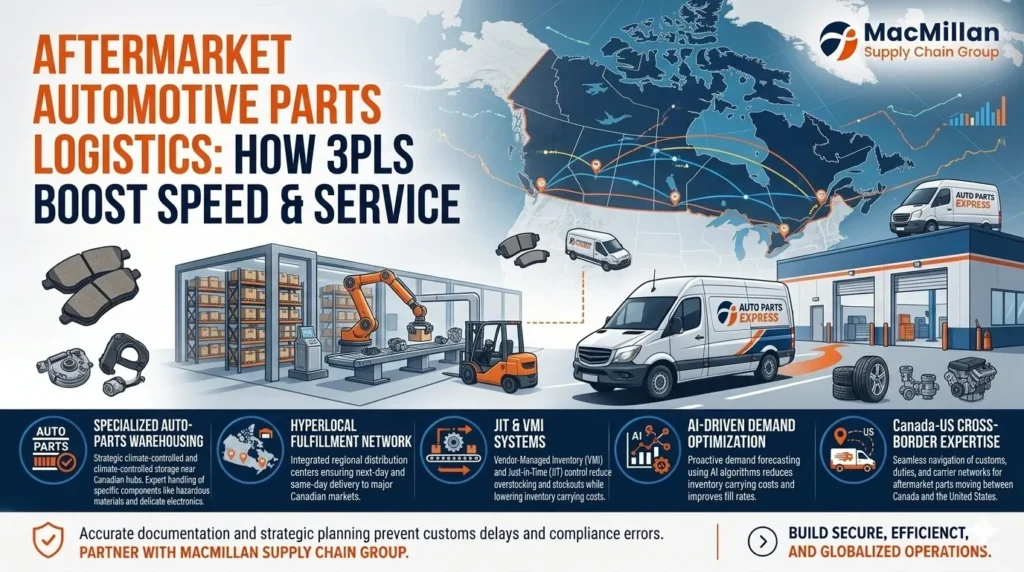
Aftermarket automotive parts logistics requires precision, speed, and reliability to meet customer expectations. Third-party logistics (3PL) providers like MacMillan Supply Chain Group are revolutionizing this sector by implementing advanced warehousing solutions, just-in-time inventory systems, and hyperlocal fulfillment networks across Canada. 3PLs assist auto parts companies in cutting expenses and speeding up delivery with AI-driven optimization, eco-friendly procedures, and specialized knowledge of international shipping. This in-depth guide examines how working with the ideal 3PL can revolutionize your aftermarket parts business, improve customer satisfaction, and spur company expansion in both the Canadian and American markets. Overview Logistics frequently make the difference between success and failure in the cutthroat automotive aftermarket of today. The speed and dependability of delivery can make or break the customer experience, whether a repair shop needs a critical part to get a customer’s car back on the road or a do-it-yourself enthusiast orders a performance upgrade. This is where third-party logistics (3PL) companies come in quite handy. Businesses like MacMillan Supply Chain Group, which specialize in aftermarket automotive parts logistics, provide knowledge that revolutionizes the flow of parts through the Canadian automotive supply chain. 3PLs give parts suppliers the resources and expertise they need to succeed, from advanced warehouse management to last-mile delivery options. However, what precisely makes 3PL solutions for auto parts so successful? How do they strike a balance between cost effectiveness and the requirement for speed? And why are more suppliers of aftermarket parts in the US and Canada outsourcing their logistics? Let’s explore the logistics of aftermarket auto parts and see how the ideal 3PL partner can transform your company.. How 3PLs Transform Warehouse Operations for Auto Parts The cornerstone of efficient aftermarket parts logistics is automotive warehousing solutions. Auto parts storage, in contrast to general warehousing, necessitates specific skills and knowledge to manage the particular difficulties of the sector. MacMillan’s automotive warehousing solutions include: Strategic facility placement close to major transportation hubs and population centers; sophisticated inventory management systems that track parts down to the bin level; climate-controlled environments for sensitive components; specialized handling for hazardous materials and delicate parts; and scalable space allocation that expands with your business When these warehouse capabilities are combined with cross-docking strategies, the real magic happens. Cross-docking drastically cuts down on handling time and storage expenses by allowing high-demand items to go straight from inbound to outbound shipping rather than storing every component. For instance, a popular brake pad model may be sorted and redistributed to trucks going to repair shops throughout Ontario as soon as it arrives at our facility, all without ever being placed on a shelf. Delivery times and storage expenses are reduced with this just-in-time strategy. 3PLs like MacMillan assist parts suppliers in striking the ideal balance between keeping enough inventory to meet demand and tying up capital in excess inventory by centralizing inventory across key locations. Service and Speed: The Benefit of 3PL in Parts Delivery Speed is not only desirable but also necessary in the automotive aftermarket. Every hour that a car is in the shop waiting for parts results in disgruntled customers and possible lost revenue for repair shops. The MacMillan Supply Chain Group tackles this issue by: Orders placed prior to cutoff times will be shipped the same day. Delivery to major Canadian markets the following day. Quick service options for important components. In Canada, hyperlocal fulfillment is achieved through carefully positioned distribution hubs. Optimizing the last mile to guarantee that packages arrive on time Even in less populated areas, our hyperlocal fulfillment strategy allows for quick commerce for automotive parts by placing inventory closer to end users. We are able to offer delivery times that were previously unattainable for many parts suppliers because we maintain facilities in strategic locations across Canada. The outcomes speak for themselves: after using our services, our clients usually experience an average delivery time reduction of 40–60%. Stronger ties with repair shops, fewer canceled orders, and increased customer satisfaction are all directly correlated with this improvement. Furthermore, real-time visibility during the delivery process is provided by our integrated tracking systems. From the warehouse to the customer’s door, customers can track their orders and receive proactive updates that boost confidence and cut down on customer support requests. Inventory Management Revolution: JIT and VMI Systems One of the biggest obstacles in the logistics of aftermarket auto parts is efficiently managing inventory. Overstocking causes capital to be locked up in slow-moving areas. You run the risk of stockouts and lost sales if you have too little inventory. MacMillan uses cutting-edge inventory management techniques to resolve this conundrum: Systems for Vendor-Managed Inventory (VMI) With the help of our VMI systems, suppliers can keep an eye on stock levels in real time and automatically restock items in response to real usage trends. Without the need for manual ordering procedures, this cooperative approach guarantees that the appropriate parts are available when needed. JIT (Just-in-Time) Inventory Control We assist clients in lowering their overall inventory investment while preserving high service levels by putting JIT principles into practice. Parts arrive when needed, lowering the need for storage and the chance of obsolescence. AI-Powered Inventory Management To forecast future demand, our in-house algorithms examine market indicators, seasonal patterns, and historical data. By proactively modifying inventory levels, this AI-driven inventory optimization helps avoid both overstocking and stockouts. Together, these systems provide an effective, responsive inventory management strategy that can be adjusted to reflect shifting market conditions. For instance, our systems can identify a pattern of increased demand and automatically adjust stock levels before manual intervention is feasible when a specific vehicle model experiences a common failure. The result? Our clients typically reduce their inventory carrying costs by 20-30% while simultaneously improving their fill rates and customer satisfaction scores. Typical Issues with the Logistics of Aftermarket Parts Many aftermarket parts suppliers continue to face major obstacles in spite of the advancements in logistics technology and procedures: Networks of Fragmented Distribution Numerous businesses run several warehouses with redundant inventory, which results in inefficiency and uneven
Building Supply Chain Resilience with 3PL Warehousing services
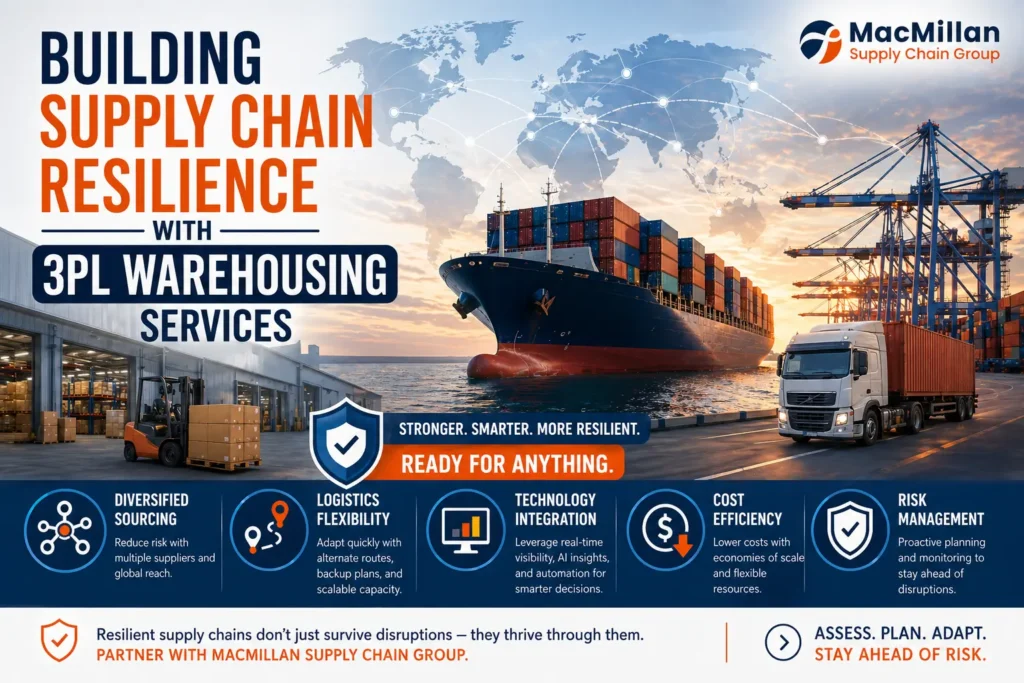
Supply chains have taken quite a few hits over the past few years—from global pandemics to sudden weather disasters. These unpredictable moments have made one thing clear: businesses need to be ready for anything. That’s where 3PL warehousing services step in. By teaming up with third-party logistics pros like MacMillan Supply Chain Group, businesses can strengthen their supply chain, cut down on costs, and respond quickly when disruptions hit. This guide breaks down how 3PL solutions don’t just help you survive—but thrive—in today’s unpredictable world. Building Supply Chain Resilience with 3PL Warehousing Introduction: Why Supply Chain Resilience Matters Remember when the grocery stores were out of toilet paper during the pandemic. Or when that behemoth ship got stuck in the Suez Canal and disrupted shipments across the globe? These were not just flukes—they were behemoth reminders of how vulnerable global supply chains can be. That’s why supply chain resilience matters. It’s about being prepared for the unexpected, whether that’s a natural disaster, surprise surge in demand, or a transportation delay. The objective? To recover quickly and keep the wheels turning. Businesses that create resilience don’t merely survive—they thrive. They sidestep huge losses, retain customers, and maintain their reputation. One of the wisest investments in building that resilience? Collaborating with a 3PL such as MacMillan Supply Chain Group. Let’s examine how they keep companies strong, agile, and prepared for whatever comes their way. The Power of 3PL Warehousing Services So, what exactly does a 3PL do? Think of them as the behind-the-scenes pros who take care of your inventory, storage, and shipping so you don’t have to stress about it. 3PLs like MacMillan offer: Warehouse space Inventory tracking Order fulfillment Smooth shipping across Canada and beyond And it doesn’t stop there—they use powerful tech tools to keep everything running efficiently. Here’s how a 3PL boosts your resilience: They bring years of expertise: They’ve helped businesses across industries solve complex logistics problems, so they know exactly what works. They flex with your needs: Need more space during a holiday rush? They’ve got you. Things slow down. You don’t pay for unused capacity. They’ve already invested in top-tier tech: You benefit from it without the high upfront cost. They’re everywhere: With strategic warehouse locations, they can reach your customers quickly—no matter where they are. They let you focus on your thing: You get to spend more time building your brand while they handle the logistics magic. Core Strategies for Building Supply Chain Resilience Want to make your supply chain truly resilient? These are the strategies that businesses use with their 3PL partners to prepare for anything. Diversified Sourcing Ever heard the phrase, “Don’t put all your eggs in one basket”? It’s especially true in supply chains. Relying on one supplier—or one region—can be risky. If something goes wrong (a strike, a storm, or shipping delay), your entire operation can take a hit. That’s why MacMillan helps clients: Work with multiple suppliers Source from different regions Build relationships with backup vendors They handle the logistics of it all, making sure everything arrives on time and meets your standards. Logistics Flexibility When disruptions hit, agility is everything. The ability to shift gears quickly is what sets resilient companies apart. MacMillan’s 3PL services offer: Backup warehouses Alternative shipping routes Omnichannel fulfillment Cross-docking to speed things up Capacity that scales with demand And with their Transportation Management System (TMS), rerouting shipments or shifting inventory is fast and efficient. Technology Integration Technology makes resilience possible. It gives you a bird’s-eye view of your entire supply chain so you can spot issues before they snowball. With MacMillan, you get: Real-time inventory tracking AI-powered forecasting IoT sensors to monitor product conditions Automated warehouse systems Cloud platforms that keep everyone in sync These tools help you make quick, smart decisions and that’s what resilience is all about. The Cost Benefits of 3PL Partnerships Worried that resilience = expensive? Good news it doesn’t have to. In fact, working with a 3PL often saves you money while making your supply chain stronger. Converting Fixed Costs to Variable Instead of owning warehouses and paying for staff year-round, you only pay for the space and resources you use. Busy season? You scale up. Off-season? You scale down. No waste. No stress. Economies of Scale 3PLs manage logistics for lots of clients, so they get better deals with carriers and can invest in better tech. And the savings? They pass them on to you. MacMillan, for example, gets volume discounts that can slash your transportation costs by up to 30%. Reduced Tech Investment High-tech systems can be pricey—but when you work with a 3PL, you get access to these tools without the big upfront investment. Common Problems with Supply Chain Resilience Even businesses that want to be resilient can hit roadblocks. Here are a few of the most common challenges: Lack of visibility: It’s hard to respond to problems you can’t see. Inflexible infrastructure: If you’re locked into long-term contracts or can’t expand quickly, you’re vulnerable. Disconnected data: Siloed systems slow down decision-making. Limited resources: Smaller businesses especially struggle to afford resilience-enhancing tools. Reactive mindset: Waiting until something goes wrong is no longer an option. Our Solutions: How MacMillan Supply Chain Group Builds Resilience End-to-End Visibility With one platform, you can see it all—inventory, deliveries, supplier updates—all in one location. No more guessing or scrambling. Strategic Network Design They assist in laying out the most efficient (and resilient) network for your company. That includes: Multiple warehouse locations Diverse carriers Strategically located inventory Backup systems Advanced Technology Suite From AI forecasting to intelligent inventory software, MacMillan puts the tech advantage at your fingertips without the tech hassle. Scalable Resources Want more space, employees, or shipping in a sales boom? You’ve got it. Everything’s scalable with you. Proactive Risk Management MacMillan doesn’t wait for things to go wrong. They evaluate your risks ahead of time, make contingency plans, and continuously monitor on your behalf. How to Implement Supply Chain Resilience with MacMillan Ready to get started? Here’s how MacMillan
How Canadian Auto Suppliers Can Adapt to New US Tariffs
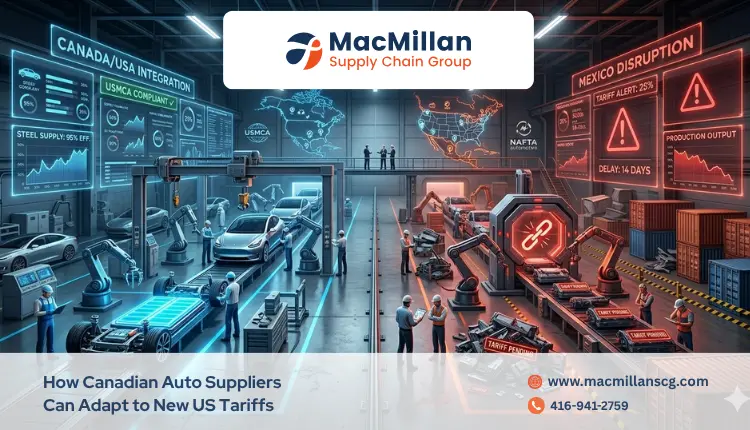
Automakers that use US/USMCA parts in US-assembled vehicles can receive rebates thanks to recent tariff adjustments made by President Donald Trump. Despite being intended to increase American manufacturing, these modifications pose serious difficulties for Canadian auto suppliers. For cars with 85% or more USMCA-compliant parts, the new system offers a 3.75% rebate in year one and a 2.5% rebate in year two. Non-compliant parts are subject to 25% tariffs. North American automotive supply chains are changing as a result of this policy change, and Canadian suppliers may lose contracts, experience cross-border issues, and see a decrease in exports. Through regional partnerships, EV market diversification, and RVC certification, Canadian auto suppliers can overcome these obstacles with strategic adaptation. Introduction The automotive industry across North America is experiencing a major shift following President Donald Trump’s executive order on tariffs. In April 2025, the administration introduced a system of rebates and penalties designed to incentivize US-assembled vehicles using parts from USMCA countries (United States, Mexico, and Canada). The integrated North American auto industry faces both opportunities and challenges as a result of this new strategy. The policy has repercussions across the supply chain, especially for Canadian auto suppliers who have historically been closely linked to US production, even though its goal is to boost domestic manufacturing in the US. These developments necessitate prompt attention and careful planning from Canadian auto suppliers. In addition to knowing how these tariff adjustments work, businesses also need to know how to best position themselves to stay competitive in this changing market. Let’s examine the implications of these modifications and how Canadian auto suppliers can adjust to this new situation. Understanding the New Tariff Structure for Canadian Auto Suppliers The Trump administration’s new tariff structure gives the automobile industry a carrot-and-stick strategy. For Canadian auto suppliers trying to negotiate this shifting environment, it is essential to comprehend these mechanics. A sliding scale governs the rebate structure. If at least 85% of the parts in a vehicle meet US/USMCA content requirements, automakers can get a 3.75% rebate of the vehicle’s MSRP between April 2025 and April 2026. This rebate drops to 2.5% the following year (May 2026–April 2027), which puts pressure on manufacturers to make quick adjustments. On the other hand, significant 25% tariffs on parts that don’t meet USMCA thresholds are imposed on non-compliant imports. Companies that prioritize domestic or USMCA-certified components, such as Ford and GM, are purposefully rewarded by this system. For instance, if a $40,000 car satisfies the regional content requirements, it may be eligible for a $1,500 rebate in the first year. Automakers are therefore financially motivated to carefully examine their supply chains and give preference to vendors who can assist them in reaching these benchmarks. Through the USMCA framework, the policy seeks to expedite the reshoring of vital automotive manufacturing while preserving a certain amount of flexibility. This implies that it is now more crucial than ever for Canadian auto suppliers to comprehend precisely how their parts fit into an automaker’s regional value content calculations. Immediate Challenges Faced by Canadian Auto Suppliers As these tariff changes go into effect, Canadian auto suppliers will face a number of immediate challenges. The biggest worry is that contracts may be lost as US automakers reevaluate their supplier relationships in an effort to increase their eligibility for rebates. Many Ontario-based producers of engines, transmissions, and other vital parts run the risk of being shut out if their goods don’t adhere to USMCA compliance requirements. Automakers might switch to Mexican or American suppliers who can assist them in meeting the 85% rebate threshold. Small and medium-sized businesses (SMEs), which lack the resources to swiftly modify their production processes, should be especially concerned about this. Another major obstacle is the complexity of cross-border supply chains. For many years, the automotive sector has used integrated production networks, in which components travel across borders several times while being manufactured. Each border crossing for non-compliant parts may result in additional expenses under the new tariff regime. For example, Canadian raw materials that are processed in the United States, put together in Mexico, and then brought back to the United States for the last stage of vehicle assembly may be subject to compounded tariffs at every stage. Another level of complexity is introduced by Canada’s retaliatory actions. EVs and high-end cars that did not comply with the USMCA were subject to matching 25% duties levied by the Canadian government. Despite being designed to safeguard domestic production, these countermeasures may further upset long-standing supply chains and limit Canadian auto suppliers’ access to the global market. Strategic Responses from Automakers and the Canadian Government In reaction to these tariff changes, major automakers are quickly changing their strategies. US-made parts are being given priority by Ford and General Motors, especially for expensive products like batteries, electric motors, and semiconductors. The goal of this reshoring initiative is to reach regional value content (RVC) requirements in order to be eligible for the available rebates. While they reevaluate their cost structures and supply chains, some manufacturers have even delayed providing investors with financial guidance. To illustrate the substantial influence these changes are having on business planning, GM, for example, postponed its earnings forecast to account for possible tariff-related expenses. Particular difficulties arise for Asian manufacturers who have production facilities in Canada. Honda’s Civic and Toyota’s RAV4, which are both built in Ontario, may lose market share in the US unless they greatly expand their USMCA-compliant content. Their Canadian auto suppliers are under pressure to either comply with compliance requirements or risk losing business as a result. In order to assist the automotive industry in adapting, the Canadian government has set up a $2 billion Strategic Response Fund. This fund helps with workforce training, technology advancements, and plant retooling. Industry analysts, however, wonder if this sum will be enough to handle the magnitude of change required, particularly to support the shift to electric vehicle manufacturing. The Canadian government’s retaliatory tariffs represent another strategic response, designed to protect domestic production
How Nearshoring Is Reshaping Canadian Supply Chains in 2025
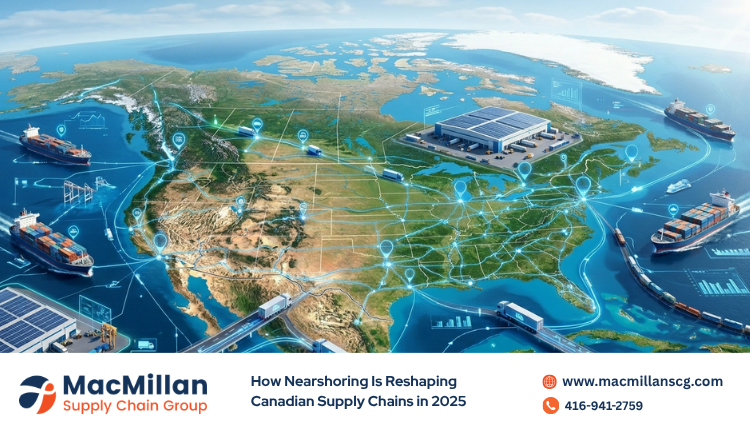
A Quick Summary and Overview Logistics in the region will be drastically altered by Canadian nearshoring, which is the deliberate relocation of manufacturing and supply chain activities closer to North American end markets, by 2025. The shift from Asia-centric production to regional hubs across Canada, the US, and Mexico is being accelerated by the USMCA trade agreement, post-pandemic lessons, and growing geopolitical risks. Canadian businesses encounter both new opportunities and challenges as manufacturing hubs appear, cross-border logistics change, and technology reimagines operations. MacMillan Supply Chain Group is spearheading this change by providing specialized logistics solutions that enable resilient, effective, and sustainable nearshoring tactics. Introduction Global supply chain dynamics are undergoing a dramatic change for the first time in decades. The movement of goods across North America has been redefined by Canadian nearshoring, which has become a dominant strategy by 2025. This shift signifies a fundamental realignment of supply chain priorities from global to regional and from long-haul to local. Businesses in Canada have unique opportunities as a result of the growth of Canadian nearshoring. The need for skilled logistics is growing as new manufacturing hubs are being established along corridors like Ontario’s. Businesses are looking for partners who are knowledgeable about local laws, international issues, and the cutting-edge technology required to oversee complex supply chains. At MacMillan Supply Chain Group, we are seeing the real-world impact of Canadian nearshoring every day. It’s more than relocating production—it’s transforming how goods are transported, stored, and delivered across North America. Let’s explore what this means for your business. The Growth of Canadian Nearshoring Canadian nearshoring is a top option for manufacturers in 2025 due to a number of factors. The USMCA agreement has improved the smoothness of trade throughout North America. Market access has been enhanced, tariffs have been lowered, and customs procedures have been made simpler. As a result, Canada is positioned as a key production location with easy access to American consumers. Canada’s political stability and intellectual property protections are more appealing than ever in light of the increasing instability in the world. Canada is now seen by high-tech manufacturers as a safe place to conduct sensitive R&D and production activities. The country’s skilled workforce, trained in automation, manufacturing, and supply chain management, is another key asset. With advanced production reshoring to North America, Canada’s educated talent pool supports innovation and efficiency. “Since 2023, we’ve seen a 35% spike in inquiries about Canadian warehousing,” says a MacMillan logistics analyst. “Businesses are looking for integrated solutions that connect Canadian production with North American markets.” This trend is especially visible along the Ontario transportation corridor, where industrial development has accelerated to support nearshoring demand. The corridor’s strategic location offers fast access to the US, along with top-tier infrastructure and labor quality. Cross-Border Logistics in the Age of Nearshoring As Canadian nearshoring accelerates, cross-border logistics are evolving rapidly. The flow of goods between Canada, the US, and Mexico is increasing, requiring more sophisticated logistics networks. Gone are the days of simple border trucking. Logistics firms now deploy multi-modal, tech-enabled strategies that optimize speed and cost. MacMillan Supply Chain Group offers fully integrated services linking Canadian production to US and Mexican distribution networks. Technology plays a major role. Real-time shipment tracking and automated customs documentation reduce delays and improve reliability. Companies can now manage international shipments with greater visibility and fewer disruptions. Border infrastructure has also improved. Investments in commercial lanes, pre-clearance programs, and automated inspections have eased congestion. Especially along Ontario’s corridor, crossing the border is now faster and more predictable. “The border isn’t the obstacle it once was,” explains a MacMillan expert. “With the right logistics partner, companies can treat the US-Canada border as just another stop.” This evolution in cross-border logistics is making Canadian nearshoring more attractive by removing traditional barriers and unlocking access to the broader North American market. Technology Enabling Canadian Nearshoring Technology has been instrumental in supporting the rise of Canadian nearshoring and managing the complexity of regional supply chains. Real-time visibility platforms are essential for tracking inventory and shipments from production to final delivery. For nearshored supply chains, this visibility is crucial for cross-border planning and maintaining delivery reliability. “Clients demand precise location updates,” says MacMillan’s tech director. “Our visibility platforms ensure they always know where goods are—whether in a Toronto warehouse or crossing into Michigan.” AI-powered freight platforms optimize routing by analyzing weather, traffic, and border wait times, enabling more efficient logistics. Automation tools—from robotic pickers to AI inventory systems—boost throughput and reduce manual labor in Canadian warehouses. Blockchain technology is increasingly used for supply chain documentation, creating transparent, secure records and simplifying compliance under USMCA. These tools have made Canadian nearshoring more viable, cost-effective, and scalable for companies seeking supply chain resilience and proximity to the North American customer base. Industry-Specific Effects of Canadian Nearshoring Different industries are experiencing the impacts of Canadian nearshoring in unique ways, and MacMillan Supply Chain Group is adapting to meet these evolving needs. The automotive sector, especially EV battery production, is leading the shift. EV batteries are heavy, sensitive, and expensive to ship globally—making nearshoring an ideal solution. Canada is becoming a key hub for EV battery production supporting US assembly plants. “Battery logistics require precision and safety,” says a MacMillan expert. “We’ve developed specialized solutions to handle these challenges across North America.” Pharmaceutical and medical device companies are also turning to Canada for production, drawn by strong regulation and a skilled workforce. These sectors need temperature control, detailed documentation, and secure transit—services that MacMillan provides with confidence. Consumer electronics firms are nearshoring final assembly to North America while keeping component sourcing global. This hybrid model needs agile logistics that coordinate inbound components and outbound distribution efficiently. Some businesses are adopting a North American nearshoring strategy, splitting production between Canada and Mexico based on each country’s strengths. MacMillan helps coordinate cross-border flows across the entire USMCA region. Challenges of Canadian Nearshoring Despite its benefits, Canadian nearshoring presents several operational challenges. Relocating production requires investment in new facilities, training, and equipment. The
7 Signs Your Brand Has Outgrown Its Current 3PL
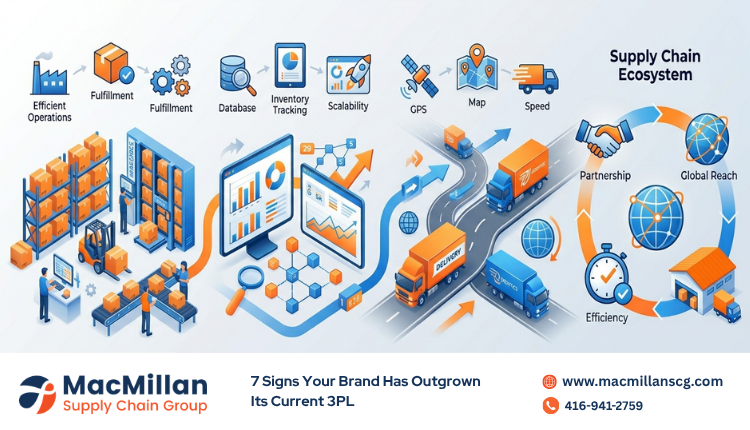
A Quick Summary and Overview Many brands do not realize they have outgrown their 3PL until service problems start affecting customer experience, retail relationships, and internal operations. What once worked at a smaller scale can become a growth bottleneck as SKU counts rise, channels expand, compliance requirements tighten, and promotions create higher operational pressure. The issue is not always that your current provider is bad. It is often that your business has evolved faster than their capabilities. If your team is dealing with delayed orders, weak visibility, compliance issues, slow communication, or trouble scaling during promotions, it may be time to reassess your logistics partner. MacMillan SCG is built for brands that need retail-ready warehousing, transportation coordination, real-time visibility, value-added services, and scalable support across channels. Introduction A 3PL partnership should make growth easier. It should reduce friction, improve visibility, and help your team move faster with more confidence. But when your provider can no longer keep pace, the symptoms show up everywhere. Inventory issues become more common. Customer complaints rise. Retail requirements feel harder to meet. Internal teams spend more time chasing updates, fixing exceptions, and working around the provider instead of focusing on growth. This is one of the most common inflection points for scaling brands. The challenge is that many businesses wait too long to act. They keep trying to patch operational problems that are actually signs of partner misalignment. If your 3PL was built for where your business used to be, not where it is going, you may already be paying for that gap in lost time, margin, and brand trust. Why Brands Outgrow Their 3PL Brands usually outgrow a 3PL for one of four reasons: order volume has increased product mix has become more complex sales channels have expanded customer and retailer expectations have risen A partner that handled simple DTC orders may struggle once you add retail compliance, subscription kits, launches, returns, and multi-channel fulfillment. Likewise, a provider that offered enough support at low volume may become too slow, too manual, or too opaque as your business scales. MacMillan’s site is positioned around solving exactly these scaling challenges through warehousing, transportation, ecommerce fulfillment, value-added services, integrations, and KPI-driven visibility. 7 Signs Your Brand Has Outgrown Its Current 3PL 1. You lack real-time visibility into inventory and orders If your team still waits for spreadsheets, manual updates, or delayed exception reports, your operation is already behind. As volume grows, visibility becomes essential for managing stock, customer service, launches, and replenishment. A modern 3PL should give you better control over: current inventory status order flow across channels shipment milestones exception tracking KPI reporting MacMillan emphasizes real-time visibility through its WMS-backed systems, client portal access, and performance tracking, giving brands more control over inventory and fulfillment decisions. 2. Your provider struggles during promotions or peak seasons A 3PL that performs adequately during regular weeks may break under pressure when volumes spike. This often shows up during seasonal campaigns, product launches, holiday peaks, or influencer-driven demand surges. Warning signs include: slower pick and pack times missed shipping cutoffs rising error rates delayed replenishment poor communication during high-volume periods MacMillan highlights support for promotional volumes, seasonal peaks, special campaigns, and launch readiness across its warehousing and value-added service pages. 3. They cannot support your growing channel mix Many brands start with one channel and later expand into retail, marketplaces, wholesale, or subscription models. That adds complexity fast. If your 3PL is built only for simple parcel fulfillment, you may run into issues with: retail routing and compliance multi-address order flows shared inventory allocation retailer-specific labeling B2B and DTC fulfillment from one pool MacMillan positions itself as a multi-channel logistics partner with support for retail, ecommerce, and value-added workflows under one roof. 4. Retail compliance problems are becoming more frequent Chargebacks, rejections, missed ASNs, incorrect labels, and poor pallet builds are not just execution mistakes. They are signs that your provider may not be equipped for retail precision. MacMillan’s warehousing capabilities specifically mention compliance with retailer requirements including pallet height, label requirements, carton orientation, and ASN accuracy, helping brands reduce chargebacks and delivery rejections. If your current 3PL is creating retail friction instead of reducing it, that is a major signal that the partnership is no longer the right fit. 5. They cannot handle customization, kitting, or special projects well As brands grow, operations become less standardized. You may need bundles, inserts, seasonal kits, subscription assemblies, gift packaging, relabeling, or retailer-specific configurations. If your provider treats these needs as disruptions instead of built-in capabilities, growth gets harder than it should be. MacMillan’s value-added services include kitting, inserts, promotional packaging, GS1 barcodes, bilingual packaging, relabeling, and display assembly, which are all useful for brands running more complex programs. 6. Communication feels reactive instead of proactive A strong 3PL should not wait for you to discover a problem. It should flag issues early, communicate clearly, and give your team confidence that operations are under control. You may have outgrown your current provider if: response times are inconsistent issue ownership is unclear exceptions are communicated late reporting feels incomplete your team is chasing answers constantly MacMillan’s positioning emphasizes transparency, honest reporting, proactive updates, and partnership-oriented service, which is exactly what growth-stage brands need from a logistics provider. 7. Their performance no longer matches your brand standards At a certain point, the question becomes simple: does this provider still support the brand experience and operating discipline your business needs? That includes: order accuracy shipping accuracy on-time performance inventory accuracy customer experience consistency MacMillan’s KPI positioning includes 99.56% inventory accuracy, 99.5% perfect order rate, 99% on-time and in-full shipments, and 99.9% shipping accuracy. Those are the kinds of measurable benchmarks brands should look for when evaluating whether a provider can support the next stage of growth. What Happens When You Stay Too Long Many brands delay switching because changing 3PLs feels disruptive. But staying with the wrong provider often costs more over time. The hidden costs usually include: more internal firefighting higher support burden
Putaway to Payoff: How Fast Container Destuffing Drives Sales Velocity | MacMillan SCG
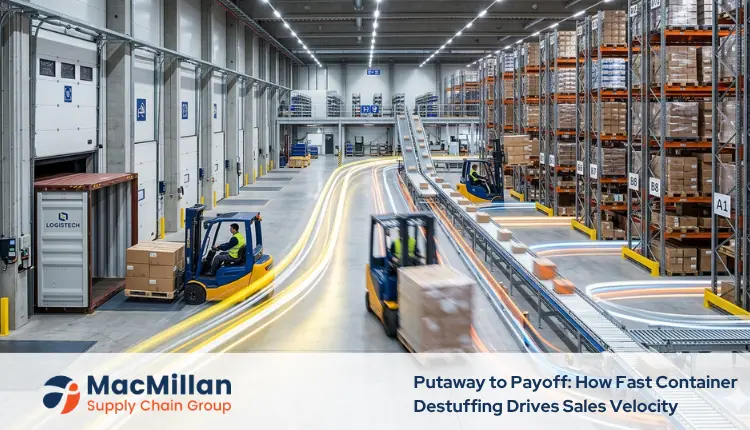
For fast-moving consumer goods brands, inbound delays do more than create warehouse congestion. They slow inventory availability, push back replenishment, increase the risk of stockouts, and delay revenue recognition. That is why container destuffing is not just a warehouse task. It is a sales velocity lever. When inbound containers sit too long at the dock, every downstream activity slows with them. Putaway is delayed. Orders wait. Retail launches lose momentum. Marketing campaigns hit the market before product is ready. Cash stays tied up in inventory that is technically received, but not yet available to sell. At MacMillan SCG, fast inbound execution is built to keep products moving. With container destuffing designed for speed, proper palletization, organized storage, and efficient order readiness, brands gain a critical advantage: faster conversion from inbound freight to sellable inventory. Why container destuffing directly affects sales velocity The real cost of slow destuffing is rarely limited to labor or dock utilization. The larger impact is commercial. When products are not unloaded, sorted, palletized, and moved into inventory quickly, businesses face several risks: delayed retailer replenishment missed promotional windows lost direct-to-consumer sales backorders and cancelled orders slower inventory turns delayed invoicing and weaker cash flow For brands operating in FMCG logistics strategies , personal care, wellness, food, beverage, and retail-driven categories, timing matters. A product that misses shelf placement or arrives late for a campaign can lose far more than a few hours. It can lose the sale altogether. Fast container destuffing shortens the gap between product arrival and product availability. That translates into stronger sales responsiveness and fewer missed opportunities. From inbound container to available inventory faster MacMillan’s operating model is built around precision, visibility, and execution speed. Across its warehousing and value-added service capabilities, the company supports retail efficiency, SKU-level accuracy, lot and batch tracking, and rapid movement from receipt through fulfillment. The business also highlights strong KPI visibility and a WMS-driven approach that gives clients real-time operational insight. That matters because the goal is not simply unloading a container. The goal is moving inventory into the right location, in the right condition, with the right data, so it can be allocated, picked, packed, and shipped without delay. Fast destuffing helps accelerate: 1. Dock-to-stock speed The sooner product is unloaded and scanned into the warehouse flow, the sooner it becomes usable inventory rather than stranded inventory. 2. Order fulfillment readiness When inbound product is organized correctly from the start, fulfillment teams can process replenishment and e-commerce orders faster and more accurately. 3. Promotional and retail execution Promotional kits, displays, relabeling, and retailer-specific prep all depend on inventory being available on time. Fast inbound handling protects launch windows. 4. Cash flow conversion Inventory that becomes sellable faster can be invoiced faster. That improves working capital velocity and reduces the strain of capital tied up in landed goods. The hidden cost of waiting at the dock Many brands underestimate how much value is lost between container arrival and putaway. A container that waits too long can trigger a chain reaction: the warehouse receives inventory, but cannot release it for orders the sales team commits supply that operations cannot ship yet retailers wait for replenishment customers see out-of-stock notices online marketing spend drives demand before inventory is ready finance sees cash tied up with no revenue movement In other words, a slow inbound process creates friction across the entire business. For high-velocity categories, especially FMCG and consumer goods, inbound speed should be treated as a growth strategy, not just an operations metric. Why organized destuffing matters as much as speed Speed alone is not enough. A rushed unload without proper checks, palletization, labeling, or inventory control can create downstream errors that cost more than the delay. MacMillan’s broader service framework emphasizes careful handling, retailer compliance, lot and batch visibility, and retail-ready execution. That is what makes fast destuffing valuable. It supports speed without sacrificing control. When executed correctly, container destuffing should include: efficient unloading and handling proper palletization for storage and fulfillment SKU-level organization scanning and inventory visibility lot, batch, or expiry control where required routing into storage, kitting, or value-added workflows readiness for replenishment, e-commerce, or retail compliance That combination reduces avoidable touches, prevents confusion on the floor, and helps every downstream process run cleaner. Fast inbound helps protect revenue during peak periods Peak seasons, promotions, retail resets, and product launches amplify the cost of delay. If your products arrive late into a congested inbound process, you may lose the exact window where demand is strongest. That is especially important for brands managing: seasonal programs retailer promotions new product launches event-based merchandising DTC campaign spikes replenishment for high-turn SKUs MacMillan’s services are designed to support fluctuating promotional volumes, urgent restocks, retail rollouts, and fast-moving consumer goods workflows. That alignment between inbound execution and market timing is where real value is created. How fast destuffing improves cash flow Cash flow improves when inventory moves faster through the system. Here is the operational sequence: Container arrives → product is destuffed quickly → inventory is put away faster → orders are fulfilled sooner → invoices go out earlier → cash is collected faster. That may sound simple, but for growing brands, this cycle can have a measurable impact on working capital. Faster inventory availability can reduce the amount of cash sitting idle in product that cannot yet generate revenue. It can also reduce the need for reactive measures such as expedited shipments, short-term storage workarounds, or emergency replenishment activity caused by inbound delays. What brands should look for in a container destuffing partner If you are choosing a 3PL or reviewing your inbound process, speed should be evaluated alongside operational discipline. Look for a partner that can support: fast and organized unloading warehouse management system visibility lot, batch, and expiry controls where needed retailer-ready palletization and labeling value-added services after receipt flexible capacity during volume spikes integration between warehousing, fulfillment, and transportation MacMillan positions these contract logistics capabilities under one roof, combining warehousing, transportation solutions, e-commerce fulfillment, and value-added
Electronics Supply Chain: Reshoring & 3PL in Canada
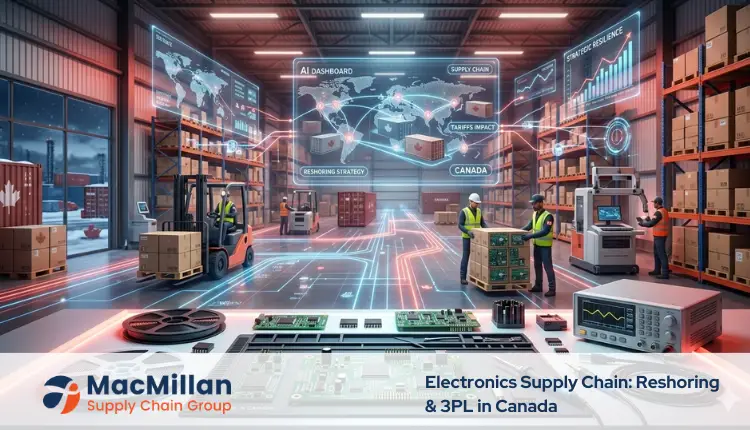
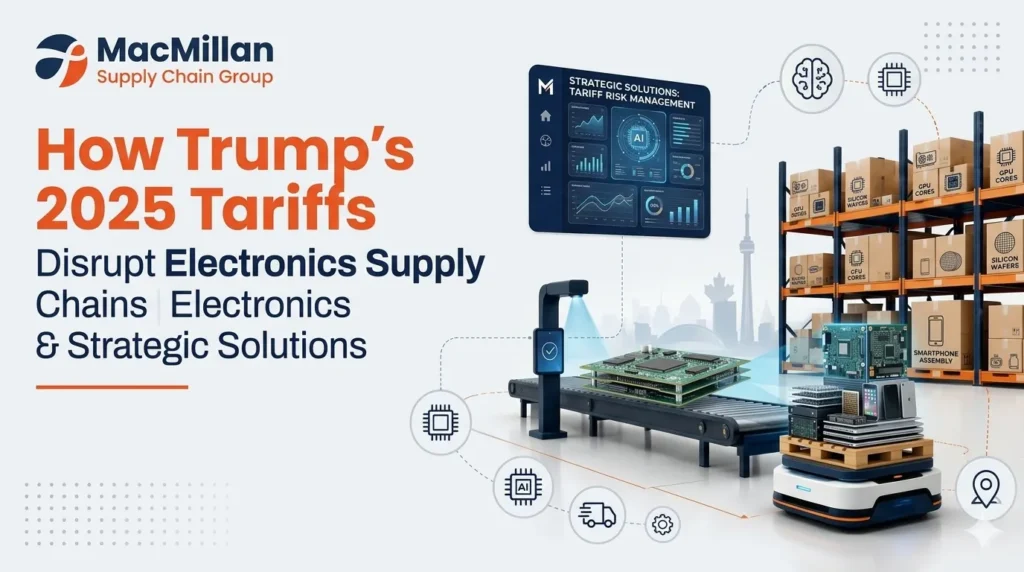
Growing tariffs, geopolitical unrest, and changing manufacturing environments present the electronics supply chain with previously unheard-of difficulties. This thorough guide examines the ways in which digital transformation, tariff mitigation, and strategic reshoring can help Canadian companies manage these challenges. These issues are closely connected to the broader US–China trade war and ongoing shifts in global supply chains. Specialized 3PL solutions are provided by MacMillan Supply Chain Group to assist businesses in strengthening their supply chains, cutting expenses, and increasing resilience. Learn useful strategies to prosper in the face of trade disruptions and set up your company for long-term success in Canada’s developing electronics industry, from utilizing foreign trade zones to putting blockchain traceability into place. This guide will help Canadian companies future-proof their electronics supply chain. The Changing Landscape of Electronics Manufacturing The electronics manufacturing industry is changing dramatically. Major economy-to-economy tariffs have risen to all-time highs, with some electronic components subject to 245% duties. Global supply chains have been rocked by this, and businesses are now being forced to reconsider where and how they manufacture their products. These issues offer opportunities as well as challenges to Canadian companies. Effectively managing tariffs has emerged as a crucial business ability, and reshoring in Canada presents a viable substitute for manufacturing that is done abroad. More flexibility, transparency, and resilience are now more important than ever in the electronic supply chain. Numerous Canadian electronics manufacturers have benefited from our assistance at MacMillan Supply Chain Group in adjusting to these shifting circumstances. In today’s intricate trading environment, our specialized 3PL services offer the infrastructure and know-how required to overcome supply chain interruptions and preserve competitive advantage. Understanding Tariff Impacts on Canadian Electronics For Canadian electronics companies, tariffs have become a major headache. Canadian companies are frequently caught in the crossfire of trade disputes between the United States and China. Before a Chinese-made component reaches its final destination in North America, it may be subject to several tariffs, which would significantly raise supply chain costs. Think about the effects of tariffs on semiconductors, which are the fundamental components of contemporary electronics. Everything from smartphones to medical devices is impacted when these tiny chips are subjected to 50% or more of the workload. Higher production costs, reduced margins, and challenging pricing decisions are what this means for Canadian manufacturers. Strategies for mitigating tariffs are now crucial business tools. Smart businesses are looking into possibilities such as: Strategic inventory control (purchasing prior to the imposition of tariffs) Replacement of components with non-tariffed substitutes Moving assembly to areas that comply with the USMCA Utilizing the benefits of foreign trade zones to postpone duty payments Through specialized logistics planning, MacMillan assists Canadian companies in putting these strategies into practice. Our customs compliance specialists examine tariff codes, spot areas for improvement, and create customized solutions that reduce duty exposure while preserving supply chain effectiveness. Reshoring: Relocating Electronics Production to Canada As companies reevaluate their global manufacturing strategies, the idea of reshoring in Canada has gained a lot of traction. While tariffs reduced the economic appeal of offshore production, the pandemic revealed weaknesses in extended supply chains. Many electronics manufacturers are moving their manufacturing closer to home these days. This change has been largely attributed to Canadian manufacturing incentives. Companies that invest in domestic production can receive grants, tax breaks, and other forms of assistance from federal and provincial programs. By creating more robust supply networks, these incentives aid in offsetting the higher labor costs connected to North American manufacturing. Reshoring has advantages beyond just the bottom line: Shorter lead times and lower transportation expenses Improved quality assurance and protection of intellectual property Easier adherence to North American trade laws Reduced shipping distances result in a smaller carbon footprint Increased responsiveness and visibility in the supply chain At MacMillan, we provide specialized warehousing, distribution, and logistics services to support reshoring initiatives. Our well-positioned facilities across Canada give businesses the framework they need to successfully execute reshoring plans, and our cross-border knowledge guarantees seamless integration with American markets. Digital Transformation in the Canadian Electronics Supply Chain Canadian businesses in the electronics supply chain are turning to digital platforms the way electronic supply chains function is being revolutionized by technology. Businesses can now confidently navigate complex trade environments thanks to AI-driven supply chain solutions, which offer previously unheard-of visibility and control. Among the most potent uses of this technology are BOM optimization tools. Before production starts, these systems find cost-saving options by comparing bills of materials to tariff databases. Manufacturers can incorporate tariff mitigation into their product designs from the outset by choosing components according to origin, classification, and duty exposure. Another significant benefit is blockchain traceability. Immutable records of a component’s movement through the supply chain are produced by this technology, offering: Verifiable proof of origin for customs declarations Defense against the supply of fake parts Automated documentation for regulatory compliance Visibility in real time over intricate multi-tier networks MacMillan helps customers use technology to gain a competitive edge by incorporating these digital capabilities into our logistics services. Our systems offer real-time data flows that facilitate improved decision-making across the supply chain by integrating seamlessly with manufacturer ERPs. Regional Alternatives and Trade Agreements Pure domestic production isn’t always possible, even though reshoring has many advantages. For this reason, a lot of Canadian electronics companies are looking into regional options that strike a balance between supply chain resilience and cost considerations. Opportunities for nearshoring to Mexico have garnered a lot of interest. Mexico provides competitive labor rates and duty-free access to the U.S. and Canadian markets as a member of the USMCA trade zone. Mexico is now the production center for many electronics manufacturers’ “China+1” strategies in the Western Hemisphere. Important frameworks for cross-border trade are provided by the USMCA agreement itself. Electronics manufacturers can avoid tariffs and preserve effective production networks by adhering to regional content requirements. For competitive positioning, it is essential to comprehend and take advantage of these provisions. Southeast Asian countries for large-scale manufacturing, such as Vietnam and