
Revolutionizing Last-Mile Delivery with Drones and Autonomous Technologies
Quick Summary Picture this: You’re waiting for a package, tapping your foot impatiently. In today’s fast-paced world, the final stretch of delivery the last mile is where logistics either shines or stumbles. Enter drones zipping through skies, droids rolling down sidewalks, and self-driving vans quietly navigating neighborhoods. These aren’t sci-fi fantasies; they’re real innovations reshaping how goods reach your doorstep. Beyond speed and cost savings, they’re transforming customer expectations and even helping the planet breathe a little easier. Introduction Let’s face it: The last mile is the make-or-break moment in delivery. It’s where delays frustrate customers and costs pile up. But as online shopping skyrockets, the pressure to deliver faster, cheaper, and greener has sparked a tech revolution. Autonomous vehicles, drones, and droids are stepping into the spotlight, promising to tackle age-old logistics headaches with precision. Think fewer missed deliveries, happier customers, and a lighter carbon footprint. Autonomous Delivery: Not Just a Gimmick Imagine a drone dropping off your morning coffee or a droid delivering groceries while you’re stuck in a meeting. These aren’t quirky experiments anymore. Companies like Amazon and Nuro are already testing autonomous vehicles that dodge traffic, slash delivery times, and cut fuel use. For instance, Amazon’s Prime Air drones can zip packages under five pounds to doorsteps in under an hour, while Nuro’s pint-sized robo-vans handle local grocery runs. The best part? These innovations aren’t just fast they’re eco friendly. Fewer gas guzzling trucks idling in traffic means cleaner air and quieter streets. It’s a win win for businesses racing to meet customer demands and communities tired of delivery gridlock. Slashing Costs Without Cutting Corners Here’s a staggering fact: Over half of delivery expenses come from the last mile. But automation is flipping the script. Smart route optimization tools act like GPS wizards, finding the quickest paths while dodging traffic jams. Predictive analytics? They’re like crystal balls for logistics, spotting potential delays before they happen. Take a bakery delivering fresh croissants: Real-time tracking ensures they’re warm when they arrive, and automated routing means fewer wrong turns. The result? Lower fuel bills, fewer overtime hours, and customers who actually look forward to delivery updates. Roadblocks: Rules and Trust Issues Of course, innovation doesn’t come easy. Safety concerns and red tape loom large. How do you convince regulators that a drone won’t crash into a tree? Or reassure customers that a driverless van won’t mix up their address? The answer lies in collaboration. Governments need clear safety frameworks, while companies must demystify the tech for the public. Think interactive demos, transparent safety data, and maybe even cute droid mascots to win hearts. After all, trust is the real fuel for adoption. Happy Customers = Loyal Customers What’s cooler than tracking your pizza delivery like a Uber ride? Autonomous tech turns delivery into a seamless experience. Smart lockers let you grab packages at 2 AM, while live maps eliminate “Where’s my order?” anxiety. Say you’re stuck at work: A droid can drop your laptop charger at your doorstep, or a locker holds it securely until you’re free. This isn’t just convenience it’s empowerment. And when customers feel in control, they stick around. Challenges? We’ve Got Solutions Let’s be real: Upgrading to autonomous delivery isn’t a plug and play fix. Legacy systems, budget constraints, and tech hiccups can trip up even the savviest teams. Here’s How We Help: At MacMillan Supply Chain, we’re your co pilots in this transition. Our experts decode regulations, integrate tech without disrupting workflows, and tailor strategies to your goals. From optimizing routes to training your team, we turn hurdles into stepping stones. Ready to Leap Into the Future? Start by auditing your current delivery process. Where are the delays? The cost sinks? Partner with a team that’s done this before like ours. Your Next Move: Reach out to MacMillan Supply Chain today. Let’s brainstorm over coffee (delivered by humans, we promise!) and map out a plan that puts you ahead of the curve. The future of delivery isn’t coming it’s here. Let’s grab it together. By maintaining a focus on overcoming current challenges through strategic collaboration and innovation, businesses can capitalize on the numerous benefits autonomous delivery technologies offer. Partner with MacMillan Supply Chain to lead your business into this promising future. Frequently Asked Questions What are the primary technologies transforming last-mile delivery? The foremost technologies include drones, droids, and autonomous delivery vehicles. These innovations enhance delivery speed and efficiency while reducing costs. How do drones benefit last-mile delivery? Drones bypass road traffic, offer rapid delivery times, ensure precision, and contribute to a reduced carbon footprint, making them pivotal in last-mile innovations. What challenges do these technologies face in mainstream adoption? Main challenges include regulatory barriers, public acceptance, and ensuring technology meets safety and privacy standards. How can companies reduce costs through automation in last-mile delivery? By implementing route optimization, real-time tracking, and predictive analytics, companies can minimize travel times, lower fuel consumption, and reduce overall operational costs What improvements in customer experience do these technologies offer? Customers benefit from real-time order tracking, accurate ETAs, and smart parcel lockers, offering transparency, convenience, and flexible delivery options. Which companies are pioneering autonomous last-mile delivery? Leading companies include Amazon, Starship Technologies, and Nuro, which drive innovation and adoption of autonomous delivery solutions. Is the market for autonomous last-mile delivery growing? Yes, the market is expected to grow significantly, driven by the expansion of e-commerce and the increasing demand for efficient delivery solutions.
Women Revolutionizing Canada’s Supply Chain Industry | 2025 Insights
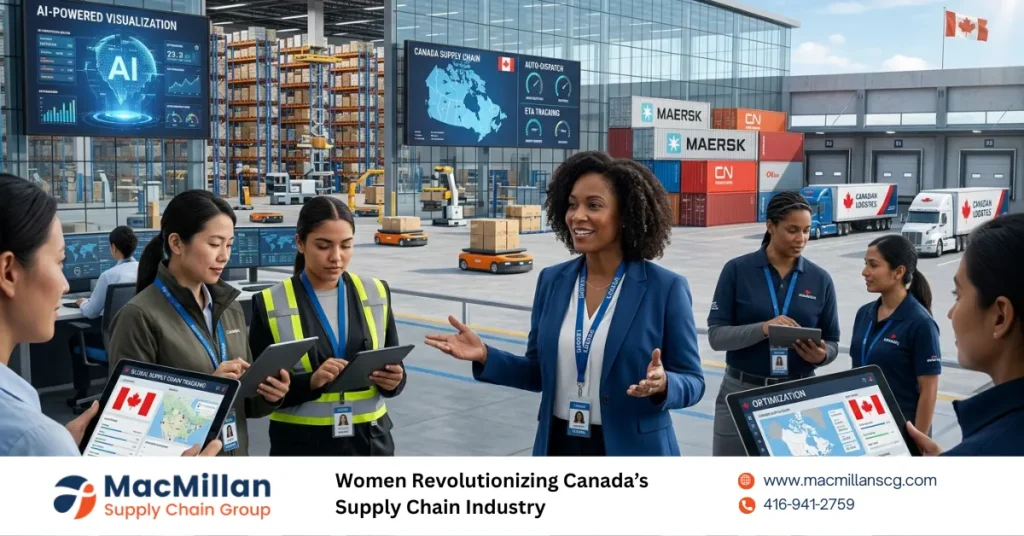
Women Leading the Charge in Canada’s Supply Chain Revolution As International Women’s Day approaches, the logistics and supply chain sector stands at a pivotal moment. Women now constitute 41% of the global supply chain workforce and hold 26% of C-suite roles a historic high that reflects their growing influence in reshaping how goods move, businesses operate, and communities thrive.In Canada, where effective supply chains account for more than 60% of trade, female executives are spearheading advancements in cross-border logistics, sustainable last-mile delivery, and warehouse automation. This blog highlights their accomplishments, looks at persistent challenges, and investigates how the industry could speed up the transition to gender parity. The New Faces of Supply Chain Leadership From Trailblazers to Transformational Executives The once male-dominated logistics landscape is being redefined by women who combine technical expertise with collaborative leadership. Take Carol Tomé, CEO of UPS, who revolutionized the company’s 115-year-old operations by prioritizing customer-centric strategies and diversifying leadership teams (now 57% female at senior levels). Under her guidance, UPS achieved a 15% reduction in carbon intensity while expanding same-day delivery networks a testament to how inclusive leadership drives both profitability and sustainability. Using AI-driven demand forecasting, Kathryn Wengel (EVP at Johnson & Johnson) revolutionized global supply chains in healthcare logistics during the pandemic, guaranteeing the continuous delivery of vital drugs while slashing operational costs by 22%. These stories reflect larger trends: 52% of women in supply chain roles now hold advanced degrees in STEM fields Teams led by women report 21% higher profitability than industry averages Female-led sustainability initiatives reduce waste by 18% more than male-led projects Meet the incredible women of Macmillan, who are leaders, innovators, and change-makers, shaping the future and transforming the supply chain industry. Led transportation and logistics strategies to optimize supply chain efficiency, ensuring cost-effective operations, on-time deliveries, and seamless coordination. The Business Imperative for Gender Diversity Why Inclusive Teams Outperform Diversity isn’t just ethical it’s economical. Research reveals three key advantages of gender-balanced supply chains: 1. Innovation Through Cognitive Diversity Mixed teams solve complex problems 30% faster by combining analytical rigor (often stronger in women engineers) with systems thinking. Ivanka Janssen (CSCO at Philips), for instance, credits advancements in AI-driven warehouse robotics that reduced processing times by 40% to her female-dominated R&D team. 2. Resilience in Crisis Management During the 2024 port strikes, companies with gender diverse leadership recovered 50% quicker by leveraging women’s strengths in stakeholder collaboration. Sheri Hinish, IBM’s Supply Chain Futurist, notes: “Women excel at building cross-functional coalitions a survival skill in today’s volatile trade environment”. 3. Customer-Centric Supply Chains Given that 85% of consumer purchases are made by women, female supply chain executives are better able to predict changes in the market. Jennifer Han increased on-time deliveries to 98.7% at Unilever by redesigning North American distribution networks using sentiment analysis from focus groups aimed at women. Persistent Barriers and How to Break Them The Glass Warehouse Ceiling Despite progress, systemic hurdles remain: Mid-Career Attrition: 57% of women leave logistics roles between ages 30-45 due to inflexible schedules Pay Gaps: Female supply chain managers earn $0.87 for every male dollar Representation Gaps: Only 21% of VP-level roles are held by women Solutions Gaining Momentum Forward-thinking companies are deploying four strategies: A. Hybrid Work Models Flexible scheduling (e.g., remote inventory analytics, job-sharing for dispatchers) reduced attrition by 33% at Fortune 500 retailers. B. Mentorship Ecosystems Programs like MIT’s Women in Supply Chain Initiative pair emerging talent with executives like Sarah Bonnaud (Estée Lauder), whose mentees achieve promotions 2.5x faster than industry norms. C. Skills-Based Advancement Tools like Gartner’s Career Pathfinder help women visualize growth from warehouse roles to leadership a tactic that boosted female promotions by 41% at pharmaceutical giants. D. Parental Support Systems Progressive policies like phased parental returns and on-site childcare at distribution hubs increased retention of working mothers by 28%. Voices Shaping Canada’s Logistics Future Leaders to Watch Tiffany Soots, Principal Business Architect at First Call Logistics, reflects: “A decade ago, women were siloed in customer service roles. Today, we’re redefining freight management through data science—I’ve seen female-led teams reduce carrier costs by 19% using predictive algorithms”. Meanwhile, Lauren Lepley (Group Supply Chain Director at Morrisons) slashed food waste by 15% using AI-powered demand planning proving that female leaders drive both efficiency and sustainability. Building an Equitable Future Action Steps for Companies Audit Promotion Practices: Adopt blind resume screenings to counteract unconscious bias. Invest in STEM Partnerships: Sponsor scholarships for women pursuing logistics analytics degrees. Amplify Role Models: Highlight leaders like Carol Tomé in recruitment campaigns to attract diverse talent. Reward Inclusive Leadership: Tie 20% of executive bonuses to gender parity metrics. This International Women’s Day, Let’s Deliver Equality The future of the supply chain industry depends on maximizing the potential of women. From sustainability directors creating carbon-neutral warehouses to AI engineers streamlining delivery routes, female talent is not only contributing but taking the lead. According to Katie Date, the founder of the MIT Initiative, “When women thrive, supply chains survive”. To every woman in logistics: Your vision is transforming this industry. Let’s keep breaking barriers = one shipment, one innovation, and one leadership role at a time.
Cross-Border Fulfillment: How 3PLs Power Global E-Commerce Growth | MacMillan Supply Chain
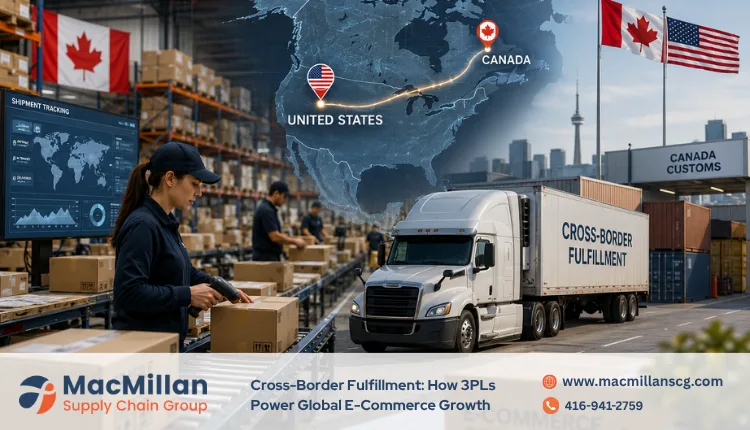
A Brief Summary and Overview Cross border fulfillment is revolutionizing the global expansion of e-commerce companies. Businesses can handle difficult international shipping laws, Canadian customs clearance, and quick delivery to customers throughout the world by collaborating with third party logistics providers (3PLs). 3PLs provide specialized services including multi node distribution networks, technology-driven solutions that optimize the entire fulfillment process, and warehousing in major regions like British Columbia and Ontario. Through effective, affordable logistics solutions, the ideal 3PL collaboration eliminates obstacles to international trade while preserving customer satisfaction for Canadian companies seeking to expand overseas or US companies entering the Canadian market. Overview Global boundaries have been erased by the e-commerce industry, giving companies previously impossible chances to connect with clients abroad. However, logistics, customs laws, and satisfying customers’ demands for prompt delivery present serious obstacles when selling goods internationally, especially between the US and Canada. This is where third-party logistics companies (3PLs) and cross-border fulfillment become crucial allies in your international e-commerce growth. By managing everything from warehousing to customs clearance in Canada, a professional 3PL can simplify complex international shipping procedures. Knowing how 3PLs facilitate cross-border trade is essential for businesses trying to enter the Canadian market or for Canadian businesses growing internationally. Let’s examine how these logistics professionals can assist you in navigating global waters and expanding your online store internationally. How 3PLs Simplify Cross-Border Shipping in Canada Sending parcels from point A to point B is only one part of shipping goods across international borders.In spite of possible delays at border crossings, it involves organizing customs paperwork, understanding complicated procedures, and guaranteeing on-time delivery. For e-commerce companies, third-party logistics companies are excellent at streamlining these procedures. They know the ins and outs of cross border transportation in Canada and have built-up connections with customs officers. Because of their experience, they can transfer your things quickly and with the least amount of hassle. Working with a 3PL that specializes in shipping from the US to Canada gives you access to their well-established infrastructure as well. In order to put your products closer to your Canadian clients, this includes strategically positioned warehouses in Ontario and other important Canadian provinces. The advantages go beyond the infrastructure itself. 3PLs use advanced tracking systems that provide you real time visibility into your shipments as they travel across international boundaries. You can proactively handle any problems that may occur during transit and keep clients updated on their orders thanks to this transparency. Furthermore, 3PLs manage every piece of complex paperwork involved in overseas transportation, such as tax filing, duty computations, and customs documents. This knowledge guarantees compliance to rules while averting expensive delays that can affect client satisfaction. Strategic Warehousing: The Foundation of Effective Cross Border Fulfillment One of the most significant advantages of working with a third party logistics provider is access to their network of fulfillment warehouses. For cross border e-commerce between the US and Canada, having inventory stored in strategic locations dramatically improves delivery times and reduces shipping costs. A fulfillment warehouse in Ontario serves as an ideal hub for serving the densely populated regions of Eastern Canada. Orders can be swiftly processed and dispatched from this central location to key markets like Toronto, Montreal, and Ottawa, usually arriving the following day. The delays that come with crossing the border for each individual order are eliminated because of this close proximity. In the same way, British Columbia warehouses offer great access to markets in Western Canada and act as a gateway for trade with the Pacific. No matter where your clients are situated, 3PLs maximize delivery times by distributing inventory across several key sites, forming a multi-node distribution network. Additionally, these storage options provide flexibility. When order volumes increase during peak seasons, 3PLs can set aside more space to handle higher inventory levels. Your company can satisfy seasonal demand thanks to this scalability without having to invest in permanent warehouse space that can be largely empty during slower times. Automated warehouse systems that accelerate order processing are another element of modern fulfillment warehouses. Conveyor belts, sophisticated picking systems, and sorting technologies guarantee precise and effective order fulfillment, cutting down on the time between order placing and shipment. Technology Driven International Logistics Solutions The backbone of effective cross border fulfillment is technology. The most successful 3PLs of today use advanced systems which communicate with your e-commerce platform, ensuring a smooth information flow from the time a consumer places an order till it is delivered to their door. Real-time inventory management across several warehouse sites is made possible by 3PL technology integration.Strategic inventory placement based on regional demand patterns is made possible by this visibility, which also helps to avoid stockouts.The program automatically chooses the optimum fulfillment center for a customer’s order based on factors like inventory availability, delivery schedules, and shipping distance. Proactive inventory management is made possible by AI-driven shipment projections that help forecast changes in demand. Businesses with seasonal products or those running marketing initiatives that could cause unexpected spikes in order volume will find these predictive analytics very useful. Order management systems provide picking lists, packing guidelines, and shipping labels automatically, streamlining the fulfillment process. Orders are filled precisely and quickly thanks to this technology, which also cuts down on processing time and human error. For cross border shipments, technology plays a crucial role in customs clearance. Advanced systems prepare and submit customs documentation electronically, speeding up the clearance process. Real time tracking allows both you and your customers to monitor shipments as they move through customs and toward their final destination. Navigating Customs Clearance and Compliance Challenges Navigating the complex web of customs laws, taxes, and charges is arguably the most difficult part of cross-border e-commerce. This is where companies growing into foreign markets find that specific 3PL knowledge is extremely helpful. In Canada, clearing customs includes a number of requirements, such as exact valuation, country of origin documentation, correct classification of commodities, and adherence to various trade agreements. Errors in any of these areas may
How Food & Beverage Brands Can Reduce Spoilage, Delays, and Retail Risk in 2026
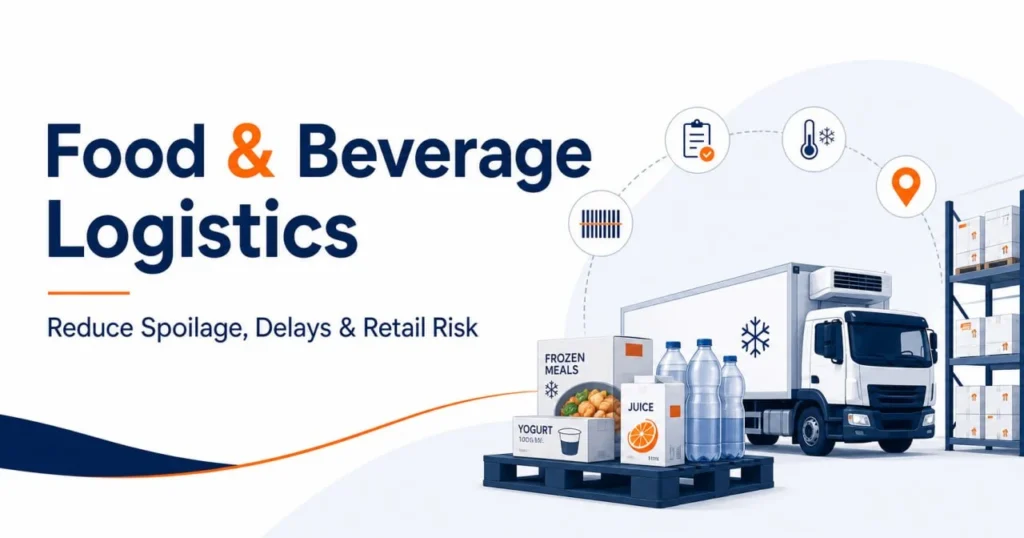
A Quick Summary and Overview Food and beverage brands in 2026 are under pressure to protect shelf life, reduce spoilage, improve traceability, and meet stricter retailer expectations. Strong logistics performance now depends on more than moving product quickly. It depends on controlled storage, accurate lot and expiry tracking, retail-ready execution, and real-time visibility across the supply chain. MacMillan’s food and beverage logistics offering is built around these needs, with SQF and GMP-certified, HACCP-compliant warehousing, temperature-maintained environments, lot control, expiry tracking, and real-time delivery visibility. Introduction In food and beverage logistics, a delay is rarely just a delay. It can shorten shelf life, increase spoilage, create a retailer compliance issue, or leave shelves empty when demand is highest. That is why food and beverage brands need more than basic storage and transport. They need logistics built around product integrity, visibility, and execution from inbound receipt to final delivery. Industry coverage continues to highlight traceability, cold chain performance, and stronger compliance expectations as major priorities in 2026. For MacMillan, this topic is a natural fit. The company’s food and beverage capabilities already focus on temperature-controlled handling, inventory accuracy, lot and expiry tracking, retailer-ready fulfillment, and reliable transportation execution across Canada. Why This Topic Matters More in 2026 Food and beverage logistics is getting more demanding because brands are balancing freshness, compliance, traceability, and speed at the same time. Product integrity has to be maintained across storage, handling, picking, staging, and transport. Retailers are also expecting more precise execution, while brands need tighter control over lot tracking, shelf life, and replenishment timing. Recent industry reporting emphasizes that food supply chains are facing growing pressure around food safety, traceability, and operational responsiveness. For brands, that creates a few urgent questions: how do we reduce spoilage without overstocking how do we improve lot and expiry visibility how do we avoid delivery issues that reduce saleable shelf life how do we stay retail-ready without slowing down fulfillment These are the areas where a strong logistics partner can make a measurable difference. The 5 Biggest Risks Food & Beverage Brands Need to Control 1. Spoilage from weak temperature and handling control Spoilage risk does not begin only when temperatures fail. It can also come from slow receiving, poor staging, inconsistent handling, and delays between inbound receipt and controlled storage. Cold chain integrity matters because even short exposure or poor process discipline can affect freshness, safety, and usable shelf life. Industry coverage continues to stress the importance of end-to-end temperature control and monitoring in food logistics. MacMillan’s food and beverage logistics service emphasizes temperature-maintained warehousing environments designed to preserve product quality and integrity. 2. Poor lot, batch, and expiry visibility Traceability is essential in food and beverage logistics, but visibility alone is not enough. Brands need to know where product is, which lots are aging, which inventory should move first, and how quickly they can isolate an issue if one arises. Strong lot and expiry visibility supports recall readiness, better inventory rotation, and lower write-off risk. Industry reporting continues to highlight traceability as a major requirement in food supply chains. MacMillan already positions lot control and expiry date tracking as core parts of its food and beverage logistics capability. 3. Retail compliance failures before delivery A shipment can leave the warehouse on time and still fail at retail. Incorrect labeling, missed ASN requirements, wrong pallet configuration, or failure to meet retailer-specific receiving standards can all lead to rejected deliveries or lost shelf time. For food and beverage brands, that can quickly turn into spoilage, margin loss, and weaker service performance. MacMillan’s warehousing and value-added services are built around retailer readiness, including labeling, compliance-focused prep, and execution aligned with retail requirements. 4. Forecasting errors that create waste or stockouts Food and beverage brands deal with promotion spikes, seasonal demand, expiry windows, and fast replenishment cycles. When forecasting is weak, the result is usually one of two problems: too much stock, which drives spoilage and carrying cost, or too little stock, which drives missed sales and rushed replenishment. Current industry coverage points to better forecasting and smarter operational planning as critical to reducing waste and improving resilience. MacMillan’s broader service positioning also highlights data-driven inventory visibility and systems designed to support faster, more informed logistics decisions. 5. Slow exception handling Visibility only creates value when it leads to action. If a shipment is delayed, a lot is aging, a retailer requirement changes, or a storage issue appears, brands need fast response. Slow exception handling is one of the easiest ways to lose sellable inventory without noticing until the cost is already locked in. Real-time tracking and operational transparency are increasingly important because supply chains need faster intervention when something changes. MacMillan’s transportation and fulfillment capabilities emphasize real-time tracking, milestone updates, and operational visibility that help teams respond earlier and with more confidence. How Food & Beverage Brands Can Reduce Spoilage, Delays, and Retail Risk 1. Build inventory flow around FEFO In food and beverage logistics, FEFO is often more useful than basic FIFO because expiry risk matters more than receipt order alone. The right inventory needs to move first, especially when multiple lots, multiple facilities, or promotional volumes are involved. MacMillan’s lot and expiry tracking capabilities support more disciplined inventory rotation and better freshness protection. 2. Tighten the gap between receipt and storage Product protection starts at inbound. Faster receiving, scanning, checking, and put-away help protect quality and reduce the risk of avoidable shelf-life loss. This is especially important for sensitive products and high-turnover categories. MacMillan’s warehousing model is built around operational speed, traceability, and product integrity from the moment inventory enters the facility. 3. Treat retailer readiness as part of product protection Retail execution is not separate from food quality. A rejected or delayed shipment can reduce usable shelf life just as quickly as a cold chain issue. Brands need logistics workflows that prepare orders for retailer requirements before the truck leaves the dock. MacMillan supports this through retailer-focused warehousing, labeling, ASN accuracy, and value-added preparation aligned to
Canadian Supply Chains Under Fire: Navigating the 2025 US-China Trade War
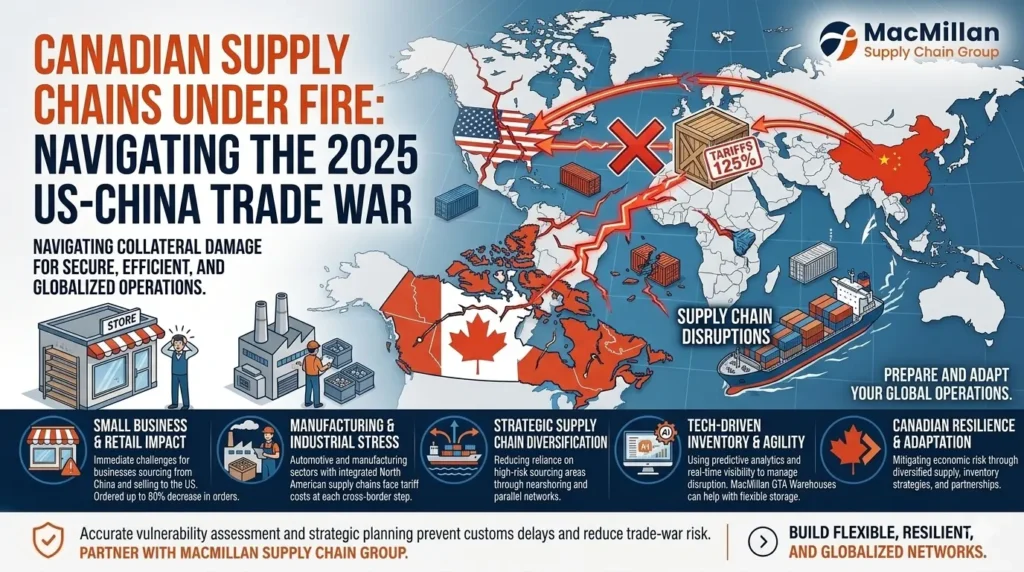
With tariffs on Chinese imports to the US rising to 125% in, the US-China trade war 2025 has escalated to unprecedented levels. Canadian companies are caught in the crossfire even though the country isn’t specifically targeted. For businesses that depend on cross-border trade, this economic conflict threatens market access, raises costs, and disrupts supply chains. While larger businesses struggle with operational disruptions, small retailers who source from China and sell to the US face immediate challenges. Important industries like forestry, textiles, and electronics are especially at risk. This article examines how the trade war has affected Canadian supply chains and provides useful advice for companies looking to weather these choppy waters. Caught in the Crossfire: What the US-China Trade War 2025 Means for Canadian Supply Chains In 2025, the US-China trade war has escalated significantly, sending shockwaves well beyond the boundaries of these two economic superpowers. Despite not being the direct targets, Canadian companies are suffering severe collateral damage as a result of the United States’ imposing tariffs of up to 125% on Chinese goods. Supply chains that Canadian businesses have depended on for decades are being disrupted by this economic conflict, which is also changing patterns of international trade. The impact is getting harder to ignore for companies all over Canada, from manufacturing behemoths in Ontario to tiny retailers in British Columbia. As the ripple effects spread throughout interconnected global markets, even businesses without direct ties to China are impacted. Canadian supply chains face previously unheard-of difficulties as tariffs raise prices and cause uncertainty, necessitating innovative solutions and strategic adaptation. Let’s explore how this trade war is affecting Canadian businesses, which sectors are most vulnerable, and what strategies companies can implement to protect themselves in this volatile environment. Understanding the US-China Trade War 2025: A Perfect Storm It took time for the US and China to develop the current trade tensions. They are the result of years of conflicting global aspirations, political disagreements, and economic rivalry. International trade relations are in a perfect storm in 2025 due to a number of factors. Targeting Chinese imports, the US has imposed a multi-tiered tariff system, with duties on some goods reaching 125%. Raw materials and completed goods, as well as textiles and electronics, are all impacted by these tariffs. Reducing the US trade deficit, preserving American jobs, and resolving national security issues pertaining to vital supply chains and technologies are among the stated objectives. China has retaliated with its own countermeasures, such as import restrictions and tariffs on American goods. For businesses around the world, long-term planning is very challenging due to the climate of uncertainty created by this tit-for-tat escalation. Because of our special position, the situation is especially difficult for Canadian businesses. With China as our second-largest trading partner and the United States as our largest, Canada maintains close economic ties with both nations. Canadian companies are frequently caught in the middle of these titans’ conflicts, with disruptions coming from both sides. As these trade tensions continue to reshape global commerce, many Canadian businesses are also exploring broader strategies to reduce reliance on traditional U.S. trade channels and diversify their international supply chain networks. Another level of complexity is introduced by the unpredictable nature of policy changes. Businesses are frequently given little notice when new tariffs or trade restrictions are announced, leaving them with little time to adjust. Instead of adhering to meticulously crafted strategic plans, this volatility compels businesses to function in a reactive manner. Canada Supply Chain Impact,Who’s Suffering The ways that the US-China trade war 2025 has affected Canadian supply chains differ greatly depending on the kind of business and industry. It is essential to comprehend these effects in order to create efficient response plans. Small and Medium-Sized Businesses Small manufacturers and retailers are especially at risk. They are directly in the crossfire since many import goods or materials from China and resell them in the US market. For instance, a clothing company based in Vancouver that imports fabrics from China and exports completed clothing to the US now has to deal with increased expenses at both ends of their supply chain. Uncertainty and growing expenses have caused some small businesses to halt up to 80% of their Chinese orders. Usually, these smaller businesses don’t have the resources to switch suppliers or markets quickly. They frequently have smaller profit margins, which limits their ability to absorb rising expenses without raising consumer prices. Larger Enterprises There are many obstacles to overcome, even for big Canadian companies with more resources. Businesses that rely heavily on US sales, such as Lululemon, have seen a drop in stock values as investors fear the effects of the trade war. Large manufacturers and retailers have to manage intricate supply chain interruptions while keeping prices competitive. Larger companies frequently have more intricate supply chains with numerous touchpoints in both China and the US, even though they might be more adaptable. Even though they have a lot of resources at their disposal, restructuring these established networks takes a lot of time and money. Sectors Most Affected by US China Tariffs 2025 Different industries are affected by the trade war in very different ways, with some experiencing more serious disruptions than others. Technology and Electronics The electronics sector has been particularly severely impacted. Businesses deal with increased component costs and production delays as a result of intricate global supply chains that are frequently based on Chinese manufacturing. Computers, gaming consoles, and smartphones are becoming more expensive for Canadian consumers. Due to supply constraints and manufacturers’ preference for larger markets, some technology releases have been postponed in the Canadian market. Textiles and Apparel Given that textile production has been largely concentrated in China for decades, clothing manufacturers and retailers face numerous obstacles. Relocating production to other countries, such as Bangladesh, India, or Vietnam, necessitates forging new connections, maintaining quality control, and negotiating various regulatory frameworks, all of which take time and temporarily raise costs. Rural Materials and Forestry Trade disruptions put additional strain on Canada’s
The Impact of Warehouse Location on Shipping Speed and Costs
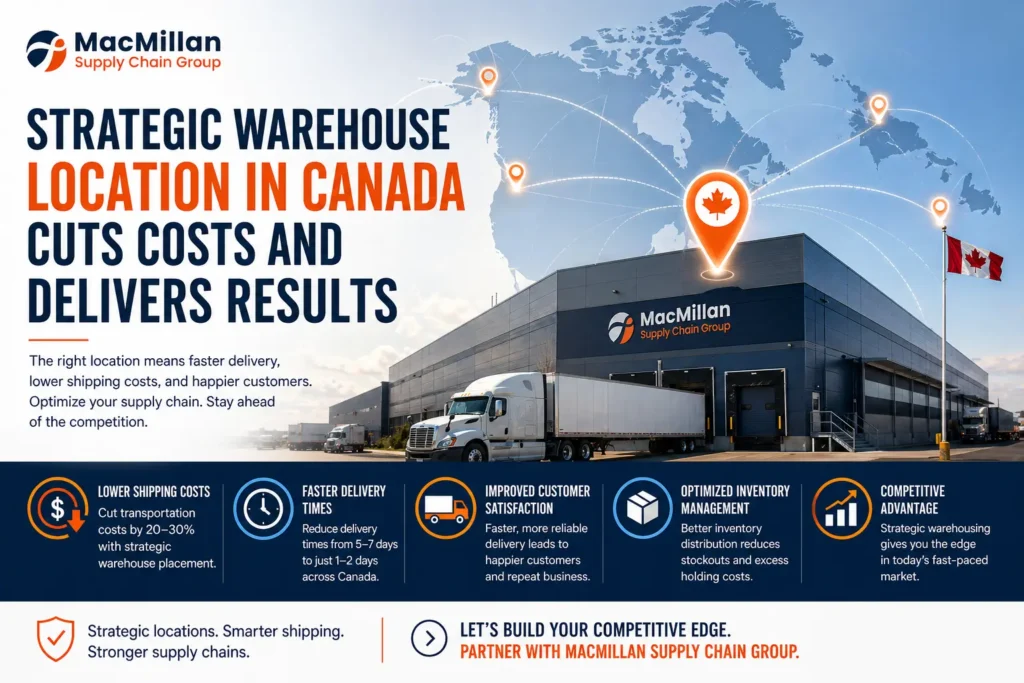
The cost and speed of product delivery to customers are directly impacted by the strategic location of warehouses. Businesses with strategically placed distribution centers in Canada can cut shipping costs by 20–30% and delivery times from 5-7 days to just 1-2 days. This article examines how warehouse location impacts cross-border logistics and last-mile delivery, as well as why companies that work with 3PL providers like MacMillan Supply Chain Group benefit from strategic Canadian warehousing solutions that give them a competitive edge. Why Your Warehouse Location Matters More Than Ever Ever ponder why some orders placed online arrive the following day while others take a week to arrive? In many cases, the warehouse location rather than the shipping method is the key. Customers expect speedy delivery at competitive prices in today’s fast-paced market. Because of this, choosing where to locate your warehouse is one of the most important aspects of your logistics plan. We at MacMillan Supply Chain Group have personally witnessed how a well-chosen warehouse location can revolutionize an organization. 40% of Canadian consumers can be reached in a day by a Toronto fulfillment center, whereas a poorly located warehouse may take three to five days to reach the same customers. The distinction has an impact on your bottom line, customer satisfaction, and competitiveness in the current market in addition to shipping speed. Let’s explore why warehouse location has become the cornerstone of successful supply chain optimization. The Distance Factor The main determinant of shipping speed is distance. Your products will arrive more quickly if your warehouse is located close to your customers. This simple idea has significant business ramifications. A package may arrive the following day if it is shipped from a fulfillment center in Toronto to a customer in Ontario. It might take three to four days to ship the same package from Vancouver to Ontario using the same shipping method. This discrepancy is due to geography rather than efficiency. The size of our nation must be taken into consideration when developing warehousing strategies in Canada. Businesses must carefully consider where to store inventory because major population centers are dispersed over thousands of kilometers. Western provinces could be adequately served by a single warehouse in Calgary, but eastern customers would have to wait days longer than necessary. The best approach? Many businesses find that an Ontario warehouse hub serves as an excellent starting point, with additional distribution centers in Canada’s western and eastern regions as they grow. This multi-node distribution approach ensures that no customer is too far from your products. Breaking Down Shipping Costs The cost of shipping a package increases with each kilometer of travel. You essentially pay for additional distance when your warehouse location is far from your customers. These expenses mount up quickly and can have a big effect on your profit margins. Take a look at these actual numbers: Transporting a 5 kg parcel inside the same province: $8–12 for shipping the identical package to more than three provinces: $18–25 Costs of last-mile delivery in cities: 53 percent of the total cost of shipping Strategic warehouse placement can significantly lower these expenses. Compared to a competitor with a single warehouse, a company with distribution centers in both Toronto and Vancouver may save 40% on shipping. Location affects more than just transportation costs. There are large regional differences in labor availability, real estate values, and utility costs. The Greater Toronto Area, for instance, has more expensive warehouse space per square foot than smaller cities, but the savings on shipping and quicker delivery times frequently make the difference. The secret is figuring out the sweet spot, which our logistics experts at MacMillan Supply Chain Group are skilled at determining, where shipping and operating costs add up to the lowest overall cost. Multi-Node vs. Centralized Distribution Should your business operate from one large warehouse or several smaller ones across Canada? This question faces every growing business, and the answer depends on your specific needs. A centralized approach with one major warehouse offers simplicity and lower facility costs. However, a multi-node distribution network with strategically placed warehouses provides faster shipping speeds and reduced shipping costs. The trade-off is more complex inventory management and higher facility expenses. Consider these approaches: Single Central Hub: Works well for specialized products with nationwide demand but lower order volume East-West Strategy: Two warehouses (typically Ontario and BC) covering eastern and western Canada Regional Network: Multiple smaller facilities near major population centers for fastest possible delivery For businesses shipping to both Canadian and American customers, cross-border logistics adds another layer of complexity. Warehouses near border crossings like Windsor or Niagara Falls can facilitate smooth US-Canada shipping while maintaining fast delivery to Canadian customers. MacMillan’s network of distribution centers in Canada allows businesses to implement the right strategy for their unique needs, whether that’s a single Ontario warehouse hub or a comprehensive national network. Urban Proximity and Delivery Speed More than half of all shipping expenses go toward the “last mile,” which is the last section of delivery from the local distribution center to the customer’s door. The location of the warehouse is essential to making the most of this costly step. Last-mile distances are shortened by urban warehouses located close to city centers, allowing for same-day or next-day delivery options. Reduced delivery expenses and fuel consumption Shorter routes result in lower carbon emissions; more scheduling flexibility for deliveries Local clients can receive same-day delivery from a Toronto fulfillment center, which is not feasible with a warehouse located outside of the city. Beyond just speed, this proximity advantage opens up possibilities for competitive service offerings that are impossible for distant warehouses to match. However, the cost of real estate is usually higher for urban warehouses. Determining whether the cost savings and shipping speed benefits of paying more for city center proximity are sufficient to make the investment worthwhile is crucial. The answer is becoming more and more “yes” for many companies catering to urban clients. The Hidden Costs of Poor Placement The consequences
Canada-US Trade War Supply Chain Solutions by Macmillan
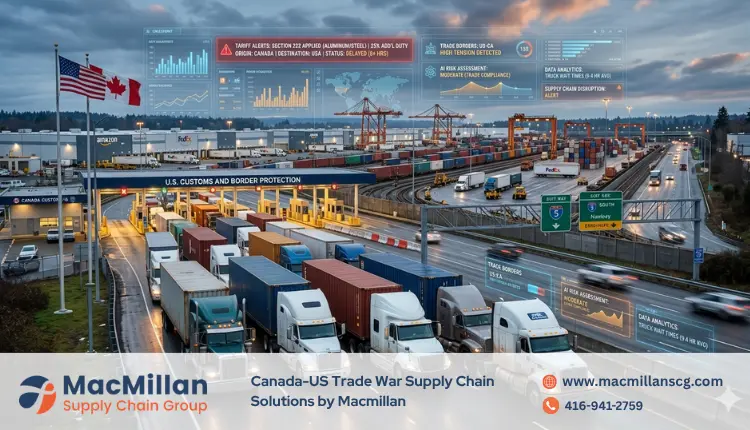
How Macmillan SCG Strengthens Supply Chain Resilience in the Face of the US-Canada Trade War Industries that depend on cross-border trade have been shaken by the recent increase in trade tensions between the US and Canada. Businesses are experiencing supply chain disruptions never seen before as a result of President Trump’s administration’s 25% tariffs on Canadian goods and Prime Minister Mark Carney’s targeted duties on $30 billion worth of US exports in retaliation. At Macmillan Supply Chain Group, we understand that these issues are practical roadblocks that call for quick, technologically advanced solutions. This blog examines how Canadian companies can protect their operations from fluctuations in trade while preserving cost effectiveness and client satisfaction. As a leading provider of Canada-US trade war supply chain solutions, Macmillan SCG offers actionable insights in times of uncertainty. The New Trade Reality: Understanding the Economic Effects of Tariffs on Different Industries 18% of Canada’s yearly cross-border trade volume is directly impacted by the 2025 tariffs, which target industries ranging from consumer goods to auto parts. This means the following for SMEs: Cost increases of 15–30% for imported raw materials from US suppliers Delays of four to six weeks at important border crossings, such as Ambassador Bridge Stockouts in inventory as a result of hasty reshoring attempts Our team recently learned from a Toronto-based electronics retailer that their customs clearance times doubled overnight, putting $2 million in backorders at risk. These anecdotes highlight why supply chain diversification has become a top priority for 73% of Canadian companies looking for Canada-US trade war supply chain solutions. Creating a Supply Chain That Is Tariff-Proof: Four Key Elements 1. Flexible Warehousing Combined with Nearshoring Businesses can do the following thanks to Macmillan’s 45 cross-dock facilities across Canada: Keep products in duty-free areas until tariffs are resolved Depending on current demand, move inventory between our 250,000 square foot GMP-certified warehouses Get 40% less for shared warehouse space than for private leases Case Study: By using our Windsor warehouse for staged US-bound shipments, a Montreal fashion brand was able to reduce border wait times by 58% and avoid $470,000 in tariffs. This is a clear example of how Canada-US trade war supply chain solutions can directly impact profitability. 2. Customs Optimization Driven by AI The CARM system from CBSA is integrated with our proprietary Mantis WMS to: 99.1% accuracy in auto-classification of HS codes Use political sentiment analysis to forecast changes in tariffs During inspections, create alternate routing scenarios Our AI saved clients $28K per day in detention fees by rerouting 1,200 shipments through Sarnia in 4 hours during the Detroit border slowdown last month. These AI-driven capabilities are a cornerstone of our Canada-US trade war supply chain solutions. 3. Last-Mile Agility in Turbulent Times With 90% of Canadian FSAs covered by next-day delivery, we help businesses: Split inventories between urban fulfillment centers to bypass choke points Deploy electric vehicles for tariff-exempt “green” shipments in carbon-tax regions Offer customers real-time duty calculators at checkout “After the tariffs hit, Macmillan’s same-day Toronto delivery let us absorb costs without raising prices,” notes a Kitchener-based medical supplier. This agility is key in implementing effective Canada-US trade war supply chain solutions. 4. Sustainability as a Protective Factor Our Net-Zero Logistics Program converts ROI from regulatory compliance: Compared to diesel alternatives, an electric fleet lowers fuel costs by 34% 22% of tariff-related costs are offset by carbon credit trading AI-optimized routes avoid crowded borders while reducing emissions Sustainability isn’t just a goal—it’s a tool within Canada-US trade war supply chain solutions. Beyond the Headlines: Future-Proofing The Benefit of Automation Given that 38% of logistics companies in Canada are experiencing a labor shortage, our facilities leverage: Autonomous mobile robots (AMRs) that increase picking speed by four times Computer vision systems that audit 100% of inbound/outbound shipments Blockchain-based smart contracts for instant tariff rebate claims Diplomatic Winds of Change While Carney’s team negotiates, we’re preparing clients for multiple scenarios: Status Quo Contingency: Buffer stock management via our Halifax deep-sea port access Escalation Playbook: Temporary manufacturing partnerships through our Mexico 3PL network Resolution Readiness: Just-in-time inventory reactivation protocols Why Canadian Businesses Choose Macmillan A Partner, Not Just a Provider Our 3-Step Migration Guarantee eliminates transition risks: Seamless Integration: 48-hour onboarding with existing 3PLs Stress Testing: Using historical trade data, tariff surges were simulated Support Around-the-Clock: Committed account managers knowledgeable about USCBP and CBSA compliance By the Numbers: 99.4% order accuracy in spite of SKU explosions brought on by tariffs 97% of 3.1 million shipments are handled on time each year Since 2020, last-mile optimization has saved $6.51 billion for clients These figures validate our role as a leader in Canada-US trade war supply chain solutions. Using Trade Difficulties to Gain a Competitive Advantage The Canadian–US trade war is about strategically adapting, not just surviving. At Macmillan SCG, we have assisted more than 40 industry leaders in converting their supply chains into networks that are resilient to tariffs and responsive. The first step toward stability is having a discussion, whether that involves using our cross-dock network or our AI customs platform. If you’re searching for proven Canada-US trade war supply chain solutions, we’re ready to support you. Ready to Future-Proof Your Supply Chain? → Explore our Tariff Mitigation Playbook→ Schedule a free logistics audit with our trade experts→ Follow us on LinkedIn for real-time tariff updates Because in turbulent times, the right partner makes all the difference. FAQS How exactly does Trump's trade war with Canada affect my business if I'm based in the GTA? If you import from or export to the U.S., you’ll face direct impacts through tariffs, increased customs scrutiny, and potential delays at border crossings. Even if you don’t trade directly with the U.S., you may experience indirect effects through your suppliers or customers who do. Many GTA businesses report 15-20% higher input costs due to tariffs being passed through the supply chain. Working with a local 3PL like MacMillan Supply Chain Group can help you navigate these challenges with our expertise in cross-border logistics. What
US-China Tariff Deal: Impact on Canadian Supply Chains & Trade
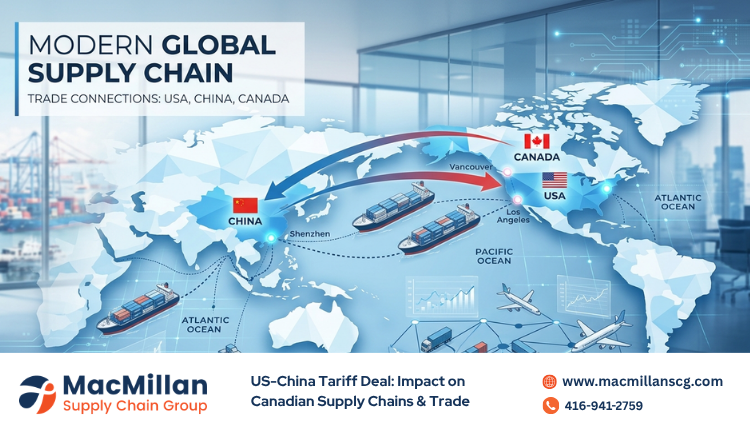
Recognizing How the US-China Tariff Deal Affects Canadian Companies Changes in trade policies by the two biggest economies in the world have an impact that goes well beyond their boundaries. With significant ramifications for Canadian companies and supply chains, the recent US-China tariff deal represents a significant change in the dynamics of global trade. This new agreement seeks to lower tariffs and loosen trade restrictions between these two economic titans following years of rising tensions in the US-China trade war. However, what does this entail for middle-tier Canadian businesses? What effects will these modifications have on your supply chain’s overall resilience, export prospects, and import strategy? MacMillan Supply Chain Group, a top 3PL supplier in Canada, is aware of the intricate difficulties these changes bring. We’ll analyze the main features of the US-China tariff deal, look at how it affects Canada’s economy, and provide helpful advice for negotiating this changing trade environment in this article. What’s Changing in the US-China Tariff Deal? The US-China tariff deal is the most recent development in a rocky trade relationship. Under this new agreement, both countries have agreed to significant tariff reductions after imposing tariffs as high as 25% on goods valued at hundreds of billions of dollars. However, what does the deal exactly include? Fundamentally, the deal lowers tariffs on thousands of goods that are traded between the two nations. In order to update your Canada import strategy, it is imperative that Canadian businesses comprehend these changes. A number of important topics are covered in the deal: Lower taxes on consumer goods, electronics, and industrial machinery Agricultural product restrictions were relaxed Promises to buy a certain amount of merchandise Clauses pertaining to intellectual property disputes Frameworks for addressing trade imbalances This isn’t a total overhaul of trade relations, though. The underlying tensions that led to the US-China trade war have not gone away, and many tariffs are still in effect. Consider this to be less of a comprehensive peace treaty and more of a bilateral tariff truce. These changes have an impact on supply chains in Canada. Price changes may occur for goods that pass through the US or contain Chinese components. Businesses that moved their sourcing out of China when tensions were at their highest now need to consider whether to change their approaches once more. The secret is to anticipate how this relationship may change in the future as well as to comprehend what is changing now. Canada’s Economic Impact: Opportunities and Challenges The US-China tariff deal has had a complex economic impact on Canada, posing opportunities and challenges for companies in a wide range of industries. Canada is in a unique position as these two significant trading partners modify their relationship. Positively, the economy of North America as a whole may benefit from lowered tensions between the US and China. Freer trade lowers manufacturing costs, which could help Canadian businesses that: Purchase parts for North American manufacturing from China Export completed goods to markets in China or the United States Connect these important economies by offering logistics services But there are also difficulties. Some manufacturers moved their operations to Canada during the height of the US-China trade war in order to avoid tariffs and keep access to North American markets. Now that tariffs have been lowered, this competitive edge might be lost. The environment for Canadian exporters is not uniform. Chinese suppliers may now present a fresh threat to those who increased their market share during the trade disputes. More reliable supply chains and lower prices for imported parts might help others. The effects differ greatly depending on the industry, with the automotive, electronics, and agricultural sectors all seeing different results. This changing environment necessitates careful consideration for companies in charge of Canadian supply chains. Which of your clients, vendors, or goods will be impacted by these changes in tariffs? What could your rivals say? Maintaining your competitive position in this changing trade environment requires that you respond to these questions. Rethinking Your Approach to Importing from Canada Now is the ideal moment to review your Canada import strategy because the US-China tariff deal is changing trade flows. Rapidly adapting businesses can benefit greatly in terms of price, dependability, and market responsiveness. Start by determining how exposed your present supply chain is to the dynamics of US-China trade: Which of your products have Chinese components? Do you use US middlemen or import straight from China? What effects have past tariff adjustments had on your lead times and expenses? The basis for a more robust strategy is this analysis. While keeping in touch with your most dependable Chinese partners, think about expanding your supplier base outside of China. This well-rounded strategy offers flexibility in the event that tariff escalation risks reappear. In this setting, logistics planning becomes even more important. You can access experience in navigating evolving customs regulations and determining the best trade routes by partnering with a seasoned 3PL like MacMillan Supply Chain Group. We assist clients in determining whether, in light of the new tariff structure, it makes more sense to route through US distribution centers or import directly from China. Modern import strategies heavily rely on technology. You can react swiftly to changes in tariffs by using digital tools for: Tracking shipments Handling customs paperwork Evaluating landed costs These systems offer the transparency required to make wise choices regarding inventory control, routing, and sourcing. Keep in mind that developing a competitive edge is the goal of import strategy, not merely cutting expenses. Businesses that understand the intricacies of global trade can outperform their rivals in terms of pricing, delivery dependability, and flexibility. Managing the New Market Realities for Canadian Exporters The US-China tariff deal alters the competitive environment for Canadian exporters, necessitating strategic adjustment. Maintaining and expanding your export business requires an understanding of how these changes impact your particular markets. The effects differ greatly by sector: US goods may reenter the Chinese market as a threat to agricultural exporters Manufacturers selling to the US may
How to Scale Your Operations Without Scaling Your Payroll

Scale Your Operations Without Scaling Your Payroll Expanding your team isn’t always necessary to grow your business. Astute Canadian business owners of today are figuring out how to grow their companies while maintaining stable payroll expenses. You can scale your operations without scaling your payroll by utilizing automation tools, strategic outsourcing, and flexible workforce models. This manual examines tried-and-true methods that enable companies in the Greater Toronto Area (GTA) and throughout Canada to grow sustainably without having to worry about rising payroll costs. These techniques, which range from lean methodologies to no-code automation, are applicable to a variety of industries and can help you get more out of your current workforce. Introduction Is your company prepared for expansion, but your budget isn’t prepared for a hiring frenzy? You’re not by yourself. Scaling operations without increasing payroll is a challenge for many Canadian business owners. The good news? It is completely feasible. “More business = more employees” is an antiquated growth model. The most prosperous businesses of today are figuring out more intelligent ways to grow. The fundamentals are the same whether you’re a Mississauga manufacturer, a Toronto e-commerce company, or a Brampton service provider: make use of technology, streamline procedures, and design adaptable systems that can expand with you. Numerous companies throughout the GTA have benefited from our assistance at MacMillan Supply Chain Group in putting these strategies into practice. We’ll go over doable strategies in this guide that will help you grow your capacity, serve more clients, and increase sales without having to hire a lot more staff. Let’s look at how to scale your operations without scaling your payroll. Use Automation to Scale Your Operations Without Scaling Your Payroll Automation of business processes is no longer limited to big businesses. These days, businesses of all sizes can automate tedious tasks and free up their workforce for higher-value work by using reasonably priced tools. Although it sounds complicated, robotic process automation (RPA) is just software that manages repetitive tasks. Imagine them as digital employees who never take breaks, sleep, or make mistakes. Without human assistance, these “bots” can update inventory records, process orders, send confirmation emails, and enter data. Modern automation is great because it doesn’t require you to be an expert in technology to use. Anyone on your team can create robust workflows without knowing a single line of code thanks to no-code automation tools like Make.com, Airtable, and Zapier. For instance, you can automatically: Create and distribute reports to stakeholders; Send customized follow-up emails to customers; Transfer data between your accounting software and shipping system; Adjust stock levels in various sales channels. We worked with a retailer in Toronto who automated their order processing system, resulting in an 85% reduction in manual data entry. Without adding more employees, they were able to triple their order volume during busy times. Their current staff just redirected their attention to strategic projects and customer service, leaving the repetitive tasks to automation. Remind yourself that automation is about enabling people to perform more meaningful work while technology takes care of the repetitive tasks, not about replacing them. Automation is one of the smartest ways to scale your operations without scaling your payroll. Strategic Outsourcing to Grow Your Business Without Growing Payroll A tried-and-true strategy for expanding small businesses in Canada is cost-cutting outsourcing. You can access capacity and expertise by partnering with specialized service providers without having to pay full-time employees. It’s one of the most efficient ways to scale your operations without scaling your payroll. Finding the right functions to outsource is crucial. Usually, these consist of: Fulfillment and warehouse operations IT management and support Customer service, especially after-hours assistance Expert marketing services Bookkeeping and accounting Logistics and transportation Virtual assistant services have also become increasingly popular for handling administrative tasks. On a flexible, as-needed basis, a virtual assistant can take care of social media, prepare documents, answer emails, and manage your calendar. MacMillan Supply Chain Group was hired to handle the warehouse operations for one of our clients, a developing manufacturing company in the Greater Toronto Area. This enabled them to concentrate their internal team on product development and quality control while increasing their production capacity by 40%. The outcome? Improved quality, higher output, and stable payroll expenses. Seek out partners who can easily integrate with your operations and have a thorough understanding of your industry when thinking about outsourcing. The ideal partner turns into more than just a supplier; they become an extension of your team. Build an Agile Workforce to Scale Operations on a Budget Developing flexibility in your staffing strategy is the goal of agile workforce management. Instead of employing full-time workers for every position, think about using a core-flex staffing model that can be adjusted to meet your company’s needs. This strategy entails keeping a core group of full-time workers who manage consistent, necessary tasks. Then, add adaptable personnel to this team for special projects or during busy times. These adaptable resources could consist of: Temporary workers Contract specialists Part-time workers Freelancers Gig workers Cross-training employees is another powerful strategy. You can change resources as needed without hiring more people when team members are capable of performing multiple tasks. A warehouse worker who can also answer calls from customers, for instance, offers a great deal of flexibility during peak hours. This model was applied by a distribution company we collaborate with in Mississauga, and the results were remarkable. They keep a small staff of 15 full-time employees during regular business operations. They use temporary workers to scale up to 35 people during the holiday rush. By using this strategy, they were able to manage their permanent payroll while managing a 300% increase in volume during peak season. Developing transparent procedures and training materials that facilitate the rapid onboarding of adaptable team members is essential to success. When properly trained, these workers can be productive in a matter of days as opposed to weeks. This approach is a practical way to scale your operations without
Scaling Subscription Box Fulfillment for D2C Wellness Brands | MacMillan SCG

Subscription commerce has changed the growth model for wellness and personal care brands. Recurring revenue is attractive. Predictable demand helps with planning. Customer lifetime value can improve. But the operational side of subscription fulfillment is far more complex than it appears. A wellness subscription box is not just a parcel shipment. It is a brand experience delivered on a schedule. Every box needs the right products, the right batch controls, the right presentation, and the right handling standards. When that consistency breaks down, customers notice immediately. For D2C wellness and personal care brands, fulfillment quality is not just an operations issue. It is a retention issue. That is why scalable subscription box fulfillment depends on three fundamentals: batch control, clean handling, and precise kitting. Why subscription box fulfillment is different Unlike standard single-SKU shipping, subscription box fulfillment combines multiple complexity points at once: recurring ship cycles multi-item kits promotional inserts and seasonal swaps lot and expiry sensitivity SKU substitutions presentation requirements customer-specific configurations returns and replacement workflows In wellness and personal care, the stakes are higher because customers expect trust, consistency, and product integrity. A wrong item, damaged component, or poorly assembled kit can directly affect customer confidence in the brand. MacMillan’s service framework is built around high-precision fulfillment, lot and batch tracking, value-added kitting, and handling standards that support sensitive consumer goods categories. That makes it well suited for subscription-based personal care and wellness operations. Batch control protects consistency and compliance For wellness brands, batch control is one of the most important pieces of the fulfillment process. Whether you are shipping skincare, cosmetics, supplements, or self-care products, batch and lot visibility matters for: quality control traceability recall readiness inventory rotation customer consistency compliance requirements When subscription fulfillment scales without strong batch controls, problems grow quickly. One inaccurate pick can affect thousands of boxes in a single run. One missed expiry control can create customer complaints, replacement costs, and reputational damage. MacMillan’s warehousing and fulfillment capabilities emphasize lot and batch tracking, FEFO and FIFO inventory control, and real-time visibility through its WMS. Those capabilities are essential for D2C wellness brands that need subscription reliability without sacrificing traceability. Clean handling matters more in wellness and personal care In categories like beauty, self-care, supplements, and wellness kits, customers expect more than fast shipping. They expect products to arrive clean, protected, and brand-right. That means fulfillment processes need to support: careful product handling controlled storage conditions where required organized assembly processes packaging that protects presentation workflows that reduce contamination and product damage documented quality checks MacMillan’s site highlights GMP-certified and compliance-focused operations in relevant consumer goods categories, as well as handling standards designed to protect product integrity. Its personal care and wellness positioning also emphasizes precision, consistency, and presentation. For subscription brands, that translates into a better customer experience. Products arrive looking intentional, not rushed. Components stay protected. Inserts are placed correctly. The unboxing moment reinforces the brand promise. Kitting is where subscription experiences are won or lost A subscription box is essentially a kitting operation under recurring pressure. Every cycle requires multiple components to come together accurately and efficiently. That may include: hero products sample sizes inserts educational cards promotional offers channel-specific packaging retailer or marketplace variations protective dunnage MacMillan’s value-added services page specifically highlights end-to-end product kitting, inserts, relabeling, multi-SKU bundles, protective packaging, and e-commerce-ready assembly. Those services align directly with subscription box fulfillment needs. Strong kitting processes help wellness brands deliver: Consistent customer experience Every subscriber receives a box assembled the same way, with the same attention to detail. Better scalability As volume grows, standardized kitting workflows prevent chaos and reduce rework. Lower error rates Structured assembly and verification help reduce wrong-item shipments and missing components. Faster campaign execution Monthly themes, limited-edition inserts, and promotional changes can be rolled out without breaking the operation. The operational challenge of scaling D2C wellness subscriptions Many brands can manage subscription fulfillment in-house early on. But as order volume grows, complexity expands faster than expected. Common signs the operation is under strain include: longer cycle times before ship dates inconsistent kit assembly inventory mismatches between components manual workarounds for substitutions poor lot visibility packaging inconsistencies growing replacement and customer service costs difficulty managing peak subscription runs At that point, fulfillment stops being a back-end support function and starts affecting retention, reviews, and growth. A scalable partner can help absorb that complexity through warehouse systems, standardized SOPs, trained labor, quality controls, and integrated fulfillment workflows. What scalable subscription fulfillment should include D2C wellness brands should look for a fulfillment model that supports both customer experience and operational discipline. That includes: lot and batch control FEFO or FIFO inventory logic where needed kit assembly workflows insert and promotional handling protective packaging clean, organized product handling inventory visibility across components integration with e-commerce platforms returns processing and sellable inventory recovery flexibility for recurring volume spikes MacMillan’s e-commerce fulfillment offering includes platform integrations, real-time order status, analytics, returns workflows, and full-cycle support for DTC parcels and B2B replenishment. Combined with its value-added services, this creates a strong operating model for wellness brands that need subscription scalability with consistency. Customer experience is built in the warehouse For subscription brands, the warehouse is not separate from the brand. It is one of the places where the brand is delivered. Customers may never see the warehouse floor, but they see the outcome of every process decision: whether the kit is accurate whether the packaging feels premium whether product condition matches expectations whether the monthly shipment arrives on time whether substitutions are handled smoothly whether the box feels consistent from one cycle to the next That is why fulfillment should be treated as a customer experience system, not just a shipping function. For personal care and wellness companies, especially those building loyalty through recurring orders, operational consistency is a direct driver of retention. How the right 3PL helps wellness brands grow with confidence A specialized 3PL can help wellness brands move from manual fulfillment to a more scalable and resilient model.