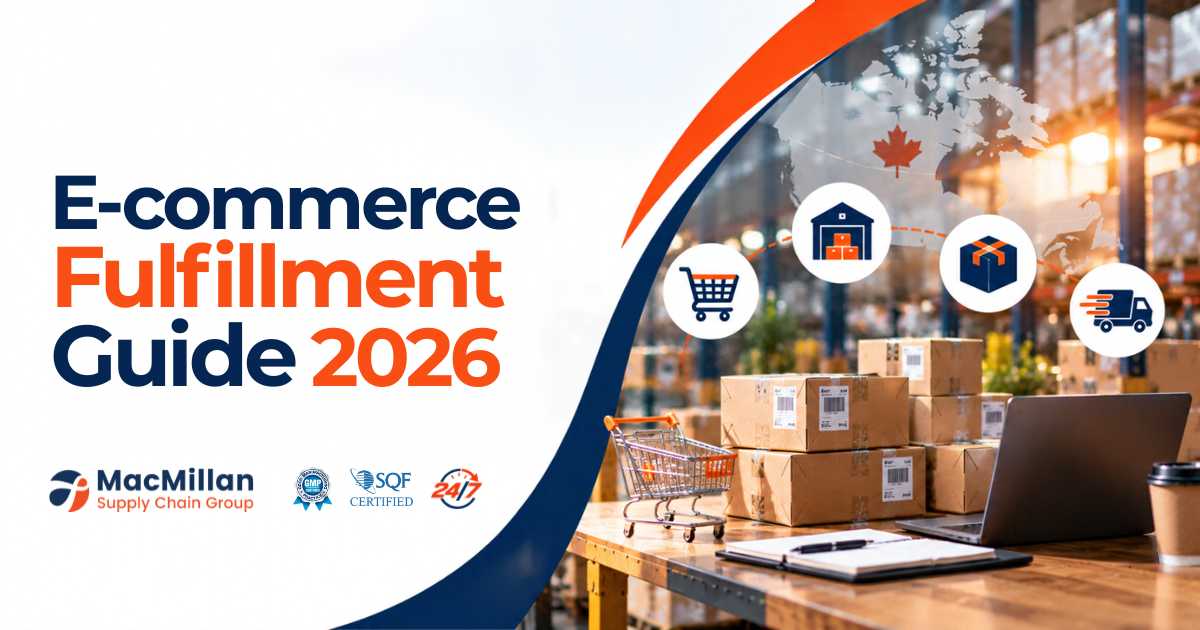
E-commerce Fulfillment Guide 2026
If you’ve ever wondered why some online stores thrive while…
If you’ve ever wondered why some online stores thrive while…
Black Friday Fulfillment Canada: How E-commerce Brands Can Prepare for…
When discussing e-commerce, what typically springs to mind? Most likely,…
As the busiest time of the year draws near, the…
If you’ve ever wondered why some online stores thrive while others struggle, the secret often lies in how they handle order fulfillment. Did you know that 48% of online shoppers will abandon their carts if delivery takes more than a week? These stats highlight the importance of efficient e-commerce fulfillment.
Effective e-commerce fulfillment is not merely a logistical requirement but a vital element in fostering customer satisfaction and facilitating business growth.
It involves establishing a seamless connection between your products and customers, thereby ensuring that each order not only fulfills a need but also reinforces the strength and reliability of your brand.
In this blog, we will explore the fundamental aspects of e-commerce fulfillment, aiming to assist you in optimizing time efficiency, minimizing costs, and enhancing customer satisfaction.

E-commerce fulfillment is a critical section of your supply chain, involving the reception of bulk goods, the storage of stock-keeping units (SKUs), and the execution of order processing, which includes picking and packing, as well as the delivery of products to customers.
The key processes in this segment include:
E-commerce fulfillment involves ensuring that products are stored correctly, orders are processed efficiently, and customers receive their purchases promptly and in good condition. Good fulfillment practices can lead to happier customers and more successful business operations.
An e-commerce fulfillment process commences upon a customer’s online purchase of a product and concludes with the delivery of that product. Let’s explore the list of various types of e-commerce fulfillment services:
This fundamental service encompasses the selection, packaging, and dispatch of products to customers. Specialist 3PLs, such as MacMillan, enhance this process, ensuring efficiency and effectiveness for e-commerce entities.
This involves the tracking of all customer orders. It includes monitoring the status of each order, analyzing customer purchasing patterns, and managing inventory levels to prevent stock shortages.
This crucial step involves the administration of a business’s product inventory. It encompasses the storage, replenishment, and estimation of required stock levels, aiming to perfectly balance supply with customer demand.
Shipping is the method of product delivery to customers. It varies depending on the origin and destination of the shipment, the nature of the products, and the desired speed of delivery.
Businesses range from self-handling shipments to collaborating with carriers for optimized rates.
This refers to the storage of products prior to their purchase. Warehousing solutions can range from modest in-house storage to extensive warehouse facilities, with a focus on maintaining product safety and organization.
This process involves the handling of returned merchandise, including its receipt, inspection, and reintroduction into available inventory. Given the nature of online shopping, an efficient returns process is vital.
This technology streamlines the fulfillment process by linking e-commerce platforms with fulfillment centers.
It provides real-time updates on orders and inventory, and can strategically allocate orders to the most suitable fulfillment center.
This pertains to the fulfillment of orders for international customers, a process complicated by varying international regulations, tariffs, and taxes. Collaboration with experienced fulfillment providers is advisable to navigate these complexities.
This operation involves retrieving items from storage and preparing them for shipment upon receipt of an order. Efficiency in this process is key, whether it involves batch picking or specialized packing stations.
Employed for products that require specific assembly or arrangement before shipping, this service involves additional steps such as the combination of various components, which may require more time and resources.
Each of these components plays a pivotal role in the smooth operation of an e-commerce business, contributing to overall efficiency, customer satisfaction, and business growth.
E-commerce fulfillment is a critical aspect of any online business, impacting customer satisfaction and operational efficiency. As your business evolves, so too might your fulfillment strategy.
Understanding the different models available can help you make the best choice for your business at each stage of its growth.
This approach involves the complete management of the fulfillment process internally, ranging from utilizing a modest space like a spare room for initial storage to potentially expanding into a full-scale warehouse as the business grows.
Outsourced order fulfillment, commonly known as Third-Party logistics (3PL), involves delegating the entirety of supply chain management to external logistics providers.
Companies like MacMillan assume responsibilities for storing, selecting, packaging, and dispatching products.
Fulfillment by Amazon (FBA) is a comprehensive service where merchants send their inventory to Amazon’s fulfillment centers. Amazon then assumes responsibility for storage, packaging, shipping, and customer service.
The retailer facilitates the sale of products without physically possessing or managing the inventory.
This process eliminates the need for the retailer to maintain a physical stock of products, as they act primarily as an intermediary between the supplier and the customer.
Each e-commerce fulfillment model offers distinct advantages and challenges. Your choice should align with your business size, growth trajectory, resource availability, and how much control you want over the fulfillment process.
When it comes to e-commerce fulfillment, the costs can vary significantly depending on the model you choose. Here’s a brief look at how each model can impact your overall fulfillment expenses:
| Fulfillment Model | Inclusive Features | Cost Implications |
|---|---|---|
| In-House Fulfillment | Managing inventory, storage, picking, packing, and shipping yourself. | High costs due to the need for storage space, inventory systems, staff training, and courier partnerships. Costs escalate as the business grows. |
| 3PL Fulfillment | Partnering with a third-party logistics provider for fulfillment needs. | More cost-effective than self-fulfillment. Fees are based on inventory and storage used, reducing overhead and labor costs. Proximity to customers can further decrease shipping costs and times. Ideal for scaling businesses. |
| Dropshipping | Suppliers handle shipping, storage, and processing; no inventory is owned. | Low initial overhead and upfront costs. However, complexities and costs can increase with business expansion, especially when coordinating with multiple drop shippers. |
| Amazon FBA | Utilizing Amazon’s fulfillment services, including storage, picking, packing, and shipping. | Amazon charges a 15% seller fee on each product sold, plus inventory storage fees (monthly and long-term), fulfillment fees per unit (standard and oversized), and additional fees for apparel and inventory removal. Costs can be significant, especially for larger inventories and long-term storage. |
The best fulfillment model depends on specific business needs and growth stages:
Each model has its strengths and is best suited to different types of businesses and stages of growth. The decision should align with the business’s operational capabilities, financial constraints, and long-term strategic goals.
Deciding on the right e-commerce fulfillment provider is crucial for your business’s growth and customer satisfaction. Here’s a straightforward guide to help you make this important decision:
Choosing the right fulfillment partner like MacMillan can transform your e-commerce operations, enabling you to scale efficiently and meet your customers’ expectations with ease.

E-commerce fulfillment is a critical component of your online business, necessitating precise execution to guarantee a satisfactory delivery experience for your customers.
MacMillan stands out for its comprehensive supply chain management and advanced reverse logistics, enhancing customer trust and satisfaction through expert handling of products from arrival to delivery.
Understanding the uniqueness of each e-commerce business, we offer customized solutions tailored to specific challenges and market dynamics.
With a focus on sustainability and trust, MacMillan has established a reliable network, positioning itself as a dependable partner in the ecommerce industry.
Elevate your e-commerce fulfillment with MacMillan, where efficient logistics meet a commitment to trust, reliability, and customer satisfaction.