
How to Make Big and Bulky Last-Mile Work For You
Hats off to you for always wanting to make life…
Hats off to you for always wanting to make life…
You’ve sent your product out for delivery, they’ve received it,…
In the fast-evolving landscape of global trade and e-commerce, supply…
Following its success with Prime delivery and becoming the business…
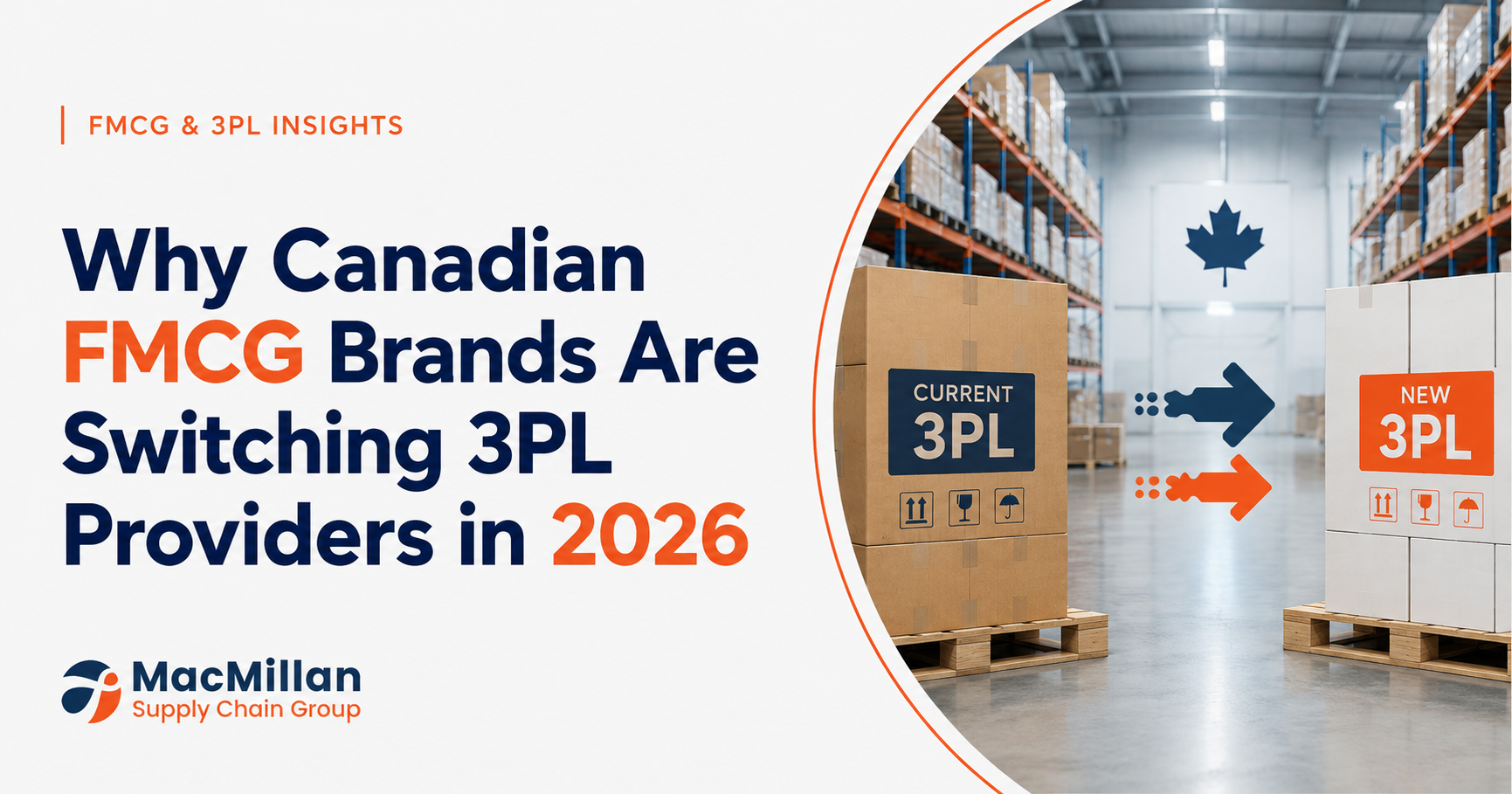
Canadian FMCG brands are switching 3PL providers in 2026 because basic storage and shipping are no longer enough. Brands now need accurate inventory visibility, reliable retail compliance, flexible labour, faster order processing and better control over total logistics costs. When an existing provider cannot support changing retailer requirements, seasonal demand or omnichannel growth, changing 3PL partners becomes a business decision rather than a simple warehouse move.
Fast-moving consumer goods businesses operate on narrow margins and demanding timelines. A few recurring inventory errors, missed retailer appointments or poorly prepared promotional orders can quickly affect profitability. As grocery, wellness, personal care, home care and general merchandise brands expand across Canadian retail and ecommerce channels, many are questioning whether their current logistics partner can still support the next stage of growth.
FMCG logistics once centred largely on moving cases from a warehouse to a distributor or retailer. The modern model is more complicated.
A single Canadian brand may now ship full pallets to distribution centres, mixed cases to regional retailers, individual units to ecommerce customers and promotional kits to marketing partners. Each channel has different order formats, cut-off times, packaging requirements and delivery expectations.
A 3PL designed mainly for straightforward pallet storage may struggle when the account begins adding direct-to-consumer orders, subscription programs or retailer-specific preparation. The provider may still be capable of moving inventory, but the processes surrounding that inventory may become increasingly manual and expensive.
This is one reason FMCG brands are looking for partners that combine warehousing and distribution services with fulfillment, transportation coordination and value-added operations.
Inventory visibility is one of the most common reasons a business begins reviewing its 3PL relationship. FMCG teams need to know what inventory is available, what has been allocated, which products are approaching expiry and whether orders have shipped on time.
Receiving a spreadsheet once a day may have been acceptable when a brand had a small number of SKUs and one sales channel. It becomes risky when the company sells through retail, ecommerce, wholesale and marketplace channels at the same time.
Poor visibility can lead to:
Brands switching providers are increasingly asking for real-time inventory visibility, clear reporting and exception alerts. They want the warehouse management system to support decisions—not simply record what happened after the fact.
Canadian retailers may require specific carton labels, pallet configurations, advance shipping notices, routing instructions and delivery appointments. These requirements can differ by retailer, distribution centre and product category.
A shipment can contain the correct products and still be considered non-compliant. A label placed in the wrong position, an incorrect case quantity or a late delivery appointment may result in a chargeback, delayed payment or rejected shipment.
For FMCG brands operating on thin margins, repeated compliance issues can erase the savings created by a low warehouse rate.
Brands are therefore moving away from providers that treat retail preparation as an occasional manual task. They are looking for 3PLs with documented workflows, retailer-specific knowledge and dedicated retail compliance preparation.
The problem is not only the financial penalty. A pattern of inaccurate or late shipments can affect retailer relationships and make future promotions harder to secure. This article on reducing retail chargebacks explains why prevention must begin inside the fulfillment operation.
Warehouse labour, transportation, packaging and facility costs continue to influence fulfillment pricing. Statistics Canada reported an average hourly wage of C$34.22 in transportation and warehousing for 2025, reflecting the cost environment logistics operators carry into 2026.
Higher costs do not automatically mean a 3PL is overpriced. The real concern is whether the provider is using labour efficiently.
An FMCG brand may be paying too much because:
Brands are switching when a provider responds to every challenge by adding another fee rather than improving the process. The lowest pick-and-pack rate is not useful if the business also pays for corrections, rush handling, inventory investigations and preventable retailer penalties.
Understanding the complete cost structure is essential. Our guide to the economics of 3PL warehousing outlines why storage and picking should never be evaluated in isolation.
Food, beverage, personal care, wellness and household products may require lot, batch or expiry-date tracking. These controls support inventory rotation, product quality and recall readiness.
A warehouse can report an accurate total unit count while still allocating the wrong batch or shipping shorter-dated inventory behind newer stock. For regulated or shelf-life-sensitive products, that is not a minor inventory error.
FMCG brands may switch providers when the existing 3PL cannot reliably support:
A provider offering structured lot, batch and expiry control can help brands maintain better product rotation and respond more quickly when an inventory issue occurs.
For food and beverage companies, industry knowledge matters just as much as warehouse space. The facility, systems and operating procedures must match the product’s handling and traceability requirements. MacMillan’s food and beverage logistics solutions are structured around these operational needs.
Many FMCG businesses originally selected a 3PL to serve one dominant channel. The relationship becomes strained when the brand adds Shopify, Amazon, wholesale accounts, national retailers or subscription orders.
Retail fulfillment and direct-to-consumer fulfillment are not interchangeable.
A retail order may involve:
A direct-to-consumer order may require:
If the 3PL uses one rigid workflow for every channel, service quality and costs can suffer. Canadian brands are switching to providers capable of supporting omnichannel fulfillment without losing inventory control between channels.
Real omnichannel fulfillment means more than connecting several order sources. Inventory data, allocation rules, warehouse processes and reporting must work together. This is explored further in our guide to omnichannel fulfillment and inventory visibility.
A 3PL may perform well during an average week and struggle during a product launch, retailer promotion or holiday surge. FMCG brands often begin searching for another provider after experiencing the same peak-season failures repeatedly.
Warning signs include:
Peak performance depends on planning, but the brand should not carry the responsibility alone. A capable 3PL should review forecasts, identify labour requirements, reserve packaging materials and discuss carrier capacity before the surge begins.
Brands with seasonal demand are increasingly choosing providers that can scale labour and warehouse workflows without sacrificing accuracy. Effective seasonal inventory planning gives both parties time to prepare instead of relying on expensive last-minute fixes.
Manual order entry creates delays and increases the risk of incorrect quantities, addresses or shipping methods. As FMCG brands add more channels, the number of manual touchpoints can grow quickly.
In 2026, brands expect their 3PL to connect with ecommerce platforms, enterprise resource planning systems, marketplaces and retailer EDI networks. They also expect inventory and order updates to move between those systems without constant intervention.
Businesses are switching providers when:
A provider with flexible platform and ERP integrations can reduce manual work while giving operations, sales and customer service teams access to more consistent information.
Technology alone will not repair a poorly designed warehouse process. Systems create value when they are supported by accurate receiving, disciplined inventory control and clear operating procedures.
FMCG products frequently require work beyond storage and shipping. Retail promotions, seasonal campaigns and product launches may need bundles, labels, inserts, displays or repacking.
When a 3PL cannot perform this work, the brand may need to move inventory to another facility. Each transfer adds transportation, handling time and inventory risk.
Common FMCG value-added requirements include:
Brands are switching to partners that can integrate value-added services directly into the warehouse operation.
A coordinated model allows products to move from storage to assembly, quality checking and fulfillment without leaving the facility. This can shorten project timelines and improve inventory accountability.
Not every 3PL switch begins with a major operational failure. Sometimes the problem is a steady decline in communication.
A brand may receive reports but no useful explanation. Inventory discrepancies may remain open for weeks. Account managers may forward questions without taking ownership. Operational changes may appear on invoices before they are discussed.
Common communication warning signs include:
FMCG brands need a 3PL that can discuss performance honestly. A useful account review should cover order accuracy, inventory accuracy, receiving time, shipping performance, chargebacks, returns and upcoming demand.
A provider does not need to be perfect. It does need to identify problems quickly, explain what happened and implement corrective action.
A logistics relationship that worked well for a smaller business may not be suitable after the brand expands. Increased volume creates new demands on warehouse space, labour, technology and management.
The provider may have reached its limit when:
These signs do not necessarily mean the 3PL is a poor operator. They may simply mean the brand and provider are no longer a suitable match.
This guide to the signs that a business has outgrown its 3PL can help companies determine whether the problems can be corrected or whether a change is necessary.
Switching providers is a significant project. Inventory must be transferred, systems must be connected and operating procedures must be tested. Choosing another provider based only on a lower rate can recreate the same problems in a different warehouse.
FMCG brands should evaluate the following areas:
Ask whether the provider already handles products with similar shelf-life, retailer, packaging and traceability requirements.
Review cycle-counting procedures, receiving controls, barcode use and discrepancy reporting.
Confirm how the provider manages routing guides, labels, appointments, advance shipping notices and chargeback investigations.
Request a demonstration of the warehouse management system, reporting tools and relevant integrations.
Discuss average volume, peak volume, future SKU growth and labour planning. Do not evaluate capacity using current demand alone.
Confirm whether kitting, repacking, relabelling and display assembly are performed in-house.
Request a complete rate card, sample invoice and explanation of monthly minimums, project fees and surcharges.
Identify who will manage the relationship, how issues will be escalated and how often performance will be reviewed.
A 3PL transition should be managed as a supply-chain project rather than a simple inventory transfer.
Record SKUs, inventory levels, order workflows, retailer requirements, packaging rules and current integrations.
Resolve discrepancies, inactive SKUs and damaged stock before the transfer begins.
Test order flow, inventory updates, shipping confirmations and retailer documents before launch.
Where practical, move products by channel, category or sales velocity rather than transferring everything at once.
Protect key customers and top-selling products from short-term disruption.
Use controlled orders to verify picking, packing, labels, tracking and system updates.
Update shipping locations, routing details and pickup arrangements before the change becomes active.
Review receiving, inventory accuracy, order processing and delivery exceptions every day during stabilization.
A well-planned transition can improve service without creating a noticeable disruption for customers. A rushed transition can carry old inventory problems into the new facility.
Canadian FMCG brands are not switching providers simply because another warehouse offers a lower rate. They are moving because logistics now affects retail relationships, inventory investment, customer experience and growth.
The right provider should be able to support the full operation: inbound receiving, inventory control, retail distribution, ecommerce fulfillment, compliance, transportation and value-added work.
MacMillan Supply Chain Group provides customized logistics programs for Canadian food and beverage, personal care, wellness, home care and general merchandise brands. Its services bring together warehousing, fulfillment, inventory visibility, transportation and retail preparation within one coordinated operation.
Brands reviewing their current 3PL relationship can begin by identifying where cost, visibility or service failures occur today. The objective should not be to find a provider that promises everything. It should be to select a partner with the processes, technology and people required to manage the brand’s real operating requirements.
To discuss your current challenges and evaluate a tailored Canadian FMCG logistics solution, request an online quote from MacMillan Supply Chain Group.
Many brands are changing providers because they need better inventory visibility, retail compliance, omnichannel fulfillment, expiry tracking, technology integrations and peak-season scalability. Repeated errors, unclear costs and slow communication are also common reasons.
Common signs include frequent inventory discrepancies, delayed orders, recurring retail chargebacks, limited warehouse capacity, poor reporting, unreliable integrations and an inability to support new sales channels or value-added work.
It is critical for products with shelf-life, quality or traceability requirements. Lot and expiry controls support inventory rotation, retailer shelf-life rules, recall readiness and more accurate product allocation.
Yes, provided the 3PL has separate workflows for case, pallet and individual-unit orders. The provider must also maintain synchronized inventory data across every sales channel.

2 Responses
Really enjoyed this read. It’s interesting to see how changing customer expectations and the need for more flexible operations are pushing FMCG brands to rethink their 3PL partnerships. The focus on efficiency and dependable fulfillment is especially relevant. Great insights!
Thank you! Glad you found the insights on flexible 3PL partnerships and efficient fulfillment valuable.