


Black Friday Fulfillment Canada: 2026 Peak Season Guide
Black Friday Fulfillment Canada: How E-commerce Brands Can Prepare for…



Black Friday Fulfillment Canada: How E-commerce Brands Can Prepare for…

When discussing e-commerce, what typically springs to mind? Most likely,…

As the busiest time of the year draws near, the…
As the busiest time of the year draws near, the…
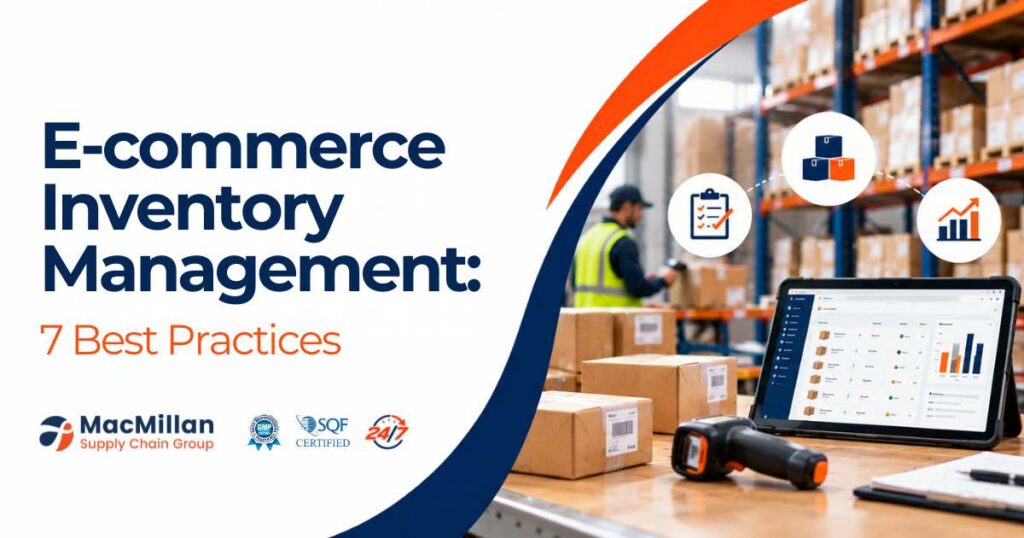
Effective inventory management is crucial for businesses seeking to optimize their supply chain operations. This comprehensive guide explores advanced techniques, innovative solutions, and the benefits of partnering with a third-party logistics provider like MacMillan Supply Chain Group. From demand forecasting to just-in-time inventory, we’ll cover strategies that can revolutionize your inventory control. Learn how outsourcing inventory management can provide access to cutting-edge technology and expertise, helping you reduce costs and improve customer satisfaction. Discover how MacMillan Supply Chain Group’s tailored solutions can address common inventory challenges and propel your business towards greater efficiency and profitability.
In today’s fast-paced business environment, mastering inventory management is essential for maintaining a competitive edge. Effective inventory control can mean the difference between thriving and struggling in an increasingly complex marketplace. This article delves into advanced inventory management techniques, exploring how businesses can leverage technology, data analytics, and strategic partnerships to optimize their supply chain operations.
We’ll examine the critical role of inventory management in supply chain success, discuss key steps for implementation, and explore innovative techniques that are reshaping the industry. Additionally, we’ll highlight the benefits of outsourcing inventory management to third-party logistics providers like MacMillan Supply Chain Group, offering insights into how expert partners can drive efficiency and growth.
Whether you’re a small business owner looking to streamline operations or a large corporation seeking to enhance your existing systems, this guide will provide valuable insights and actionable strategies to transform your inventory management processes.
Inventory management is far more than just keeping track of stock levels. It’s a strategic function that can significantly impact a company’s financial health, customer satisfaction, and overall competitiveness. Effective inventory management ensures that the right products are available at the right time, in the right quantities, and at the right locations.
The benefits of optimized inventory management are manifold:
By recognizing inventory management as a strategic function, businesses can unlock significant value and drive sustainable growth. The key lies in implementing the right techniques and leveraging advanced technologies to gain a comprehensive view of inventory across the entire supply chain.
Implementing a robust inventory management system involves several critical steps:
By following these steps, businesses can create a solid foundation for effective inventory management, setting the stage for improved efficiency and profitability.
The field of inventory management is constantly evolving, with new techniques emerging to address the challenges of today’s dynamic business environment. Here are some innovative approaches that are transforming inventory management:
By adopting these innovative techniques, businesses can significantly enhance their inventory management capabilities, leading to improved efficiency, reduced costs, and increased agility in responding to market demands.
Outsourcing inventory management to third-party logistics (3PL) providers like MacMillan Supply Chain Group offers numerous advantages:
By partnering with a reputable 3PL provider like MacMillan Supply Chain Group, businesses can transform their inventory management, achieving higher efficiency and competitive advantage.
Despite its critical importance, many businesses struggle with effective inventory management. Here are some common challenges and how MacMillan Supply Chain Group addresses them:
Inaccurate Demand Forecasting:
Problem: Poor forecasting leads to overstocking or stockouts, resulting in increased costs or lost sales.
Solution: MacMillan employs advanced predictive analytics and machine learning algorithms to analyze historical data, market trends, and external factors. This approach significantly improves forecast accuracy, helping businesses maintain optimal inventory levels.
Lack of Real-Time Visibility:
Problem: Without up-to-date information, businesses struggle to make informed decisions about inventory management.
Solution: Our state-of-the-art inventory management system provides real-time tracking and reporting. This enables instant visibility across all locations and channels, facilitating proactive decision-making.
Inefficient Warehouse Management:
Problem: Poor organization and inefficient processes in warehouses lead to increased handling times and errors.
Solution: MacMillan implements optimized warehouse layouts, advanced picking strategies, and automated systems to streamline operations. This reduces handling times, minimizes errors, and improves overall efficiency.
High Carrying Costs:
Problem: Excess inventory ties up capital and increases storage costs.
Solution: We employ techniques like Just-In-Time inventory and cross-docking to minimize holding times. Our demand-driven approach ensures that inventory levels are optimized to balance carrying costs with service levels.
Multi-Channel Inventory Challenges:
Problem: Managing inventory across multiple sales channels can be complex and prone to errors.
Solution: Our integrated inventory management system provides a unified view across all channels. This ensures consistent stock levels and prevents overselling or stockouts across different platforms.
Slow-Moving and Obsolete Inventory:
Problem: Accumulation of outdated or slow-moving stock ties up resources and warehouse space.
Solution: MacMillan implements regular inventory analysis to identify slow-moving items. We develop strategies for liquidation, repurposing, or donation of these items, freeing up valuable space and resources.
Lack of Skilled Personnel:
Problem: Many businesses struggle to find and retain staff with specialized inventory management skills.
Solution: By outsourcing to MacMillan, you gain access to a team of experienced professionals. Our experts stay updated on the latest industry trends and best practices, ensuring your inventory is managed optimally.
Technology Integration Issues:
Problem: Integrating new inventory management systems with existing business software can be challenging and disruptive.
Solution: MacMillan’s technology solutions are designed for seamless integration with a wide range of ERP and business management systems. Our IT specialists ensure a smooth transition with minimal disruption to your operations.
Scalability Challenges:
Problem: As businesses grow, their inventory management needs become more complex.
Solution: Our scalable solutions are designed to grow with your business. Whether you’re expanding into new markets or adding product lines, our systems and processes can adapt to your changing needs.
By addressing these common challenges, MacMillan Supply Chain Group helps businesses transform their inventory management from a potential liability into a strategic asset, driving efficiency, reducing costs, and improving customer satisfaction.
To avoid the pitfalls of poor inventory management and implement effective solutions, consider the following steps:
However, implementing these changes can be challenging, especially while managing day-to-day operations. This is where partnering with MacMillan Supply Chain Group can make a significant difference. Our team of experts can guide you through every step of the process, from initial assessment to full implementation and ongoing optimization.
Don’t let inventory management challenges hold your business back. Contact MacMillan Supply Chain Group today for a free consultation. Let us show you how our tailored solutions can transform your inventory management, reduce costs, and drive your business forward. Visit our website or call us to start your journey towards inventory management excellence.
Inventory management is the process of ordering, storing, and using a company's inventory. This includes the management of raw materials, components, and finished products, as well as warehousing and processing such items. It's crucial because effective inventory management helps businesses maintain the right amount of stock to meet customer demand without tying up excess capital in inventory.
MacMillan Supply Chain Group improves inventory accuracy through advanced warehouse management systems, barcode scanning, real-time inventory tracking, and regular cycle counting. By combining automated processes with experienced inventory specialists, MacMillan minimizes manual errors, maintains accurate stock records, and provides businesses with complete visibility into their inventory. This results in fewer discrepancies, faster order fulfillment, and better customer satisfaction.
MacMillan leverages modern inventory management technologies, including cloud-based Warehouse Management Systems (WMS), real-time inventory tracking, barcode and RFID technology, predictive analytics, and system integrations with ERP and eCommerce platforms. These technologies help businesses monitor inventory across multiple locations, improve demand forecasting, automate replenishment, and make data-driven inventory decisions.
Outsourcing inventory management to MacMillan allows businesses to reduce operational costs while gaining access to experienced logistics professionals and advanced technology. Instead of investing heavily in warehouse infrastructure, software, and staffing, companies benefit from scalable inventory solutions, improved inventory accuracy, optimized stock levels, faster order processing, and the flexibility to support business growth without increasing operational complexity.
Yes. MacMillan provides centralized inventory management for businesses selling across multiple sales channels, including eCommerce marketplaces, retail stores, and wholesale distribution. Its integrated inventory system synchronizes stock levels in real time, helping prevent overselling, stock discrepancies, and fulfillment delays while ensuring consistent inventory visibility across every sales channel.