



How to Make Big and Bulky Last-Mile Work For You
Hats off to you for always wanting to make life…


Hats off to you for always wanting to make life…

You’ve sent your product out for delivery, they’ve received it,…

In the fast-evolving landscape of global trade and e-commerce, supply…

Following its success with Prime delivery and becoming the business…
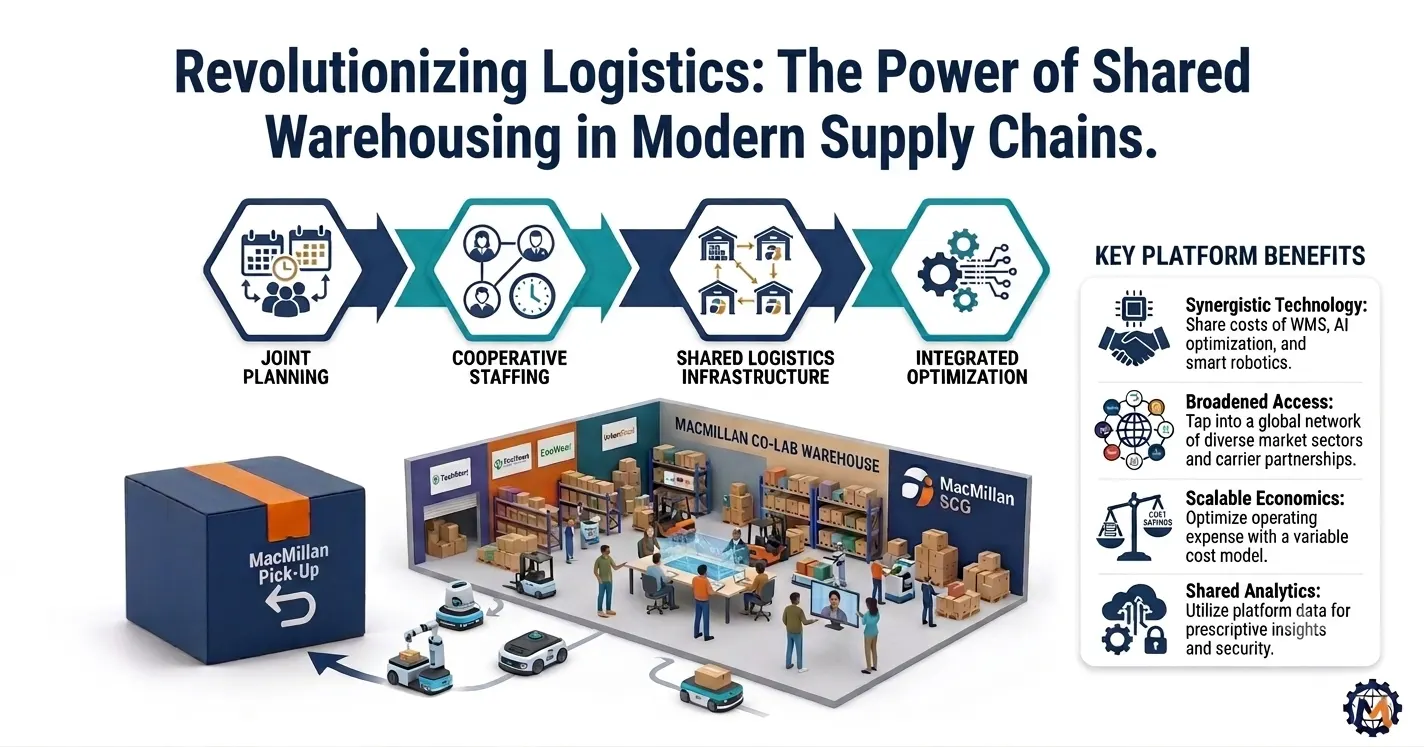
Shared warehousing is revolutionizing the logistics landscape, offering businesses a flexible and cost-effective alternative to traditional warehousing models. This innovative approach allows multiple companies to utilize a single warehouse facility, sharing resources, technology, and operational costs.
By leveraging shared warehousing, businesses can significantly reduce overhead expenses, improve scalability, and enhance supply chain efficiency. This article explores the numerous benefits, common challenges, and how MacMillan Supply Chain Group’s tailored solutions can help businesses optimize logistics operations.
Discover how this game-changing strategy can propel your company towards greater profitability and competitive advantage in today’s dynamic market.
In the ever-evolving world of supply chain management, businesses are constantly seeking innovative ways to streamline operations, reduce costs, and improve efficiency. One solution that has gained significant traction in recent years is shared warehousing.
This revolutionary approach offers a wide range of benefits, from cost savings and increased flexibility to enhanced scalability and improved supply chain performance.
As we explore shared warehousing, we will examine its advantages, challenges, and how MacMillan Supply Chain Group helps businesses navigate this transformation. Whether you are a startup or an enterprise, shared warehousing can be a game-changing solution.
One of the most compelling advantages of shared warehousing is the significant cost savings it offers. By sharing warehouse space, equipment, and labor with other businesses, companies can dramatically reduce their operational expenses. This cost-sharing model allows businesses to access state-of-the-art facilities and technologies that might otherwise be prohibitively expensive.
In a shared warehousing environment, fixed costs such as rent, utilities, and maintenance are distributed among multiple tenants. This arrangement not only lowers individual expenses but also provides a buffer against market fluctuations. For instance, during slower periods, businesses aren’t burdened with the full cost of maintaining an underutilized warehouse.
Moreover, shared warehousing optimizes resource utilization. Advanced warehouse management systems (WMS) and automated technologies are often standard in these facilities, allowing for more efficient inventory management and order fulfillment. These shared resources can lead to improved accuracy, faster processing times, and reduced labor costs.
By leveraging the economies of scale inherent in shared warehousing, businesses can redirect their capital towards core competencies and growth initiatives. This financial flexibility is particularly beneficial for small to medium-sized enterprises and startups, enabling them to compete more effectively with larger corporations without the burden of substantial upfront investments in warehousing infrastructure.
Shared warehousing offers unparalleled flexibility and scalability, allowing businesses to adapt quickly to changing market demands. Unlike traditional warehousing models that often require long-term leases and significant capital investment, shared warehousing provides the agility to scale operations up or down as needed.
This flexibility is particularly valuable in today’s volatile market conditions. Seasonal fluctuations, sudden spikes in demand, or unexpected downturns can be managed more effectively in a shared warehousing environment. Businesses can easily adjust their storage space and resources without the constraints of fixed infrastructure or long-term commitments.
Furthermore, shared warehousing facilitates geographic expansion without the need for substantial investment. Companies can tap into new markets by utilizing shared facilities in strategic locations, enabling them to test new territories or respond to regional demand shifts without the risk and expense of establishing their own warehouses.
The scalability offered by shared warehousing also supports business growth. As companies expand, they can incrementally increase their warehouse space and resources, avoiding the need for large, step-change investments. This gradual scaling allows businesses to align their logistics capabilities closely with their growth trajectory, optimizing costs and operational efficiency at every stage of development.
Shared warehousing significantly enhances supply chain efficiency through strategic location placement and advanced technological integration. These facilities are typically situated near major transportation hubs, urban centers, and key markets, optimizing distribution networks and reducing transportation costs and transit times.
By leveraging shared warehousing, businesses can benefit from a more extensive and flexible distribution network without the burden of managing multiple facilities. This strategic positioning allows for faster order fulfillment and improved customer satisfaction, as products can be stored closer to end consumers.
Moreover, shared warehouses often employ cutting-edge logistics technologies that individual businesses might find cost-prohibitive to implement independently. These may include advanced inventory management systems, automated sorting and picking technologies, and real-time tracking capabilities. Such technologies streamline operations, minimize errors, and provide valuable data insights for continuous improvement.
The collaborative nature of shared warehousing also fosters opportunities for synergies among tenants. For instance, businesses with complementary products or similar customer bases can potentially share transportation resources, further reducing costs and environmental impact. This collaborative approach can lead to more efficient use of resources across the entire supply chain, from inbound logistics to last-mile delivery.
Shared warehousing offers significant advantages in terms of risk mitigation and access to specialized expertise. By distributing operational risks among multiple tenants, businesses can better weather market uncertainties and unforeseen challenges.
In a shared warehousing model, the burden of facility management, security, and compliance is typically handled by experienced professionals. This arrangement allows businesses to focus on their core competencies while benefiting from the expertise of seasoned logistics specialists. These experts stay abreast of industry best practices, regulatory changes, and technological advancements, ensuring that the warehouse operations remain efficient and compliant.
Furthermore, shared warehousing providers often have established relationships with carriers and other supply chain partners. This network can provide businesses with better negotiating power for transportation rates and access to a wider range of logistics services. In times of supply chain disruptions, these relationships can prove invaluable in finding alternative solutions and maintaining business continuity.
The diversity of businesses within a shared warehouse can also serve as a natural hedge against industry-specific downturns. If one sector experiences a slump, the overall warehouse operations remain stable due to the varied tenant mix. This resilience can provide peace of mind and operational stability, particularly for smaller businesses or those in volatile industries.
While shared warehousing offers numerous benefits, it’s not without its challenges. Some common problems businesses face include:
MacMillan Supply Chain Group addresses these challenges head-on with our tailored solutions:
By addressing these common challenges with innovative solutions, MacMillan Supply Chain Group ensures that you can fully leverage the benefits of shared warehousing while mitigating potential drawbacks.
To fully harness the power of shared warehousing while avoiding potential pitfalls, partnering with an experienced logistics provider is crucial. MacMillan Supply Chain Group offers the expertise and tailored solutions you need to optimize your supply chain operations.
Here’s how you can get started:
Don’t let warehousing challenges hold your business back. Experience the transformative power of shared warehousing with MacMillan Supply Chain Group. Our innovative solutions, coupled with decades of industry expertise, will elevate your supply chain performance and drive your business forward.
Contact MacMillan Supply Chain Group today to schedule your personalized consultation and take the first step towards optimizing your logistics operations. Let’s build a more efficient, flexible, and cost-effective supply chain together.
Shared warehousing is a logistics model where multiple businesses utilize the same warehouse facility, sharing space, equipment, and operational resources. This approach allows companies to benefit from economies of scale, reduced costs, and increased flexibility.
Shared warehousing allows multiple businesses to use the same warehouse facility, sharing space, resources, and operational costs. In contrast, traditional warehousing typically involves a single company owning or leasing an entire warehouse. Shared warehousing offers more flexibility, lower costs, and better scalability compared to traditional fixed-space models.
Shared warehousing is suitable for most businesses, especially small to medium-sized enterprises, eCommerce brands, and companies with fluctuating inventory needs. However, businesses with highly specialized storage requirements or strict regulatory needs may require customized solutions within the shared model.
MacMillan Supply Chain Group ensures strong inventory security through advanced systems including segregated storage areas, restricted access controls, surveillance systems, and encrypted data management. These measures ensure that each client’s inventory remains safe, private, and fully protected at all times.
Yes. One of the key advantages of shared warehousing is flexibility. MacMillan allows businesses to scale storage space and resources up or down based on demand, seasonal changes, or business growth without long-term commitments or operational disruption.
Pricing is typically based on the amount of space used, storage duration, handling requirements, and additional services like packaging or fulfillment. Since resources are shared among multiple clients, costs are significantly more affordable compared to traditional dedicated warehousing models.
Yes. MacMillan provides real-time inventory visibility through advanced Warehouse Management Systems (WMS) and dedicated client portals. Businesses can monitor stock levels, order status, and operational updates anytime, ensuring full transparency and control.
MacMillan offers customizable storage solutions tailored to different product types. This includes temperature-controlled storage, fragile goods handling, kitting, labeling, and dedicated storage zones to ensure all special requirements are properly managed within the shared warehouse environment.




2 Responses
Great insights! Shared warehousing is a smart way to improve flexibility and reduce costs.
Thanks for reading! I’m glad you found it valuable.